Licensed under Creative Common Page 1
http://ijecm.co.uk/
ISSN 2348 0386
AN EVALUATION OF CONTRACT AUDITING PRACTICE IN
NIGERIAN BUILDING CONSTRUCTION PROJECTS
Nuruddeen Usman
Department of Building, Faculty of Environmental Technology, Abubakar Tafawa Balewa University, Bauchi, Nigeria
Abdulkadir Sani
Department of Building, Faculty of Environmental Technology, Abubakar Tafawa Balewa University, Bauchi, Nigeria
Abstract
Construction projects are faced with an increase in financial fraud due to the number of people,
companies and money involved. This is the reason why this article aimed at assessing the
practice and approach used in contract auditing system in Nigerian building construction
projects. The study adopted a well-structured questionnaire and the populations are practicing
construction professionals within the study area, and the respondent were selected at random.
Simple descriptive analysis and mean score were adopted and used in analysing the data. The
study revealed that, the level of engagement of contract auditing practice during the contracts
active life is paramount important than on the other stages, then all the construction contracts
require prompt attentions of contract auditing practices. Moreover, site visitation for
self-assessment identified as the most effective approach to be use, and the most important reasons
of carrying out contract auditing is to check and prevent corruption. Therefore, the study
recommends the adaptation of contract auditing systems in all construction projects and the
government should make it as part of the requirement in executing projects.
Licensed under Creative Common Page 2 INTRODUCTION
Auditing is a systematic and official examination and check of business accounts (Arah, 2000), or as seen by Cai et al. (2012) as a systematic and independent examination of data, statement, record, operations performance (financial or otherwise) of an enterprises for a stated purpose. Construction contract audit therefore is an essential internal control process to maximize capital program effectiveness. The first objective of audit is to obtain a documentation of cost incurred and paid for by the owner in completion of the project to justify if the request for reimbursement were in alignment with the applicable contracts. The scope of the financial audit here includes all cost involved by contractor including sub-contractor cost, in addition to direct cost paid for by the owner. The second objective of the audit is to obtain an understanding of the control environment surrounding a particular project to determine if any control deficiencies were noted. The role of contract auditing practice is paramount important in construction activities it serves as means of ascertaining how the financial transaction of construction contract is being handle by both parties to the contracts. Furthermore, the purpose of project auditing practice is to ascertain the fair administration of project cost and identifying lessons learned that can help improve the performance of a project or improve the performance of future projects by undertaking a forensic review to uncover problems to be avoided.
Construction contract auditing service is a popular aspect of services in the construction management and the engineering industry as a service support and purposed operation. Although not enjoying an outstanding recognition in the Nigeria’s construction industry as compare to other aspects of services operating in project management, construction managers have always tried to ensure project success through accountability and technological advancement. Construction contract audits are an essential internal control process to maximize capital progress effectiveness in addition, with cost segregation studies are not an expense – they are necessary for sound, effective cost management that reduces total project cost and failure.
Licensed under Creative Common Page 3 Construction managers performances indicates operating below satisfactory in carrying out effective contract auditing in Nigeria either because they see the role as cumbersome and confusing by indicating not getting adequate training on it or the operating environment does not facilitate conveniently the opportunity to do so. Therefore, the aim of the study is to assess the practices and procedural approach use in construction contract auditing system in Nigeria.
According to Bonderik and Tamkovich (1995), construction is an interrelated complex of operations where by buildings and installations are erected. Construction can also be defined as a process of forming buildings and building systems”. Furthermore, According to Seeley (1997), construction work may be carried out by private contractors or Direct Labour Organizations (DLO’s). In the past, local authorities have ended to use direct labour organizations for extensive areas of work. Therefore, the end project of construction and engineering work is a finished building and installations.
CONTRACT
Contract can be defined as an agreement which the law will enforced or recognize as affecting the legal rights and duties of the parties (involved in the contract). A contract can also be seen as a promise or a set of promises the law will enforce. In addition, Seely (1997), say the law relating to building contact is one aspect of the law of contract and tort. It is desirable to have an appreciation of the law relating to contracts generally before considering the main characteristics and requirements of building contracts. Therefore, A simple contract consist of an agreement enter into by two or more parties, where by one of the parties undertakes to do something in return for something (reward) to be undertaking by the other. A contract has been defined as an agreement which directly creates and contemplates an obligation. A contract generally has certain provisions and allocates a balance of responsibility, reward and risk.
AUDITING
Licensed under Creative Common Page 4 swayed by selfish popular opinion on a mater concerning the audit, this may make him over look key areas in an audit which may negatively affect the entire audit work. Auditing has been defined by several authors; all the definitions tend to portray it as an act of verifying already prepared accounting records together with the policies and procedures that govern the preparation of such records. The point however is that the said verification must be by a qualified person who does the verifications with the view to providing a report to the authority that commissioned the audit. The definition emphasize that an auditor has to be an independent of the management who are responsible for the preparation of the accounts (financial statements) and he must be responsible to the owner receives and utilizes the report (Damagum, 2005).
An audit can be characterized according to the nature of work undertaken and the method of approach to the work. By nature of work undertaken it comprises of statutory audits, Private audits, internal audits and Management audit. By Method of approach it includes Final or complete audits, Interim audit and Continuous audit. For conveniences, auditing is described with reference to the requirement of companies. Auditing can classified as either Internal Audit which review or appraise within an organization of the accounting, financial or other operations as a basis for protective and constructive service to the management or external Audit undertaken by a qualified statutory auditor who conducts his work independently out of the organization. External audit is required by law and is mandatory on all Limited Liability Companies (Dandago, 1999).
Therefore, contract Audit practice is a particular kind of investigation, which is performed by a specialist auditor and consultants, if properly performed, a contract audit provides an opportunity to assess the management and control the contract, especially if the process begins during the pre-construction and early construction stages and extends to a post-completion review and verification.
METHODOLOGY
Licensed under Creative Common Page 5 The data analyzed using percentages and mean score method that had been adopted from Assaf et al (1995) In this method weighting scale of 1 to 4 was adopted to calculate the mean score for each variables factor, which is then used to determine the ranking of each factor by assigning ranking to mean score, with low mean score assigned low ranks and high scores allocated high ranks. The mean score (MS) for each factor is computed by using the following formula:
MS = ∑ (F*S)/N Where (S) is the score given to each factor by respondents and ranges from 1 to 4 in which "1" is not effective and "4" is very effective ;( F) is frequency of responses to each rating for each factor; and ( N) is the total number of responses concerning that factor and (MS) is mean scored by each factor.
ANALYSIS & DISCUSSION OF RESULTS
In order to achieve the papers’ aim, the following analysis carryout based on the retrieved questionnaires from the respondents within the study area;
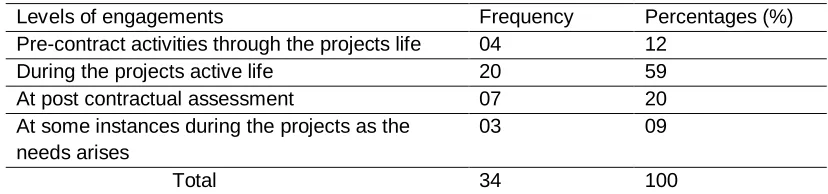
Table 1: At which level of engagement is construction contract auditing practice consider ideal in project life cycle?
Levels of engagements Frequency Percentages (%)
Pre-contract activities through the projects life 04 12
During the projects active life 20 59
At post contractual assessment 07 20
At some instances during the projects as the needs arises
03 09
Total 34 100
In Table 1: The analyses revealed that, during the project active life attracted 59% response as the most ideal stage of engagement to employ contract auditing services, 20% have the opinion that contract auditing should take the form of post contract assessment, 12% as pre-contract activities through the project life and 9% that only when there is need.
Table 2: Which among these construction contracts nature requires more prompt project auditing practice attention?
Frequency Percentage of frequency (%) All newly signed construction contract 10 29
Only to public contract (own by government) 05 15 Renovation and expansion of existing property 05 15
All of the above 14 41
Licensed under Creative Common Page 6 Base on Table 2 all the nature of the construction contracts require prompt auditing for their effective delivery, although the output of this analysis pointed out that “all newly signed projects” needs much more attention than others.
Table 3: How effective can these approaches be justify as tools in contract auditing practice? Very effective (4) Effective (3) Fairly effective (2) Not effective (1)
∑Fx Mean score
Ranks
Interview with personnel on site
7 14 5 - 80 3.08 2nd
Questionnaire administration 3 14 8 1 71 2.73 5th
Site visitation for self-assessment
16 8 2 - 92 3.54 1st
Scrutinizing check book 8 11 5 2 77 2.96 4th
In-depth research 7 15 2 2 79 3.04 3rd
Table 3 analysis of the effectiveness of some appraisal approach as tools in contract auditing vindicated that, Site visitation for self-assessment is the most effective tool in construction contract auditing, followed by Interview with personnel on site ranked as second approach tool, then the in-depth research as third effective approach, Scrutinizing checkbooks was scored fourth and Questionnaire administration got the least scoring.
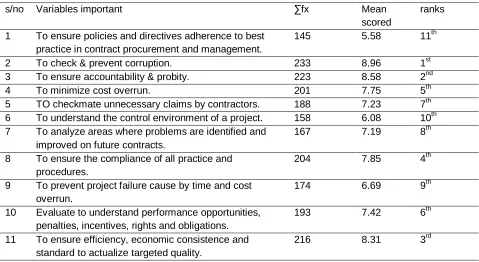
Table 4: Using a score of 0 – 11, rate the important of each of the following reason for carrying out contract auditing.
s/no Variables important ∑fx Mean
scored
ranks
1 To ensure policies and directives adherence to best practice in contract procurement and management.
145 5.58 11th
2 To check & prevent corruption. 233 8.96 1st 3 To ensure accountability & probity. 223 8.58 2nd
4 To minimize cost overrun. 201 7.75 5th
5 TO checkmate unnecessary claims by contractors. 188 7.23 7th 6 To understand the control environment of a project. 158 6.08 10th 7 To analyze areas where problems are identified and
improved on future contracts.
167 7.19 8th
8 To ensure the compliance of all practice and procedures.
204 7.85 4th
9 To prevent project failure cause by time and cost overrun.
174 6.69 9th
10 Evaluate to understand performance opportunities, penalties, incentives, rights and obligations.
193 7.42 6th
11 To ensure efficiency, economic consistence and standard to actualize targeted quality.
Licensed under Creative Common Page 7 Based on Table 4, the most three important reason for carrying out contract auditing practice were identified as follows; to check and prevent corruption as first then to ensure accountability and probity and followed with to ensure efficiency, economic consistence’s and standard as the third most important reasons but based on the analysis it revealed that, to prevent project failure cause by time and cost overrun, to understand the control environment of a project, to ensure policies and directives adherence to best practice in contract procurement and management were identified as the lowest important reason as ranks by the respondents.
Table 5: Is the application of contract auditing in construction contract prompt system that can enhance performance relatively at a more economical cost?
Frequency Percentage of frequency (%)
Very economical 21 62
Attracting extra cost (compromise able cost)
10 29
Attracting uncompromised cost 03 09
Table 5 revealed that, despite extra engagement for additional service to probe or appraises the project, construction contract auditing was considered of economic advantage to contract administration.
CONCLUSION
In conclusion base on the research carried out, the following were major findings of the study:
1- The respondents agreed that, the level of engagement of contract auditing practice during the contract active life cycle and at the post contract assessment are considered as more ideal than any other levels of projects life cycle.
2- Based on the perception of the respondents almost all the constructions contract require more prompt attention of contract auditing practice in assessing the financial management of projects activities.
3- The most effective approach of contract auditing system were identified as site visitation for self-assessment and coupled with interview with personnel’s on sites.
4- The study revealed the most important reasons for carrying out contract auditing practice as to check and prevent corruption, and also to ensure accountability, efficiency, economic consistency and standard of projects activities.
Licensed under Creative Common Page 8 Therefore, it is recommended that professionals should adapt contract auditing practice in all construction projects, and government should incorporate construction auditing practice as one of the requirement in carrying out construction projects.
However, this study is limited to practicing professionals operating within institutions, agencies, and ministries in Gombe state. Further studies needs to be carried out in a wider perspective so as to assess the perception of contractors, clients, and other professionals in both private and public sectors on contract auditing practice, in which the findings may give room for the development of a best practising contract auditing framework.
REFERENCES
Arah G.O. (2000), Construction Cost Auditing- A Panacea for Construction in capital project procurement, Budgetary Planning for Capital Projects and Construction Contract Auditing, published by Nigerian Institute of Quantity Surveyors, Lagos.
Barke Tilly, (2014), Construction Contract Controls and Construction Audit Services, Virchow Krouse, L.L.P. Legal and Privacy.
Bondarki V.A. and Tamkuvich J.A. (1995), Construction Technology, Second Edition publish by Mir Publishers, Moscow.
Cai, H., Kandil, A., Hastak, M., & Dunston, P. (2012). Construction Research Congress 2012: American Society of Civil Engineers.
Damagum M.Y. (2005), Auditing Theory and Practice, Second Edition published by Ahmadu Bello Zaria. Dandago I.K. (1999), Auditing in Nigeria, Comprehensive Text Book Published by Adamu Joji, 23, Lamido Terrace, Kano, Nigeria.
Institute of Certified Public Accountants of Singapore, Practical Guidance 2, ; Audit of Long Term Construction Contracts. (2012).