203
Dynamic Fuzzy Interface System Using Pso For
Intelligent Handover In Wireless
Onkar Kaur, Sukhjinder Kaur
Abstract: Handoff in wireless system is the crucial aspect for communication between different channels. Several works are projected to make an efficient handoff using fuzzy inference system. These systems are limited to a certain number of parameters such as specific distance of base station, mobility. Moreover, with the increase in the data would make it difficult to generate fuzzy rules and range of membership function. These limitations are resolved by taking into consideration the dynamic environment. This dissertation presents a novel optimized mechanism based on fuzzy rules for making the handoff decision. In this approach, Particle Swarm Optimization is implemented to generate dynamic values for membership functions in terms of different areas for handoff and extended parameters. Simulation is performed using MATLAB tool and the outcome of the proposed work surpassed the traditional works.
Index Terms: Handoff, fuzzy rules, Particle Swarm Optimization (PSO)
————————————————————
1Introduction
AS wireless communication technology is growing, there is a rapid up-gradation in wireless communication networks. Currently, different kinds of wireless networks are available for meeting the different requirements of mobile users. Also, the demand of Internet of Things (IoT), different types of wireless networks and the swift development of ICT (information & communication technology) is considerably increased [1]. On the contrary, the process of handover controls the mobility of user equipment (UE) to keep the communication link between UE and evolved Node B (eNB) being connected [2]. In general, the quality of handover relies on the communication environment. Although, environment has a dynamic nature and in order to avoid the conductance of a long handover delay, environmental factors are required by the handover process. These parameters can be- signal strength, UE’s location, etc. which must retrieved after continuous observation of the environment. In fact, the area provided by eNB is used as the area in which user equipment can reside [2]. Selection of an unsuitable Target eNB (TeNB) to hand over can result in increasing waste radio resources and communication overhead because the subsequent handover might come much earlier or just after the handover, thus making the poor quality for communication.
1.1 Types of Handoff
Handoffs has two broad categories [4]—hard handoff and soft handoff. Generally, hard handoff is classified into two types—i) intra- and ii) inter-cell handoffs. The soft handoff also has two sub divisions— i) multi-way soft handoffs, ii) softer handoffs.
1.2 Factors for Handover Decision
Handoff is initiated in the first phase and after this, optimum networks are decided for handoff in second phase i.e. decision making phase. Current and neighboring networks are then compared with regards to parameters such as signal strength, direction, QoS, cost, velocity, etc [3]. The decision of handoff is dependent on factors which are given below for entire process of handoff: Transmitted power: It is known that the transmission power varies according to the different types of cells. Thus, the handoff threshold or power margin also differs from one cell to another cell. Received power: The signal strength retrieved from each wireless network access point is measured in a continuous way, and the comparison is made between these values and an RSS threshold (with predetermined value) in order to determine the handover [1]. Therefore, when the RSS of the latter becomes stronger, transmission takes place between original wireless networks to a new one. Area and shape of the cell: Despite the power levels, the cell structure also plays a significant role in the handoff process. Mobility of users: The number of mobile users entering or leaving a particular cell has effect on the cell’s handoff strategy.Existing mobile devices based handover mechanisms are studied by taking various factors into account that influence the communication environment (e.g., transfer rate, processing rate, frequency, signal strength, etc.). Though, existing handover determination cannot be applied on mobile IoT devices such as drones. In this paper, a swarm intelligent algorithm named as PSO (particle swarm optimization) is proposed to make enhancements in the existing fuzzy interface system based handover scheme for drones.
(a) Before Handoff (b) After Handoff
Fig. 1. Hard handoff between the MS and BSs
____________________
Onkar is currently pursuing masters degree in Electronic and Communication Engineering in Sri Sukhmani Institute of Engineering
& Technology, Derabassi, Punjab, India, E-mail:
2
FUZZY
INTERFACE
SYSTEM
IN
HANDOVER
DECISIONS
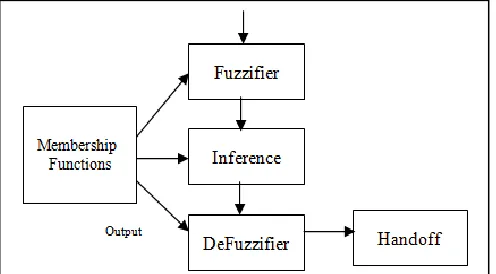
Fuzzy systems are one of the prominent methods for processing imprecise values [5]. Fig. 2 shows the position of a fuzzy input variable in a fuzzy system in order to transform it to a fuzzy set prepared to use with the inference engine. The inference engine handles incoming data and generates a fuzzy result by utilizing the fuzzy outputs and the if-then regulations contained in the rule base. The defuzzifier transforms variables of fuzzy into crisp variables.
These fuzzy systems are capable of managing nonlinearities and uncertainties of complex systems, and can be developed from heuristic knowledge, without need of an accurate description of the controlled system [6]. Therefore, many researchers have adopted fuzzy strategies for handoff decisions. Nevertheless, tuning the parameters of a fuzzy logic controller, such as scaling factors [6], is not always straightforward, and trial and error methods can be time demanding. For this reason, in latest years, bio-inspired intelligence techniques for tuning of fuzzy interface systems have been effectively implemented.
2.1 Particle Swarm Optimization
PSO can produce a high-quality method with more stable convergence and less computational time than other stochastic methods, including genetic algorithms [6]. PSO is a technique centered on the conduct of bird swarms and fish schools used to check the stochastic for optimizing an objective function by improving swarm positions and speeds [7]. This technique is used to optimize the objective function. The PSO algorithm is effective in addressing a variety of engineering and informatics issues. In this paper, PSO optimization algorithm is used for updation of existing Fuzzy Interface System for the handoff decision for the drone. The basic algorithm of PSO approach that is used for the solving problem of multiple domains is as follow:
The problem formulation and the proposed model are presented in Section III of this paper with defined work flow. The results and discussion of proposed model is defined in Section IV with comparative analysis with existing techniques.
3 PRESENT
WORK
In traditional work [1], a handoff system was prepared with regards to the fuzzy system. The Fuzzy system is somewhere useful for Handoff technique as the parameters are limited therefore the fuzzy system is good strategy for the limited number of parameters. But in a network, a number of nodes occur whereas every node has its individual dependency. In addition, the other flaw of using fuzzy is that if the data is increased, defining the membership function’s range and rules become difficult. However, for limited parameters, rules can be easily defined while defining the membership function’s range is a challenging part. Thus, there is a requirement of a novel method that can define the range in a better way and also it can be optimized according to the network so that the membership function can be dynamic in any network and cannot be in fixed form.
3.1 Proposed Intelligent Handover Decision Model
As discussed in the above section there are some flaws in the traditional work [1], however, to conquer these flaws a new mechanism is offered in this paper. It was seen in the existing work that there may be an issue with the membership function Fig. 2. Block diagram of Fuzzy logic system
FOR each particle i FOR each dimension d
Initialize position xid randomly Initialize velocity vid randomly END FOR
END FOR
Iteration k=1 DO
FOR each particle i Calculate fitness value
IF the fitness value is better than p bestid in history Assign current fitness value as the p bestid END IF
IF the fitness value is better than g bestid in history Assign current fitness value as the g bestid END IF
END FOR FOR each particle i
FOR each dimension d
Calculate w, c1 and c2 with the fuzzy inference system Calculate velocity using the equation
vid (k+1) = w vid (k) + c1 Rand1 (pid - xid) + c2 Rand2 (pid - xid)
Update particle position using the equation xid (k+1) = xid (k) + vid (k+1)
END FOR END FOR k = k + 1
205 of the fuzzy system as the nodes are going to be increased,
the range of defining the membership function must be dynamic [7]. So for that, a novel PSO based approach is proposed in which particle swarm optimization will define the membership functions’ range in each variable of the fuzzy system that is taken to have the handover decision. Now the question arises why PSO is selected for the optimization purpose? It is due to some advantages of PSO algorithm over other optimization techniques as given below which inspired the proposed model to work with PSO. PSO is an intelligence-based approach, thus it has the following advantages that make it more prior to other optimization techniques: It can search a large space for candidate solution.PSO does not consist of overlapping and mutation computation. The search can be performed by the particle’s speed. Only the most optimistic electrons can convey data on the other atoms over the growth of several centuries and the pace of research is rapid. PSO has easy computation. It takes the larger optimization capacity as compared to other developed calculations and can be readily finished. PSO uses the real number code and it is determined by the solution. The dimension amount is equal to constant of solution. In the proposed model the factors those are considered for the decision of handoff of drone are also extended with respect to traditional approaches. For the proposed handover scheme the factors as speed, coverage and load are considered, this will result in increase of dependency factors and also keep the quality of system improved.
4 METHODOLOGY
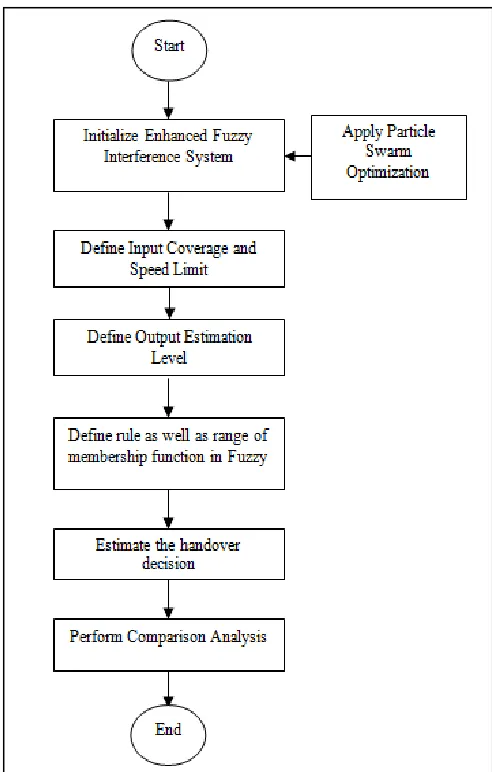
The methodology of proposed work has mentioned in the following steps which are followed to attain the handover decision. Step 1: Initialization of Enhanced FIS is done to which PSO is applied to define the range of membership function. Step 2: The input parameters such as Coverage and speed limit are defined. Step 3: The criteria on which the estimation level is based is defined, i.e. the condition according to which the estimation is decided. Step 4:After that, fuzzy rules are defined and the membership function’s range is also defined with the help of PSO. Step 5:Then the handover decision is taken based upon the obtained estimation level.Step 6: Finally, the comparison analysis of the proposed technique with the traditional technique is performed.
5 RESULTS
AND
DISCUSSION
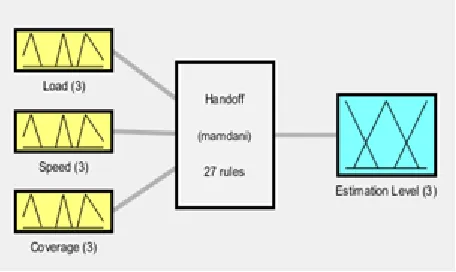
handover decision is presented. The proposed system was simulated with the fuzzy inference system (FIS). FIS is optimized with the help of PSO (Particle Swarm Optimization). It used MATLAB for the processing of inference. Simulation involved three base stations and a terminal. Handover trails are measured and evaluated using random movement and straight-line movement. The parameters are extended for the proposed systems which were considered for the experiments. Table 1 represents the parameters and their respective values. In fig. 4, three factors (load, coverage and speed) are demonstrated which are used as input to the fuzzy for making estimation for handoff. The information of the parameters is given using fuzzy rules. The overall results showed that proposed technique using PSO outperformed the existing method.
Fig. 4. Extended parameters in Fuzzy inference system
The results are discussed below:
The results of the anticipated system are compared with the conventional FIS system for handoff decisions and the outcome is shown in the fig. 5. The graphs represent the distance from the RSS boundary with respect to the probability to the disconnect (Pf). The distance has the range between 0m -35m and Pf lies on y axis which varies from 0 to 1. The output is measured in terms of d and Pd where d is the distance from the RSS (received signal strength) and Pd is the ratio of area corresponding only to the base station area. When d has the larger value then the device is less likely to leave the base station which in return reduces the Pd.
Both the systems are analyzed for two different radii (R) of bases stations i.e. 100 m and 1000 m and same maximum speed (10m/s) and time period of 0.5 s for both systems. For same distance, the probability of the proposed system accounted to slight less than 0.1 for larger base station. The graph followed downward trend thus resulting in very less disconnection value as compared to that of traditional system. This made the system more effective to make handoff decisions by surpassing the simple fuzzy system for handoff decision making
6 CONCLUSION
AND
FUTURE
SCOPE
An optimized approach of handoff decision using fuzzy inference system and particle swarm optimization is proposed in this paper. Fuzzy inference system is used to generate fuzzy rules and the range of membership functions. With the help of PSO, membership functions no longer remains fixed, their values changes automatically with respect to the network area and the nodes. Coverage area and speed limit are considered for making an effective handoff decision. Simulations are performed with the help of MATLAB. Proposed system is compared with the traditional system. The outcome shows that proposed system has minimum disconnections of the network resulting in better performance. Thus, the novel approach outperformed the traditional works. In future, more enhancements can be made by reducing its complexity and increasing its reliability.
R
EFERENCES[1] Eunji Lee, et.al, ―Intelligent Handover Scheme for Drone Using Fuzzy Inference Systems‖, IEEE, Vol 5, Pp 1-8, 2017
[2] Yu-Shin Huang, Fang-Yie Leu, ―A Handover Scheme for LTE Wireless Networks under the Assistance of GPS‖, International Conference on Broadband, Wireless Computing, Communication and Applications, IEEE, Pp 399-403, 2013
[3] Pooja Dhand, Parwinder Kaur Dhillon, ―Handoff Management: Issues And Challenges‖, International Journal of Advanced Research in Computer Science, Vol-9, No-1, Pp 111-114, 2018
[4] Qing-An Zeng And Dharma P. Agrawal, ―Handoff in Wireless Mobile Networks‖, Handbook of Wireless Networks and Mobile Computing, Pp 1-26, 2002
[5] [5] Shih-Jung Wu, ―Fuzzy-Based Handover Decision TABLE 1
PARAMETERS INCLUDED IN THE SIMULATION ENVIRONMENT
PARAMETER VALUE
Bandwidth 20 MHz
BS Serving Coverage 1KM
Distance between BS and BS 0.75 KM
Moving direction Random/straight
Altitude of Terminal 32m
Speed of terminal 80km/h
207 Scheme for Next-Generation Heterogeneous Wireless
Networks‖, Journal of Convergence Information Technology, Vol 6, No 4. Pp 285-297, 2011
[6] Jorge Hurel, et.al, ―Tuning a Fuzzy Controller by Particle Swarm Optimization for an Active Suspension System‖, IEEE, Pp 2513-2518, 2012
[7] Fevrier Valdez, et.al, ―Fuzzy Dynamic Parameter Adaptation in ACO and PSO for Designing Fuzzy Controllers: The Cases of Water Level and Temperature Control‖, Hindawi Advances in Fuzzy Systems, Pp 1-19, 2018.
[8] Harvinder Gill, Silki Baghla, ―A New Fuzzy Simulation Model for Vertical Handoff in Heterogeneous Networks‖, IJECE, Volume1, Issue 6, Pp 24-29, 2014.
[9] Shefali Modi, Mahendra Kumar Murmu, ―An Intelligent Spectrum Handover Scheme for Cognitive Radio Ad Hoc Networks Using ANFIS with ANN‖, ICTN, Pp 1-6, 2017. [10]C. F. Kwong, et.al, ―The ANFIS Handover Trigger Scheme:
The Long Term Evolution (LTE) Perspective‖, IICFS, Pp 1374-1381, 2014
[11]Md. Tajul Islam, et.al, ―Vertical Handover Decision using Fuzzy Logic in a Heterogeneous Environment‖, ICIEV, Pp 1-3, 2013.
[12]Takaaki Inaba, et.al, ―Application of Fuzzy Logic for Secure Handover in Wireless Cellular Networks‖, CISIS, Pp 509-515, 2016
[13]Lu Zhang, et.al, ―Fuzzy Logic Based Vertical Handover Algorithm for Trunking System‖, WOCC, Pp 1-5, 2017 [14]Kemeng Yang, et.al, ―A Fuzzy Adaptive Soft Handover
Scheme Supporting Four Active Sets‖, ICCIS, Pp 147-152, 2007.
[15]Lei Ning, et.al, ―Fuzzy Clustering Based Group Vertical Handover Decision for Heterogeneous Wireless Networks‖, WCNC, Pp 1231-1236, 2013.
[16][16] Qilian Liang, ―Soft handover for non uniformly-loaded mobile multimedia cellular networks‖, IEEEVTC, Volume 3, Pp 1096-1100, 2002.
[17]Solomon T. Girma and Abinet G. Abebe Asas, ―Mobility Load Balancing in Cellular System with Multicriteria Handoff Algorithm‖, Advances in Fuzzy Systems, Pp 1-8, 2017.
[18]Ranada Prasad Ray and Lun Tang, ―Hysteresis Margin and Load Balancing for Handover in Heterogeneous Network‖, International Journal of Future Computer and Communication, Vol. 4, No. 4, Pp 231-235, 2015.
[19]Baoling Zhang, et.al, ―A Markov Based Performance Analysis of Handover and Load Balancing in HetNets‖, Int. J. Communications, Network and System Sciences, Vol 10, Pp 223-233, 2017
[20]P. Muñoz, R.Barco, ―Load Balancing and Handover Joint Optimization in LTE Networks using Fuzzy Logic and Reinforcement Learning‖, The International Journal of Computer and Telecommunications Networking, Vol 76, Pp 112-125, 2015.
[21]Shang-Lin Wu, Yu-Ting Liu, ―Fuzzy Integral with Particle Swarm Optimization for a Motor-Imagery-based Brain-Computer Interface‖, IEEE, Pp 1-8, 2016.
[22]Juing-Shian Chiou, Huu-Khoa Tran, ―Particle Swarm Optimization Algorithm Reinforced Fuzzy Proportional– Integral–Derivative for a Quadrotor Attitude Control‖, Advances in Mechanical Engineering, Vol 8, Issue 9, Pp 1-7, 2016.
[23]Andreas Lobinger, et.al, ―Coordinating Handover
Parameter Optimization and Load Balancing in LTE Self-Optimizing Networks‖, IEEE 73rd, Vehicular Technology Conference (VTC Spring), Pp 1-6, 2012.