1523 IJSTR©2020
A Spline Technique Solution For Vibrations Analysis Of
Rectangular Plate Having Parabollically Varying
Thickness Considering The Parameters ‘Thermally
Induced Non-Homogeneity’, Damping And Elastic
Foundation
Manu Gupta, Ajendra Kumar, Ankit Kumar
Abstract- A mathematical solution to a governing model plate equation is given here in which we study effect of plate parameters namely thermally induced non –homogeneity, damping and elastic foundation on rectangular plate of parabollically varying thickness. The model is solved using quintic spline interpolation technique. Numerical results which consist of three modes of frequency parameter for the rectangular plate are calculated for two assumed boundary conditions (BC’s) viz. CL-SS-CL-SS(clamped - clamped) and CL-SS-SS-SS(clamped –simply supported).Comparisons of results obtained by the quintic spline interpolation technique with those that are available in the literature are also presented. Numeric results are obtained and represented in tabular and graphical form.
Key words-Non-homogeneity, Elastic foundation, Damping, Thermal gradient, spline technique, Taper constant
————————————————————
1.
INTRODUCTION
Modern engineering structures consist of structural component which should be made up of strong material. Thus stronger materialsare needed in wide range of engineering and industrial application. The applications includes- (i) Automobile industry: In which sports cars require supported beam, stronger bumper structure, strong air pressure vessels; (ii) Aerospace industry: In which aerospace structure and space vehicle require fairings,spoiler, turbine engine, fan blade, landing gear doors, propellers etc.; (iii) Mechanical and civil engineering industry: which require lifting device, agriculture and foresting machine cranes, packaging machines etc. These requirements are full field by anisotropic material which are generally non-homogenous in nature by physical composition, imperfection in material and by design. Plate of variable thickness provides greater efficiency in vibration problems and also helps in material saving, providing high strength and stiffness enhancing.Elastic foundation has applications in pressure vessel technology, And now a day’s it’s frequently used in engineering structure technology. In the case of vibration, damping is a natural phenomenon to make problem real to working environment.Design structures require accurate determination of natural frequency and mode shape.In real all the vibrations are subjected to damping ascondition of “free vibrations” are ideal and practicallyimpossible. So we cannot study vibration analysis without considering damping. Crandall discussed on role of damping in the theory of vibration [1].
_________________________
Manu Gupta, Department of PG Studies and Research In Maths,
J.V.Jain College, Saharanpur- 247001,INDIA, E-mail: gupta_manu13rediffmail.com
Ajendra Kumar, Department of Mathematics and Statistics, Gurukula Kangri Vishwavidyalaya, Haridwar-249404(U.K.),INDIA,
E-mail: [email protected]
Ankit Kumar, Department of Mathematics and Statistics, Gurukula
Kangri Vishwavidyalaya, Haridwar-249404(U.K.),INDIA , E-mail: [email protected]
INTERNATIONAL JOURNAL OF SCIENTIFIC & TECHNOLOGY RESEARCH VOLUME 9, ISSUE 04, APRIL 2020 ISSN 2277-8616
1524 modes, behavior and nature of vibration of plates with
variousparameters and diversegeometrical shapes. Since each method has its advantage and disadvantage. In our problem quintic spline interpolation technique is applied to solve the model for the above discussed problem, and this method provides us highly accurate results with less computational work with two assumed boundary conditions (BC’s) CL-SS-CL-SS(clamped - clamped)and CL-SS-SS-SS(clamped –simply supported).
2.
EQUATIONS OF MODEL FORMULATION
(MATHEMATICAL MODEL)
In the present model we have consider plate which is an isotropic non-homogeneous rectangular plate of dimension ‘a’( length), ‘b’(width) and thickness
h where h
h x y
( , )
respectively .Plate density is assumed
' '
& plate rests on an elastic foundation material(Winkler-type )occupying the rectangular area0
x
a
, 0
y
b
in two dimensional coordinates system. The mathematical equation/model which governs the vibrational behavior of damped plate which rest on elasticfoundation is given by a standard equation,
2 2 2 2 2 2
2 2
( ) (1 ) 2
2 2 2 2
2
0, 2
D u D u D u
D u
x y x y
y x x y
u u
h k kfu I
t t
Where
D
Eh
3/ 12(1
2)
and h
h x y
( , )
D is called ‘flexural rigidity’ of the plate at a point in the middle plane,k
d is assumed damping parameter,k
fis elastic foundation parameter andu
u x y t
( , , )
is the deflection function (transverse deflection). Two plate edgesnamely y=0 and y=b which are opposite to each other are considered asSimply Supported (SS) & thickness varies parabollically in direction of x-axis only. So ‘h’does not depend on yi e
. .
we consider h=h(x). For the harmonic solution the above problem the transverse deflection function'
u
u x y
( , ) '
is of the form,( ) tsinn ycos
u U x e ct
b
At y0 and yb,
II)Here
c
is ‘circular frequency’ for vibration ofplate &n ε N. Eq. (I) on substituting Eq. (II) becomes6 6
3
2 2
4 3
3 3 2
4 3
2
2 2
3 2 2
2 2
2 2 2
3 3 2
2
4 4 2 2 2
3 4
cos 2 6 cos
3
2 cos 2 6 cos
E E h h h
h h Eh
x x x
x x
m m E
Eh h
b x
b
U E h U
Eh pt h Eh pt
x x
x x
Eh
m U E m U
Eh pt h Eh pt
b x x b x
6 6 III 2 2 22 2 2 2
2
3 cos 12 1
cos 2 sin 0
h E h
h Eh
x x x
h p k
f
h
Eh U pt
x
k U pt hp kp U pt
We now introduce the dimensionless variables as,
x
X
a
,E
E
a
,U
U
a
,a
,H
h
a
,2 2 2
a
n
b
And putting physical quantities of interest to our study which are variation in thickness(taper constant)and non-homogeneity, given by
2
0
1
,
H
H
X
2 2
0
1
(1
)
,
E
E
X
2 2
0
1
(1
X
)
,
where α is a taper constant and
is thermal gradient and performing suitable mathematical calculations the following relation is obtained:4 3 2
0 4 1 3 2 2 3 4
0, (
)
U
U
U
U
V
V
V
V
V U
IV
X
X
X
X
Where
2 4 2 2
(1 ) (1 (1 ) ) 0
2 2 4 2 3 2 2
2(2 (1 )(1 ) 6 (1 ) (1 (1 ) ))
1
2 2 2 2 2 2
24 (1 ) (1 (1 ) )
2
2 3 2
24 (1 ) (1 )
2 3 2 2
6 (1 ) (1 (1 ) )
2 2 4 2 2 4 2 2
2 (1 ) 2 (1 ) (1 (1 ) )
V X X
V X X X X X
V X X X
X X X
X X
X Y X X
2 3 2 2
12 (1 ) (1 (1 ) )
3
2 2 4 2
2 (1 ) (1 2 (1 )
2 2 4 2 2 2 2 2 4
(1 ) (1 (1 ) (2 (1 )
4
2 3 2
12 (1 ) (1 2 (1 )
2 2 2 2 2 2
24 (1 ) (1 (1 ) )
2 3 2 2
6 (1 ) (1 (1 ) )
2 2 2 2
( * /(1 (1 )
2 2
* (1 )
V XY X X
Y X X
V Y X X Y X
X X X
X X X
X X
Dk I X
E Cf X
(1X2 2) (12(1X) ) *2 I
Here
E
f,
d
k,.
are foundation parameter, damping parameter and frequency parameter respectively given as-,2 2 2
2
0 0 0
2 2 2 2 0
12(1
)
3(1
)
,
,
12(1
)
f k fv k
v k
D
E
a
E
E
v a p
E
In order to solve equation (III) using assumed BC’sat edges X=0 & X=1, we apply the technique of quintic splines. For we suppose U(x) is continuous differentiable function
0,1
x
and let interval [0, 1] ispartitioned into ‘m’ sub1525 IJSTR©2020
is required partition, taking
1
,
r,
0(1)
X
X
r X r
m
m
Let
U X
be a quintic spline which an approximating function for U(x) and the condition given below are satisfied, (i)U X
is quintic polynomial where X
X X
i, i1
,
i
0,1, 2,...
m
1
(ii)
U X
U X
r,
r
0,1, 2,..., .
n
(iii) The partial derivatives of
U X
i.e.2 3 4
2 3 4
,
,
U
U
U
U
and
X
X
X
X
are continuous.Considering the above properties, the quintic spline interpolation technique gives
4
1
50 0
1 0
, ( )
m i
i j t
i t
U X
a
a X
X
b
X
X
V
Where,
0,
,
t t t tif X
X
X
X
X
X
if X
X
and' ,
'
i ja s b s
are coefficients considered constants. Thus form
thknot, eq. (IV) reduced to2
3 2
4
4 3 2
4 12
4 3 2
4 0
4 0 4 0 3 1 2
2 3 0 2 2
3 6 6
0 3 0 2 0 1 3
24
0 0 0 1 0
V
V V V
V Xj X
V a V Xj X V a a
V Xj X V Xj X V Xj X V Xj X V a Xj X Xj X Xj X V Xj X
24 4
5 4 3
2
2
0
5 20
1 4 3
0, ( ) 0
601 120 0
V a
V X X V X X V X X
m j t j t j t
bj VI
t
V Xj Xt V Xj Xt
For
j
0 1
m
,
(m+1) homogeneous equation with (m+5) unknowns are obtained from above system,a i
i,
0 1 4
and the above system of equations can be represented in matrix equation form as
P Q
O zero matrix
(
),
(
VII
)
Where
P
matrix is of order
m
1
m
5 ,
while
Q
is column matrix of order m+5 andO zero matrix
(
)
is also column matrix of order (m+5).3.
BOUNDARY CONDITIONS (BC’s)
The following BC’s have been assumed in our problem:
(i) (CL-CL) boundary condition i.e. clamped at edges X=0 & X=1.
(ii) (CL-SS)boundary condition i.e. clamped at X=0 &simply supported at edge X=1.
These B.C.’s have the following relations to be satisfied
2 20,
0,
,
dU
U
CL
CL Position
dX
d U
U
CL
SS Position
VIII
dX
Applying the BC’s(CL-CL) to the deflection function given by(eq. V) we obtain a system of four homogeneous eqns.in (m+5) unknown,
(
)
cc
A
Q
O zero matrix
whereA
cc is a matrixhaving order 4× (m+5).(IX)
Therefore (VII) together with (IX) provide usa system of (m+5) eqns. which arehomogeneous in (m+5) unknowns. The complete system is represented in matrix form as,
(
)
cc
P
Q
O zero matrix
A
(X)For a non-zero results of (eq. X), the corresponding determinantobtain mustbe zeroi.e.
0
ccP
A
(XI)Again applying B.C.’s for (CL-SS) the required determinant is obtained as,
0.
ssP
A
Wheress
A
is a matrix of order4 (
m
5),
(
XII
)
4.
RESULTS AND DISCUSSION
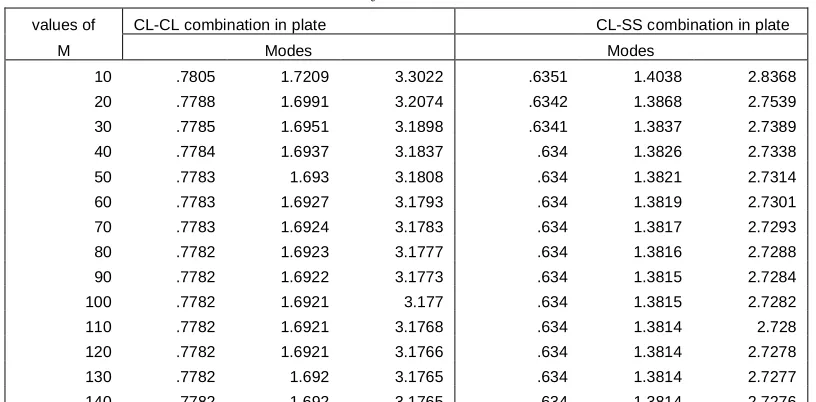
On solving the frequency equation XI and XII they provide us the numerical results for frequency parameter (Ω) considering variation in differentcombinations of plate parameters. Here in this model solution first 3 modes of vibration are obtained forthe two assumed boundary conditions (BC’s). The programming code is developed using MATLAB. Since method is approximate, therefore to minimize the error optimum size of interval length
X
is determined. For present problemX
1
,
m
where10(10)130
m
, form
130,
there is no improvement in results.The results obtained are given by table (I) and depicted in fig. 1(a) & 1(b) for the following conditions;0.03,
0.3,
1,
0.4,
0.4,
0.01,
0.01
k f
h
v
n
d
E
INTERNATIONAL JOURNAL OF SCIENTIFIC & TECHNOLOGY RESEARCH VOLUME 9, ISSUE 04, APRIL 2020 ISSN 2277-8616
1526 constant (
) =0.0(0.1)0.4,(ii)foundation paramete
0.0 0.005 0.02,
fk
(iii)non-homogeneity parameterη=0.0(0.1)0.4and damping
k
d=0.0(.0025)0.01respectively.Also calculating the results for
different variation in parameters we have considered:
0.3,
a
0.25,
0.03&
1
v
plate thickness h
n
b
.Table1.Convergence of Ω for Number of increasing nodes for CL-CL combination and CL-SS combination plates for
1, 0.4, 0.4, 0.4, 0.01, 0.01, 0.25, 0.03, 0.3,
n k k a b h v
d f
values of CL-CL combination in plate CL-SS combination in plate
M Modes Modes
10 .7805 1.7209 3.3022 .6351 1.4038 2.8368
20 .7788 1.6991 3.2074 .6342 1.3868 2.7539
30 .7785 1.6951 3.1898 .6341 1.3837 2.7389
40 .7784 1.6937 3.1837 .634 1.3826 2.7338
50 .7783 1.693 3.1808 .634 1.3821 2.7314
60 .7783 1.6927 3.1793 .634 1.3819 2.7301
70 .7783 1.6924 3.1783 .634 1.3817 2.7293
80 .7782 1.6923 3.1777 .634 1.3816 2.7288
90 .7782 1.6922 3.1773 .634 1.3815 2.7284
100 .7782 1.6921 3.177 .634 1.3815 2.7282
110 .7782 1.6921 3.1768 .634 1.3814 2.728
120 .7782 1.6921 3.1766 .634 1.3814 2.7278
130 .7782 1.692 3.1765 .634 1.3814 2.7277
140 .7782 1.692 3.1765 .634 1.3814 2.7276
Fig.1(a) Fig.1(b)
Fig.1 (a) & (b) % error in Ω for (i) CL-CL combination (ii) CL-SS combination, for α=0.4, =0.4,
k
f
0.01,
k
d
0.01
: □first mode; ○ second mode; ◊ third mode.Table 1 express convergence of different modes of frequency parameters Ω with increment in number of nodes for particular parameters combinations given as: α=0.4,
0.01,
fk
=0.04,k
d
0.01
for this a MATLAB coding was developed & calculation were completed for10(10)140.
m
It was further observed that Ω for the 3 modes converges as number of nodes m increases; i.e. convergence of Ω as number of nodes increases is monotonic for both plate combinations. % error in Ω for first 3 modes of vibrations of plates is depicted in fig. 1(a) &1(b).1527 IJSTR©2020
parameters are not zero then results compares well with Gupta M. [15], who have studied this combination with Frobenious method.
Table 2(a) and 2(b) shows the numerical results of Ω for different value of taper parameters (α) for non-damped (
0.0
dk
) & damped (k
d
0.01
) for two BC’s CL-CLposition and CL-SS position. The results obtained are depicted by fig. 2(a), 2(b) and 2(c) assuming fixed values of non- homogeneity parameter (
) and foundation parameters (FP) for first 3 mode of vibration of platecombinations (i.e. CL-CL combination and CL-SS combination). Fig. 2(a) represents variation in Ω with represent to taper constant for 1st mode of Ω. We find that the value of Ω decreases as the value of α increase but introduction of foundation parameter
k
f
0.01
increasethe value of Ω for CL-SS combinations as value of taper constant increase. Fig. 2(b) represents that value of frequency parameters Ω decreases for second mode as the value of taper constant increases. The same is the nature depicted by fig. 2(c) for third mode of Ω when taper constant increases but the changes in C-C plate combination for the combination
k
d
0.0,
0.4,
0.0
fk
andk
d
0.0,
0.4,
k
f
0.01
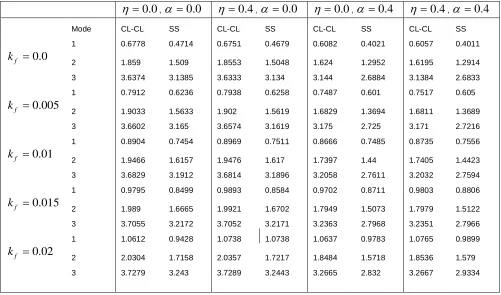
when taper constant is increases irregular.Table 3(a) and 3(b) provided the inference that numerical value of Ω increased with the increase for different values of foundation parameters for non-damped and damped plates. Considering two different value of and α also from fig. 3(a) observed that there is parabollically increment in frequency parameter for first mode of Ω. From fig. 3(b) we observe that the increment in frequency parameters Ω with
respect to increasing foundation parameter is linear. The same is the result for third modes of Ω as for the second mode which is given by fig. 3(c) but the linear change is less in third mode then in second mode.
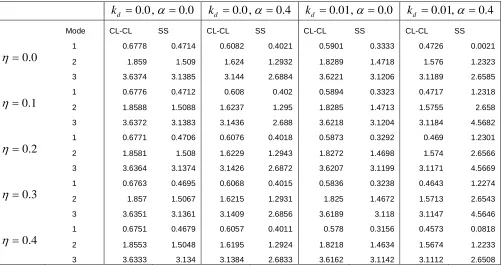
Table 4(a) and 4(b) provide the inference that the numerical value of Ω decreases when there is increases in the damping parameter for homogeneous and non-homogeneous plate considering two different values α and FP. From fig. 4(a) we observed that there is parabollically decrement in frequency parameters for first mode of Ω. From fig. 4(b) and 4(c) we observed that the value of frequency parameters Ω decreases linearly with increase in the value of damping parameter considering two different combination of α& FP for homogeneous and
non-homogeneous plates. Also it is observed that the linear change in second mode is much greater then third mode of frequency parameters.
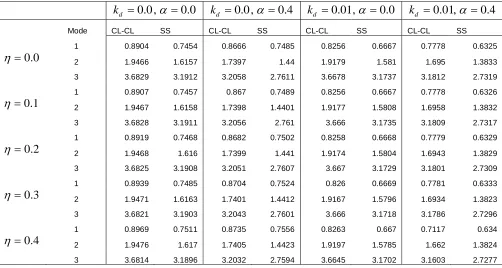
Table 5(a) and 5(b) provides the values of Ω as there is increase in values of non-homogeneity parameter Ƞ for
0.0
fk
andk
f
0.01
respectively for both BC’s. The results obtained in these tables are plotted in fig. (5a), (5b) and (5c) assuming the constant value of damping parameter (k
d) and taper constant (
) for 3 modes of vibrations of CL-CL combination & C-SS combination. The fig. (5a), (5b) and (5c) represent the behavior of frequency parameters Ω and it decreases as there is increases in value of
for different value, taking
0.0
, 0.4 and0.0, 0.01
dk
& consideringk
f as 0.0 and 0.01. Thus we observed that there is linear relationship between Ω and Ƞ for the 3 modes of CL-CL & CL-SS Plates, also the linear change is very small.Table 2(a): Value of Ω considering different value of α, when h=0.03, ν=0.3, n=1,
k
d
0.0,
a b
/
0.25
0.0,
k
f0.0
0.4,
k
f
0.0
0.0,
k
f
0.01
0.4,
k
f
0.01
Mode CL-CL SS CL-CL SS CL-CL SS CL-CL SS
1 0.6778 0.4714 0.8904 0.7454 0.6751 0.4597 0.8969 0.7511
α=0.0 2 1.859 1.509 1.9466 1.6157 1.8553 1.4686 1.9476 1.617
3 3.6374 3.1385 3.6829 3.1912 3.5377 3.0529 3.5845 3.1896
1 0.6632 0.4599 0.8848 0.7465 0.6456 0.4494 0.8911 0.7528
α=0.1 2 1.8074 1.4645 1.9003 1.578 1.7585 1.4259 1.9007 1.5796
3 3.5264 3.0394 3.5749 3.0956 3.5216 2.9572 3.573 3.094
1 0.6469 0.4451 0.8789 0.748 0.6438 0.4359 0.8852 0.754
α=0.2 2 1.752 1.415 1.8506 1.5367 1.7471 1.3783 1.8061 1.5355
3 3.4082 2.9326 3.4603 2.9932 3.3162 2.8542 3.3697 2.9916
1 0.6286 0.4263 0.8727 0.7482 0.6257 0.4182 0.8793 0.7548
α=0.3 2 1.6908 1.3592 1.7973 1.491 1.6863 1.3244 1.7978 1.4931
3 3.2814 2.8165 3.3378 2.8824 3.276 2.7419 3.3353 2.8095
1 0.6082 0.4021 0.867 0.7485 0.6057 0.4011 0.8735 0.7556
α=0.4 2 1.624 1.2932 1.7397 1.44 1.6195 1.2914 1.7405 1.4423
INTERNATIONAL JOURNAL OF SCIENTIFIC & TECHNOLOGY RESEARCH VOLUME 9, ISSUE 04, APRIL 2020 ISSN 2277-8616
1528
Table 2(b):Value of Ω considering different value of α,when h=0.03, ν=0.3, n=1,
k
d
0.01,
a b
/
0.25
0.0,
k
f0.0
0.4,
k
f
0.0
0.0,
k
f
0.01
0.4,
k
f
0.01
Mode CL-CL SS CL-CL SS CL-CL SS CL-CL SS
1 0.5901 0.3333 0.8256 0.6667 0.578 0.3156 0.8263 0.667
α=0.0 2 1.8289 1.4718 1.9179 1.581 1.8218 1.4634 1.9157 1.5785
3 3.6221 3.1206 3.6678 3.1737 3.6162 3.1142 3.6645 3.1702
1 0.5677 0.3031 0.8156 0.6616 0.5544 0.2846 0.8159 0.6624
α=0.1 2 1.7743 1.4233 1.8688 1.5398 1.7665 1.415 1.866 1.5375
3 3.5095 3.0197 3.5583 3.0763 3.5029 3.0129 3.5543 3.0726
1 0.5414 0.2607 0.8044 0.6546 0.5273 0.2405 0.8045 0.6557
α=0.2 2 1.7148 1.3685 1.8155 1.494 1.7065 1.3602 1.8128 1.4919
3 3.3893 2.9104 3.4417 2.9715 3.3822 2.9034 3.4373 2.9677
1 0.5103 0.1953 0.7918 0.6451 0.4956 0.1691 0.7921 0.6465
α=0.3 2 1.6493 1.3058 1.7583 1.4424 1.6407 1.2972 1.7552 1.4404
3 3.2599 2.791 3.317 2.8575 3.2524 2.7837 3.3121 2.8535
1 0.4726 0.0021 0.7778 0.6325 0.4573 .0012 0.7782 0.634
α=0.4 2 1.576 1.2323 1.695 1.3883 1.5676 1.2233 1.692 1.3814
3 3.1189 2.6585 3.1812 2.7319 3.1112 2.6508 3.1765 2.7277
Table3 (a):Value of Ω considering different value of
k
f,
when h=0.03, ν=0.3, n=1,k
d
0.0,
a b
/
0.25
0.0
,
0.0
0.4
,
0.0
0.0
,
0.4
0.4
,
0.4
Mode CL-CL SS CL-CL SS CL-CL SS CL-CL SS
1 0.6778 0.4714 0.6751 0.4679 0.6082 0.4021 0.6057 0.4011
0.0
fk
2 1.859 1.509 1.8553 1.5048 1.624 1.2952 1.6195 1.2914
3 3.6374 3.1385 3.6333 3.134 3.144 2.6884 3.1384 2.6833
1 0.7912 0.6236 0.7938 0.6258 0.7487 0.601 0.7517 0.605
0.005
fk
2 1.9033 1.5633 1.902 1.5619 1.6829 1.3694 1.6811 1.36893 3.6602 3.165 3.6574 3.1619 3.175 2.725 3.171 2.7216
1 0.8904 0.7454 0.8969 0.7511 0.8666 0.7485 0.8735 0.7556
0.01
fk
2 1.9466 1.6157 1.9476 1.617 1.7397 1.44 1.7405 1.44233 3.6829 3.1912 3.6814 3.1896 3.2058 2.7611 3.2032 2.7594 1 0.9795 0.8499 0.9893 0.8584 0.9702 0.8711 0.9803 0.8806
0.015
fk
2 1.989 1.6665 1.9921 1.6702 1.7949 1.5073 1.7979 1.51223 3.7055 3.2172 3.7052 3.2171 3.2363 2.7968 3.2351 2.7966 1 1.0612 0.9428 1.0738 1.0738 1.0637 0.9783 1.0765 0.9899
0.02
fk
2 2.0304 1.7158 2.0357 1.7217 1.8484 1.5718 1.8536 1.5791529 IJSTR©2020
Table3 (b):Value of Ω consideringdifferent value of
k
f,
whenh=0.03, ν=0.3, n=1,k
d
0.01
,a b
/
0.25
0.0,
k
f0.0
0.4,
k
f
0.0
0.0,
k
f
0.01
0.4,
k
f
0.01
Mode CL-CL SS CL-CL SS CL-CL SS CL-CL SS
1 0.5901 0.3333 0.578 0.3156 0.4726 0.0021 0.4573 0.0012
0.0
fk
2 1.8289 1.4718 1.8218 1.4634 1.576 1.2323 1.5674 1.2233
3 3.6221 3.1208 3.6162 3.1142 3.1189 2.6585 3.1112 2.6508
1 0.7176 0.5271 0.713 0.5218 0.6436 0.4475 0.6383 0.4434
0.005
fk
2 1.8739 1.5273 1.8693 1.5221 1.6366 1.3099 1.6309 1.3047
3 3.645 3.1474 3.6404 3.1423 3.1502 2.6954 3.144 2.6895
1 0.8256 0.6667 0.8263 0.667 0.7778 0.6325 0.7782 0.634
0.01
fk
2 1.9179 1.581 1.9157 1.5785 1.695 1.3833 1.692 1.38143 3.6678 3.1737 3.6645 3.1702 3.1812 2.7319 3.1765 2.7277
1 0.921 0.7818 0.9258 0.7858 0.8919 0.7742 0.8965 0.7791
0.015
fk
2 1.9608 1.6328 1.9609 1.633 1.7515 1.4531 1.751 1.45413 3.6905 3.1999 3.6884 3.1978 3.2119 2.7679 3.2087 2.7654 1 1.0075 0.8819 1.0156 0.8889 0.9929 0.8935 1.0009 0.901
0.02
fk
2 2.0029 1.6831 2.0052 1.6858 1.8062 1.5198 1.8082 1.52343 3.713 3.2258 3.7122 3.2251 3.2424 2.8035 3.2405 2.8026
Table4 (a): Value of Ω considering different value of
k
d, when h=0.03, ν=0.3, n=1,
0.0,
a b
/
0.25
0.0 ,
0.0
f
k
k
f
0.01 ,
0.0
k
f
0.0 ,
0.4
k
f
0.01 ,
0.4
Mode CL-CL SS CL-CL SS CL-CL SS CL-CL SS
1 0.6778 0.4714 0.8904 0.7454 0.6082 0.4021 0.8666 0.7485
kd=0.0 2 1.859 1.509 1.9466 1.6157 1.624 1.2952 1.7397 1.44
3 3.6374 3.1385 3.6829 3.1912 3.144 2.6884 3.2058 2.7611
1 0.6726 0.464 0.8864 0.7407 0.6006 0.3893 0.8613 0.7418
kd=0.0025 2 1.8572 1.5067 1.9448 1.6136 1.621 1.2913 1.737 1.4365
3 3.6364 3.1374 3.682 3.1901 3.1424 2.6866 3.2043 2.7593
1 0.657 0.441 0.8746 0.7265 0.5773 0.3484 0.8453 0.7213
kd=0.005 2 1.8516 1.4998 1.9395 1.6071 1.6121 1.2797 1.7287 1.426
3 3.6336 3.1341 3.6792 3.1868 3.1377 2.681 3.1997 2.7539
1 0.63 0.3997 0.8545 0.7022 0.5362 0.2662 0.8179 0.6858
kd=0.0075 2 1.8421 1.4882 1.9305 1.5963 1.5972 1.2601 1.7147 1.4084
3 3.6288 3.1286 3.6744 3.1814 3.1299 2.6716 3.192 2.7447
1 0.5901 0.3333 0.8256 0.6667 0.4726 0.0021 0.7778 0.6325
kd=0.01 2 1.8289 1.4718 1.9179 1.581 1.576 1.2323 1.695 1.3833
INTERNATIONAL JOURNAL OF SCIENTIFIC & TECHNOLOGY RESEARCH VOLUME 9, ISSUE 04, APRIL 2020 ISSN 2277-8616
1530
Table 4(b): Value of Ω considering different value of
k
d,
when h=0.03, ν=0.3, n=1,
0.4,
a b
/
0.25
.0.0 ,
0.0
f
k
k
f
0.01 ,
0.0
k
f
0.0 ,
0.4
k
f
0.01 ,
0.4
Mode CL-CL SS CL-CL SS CL-CL SS CL-CL SS
1 0.6751 0.4679 0.8969 0.7511 0.6057 0.4011 0.8735 0.7556
kd=0.00 2 1.8553 1.5048 1.9476 1.617 1.6195 1.2924 1.7405 1.4423
3 3.6333 3.134 3.6814 3.1896 3.1384 2.6833 3.2032 2.7594
1 0.6694 0.4599 0.8927 0.7461 0.5975 0.3877 0.8679 0.7486
kd=0.0025 2 1.8532 1.5022 1.9456 1.6146 1.6163 1.2873 1.7375 1.4385
3 3.6322 3.1328 3.6803 3.1884 3.1367 2.6813 3.2015 2.7574
1 0.6522 0.4348 0.8798 0.731 0.5722 0.3442 0.8507 0.7271
kd=0.005 2 1.847 1.4946 1.9396 1.6074 1.6066 1.2747 1.7285 1.4273
3 3.629 3.1291 3.6772 3.1848 3.1316 2.6752 3.1965 2.7515
1 0.6232 0.3896 0.8579 0.7051 0.5274 0.2557 0.7904 0.6899
kd=0.0075 2 1.8365 1.4817 1.9297 1.5955 1.5904 1.2536 1.6988 1.4083
3 3.6237 3.1229 3.6719 3.1787 3.1231 2.665 3.1804 2.7416
1 0.578 0.3156 0.8263 0.667 0.4573 0.0012 0.7117 0.634
kd=0.01 2 1.8218 1.4634 1.9197 1.5785 1.5674 1.2233 1.662 1.3824
3 3.6162 3.1142 3.6645 3.1702 3.1112 2.6508 3.1603 2.7277
Table 5(a): Value of Ω considering different value of
,
when h=0.03, ν=0.3, n=1,k
f
0.0,
a/b=0.25
k
d
0.0 ,
0.0
k
d
0.0 ,
0.4
k
d
0.01,
0.0
k
d
0.01,
0.4
Mode CL-CL SS CL-CL SS CL-CL SS CL-CL SS
1 0.6778 0.4714 0.6082 0.4021 0.5901 0.3333 0.4726 0.0021
0.0
2 1.859 1.509 1.624 1.2932 1.8289 1.4718 1.576 1.23233 3.6374 3.1385 3.144 2.6884 3.6221 3.1206 3.1189 2.6585
1 0.6776 0.4712 0.608 0.402 0.5894 0.3323 0.4717 1.2318
0.1
2 1.8588 1.5088 1.6237 1.295 1.8285 1.4713 1.5755 2.6583 3.6372 3.1383 3.1436 2.688 3.6218 3.1204 3.1184 4.5682
1 0.6771 0.4706 0.6076 0.4018 0.5873 0.3292 0.469 1.2301
0.2
2 1.8581 1.508 1.6229 1.2943 1.8272 1.4698 1.574 2.65663 3.6364 3.1374 3.1426 2.6872 3.6207 3.1199 3.1171 4.5669
1 0.6763 0.4695 0.6068 0.4015 0.5836 0.3238 0.4643 1.2274
0.3
2 1.857 1.5067 1.6215 1.2931 1.825 1.4672 1.5713 2.65433 3.6351 3.1361 3.1409 2.6856 3.6189 3.118 3.1147 4.5646
1 0.6751 0.4679 0.6057 0.4011 0.578 0.3156 0.4573 0.0818
0.4
2 1.8553 1.5048 1.6195 1.2924 1.8218 1.4634 1.5674 1.22333 3.6333 3.134 3.1384 2.6833 3.6162 3.1142 3.1112 2.6508
1531 IJSTR©2020
Table 5(b): Value of Ω considering different value of
,
when h=0.03, ν=0.3, n=1,k
f
0.01,
a b
/
0.25
,
k
d
0.0 ,
0.0
k
d
0.0 ,
0.4
k
d
0.01,
0.0
k
d
0.01,
0.4
Mode CL-CL SS CL-CL SS CL-CL SS CL-CL SS
1 0.8904 0.7454 0.8666 0.7485 0.8256 0.6667 0.7778 0.6325
0.0
2 1.9466 1.6157 1.7397 1.44 1.9179 1.581 1.695 1.38333 3.6829 3.1912 3.2058 2.7611 3.6678 3.1737 3.1812 2.7319
1 0.8907 0.7457 0.867 0.7489 0.8256 0.6667 0.7778 0.6326
0.1
2 1.9467 1.6158 1.7398 1.4401 1.9177 1.5808 1.6958 1.38323 3.6828 3.1911 3.2056 2.761 3.666 3.1735 3.1809 2.7317
1 0.8919 0.7468 0.8682 0.7502 0.8258 0.6668 0.7779 0.6329
0.2
2 1.9468 1.616 1.7399 1.441 1.9174 1.5804 1.6943 1.38293 3.6825 3.1908 3.2051 2.7607 3.667 3.1729 3.1801 2.7309
1 0.8939 0.7485 0.8704 0.7524 0.826 0.6669 0.7781 0.6333
0.3
2 1.9471 1.6163 1.7401 1.4412 1.9167 1.5796 1.6934 1.38233 3.6821 3.1903 3.2043 2.7601 3.666 3.1718 3.1786 2.7296
1 0.8969 0.7511 0.8735 0.7556 0.8263 0.667 0.7117 0.634
0.4
2 1.9476 1.617 1.7405 1.4423 1.9197 1.5785 1.662 1.38243 3.6814 3.1896 3.2032 2.7594 3.6645 3.1702 3.1603 2.7277
Fig.2: Graphic representation of Ω considering CL-CL and CL-SS combinations in plates: (2a) I-mode (2b) II-mode (2c) III-mode, for a/b=0.25. —, C-C, ---, C-SS, *,
k
d
0.0
,k
f
0.0,
0.0
;
,k
d
0.0
,k
f
0.01,
0.0
; v ,k
d
0.0
,k
f
0.0,
0.4
;
,
k
d
0.0
,0.01,
0.4
f
k
; ⌂,k
d
0.01,
k
f
0.0,
0.0
; ꙳,k
d
0.01,
k
f
0.01,
0.0
; ○,k
d
0.01,
0.0,
0.4
f
k
; □,k
d
0.01,
k
f
0.01,
0.4
INTERNATIONAL JOURNAL OF SCIENTIFIC & TECHNOLOGY RESEARCH VOLUME 9, ISSUE 04, APRIL 2020 ISSN 2277-8616
1532
Fig.3: Graphic representation of Ω considering CL-CL and CL-SS combination of plates: (3a) I-mode (3b) II-mode (3c) III-mode,
a b
/
0.25
—, C-C, ---, C-SS, *,k
d
0.0
,
0.0,
0.0
;
,k
d
0.0
,
0.0,
0.4
; v ,k
d
0.0
,
0.4,
0.0
;
,
k
d
0.0
,0.4,
0.4
; ⌂,k
d
0.01,
0.0,
0.0
; ꙳,k
d
0.01,
0.0,
0.4
; ○,k
d
0.01,
0.4,
0.0
; □,0.4,
k
d
0.01,
0.4Fig.(3a) Fig.(3b) Fig. (3c)
Fig.4: Graphic representation of Ωconsidering CL-CL and CL-SS combinations inplates: (4a) I- mode (4b) II- mode (4c) III-mode,
a b
/
0.25
—, CL-CL, ---, CL-SS, *,k
d
0.0
,k
f
0.0,
0.0
;
,k
d
0.0
,k
f
0.01,
0.0
; v ,k
d
0.0
,k
f
0.0,
0.4
;
,
0.0
dk
,k
f
0.01,
0.4
; ⌂,k
d
0.01,
k
f
0.0,
0.0
; ꙳,k
d
0.01,
k
f
0.01,
0.0
; ○,k
d
0.01,
0.0 ,
0.4
f
k
; □,k
d
0.01,
k
f
0.01,
0.4
1533 IJSTR©2020
Fig.5: Graphicrepresentation of Ω considering CL-CL and CL-SS combinations in plates: (5a) I- mode (5b) II- mode (5c) III- mode, for
a b
/
0.25
. — , CL-CL plates , ---, CL-SS, *,k
d
0.0
,k
f
0.0,
0.0
;
,k
d
0.0
,k
f
0.01,
0.0
; v ,k
d
0.0
,0.0,
0.4
f
k
;
,
k
d
0.0
,k
f
0.01,
0.4
; ⌂,k
d
0.01,
k
f
0.0,
0.0
; ꙳,k
d
0.01,
0.01,
0.0
f
k
; ○,k
d
0.01,
k
f
0.0,
0.4
; □,k
d
0.01,
k
f
0.01,
0.4
Fig.(5a) Fig.(5b) Fig. (5c)
5.
CONCLUSION
For the computation of results for present problem MATLAB is used within allowed range of plate parameters as per desired accuracy
10
8 , it helps in validation of actual vibrational problem. The present model results deals with the effect of damping on rectangular plate considering varying thickness, thermally induced non-homogeneity and plate which rest on wrinkle type elastic foundation material using the method quintic spline interpolation technique. Determination of natural frequency of plates is of great importance in industry because plate failure can results in loss of money and life. Thus assessment of failure life of a plate structure with effect of different parameters is of most importance. Calculation of natural frequency considering the effect of different parameters helps in assessment of design of plate to engineering who can modified plate structures as per the structural need to prevent cyclic fatigue and complete failure. Thus the present model results will be greatly useful for design to civil and mechanical engineers in various industries to obtain desired frequency by controlling different parameters which in turnalso helps in robustness of the design structures.6.
REFERENCES
[1] Crandall S.H., The role of damping in vibration theory. J. of Sound and Vibration, Vol. 11, No. 1, pp. 3-18 (1970).
[2] Gupta U.S. and Lal R., Transverse Vibration of Non-uniform rectangular plate on elastic Foundation,
Journal of sound and vibration, Vol. 61, No.1, pg. 127-133, (1978).
[3] Leissa A. W., The free vibration of rectangular plates, J sound and vibrations, vol. 31 (3), pg. 257-293,(1973).
[4] Lal R., Gupta U. S., and Reena, Quintic spline in the study of transverse vibrations of non-uniform orthotropic rectangular plates. Journal of sound and vibration 207: 1-13(1997)
[5] Gupta A.K. and Jain M., Exponential temperature effect on frequencies of a rectangular plate of non- linear varying thickness. A quintic spline technique, Journal of Theoretical and Applied Mechanics, Vol. 52, No. 1, pp. 15-24, (2014).
[6] Chakraverty S., Pradhan KK., Free vibration of exponential functionally graded rectangular plates in thermal environment with general boundary conditions. Aerospsci Technol; 36:132-56, (2004).
[7] Robin and Rana U.S., Study of damped vibration of non- homogeneous rectangular plate of variable thickness, International Journal of Engineering and applied science (IJEAS), ISSN: 2394-3661, Volume-3, Issue-8, (2016).
[8] Sakata T., A note on nodal lines of rectangular plates. J. Appl. Mech., Vol. 45(3), pp. 691-693, (1978). [9] Gupta A.K., Johri T. and Vats R.P., Thermal effect on
INTERNATIONAL JOURNAL OF SCIENTIFIC & TECHNOLOGY RESEARCH VOLUME 9, ISSUE 04, APRIL 2020 ISSN 2277-8616
1534 San-Francisco, USA, 24-26 Oct., 2007, pp. 784-787,
(2007).
[10] Bahmyari E. and Rahbar-Ranji A., Free vibration analysis of orthotropic plates with variable thickness resting on non-uniform elastic foundation by element free Galerkin method. Journal of Mechanical Science and Technology, vol. 26, pg. 2685-2694, (2012). [11] Sharma S., Gupta U. S., and Singhal P., Vibration
analysis of non- homogeneous orthotropic rectangular plates of variable thickness resting Winkler foundation, Journal of applied science and engineering, vol. 15(3), pp. 291-300, (2012).
[12] Tomar J.S. and Gupta A.K., Thermal gradient on frequency of orthotropic rectangular plate whose thickness varies in two directions. Journal of Sound and Vibration, Vol. 98, No. 2, pp. 257-262, (1985). [13] Gupta M., Kumar A., Kumar A., Analysis of Damping
and Non-homogeneity through spline interpolation technique of an isotropic Rectangular plate of Parabollically varying thickness which rests on Elastic foundation, ESSENCE Int. J. Env. Rehab. Conserv. X (1): 15—24(2019).ISSN : 0975 – 6272
[14] Jain R. K. and Soni S. R., Free vibration of rectangular plates of parabollically varying thickness, Indian Journal of Pure and Applied Mathematics, Vol.4(3), pp. 267-277, (1973).