4040
Convolutional Self-Attention Networks
Baosong Yang† Longyue Wang‡ Derek F. Wong† Lidia S. Chao† Zhaopeng Tu‡∗
†NLP2CT Lab, Department of Computer and Information Science, University of Macau ‡Tencent AI Lab
†[email protected], {derekfw,lidiasc}@umac.mo ‡{vinnylywang,zptu}@tencent.com
Abstract
Self-attention networks (SANs) have drawn increasing interest due to their high paral-lelization in computation and flexibility in modeling dependencies. SANs can be fur-ther enhanced with multi-head attention by allowing the model to attend to information from different representation subspaces. In this work, we propose novel convolutional self-attention networks, which offer SANs the abilities to 1) strengthen dependencies among neighboring elements, and 2) model the inter-action between features extracted by multiple attention heads. Experimental results of ma-chine translation on different language pairs and model settings show that our approach outperforms both the strong Transformer base-line and other existing models on enhancing the locality of SANs. Comparing with prior studies, the proposed model is parameter free in terms of introducing no more parameters.
1 Introduction
Self-attention networks (SANs) (Parikh et al., 2016; Lin et al., 2017) have shown promising empirical results in various natural language pro-cessing (NLP) tasks, such as machine transla-tion (Vaswani et al., 2017), natural language in-ference (Shen et al., 2018a), and acoustic model-ing (Sperber et al.,2018). One appealing strength of SANs lies in their ability to capture dependen-cies regardless of distance by explicitly attending to all the elements. In addition, the performance of SANs can be improved by multi-head atten-tion (Vaswani et al.,2017), which projects the in-put sequence into multiple subspaces and applies attention to the representation in each subspace.
Despite their success, SANs have two major limitations. First, the model fully take into
ac-∗
Zhaopeng Tu is the corresponding author of the paper. This work was conducted when Baosong Yang was interning at Tencent AI Lab.
count all the elements, which disperses the atten-tion distribuatten-tion and thus overlooks the relaatten-tion of neighboring elements and phrasal patterns (Yang et al., 2018; Wu et al., 2018; Guo et al., 2019). Second, multi-head attention extracts distinct lin-guistic properties from each subspace in a parallel fashion (Raganato and Tiedemann, 2018), which fails to exploit useful interactions across differ-ent heads. Recdiffer-ent work shows that better features can be learned if different sets of representations are present at feature learning time (Ngiam et al., 2011;Lin et al.,2014).
To this end, we propose novel convolutional self-attention networks(CSANs), which model lo-cality for self-attention model and interactions be-tween features learned by different attention heads in an unified framework. Specifically, in order to pay more attention to a local part of the input se-quence, we restrict the attention scope to a window of neighboring elements. The localness is there-fore enhanced via a parameter-free 1-dimensional convolution. Moreover, we extend the convolu-tion to a 2-dimensional area with the axis of at-tention head. Thus, the proposed model allows each head to interact local features with its adja-cent subspaces at attention time. We expect that the interaction across different subspaces can fur-ther improve the performance of SANs.
We evaluate the effectiveness of the proposed model on three widely-used translation tasks: WMT14 English-to-German, WMT17 Chinese-to-English, and WAT17 Japanese-to-English. Ex-perimental results demonstrate that our approach consistently improves performance over the strong
TRANSFORMER model (Vaswani et al., 2017)
Bush held a talk with Sharon
Bush held a talk with Sharon
Bush held a talk with Sharon Bush held a talk with Sharon
Bush held a talk with Sharon
(a) Vanilla SANs
Bush held a talk with Sharon
Bush held a talk with Sharon
Bush held a talk with Sharon Bush held a talk with Sharon
Bush held a talk with Sharon
(b) 1D-Convolutional SANs
Bush held a talk with Sharon
Bush held a talk with Sharon
Bush held a talk with Sharon Bush held a talk with Sharon
Bush held a talk with Sharon
[image:2.595.81.518.72.175.2](c) 2D-Convolutional SANs
Figure 1: Illustration of (a) vanilla SANs; (b) 1-dimensional convolution with the window size being3; and (c) 2-dimensional convolution with the area being3×3. Different colors and patterns represent different subspaces modeled by multi-head attention, and transparent colors denote masked tokens that are invisible to SANs.
2 Multi-Head Self-Attention Networks
SANs produce representations by applying atten-tion to each pair of tokens from the input se-quence, regardless of their distance.Vaswani et al. (2017) found it is beneficial to capture different contextual features with multiple individual atten-tion funcatten-tions. Given an input sequence X =
{x1, . . . ,xI} ∈ RI×d, the model first transforms
it into queriesQ, keysK, and valuesV:
Q,K,V=XWQ,XWK,XWV ∈RI×d (1)
where {WQ,WK,WV} ∈ Rd×d are trainable
parameters and d indicates the hidden size. The three types of representations are split intoH dif-ferent subspaces, e.g., [Q1, . . . ,QH] = Q with Qh ∈ RI×d
H. In each subspace h, the element oh
i in the output sequence Oh = {oh1, . . . ,ohI}is
calculated by
ohi =ATT(qih,Kh)Vh ∈R
d
H (2)
where ATT(·) is an attention model (Bahdanau et al., 2015; Vaswani et al., 2017) that retrieves the keysKh with the queryqhi. The final output representation O is the concatenation of outputs generated by multiple attention models:
O= [O1, . . . ,OH] ∈RI×d (3)
3 Approach
As shown in Figure 1(a), the vanilla SANs use the queryqhi to compute a categorical distribution over all elements fromKh(Equation2). It may in-herit the attention to neighboring information (Yu et al.,2018;Yang et al.,2018;Guo et al.,2019). In this work, we propose to model locality for SANs by restricting the model to attend to a local re-gion via convolution operations (1D-CSANs, Fig-ure1(b)). Accordingly, it provides distance-aware
information (e.g. phrasal patterns), which is com-plementary to the distance-agnostic dependencies modeled by the standard SANs (Section3.1).
Moreover, the calculation of output oh are re-stricted to the a single individual subspace, over-looking the richness of contexts and the dependen-cies among groups of features, which have proven beneficial to the feature learning (Ngiam et al.,
2011; Wu and He, 2018). We thus propose to
convolute the items in adjacent heads (2D-CSANs, Figure1(c)). The proposed model is expected to improve performance through interacting linguis-tic properties across heads (Section3.2).
3.1 Locality Modeling via 1D Convolution
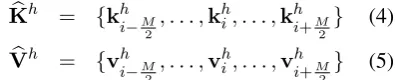
For each query qhi, we restrict its attention re-gion (e.g.,Kh ={kh1, . . . ,khi, . . . ,khI}) to a local scope with a fixed sizeM + 1(M ≤I) centered at the positioni:
b
Kh = {khi−M 2
, . . . ,khi, . . . ,khi+M 2
} (4)
b
Vh = {vhi−M 2
, . . . ,vhi, . . . ,vhi+M 2
} (5)
Accordingly, the calculation of corresponding out-put in Equation (2) is modified as:
ohi =ATT(qhi,Kbh)Vbh (6)
As seen, SANs are only allowed to attend to the neighboring tokens (e.g., Kbh, Vbh), instead of all
the tokens in the sequence (e.g.,Kh,Vh).
[image:2.595.328.526.509.549.2]this way, the representations are learned in a hi-erarchical fashion (Yang et al.,2017). That is, the distance-aware and local information extracted by the lower SAN layers, is expected to complement distance-agnostic and global information captured by the higher SAN layers.
3.2 Attention Interaction via 2D Convolution
Mutli-head mechanism allows different heads to capture distinct linguistic properties (Raganato and Tiedemann,2018;Li et al.,2018), especially in diverse local contexts (Yang et al., 2018). We hypothesis that exploiting local properties across heads can further improve the performance of SANs. To this end, we expand the 1-dimensional window to a 2-dimensional area with the new di-mension being the index of attention head. Sup-pose that the area size is (N + 1) × (M + 1)
(N ≤H), the keys and values in the area are:
e
Kh = [[Kbh−
N
2, . . . ,Kbh, . . . ,Kbh+
N 2](7)
e
Vh = [[Vbh−
N
2, . . . ,Vbh, . . . ,Vbh+
N 2](8)
whereKbh,Vbh are elements in theh-th subspace,
which are calculated by Equations4and5 respec-tively. The union operation S
means combining the keys and values in different subspaces. The corresponding output is calculated as:
ohi =ATT(qhi,Keh)Veh (9)
The 2D convolution allows SANs to build rel-evance between elements across adjacent heads, thus flexibly extract local features from different subspaces rather than merely from an unique head. The vanilla SAN models linearly aggregate fea-tures from different heads, and this procedure lim-its the extent of abstraction (Fukui et al.,2016;Li et al.,2019). Multiple sets of representations pre-sented at feature learning time can further improve the expressivity of the learned features (Ngiam et al.,2011;Wu and He,2018).
4 Related Work
Self-Attention Networks Recent studies have shown that SANs can be further improved by cap-turing complementary information. For exam-ple, Hao et al. (2019) complemented SANs with recurrence modeling, while Yang et al. (2019) modeled contextual information for SANs.
Concerning modeling locality for SANs, Yu et al. (2018) injected several CNN layers (Kim,
2014) to fuse local information, the output of which is fed to the subsequent SAN layer. Several researches proposed to revise the attention distri-bution with a parametric localness bias, and suc-ceed on machine translation (Yang et al., 2018) and natural language inference (Guo et al.,2019). While both models introduce additional parame-ters, our approach is a more lightweight solution without introducing any new parameters. Closely related to this work,Shen et al.(2018a) applied a positional mask to encode temporal order, which only allows SANs to attend to the previous or fol-lowing tokens in the sequence. In contrast, we employ a positional mask (i.e. the tokens outside the local window is masked as 0) to encode the distance-aware local information.
In the context of distance-aware SANs, Shaw et al. (2018) introduced relative position encod-ing to consider the relative distances between se-quence elements. While they modeled locality from position embedding, we improve locality modeling from revising attention scope. To make a fair comparison, we re-implemented the above approaches under a same framework. Empirical results on machine translation tasks show the su-periority of our approach in both translation qual-ity and training efficiency.
Multi-Head Attention Multi-head attention
mechanism (Vaswani et al., 2017) employs
different attention heads to capture distinct fea-tures (Raganato and Tiedemann, 2018). Along this direction, Shen et al. (2018a) explicitly used multiple attention heads to model different dependencies of the same word pair, andStrubell et al. (2018) employed different attention heads to capture different linguistic features. Li et al. (2018) introduced disagreement regularizations to encourage the diversity among attention heads. Inspired by recent successes on fusing informa-tion across layers (Dou et al., 2018, 2019), Li et al. (2019) proposed to aggregate information captured by different attention heads. Based on these findings, we model interactions among attention heads to exploit the richness of local properties distributed in different heads.
5 Experiments
We conducted experiments with the Transformer model (Vaswani et al.,2017) on English⇒German
(En⇒De), Chinese⇒English (Zh⇒En) and
For the En⇒De and Zh⇒En tasks, the mod-els were trained on widely-used WMT14 and WMT17 corpora, consisting of around 4.5 and
20.62 million sentence pairs, respectively. Con-cerning Ja⇒En, we used the first two sections of WAT17 corpus as the training data, which consists of 2M sentence pairs. To reduce the vocabulary size, all the data were tokenized and segmented into subword symbols using byte-pair encoding (Sennrich et al.,2016) with 32K merge operations. Following Shaw et al. (2018), we incorporated the proposed model into the encoder, which is a stack of 6 SAN layers. Prior studies revealed that modeling locality in lower layers can achieve better performance (Shen et al., 2018b; Yu et al.,2018;Yang et al.,2018), we applied our approach to the lowest three layers of the encoder. About configurations of NMT models, we used theBase andBigsettings same as Vaswani et al. (2017), and all models were trained on 8 NVIDIA P40 GPUs with a batch of 4096 tokens.
5.1 Effects of Window/Area Size
We first investigated the effects of window size (1D-CSANs) and area size (2D-CSANs) on En⇒De validation set, as plotted in Figure2. For 1D-CSANs, the local size with 11 is superior to other settings. This is consistent withLuong et al. (2015) who found that 10 is the best window size in their local attention experiments. Then, we fixed the number of neighboring tokens being 11 and varied the number of heads. As seen, by considering the features across heads (i.e. > 1), 2D-CSANs further improve the translation qual-ity. However, when the number of heads in at-tention goes up, the translation quality inversely drops. One possible reason is that the model still has the flexibility of learning a different distribu-tion for each head with few interacdistribu-tions, while a large amount of interactions assumes more heads make “similar contributions” (Wu and He,2018).
5.2 Accuracy of Phrase Translation
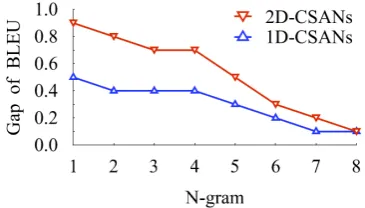
One intuition of our approach is to capture useful phrasal patterns via modeling locality. To evalu-ate the accuracy of phrase translations, we calcu-late the improvement of the proposed approaches over multiple granularities of n-grams, as shown in Figure 3. Both the two model variations con-sistently outperform the baseline on larger granu-larities, indicating that modeling locality can raise the ability of self-attention model on capturing the
(a) 1D-CSANs
[image:4.595.337.497.61.318.2](b) 2D-CSANs
Figure 2: Effects of (a) window size on 1D-CSANs, and (b) attended head numbers on 2D-CSANs. For 2D-CSANs, the window size dimension is fixed to be 11.
Figure 3: Performance improvement on different n-grams. “Gap of BLEU” denotes the improvement achieved by the proposed models over the baseline.
phrasal information. Furthermore, the dependen-cies among heads can be complementary to the lo-calness modeling, which reveals the necessity of the interaction of features in different subspaces.
5.3 Comparison to Related Work
[image:4.595.325.508.384.488.2]Model Parameter Speed BLEU 4
TRANSFORMER-BASE(Vaswani et al.,2017) 88.0M 1.28 27.31
-+ BI DIRECT(Shen et al.,2018a) +0.0M -0.00 27.58 +0.27
+ REL POS(Shaw et al.,2018) +0.1M -0.11 27.63 +0.32
+ NEIGHBOR(Sperber et al.,2018) +0.4M -0.06 27.60 +0.29
+ LOCAL HARD(Luong et al.,2015) +0.4M -0.06 27.73 +0.42
+ LOCAL SOFT(Yang et al.,2018) +0.8M -0.09 27.81 +0.50
+ BLOCK(Shen et al.,2018b) +6.0M -0.33 27.59 +0.28
+ CNNs (Yu et al.,2018) +42.6M -0.54 27.70 +0.39
+ 1D-CSANs +0.0M -0.00 27.86 +0.55
[image:5.595.103.499.62.215.2]+ 2D-CSANs +0.0M -0.06 28.18 +0.87
Table 1: Comparing with the existing approaches on WMT14 En⇒De translation task. For a fair comparison, we re-implemented the existing locality approaches under the same framework. “Parameter” denotes the number of model parameters (M = million) and “Speed” denotes the training speed (steps/second). “4” column denotes performance improvements over the Transformer baseline.
Model WMT14 En⇒De WMT17 Zh⇒En WAT17 Ja⇒En
Speed BLEU Speed BLEU Speed BLEU
TRANSFORMER-BASE 1.28 27.31 1.21 24.13 1.33 28.10
+ CSANs 1.22 28.18⇑ 1.16 24.80⇑ 1.28 28.50↑
TRANSFORMER-BIG 0.61 28.58 0.58 24.56 0.65 28.41
+ CSANs 0.50 28.74 0.48 25.01↑ 0.55 28.73↑
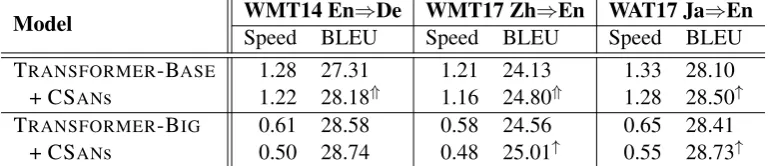
Table 2: Experimental results on WMT14 En⇒De, WMT17 Zh⇒En and WAT17 Ja⇒En test sets. “Speed” denotes the training speed (steps/second). “↑ / ⇑” indicates statistically significant difference from the vanilla self-attention counterpart (p <0.05/0.01), tested by bootstrap resampling (Koehn,2004).
CNNs, revealing that extracting local features with dynamic weights is superior to assigning fixed pa-rameters. Moreover, while most of the existing ap-proaches (except forShen et al.(2018a)) introduce new parameters, our methods are parameter-free and thus only marginally affect training efficiency.
5.4 Universality of The Proposed Model
To validate the universality of our approach on MT tasks, we evaluated the proposed approach on dif-ferent language pairs and model settings. Table2 lists the results on En⇒De, Zh⇒En and Ja⇒En translation tasks. As seen, our model consistently improves translation quality across language pairs, which demonstrates the effectiveness and univer-sality of the proposed approach. It is encouraging to see that CSANs withbasesetting yields compa-rable performance with TRANSFORMER-BIG.
6 Conclusion
In this paper, we propose a parameter-free convo-lutional self-attention model to enhance the fea-ture extraction of neighboring elements across
multiple heads. Empirical results of machine translation task on a variety of language pairs demonstrate the effectiveness and universality of the proposed methods. The extensive analyses suggest that: 1) modeling locality is beneficial to SANs; 2) interacting features across multiple heads at attention time can further improve the performance; and 3) to some extent, the dynamic weights are superior to their fixed counterpart (i.e. CSANs vs. CNNs) on local feature extraction. Moreover, it is interesting to validate the proposed model in other sequence modeling tasks.
Acknowledgments
[image:5.595.107.495.291.374.2]References
Dzmitry Bahdanau, Kyunghyun Cho, and Yoshua Ben-gio. 2015. Neural Machine Translation by Jointly Learning to Align and Translate. InICLR.
Ziyi Dou, Zhaopeng Tu, Xing Wang, Shuming Shi, and Tong Zhang. 2018. Exploiting Deep Representa-tions for Neural Machine Translation. InEMNLP.
Ziyi Dou, Zhaopeng Tu, Xing Wang, Longyue Wang, Shuming Shi, and Tong Zhang. 2019. Dynamic Layer Aggregation for Neural Machine Translation. InAAAI.
Akira Fukui, Dong Huk Park, Daylen Yang, Anna Rohrbach, Trevor Darrell, and Marcus Rohrbach. 2016. Multimodal Compact Bilinear Pooling for Vi-sual Question Answering and ViVi-sual Grounding. In
EMNLP.
Maosheng Guo, Yu Zhang, and Ting Liu. 2019. Gaus-sian Transformer: A Lightweight Approach for Nat-ural Language Inference. InAAAI.
Jie Hao, Xing Wang, Baosong Yang, Longyue Wang, Jinfeng Zhang, and Zhaopeng Tu. 2019. Modeling Recurrence for Transformer. InNAACL.
Yoon Kim. 2014. Convolutional Neural Networks for Sentence Classification. InEMNLP.
Philipp Koehn. 2004. Statistical Significance Tests for Machine Translation Evaluation. InEMNLP.
Jian Li, Zhaopeng Tu, Baosong Yang, Michael R. Lyu, and Tong Zhang. 2018. Multi-Head Attention with Disagreement Regularization. InEMNLP.
Jian Li, Baosong Yang, Zi-Yi Dou, Xing Wang, Michael R. Lyu, and Zhaopeng Tu. 2019. Infor-mation Aggregation for Multi-Head Attention with Routing-by-Agreement. InNAACL.
Min Lin, Qiang Chen, and Shuicheng Yan. 2014. Net-work in NetNet-work. InICLR.
Zhouhan Lin, Minwei Feng, Cicero Nogueira dos San-tos, Mo Yu, Bing Xiang, Bowen Zhou, and Yoshua Bengio. 2017. A Structured Self-Aattentive Sen-tence Embedding. InICLR.
Thang Luong, Hieu Pham, and Christopher D. Man-ning. 2015. Effective Approaches to Attention-based Neural Machine Translation. InEMNLP.
Jiquan Ngiam, Aditya Khosla, Mingyu Kim, Juhan Nam, Honglak Lee, and Andrew Y Ng. 2011. Mul-timodal Deep Learning. InICML.
Ankur Parikh, Oscar T¨ackstr¨om, Dipanjan Das, and Jakob Uszkoreit. 2016. A Decomposable Attention Model for Natural Language Inference. InEMNLP.
Matthew E Peters, Mark Neumann, Mohit Iyyer, Matt Gardner, Christopher Clark, Kenton Lee, and Luke Zettlemoyer. 2018. Deep Contextualized Word Rep-resentations. InNAACL.
Alessandro Raganato and J¨org Tiedemann. 2018. An Analysis of Encoder Representations in Transformer-Based Machine Translation. In
EMNLP Workshop BlackboxNLP: Analyzing and Interpreting Neural Networks for NLP.
Rico Sennrich, Barry Haddow, and Alexandra Birch. 2016. Neural Machine Translation of Rare Words with Subword Units. InACL.
Peter Shaw, Jakob Uszkoreit, and Ashish Vaswani. 2018. Self-Attention with Relative Position Repre-sentations. InNAACL.
Tao Shen, Tianyi Zhou, Guodong Long, Jing Jiang, Shirui Pan, and Chengqi Zhang. 2018a. DiSAN: Directional Self-Attention Network for RNN/CNN-Free Language Understanding. InAAAI.
Tao Shen, Tianyi Zhou, Guodong Long, Jing Jiang, and Chengqi Zhang. 2018b. Bi-Directional Block Self-Attention for Fast and Memory-Efficient Sequence Modeling. InICLR.
Matthias Sperber, Jan Niehues, Graham Neubig, Se-bastian St¨uker, and Alex Waibel. 2018. Self-Attentional Acoustic Models. Interspeech.
Emma Strubell, Patrick Verga, Daniel Andor, David Weiss, and Andrew McCallum. 2018. Linguistically-Informed Self-Attention for Seman-tic Role Labeling. InEMNLP.
Ashish Vaswani, Noam Shazeer, Niki Parmar, Jakob Uszkoreit, Llion Jones, Aidan N Gomez, Łukasz Kaiser, and Illia Polosukhin. 2017. Attention is All You Need. InNIPS.
Wei Wu, Houfeng Wang, Tianyu Liu, and Shuming Ma. 2018. Phrase-level Self-Attention Networks for Universal Sentence Encoding. InEMNLP.
Yuxin Wu and Kaiming He. 2018. Group Normaliza-tion. arXiv:1803.08494.
Baosong Yang, Jian Li, Derek F. Wong, Lidia S. Chao, Xing Wang, and Zhaopeng Tu. 2019. Context-Aware Self-Attention Networks. InAAAI.
Baosong Yang, Zhaopeng Tu, Derek F. Wong, Fandong Meng, Lidia S. Chao, and Tong Zhang. 2018. Mod-eling Localness for Self-Attention Networks. In
EMNLP.
Baosong Yang, Derek F Wong, Tong Xiao, Lidia S Chao, and Jingbo Zhu. 2017. Towards Bidirec-tional Hierarchical Representations for Attention-based Neural Machine Translation. InEMNLP.