Digital Pedagogy Analysis On Technology Trend
Relevant To Education 4.0
Eric G. Pardiñan, Romarico A. Loremia
Abstract: Technology is essential in the development of the educational process. The rapid growth of information technologies has led to the birth of information societies and led organizations to adjust to new technological advances. The 4th industrial revolution or Industry 4.0 can be referred to as the current and developmental transformation, which results from innovative technologies and trends. Hence, the study would look into the implications of the technology-supported pedagogies; the article would introduce a hybrid instructional platform adapting technology trends relevant to Education 4.0 called Systematic Computer Assisted Learning Environment (SCALE). The study used an experimental research design, sought to compare the level of learning in terms of knowledge, practical skills acquisition, and craftsmanship, involving learners using the conventional methods in teaching-learning and the SCALE platform. The study used two instruments that were based on the instructional objectives of lessons on Embedded Systems Programming & Industrial Automation. Data obtained were analyzed using weighted mean, standard deviation, and T-test analysis. Cohen’s Kappa was also used to determine the inter-rater level of agreement of respondents using the SCALE platform. According to the results, the SCALE contributed to the academic success of the group that had used the computer-assisted learning environment as compared to the group that utilized conventional methods. The researchers somehow express that despite the existing gaps and mixed findings, a list of significant recommendations for when and how to use technologies on a computer-assisted learning environment may be considered to increase the likelihood of promoting student engagement
Index Terms: Computer Assisted Learning (CAL), Education 4.0, Electronics, Simulation, Technology
—————————— ——————————
1.
INTRODUCTION
EDUCATION is central to any society, and its effectiveness is reflected in a community is strengths and weaknesses, both domestically and abroad. For a society to be prosperous in competing economically in the world, education is fundamental and is conditioned by a wide range of interrelated elements, including economics, advances in scientific technology, and technical knowledge, amongst others. Education and school practices can be described and illustrated as a practice involving multiple and diverse actors, entities, relationships, and viewpoints, as well as influencing and challenging issues of concern [29]. The fast improvement in science and technology affects the educational and social system as much as concerning the economic system. Technology use in education allows the students to produce projects by working together in an environment that supported the Internet and mobile learning devices. Technology has many different effects on education, specifically in enhancing students learning. When technology and appropriate teaching methods blend into teaching and learning, a positive impact may result in both the cognitive and affective domains.
Schindler et al. [32] claimed that integrating technology into teaching and learning is not a new challenge for universities. It was further added that, since the 1900s, administrators and faculty have grappled with how to effectively use technical innovations such as video and audio recordings, email, and teleconferencing to augment or replace traditional instructional delivery methods [32], [46]. Technology is essential in the development of the educational process. The rapid growth of information technologies has led to the birth of information societies and made it necessary for organizations to follow it and adjust themselves to new technological advances. The rapid increase in information and the number of students have brought about several problems, and these new technologies have taken part in the development of the educational process. The quality imposed on educational institutions has become compulsory [16]. With the explosive growth of computers in academia in the latter half of the last century and for individual use in the early eighties, and the emergence of the Internet in mainstream education in the nineties, educational technology has become somewhat synonymous to computer-based learning and online teaching. The education sector had started to harness the power of continuously improving communication technologies, with the computer as its front end. The activity and the inter-connectivity offered by these technologies promised to have an unprecedented impact on education. Computers and related technology can be viewed as the future of teaching and learning and as a powerful technological machine to promote knowledge development. Networks can create a more attractive and practical learning environment. Educational technology encompasses environmental organization or the design of the teaching environment for detecting student behaviors, the determining of certain educational situations, and gaining in experiences [12], [16]. Keser & Ozcan [16] added that educational technologies had become recent developments in educational instruments and other new electronic technologies. Thus, it was further suggested that there are essential reasons for teachers to use technology in education: motivation, distinctive instructional abilities, higher productivity of teachers, vital skills in the ————————————————
Eric G. Pardiñan an Associate Professor IV of Cebu Technological University, College of Technology, Electronics Department, Cebu
City, Philippines ORCID: 0000-0001-9836-859 E-mail:
information age, and support for new teaching techniques. Salavati [28] claimed that digital technologies had been pushed into schools due to political decisions. He further highlights that changes in pedagogical practices and modifications to learning environments have to be made by individuals who work in the schools. He also explained that the mandate for integrating digital technologies in the schools had been imposed on the teachers after the school leaders and authorities have taken the decisions to integrate digital technologies into classroom education. However, schools have a long history of teacher autonomy. Traditionally, teachers have, to a large extent, been able to shape their teaching without direct influence or involvement from school leaders or governmental authorities. Salavati [28] further claimed that the practical realization of schools' digitalization was through the teachers themselves within their standard work practices. Therefore, the changes required for adopting and using digital technologies in everyday education practices should be developed in cooperation among the schools, including authorities and classroom teachers, the
municipalities, and the commercial and industrial life. The 4th industrial revolution, usually called Industry 4.0 or 4IR
can be referred to as the current and developmental transformation in the ways human function, which is as a result of innovative technologies and trends such as robotics, Internet of Things (IoT), virtual reality and Artificial Intelligence(AI) [27]. These disruptive technologies and trends have blurred the lines between the physical, digital, and biological spheres and, as opined by Marr [19], will impact all disciplines, industries, and economies. According to Fisk [8], these disruptive technologies are reshaping the world, and as such, engineering education and the world at large should focus on training students on these technologies. They include mobile Internet, automation of knowledge work, Internet of things, cloud, advanced robotics, autonomous vehicles, genomics, energy storage, 3D printing, advanced materials, advanced oil and gas exploration, and renewable energy. Therefore, this paper focuses on the implications of these transformations on engineering education globally and its value and importance. Technology is not intended to replace teachers; however, it is here to help them transform their classrooms, students, and the future [18]. Technology can become a powerful tool for transforming learning; thus, it can help affirm and advance relationships between educators and students. It would further reinvent our approaches to learning and collaboration, shrink long-standing equity and accessibility
gaps, and adapt learning experiences to meet all learners. Higher education institutions face new challenges, especially
in this age of rapid technological changes and adoption in this sector. Educators need to meet and address today's higher education learning landscape offering new insights, fresh ideas, and learning experiences from different educator perspectives. This paper presents the trends in technology-supported teaching-learning processes and the approaches used in higher education institutions to add value to the knowledge creation, curation, distribution and sharing with their learners, as well as to support learners through their academic life with the institution. It is focused on student engagement as the dependent variable of interest because it encompasses many aspects of the teaching and learning activities. The paper would look into the implications of the technology-supported pedagogies for users and stakeholders; the article would introduce a hybrid instructional platform
adapting technology trends relevant to Education 4.0 called Systematic Computer Assisted Learning Environment (SCALE).
2 MATERIALS AND METHODS
2.1 Systematic Computer Assisted Learning Environment (SCALE)
Systematic Computer Assisted Learning Environment (SCALE) is a hybrid instructional platform adapting technology trends relevant to Education 4.0. SCALE provides students with a useful and easy to use environment for concept, design, and implementation for teaching-learning electronics. It is an online platform for students to access materials easily, simulations, modules, and design software relevant to electronics engineering and technology. It is a friendly and straightforward interface that allows students to master the program performance in a short space of time with the luxury of doing the task online. SCALE simplifies the task of the students in the designing process. The platform helps in preventing typical mistakes in designs such that connections that can damage the devices in a real assembly are not permitted. Second, avoiding graphical design errors by clearly showing the electrical connections between the system components; third, fault simulation activities, and fourth, allowing students to link their designs with commercial simulators and with PCB design programs such as Livewire, PCB Wizard, Proteus, Fritzing, Circuit Wizard and the like. These features are innovative for business programs. The integration of useful simulation design software provides convenience, ensuring the direct relationship between schematic and real design that students would assemble, thereby making the understanding and testing the reliability of the operation of the circuits easier.
2.2 SCALE Platform Development
Figure. 1. The OBS working environment.
Figure. 2. The SCALE platform with captured active window
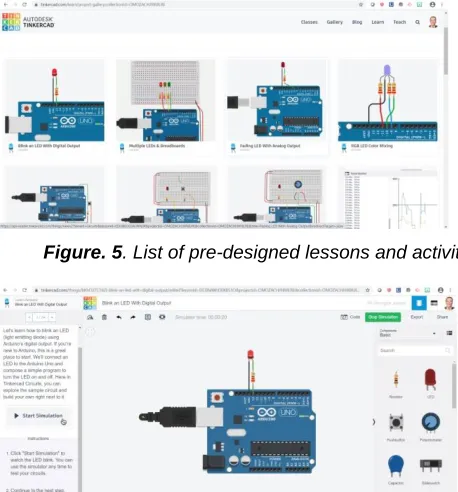
of an online simulator called TINKERCAD.
Figure. 3. The SCALE platform with an active window of an
on-going real time activity using Arduino UNO R3.
Figure. 4. The SCALE platform with an active window of
an on-going real time activity with an inset of the trainer presenting the lecture.
Figure. 5. List of pre-designed lessons and activities
Figure. 6. An Arduino UNO R3 placed with electronic
components thru digital input pins
Figure. 7. Window pane named TEXT where a sketch can be
made
Figure. 8. Window pane named Blocks where an option using
Figure. 9. Module activity for Traffic Light Simulator using LEDs and Breadboard
Figure. 10. Overview on the actual picture on how actual
components should be connected and wired based from the simulator presentation.
Figure. 11. Simulation activity using Temperature Sensors
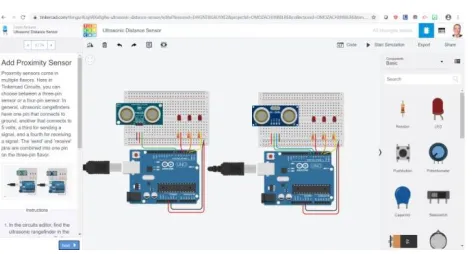
Figure. 12. Simulation activity using Ultrasonic /Proximity Sensors
Figure. 13. Simple Code using Block for Ultrasonic Range
finder with its auto generated equivalent sketch in the TEXT window pane
Figure. 14. Simulation for a 2 Wheel Drive Collision Avoidance
Robot with sketch displayed on the TEXT window pane
2.3 Research Design
The study used an experimental design. The study sought to compare the level of learning, in terms of knowledge, practical skills acquisition, and craftsmanship, involving learners using the conventional method in teaching-learning and the identified technology trends in education, more specific technologies, and digital pedagogies relevant to Education 4.0 through the platform called SCALE. The main variables involved were the level of learning as the dependent variable and the different technology trends, as the independent variables. There are three ways to assign participants to experimental conditions: a between-subjects design (sometimes called an independent-group design), a within-subjects design (also called a repeated-measures design), and a mixed design [23], [7], [43]. The study adapted in only one of the two experimental conditions making the study a between-subjects design. Vernoy & Kyle [43] as cited by Pepen et al. [23] pointed that a between-subjects design requires that each level of each independent variable has different participants; thus, there is a distinct difference between each level of the experiment because each person participates in one and only one level.
2.4 Research Question
The following research questions guided the study: 1. How do learners using the SCALE platform and those using
conventional methods compare in theoretical knowledge? 2. How do learners using the SCALE platform and those using
conventional methods compare in practical skills acquisition?
2.5 Population and Sample Size
The population comprised of 50 technology and engineering students who were enrolled during the 2018 - 2019 academic year at different Higher Educational Institutions (HEIs) offering the subject Embedded System Programming & Industrial Automation. The study also considered professors from the selected HEIs as well as industry experts. The respondents were assigned randomly to two treatment groups, as indicated in Table 1: respondents using the SCALE platform and those using the conventional methods for teaching-learning electronics engineering and technology.
TABLE1
DISTRIBUTION OF STUDY SAMPLE ACCORDING TO
EXPERIMENTAL CONDITIONS
Respondents
Number of Respondents
Total SCALE
platform
Conventional Method A. Students
from different HEIs
25 25 50
B. Professors from different HEIs
15 15 30
C. Industry
Experts 5 5 10
Total 45 45 90
2.6 Research Instruments
The study used two instruments to collect data to answer the three research questions posed. The two instruments were based on the instructional objectives of lessons on Embedded Systems Programming & Industrial Automation. The first instrument was an achievement test that sought to measure the level of theoretical knowledge acquired after the respondents had been exposed to theoretical and practical lessons based on the SCALE platform and the conventional methods. It consisted of 50 objective test items relevant to Embedded Systems Programming and Industrial Automation. Each item had four options of responses. The second instrument was a performance test that sought to measure the level of practical skills acquired by learners after exposure to the practical lessons from either the SCALE platform and the
conventional methods. The participants were instructed to perform specific tasks to demonstrate individual skills acquired. A rubric is established based on the output from the respondents.
3 RESULTS AND DISCUSSION
As demonstrated in this document, the numbering for sections The research findings are presented in three sections according to the three research questions that guided the study.
1. How do learners using the SCALE platform and those using conventional methods compare in the level of theoretical knowledge acquired?
The level of theoretical knowledge acquired by the participants was measured by the achievement test. The distribution of the achievement test scores (out of a possible 50) showed that the group that used the SCALE platform had scores ranging from 40 to 49, while the group that used the conventional methods had scores ranging from 31 to 41. For the users of the SCALE platform, the modal score was 48 with a frequency of eight. The modal score for users of the conventional methods was 39 with a frequency of twelve. The mean score for the group that had used the SCALE platform for theoretical knowledge acquisition was 45.11 (SD = 2.773). For the group that had used conventional methods for theoretical knowledge acquisition, the mean score was 37.82 (SD = 2.525).
2. How do learners using the SCALE platform and those using conventional methods compare in practical skills acquisition?
The performance test measured the level of practical skills acquired by the participants. The performance test was scored using the ICE – based rubric assessment criteria by Woodhall & Strong [47]. ICE is an acronym for Ideas, Connections, Extensions representing three different stages of learning.
TABLE2
RESULTS OF T-TEST ANALYSIS FOR THE ACHIEVEMENT TEST
Independent Samples Test Levene's Test
for Equality of
Variances t-test for Equality of Means
F Sig. t df Sig. (2-tailed)
Mean Difference
Std. Error Difference
95% Confidence Interval of the
Difference Lower Upper SCORES Equal variances
assumed
1.406 .239 13.036 88 .000 7.28889 .55914 6.17772 8.40006
Equal variances not assumed
TABLE3
RESULTS OF T-TEST ANALYSIS FOR THE PERFORMANCE TEST
Independent Samples Test Levene's Test
for Equality of
Variances t-test for Equality of Means
F Sig. t df Sig. (2-tailed)
Mean Difference
Std. Error Difference
95% Confidence Interval of the
Difference Lower Upper SCORES Equal variances
assumed
24.024 .000 21.882 88 .000 10.62222 .48543 9.65753 11.58692
Equal variances not assumed
21.882 56.245 .000 10.62222 .48543 9.64988 11.59457
The Ideas stage represents the essential elements of knowledge, with the students being assessed on their understanding of the basic steps in a process, the necessary vocabulary, and the rudimentary understanding of the skill set required within the appropriate phase. Students then progress into the Connection stage, which occurs when students demonstrate if they understand relationships between the different standalone elements in the Ideas Phase. The last level of mastery is the Extension stage, where learners internalize material and can develop new learning on their own. In the ICE rubric, students are being assessed on their ability to demonstrate different levels of understanding, not just an increase in proficiency. The distribution of the performance test scores showed that the group that used the SCALE platform had scores ranging from 40 to 44, while the group that used the conventional methods had scores ranging from 28 to 40. For the users of the SCALE platform, the modal score was 44, with a frequency of twenty. The modal score for users of the conventional methods was 30, with a frequency of seven. The mean score for the group that had used the SCALE platform for practical skills acquisition was 43.00 (SD = 1.148). For the group that had used conventional methods for practical skills acquisition, the mean score was 32.38 (SD = 3.047). The SCALE platform showed tremendous advantage on skill acquisition, where 44.4 % of the respondents scored 44, while only 4.4% of respondents under the conventional methods scored 40. Noticeably, the respondents that utilized the SCALE platform acquired excellent ratings (score of 4) on the following ICE rubric criterion; Ability to follow directions, Ability to Identify Functional Requirements, Demonstrate Knowledge of the Process, Application of Safety Practices and the Level of Needed Assistance. Whereas the conventional method showed discrepancies on the following criterion; Ability to follow directions = 2.84, Ability to Identify Functional Requirements = 3.04, Demonstrate Knowledge of the Process = 2.62, Application of Safety Practices = 3.33, and Level of Needed Assistance = 2.38. The study clearly illustrates that integrating simulation activities may also help simplify the transition of conceptual-based instruction to actual circuit fabrication and testing [21]. Frederiksen et al. [10] emphasized that for cognitive diagnosis, the level of assistance needed for task performance can be used to gauge an individual's readiness to move toward higher levels of understanding and skill. Furthermore, the dynamic assessment of the level of assistance is considered to be the most informative piece of evidence regarding a student for change, that is, her or his learning potential. Practical skills acquisition was compared in
terms of its instructional effectiveness thru the SCALE platform and the conventional methods, the mean scores of the two treatment groups in the performance test were compared using t-test at the 0.05 level of significance. The results of the t-test analysis are presented in Table 3. The results indicated that the performance test scores of the group that used the SCALE platform for practical skills acquisition were significantly higher than those who used the conventional methods (p-value < 0.05). Thus, the SCALE platform was more effective than the conventional means in equipping learners relevant to practical skills acquisition in electronics technology and engineering.
3. How do learners using the SCALE platform and those using conventional methods compare in their craftsmanship?
Using the ICE rubric criterion for craftsmanship, for the users of the SCALE platform, the modal score was 4 with a frequency of forty-one or 91.1% of the respondents. The modal score for users of the conventional methods was 3, with a frequency of thirty-four or 75.6%. There are 5 or 11.1% of the respondents scored 4 on the craftsmanship criterion under the conventional method, which happens to be the industry experts. The mean score for the group that had used the SCALE platform for craftsmanship was 3.91 (SD = 0.2878). For the group that had used conventional methods for craftsmanship, the mean score was 2.98 (SD = 0.499).
Cohen’s Kappa
An obvious factor restricting the comparability of categorical (nominal and ordinal) and quantitative (interval and ratio) data is that their descriptive statistics differ. For appraising reliability, for example, a useful measure of inter-rater agreement for categorical scales provided by kappa or weighted kappa [36], [9].
TABLE4
INTERPRETATION OF COHEN’S KAPPA (MCHUGH,2012)
Value of Kappa Level of Agreement % of Data that are Reliable
0–.20 None 0–4%
.21–.39 Minimal 4–15%
.40–.59 Weak 15–35%
.60–.79 Moderate 35–63%
.80–.90 Strong 64–81%
Shan & Wang [35] described Cohen’s kappa as a robust statistic useful for either inter-rater or intra-rater reliability testing. McHugh [20] further stated that similar to correlation coefficients, it can range from −1 to +1, where 0 represents the amount of agreement from random chance, and 1 constitutes a perfect agreement between the raters. Furthermore, while kappa values below 0 are possible, Cohen notes they are unlikely in practice. Thus, as with all correlation statistics, the kappa is a standardized value and accordingly is interpreted the same across multiple studies. Cohen [6] as cited by McHugh [20] suggested that the Kappa result interpretations are as follows; with values ≤ 0 as indicating no agreement and 0.01–0.20 as none to slight, 0.21–0.40 as fair, 0.41– 0.60 as moderate, 0.61–0.80 as substantial, and 0.81–1.00 as almost perfect agreement. McHugh [20] presented a more logical interpretation of kappa values, as shown in Table 2. The kappa below 0.60 indicates inadequate agreement among the raters, and little confidence should suggest in the study results. The Kappa values below zero, although unlikely to occur in research data when this outcome does occur, it is an indicator of a severe problem. It was also added that a negative kappa would represent an agreement as worse than expected or disagreement. The low negative values (0 to −0.10) may generally constitute ―no agreement.‖ Therefore, a sizeable negative kappa would represent a considerable disagreement among raters. Thus, data collected under conditions of such disagreement among raters may not be meaningful. Such a finding requires action to either retrain raters or redesign the instruments. Based on McHugh’s [20] logical interpretation of Cohen’s Kappa identified above, our kappa value indicates strong agreement of 0.862. Beyond traditional measures of inter-rater reliability, researchers wanted to identify areas or statements [1] of most agreement, with rating of 5 or Strongly Agree.
The most agreement was found to be:
A. SCALE platform learning may be the part of curriculum.
B. SCALE platform helps in teacher's instructions.
C. SCALE platform tools help in self learning of students. D. SCALE platform is a better way of learning in which allow students to move at their own pace.
E. SCALE platform were more appropriate to meet the student’s requirements
F. SCALE platform where learning through projects and simulation exercises is more intensive than learning through boards or other print based materials.
G. SCALE platform helps in simplifying the complex concepts of the subject.
H. SCALE platform were more helpful at higher level. I. SCALE platform required less time for lesson preparation and energy of teachers.
J. SCALE platform is helpful in development of competence.
Most agreement presented are most significant and is promising; an implication that the following observations are pivotal to the general understanding on the significance and advantage of hybrid instructional platform adapting technology trends relevant to Education 4.0 such as the SCALE platform.
TABLE5
STATEMENTS AND INTER-RATER LEVEL OF AGREEMENT BETWEEN INDUSTRY EXPERTS AND PROFESSORS USING THE SCALEPLATFORM
Statements Agree (5) Strongly Agree (4) Undecided (3) Disagree (2) Disagree (1) Strongly
SCALE platform learning may be part of curriculum SCALE platform helps in teacher's instructions SCALE platform tools help in self learning of students. SCALE platform is a better way of learning in which allow students to move at their own pace
Different tools embedded in the SCALE platform can become a replacement for a human teacher
SCALE platform were more appropriate to meet the student’s requirements
SCALE platform where Learning through projects and simulation exercises is more intensive than learning through boards or other print based materials.
SCALE platform helps in simplifying the complex concepts of the subject.
SCALE platform were more helpful at higher level.
SCALE platform were more useful to develop cognitive skills in certain type of contents.
SCALE platform can be helpful for all kind of students. SCALE platform play an important role to improve problem-solving skills.
SCALE platform required less time and energy of teachers. There is a difference in teacher’s perception in using the SCALE platform and traditional instructions.
TABLE6
RESULT OF INTER-RATER AGREEMENT BETWEEN INDUSTRY EXPERTS AND PROFESSORS USING THE SCALE PLATFORM
Industry Expert* Professor Cross Tabulation
Professor
Total
4.00 5.00
Industry
Expert 4.00
Count 5 1 6
Expected Count 1.9 4.1 6.0
5.00 Count 0 10 10
Expected Count 3.1 6.9 10.0
Total Count 5 11 16
Expected Count 5.0 11.0 16.0
Value
Asymptotic
Standard Errora Approximate Tb Approximate Significance
Measure of Agreement Kappa .862 .132 3.482 .000
N of Valid Cases 16
a. Not assuming the null hypothesis.
b. Using the asymptotic standard error assuming the null hypothesis.
4
CONCLUSION
The effects from computer-assisted learning environment on education have extensively been used frequently in modern educational systems because of its benefits like providing persistence in learning in general, providing a learner-centered learning process, getting the event of learning out of four walls and making it independent from space and time, providing the possibility to practice frequently and providing quick access to information. According to the results of the SCALE developed by researchers, was the academic success of the group that had received a visual training on computer-assisted learning environment as a supplement to the traditional education was higher than the success of the group that had learned only with the conventional education system. It is observed that the students of the group that possessed a Systematic Computer Assisted Learning Environment (SCALE)during a process, asked the instructors for less help. This shows that the computer-assisted learning environment contributed to the development of the individual competences of the students.
5
FUTURE SCOPE
Future recommendations for policy and practice are presented, given the findings derived from this study and the conclusions that arrive from them. They are mainly related to strategies that policymakers can implement to ensure the success of Systematic Computer Assisted Learning Environment (SCALE) in education. Schindler et al. [32] stated that despite the existing gaps and mixed findings in the literature, a list of recommendations for when and how to use computer-assisted learning environment technology to increase the likelihood of promoting student engagement might be necessary. There may be relevant recommendations to add to this list; however, the researchers intend to provide some useful information to help address barriers to technology integration among faculty who feel uncertain or unprepared to use technology.
The following recommendations for practice are as follows:
1. Consider context before selecting technologies. Contextual factors such as existing technological infrastructure and requirements, program and course characteristics, and the intended audience will help determine which technologies, if any, are most appropriate [32].
2. The use of technology to provide authentic and integrated learning experiences; besides, integrating technology into regularly- scheduled classroom activities, such as lectures, may help to promote student engagement.
3. Given the demand for the limited resource, a strong recommendation for more computers to be made available that would allow students to work individually and to spend more time on the computer.
4. The Digital learning environment in the form of a model or ICT learning platform should be offered to faculty to distinguish different components of the learning environment and their interdependency. 5. The government may use a range of methods to
encourage faculty to use Computer Assisted Learning Environment, such as the SCALE platform in their teaching to ensure equal learning opportunities for all students.
6. The government should ensure that all teachers receive adequate training. Training should not merely focus on basic of ICT skills but should also present methods for integrating computer-assisted learning environment in teaching and learning.
REFERENCES
Social Sciences and Education. Volume: 2 Issue: 1 ISSN: 2223-4934
[2] Benešová, A., & Tupa, J. (2017). Requirements for Education and Qualification of People in Industry 4.0. Procedia Manufacturing, 11, 2195–2202. doi: 10.1016/j.promfg.2017.07.366
[3] Bogoviz, A. V. (2018). Industry 4.0 as a New Vector of Growth and Development of Knowledge Economy. Studies in Systems, Decision and Control, 85–91. doi:10.1007/978-3-319-94310-7_8
[4] Chugh, R., &Ruhi, U. (2017). Social media in higher education: A literature review of Facebook. Education and Information Technologies, 23(2), 605–616. doi:10.1007/s10639-017-9621-2
[5] Ciolacu, M., Tehrani, A. F., Beer, R., & Popp, H. (2017). Education 4.0 — Fostering student’s performance with machine learning methods. 2017 IEEE 23rd International Symposium for Design and Technology in Electronic Packaging (SIITME). doi:10.1109/siitme.2017.8259941 [6] Cohen, J. (1960). A coefficient of agreement for nominal
scales. Educational and Psychological Measurement, 20, 37–46. https://doi.org/10.1177/001316446002000104 [7] Donkor, F. (2010). The comparative instructional
effectiveness of print-based and video-based instructional materials for teaching practical skills at a distance. International Review of Research in Open and Distributed Learning, 11(1), 96-116.
[8] Fisk, P. (2017). Education 4.0 … the future of learning will be dramatically different, in school and throughout life.
Retrieved from
https://www.thegeniusworks.com/2017/01/future-education-young-everyone-taught-together/
[9] Fleiss, J.L, Cohen, J. (1973). The Equivalence of Weighted Kappa and the Interclass Correlation Coefficient as Measures of Reliability. Educational and Psychological Measurement, 33, 613-619
[10]Frederiksen, N., Glaser, R., Lesgold, A., & Shafto, M. G. (Eds.). (2013). Diagnostic monitoring of skill and knowledge acquisition. Routledge.
[11]Hron ík, F. Rozvoj a Vzdˇel ávan í Pracovn íkú; Grada Publishing: Prgue, Czech Republic, 2007; pp. 173–210. ISBN 978-80-247-1457-8.
[12]İnelmen, E. (2009). Introducing a ―Decision Support System‖ to enhance ―Critical Educational Governance‖ in a digital era. World Journal on Educational Technology, 1(1), 57–72.
http://search.ebscohost.com/login.aspx?direct=true&db=ps
yh&AN=2012-24285-005&site=ehost-live%5Cnhttp://[email protected]
[13]Kachanakova, A.; Stachov á, K.; Stacho, Z. Riadenie L’udských Zdrojov v Organiz áci ách P ôsobiacich na Slovensku; Wolters Kluwer: Bratislava, Slovakia, 2013; pp. 10–125. ISBN 9788080786069.
[14]Kang, J. W., Yu, Q., Golen, E., & Holden, E. P. (2018). IT Curriculum. Proceedings of the 19th Annual SIG Conference on Information Technology Education - SIGITE ’18. doi:10.1145/3241815.3241852
[15]Karre, H., Hammer, M., Kleindienst, M., & Ramsauer, C. (2017). Transition towards an Industry 4.0 State of the LeanLab at Graz University of Technology. Procedia
Manufacturing, 9, 206–213. doi:
10.1016/j.promfg.2017.04.006
[16]Keser, H., & Özcan, D. (2011). Current trends in educational technologies studies presented in World Conferences on Educational Sciences. Procedia - Social and Behavioral Sciences, 15, 3989–3998. https://doi.org/10.1016/j.sbspro.2011.04.403
[17]Livingston, K., & Flores, M. A. (2017). Trends in teacher education: a review of papers published in the European journal of teacher education over 40 years. European Journal of Teacher Education, 40(5), 551–560. doi:10.1080/02619768.2017.1387970
[18]Lutz, A. (2017). Technology in the Classroom: The
Teacher’s Companion. Retrieved from
https://blog.edgenuity.com/technology-in-the-classroom/#:~:text=George%20Couros%2C%20educator %20and%20author,student%20performance%20enhances %20the%20relationships
[19]Marr, B. (2018). 5 Important Artificial Intelligence Predictions (For 2019) Everyone Should Read. Retrieved from
https://www.forbes.com/sites/bernardmarr/2018/12/03/5- important-artificial-intelligence-predictions-for-2019-everyone-should-read/#2eeb1218319f
[20]McHugh M. L. (2012). Interrater reliability: the kappa statistic. Biochemia medica, 22(3), 276–282. Mbarika, V. W., Sankar, C. S., Raju, P. K., & Raymond, J. (2000). Importance of Learning-Driven Constructs on Perceived Skill Development When Using Multimedia Instructional Materials. Journal of Educational Technology Systems, 29(1), 67–87. doi:10.2190/8g4w-2w33-ukub-0lh5
[21]Moreira, F., Ferreira, M. J., Santos, C. P., &Durão, N. (2017). Evolution and use of mobile devices in higher education: A case study in Portuguese Higher Education Institutions between 2009/2010 and 2014/2015. Telematics and Informatics, 34(6), 838–852. doi: 10.1016/j.tele.2016.08.010
[22]Pardiñan, E., Loremia, R. (2019). Simulation-Based Learning in Electronics: Modified TAM and DeLone & McLean IS Success Model. Journal of Science, Engineering and Technology 7:77-93. ISSN 2545-9732 [23]Pepen, M. J., Bandara, P., Sims, B., & Manu, I. (2016). An
Exploratory Case Study: The Sudden Introduction of Internet Protocol Television (IPTV) in an ODL Accounting Program. The University of Papua New Guinea Open College (UPNG OC) experience.
[24]Pereira, A. C., & Romero, F. (2017). A review of the meanings and the implications of the Industry 4.0 concept. Procedia Manufacturing, 13, 1206–1214. doi: 10.1016/j.promfg.2017.09.032
[25]Posada, J., Toro, C., Barandiaran, I., Oyarzun, D., Stricker, D., de Amicis, R., Vallarino, I. (2015). Visual Computing as a Key Enabling Technology for Industrie 4.0 and Industrial Internet. IEEE Computer Graphics and Applications, 35(2), 26–40. doi:10.1109/mcg.2015.45
[26]Reimagining the Role of Technology in Education (2017). U.S. Department of Education 2017 National Education Technology Plan Update. Retrieved from https://tech.ed.gov/files/2017/01/NETP17.pdf
[27]Rouse, M. (2017). Fourth Industry Revolution. Retrieved from https://whatis.techtarget.com/definition/fourth-industrial-revolution
Linnaeus University Dissertations No 264/2016, ISBN: 978-91-88357-39-9
[29]Salavati, S. (2017). Dilemmas in Teachers’ Use of Digital Technologies in Everyday School Practice. https://doi.org/10.15626/dirc.2015.16
[30]Scherer, R., Siddiq, F., &Tondeur, J. (2018). The technology acceptance model (TAM): A meta-analytic structural equation modeling approach to explaining teachers’ adoption of digital technology in education.
Computers & Education. doi:
10.1016/j.compedu.2018.09.009
[31]Schindler, L. A., Burkholder, G. J., Morad, O. A., & Marsh, C. (2017). Computer-based technology and student engagement: a critical review of the literature. International Journal of Educational Technology in Higher Education, 14(1). https://doi.org/10.1186/s41239-017-0063-0
[32]Schindler, L.A., Burkholder, G.J., Morad, O.A. et al. Computer-based technology and student engagement: a critical review of the literature. Int J Educ Technol High Educ 14, 25 (2017). https://doi.org/10.1186/s41239-017-0063-0
[33]Schwab,K. (2015). The Fourth Industrial Revolution. What It Means and How to Respond. Retrieved from https://www.foreignaffairs.com/articles/2015-12-12/fourth-industrial-revolution
[34]Sein-Echaluce, M. L., Fidalgo-Blanco, Á., & Alves, G. (2017). Technology behaviors in education innovation. Computers in Human Behavior, 72, 596–598. doi: 10.1016/j.chb.2016.11.049
[35]Shan, G., & Wang, W. (2014). Exact one-sided confidence limits for Cohen’s kappa as a measurement of agreement. Statistical Methods in Medical Research, 26(2), 615–632 [36]Spitzer RL, Cohen J, Fleiss JL, Endicott J. (1967).
Quantification of agreement in psychiatric diagnosis. A new approach. Arch Gen Psychiatry. 17(1):83-87. doi:10.1001/archpsyc.1967.01730250085012
[37]Skliarova, I., Sklyarov, V., Sudnitson, A., &Kruus, M. (2017). Reconfigurable systems in engineering education: Best practices and future trends. 2017 IEEE Global Engineering
Education Conference (EDUCON).
doi:10.1109/educon.2017.7942983
[38]Stachová, K., Papula, J., Stacho, Z., & Kohnová, L. (2019). External Partnerships in Employee Education and Development as the Key to Facing Industry 4.0 Challenges. Sustainability, 11(2), 345. doi:10.3390/su11020345
[39]Sung, T. K. (2018). Industry 4.0: A Korea perspective. Technological Forecasting and Social Change, 132, 40–45. doi: 10.1016/j.techfore.2017.11.005
[40]Thelwall, M., &Kousha, K. (2017). SlideShare presentations, citations, users, and trends: A professional site with academic and educational uses. Journal of the Association for Information Science and Technology, 68(8), 1989–2003. doi:10.1002/asi.23815
[41]Tondeur, J., van Braak, J., Ertmer, P. A., &Ottenbreit-Leftwich, A. (2016). Understanding the relationship between teachers’ pedagogical beliefs and technology use in education: a systematic review of qualitative evidence. Educational Technology Research and Development, 65(3), 555–575. doi:10.1007/s11423-016-9481-2
[42]Urbancov á, H.; Urbanec, J. Internal Factors Influencing the Knowledge Continuity Ensuring. Acta Univ. Agric. Silvic. Mendel. Brun. 2012, 60, 387–396. [CrossRef]
[43]Vernoy, M., & Kyle, D. (2002). Behavioral statistics in action (3rded.). Boston. McGraw – Hill. p. 259
[44]Viberg, O., &Grönlund, Å. (2015). Understanding students’ learning practices: challenges for design and integration of mobile technology into distance education. Learning, Media
and Technology, 42(3), 357–377.
doi:10.1080/17439884.2016.1088869
[45]Voogt, J., &McKenney, S. (2016). TPACK in teacher education: are we preparing teachers to use technology for early literacy? Technology, Pedagogy and Education, 26(1), 69–83. doi:10.1080/1475939x.2016.1174730 [46]Westera, W. (2015). Reframing the Role of Educational
Media Technologies. Quarterly Review of Distance Education, 16(2), 19–32.
[47]Woodhall, T. F., & Strong, D. S. (2008). Implementing a rubric-based assessment scheme into the multidisciplinary design stream at Queen's University. Proceedings of the Canadian Engineering Education Association (CEEA). [48]Xie, H., Chu, H.-C., Hwang, G.-J., & Wang, C.-C. (2019).
Trends and development in technology-enhanced adaptive/personalized learning: A systematic review of journal publications from 2007 to 2017. Computers &
Education, 140, 103599. doi: