http://www.sciencepublishinggroup.com/j/ipa doi: 10.11648/j.ipa.20170101.13
The Influence of Governance in Management of
Development Effects: Sri Lankan Perspective
Mohamed Ibrahim Mohamed Irfan
Faculty of Islamic Studies and Arabic Language, South Eastern Universitry, Oluvil, Sri Lanka
Email address:
[email protected]To cite this article:
Mohamed Ibrahim Mohamed Irfan. The Influence of Governance in Management of Development Effects: Sri Lankan Perspective. International and Public Affairs. Vol. 1, No. 1, 2017, pp. 14-23. doi: 10.11648/j.ipa.20170101.13
Received: May 5, 2017; Accepted: May 27, 2017; Published: July 17, 2017
Abstract:
This study examines the role of governance and effective management of development to ensure that fruits of development reach all citizens, specifically Sri Lankan perspective. Major objective of this study is to provide evidence of the link between governance and management of development and to analyze how citizens’ utilizes development through different aspects, modes and features of governance. Governance has increasingly become a major instrument for the successful growth performance and development purposes in the world. Achieving sustainable results in international development depends on efficient, effective and inclusive governance systems that reflect the will of the all citizens. This study is a qualitative research and data were collected mainly from secondary sources such as books, journals, newspapers, internet articles and relevant research articles. Accordingly, this paper is organized as follows: the role of governance to ensure development; governance and development policies; good governance and development; e-Governance and development; finally, poor governance and challenges for management of development and conclusion are provided.Keywords:
Governance, Management of Development, Citizens1. Introduction
1.1. Governance
The World Bank defines governance as “the manner in which power is exercised in the management of a country’s economic and social resources for development” [1]. Governance has increasingly become a major instrument for the successful growth performance and development purposes in the world. Governance is the deliberate and conscious management of regime structures for enhancing the public realm [2] it can be viewed from social, political and economic perspectives. Indeed, good governance is pivotal to the development process. Development linked governance has been an issue much debated in the contemporary world [3]. There are many definitions and interpretations of governance. The broad definition of governance makes it difficult to measure; however, some scholars and researchers use some indicators to measuring governance. Therefore, According to Kaufmann (2005) there are six major indicators that capture the quality of governance including:
(1)Voice and Accountability: which refers to the
participation of the civil society in monitoring and measuring political decisions on civil and human rights;
(2)Political Instability: it examines the vulnerability of government to changes through violent threats or unconstitutional means;
(3)Government Effectiveness: it measures the quality and the competence of civil servants in service deliver including their credibility as well as the effectiveness of the bureaucratic process;
(4)Regulatory Quality: it measures whether the policies are friendly to the business environment;
(5)Rule of Law: it measures whether the quality of law enforcement including: the police, the courts, as well as property rights are not vulnerable to crime or violence; (6)Control of Corruption: it measures the exercise of
public power for private gain, including both bribery and extortion [4].
1.2. Management of Development
development and sustainability. Development has varied definitions depending on the context in which it is being used. Development for one country might not be the same in another jurisdiction as distinctive features such as culture, social orientation and goals differs across regions. Development has gone through a series of redefining which has garnered widespread appreciation. After World War II, development was envisioned through the eyes of “advanced
Western states” in which countries progressed through
several stages modernization, synonymous with industrialization. Based on the shifts in ideologies over the decades, the notion of development has moved from
"technological inclined institutions” to “citizen focus” all in an attempt to achieve economic progress [5]. Organizations such as the World Bank and the World Trade Organization have formulated definitions of development which speaks to good governance and specific references made to human development.
There are three discernable definitions of development: Development as a long term process of structural societal transformation; Development as a short-to medium term outcome of desirable targets; and Development as dominant discourse of western modernity [6]. Similarly, Development defined as the competency of individuals, public-sector institutions, private-sector entities, civil-society organizations, and local communities to engage in activities in a sustainable manner that permit the achievement of beneficial goals such as poverty reduction, efficient service delivery, good governance, economic growth, effectively facing the challenges of globalization, and deriving the greatest possible benefits from such trends as rapid changes in information technologies and science [7, 8]. From whichever point of view development is being defined it simply means progressing or moving from one stage to the next.
The Overall, development define that enhancement of the competency of the range of social actors enumerated above to engage in activities in a sustainable manner for positive development impacts such as poverty reduction, improvements in governance quality or meeting the Millennium Development Goals (MDGs).
This study examines the role of governance and effective management of development to ensure that fruits of development reach all citizens. In this case, I identify and discuss link between governance and management of development and analyze how citizens’ utilizes development through different aspects, modes and features of governance: good governance, e-Governance, development policies, participation etc. The aspects and features will require separate management of development efforts. Accordingly, this paper is organized as follows: the role of governance to ensure development; governance and development policies; good and poor governance and development; e- governance and development; finally, way forward and conclusion are provided.
2. The Role of Governance to Ensure
Development
Governance is generally defined by economist as “the manner in which power is exercised in the management of a country’s economic and social resources for development” [9]. Governance include two specific aspects: (1) the process by which authority is exercised in the management of a country’s economic and social resources (integrity efficient management), and (2) the capacity of a government to design, formulate, and implement policies and discharge its functions [9]. The issue of governance is now an overriding aspect of a country to both economic growth and social development [10]. The poor state of governance distorts the potential for economic grow now conventional wisdom [9].
Achieving sustainable results in international development depends on efficient, effective and inclusive governance systems that reflect the will of the citizen. By improving governance mechanisms, processes and institutions that make governments accountable to citizens, and by supporting the ability of individuals and other members of civil society to participate in the governance and development of their own societies, there is an opportunity to increase the impact of other development initiatives, resolve conflicts peacefully and without violence, and advance democracy and respect for universal human rights [11]. Governance will play a crucial role in shaping the Sustainable Development Goals (SDGs) and the post-2015 development agenda. The SDGs provide an opportunity to go beyond the MDGs, which did not include significant governance aspects. The centrality of governance in sustainable development has been emphasized repeatedly [12]. For example, United Nations Development Programme (UNDP) in 2014, report argued that “the quality of governance plays a defining role in supporting the (economic, social, and environmental) pillars” of the SDGs [13]. UNDP observes again and again the importance of such governance for achieving development results. Three reasons could be postulated for that:
First, active governance, which anticipates and responds to the needs of its citizen and evolving development challenges, with deliberate, targeted, and pro-active planning and delivery, is essential to getting the business of development done. Active and effective governance requires governing institutions which are capable of delivering reliable and quality services where and when they are needed. For example, from Singapore’s history, active and effective governance has made a substantial contribution to this country’s development success. And also, Singapore one of the highest levels of Gross Domestic Product (GDP) per capita in the world [14]. As well, in 2014, Singapore ranked a
(Very High Human Development [HD]) 11 out of 187
India 130th (Medium HD), Bhutan 132th (Medium HD),
Bangladesh 142th (Medium HD), Nepal 145th (Low HD),
Pakistan 147th(Low HD), and Afghanistan 171th(Low HD).
UNDP’s Human Development Index – which is a composite index of education, health and income measures [15].
Second, effective governance is a prerequisite for putting in place the integrated policy making capacity which is needed to drive sustainable development [14]. And also it focused on the capacity of institutions to resolve problems of public policy and implement effective rules.
Third, fair governance matters for sustainable development because it holds the key to building stable and secure societies and to drive inclusive growth within the finite boundaries of the planet over the long term. Fair, reliable, and accountable governing institutions build trust between people and government [14].
However, if governance was addressed as a stand-alone SDG, then this would offer the best opportunity to comprehensively incorporate all type aspects of governance into a post-2015 development agenda. However, because of existing indicators of governance and actor coalitions organized around specific issues, the risk remains that good governance might be privileged over effective governance.
3. Results and Discussion
3.1. Development Policies and Governance
In the analysis of economic development, metaphors obscure the crucial relation between development policy and political governance [16]. Political governance is determined by perception indicators such as corruption, quality of the civil service, accountability, law and order situation, as well as social and ethnic tensions [9]. Policy reforms played an important role in accelerating growth by exploiting the opportunities offered by technological breakthroughs in developing countries. By combining progressive policies with innovative institutions, for example, Bangladesh has shown impressive achievements in the area of social development, and Bangladesh has been successful in increasing life expectancy, reducing infant mortality, decreasing birth rate, spreading immunization, improving child nutrition, and increasing girls’ education with overall increases in primary and secondary enrolments [17].
3.2. Development Policies and Governance in Sri Lanka
Western Region Megapolis Plan (WRMPP): This
Megapolis Development Plan formulated for entire megapolis development in the island including Western Province was presented to President Maithripala Sirisena. The aim of this plan is to beautification of the towns as well as boosting the living standards of the citizen will be done through this development plan and to make the Western Province more sustainable and ensure economic growth, social equity, proper governance, proper land use, spatial configuration and a sustainable environment by 2030 [18].
Mahinda Chintana - Towards a New Sri Lanka: during the
former president Mahinda Rajapakcha period (2005- 2015) he developed very good national policy under the title of ‘Mahida Chinthana – Vision for the Future’. This policy objective and goals are self-evident and easily measurable and identify the performance (in positive development in Sri Lanka). The objective of next massive leap forward is to transform Sri Lanka into a strategically important economic centre of the world [19]. Sri Lanka has achieved many positive developments during the period 2010 to 2015 with the policies implemented under the goals and objective of Mahinda Chintana - Towards a New Sri Lanka. It has also created a strong base to achieve a high and sustainable economic growth in the years to come. This process is envisaged to continue at a renewed pace with the policies and measures to be implemented during the six years (2010 to 2016) under the Mahinda Chintana – Vision for the Future. This policy envisaged to resolve the prolonged conflict, implement large infrastructure development initiatives consisting of electricity generation, ports, airports, water supply and irrigation, roads and transport, revitalize agriculture and domestic enterprises, strengthen public services and state owned enterprises, promote private sector [19]. Consequently, this policy has help to macro and micro level development in Sri Lanka and it ensure that fruits of development reach for all citizens (especially grass-root level citizens) in Sri Lanka.
Reawakening of the East and North (Nagenahira Navodaya and Uturu Vasantaya Programme): This policies initiated under the ‘Nagenahira Navodaya Programme’ (Reawakening of the East) ‘Uturu Vasantaya’ (Reawakening of the North) are being fully implemented bringing benefits to the communities living in the Provinces. After the eviction of the Liberation Tigers of Tamil Eelam (LTTE) from the Northern and Eastern Province, the government commenced the Nagenahira, Uturu Vasantaya Navodaya Programme in the Province. The immediate areas of focus include agriculture & irrigation, roads, power & energy, livelihood support, fisheries and livestock development, education, civil administration, health & sanitation etc. This policy is an integral part of the National Development Plan, including mega infrastructure projects which are aimed mainly at improving connectivity with other regions. These policies are expected to create new opportunities in the region boosting economic activities, particularly the promotion of private sector investment. In this policy types are major change and high consensus because under this policy Eastern and Northern provinces has achieved many positive developments such as envisaged to resolve the prolonged conflict, implement large infrastructure development initiatives, and so on.
For instance, in Sri Lanka, successive post-independent governments tried to eradicate poverty through introducing policies and specific development plans. But, that policies and plans were failed due to wide variety of reasons including the decline in institutional integrity and capacity, aggravated by arbitrary actions further compromised by a conflict of interests, lack of efficient bureaucratic structure led to the policy failure of above development plans, Top-Down implementation process and politicization of bureaucracy, weakened institutional capacity and control becomes a hotbed of bureaucratic corruption, the lack of effective mechanisms for formulation of policies is often linked to budgetary constraints, and the weak enforcement of the rule of law contributes to a high degree of arbitrariness in government actions.
Policy implementing agencies and sectors neglect the socio-cultural, political and economic aspect surrounding the public policies and decisions. It led to continuous failure of public policy. Meanwhile, most of the policies reflect political agenda of successive governments. For instance, Sri Lankan government took neo-liberal economic policy in 1977 and it was expected that it will contribute to the rapid development of the country. This policy was included economic liberation and reforms in the public sector, financial sector, labour market, anti-poverty programmes, and gender relations [20]. Unfortunately, it created multifaceted socio-economic and political crisis due to the incompatibly of particular policy to the socio-cultural, political and economic setting of the country. As a result, some of development projects were also abandoned in Sri Lanka.
3.3. Participation and Development
Participation is the process through which stakeholders’ influence and share control over priority setting, policy-making, resource allocations and access to public goods and services. That means that all civil groups involved in the development process have to be included. Participation can play any role in the development process in existing socio-cultural, for instance, in USA, citizen’ participation in public affairs ‘seems to hold a sacrosanct role in USA political culture’[21]. Participation is both a right, and a means to more sustainable development. When communities are actively engaged in their development processes, project outcomes will be better targeted to local needs and results will be more sustainable. According to United Nation Public Administration Glossary define that citizens participation is “…implies the involvement of citizens in a wide range of policy making activities, including the determination of levels of service, budget priorities, and the acceptability of physical construction projects in order to orient government programs toward community needs, build public support, and encourage a sense of cohesiveness within neighborhoods [22]. In addition, for example, participatory budgeting in Brazilian municipalities between in 1990-2004 led to greater
spending on health and sanitation and reduced infant mortality rates [23]. One of the major findings of various national and thematic consultations on the post-2015 development agenda is the need for strong participatory monitoring mechanisms by non-state actors (e.g. communities, youth and women’s networks, civil society networks, etc.) to hold government accountable [23].
Political participation, freedom of association, freedom of speech and freedom of the press, are also fundamental human rights and are widely seen as development objectives. Strengthening the rule of law (formal and informal) and the justice sector key to ensuring that women’s indivisible human rights are protected and that they have access to justice. National parliaments and assemblies have played critical roles in many countries in support of the MDGs [23].
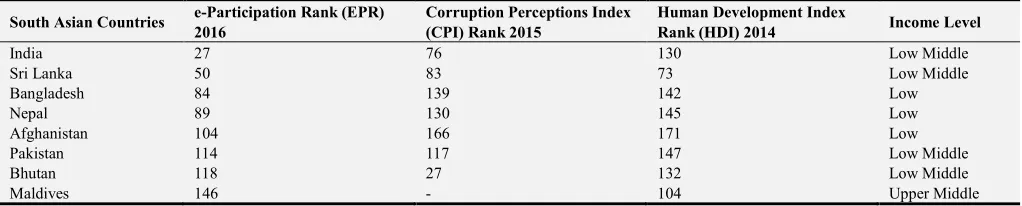
Similarly, e-Participation facilities reflects its political openness and extent of corruption, GDP per capita, urbanization, and the Transparency International rating on corruption, these are modern resources of e-Governance [24]. Participation is major feature of Governance; e-Participation, online consultation and deliberation is expanding all over the world. It can help to developed people’s participation and participatory decision making in administrative level. It can contribute to the improve service delivery in public sector and combat the corruption. e-Participation is done through open data, online consultations, multiple Information and communication technology (ICT)-related channels and social media, for example, European countries, and now a day’s many developing countries making good process as well, especially lower middle income countries, for example in South Asia, India, Sri Lanka, Pakistan and Bhutan. In contrast, low income countries need to be supported in addressing such challenges, for example, Bangladesh, Afghanistan and Nepal [25] although corruption exists in all countries it is more widespread in low income countries [26]. Overall, improved e-Participation can support the consciousness of the combat the corruption, increasing human development index and delivering effective service in administrative level.
Table 1. e-Participation Rank 2016, Human Development Index Rank 2014, Corruption Perceptions Index (CPI) Rank 2015 & Income Level of South Asian Countries.
South Asian Countries e-Participation Rank (EPR) 2016
Corruption Perceptions Index (CPI) Rank 2015
Human Development Index
Rank (HDI) 2014 Income Level
India 27 76 130 Low Middle
Sri Lanka 50 83 73 Low Middle
Bangladesh 84 139 142 Low
Nepal 89 130 145 Low
Afghanistan 104 166 171 Low
Pakistan 114 117 147 Low Middle
Bhutan 118 27 132 Low Middle
Maldives 146 - 104 Upper Middle
Source: United Nations E-Government Survey 2016 Transparency International Corruption Perceptions Index 2015 Human Development Index 2015
Similarly, Ombudsman offices and national audit agencies could further contribute to sound governance and administrative accountability systems [23]. In context of Sri Lanka, Ombudsman (Parliamentary Commissioner for Administration) was created in 1978 by the Second Republic Constitution. He was created by the constitution to investigate and report (Corporation, Local or Central government institutions) on allegations of infringement of fundamental rights and other injustices by public officers. However, with an amendment to the law in 1994, this fetter was removed and enabled the Ombudsman to receive complaints direct [27]. Consequently, there was a flood of complaints which inundated the Ombudsman’s office which was ill equipped to meet such as exigency. Moreover, many reasons are impact the ineffectiveness Ombudsman such as: the Ombudsman has no branch offices, consequently persons from faraway places have to travel to Colombo to attend inquiries, their expenses for such trips are not reimbursed by the Ombudsman, and he could only inquire into about very few complaints a week and at present has a backlog more than 1000 complaints to be inquired into. All these factors have made the Ombudsman merely as ornament among the administrative institutions in Sri Lanka rather than being a guardian of fundamental rights of state officers.
3.4. Good Governance and Development
The World Bank defines good governance as: "…the one epitomized by predictable, open, and enlightened policy-making, a bureaucracy imbued with professional ethos acting in furtherance of the public good, the rule of law, transparent processes, and a strong civil society participating in public affairs [1]. Good governance is synonymous with sound development management and also it is central to creating and sustaining an environment which fosters strong and equitable development, and it is an essential complement to sound economic policies [1], importance of high-performing public institutions and good governance is accomplishing development [28]. Good governance is essential for sustaining economic transformation in developing countries. However, many developing countries currently lack the capacity, as opposed to the will, to achieve and then sustain a climate of good governance [29]. Good governance is
essential for good growth performance, which will lead a country to achieve greater national competitiveness to maintain high economic growth, productivity with sustained employment and to achieve higher levels of income for the citizens. Good governance encapsulates values such as enhanced participation, transparency, accountability, and public access to information. It also helps to combat and secure both basic human rights and the rule of law. Such values are often associated with Western liberal democratic political institutions, but are now increasingly sought within existing national institutions in diverse political contexts.
In 1990s, According to World Bank, ‘good governance’ catchphrase has entered into the centre of the area of development, with the policy shift from “getting the prices right” to “getting the institutions right”. It is salient that good governance agenda was significant process of policy making in the context of 1990s, notwithstanding good governance paradigm in the Post-Washington Consensus is not feasible in enhancing growth of Least Developed Countries (LDCs) [30]. Good governance has become a controversial term because of its usage in the realm of international development assistance [31]. Developing countries are concerned about the use of good governance targets and indicators as a form of aid conditionality. With the development of the SDGs, there is now an opportunity to creatively construct targets and indicators that take such concerns into account [12]. In recent years, capacity development has become recognized as underpinning a number of critical fundamentals for sustaining development in the developing countries. High on the list of those prerequisites is good governance, without which the quest for development is a fruitless goal. Consequently, capacity development has taken on added importance, both within the international development community and in developing countries themselves, as a vital aspect of policy change for growth and development. Indeed, the international development community and developing countries frequently tend to invoke capacity problems to explain why policies fail to deliver results, or why development assistance is not leading to positive sustainable outcomes.
lessons of experience from international development and technical co-operation have shown, for example, that local, institutional, and human-resource capacities are crucial in order to achieve sustainable development and poverty reduction [8]. Consequently, the focus on good governance has enhanced the emphasis on capacity development [32]. It is now recognized in the development literature that good governance can be achieved and sustained only in environments of developed human and institutional capacities. For example, Singapore has demonstrated from the earliest days of its independence that good governance matters a great deal in getting development results. Strong vision and leadership at the political level, backed by a high quality public service contributing to the design and execution of policy, has transformed Singapore into the modern, entrepreneurial nation we know it as today [14].
Good governance is defined as the existence within states of political accountability, bureaucratic transparency, the exercise of legitimate power, freedom of association and participation, freedom of information and expression, sound fiscal management and public financial accountability, respect for the rule of law, a predictable legal framework encompassing an interdependent and credible justice system, respect for human rights, an active legislature, enhanced opportunities for the development of pluralistic forces including civil society, and capacity development [29]. Good governance plays an important role in the creation of capable states that have the capacity to spearhead development efforts. In capable states, good governance would ideally exist within both the national and local politics.
Good economic outcomes are derived from good economic governance. Good economic governance is defined as the existence of institutions of government that have the capacity to manage resources efficiently; can formulate, implement, and enforce sound policies and regulations; can be monitored and be held accountable; exhibit respect for the rules and norms of economic interaction; and in which economic activity is unimpeded by corruption and other activities inconsistent with the public trust. The key elements contributing to an environment of good economic governance are transparency, accountability, an enabling environment for private-sector development and growth, and institutional development and effectiveness [8]. Good economic governance is necessary in order to enhance the capacity of the state to deliver on its economic-development mandate.
Sustainable growth and development in developing countries cannot be achieved in the absence of good governance [29]. Among other things, good governance ensures the most efficient use of already scarce resources in the promotion of development; enhances participation, responsibility, and accountability; and has the potential to emancipate people from poverty as state legitimacy is recognized and entrenched. Indeed, any effort to reduce poverty and sustain development must be built upon a foundation of good governance. If good governance were to prevail, honest government could result in the adoption of
policies that will eliminate the capacity constraints that currently hinder sustained socio-economic development [29]. Good governance, in all its aspects, has been demonstrated to be positively correlated with the achievement of better development performance, and particularly through the building of institutions in support of transparency, accountability, and better public financial management. Recent empirical analysis suggests a positive correlation between democratic governance and the levels of income, investment, human capital, economic liberalization, and distributive income growth in society [8]. In particular, a political system characterized by freedom and stability is best suited to promoting a growth-oriented economic agenda for sustainable development. Consequently, they have significant dampening effects on a nation's economic development. The effect of democracy on growth is therefore positive [33]. Several other analysts and policy makers have also drawn the link between good governance and sustainable development and have demonstrated that the link between development and the rise of democracy is robust. Those analyses have clearly shown that where there is a failure of governance, the economy is sure to fail, and often to fail badly. Moreover, the evidence indicates that strengthened governance and institutional change are essential to scaling up for longer-lasting development progress [34, 8]. There is, therefore, a growing consensus in the literature that development is impossible in the absence of democracy, respect for human rights, and generally good governance.
3.5. e-Governance and Development
Function of e-Governance can make effective, transparency, accountability of administration; it can help effective management, economic growth, sustainable development, better health and education, save time and money [37]. The major objective of e-Governance is to provide a friendly, affordable, and efficient interface G2C; it is ensuring effective and high quality public service [38]. Government is to encourage professionalism and ethics in its activities, limited interference from politicians in decision making, extensive monitoring of governance activities and systematic and good coordination of all government function these are key pillars for administrative efficiency [39]. Essentially e-Government as a part of e-Governance refers to increase efficiency and effectiveness of service delivery by the G2C of different portions of society and administrative activities through ICT [40, 37]. Therefore, it can help the government to go green by effective management of natural resources aiding sustainability to environment. e-Governance stimulates economic growth and promotes social inclusion of disabled and vulnerable sections of society. e-Governance can provide benefits in the form of new employment, better health, better education, knowledge sharing, skills developments and capacity building for sustainable development [37].
Similarly, in context of South Asia, in India, e-Governance has the potential to undertake corruption effectively and usher in societal harmony [41] it has been successfully implement many e-Governance in several places such as Lokvani-enabling citizens to report problems and resolve complaints online Sitapur (Uttar Pradesh, India); Bhoomi land record is computerized (Karnataka, India); Interstate Computerized Check posts in Gujarat; CARD-Computer-aided Administration of Registration Department (Andhra Pradesh, India) and Chief Vigilance Commission (CVC) Web site [42] and also, Public Distribution System in Akola district, EDI Systems (Software package) for Export and imports, E-Choupal, Gujrat State Wide Area Network (GSWAN), Warana Wired village program, SMART Governance in Andhra Pradesh [43]. The considers e-Governance as an important instrument for economic and social developments in various sectors in Nepal, such as education, health, agriculture, tourism, and trade, among others, have been using information technology [44]. Nepal Telecom Company (NTC), Global System for Mobile (GSM) mobile, C-phone, sky data, internet, very small aperture terminal (V-SAT) and Asymmetric Digital Subscriber Line (ADSL) facilities has been enhanced delivering public services to the citizens [45]. Similarly, e-Billing, automations of custom house at Chittagong sea port, government form online, electronic birth registration system (this is probably the best local level e-Governance service), Hajj web site, automation of international processes, using Closed-Circuit Television (CCTV) camera etc. these are best example of Bangladesh e-Governance practice [46].
3.6. e-Governance and Development in Sri Lanka
Majority of the e-Governance services in Sri Lanka come
under this category such as online delivery of vehicle licensing services, online issue of births, marriages and death certificates, online checking of balances in provident fund accounts, online booking of train tickets etc. [47]. Sri Lanka had successful e-Government practices such as the Department of Immigration and Emigration has adopted ICT tool to improve efficiency and effectiveness in the issue of passports to citizens. This service is good practice for effective management of development to ensure that fruits of development reach all citizens in Sri Lanka. It has been computerized, making Sri Lanka one of 5 countries in the world where a passport could be processed in a day [48]. This e-Government program has contributed to mitigate the time and cost and it has making the process of going overseas for employment a lot faster and easier and this service ensure sustainable development for general citizens. Consequently, the role of e-Governance is best way to ensuring administrative efficiency and good governance in Sri Lanka. Moreover, Sri Lanka has been significant efforts to develop e-Governance online e-services such as 108 for citizens, 51 for businesses, 10 non-residence related e-Services, also mobile and SMS service have also been extremely expanded [37].
A number of e-Government programs and project aims is to enhance the efficiency and effectiveness of government services [49] e-Sri Lanka project initiative in 2002, which project carries many important services such as quality public services, minimized time and costs, active citizen’s participation in government [36, 49]. For instance, 73.9% of the respondents reported their satisfaction on (Trusts, low cost service, easy access, security, responsiveness, time saving) existing e-Service delivery by government agencies in Sri Lanka. But 26.1% of respondents still do not agree and dissatisfaction on existing e-service, they had identified and grading negative factors for e-service delivery, according to their grading 34.8% transaction delay, 26.1% high bureaucracy, 13% lack of efficiency, 12% lack of privacy, 8.9% low security, and high cost 5.2% [50]. In addition to that, delay service, strong hierarchy, top down approach in organization, lack of competence, high cost of service are exist challenges of the exploit of e-Governance and enhancing effective development in Sri Lanka. However, e-Government Policy in order to transform the public sector to become more G2C oriented and IT driven such enhanced living standards of citizens, convenient and speedy access to government services and information, high transparency in public service and decision making and less room for corruption.
3.7. Poor Governance and Challenges for Management of Development
governance is characterized by arbitrary policy making, unaccountable bureaucracies, un-enforced or unjust legal systems, the abuse of executive power, a civil society unengaged in public life and widespread corruption". The decline in institutional integrity and capacity, weakened institutional capacity is the politicization of public sector management, the weakened institutional capacity and control becomes a hotbed of bureaucratic corruption, the lack of effective mechanisms for formulation of policies is often linked to budgetary constraints; and the weak enforcement of the rule of law contributes to a high degree of arbitrariness in government actions and widespread corruption is one of the most obvious signs of poor governance [9]. Overall, there are many causes of poor governance in developing countries, including: incompetence, ignorance and lack of capacity from the leadership as well as inadequate infrastructures, corruption, poor institutions etc. but, corruption is strongly correlated to poor public governance, however, the causality difficult to recognize. Especially, developing countries went through governance failures and corruption at some point in time but their governance capacity made them recover and ensure the maintenance of rapid growth performance through constant demands to improve government and reduce corruption. In particular, corruption is a major hindrance to sustainable development, with a disproportionate impact on the poor and marginalized populations. Corruption is bad for health and education outcomes, equity, rule of law, and foreign investment. It is also an international problem.
For instance, corrupt governance the ultimate destiny of South Asian countries; according to Transparency International's Corruption Perceptions Index (CPI) in 2015, Sri Lanka was ranked 83th out of 167 countries; Compared to South Asian countries, Afghanistan (166th), Bangladesh (139th), Nepal (130th), Pakistan (117th), India (76th), and Bhutan (27th) [51]. In addition, the least corrupt country is ranked as No 1 and the most corrupt country comes at the end of the list. Sri Lanka is the third least corruption rank in the whole of South Asia.
Corruption and inefficiency are endemic in Bangladesh and Sri Lanka, with nexus between politico-bureaucratic-business elites, busting patron-client relationship and leading to bribery and unethical activities [52]. The Provincial Councils of Sri Lanka, there had been more complaints about corruption. The unsolicited project plans that have been on the increase in recent times led the politicians and officials to be criticized for abuse and corruption [53] local government bodies in Sri Lanka, particularly delivering the ineffective services to the grass-root level citizens due to lack of transparency, accountability and corruption [54]. Sri Lanka was scored in 6 out of 10 in red tapism [55]. As viewed above Sri Lanka is a one of the unbiased corrupt country. Consequently, it suggest that quality of bureaucracy and management of development is moderately and infant stage in Sri Lanka. Similarly, According to Global Corruption Barometer survey (2013), percentage of respondents who felt following institutions has corrupt/extremely in Sri Lanka. 64% Police, 51% political parties, 39% Parliament /
legislature, 33% Public officials and civil servants, 33% Educational system, 23% Business, 23% NGO’s, 21% Judiciary, 21% Medical and health service, 20% Media, 13% Military, 10% Religious bodies were corrupt/extremely corrupt [56].
However, good governance also translates into the elimination of corruption to preserve the integrity of democracy. In contrast, the lack of good governance has been demonstrated to have corrosive effects on the development process. Governments must strive to rid themselves of bribery as corruption damages economic development and reform, and is an obstacle as far as the ability of developing countries to attract foreign investment is concerned while also hindering the growth of democratic institutions, and concentrating power in the hands of a few. The best way to combat corruption is for governments to be open and transparent. While in certain cases governments have a responsibility to retain secrecy and confidentiality, democratic governments must be sensitive to the citizen’s right to know. Strong laws against corruption and the presence of law enforcement agencies that work against corruption demonstrate a government’s commitment to this principle.
4. Conclusion
References
[1] Governance Matters, 2006, A Decade of Measuring the Quality of Governance, The International Bank for Reconstruction and Development / The World Bank, Washington, DC.
[2] UK Essays, March 2015. Poor Governance Effects on Growth Performance in Africa Economics Essay. [online]. Available from: https://www.ukessays.com/essays/economics/poor- governance-effects-on-growth-performance-in-africa-economics-essay.php?cref=1 [Accessed on: 21 November 2016].
[3] UK Essays, November 2013. Understanding the Principles of Good Governance Politics Essay. [online]. Available from: https://www.ukessays.com/essays/politics/understanding-the-principles-of-good-governance-politics-essay.php?cref=1 [Accessed on: 21 November 2016].
[4] Kaufmann, Daniel, Aart Kraay and Massimo Mastruzzi (2005). “Governance Matters IV: Governance Indicators for 1996-2004. World Bank Policy Research Working Paper No. 3630. Washington, D. C.
[5] Turner, M. and Hulme, D. (1997). Governance, administration, and development: making the state work: VA, USA: Kumarian Press.
[6] Samner, 2008, What is Development? In Andrew Sumner & M. A. Tribe, International Development Studies, Theories and Methods in Research and Practice, Sage Publications.
[7] Browne, S. (ed.) (2002) ‘Developing Capacity through Technical Cooperation: Country Experience's’, London: Earthscan.
[8] Hope, K. R. (2006) 'Capacity development and good governance', in A. S. Huque and H. Zafarullah (eds.) International Development Governance, Boca Raton, FL: CRC Press/Taylor and Francis.
[9] Qureshi, S. K., 1999, ‘A Governance Perspective on Development Issues The Pakistan Development Review’, Vol. 38, No. 4, Papers and Proceedings PART I Fifteenth Annual General Meeting and Conference of the Pakistan Society of Development Economists Islamabad, Pakistan Institute of Development Economics, Islamabad.
[10] Roy, D. K., (2005), Governance and Development: The Challenges for Bangladesh The Bangladesh Development Studies, Vol. 31, No. ¾, Bangladesh Institute of Development Studies pp. 99-136.
[11] Strengthening Governance, 2016,
http://www.international.gc.ca/development developpement/priorities-priorites/governance-gouvernance/index.aspx?lang=eng.
[12] Biermann, F., Stevens, C., Bernstein, S., Gupta, A., Kabiri, N., Kanie, N., Levy, M., Nilsson, M., Pintér, L., Scobie, M., and Young, O. R., 2015, ‘Integrating Governance into the Sustainable Development Goals’, Policy Brief, UNU-IAS.
[13] UNDP (United Nations Development Programme) 2014. Discussion Paper: Governance for Sustainable Development--Integrating Governance in the Post- 2015 Development Framework. UNDP. Available from:
http://www.worldwewant2015.org/node/429902 [Accessed on: 12 November 2016].
[14] Clark, H., 2012, ‘The Importance of Governance for Sustainable Development, Institute of Southeast Asian Studies’, Singapore.
http://www.undp.org/content/undp/en/home/presscenter/speec
hes/2012/03/13/the-importance-of-governance-for-sustainable-development.html. [Accessed on: 02 November 2016].
[15] Human Development Report, (2015), Work for Human Development, UNDP.
[16] Macli, S. A., 1997, ‘Economic Development as Political Governance, Administrative Theory & Praxis’, Vol. 19, No. 2, Taylor & Francis, Ltd. Pp. 132-145.
[17] Ahluwalia, I. J., and Hussain, Z., 2004, ‘Development Achievements and Challenges, Economic and Political Weekly, Vol. 39, No. 36, Economic and Political Weekly.
[18] Ministry of Megapolis and Western Development: WRMPP, n.d., http://www.megapolis.gov.lk/. [Accessed on: 02 November 2016].
[19] Mahinda Chintana – Vision for the Future, (2010). Department of National Planning Ministry of Finance and Planning.
[20] Sarvananthan, M (ed.), (2005). Economic Reforms in Sri Lanka Post-1977 Period, International Centre for Ethnic Studies, Colombo, Sri Lanka.
[21] Day, Diane, 1997, ‘Citizen Participation in the Planning Process: An Essentially Contested Concept?’, Journal of Planning Literature 11 (3): 421-434.
[22] UN World Public Sector Report, 2008, http://www.unpan.org/Directories/UNPublicAdministrationGl ossary/tabid/928/language/en-US/Default.aspx[Accessed on: 12 November 2016].
[23] Discussion Paper, 2014, ‘Governance for Sustainable Development: Integrating Governance in the Post-2015 Development Framework’, UNDP.
[24] Rose. R, 2005, ‘A Global Diffusion Model of e-Governance’, Cambridge University Press, United Kingdom.
[25] United Nations E-Government Survey, 2016. https://publicadministration.un.org/egovkb/en-us/reports/un-e-government-survey-2016 [Accessed on: 12 November 2016].
[26] Myint, U., 2000, ‘Corruption: Causes, Consequences and Cures’, Vol. 7, No. 2, Asia –Pacific Development Journal.
[27] The Ombudsman, 2015, The Constitution of the Democratic Socialist Republic of Sri Lanka, Parliament Secretariat.
[28] UK Essays, March 2015. Comparative Development Management In Institution Building Politics Essay. [online]. Available from:
https://www.ukessays.com/essays/politics/comparative- development-management-in-institution-building-politics-essay.php?cref=1 [Accessed 21 November 2016].
[30] UK Essays, November 2013. Why Is Good Governance Economics Essay. [online]. Available from: https://www.ukessays.com/essays/economics/why-is-good-governance-economics-essay.php?cref=1 [Accessed on: 21 November 2016].
[31] Best, Jacqueline 2014. Governing Failure: Provisional Expertise and the Transformation of Global Development Finance, London, Cambridge University Press.
[32] Saldanha, C. (2006) 'Rethinking capacity development', International Public Management Review 7 (2): 15-42.
[33] Feng, Y. (2003), ‘Democracy, Governance, and Economic Performance: Theory and Evidence’, Cambridge, MA: MIT Press.
[34] Bhagwati, J. (2004) ‘In Defense of Globalization, New York’, NY: Oxford University Press. B?iger, J. (2000) 'Capacity development: why, what and how', CD Occasional Series, Ottawa: Canadian International Development Agency.
[35] Dawes, S. S, 2008, ‘The Evolution and Continuing Challenges of E-Governance’, Public Administration Review, Vol. 68, Wiley on behalf of the American Society for Public Administration.
[36] Akman, I., Yazici, A., Mishra, A., & Arifoglu, A., 2005, ‘E-Government: A global view and an empirical evaluation of some attributes of citizens’, 22 (2), Government Information Quarterly.
[37] Rahman, M. L., 2016, ‘E-Governance and Bangladesh’, http://www.thedailystar.net/25th-anniversary-special-part-1/e-governance-and-bangladesh-210577., [Accessed on: 12 October 2016].
[38] Hossain, M, S., and Saba, R., ‘E-Governance in Bangladesh: Definition, Problems, Implementation and Future Development’, https://www.academia.edu/9074297/E-Governance_in_Bangladesh_Definition_Problems_Implement ation_and_Future_Development., [Accessed on: 10 November 2016].
[39] Basheka, B. C., Tumutegyereize, M., and Sabiit, C. K., 2012, ‘Procurement Governance and Administrative Efficiency in Uganda: an Empirical Relational Analytical Framework’, http://www.ippa.org/IPPC5/Proceedings/Part7/PAPER7-8.pdf., [Accessed on: 12 October 2016].
[40] Alam, M, J., 2012, ‘E-Governance in Bangladesh: Present Problems and Possible Suggestions for Future Development’, Volume 4– No. 8, International Journal of Applied Information Systems (IJAIS), Foundation of Computer Science FCS, New York, USA.
[41] Pathak, R. D., Prasad, R. S., 2005, ‘Role of E-Governance in Tackling Corruption and Achieving Societal Harmony: Indian Experience’, Annual Conference 2005 BEIJING, Network of Asia-Pacific Schools and Institutes of Public Administration and Governance (NAPSIPAG).
[42] Kaur, S., 2015, ‘E-Governance- Combating Corruption Strategy’, Vol. 6, Issue 3, IJCST.
[43] Barthwal, C. P., 2003, ‘E-Governance for Good Governance’, Indian Political Science Association.
[44] Jamil, I., and Dhakal, T. N., 2013, Citizens' trust in public and political institutions in Nepal International Political Science Review / Revue internationale de science politique, Vol. 32, No. 4 (SEPTEMBER 2011), pp. 417-437.
[45] Sharma, G., Bao, X., and Qian, W., 2012, ‘Empirical Investigation on Adoption of E-governance Services in Developing Countries and Ethical Issues’, Vol 2, Issue 12, International Journal of Advanced Research in Computer Science and Software Engineering (IJARCSSE).
[46] Hasan, M. K., 2012, ‘Role of E-governance in Enhancing Administrative Efficiency and Combating Corruption’, Vol. XXI No. 1, Bangladesh Journal of Public Administration.
[47] Chandraguptha, B. D., 2012, ‘e-Government Concepts and Practices in Sri Lanka’, Issue 8, Survey Journal the Annual Publication of the Survey Department of Sri Lanka.
[48] Dissanayake, D. M. R., 2011, ‘Information Communication Technology (ICT) Policy of Sri Lanka and its Impacts to Socioeconomic Development: A Review of Sri Lankan Experience’, Vol. 1, No. 2, Journal of Education and Vocational Research, pp. 53-59.
[49] Karunasena, K., Deng, H. and Singh, M., 2011, ‘Measuring the Public Value of E-Government: A Case Study from Sri Lanka’, Transforming Government: People, Process and Policy, Vol. 5 No. 1, pp. 81-99.
[50] Senadheera, K. A. S., 2013, ‘Factors Affecting E-Service Delivery in the Public Sector of Sri Lanka’, Department of Computer Science & Engineering University of Moratuwa Sri Lanka.
[51] Corruption Perceptions Index, 2015, Transparency International.
[52] Peters, G., & Pierre, J., 2012, The SAGE Handbook of Public Administration, SAGE publication.
[53] Fernando, A., 2013, ‘Politicisation of the Public Service’,
Available From:
http://www.thesundayleader.lk/2013/12/15/politicisation-of-the-public-service/. [Accessed on: 05 November 2016].
[54] Ramesh, R., Ijhas, M. M., and Dickwella, R., 2013, ‘Accountability, Transparency and Corruption in Decentralized Governance: A case of Local Government in Sri Lanka’, Proceedings of the Third International Symposium, SEUSL, Oluvil, Sri Lanka.
[55] Jabes, J., 2005, ‘The Role of Public Administration in Alleviating Poverty and Improving Governance’: Selected Papers from the Launching Conference of the Network of Asia-Pacific Schools and Institutes of Public Administration and Governance (NAPSIPAG), Asian Development Bank.
[56] Global Corruption Barometer, 2013, 'Transparency International,