Prevalence of Security Risks in
e-Governance Applications and its
Remediation - A Case Study
B.S. Kumar#1,V. Sridhar#2 , K. R. Sudhindra#3 #1
Department of Electronics and Communication Engineering, PES College of En-gineering, Mandya (India)
#2
Department of Electronics and Communication Engineering, Nitte Meenakshi Institute of Technology (India)
#3
Department of Electronics and Communication Engineering, B.M.S College of Engineering, Bengaluru (India)
Abstract
Over last few years, e governance in India has made rapid progress and adopted global best practices in terms of citizen-centricity, reach, connectivity, effi-ciency, transparency, accountability and availability. Accordingly, as e Governance software are becoming increasingly criti-cal, complex, and connected, the difficulty of achieving application security has in-creased exponentially. The security threat landscape for applications constantly changes and new type of vulnerabilities keep manifesting. In today’s race to build complex and cutting-edge e Governance business solutions, web applications are being developed and deployed with mini-mum attention to security threats. Proven threat design techniques and known pat-terns are being invariably used by the attackers to exploit the commonly found security loopholes in web applications. Government can no longer afford to tole-rate relatively simple and widespread se-curity issues which could hinder delivery of services and impact the confidentiality, integrity and availability of information. In this context, an attempt is made to pool together application security issues in e Governance applications to gain a better understanding of application vulnerability landscape and its prevalence. Based on
analysis, this paper outlines the vulnera-bility distribution pattern generally found in e Government applications and deter-mines the prevalence and probability of different vulnerability security issues. Recommended remediation process and security controls to mitigate prevalent security issues are also discussed.
Keywords: e Governance application security, prevalent security issues, Defect density, injection attack, Security misconfiguration, Sensitive data exposure
I.INTRODUCTION
periodic analysis of these risks from e Governance perspective to determine the prevalence and its severity. This will not only save time and effort but ultimately facilitates to take an informed decision on initiating timely countermeasures. The aim is to ensure that the services does not get disrupted by prevalent known risks and at the same time cannot ignore the consequences due to less understood critical risks.
II.COMPILATIONANDANALYSIS OFAPPLICATIONSECURITY
AUDITREPORTS
Government departments generally get their applications audited for application security before hosting in production environment[3,4]. Most of the state data centre have made it mandatory to get „free to host‟ clearance certificate from „CERT IN‟ empaneled audit agencies before go live. The security audit is generally carried out in staging environment similar to production environment. The security audit is generally performed for presence of top 10 vulnerabilities/security risks as per OWASP[1]. OWASP is widely accepted as the de facto application security standard which lists the most critical web application security flaws in a document entitled “The Ten Most Critical Web Application Security Vulnerabilities”. Based on independent application security audit reports, the application security vulnerabilities for compliance with OWASP top ten issues commonly found in e Governance applications are compiled and analysed for 31 tested applications. The security issues were analysed and the vulnerability distribution pattern generally found in e Governance applications is established[2]. The following sequence of activities is carried out to determine the prevalence factor associated with each identified security issues:
Compilation of e-Governance
Application Security Test reports
Analysis of Security defects/issues: Distribution pattern and prevalence
Determining prevalence risk factor for each security issues which can be taken as one of likelihood parameter for estimating overall risk score
III. ANALYSISOFSECURITY ISSUESASFOUNDINE GOVERNANCESECURITYAUDIT
REPORTS
The security issues as reported in 31 Application Test reports are analyzed for OWASP Top 10 2013 standard since the test reports issued pertains to the period 2016-17. The two issues of OWASP Top 10 2013 standard viz. Insecure direct ob-ject reference and Missing Function Level Access Control are combined and is represented as Broken Access control is-sue in line with OWASP Top 10 2017. Merging is done since both issues represent access control issue pertaining to data and Functionality separately. The observations resulting from analysis of Application security issues as found and reported in e Governance application audit are given below[8]:
A. Prevalence of security issues in e Go-vernance applications
The following inferences are made based on the analysis:
- E Governance applications are affected by all types of Top ten OWASP securi-ty risks.
- The most widespread vulnerabilities are Security misconfiguration and Sen-sitive data exposure issues with preva-lence of 94% and 78% respectively. According to OWASP Top 10 2017 Risk factor summary, these two issues are also rated as widespread.
Sensi-tive data exposure have high impact risk value. The impact score of Securi-ty misconfiguration issue is highest with 7.2 and that of Sensitive data ex-posure is fourth highest with impact score of 6.
- The prevalence of injection (47%) and Broken access control (44%) issues are substantial and have considerably high impact score of 6.8 and 6.6 respective-ly.
- The Cross site request forgery is spread across 69% of web sites and its impact value is also moderately high with 5.2 score. However, as per WASC web application security statistics [8], it is prevalent in 5% of the applications and it is reducing since many frame-works are providing CSRF defenses. - It is found that the following 5 security
issues which are widespread are also having significant impact risk score.
table i IMPACE SCORE FOR PREVALENCE PER-CENTAGE
Security Issue Prevalence Impact score Security
Miscon-figuration 94% 7.2
Sensitive Data
Exposure 78% 6
Broken Access
Control 44% 6.6
Injection 47% 6.8
Cross site
script-ing (XSS) 69% 4.8
B. Security defect density analysis: Num-ber of defects detected in each e-Governance application
The following inferences are made based on the analysis:
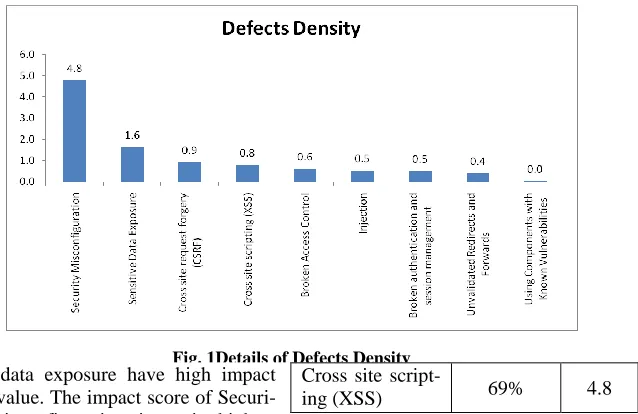
On an average more than four (4.8) Security misconfiguration issues are found in each website. Since its im-pact is also very high, the presence of multiple defects per application could be very harmful and damaging.
On an average, one issue pertaining to Sensitive data exposure (1.6) are present per application which also needs to be mitigated since its impact is significantly high
IV.DETAILANALYSISOFTOP THREEMOSTPREVALENT
SECU-RITYISSUES
The prevalence and defect density of security issues like Security misconfigura-tion, Sensitive data exposure and Injection is significant. These three security issues also have high impact risk score [7]. Fur-ther analysis of these three prevalent risks is carried out to know in detail the actual contribution and defect distribution at attack vector level.
A. Types of Security misconfigurations threat vectors and its distribution
Fig. 1Details of Defects Density
The following inferences are made based on the analysis of distribution of attack vectors[5]:
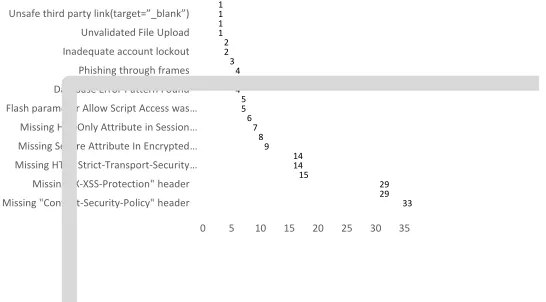
One major finding is that HTTP security headers related vulnerabilities such as Content Security Policy, X-Content-Type-Options, X-XSS-Protection and HTTP Strict Transport Security comprises major share of 60% of detected risks under secu-rity misconfiguration vulnerability. These HTTP response header categories require configuration settings at web serv-er and application level to mitigate attacks and provide much needed protection. These five Security Headers are crucial to a web browser to initiate security checks. This is very handy and easy to implement and prevents attacks to a large extent. These web security policy mechanisms determines which content to be trusted, whitelists specific origins using nonce or hash, protects against MIME sniffing, provides XSS filtering, ensures secure HTTPS connections etc. basically to pre-vent from code injection, Cross site script-ing, etc.
Clickjacking is another major vulnerabili-ty which uses iframes with hidden mali-cious code in an application. It opens a door for resource sharing from other web pages but also leads to leakage of informa-tion or script injecinforma-tion from malicious
sites. This can be prevented using Content security policy by instructing browser not to allow framing from other domains.
Another issue is autocomplete feature which allows a browser to cache whatever the user types in an input field. If an at-tacker gets hold of this in user‟s browser, credentials could be compromised and sensitive details is leaked. The autocom-plete attribute should be disabled.
Security issue due to Missing HTTPOnly Attribute in session Cookie may allow adversary to steal sensitive information stored in the cookie (e.g., a session ID) and assume the identity of the user. Set-ting the HttpOnly flag directs compatible browsers to prevent client-side script from accessing cookies. This will mitigate the risk associated with certain client-side attacks such as Cross-site scripting.
Sensitive Cookie in HTTPS Session with-out `Secure‟ Attribute can expose cookies in plain text over an HTTP session leading to man in the middle attack. Setting the secure flag on the cookie will prevent browser submitting the cookie in any re-quest that use an unencrypted HTTP con-nection.
33 29 29 15
14 14 9 8 7 6 5 5 4 4 4 3 2 2 1 1 1 1
0 5 10 15 20 25 30 35 Missing "Content-Security-Policy" header
Missing "X-XSS-Protection" header Missing HTTP Strict-Transport-Security …
Missing Secure Attribute In Encrypted … Missing HttpOnly Attribute in Session … Flash parameter Allow Script Access was … Database Error Pattern Found
Phishing through frames Inadequate account lockout Unvalidated File Upload Unsafe third party link(target=”_blank”)
21 9
7 6 4 3 2 2 2 2 2 1 1 1 1 0 0
0 5 10 15 20 25
Body Parameters Accepted in Query Unencrypted __VIEWSTATE Parameter Email Address Pattern Found Unencrypted Login Request Query Parameter in SSL Request Internal IP disclosure pattern found Database Error Pattern found Web Application Source Code Disclosure Pattern Found Permanent Cookie Contains Sensitive Session Information HTML Comments Sensitive Information Disclosure Integer Overflow Credit Card Number Pattern Found (MasterCard & Visa) …
Session Id Exposure Potential registration information found Oracle log file Information Disclosure Padding oracle on Downgraded Legacy Encryption (a.k.a …
Potential order information found
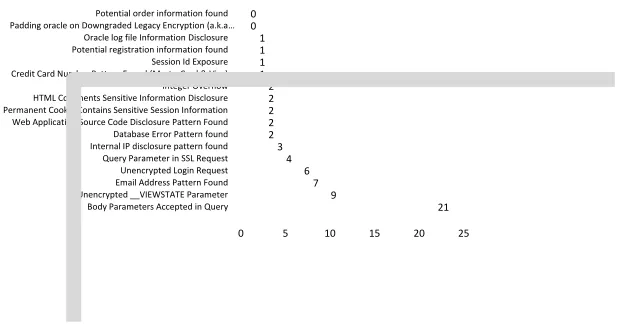
Fig. 3 Threat vector and its Defect distribution
B Types of Sensitive data exposure threat vectors and its distributions
The following inferences are made based on the analysis:
From the above findings, the risk due to “Body Parameters accepted in query” is significant contributing around 33% of the total risks of sensitive data exposure cate-gory. An attacker changes the type of re-quest to inject some malicious content in the query string of the web application request to initiate attacks like directory traversal etc. If exploited sensitive details could be revealed to the outside world. This problem is due to developers rely on client-side validation and neglect the serv-er-side validation all together.
In ASP.NET View-state parameter is another vulnerability issue which is gener-ally used to save the state of the web page and lessen the load on server. If the confi-guration is not set properly to encrypt the Viewstate parameters in web.config file, an attacker could exploit it.
Sometimes developers leave sensitive details like email address, IP, phone num-bers etc. in the HTML pages which is vis-ible to the outside world.
C. Types of Injection threat vectors and its distributions
Injection attacks refer to a broad class of attack vectors with SQL injection (SQLi) being the most prevalent. Other types of injection attacks which are commonly ex-ploited are OS command injection, Car-riage Return and Line Feed injection, LDAP injection, etc. SQL Injection in-volves tampering of user provided data with SQL commands that can read or modi-fy data from a database. Potential impact could lead to Information disclosure, Data loss, Data theft, Loss of data integrity, Denial of service and Full system compro-mise. This can be prevented by using Pre-pared statement with parameterized que-ries, whitelisting input validation or escap-ing all user supplied data.
V. DETERMININGPREVALENCE RISKFACTORRATING
Table 2
PREVALENCE VALUE FOR VARIOUS SE-CURITY ISSUES
Security Issues Prevalence value
Injection 5
Broken Authentication 5 Sensitive Data Exposure 8 Broken Access Control 5 Security
Misconfigura-tion
9
Cross Site Scripting (XSS)
4
Using Components with Known Vulnerabilities
1
Cross-Site Request For-gery
7
Unvalidated Redirects and Forwards
4
VI.CONCLUSION
The security threat landscape for ap-plications constantly changes and known techniques are being frequently adopted by attackers to probe the e-Governance sites. To ensure that Government applications are hack resistant from widespread security threats, it is required to monitor and identi-fy widespread security vulnerabilities with similar exercise of analysis on regular basis by reputed National agencies. The Preva-lence risk factor rating determined periodi-cally will facilitate organizations and de-velopers to mitigate the prevalent risk is-sues to acceptable level in a cost-effective manner. Mitigation plan should ensure identifying and initiating remediation process and appropriate security controls spanning the life cycle.These will not only produce secure e-Governance web applica-tions but it also enables the stakeholders to dynamically develop preventive mitigation strategies for prevalent and potential vulne-rabilities.
REFERENCES
[1] OWASP Top 10 – The Ten most critical Appli-cation Security issues, 2013 and 2017 [2] OWASP Risk Rating Methodology,
https://www.owasp.org/index.php/
[3] CWE. Common Weakness Enumeration CWE/SANS Top 25 retreieved from https://CWE.mitre.org/
[4] Robert A. Mar Sean Barnum “A Status Update: The Common Weaknesses Enumera-tion”retrieved from
https://www.researchgate.net/publication/2348 12149
[5] WASC (2010) WASC Threat Classification, version 2.00 retrieved from http://projects.webappsec.org/f/WASC-TC-v2_0.pdf
[6] WASCWeb application security statistics 2008, http://www.webappsec.org/.
[7] Karishma Pooj , Sonali Patil. “Understanding File Upload Security for Web Applications” In-ternational Journal of Engineering Trends and Technology (IJETT) – Volume-42 Number-7 - December 2016