Survey on Industry 4.0
Chetan S Patange , Arun tigadi , Sadanand B Kulkarni Student , Assistant Professor , Associate Professor And HOD(E And C)
KLE Dr.M.S.Sheshgiri College Of Engineering And Technology, Belagavi, Karnataka, India.
Abstract — We are at the edge of Industry 4.0, the fourth industrial revolution system. Changing the business pattern and manufacturing process models, it will affect all levels of production and supply -chains, including business and production managers, factory workers, cyber-physical systems designers, customers, end-users etc. Industry 4.0 is a combination of several novel technological advancements, including information and communication technology, cyber-physical systems, network communications, big data and cloud computing, modelling, virtualization and simulation and improved tools for human-computer interaction and cooperation. Due to the current structure of digital factory, it is necessary to build the smart factory to upgrade the manufacturing industry.
Keywords — Industry 4.0, manufacturing, information and communication technology, cyber -physical systems
I.INTRODUCTION
Industry 4.0 fosters what has been called as Smart Factory. Entitled as 4th Generation of Industry development, where the machinery, production lines, are wirelessly connected to each n every entity registered to the system. The systems can be accessed being anywhere in the world and can be altered their performances for efficiency and profitable production. However, at the same time it will be accompanied by as many challenges. The objective of the present article is to give an overview of the underlying technologies, possible benefits and predicted challenges of Industry 4.0.
II.BACKGROUND
A. INDUSTRIALREVOLUTIONS
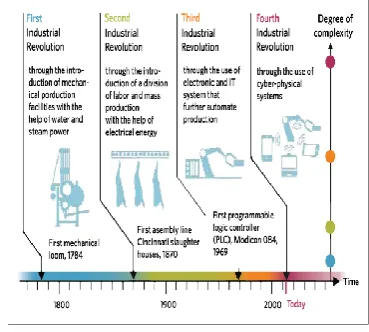
Originally it was meant to describe technological changes in manufacturing and set out priorities of a consistent policy framework to preserve the global competitiveness of the German industry. The title 4.0 indicates that Industry 4.0 is considered the fourthindustrial revolution, a logical continuation of the previous three industrial revolutions. For most people, the term “industrial revolution” refers to the changes that took place after the introduction of steam- and water-powered production methods. Indeed, the first industrial revolution started when
the first mechanical loom was invented in 1784. Hand production methods were replaced by machinery and small workshops evolved into the factory system that allowed to produce on a more massive scale. It wasn’t until 100 years later that the second industrial revolution started, between late 19 century. With the spread of electricity, the second revolution introduced major industrial developments
Fig a : Industry Growth Stages
such as the assembly line and mass production. The period between the second and the third revolution and early 20 lasted for only a few decades. Starting from the 70s, the rapid adoption of electronics and IT enabled further automation of production in factories.
B. THEFOURTHINDUSTRIALREVOLUTION The current, 4th revolution, started in the 2000s, takes automation even further and revolves around cyber-physical production systems. It overlaps largely with the technological advancements known as Smart Factories, the Industrial Internet of Things, Smart Industry, or Advanced manufacturing [1].
Industry 4.0 is a combination of several novel technological advancements:
information and communication
technology.
cyber-physical systems. network communications. big data and cloud computing.
modeling, virtualization and simulation. improved tools for human-computer
C. INFORMATIONANDCOMMUNICATION TECHNOLOGIES
80% of the innovations in manufacturing are based on ICT [4]. Digitization and the widespread application of ICT allows to integrate all systems throughout the supply and value chains and enables data aggregation on all levels. All information is digitized and the corresponding systems inside and across companies are integrated at all stages of both product creation and use lifecycles [1]. The manufactured smart products will take on additional roles to its primary purpose: an information container to store information across the complete supply chain and its life cycle; an agent: the product actively affects its environment; an observer: the product monitors itself and its environment [4]. For example, clothing items can monitor how long they have been worn or how often they’ve been washed, to report back to the manufacturing plant in order to produce a replacement for when needed [1]. The recent advancements in ICT sector form the basis of Industry 4.0, as the industrial processes have started to go beyond the simple automation of production that started in the early 1970s [5].
D. CYBERPHYSICALSYSTEMS
Cyber-physical systems improve the capability of controlling and monitoring physical processes, with the help of sensors, intelligent robots, drones, 3D printing devices etc. In cyber physical systems, physical components, such as 3D printers, drones and robots, and digital software components, such as data analytics and sensor technology, are aggregated into a network of interacting elements. While the initial inputs and final outputs are customarily physical, information often transposes between physical and digital states during manufacturing process. For example, it is possible to scan a physical component and model a digital representation if this item based on the scans. This digital data can then be turned into physical information again by 3D printing this component.
E. NETWORK COMMUNICATION
All these devices, both within the manufacturing plant and across suppliers and distributors, are connected through different wireless and Internet technologies [1]. Reliable high-quality communication networks are a crucial requirement Industry 4.0 and therefore it is important to expand the Broadband Internet infrastructure where needed [6]. This high level of networking of interconnected components allows for a decentralized and self-organized operating of the cyber-physical systems.
F. BIGDATAANDCLOUDCOMPUTING With the use of big data and cloud computing, the information retrieved through these networks can be used to model, virtualizes and simulate products and manufacturing processes. These models are called digital twins, or device shadows. A digital twin is a computerized companion of a physical asset that enables real time monitoring, diagnostics and prognostics of the asset
G. IMPROVEDTOOLS
To control these processes, human workforce is supplied with state-of-the-art ICT tools that make use of advancements in augmented reality and intelligent robotics. The cyber-physical systems of Industry 4.0 have the primary aim of assisting humans in their everyday jobs. They include
physical
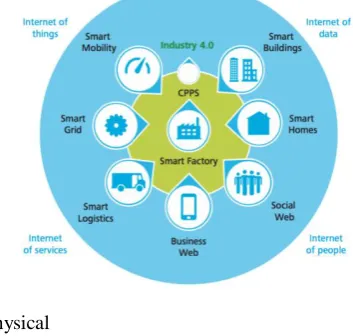
Fig B : Smart Factory
assistance exoskeletons, context-adaptive assistance systems for fault diagnosis, location-based maintenance and planning assistance systems, mobile, personalized, situation-adaptive tutoring systems etc. The key features of such systems are non-intrusiveness, context – adaptiveness, personalized, location-based and mobility. To ensure optimal user experience and efficiency, these systems will have to be judiciously designed, taking into account the possibilities of speech, gestures, eye tracking, body language and facial expressions, physical actions and helpful graphics. [4]
III.BENEFITS
These changes in manufacturing are said to result in a wide variety changes in manufacturing processes, products and business [1]. Industry 4.0 has potential to positively affect meeting individual customer requirements, production flexibility, decision-making optimization, resource productivity and efficiency, value creation opportunities through new services, demographic changes in the workplace, human labor force work-life balance, and a competitive economy with high wages [6].
H. MASS CUSTOMISATION
Countering the currently widespread mass production, mass customization will allow production on an extremely small scale – even down to a single unique product, and still be profitable [6]. This will increase the cost-effectiveness of customizing and prototyping and thus support innovation. Small last-minute changes to the products or prototypes will be possible, thanks to high configurability of the automated production systems. This will allow the companies to adopt new business models for value creation and compete not only with price but, for example, with the option for rapid prototyping.
I. FLEXIBLEPRODUCTION
With the establishment of smart factories, the intelligent and highly configurable machinery will allow for a more flexible production, enabling a greater variety of products produced in a certain manufacturing facility, more agile manufacturing processes and responding to changes and temporary shortages [6]. This allows the companies to produce for a wider range of customers and adapt fast to temporary increases or even decreases in market need. E.g. if the need for a certain product is currently low, the production line can be easily reconfigured to produce another product with additional capacity and deliver the ordered parts to the client faster than expected. This will also increase the client’s confidence and trust.
J. INCREASEDPRODUCTIONSPEED
Thanks to digital product and production process modelling and data-driven supply chains, production speed will increase [1]. Gathering, preprocessing and analysing all available factory shop-floor data will result in transparency across the whole production and allow identify the bottlenecks and potential improvement points. For example, in the automotive industry, the design specifications are often predetermined by the client. If a design change affects the production speed, it is possible to detect this change and provide the evidence to the client – thus contributing to the fast elimination of a faulty design specification.
K. HIGHER PRODUCT QUALITY AND DECREASEDERROR RATES
Although higher production speed has previously been associated with lowered quality, in the case of data-driven manufacturing, product quality will increase and error rates reduce, as sampling methods for error detection are replaced with real-time data from sensors [1]. An other important aspect of data-driven manufacturing is the root-cause analysis. In the classical factory environments, it often happens that in case of device malfunction, the symptoms are treated instead of the actual cause of the symptoms. This increases the maintenance price of machinery, as unplanned maintenance cases are frequent and maintenance staff must be present at the factory site at all times. Seeing the whole data, not just the view of one single element in the system helps detect root causes and fix them instead of just fixing the symptoms, making the maintenance procedure more predictable and decreasing the need for 24/7 on-site maintenance staff.
L. OPTIMIZEDEFFICIENCYAND DATA-DRIVENDECISIONMAKING
This data can simultaneously be used to enhance productivity and efficiency, and optimize decision-making – advanced analytics, predictive maintenance and data-driven simulations will help avoid machinery failures and plan shop-floor changes [1], [6]. Data analysis enables real time monitoring, diagnostics and prognostics of the assets. With the ability to collect massive amounts of data from different systems, combine and analyze it, the emerging patterns can be used to predict future activities. For example, it is possible to model out different scenarios that might happen with the asset and how these events affect the related elements in the cyber-physical system.
M.BETTERCUSTOMERPROXIMITY
These changes help to bring customers closer – both virtually and physically. Thanks to virtual design processes and self-service portals, individual customers will be able to supply their own designs and provide a stronger input for the general production process [1], [6]. Having largely automated the physical production processes of their factories, companies may choose to bring the factories closer to the customer to shorten logistics chain and delivery time.
N. NEWVALUECREATIONMETHODS
already preferring selling services instead of (virtual) products, but this can advance even further and gain a foothold in the physical world as well. For example, instead of selling car parts, an automotive manufacturing company could sell kilo meters instead.
O. IMPROVEDWORK LIFE
In the face of these new business models, the working settings of factory labour force will be prone to their own changes. As intelligent machinery become ever smarter, it will take over the more repetitive tasks, enabling human workers to focus on the more challenging ones. Employees will have greater autonomy to make their decisions, they are more engaged in product and process development and are free to regulate their own workload [6]. This work can mostly be done over network and allows for a more flexible and balanced work and personal life distribution [6], [7].
IV.APPLICATIONCASESTUDY
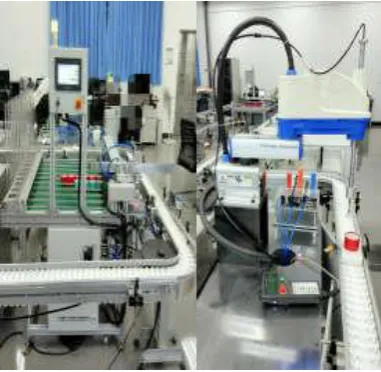
Industry 4.0 helps in gaining efficient results taking an application from the view of intelligent manufacturing, manufacturing equipment should be equipped with the abilities of edge computing, environment perception, and coordination between equipment. The smart factory, which is a cyber-physical production system (CPPS), integrates intelligent sensors, embedded terminal systems, intelligent control system, and communications facilities. The peer to peer interaction (e.g., person to equipment, equipment to equipment, service to service) is achieved by CPPS. Therefore, building of smart factory should take into consideration manufacturing characteristics to meet rapidly-changing market needs. In the following, we use the laboratory prototype platform as an example to explore typical characteristics of smart factory. The laboratory prototype platform, which represents a candy packing production line, as shown.
Fig C : Candy Manufacturing Smart Factory
Fig D : Controller Managing the Process Flow
The basic flow of candy packing is as follows. Firstly, customers choose candy and purchase it online. Then, the order information is sent directly to the manufacturing system. Finally, the completed order is automatically transported by logistical system of smart factory. The candy packaging line has typical characteristics of smart factory, such as high interconnection, dynamical reconfiguration, deep integration, and so on.
In the experiment, we took into account factors such as equipment availability, equipment performance, and qualified rate of products. Next, we developed a cloud-aided manufacturing system, which gave suggestions on scheduling optimization of self-organized equipment. The six-month experiment was performed on the equipment of candy packaging line. The smart meter is used to measure the total electrical energy for the equipment in the lab. We calculated he related parameter every day, and the average was took as the value of the month. As shown in Fig. 9, the Overall Equipment Effectiveness (OEE) of tested equipment is improved from 0.42 to 0.82 using the cloud-aided manufacturing system. Compared to the centralized scheduling, the self-organized scheduling with the cloud-aided manufacturing system has more remarkable effect. In general, the candy packing line is an example which was used to explore flexibility, efficiency, and transparency of smart factory.
V.CHALLENGES
should be flexible and reliable, and satisfy the high quality standards. The technological breakthroughs bring many opportunities for the implementation of intelligent manufacturing. However, there are still some issues and challenges.
A. CHANGINGBUSINESSPARADIGMS The changes to the value chain require companies to embrace new business models and partner with other companies, including suppliers, technology companies and infrastructure suppliers [1]. It would not be surprising if companies would have to partner with firms they once saw as competitors, e.g. when helping to establish new regulatory frameworks, standards or training methods. In addition, companies will have to invest large sums into new machinery, software, business model development, employee competency models and training, etc. If the current industrial leaders do not respond to those changes and adopt these new business paradigms, they may soon find themselves in the interchangeable and easily replaceable role of mere suppliers [7].
B. SAFETYANDSECURITY
As data is collected throughout the supply chain, questions of data ownership will arise. It is important for companies that their data won’t end up in the hands of a competitor. Another concern that will enlarge for manufacturers is cyber security: it is crucial to ensure that they cannot be infiltrated and that their factories cannot be taken over or cut off. On the other hand, it must be ensured that the production facilities themselves do not pose a threat to humans or the surrounding environment, and that the workers receive continuous safety trainings [6].
C. LEGALISSUESANDIP
Having many entities use, modify and produce new data, will result in potential legal issues. It is important that the new manufacturing processes and business models comply with the existing laws. However, it is equally important to adapt the existing regulations so that they do not cripple innovation while protecting all of the stakeholders [6].
For example, if a customer orders a product and supplies customizations for its design, who owns the intellectual property rights to the design [1]? What portion of this data is considered corporate data and how much of it is personal data?
D. STANDARDIZATION
In order to fully implement Industry 4.0, standards have to be developed and established, to ensure the correct data exchange between machinery, systems and software. Proprietary data and communication protocols will hinder the full potential of Industry 4.0 by limiting compatibility of products from other companies or regions [1] and
thus increasing integration costs or suppressing competition and promoting potential monopolies. Jointly developed and agreed standards for communication protocols, data formats and interfaces facilitate interoperability across different companies, sectors and regions, and promote the adoption and sustainability of Industry 4.0 technologies [1].
E. WORKORGANIZATIONANDDESIGN One aspect of Industry 4.0 is the way it will change the workplace. Intelligent machines are becoming smarter and cheaper, enabling human workforce to focus on less repetitive and more challenging tasks. However, this shift will bring along certain risks and demands. According to the European Parliament, employee roles will change across content, processes and environment [6]. Flexibility, work time, demographics as well as health and private life will all be impacted by Industry 4.0. Such developments will also affect the essence of certain jobs and skills profiles. New organizational structures will require a socio-technical approach for decision making, coordination, control, and support across both virtual and physical machinery and factories. These new responsibilities are accompanied by significantly higher demands towards the workforce [6]. Employees will be required to show more initiative, be self organizing, and have highly developed communication skills [6]. For this, it is important to implement participative work design and lifelong learning measures [6].
F. TRAININGANDCONTINUING
PROFESSIONALSKILLDEVELOPMENT The actual educational profile of a typical Industry 4.0 worker has not yet been developed. These workers would most possibly be graduates from a STEM (Science, Technology, Engineering, Mathematics) background but in addition to strong domain-specific competencies they will also be required to excel in general competencies, such as managerial skills, understanding of the specific industries and the interrelatedness of different industries across value chains, supply chains, and processes. There will also be a higher demand for excellent communication skills to promote team work and customer relations. All these new competency requirements advocate the development of entirely new qualifications that comply with the interdisciplinary nature of the work. This means that new learning content and didactic methods need to be established and included into professional education and lifelong learning. To support the continuous education of the workers, the development of new standards for assessing formal and informal learning is critical. [6]
not dealt with in time, industries will be led to massive recruitment challenges and talent shortage, already happening now and expanding rapidly over the next five years [9].
G. UNWILLINGNESSTOACCEPTAND CONTRIBUTETOCHANGE
In the author’s opinion, the greatest threat to the success of Industry 4.0 is inactivity. Although it is a fairly young concept, many countries, such as Germany, Switzerland and China have begun preparations for the next industrial revolution. It is crucial that the stakeholders collaborate and search for solutions together, to avoid the threat of whole sectors falling behind. For example, some academics argue that the potential skilled workforce crisis will resolve itself in time [10]. According to the 2016 World Economic Forum (WEF), however, it is crucial that businesses take an active role in promoting the re-training and up-skilling of the workforce, that the workers contribute to their own future through lifelong learning, and that governments create an enabling environment to facilitate these processes [9].
H. INTELLIGENTREQUIREMENTOF EQUIPMENT
Due to the foundation place of the underlying equipment, it is crucial to monitor and control the underlying manufacturing resource for reconfiguration of production line, dynamic scheduling, and information fusion in smart factory. Therefore, it is necessary to improve the intelligence level of manufacturing equipment. The configurable controller and self-reconfigurable robots can provide potential solutions to function expansion of manufacturing units. In the context of hybrid production, the coordination and information interaction among the multi-module manufacturing units should be explored. The optimized combination of programs should be made to enhance the workshop efficiency. The intelligent equipment should be able to collect production information, provide compatible data interface, and support generic communication protocol. In addition, the equipment could perceive manufacturing environment and cooperate with other equipment in smart factory. Flexible manufacturing is a typical feature of smart factory, but there are still many problems such as strong proprietary of production line, dynamic scheduling, and tight coupling between functions and devices.
In the context of intelligent manufacturing, the data generated by intelligent equipment is mostly unstructured.
The high-speed operation in workshop needs higher standards of data acquisition. Namely, data acquisition is the basis of big data analytics, where physical resource should support fine-grained and efficient data acquisition, and achieve visibility of
manufacturing process; integrate heterogeneous data in a unified system by generic protocols (e.g., RFID, ZigBee, and NFC); and improve extensibility of controller for access to the core industrial networks.
I. DEEP INTEGRATIONNETWORKS
The IIoT facilitates a deep integration of information and industrialization. The advanced IIoT technology is important for the implementation of the smart factory. The mature and generic standards have not been formed yet in the field of IWSNs, and the standardization process of IWSNs should be promoted continuously. In the complicated electromagnetic environment, data transmission should meet the requirements of reliability and real time
equipment control.
Due to the limited energy, energy efficiency is a key issue that affects the deployment of IWSNs. Moreover, because of the access of large-scale devices, network security also becomes very important. As the information technologies have advanced (e.g., NB-IoT, 5G, LTE-Advanced, and 3GPP), a significant progress has been made in industrial wireless networks. These progress has provided new solutions for key issues of IWSNs, such as reliability, real-time performance, energy efficiency, and security strategy.Development of information technologies has brought opportunities to the intelligent manufacturing. The OPC UA-based interaction facilitates the coordination between intelligent agents because a multi-agent system can solve problems in a parallel way. The Open Flow-based SDN technology provides more flexible solution for network configuration, which enhances network management ability. The D2D technology makes communication between devices more efficient and expands network capacity.
The edge computing equips terminal system with decision-making ability and autonomy. Additionally, high transmission rate of data, low duty cycle, and IP network availability are the requirements of network layer which denote the foundation for ubiquitous communication in smart factory.
mining technology is a serious challenge to enterprises.
Moreover, the data-based optimization of product design needs to add data receiver and feedback mechanism to the traditional product, and then the product itself will become the data source. Consequently, the product will become a participant in the process of data collection, which provides technical information to the product designer. In order to achieve a knowledge-based intelligent manufacturing, the manufacturing entity should be able to provide data collection, data fusion, and extraction of manufacturing resource characteristics. The smart factory should integrate data resources (e.g., supply chains, product data, and logistic data) into service platform, which provides product services such as sales forecasting and quality analysis. In general, data mining and knowledge discovery provide a scientific decision for planning and scheduling of manufacturing product.
VI.CONCLUSION
Although the concept of Industry 4.0 is not yet widespread, it has potential to penetrate and improve many aspects of human life. Starting from changes in business paradigms and manufacturing process models, it will affect all levels of production and supply-chains, including business and production managers, factory workers, cyber-physical systems designers, customers, end-users etc. Industry 4.0 is a combination of several novel technological advancements: information and communication technology, cyber-physical systems, network communications, big data and cloud computing, modelling, virtualization and simulation and improved tools for human-computer interaction and cooperation. The concept of Industry 4.0 promises many positive changes to today’s manufacturing, including mass customization, flexible production, increased production speed, higher product quality, decreased error rates, optimized efficiency, data-driven decision-making, better customer proximity, new value creation methods and improved work life. On the other hand, there are many challenges ahead, such as issues regarding business paradigm changes,
safety, security, legal issues, standardization and a plethora of human resource planning challenges. However, the gravest mistake is unwillingness to take part of these changes, because the future of Industry 4.0 is not yet clear – its success or failure of lies in the hands of all the stakeholders.
VII.REFERENCES
[1] H. Kinzel, “Industry 4.0 – Where does this leave the Human Factor?”Available:
https://www.researchgate.net/publication/308614137_Indu stry_40__Where_does_this_leave_the_Human_Factor. [2] R. Davies, “Industry 4.0: Digitalisation for productivity
and growth,”
[3] T. Pfeiffer, J. Hellmers, E.-M. Schön and J. Thomaschewski, “Empowering User
[4] W. Wahlster, “Industry 4.0: From Smart Factories to Smart Products,” 2012.
[5] R. C. Schlaepfer and M. Koch, “Industry 4.0: Challenges and Solutions for the Digitaltransformation and Use of Exponential Technologies,” 2014.[Online].
[6] H. Kagermann, “Recommendations for Implementing the Strategic Initiative INDUSTRIE 4.0: Securing the Future of German Manufacturing Industry ; Final Report of the Industrie 4.0 Working Group,” 2013.[Online]
[7] D. Buhr, “Social Innovation Policy for Industry 4.0,” 2015. [Online]. Available: