http://www.sciencepublishinggroup.com/j/pbs doi: 10.11648/j.pbs.20170604.14
ISSN: 2328-7837 (Print); ISSN: 2328-7845 (Online)
The Analysis and Countermeasures of the Psychological
Problems of Impoverished Undergraduates
Shuo Zhang
1, Yingmin Li
1, Bin Liu
2, *, Guishu Yu
1, Miao Tian
1, Le Qi
11Faculty of Infrastructure Engineering, Dalian University of Technology University, Dalian, China 2
International School of Information Science & Engineering, Dalian University of Technology University, Dalian, China
Email address:
[email protected] (Shuo Zhang), [email protected] (Yingmin Li), [email protected] (Bin Liu), [email protected] (Guishu Yu), [email protected] (Miao Tian), [email protected] (Le Qi)
*
Corresponding author
To cite this article:
Shuo Zhang, Yingmin Li, Bin Liu, Guishu Yu, Miao Tian, Le Qi. The Analysis and Countermeasures of the Psychological Problems of Impoverished Undergraduates. Psychology and Behavioral Sciences. Vol. 6, No. 4, 2017, pp. 65-69. doi: 10.11648/j.pbs.20170604.14
Received: June 30, 2017; Accepted: July 18, 2017; Published: August 11, 2017
Abstract:
In this paper, for the ubiquitous impoverished undergraduate colony in the college, based on the abundant investigation and analysis, we dissected the psychological problems and characteristics of the impoverished undergraduates. Furthermore, we find out the key reasons of their psychological problems and explored the solutions. The research work of this paper can provide important basis in how to solve the "psychological poverty alleviation" problem of the impoverished undergraduates for the ideological and political workers. This research work has great practical significance.Keywords:
Impoverished Undergraduates, Psychological Problems, Countermeasures Research1. Introduction
Today, impoverished undergraduates has caused widespread concern in society. The party and the government also attach great importance to this issue. Ministry of Education, Ministry of Finance, together with the relevant departments have developed a series of policies to support impoverished undergraduates. They establish a diversified funding system which contains scholarship, Tuition reduction and Student Loans. Some colleges have put forward ‘Any positive progress college student because of poverty will not be left behind’. These systems and measures ensure that impoverished undergraduates can be normal to learn, live and grow well. At the same time, the emergence of "Ma Jiajue" incident and other events let people attention psychological problems of impoverished undergraduates. All colleges have also taken corresponding measures in this regard. On the basis of investigation and analysis, this paper analyzes the psychological problems of impoverished undergraduates,
finds out the reasons of the psychological problems and explores the solutions.
2. Psychological Status of Impoverished
Undergraduates
Table 1. The survey case.
Contents 16PF Mental state
classification Specialized field Gender
The nature
of account Specialized field Gender
The nature of account Liberal arts Engineering Male Female Rural City Liberal arts Engineering Male Female Rural City
Number 72 445 365 152 351 166 70 423 354 139 327 166
Total 517 517 517 493 493 493
16PF control group uses personality status survey data which provide by Psychological center of Dalian University of Technology, sampling 10120 people. Through the
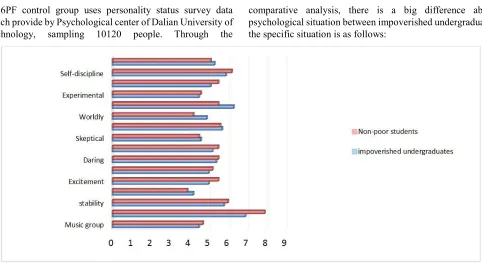
comparative analysis, there is a big difference about psychological situation between impoverished undergraduates, the specific situation is as follows:
Figure 1. The difference between impoverished undergraduates and non-poor student.
Firstly, Music group, Intelligent, stability, excitement, constant, Sensitivity, Experimental, independence, Self-discipline of impoverished undergraduates are lower than non-poor students, showing a certain differences. Intelligent and excitement are significant difference, its significance is less than 0.05.
The low intelligence factor indicates that it has significant difference in the comprehensive ability and knowledge reserves between impoverished undergraduates and non-poor students. It shows the narrow knowledge, single mode of mind of them. They only pay attention to the direction of a single tendency.
The low score of excitement is serious, prudent, calm and tacit. It is not difficult to find that, compared with non-poor students, impoverished undergraduates are more introverted. They are lack of self-confidence, caution, less words, and lack of communication with the surrounding population.
Secondly, the factors of impoverished undergraduates about strength, worldly, worrisome, tension is higher than non-poor students. Among them, the difference between worldly and worrisome is less than 0.05.
Tension factors are characterized by high anxiety and depression. It is not difficult to find out that it is directly related to the understanding and dissatisfaction of impoverished undergraduates in the real life. Appropriate dissatisfaction with the status quo can let impoverished
undergraduates establish a sense of struggle. But it can play a positive role that the appropriate tension combine with self-confidence.
The higher factors of worldly indicates that impoverished undergraduates are more capable and smooth. Compared with non-poor students, they are more mature in the financial concept and the ability to arrange personal life.
High tension reflects in the economic pressure impoverished undergraduates produce the strong psychological pressure. In the way of the cost of reading, personal future, interpersonal and other aspects, they have more pressure and anxiety than non-poor students.
3. The Psychological Characteristics of
Impoverished Undergraduates
3.1. Inferiority
Impoverished undergraduates tend to underestimate themselves in terms of ability, own value. It results in self-lightness, self-despicability, self-contempt, a completely negative attitude and emotional experience. Thus it often shows timid, fear, suspicion, and refused.
3.2. Nervous
They are confused, low degree of mind. Their inner distress mainly comes from the attitude of the real life. There are dissatisfaction or the troubled of not fulfilled wish. These factors will lead to anxiety, even depression. In this respect, girls are more serious than boys. Liberal arts students are more serious than engineering. The factors of adaptation and anxiety of impoverished undergraduates were significantly higher than non-poor students, which indicated that they had more conflict than non-poor students.
3.3. Lack of Security
In interpersonal relationships cannot take the initiative to interact with people, and sometimes even produce retreat behavior. In order to get approval they are things to accommodate. On the other hand they also showed a distrust of external things. This lack of sense of security will lead individual impoverished undergraduates to the hostile consciousness.
3.4. Rebellious, Extreme
Long-term tension, anxiety, psychological easily lead to thinking paranoid and forced behavior. Paranoid and forced thinking is very easy to fall into a dead end. They are paranoid, suspicious, narrow, and cannot adopt a mature coping style. They also cannot use social support to solve the problem, and ease the psychological pressure.
In short, on the one hand impoverished undergraduates hope that they can get recognition of others through their own efforts to change the current situation. On the one hand because of real problems, they are tension and anxiety in a long period. In fact, the psychological problems of impoverished undergraduates tend to show a comprehensive problem. Such as: learning failure, leaving, absenteeism, theft and so on.
4. The Causes of Psychological Problems
of Impoverished Undergraduates
In the youth of college students, the psychological is not fully mature. There are many questions and confusion in their mind. Their psychological tendencies is both positive and negative aspects. So it is easy to produce psychological conflict and psychological confusion. Because impoverished undergraduates study and living in special conditions, so they and the current campus culture is not very harmonious atmosphere. In the final analysis, the emergence of psychological problems of impoverished undergraduates contain their own reasons, as well as certain social reasons.
The specific reasons are as follows:
4.1. From Their Own Pressure
Impoverished undergraduates are more sensitive and self-esteem than non-poor students. They want to be recognized by others. The best way is to have better academic performance and higher scholarships to gain a sense of self-identity. But at the same time, because of economic poverty, they have to run around for tuition. They do everything possible to make money. The strong learning motivation and the more busy working life is contradictory, conflicting. Most impoverished undergraduates are not able to correctly handle the relationship between the two. Over time, personality are changed, and even appear some mental illness.
4.2. From Pressure of the Same Age Group
Today, the life of campus is rich and colorful, and has a lot of opportunities. The interpersonal communication is significantly enhanced. With the economic growth imbalance, obstacles in the process of communication gradually exposed. Many students shot generous, consumer ideas ahead, and gradually formed a bad wind about comparisons. The psychology about the pursuit of high consumption is growing. In this kind of campus culture, because of life constraints, impoverished undergraduates is busy for life and the study. They neither have money nor energy to interpersonal activities. Students whose economic strength can wear brand-name, eat dinner, generous shot. They cut a striking figure in the campus scenery for a while. In contrast, impoverished undergraduates dwarfs, sigh, inferiority complex spontaneously, nervous, rebellious. In the psychological defense response, they lost a sense of security and belonging.
4.3. From Social Pressure
Today, the university is no longer to be the safe era. College students will face a lot of competition when they are out of school. These competitions make impoverished undergraduates bear the psychological pressure from the community. At the same time, people pay attention to economic interests, and respect for the utilitarian value of things, impoverished undergraduates are often discriminated against because of "shabby" on the one hand, Sensitive impoverished undergraduates are Inferiority. On the other hand, they are self-esteem, pride. So, they performance from disdain to hostile attitude. This social reality and their subjective consciousness Conflict also exacerbates the negative changes in personality and mental health of impoverished undergraduates.
5. The Countermeasure Research to
Solve Psychological Problems of
Impoverished Undergraduates
undergraduates cannot be ignored. Thus, ideological and political education workers must pay attention to this problem, and help impoverished undergraduates out of poverty, put pressure into motivation, form positive life. The specific way is as follows:
5.1. Through Psychological Poverty Alleviation System of Social, School, Family Trinity, and Help Impoverished Undergraduates Find a Sense of Belonging
Society is the place where impoverished undergraduates have to enter when they leave the campus. So the diversity of social thought will affect their thoughts through various channels. Schools are places where impoverished undergraduates learn and live, so the environment of school will subtle influence on the growth of students. Families are the harbor and destination of impoverished undergraduates, therefore, the family warmth or not will directly affect the students' psychological situation. To solve the common problems of impoverished undergraduates, is not overnight to complete, and not a certain aspect can be achieved alone.
Based on the reasons above, in order to eliminate the psychological problems, we must establish a psychological poverty alleviation system which contains society, school and family. First of all we should promote moral norms, and establish a national struggle, awareness of equality, to stimulate the community to understand and support the poor groups, to build a humane, mutual aid, harmonious social atmosphere. At the same time, we should promote the positive factors, create more opportunities for social success with them to communicate and discuss, to improve their ability to resist frustration and confidence. We also should create atmosphere that" Self-reliance and glory "," economic poverty is not terrible, spiritual poverty is shameful ". To carry out" self-reliance advanced pacesetter "selection, and widely publicized in the poor population. So that they can realize that through their own efforts, everything is possible. School also should obtain accurate information through the multi-understanding for the poor families of the family situation, the economic situation, etc. We can set up the information network which between school and family, to targeted education through communication with parents to understand the growth of poor students’ experience. We can affect the way of education of their family through letters, calls, face to face exchange, home visits. So that they can support, understand the students, to help them healthy growth in all aspects.
5.2. Establish Mental Health Counseling Training System about Impoverished Undergraduates, Help Them Form a Healthy Personality
Through the questionnaire we can see impoverished undergraduates are anxiety, depression, low self-esteem, they desire to communicate but self-closed, they are eager to be recognized but not show. Although serious impact is caused, but it also impacts on the quality of life. It also indirectly affect the students' academic achievement, career development,
creativity and so on. Therefore, colleges and universities must strengthen the mental health education, monitoring system construction.
At present, many colleges and universities have been established or to be preparing the psychological counseling center. However establishing a mental health education system for the majority of impoverished undergraduates is more important. It should carry out targeted guidance and training. Backward, low self-esteem helpless, no sense of belonging, personality contradictions and other issues is eliminated. So that they gradually in the training to establish a sense of cooperation, innovation, communication, freedom and other good personality quality.
5.3. Enrich the Learning and Living System of Impoverished Undergraduates, and Help Them Find Self-Confidence
Impoverished undergraduates in the university campus have a lot of differences with non-poor students. Although they are very eager to show themselves, but they dare not show because of the contradictory mentality. So school can set up a special stage for them, such as: impoverished undergraduates’ own organizations-self-improvement society is established in Dalian University of Technology. There are many traditional activities, such as "three minutes talent Show "and so on. Impoverished undergraduates can gradually build self-confidence, calmly face a variety of problems and challenges.
Because of the influence of the family environment, the knowledge reserves and horizons of the impoverished undergraduates have a certain gap with the non-poor students. In view of this phenomenon, school can organize some human lectures, art salons, ceremonial exchanges and other activities to enhance the vision of impoverished undergraduates.
6. Conclusion
In short, the psychological problems of impoverished undergraduates mainly include their own pressure, social pressure and peer pressure. In order to solve these problems, colleges and universities should continue to study and explore. The scientific education methods should be formed, and put it into practice.
Acknowledgements
The article is one of the stage results of the reform project of Liaoning Provincial Department of Education (The research and practice of the mechanism of innovation and entrepreneurship education running through the whole process of personnel training)
References
[1] Gress-Smith J L, Roubinov D S, Andreotti C, et al. Prevalence, severity and risk factors for depressive symptoms and insomnia in college undergraduates [J]. Stress and Health, 2015, 31 (1): 63-70.
[2] Wu X, Tao S, Zhang Y, et al. Low physical activity and high screen time can increase the risks of mental health problems and poor sleep quality among Chinese college students [J]. PLoS One, 2015, 10 (3): e0119607.
[3] Wyatt T, Oswalt S B. Comparing mental health issues among undergraduate and graduate students [J]. American Journal of Health Education, 2013, 44 (2): 96-107.
[4] Richardson T, Elliott P, Roberts R, et al. A longitudinal study of financial difficulties and mental health in a national sample of British undergraduate students [J]. Community mental health journal, 2017, 53 (3): 344.
[5] Hussain R, Guppy M, Robertson S, et al. Physical and mental health perspectives of first year undergraduate rural university students [J]. BMC Public Health, 2013, 13 (1): 848.
[6] Bauman C W, McGraw A P, Bartels D M, et al. Revisiting external validity: Concerns about trolley problems and other sacrificial dilemmas in moral psychology [J]. Social and Personality Psychology Compass, 2014, 8 (9): 536-554.
[7] Wilson K T, Bohnert A E, Ambrose A, et al. Social, behavioral, and sleep characteristics associated with depression symptoms among undergraduate students at a women’s college: a cross-sectional depression survey, 2012 [J]. BMC women's health, 2014, 14 (1): 8.
[8] Petrov M E, Lichstein K L, Baldwin C M. Prevalence of sleep disorders by sex and ethnicity among older adolescents and emerging adults: relations to daytime functioning, working memory and mental health [J]. Journal of adolescence, 2014, 37 (5): 587-597.
[9] Comtois K A, Carmel A. Borderline personality disorder and high utilization of inpatient psychiatric hospitalization: concordance between research and clinical diagnosis [J]. The journal of behavioral health services & research, 2016, 43 (2): 272.
[10] Martin R, Usdan S, Cremeens J, et al. Disordered gambling and co-morbidity of psychiatric disorders among college students: an examination of problem drinking, anxiety and depression [J]. Journal of Gambling Studies, 2014, 30 (2).