Journal of
Applied Research on Industrial Engineering
Journal of Applied Research on Industrial Engineering
Vol. 1, No. 4 (2014) 250-258
Optimizing a Two-stage Supply Chain System with Coordinated Scheduling
Alborz Hajikhani
*, Mahtab Panahifard, Mohsen Malekmohamadi, Azar Azadi, Jamshid Bahrami
Islamic Azad University, Hidaj, Iran.
A B S T R A C T A R T I C L E I N F O
In this paper, the problem of scheduling in a two-stage supply chain system is investigated with considering coordinated scheduling of different stages. The objective is to find the similar sequences of processing tasks in two steps with two aims of minimizing the total preparation time as well as the maximum preparation time of each stage. To do so, the problem has been solved by non-dominant sorting genetic algorithm (NSGA-II) and using a variety of multi-objective techniques. The proposed meta-heuristic algorithm is applied for the first time in this problem. The results show that the proposed algorithm is able to find Pareto optimal solutions with a high efficiency.
Article history :
Received: 9 September 2014 Received in revised format: 2 October 2014
Accepted: 10 October 2014 Available online: 1 December 2014
Keywords : Supply chain management (SCM) Coordinated scheduling NSGA-II
1.
Introduction
Supply chain management is an important topic that has been discussed in recent years. A supply chain consists of all the processes that add value to a product. Supply chain management includes all integration activities related to the material flow and exchange of goods from raw material, until the final product and also its information flow that this will be achieved through improving chain rings relationships and coordinating the various stages of the supply chain to reach a reliable and continuous competitive advantage (Thomas and Griffin, 1996).
251
Coordination in the supply chain can be defined as the similar scheduling of processing tasksin the supply chain different stages to achieve a system with optimal effectiveness (Hall, 2000). In coordinated scheduling problem in a two-stage supply chain system, each task is comprised of two attributes that must be processed in the first stage and the second stage respectively, in each step by changing an attribute to another, the preparation is occurred and consequently the cost of preparation is created. The purpose of this research is to find the similar processing sequence of tasks in two phases so that the total cost of the two-step preparation will be minimal.
Hall and Patts (2000) examined various delivery scheduling problems in the supply chain as a group with the aim of minimizing the total cost of production and distribution. They used exact methods in these problems. Lee et al. (2001) reviewed advanced planning and scheduling in the supply chain. In fact, they assumed that each order has a due date, and the products that must be completed in each order are respectively processed in the fabrication and assembly stages, so each of the stages can have its own schedule and there will be a contrast between two stages which leads to increase works delivery time.
Berdestorm et al. (2004) examined the timing of production and distribution in supply chain associated with pulp mills in Sweden. For solving the problem they presented two mixed integer programming model that one of them used column generation technique and the other used the solving shortest-path algorithm. This paper deals with the production planning and the machinery scheduling has not been considered. Mansouri (2004) presented a coordinated scheduling model in a two-stage production system. The aim of this work is finding the similar sequences of processing tasks in two stages to minimize the number of set-up in each stage. He solved this problem with the use of MOGA which results in minimizing the total cost of preparation in two phases. Mansouri (2006) solved the same problem using multi-objective simulated annealing algorithm and compared the obtained results with the results of multi-objective genetic algorithm and finally the effectiveness of this algorithm has been proved in many factors. Salvarjah and Steiner (2008) examined batch scheduling in supply chain from the supplier perspective. The objective was to determine the products batch size and completion time of each batch of products for customers, so that the total cost of maintenance and orders delivery would be minimized. They presented an algorithm with polynomial complexity which gives optimal solution for a condition with a supplier and multiple customer. Manjo et al. (2010) presented the coordinated scheduling problem in a two-stage production system. In this paper the objective is to minimize the completion cost, number of tardy jobs and cost caused by re-sequencing of tasks in the middle buffer. They have used non-dominant sorting genetic algorithm (NSGA-II) to solve the problem. Mirzapour Al-e-Hashem et al. (2012) introduced a multi-objective model including minimizing the total cost, maximizing the service level, and maximizing workers’ productivity to deal with a multi-period multi-product multi-site aggregate production planning problem under uncertainty in supply chain. Sadeghi et al. (2013) considered minimizing total costs, carrying and backordering costs, and rate of changes in workforce level simultaneously as a multi-objective model for supply chain design and used a goal programming approach to solve the proposed model.
252
time of two stages of preparation. In fact the first objective seeks to maximize the performanceof the whole system and the second aim seeks to balance the cost of preparing each of the steps. The rest of paper is as follow: Section 2 defines the problem in details and formulates the problem of this research. Section 3 applies an NSGA-II to solve the model. Section 4 analyzes the results. Finally, last section provides the conclusion and some future researches.
2.
Problem formulation
Given above in the previous section, the parameters of the model are as follows (Mansouri, 2004):
| B | Number of tasks,
B Set of tasks
A1 Attributes set in the first stage
A2 Attributes set in the second stage,
| A1| The number of attributes in the first stage
| A2| The number of attributes in the second stage
a1,I ith attribute in the first stage i=1,….|A1|
a2,j jth attribute in the second stage j=1,….,|A2|
C1i,j Preparation cost of changing the attribute i to j in the first stage
C2i,j Preparation cost of changing the attribute i to j in the second stage
C1 Total cost of preparing the first phase
C2 The total cost of preparing second stage.
In this model, each task is displayed by pairs (a1,i and a2,j ), if (a1,i and a2,j) task is processed immediately after work (a1,h anda2,k), preparation is done so Xi,h is obtained by Eq. (1).
𝑋
𝑖,ℎ= {1 𝑖𝑓 𝑖 ≠ ℎ
0 𝑜𝑡ℎ𝑒𝑟 𝑤𝑖𝑠𝑒
(1)
a1(Sq) and a2(Sq) represents the characteristics of qth task in stages I and II, respectively, then
C1 and C2 are obtained from Eq. (2-3).
C1 =
∑
𝐵−1𝑞=1𝑥
𝑎1(𝑠𝑞), 𝑎1(𝑠𝑞+1).C1
q, q+1 (2)C2 =
∑
𝐵−1𝑞=1𝑥
𝑎2(𝑠𝑞), 𝑎2(𝑠𝑞+1).C2
q, q+1(3)
253
Min {
f
1(S), f
2(S
)}
(4)
S.t.
f
1(S
) =Min (
C1+C2)
(5)f
2(S
) =Min (Max (
C1, C2)
)
(6)
In this model, Eq. (2-3) calculate set-up cost. Equation (5) guarantees the total cost of preparation in the two-step and equation 6 shows the balance of the preparation cost of each step. In terms of time computing complexity, these issues are placed among NP-hard problems (Mansouri, 2004). Khosla (1995) proposed the importance of coordination in a two-stage supply chain system and its impact on reducing cost and high performance in the system for the first time. To solve the model, a branch and bound method is presented. Thomas and Griffin (1995) divided coordination issues in supply chain into three coordination categories of inventory systems, production system and the buyer.
3.
Solving methodology
In this paper, according to the conflict between objectives, non-dominated sorting genetic algorithm (NSGA-II) has been applied. This algorithmic is a version of known multi-objective genetics algorithm which instead of using fitness function, dominance concept is used to rank the population (Kuelow et al., 2002). Solutions representation: each solution is filled in interval of [1.100000] as long as the order of cargo with random numbers then for decoding the solutions, numbers within the vector are sorted in descending sequence and the index presents that sequence. Figure 1 shows the representation and decoding of the solutions.
Fig 1 Representation and decoding of the solutions
The main features of the proposed algorithm is as follow:
-
Initial Population:
The initial population size is determined by the parameter
population size.
-
Selection strategy:
Selection strategy for making mating pool is binary
tournament method.
-
Intersection operator:
The intersection operator procedure is described in Fig. 2;
therefore, the random number is generated as long as solution vector. Then, each
solution accepts another piece of the solution from the location of this random
number.
9457 8488 8484 7888 5464 5437 4344 3747 2543 1235
254
Fig 2 Intersection operator procedure
-
Mutation operator:
for mutation according to Fig. 3, two houses were randomly
selected and will be replaced with two random values.
Fig 3 Mutation operator for the vector solution
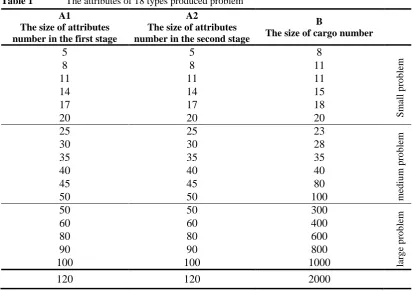
To prove the efficiency of the algorithm, sample problems are considered in three categories of small, medium and large as described in Table 1.
Table 1 The attributes of 18 types produced problem
A1
The size of attributes number in the first stage
A2
The size of attributes number in the second stage
B
The size of cargo number
5 5 8
Sm all p ro b lem
8 8 11
11 11 11
14 14 15
17 17 18
20 20 20
25 25 23
m ed iu m p ro b lem
30 30 28
35 35 35
40 40 40
45 45 80
50 50 100
50 50 300
lar g e p ro b lem
60 60 400
80 80 600
90 90 800
100 100 1000
120 120 2000
255
B_permutation=Matrix (3,3
,
5)
(7)
Cost1-Matrix=Randint (3,3,[1 10])
(8)
Cost2-Matrix=Randint (3,3,[1 10])
(9)
Fig 4 Matrix of setup and order cost for the problem of 3 and 5
In this problem, the size of cargo is 5 which has been shown by matrix B, for example, 1- b_23 means there is an order that has type 2 characteristic in the first stage and type 3characteristic in the second stage.
To examine the quality of the solutions elicited from non-dominant multi-objective sorting algorithm, at first the whole problems have been solved in single objective form using genetic algorithm and the results have been considered as a basis for comparing the quality of solutions produced by the multi-objective algorithm. Relationship 10 indicates solutions quality.
10
Q = 1 − max ((
MinSum−MinSumMinSum∗ ∗)
و
(
MinMax−MinMax∗
MinMax∗
))
It should be noted that MinMax * and MinSum * are the best solutions found by single-objective Genetic Algorithm.
4.
Results analysis
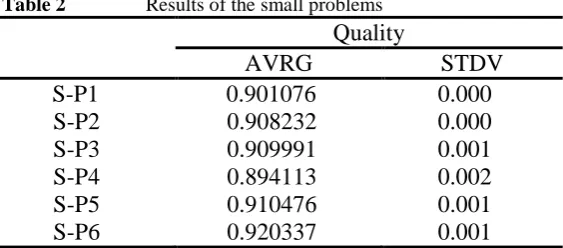
The results of the tests on each of those issues have been reported, respectively, in Tables 2, 3 and 4. To remove the consequences obtained from the stochastic nature of the results, for each of 18 problems, the sample has been run 10 times and the results average has been considered as the comparisons basis. According to Table 2, the proposed algorithm is able to find Pareto solutions with optimal quality in small problems moreover, the mean of standard deviation values is close to zero in these problems and this indicates that the algorithm has good stability. Similarly in large problems, the algorithm is capable of finding Pareto solutions with optimal quality and the total average of solutions quality in large problems is 0.89, which indicates the algorithm has good performance in large problems too.
Table 2 Results of the small problems
Quality
AVRG
STDV
S-P1
0.901076
0.000
S-P2
0.908232
0.000
S-P3
0.909991
0.001
S-P4
0.894113
0.002
S-P5
0.910476
0.001
256
Table 3 Results of the algorithm in moderate problems
Quality
AVRG
STDV
M-P1
0.901076
0.000
M-P2
0.908232
0.000
M-P3
0.909991
0.001
M-P4
0.894113
0.002
M-P5
0.910476
0.001
M-P6
0.920337
0.001
Table 4 Results of the algorithm in large problems
Quality
AVRG
STDV
L-P1
0.891726
0.071
L-P2
0.900209
0.070
L-P3
0.906445
0.034
L-P4
0.907049
0.033
L-P5
0.909247
0.031
L-P6
0.908306
0.003
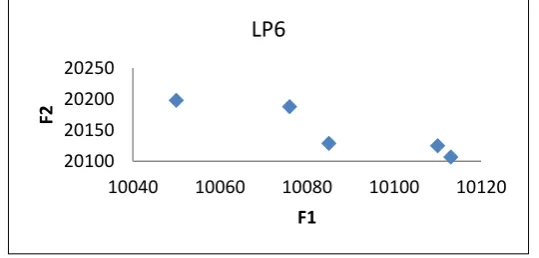
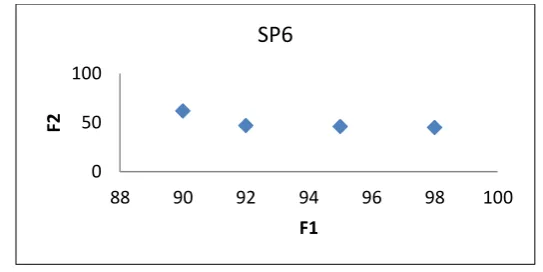
Figure 5 and 6 shows schematic of Pareto solutions set found by the proposed algorithm on two types of small and large problems. As it can be seen that the algorithm is able to find solutions with optimal quality and the found Pareto optimal solutions relatively have good uniformity.
Fig 5 Schematic of the algorithm Pareto solutions in large problem
20100 20150 20200 20250
10040 10060 10080 10100 10120
F2
F1
257
Fig 6 Schematic of the algorithm Pareto solutions in small problem
5.
Conclusion
In this paper, coordination problem in a two-stage supply chain was evaluated with the
aim of reducing the total set-up cost of two stages and increasing the efficiency of the
whole system. In this problem, each job consists of two attributes is processed in the
first stage and then immediately in the second stage that in each stage by changing an
attribute, set-up cost was created. Due to the importance and hardness of the problem in
real-life situations, NSGA-II was implemented to solve the model. Parameter
adjustments were executed using trial and error approach. The results conclude that the
algorithm is able to find optimal Pareto solutions in an appropriate time. Moreover, in
large size problems, the algorithm is also highly efficiency and stability. Future Studies
by considering tasks with more than two attributes can lead to the development of this
article. As well, other meta-heuristic algorithms such as tabu search and ant colony
optimization algorithms can be applied to solve this problem.
6.
References
Agnetis, A., Detti,P., Meloni,C., Pacciarelli,D., (2001). “Set-up coordination between two stages of a supply chain”, Annals of Operation Research, Vol. 107, No. 1-4, pp15-32.
Bredstrom, D., Lundgren, J.t., Ronnqvist, M., Carlsson, D. Mason, A. (2004). “Supply Chain Optimization in the pulp industry-IP Models, column generation and novel Constraint Branchez”, European Journal of Operational Research, Vol. 156, No. 1, pp. 2-22.
Hall, N.G., (2000). “Supply chain scheduling: Batching and delivery” Working Paper, Department of Management Sciences, The Ohio State University, Columbus, OH.
Khosla, I.S., (1995) “Economics and Operations Management: a research perspective”, Journal of Operations Management, Vol. 12, No. 1, pp. 423-436.
Mansouri,A., (2004), “Coordination Of set-ups between two-stages of a supply chain using multi-objective genetic algorithms”, International Journal of Production Research, Vol. 43, No. 15, pp3163-3180.
Mansouri, A., (2006), “A Simulated Annealing Approach to bi-Criteria Sequencing Problem in a two-stage supply chain”, Computer and Industrial Engineering, Vol. 50, No. 15, pp. 105-119.
0 50 100
88 90 92 94 96 98 100
F2
F1
258
Manjo, U.V., Sriskandarajah, E., Wagneur, (2012) “Coordination in a two-stage productionsystem: Complexity, Conflict and Cooperation”, Computers and Operations Research, Vol. 39, No. 6, pp1245-1256.
MirzapourAl-e-hashem S.M.J, Aryanezhad MB, Sadjadi SJ. (2012). “An efficient algorithm to solve a multi-objective robust aggregate production planning in an uncertain environment”, International Journal of Advance Manufacturing Technology, Vol. 58, No. 3, pp. 765–782.
Lee, Y.H., Jeong, C.S., Moon, C. (2002), “Advanced planning and scheduling with outsourcing in manufacturing supply chain”, Computers and Industrial Engineering, Vol. 43, No. 1-2, pp351-374.
Lee, Y.H., Jeong, C.J., Moon, C. (2002) “Advanced planning and Scheduling with Outsourcing in manufacturing Supply Chain”, Computer and Industrial Engineering, Vol. 43, No. 1-2, pp. 351-374.
Sadeghi M, Hajiagha SHR, Hashemi SS (2013). “A fuzzy grey goal programming approach for aggregate production planning”, International Journal of Advance Manufacturing Technology, Vol. 64, No. 1-12, pp. 1715–1727.
Selvarajah, E., Steiner, G. (2006) “Batch Scheduling in a two-level Supply Chain-a focus on the Supplier”, European Journal of operational Research, Vol. 173, No. 1, pp. 226-240.