The Influence of Architecture and Planning of
Regions and Locations of Built Environment on
Solid Waste Management in Developing
Countries
Haruna Abdu Usman PhD
Department of Architecture, Faculty of Environmental Technology Abubakar Tafawa Balewa University Bauchi, Nigeria
ABSTRACT
Municipal solid waste management in developing countries has thwarted the efforts of municipal governments of most developing countries and has continued to deteriorate both the quality of the environment, health and well-being of urban dwellers in these countries. Most researches pointed out the problems to be enormous ranging from inadequate involvement and conceptualization of the role of various stakeholders, fiscal irresponsibility, equipment failure and lack of reliable data to formulate policies. One important aspect which has suffered neglect from the perspective of various researches and has exerted much influence on solid waste management in developing countries is the architecture and planning of regions and locations (built environment). This paper analyze the impacts of architecture and planning parameters exerted on solid waste management in Bauchi metropolis.
Key words; solid waste, architecture and planning,
Bauchi metropolis, solid waste management.
I. INTRODUCTION
Municipal solid waste (MSW) is a term applied to the heterogeneous collections of wastes produced in urban areas. The characteristics and quantity is not only a function of the living standard and lifestyle of the regions inhabitants but also of the abundance and type of the regions natural resource. (UNEP, 2013).
of living in most African countries and development of technology (Dickerson, 1999).
Solid waste has posed a hydra-headed problem beyond the cope of various solid waste management systems in Nigeria. (Geoffrey,2005; cited in Babayemi and Dauda, 2009). As the streets landscape of most urban centers continued to be threatened by scatted waste, researchers and policy makers had dwelled on studies of solid waste management from various perspectives. However, most studies were undertaken in areas other than issues concerning the influence of the built environment on solid waste management systems. This has attributed to the failure of most of the systems. In urban infrastructure provisioning, while energy, water and waste water are channeled through pipes, solid waste are generated and discarded according to public wont. To bridge this academic lacuna, this paper examines some of these studies undertaken by various researchers in urban centers of developing countries in Africa.
dumps and disposals at water ways and along major streets of urban centers. In a similar study in Bauchi metropolis by Ogwuche, (2013), issues concerning the location of solid waste dumps sites were examine using GIS. Amuda et al, (2014), examined the challenges and solution of municipal and local authorities in solid waste management in Nigeria.
There are similar studies also in other African cities that addressed the issues of solid waste management at municipal level. Etengeneng, (2012) dissertation, investigates ways to improve sanitation system through solid waste management in Grahamstown, South Africa. While Moiloa, (2007), investigates solid waste management and its environmental impacts along the urban fringes of Pretoria, republic of south African. While in Ghana, Abagale et al, (2012) determined factors affecting urban solid waste sorting in tamale-Ghana. A holistic approach to urban management and solid waste issues in Africa were discussed by Van Dijk and Kwarteng (2007), at the international solid waste association (ISWA) world congress in Amsterdam.
There are also studies which examines public private partnership (PPP) in solid waste management. A study by Nkya, (2004) examines public private partnership (PPP) and institutional arrangement, constrains for improvement of solid waste management in Dar-Es-Salam. While Awortwi, (2003) and Obirin-Oparah, (2003),cited in Van Dijk and Kwarteng (2007), showed that partnerships provide additional resources to local governments in dealing with solid waste management (SWM).
Issues of SWM in relation to the contributions of community based organizations (CBO), took center stage in studies by authors such as Simon, (2008) who analyzed the activities and performance of the CBOs in dealing with solid waste management using modernized mixtures approach (MMA) in Kinindoni, Tanzania. Impacts of SWM on human health were also examined by authors as Selin, (2013) and Karija et al, (2013) in Mutomo, Kenya and Juba, south Sudan.
From the foregoing, it can be deduced that solid waste management (SWM) processes of generation, storage, collection, treatment, transport and disposal from the households (downstream to the
municipal level up-stream) were explored. However, neither of these studies examines SWM in the context of environmental/urban structure. Shubeler et al, (1996), highlighted that at the level of the built environment, the size and structure of settlement has an important influence on the character and urgency of waste management. The United Nations Habitat (Habitat, 2011), emphasized that failure to consider parameters of each particular location such as architecture and infrastructure has led to many failed systems and wastages of huge sum of money in solid waste management in developing countries. The objective of this paper is to analyze the impacts of architecture and planning factors influencing solid waste storage, collection, transport and disposal in Bauchi metropolis Nigeria.
II.MATERIALS AND METHODS A.Study Area
Metropolis, the headquarters of Bauchi state, is located between latitude 9” 00’ and 9” 30’ North of the equator and longitude 10” 25 and 11” 20’ east of the Greenwich meridian. It occupies a total land area of 3,604.0 hectares. It is about 128km north-east of Jos and 150km west of Gombe town. Bauchi is one of the towns in northern Nigeria within Sudan savannah vegetation zone. It is generally less uniform and grasses are shorter than what is obtainable further south. The topography of Bauchi metropolis is relatively flat in the center. There are ranges of disjointed hills on the north-eastern part of the metropolis.There are two major types of climate in Bauchi, namely the rainy (wet) season and the dry season. The wet season starts from May to October while the dry season covers the remaining part of the year. According to the National Population Commission, (NPC, 2014) Bauchi metropolis is a home to over 421,187 residents of the 653,596 and 6,159, 689 populations of Bauchi local government and Bauchi state respectively.
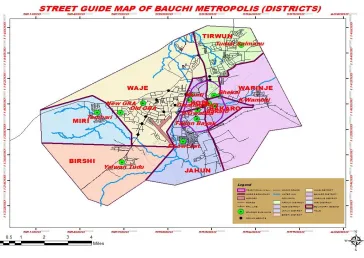
FIGURE 1; BAUCHI METROPOLIS
For the purpose of data collection, the metropolis can be divided into three different population densities; High density areas: The city proper (low income population),Mediumdensity areas: urban agglomeration (medium income areas) and Low density areas: urban transition (high income areas);
i) High density areas: The city proper (low income population); Areas of high density in Bauchi metropolis are those wards and sub-wards in the districts of Jahun, Warinje, Kobi and Bakaro which falls within the old walled city with the exception of those households at the major streets, the areas are characterized by narrow streets, poor drainages, lack of open spaces for waste storage, and poor hygiene. The populations usually living in compounds sharing resources and sometimes household’s members pursue economic and social activities within the household premises to provide for their daily needs and wellbeing. The types of households in these areas usually consist of an extended families, with or without a single household head.
ii) Medium density areas: urban
and situated in a planned environment, with access roads.
iii)Low density areas: (high income areas);These are the government reserved areas (GRAs`), characterized by large compounds, wider set- back and drainages. The populations usually consist of single family households living in the same building each in a separate compound.
II. METHODOLOGY
Bauchi State Environmental Protection (BASEPA) and major waste contractors-cosmopolitan cleaners. Direct observations were used in this research to ascertain actual conditions on household waste management and to corroborate the responses from interviews and questionnaire surveys.
III. RESULTS AND DISCUSSION
A. Solid Waste Generation And Storage;
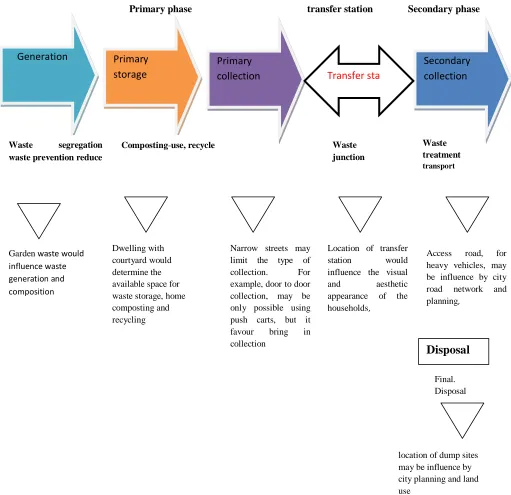
Waste storage involves placing the wastes that are generated in waste storage containers for collection. (Solomon 2011). The type of waste storage containers is significant in waste management at it changes waste generation and variation in waste composition. Also, regional and other local factors affect the amount of solid waste generation arising from an area. These influences include method and frequency of collection, capacity of container, policy on garden waste, and proximity to civic amenity sites and so on, figure 2. The most influential factor that affects solid waste storage in the high density areas is the lack of adequate space for waste storage both at the households and communal level. Waste has to be dispose up frequently to avoid foul smell and for hygiene purposes and this harboured indiscriminate disposals. To curtail this menace, the waste collection agency required households to dump their waste by the road sides for daily collection. However this process lead to more waste generation in the area which made the collection sporadic and insufficient. Tchobanoglous et al. (1993), highlighted that increase frequency in waste collection to some extent results in more waste being generated for collection.
In the medium density areas, most residential buildings occupied an average area of 300-500 meter squares, with little open space, setbacks or they lack courtyards. These affect both domestic and communal waste storage facilities in terms of size, type and location. For example, when waste containers were filled up and could not be timely remove, residence tend to dispose their waste in any available open space outside their premises usually uncompleted buildings.Waste storage in low density areas involved the use of open drums used by households who employed the service of private waste collectors, communal waste bins (wheeled and masonry waste depots), vacant plots and so on. Due to the availability of open spaces as wide setbacks, gardens and lawns, households burnt their wastes in these spaces when their waste could not be removed in a regular way. Based on this survey, about
58 % of the households burnt their waste at their backyards.
B. Solid Waste Collection And Disposal
Communal bin or transfer station made the distinction between the primary and the secondary phase of the solid waste management chain. (Solomon 2011) figure 2. The function of transfer stations is twofold. First it received wastes from households and secondly it function as the point of connection between the primary and secondary phase of waste chain and its main actors. Solomon (2011), reported that (Shubeler et al, 1996) stated that for households to carry their own waste to a transfer station, it needs to be located within easy walking distance of 100 meters. Similarly, (Parrot et al., 2009) noted that the distance between houses and garbage bins affects domestics waste disposal behaviors. One challenging issue that this study found in the study area was the placement or location of a communal bin transfer station. Open/vacant plots, uncompleted building sites, public building like schools, publics drains, road junctions and so on were used as transfer stations, communal bins, or dumping sites. These transfer stations or open dumps are usually child of circumstances. Their distances from the households were not the determinant factors in their location as they are just located on any available spaces accessible by the waste collectors.
In the high density areas of Bauchi metropolis, narrow streets due to the unplanned nature of the areas hampered accessibility for waste collection vehicles. Residents have to transport their waste to the major streets for collection, which in most cases above recommended distances. These lead to poor waste disposal sometimes infringing on the right of way (ROW) of infrastructures such as roads. These, therefore reduce collection efficiency and complicates the waste collection and disposal strategy by the municipal agency. Households in the study area resolved to various available alternatives to discard their waste when not collected by the municipal agency or private contractors.
In the medium density sub-wards, although some of the areas are accessible as in the case of sub-wards of federal low cost houses lack of spaces for citing communal facility, necessitates the use of house to house collection method. However, this service is only provided by private waste contractors who collect waste for a fee. Therefore, those households who depend on public waste collection service have to resort to alternative disposal options.
Primary phase transfer station Secondary phase
Generation Primary storage
Primary collection
Secondary collection
Waste segregation waste prevention reduce
Composting-use, recycle Waste
junction
Waste treatment
transport
Garden waste would influence waste generation and composition
Dwelling with courtyard would determine the available space for waste storage, home composting and recycling
Narrow streets may limit the type of collection. For example, door to door collection, may be only possible using push carts, but it favour bring in collection
Location of transfer station would influence the visual and aesthetic appearance of the households,
Access road, for heavy vehicles, may be influence by city road network and planning,
Disposal
Final. Disposal
. Incineration
location of dump sites may be influence by city planning and land use
Figure 2: Impacts of the physical built environment in solid waste management chain
the residents to travel long distances to discard their wastes at open dumps along the major streets. These encourage illicit and illegal disposals which complicates the waste collection process. Lack of available space for locating communal waste facility at both the medium and low density areas left the unattended waste dumps at vacant plots, uncompleted buildings and public spaces. At domestic level, available spaces as set-backs and backyards encourages waste burning. However, burning of municipal solid waste is detrimental to the built environment as it is a significant source of black carbon as well as carbon dioxide. This study has among other things established that regional factors and nature of the built environment affect solid waste generation, composition, collection and disposal. Consequently, “one size fit all” may not work in solid waste management. Therefore, there is the need for the policy makers, officials and professionals alike to prioritize researches on the impact of physical constrains in every solid waste management system in addition to socio-economic, seasonal and institutional factors. Architects and planners can add value and provide new and specialized services to their clients by “designing in” efficient waste management systems that takes into account the program, building type, geography, occupancy, and any other special circumstances of each individual building and its occupants.
REFERENCES;
1) Abagale, K. F, Mensah, A, and Osei, R. A. (2012); Urban Solid Waste Sorting in a Growing City of Ghana. International journal of environment and sustainability. Vol. 1, No. 4. Pp 18-25
2) Amalu, A. (2014). Appraisal of Solid Waste Management Practices in Enugu City. Journal of Waste Management, 4(1), 97-105.
3) Amuda, O. S, Adebisi, S. A, Jimoda, L. A, Alade, A.O. (2014); Challenges and Possible Panacea to the Municipal Solid Waste Management in Nigeria. Journal of Sustainable Development Studies. Vol.6, No. 1, pp 64-70
4) Augustine, A. and Odhiambo, F. (2009). The Primary Solid Waste Storage Gaps Experienced by Nairobi Households.
Ethiopian Journal of Environmental Studies and Management. 2(3)
5) Babayemi, J.O and Dauda, K.T. (2009). Evaluation of Solid Waste Generation, Categories and Disposal option in Developing Countries a case of Nigeria. Journal Applied Science Environmental Management, 13(3), 83-88.
6) Bogoro, A.G. (2012). The Role of Women in Household Solid Waste Management in Bauchi Metropolitan Area. Bauchi: Unpublished Ph.D Thesis Abubakar Tafawa Balewa University, Bauchi.
7) Etengeneng, D. (2012); Municipal Solid Waste Management in Grahamstown, Republic of South Africa. Unpublished Bachelors theses. University of Applied science. South Africa. 8) Moila, L. R. (2007); Solid Waste Management in Urban
Fringe Settlements. The case of Winterveld, Pretoria. Master of Science Dissertation, University of Pretoria.
9) Ndum, A.E. (2013). Bottom-up Approach to Sustainable Solid Waste Management in African Countries:. Cottbus: Unpublished Ph.D Thesis The Case of Buea-Camaroon, Brandenburg University of Technology, .
10) Nkya, E. (2004). Public Private Partnership and Institutional Arrangements; Constrain for Improvement of Solid Waste Management in Dar-es-Salam,. Uongozi Journal of Management Development, 16(1), 1-21.
11) Ogwuche, J. and Yusuf, F.A. (2013). Spatial Location of Solid Waste dump sites and Collection Scheduling using GIS in Bauchi Metropolis Nigeria. European Journal of Scientific 9(11) ISSN:1857-7831(print) 374-382.
12) Schubeler, P. Wehrle, K and Christen J. (1996) Conceptual Framework for Municipal Solid Waste Management in low Income countries. SKAT/UNDP/UNCHS (Habitat) World Bank/SDC.
13) Stanley, A.M., Andrew, S.S., Dania, A.A. and Sani, F.I. (2012). An Assessment of Household Solid Waste Disposal Practices in Sabon Gari Zaria. Journal of Environmental Technology, Abubakar Tafawa Balewa University, Bauchi 5(1)8-12
14) Simon, A. (2008). Analysis of Activities of copany Based Organization Involved in solid was Management.Investigating Modernized Mixtures Approach. Tanzania: The Nertherland;Wageningen University.
15) Solomon, A. (2011). The role of Households In Solid waste Management (Vol. 4). East Africa: The Nertherlands. 16) Tchnobanoglous, G. (1993). Integrated Solid Waste
Managment. New York: Engineering Principles & Management Issues.
17) UNEP, (2013). Global Environmental Alert Services (GEAS).
UNEP .
18) Udoakah, Y. and Akpan, U. (2013). "Sustainable Approach to Municipal Solid Waste Magement in Sourthern Nigeria. Proceedings the Institute of Electrical Electronics Engineering (IEEE) Global Humanitarian Technology Conference (GHTC) California USA 201-210