R E V I E W
Open Access
A survey of studies in systemic functional
language description and typology
Isaac N. Mwinlaaru
1*and Winfred Wenhui Xuan
2* Correspondence:isaac. [email protected]
1Polysystemic Research Group, Department of English, The Hong Kong Polytechnic University, Hung Hom, KWL, Hong Kong
Full list of author information is available at the end of the article
Abstract
Systemic functional theory embodies a multilingual perspective to language from its earliest formulation. However, it was not until the last two decades that descriptions of languages other than English, particularly in the light of language typology, garnered much interest among scholars working with systemic theory. The objective of the present study is to survey the growing literature in this field. The survey consists of two main parts. The first part discusses theoretical developments in relation to language description and typology. The second part presents a meta-analysis of empirical studies in the field. The meta-analysis examines the historical progress in systemic typology and description of non-Anglo languages, the coverage of descriptions in terms of areal and genetic language families, mode of publication and, finally, methodological procedures employed by the studies. Challenges arising from these analytical decisions are also examined. The motivation for the study is to provide a state of the art review of the field in order to guide new descriptions and draw implications for further research in functional language typology, in general, and systemic typology, in particular.
Keywords:Functional language typology, Language description, History of linguistics, Meta-analysis, Meta-theory, Multilingual studies, Systemic functional theory
Introduction
For the past two decades, the description of languages other than English, in general, and language typology, in particular, has increasingly garnered much interest in sys-temic functional linguistics (SFL). The objective of the present study is to give a carto-graphical overview of the growing literature in this field. The focus of the study is on languages other than English. The practical reason for this is to narrow down the stud-ies to a manageable scope, given the fact that descriptions on English have already pro-duced a large volume of materials (For a review of studies on English grammar, see Matthiessen 2007a).
The primary motivation behind the study is two-fold. The first is to systematically lo-cate and profile available resources, in terms of theoretical guidelines and methodo-logical procedures, in the extant literature in order to guide new research endeavours in this area. The second motivation is to profile developments in systemic language de-scription and typology since the 1960’s for the purpose of showing research areas that have been covered, limitations and challenges, and pointing to gaps for further re-search. Thus, the approach we adopt here is a meta-analysis rather than making typo-logical generalisations (see e.g. Matthiessen and Christian (2004); Teruya et al. (2007)
© 2016 The Author(s).Open AccessThis article is distributed under the terms of the Creative Commons Attribution 4.0 International License (http://creativecommons.org/licenses/by/4.0/), which permits unrestricted use, distribution, and reproduction in any medium, provided you give appropriate credit to the original author(s) and the source, provide a link to the Creative Commons license, and indicate if changes were made.
Mwinlaaru and XuanFunctional Linguistics (2016) 3:8
and Matthiessen et al. (2008) for typological generalisations). In many parts, the paper also discusses other functional approaches to typology and shows how these interact with and contribute to the growing body of studies in systemic functional language typ-ology (hereafter,‘systemic typology’).
The rest of the paper is organised into four sections. The first section discusses theor-etical developments in SFL language description and typology and the second section describes the methods and procedures employed in compiling and analysing empirical studies for the survey. In the third section, we present the meta-analysis of studies in SFL language description and typology since the 1960’s. The final section concludes the paper.
Theoretical developments in systemic language description and typology As mentioned above, typological research is increasingly becoming prominent as a de-scriptive component of SFL. For the past decade, a few scholars have mapped out the theoretical and methodological tenets of systemic typology (e.g. Caffarel et al. 2004: Ch. 1; Teruya et al. 2007; Matthiessen et al. 2008; Teruya and Matthiessen 2015). In this section, we outline some of the theoretical issues that have been discussed. We first dis-cuss the conception of the relationship between linguistic theory, language description and application and then examine characteristics of systemic typology and how it inter-acts with and is influenced by other functional typological approaches.
Linguistic theory, language description and application
Systemic functional linguistics was meant to be a holistic theory of language from the very start. In the 1950’s, Halliday (1957) noted the need for a‘general linguistic theory’ that would be holistic enough to guide empirical research in the broad discipline of lin-guistic science:
…the need for ageneraltheory of description, as opposed to auniversalscheme of descriptive categories, has long been apparent, if often unformulated, in the description of all languages (Halliday 1957: 54; emphasis in original).
If we consider general linguistics to be the body of theory, which guides and controls the procedures of the various branches of linguistic science, then any linguistic study, historical or descriptive, particular or comparative, draws on and contributes to the principles of general linguistics (Halliday 1957: 55).
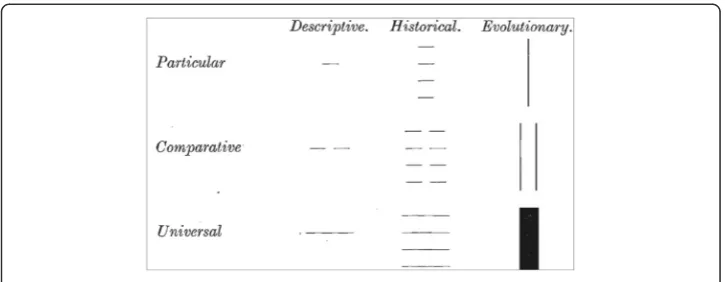
This call for a general theory was echoed by other scholars, notably the American psycholinguist Charles Osgood (cf. Osgood 1966). Halliday (1957) aligned the principles of such a theory with the system and structure framework that was being developed by J. R. Firth (see e.g. Firth 1957). As Fig. 1 shows, the demands on the theory he envis-aged broadly cover the core aims of linguistic science (i.e. the horizontal dimension) and the scope of the material typically covered in different linguistic investigations (i.e. the vertical dimension).
There were doubts during the 1950’s whether the universal dimension of language was ‘on the agenda’of linguistic investigation (Halliday 1957: 56). In the 1960’s, how-ever, the historic Conference on Language Universalsput this firmly on the agenda (cf.
the contributions in Greenberg 1966a). Recent studies have further opened up new frontiers of linguistic research on the evolution of human language (e.g. Heine and Kuteva 2002a, 2007).
Halliday’s (1961)Categories of the Theory of Grammarwas a response to the need for a general theory of language (also see Dixon’s (1963) formulation of it in logical terms). Following J. R. Firth (e.g. Firth 1957), he named the framework sketched in this article ‘General Linguistic theory’ and it gave birth to what became known as scale and cat-egory grammar and, subsequently, systemic functional linguistics (cf. Matthiessen 2007b). Further following insights from Hockett’s (1965) notions of ‘deep grammar’ and ‘surface grammar’and partly in response to transformational-generative grammar (e.g. Chomsky 1966), Halliday (1966a) emphasised the natural relationship between grammatical meaning and grammatical structure and considered meaning as the under-lying essence of language, which structurerealises(see also Hopper (1987, 1996); Bybee et al. (1994) for similar views).
With this perspective, priority was given to the paradigmatic organisation of language as the primary focus of linguistic description, and structure is analysed subsequently as a realisation of features (i.e. grammatical meanings such as ‘present’,‘past’&‘future’) in systems (such as TENSE and TRANSITIVITY). This theoretical development is very important to language typology. By giving primacy to meaning, the theory is free from the constraints of the structure of any one language (Matthiessen 2014). Linguists are then able to explore the differences and similarities across languages in their realisation of various grammatical meanings since languages tend to be more similar in terms of the range of meanings they construe than in their structural realisation of these mean-ings. The need for such a meaning-oriented approach to language, particularly in multi-lingual research, has also been articulated by experienced functional typologists since the 1960’s (cf. Jakobson 1966; Croft 1990; Haspelmath 2010a, b).
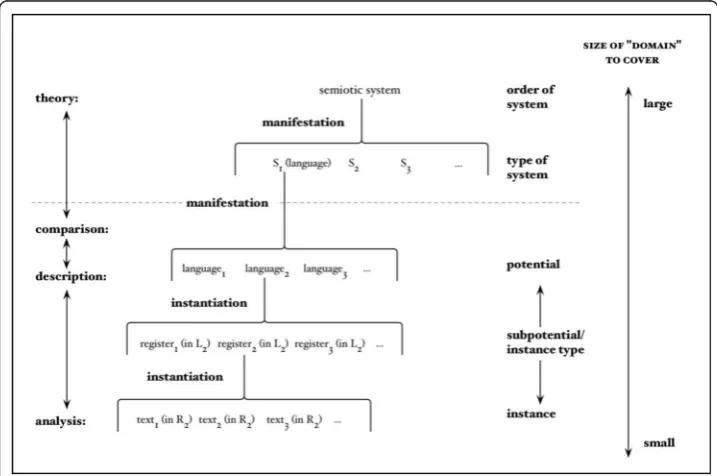
The basic theoretical formulations Halliday (1961) outlines were partly informed by his description of Chinese (e.g. Halliday 1959; Halliday 2005a) and became the basis for the descriptions of English (e.g. Halliday 1967a, b, 1968, 1974, 1984a, b; Halliday and Matthiessen 2014) and other languages (e.g. Huddleston and Uren 1969; Hudson 1973). From the very beginning, therefore, theory and description have been kept apart as two complementary resources for linguistic research and its application (Halli-day 1996, 2008; Caffarel et al. 2004: Ch. 1; Matthiessen 2007b). The formulation of the relationship between theory and description is presented in Fig. 2.
Fig. 1Empirical scope of General Linguistic theory (Halliday 1957: 56)
Theory is adesignedsystem, consisting of concepts that are systematically organised towards achieving potentially explicit goals (Halliday 1996, 2009). Specifically, SFL the-ory is designed as an enabling resource to guide particular descriptions, either of indi-vidual languages or a number of languages. The theory does not posit universal linguistic categories or structures for language; rather it provides a road map for identi-fying, describing and profiling categories and structures of particular languages, or any number of languages, in a systematic manner. For instance, although the theory posits that every language organises its lexicogrammatical resources into a fixed, identifiable number of ranks, it does not claim the universality of specific ranks such as clause, phrase/group, word and morpheme (Caffarel et al. 2004: Ch. 1). Every language is con-sidered as a unique manifestation of the semiotic system called language and‘categorial’ (or class) and structural labels must emerge from the context of the actual description of a language, although these categories are often based on a transfer comparison from existing descriptions of other languages (cf. Caffarel et al. 2004: Ch. 1). Likewise, the ex-tent to which languages are different and/or similar in terms of lexicogrammar and any aspect of language, for that matter, must emerge from the context of typology-oriented descriptions, descriptions that are essentially informed by a comparison of different lin-guistic systems.
This differentiation of a general theory of language from universal regularities of lin-guistic phenomena corroborates Osgood’s (1966: 300) conception of theory as“a higher level description”, defined as“a set of principles, which economically and elegantly, en-compasses the whole set of functions” displayed by human languages. In this regard, Osgood (1966: 301–302) emphasised the need to distinguish between two kinds of uni-versals in linguistic research as follows:
Fig. 2Analysis, description, comparison and theory in relation to one another (Matthiessen 2013a: 141), used by permission of ©Equinox Publishing Ltd. 2013
U1.Phenotypes: empirical generalizations that hold for all languages.[…] U2.Genotypes: theoretical generalizations, principles in a theory of language behaviour, that hold for all languages…the fundamental laws governing the production of semantic regularities, the production of grammatical regularities, the source of language change (emphasis in original).
Systemic functional theory maps out the ‘genotypic’constitution of language. It is in this sense that it is a ‘general theory of language’ (cf. Halliday 1961, 2009). As Fig. 2 shows, the two generalisations,‘phenotype’and ‘genotype’, are, however, not unrelated; theory is an abstraction from various descriptions, or, in other words, observable regu-larities across languages (see also Caffarel et al. 2004: Ch. 1; Matthiessen 2007b, 2013a). When we move a step further down from theory, we observe that description itself is an abstraction of, or rather, a generalization from the analysis of particular text in-stances in language (see Fig. 2) –and, in the context of typology, a generalisation from descriptions of various languages. Language is observable as text, defined as spoken or written discourse (and, by extension, other semiotic resources such as sign language or image). Text, therefore, serves as the entry point for investigators into the linguistic system they want to describe. A comprehensive description will be based on texts across different registers in the relevant speech community. However, a description may also be limited to some register (i.e. a sub-system) in the community (e.g. see Patpong (2006a) for a description of Thai folktales). In either case, the description needs to be informed by the analysis of particular discourses and the analyst will have to shuffle between developing general categories and features (i.e. description) and test-ing them on text instances (i.e. analysis).
Descriptions are considered as resources that can be applied in solving problems that are linguistic in nature. SFL descriptions have mainly been used in the context of edu-cation (e.g. Martin et al. 1987; Torsello et al. 2005; Rose and Martin 2012). Other areas they have also been applied to are translation (cf. Steiner 2002; Kunz et al. 2014 and references therein), literary stylistics (cf. Lukin and Webster 2005; Simpson 2014; Mwinlaaru 2014; Lukin 2015) computational linguistics (cf. Fawcett 1981; Henrici 1981; Matthiessen and Bateman 1991; Fawcett et al. 1993; O’Donnell and Bateman 2005), healthcare (e.g. Armstrong et al. 2005; Slade et al. 2008, 2015; Matthiessen 2013b), judi-cial contexts (e.g. Martin et al. 2013), (critical) discourse studies (e.g. Cloran et al. 2007; Edu-Buandoh & Mwinlaaru 2013) and biblical studies (e.g. Xue 2015).
It is important to distinguish between descriptions and their applications in different contexts (cf. Matthiessen 2007b, 2013a; Thompson 2013). This is because some de-scriptions are particularly aimed at solving problems in specific contexts and these have the tendency of being narrow and constrained in such a way that they may limit our understanding of the language described. This observation does not undermine the relevance of context-specific descriptions. It rather draws attention to the need to dif-ferentiate between what is described, language, and the phenomenon for which the de-scription is done (Halliday 2009). An investigator who does not make this distinction may end up describing the former as though it were the latter.
One area in which this distinction has proved useful in SFL context is computational application and artificial intelligence. In these areas, descriptive categories have had to be converted into mathematical formalizations and abstractions in order to make them
explicit and machine friendly (cf. Henrici 1981; Matthiessen and Bateman 1991; Faw-cett et al. 1993; O’Donnell and Bateman 2005). These abstract formalizations render the description most effective for application in this context. However, they cannot be taken as the best descriptive representations of language. O’Donnell and Bateman (2005), for instance, note two competing motivations in the computational applications of systemic functional grammar. While text generation is richly enhanced by the plex functional diversity in SFL descriptions, this complexity poses a challenge to com-putational parsing, which favours a less complex, syntagmatically oriented grammar. Applications in this latter context would, therefore, have to simplify the grammar of natural language by pushing it towards form (or syntagm) or by focusing on one func-tional dimension of structure such as the modal structure of the clause (which, for English, is Subject + Finite + Predicator + Complement + Adjunct) or, even, some com-bination of the two.
It must be noted, however, that applications are a testing ground for the power or the reliability and validity of language descriptions. They inform descriptions and guide de-scriptive linguists in revising their analysis. One thing the various applications of sys-temic grammars have taught us is to make our description of categories and their identification characteristics as explicit as possible, although explicitness is achievable only to the extend that the fuzzy nature of language allows. As an appliable theory, SFL takes language in its social context as essentially its primary object of inquiry while be-ing sensitive to other systems language interacts with (i.e. physical, biological and social systems) as well as the potential uses of descriptions.
Systemic functional language typology
In this section, we proceed to discuss the characteristics and scope of systemic typ-ology. Due to space constraints, the discussion will mainly be based on issues related to language typology rather than the SFL theory itself. (For a detailed discussion of the theory, see e.g. Halliday 1966a, b, 2003, 2005b, 2008; Martin 1987, 2013, 2016; Matthiessen 1992; 2007; 2015a; Halliday and Matthiessen 1999; Matthiessen and Halliday 2009). Works that are directly related to our present discussion are Caffarel et al. (2004: Ch. 1); Matthiessen et al. (2008); Matthiessen (2014, 2015b); Teich (2002) and Teruya and Matthiessen (2015).
We should mention from the onset that systemic typology is not a separate sub-discipline of linguistics but, rather, a theoretical approach to the broad research agenda of contemporary language typology as developed by Joseph Greenberg (e.g. Greenberg 1966b) and extended by Talmy Givón (e.g. Givón 1983), Bernard Comrie (e.g. Comrie 1976) and others (e.g. Hopper and Thompson 1980; Heine et al. 1991; Dryer and Has-pelmath 2013). Systemic typology essentially belongs to this functional-typological trad-ition (see further below for details). In other words, it is the study of language typology from the perspective of SFL theoretical dimensions of language.
This means that, first, research in systemic typology is sensitive to themetafunctional
diversity in language (see Fig. 3). That is, both linguistic meanings and their realisations by form or structure simultaneously embody three core functions, namely ideational (i.e. the representation of experience and logical relations), interpersonal (the enact-ment of social identities, roles and relationships in discourse) and textual (the
packaging of information flow into a consumable text). Second, it recognises that the strata of language are related as a hierarchy ofrealisation; comprising, in their respect-ive order of realisation, semantics (including pragmatic meaning), lexicogrammar, phonology and phonetics and embedded in social context. In addition, it considers the internal organisation of each strata of language as a rankof units related by constitu-ency (e.g. clause, phrase/group, word and morpheme for English lexicogrammar). Fur-ther, it organises the realisation of linguistic systems (e.g. MOOD, INFORMATION FOCUS) into a scale ofdelicacysuch that the description of features within one system tends to be accumulative (e.g. indicative: declarative: non-exclamative/exclamative for the English MOOD system). Finally, it takes description to be a generalisation of the linguistic characteristics of text instances or, in other words, the regularities of the uses of linguistic forms in discourse.
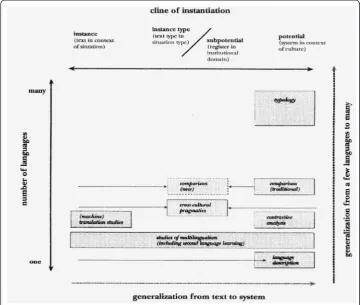
SFL considers language typology to be part of a broader research area, namely multi-lingual studies (see Fig. 4). In addition to language typology, multimulti-lingual studies com-prise contrastive analysis, comparative linguistics and, as a limiting case, the description of individual languages other than English (Caffarel et al. 2004: Ch. 1; Mat-thiessen et al. 2008; Teruya and MatMat-thiessen 2015).
As Fig. 4 shows, these different domains of multilingual studies can be situated along a cline, with typology and description of single languages at extreme poles of the con-tinuum (cf. Matthiessen et al. 2008). The relationship between the two extremes is analogous to that between ‘text analysis’and ‘language description’as discussed under “Linguistic theory, language description and application” above. Typology starts with the systematic description of linguistic systems of individual languages and these de-scriptions are then compared to identify cross-linguistic or universal tendencies for generalisations about language. In essence, the description of individual languages nor-mally has an added objective of making typological statements about the language
Fig. 3The hierarchy of stratification showing metafunctional diversity and the rank scale of English lexicogrammar
described (Caffarel et al. 2004: Ch. 1). Languages that have been described from this perspective include inter alia Arabic (Bardi 2008) Bajjika (Kumar 2008), Chinese (Tam 2004; Li 2007), French (Caffarel 2004, 2006), German (Steiner and Teich 2004), Japa-nese (Teruya 2007), Oko (Akerejola 2005), Pitjantjatjara (Rose 2004a; b), Spanish (Quiroz 2008, 2013), Tagalog (Martin 1996a, b) and Thai (Patpong 2006a).
Systemic linguistics defines the main goal of language typology itself as mainly identi-fying cross-linguistic regularities in systems (e.g. MOOD, MODALITY) and their rea-lisations. This approach follows the tradition exemplified by Comrie’s (1976) study on aspect and Hopper and Thompson’s (1980) famous study on transitivity in discourse. Within SFL, notable examples of this aspect of typology are Matthiessen (2004); Teruya et al. (2007); Matthiessen et al. (2008); Wang and Xu (2013) and Teruya and Matthies-sen (2015). Besides systems, however, Systemic typology, among others, profiles gram-matical units across languages (e.g. Sutjaja 1988; Mock 1969; Boxwell 1995; Ochi and Lam 2010; Matthiessen et al. 2016) and the lexicogrammatical resources that construe particular domains of experience such as motion, emotion and space (e.g. Matthiessen and Kashyap 2014; Matthiessen et al. 2015).
Between the typological and language specific poles of linguistic description, we can locate contrastive analysis and comparative linguistics (see Fig. 4). Contrastive analysis dates back to the work of Robert Lado in the 1950’s. It was originally introduced
Fig. 4Description, contrastive analysis, comparison and typology in relation to sample size and instantiation (Matthiessen et al. 2008: 149), used by permission of ©Bloomsbury Publishing Plc.
to support the development of materials and techniques for second language edu-cation (Lado 1957). In simple terms, it systematically compares a description of the native language of a second or foreign language learner with a description of the target language to be learned in order to predict areas of familiarity and difficulty to the learner. This approach was heavily criticised by transformational-generative theorists and was replaced by error analysis (Corder 1967) and interlanguage studies (e.g. Hyltenstam 1977).
As Matthiessen (2015b) notes, however, since the last two decades, there has been a renewed interest in contrastive analysis, particularly, in the contexts of translation stud-ies (including machine translation) and multilingual language description. This resur-gence of contrastive analysis is of interest to SFL as an appliable theory of language. Contrastive analysis is integrated into the SFL’s descriptive scope as part of its multilin-gual project and, so far, studies have contrasted English with languages such as Spanish (e.g. Lavid et al. 2010), Swedish (Holmberg and Karlsson 2006) and French (Caffarel 2006). There is also a new interest in applying SFL contrastive analysis in developing materials for language education. An example of this is the ongoing Bilingual Academic Language Development (BALD) project on English and Spanish by Andrés Ramírez (Florida Atlantic University) and Luciana de Oliveira (University of Miami) (cf. Ramírez 2015, personal communication).
While contrastive analysis often involves two languages,‘language comparison’often involves more than two languages. As Fig. 4 shows, two approaches to language com-parison can be identified in linguistic science, namely ‘comparative linguistics’ and ‘cross-cultural pragmatics’(cf. Matthiessen et al. 2008; Teruya and Matthiessen 2015).
Comparative linguistics began to develop in the 18thand 19th century and became popular in the 1960’s and 1970’s, as an approach to historical linguistics. Its objective is to compare a group of languages that are either genetically or geographically related in order to reconstruct their diachronic development and/or a common ancestor. It has been important in clarifying the grouping of languages into families. Examples are Givón’s (1971a; 1971b; 1975; 1979) studies on Bantu languages. Currently, no compara-tive linguistic study, in its traditional sense, has been done within the context of SFL (but see Teich (2002) for a comparative study of five European languages in the context of translation). However, as studies on languages within the same language family or re-gion are growing, this could be a rich research area for applying systemic functional theory. For instance, a comparative description of systems and regularities in their realisations as is exemplified by Matthiessen (2004) could be an important contri-bution to testing and validating the classification of languages into families.
Although language comparison has traditionally been associated with ‘comparative linguistics’, studies in cross-cultural pragmatics have revealed a rich body of knowledge on semantic (including pragmatic meaning) and lexicogrammatical regularities in enacting relationships and identities across languages and cultures (see Matthiessen et al. (2008) for a detailed discussion). Classic research in this area includes Brown and Gilman (1960) and Brown and Ford (1961) on address terms, and Brown and Levinson (1987) on politeness. The preoccupation with interpersonal meaning and lexicogram-matical resources in this tradition shares much with the attention given to MOOD and resources for negotiation and modal assessment across languages in systemic research (cf. Matthiessen 2004; Teruya et al. 2007; Quiroz 2013).
It should be emphasised that whatever approach is adopted, multilingual research (in-cluding typology) in SFL emphasises a holistic or an ecologically sensitive approach to the language(s) described. This can be understood in two ways. First, description should ideally be based on (or, at least, be sensitive to) whole systems (e.g. ASPECT, EVIDENTIALITY, PROJECTION), units (e.g. noun class, verbal group, clause), or ex-periential domains (e.g. motion, possession, space, etc.), just to mention a few. In this way, the description of individual lexicogrammatical items are meaningfully related to their systemic environment rather than been presented as isolated fragments or, to use Weinreich’s (1966: 144) term, in order to avoid reducing description to the ‘atomization’of linguistic items in want of explanation.
The second way is to have a ‘trinocular’ perspective on the forms described, from above, from below and from roundabout (Halliday 1996). On the dimension on stratifi-cation and with the clause as our unit of analysis, this means examining: (i) the mean-ing (e.g. speech function) realised by configuration of elements such as Subject and Finite in the English clause, (ii) the realisation of these elements by lower units such as group/phrase and word, or phonologically, and (iii) how the elements of the clause itself are patterned for the realisation of the particular meaning. On the dimension of instantiation, a trinocular vision means examining whether a grammatical or linguistic phenomenon is: (i) systemic–applies to the whole language as a system (ii) instantial– limited to a particular context of situation or (iii) register or genre specific – a characteristic of a cultural institution or a situation type. Finally, on the dimension of axis, a trinocular vision requires the analyst to identify: (i) the systemic feature a particular structure or element realises, in Saussurean terms, its valeur; (ii) the morphological and/or phonological realisation of the element (or elements) in a structure; and (iii) other features in the systemic environment. The purpose of a trinocular vision is to ensure a fuller and reliable description.
Systemic typology in relation to other approaches
SFL, in general, and systemic typology, in particular, have developed in interaction with many different approaches to language study. We limit our discussion here to connec-tions with a few other functional approaches that interact with and/or influence typ-ology research in systemic linguistics.
The immediate context for the concern with and development of language typology in SFL is the multilingual orientation of Firthian linguistics in the 1950s and 1960s (cf. Firth 1957) as well as Michael Halliday’s initial preoccupation with the description of Chinese (e.g. Halliday 1956, 1959).
The basic outline of the research agenda for language typology in SFL is, however, provided by Prague school typology. We can identify a few currents that research in systemic typology inherits from the Prague school. These are the importance placed on theory as an enriching and empowering resource in typological generalisations; em-phasis on the functional or meaning-oriented interpretation of language phenomena; the orientation towards paradigmatic organisation (i.e. systems); the conception of lan-guage typology as a multidimensional mapping of lanlan-guages; and the emphasis placed on empirically based typology (cf. Jakobson 1966; Teruya et al. 2007). In a classic paper published in the landmark report of the Conference on Language Universals, Jakobson
(1966) stated what can be regarded as the primary goal of typology in SFL and is worth quoting here:
A cautious and unremitting search for the intralingual and therewith interlingual semantic invariants in the correlations of such grammatical categories as, for example, verbal aspects, tenses, voices, and moods becomes indeed an imperative and perfectly attainable goal in present-day linguistic science. This inquiry will enable us to identify equivalent grammatical opposition [i.e. systems] within“languages of differing structure”and seek the universal rules of implication which connect some of these oppositions [i.e. systems] with one another (glosses ours, p. 272).
He continues:
We most urgently need a systematic world-wide mapping of linguistic structural prop-erties: distinctive features, inherent and prosodic–their types of concurrence and con-catenation; grammatical concepts [i.e. grammatical features, in SFL terms] and the principles of their expression [i.e. realisation, in SFL terms]. (glosses ours, p. 274)
The pursuit of the typological aspect of these goals in systemic linguistics has, how-ever, been slow, partly due to practical reasons (see Caffarel et al. 2004: Ch. 1 for de-tails), and partly because description of individual languages antedates language typology of the kind described here.
Matthiessen’s (2004) classic paper, which maps out systemic generalisations and‘ im-plicational motifs’ (rather than ‘rules’ as in the quote from Jakobson (1966) above), drawing on at least 160 languages, is an enormous contribution to this goal. Matthies-sen (2004: 544 – 553) provides an alternative analysis to Greenberg’s (1966b) word-order typology. He shows that the variations in the syntagmatic sequence of elements in the clause reflect different strategies by which languages manage metafunctional di-versity in the clause. This insightful account resonates with Casagrande’s (1966) pro-posal for the study of cross-linguistic regularities in the sequencing of clause elements as ‘universal alternatives’, which he describes as“a limited set of alternative solutions to a problem, one or more of which may be used in a particular language” (Casagrande 1966: 290; see also Fillmore 1968: 2 for a related position) In our context, the semiotic problem at hand with regards to word-order is the need to manage interaction and en-act negotiation in the clause.
Matthiessen (2004), among other things, reveals that, the placement of Predicator in the clause tends to correspond with or suggest the position of the clause where interpersonal meaning is prominent. In languages where the Predicator typically occurs at the beginning such as Arabic and Tagalog, the initial position of the clause is normally interpersonally prominent and, for that matter, interpersonal resources such as finiteness markers and ne-gotiation particles are also typically placed at this position. In languages such as Japanese where the Predicator is final, interpersonal meaning is prominent at the final position. Languages like English present a rather complex phenomenon. The Predicator occurs in medial position, while the Finite element either precedes (Finite ^ Subject ^ Predicator) or follows (Subject ^ Finite ^ Predicator) the Subject to show mood contrast between inter-rogative and declarative clauses respectively.
Outside SFL, the World Atlas of Language Structures (WALS) developed by a team of 55 scholars and maintained by the Max Planck Institute for Evolutionary Anthropol-ogy, is an enormous contribution to the semiotic mapping of languages as envisaged by Jakobson (1966) (cf. Dryer and Haspelmath 2013). This is a database of phonological, grammatical and lexical properties of a large number of languages based on reference grammars and other descriptive materials (see http://wals.info). It also includes rich typological information on a wide range of the world’s languages. Apart from the fact that it is a great scholarly contribution in its own right, WALS serves as a rich data-bank for research in language typology.
Systemic typology, in its current development, is part of the functional-typological tradition that developed from the work of Joseph Greenberg and follows the historic
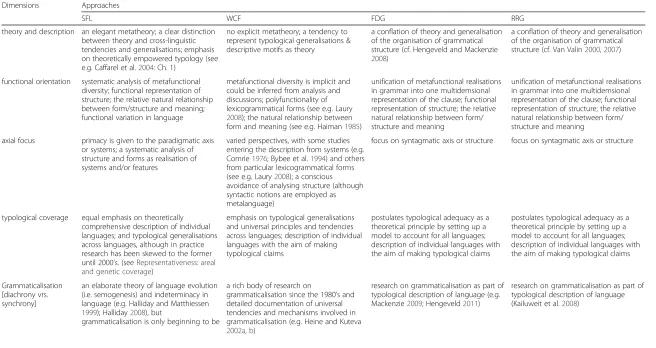
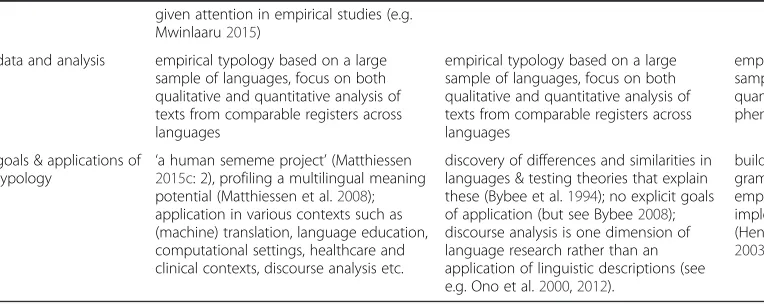
Conference on Language Universals (cf. Greenberg 1966a). This functional-typological tradition, in its loose sense, includes typological research from different functional ap-proaches to language, such as cognitive grammar (including construction grammar), Functional Discourse Grammar (FDG) and Role and Reference Grammar (RRG). There is however a relatively distinctive research group within this tradition that is normally referred to as West Coast Functionalism (WCF), exemplified by the work of Talmy Givón, Paul Hopper, Sandra Thompson, John Haiman, Bernd Heine and their team of researchers (also see Butler 2003a). This research group has been at the forefront of language typology since the 1980’s. Table 1 outlines some key characteristics of studies in language typology within WCF, FDG and RRG in relation to SFL oriented typology.
SFL theory shares many theoretical principles with West Coast Functionalism such as the lexis-grammar continuum, the polyfunctionality of linguistic items, the relative non-arbitrary relationship between grammar and meaning, the organisation of language on paradigmatic and syntagmatic axis, and the evolving nature of language, in general, and, in particular, the fact that grammar emerges out of language use. These similarities are hardly surprising since both approaches have roots in Prague school linguistics, es-pecially through connections with Roman Jakobson.
In terms of typology, both frameworks emphasise empirical typology based on large samples of languages; qualitative and quantitative analysis of texts from comparable registers across languages; and the importance of grammaticalisation in the study of languages (Teruya and Matthiessen 2015). It should, however, be noted that grammat-icalisation has not been given enough attention in descriptive and typology research in SFL (cf. Taverniers 2015). SFL contribution in this area would be a system-oriented study of grammaticalisation within and across languages. That is, how do the different features in grammatical systems in languages and their realisations evolve? (See, how-ever, Cummings (2015) analysis of the evolution of tense in English from an SFL perspective).
One difference between SFL and WFC is SFL’s commitment not only to the meanings and functions of lexicogrammatical resources but a systematic analysis of the structure of clauses and other grammatical units (and, indeed, the units of other strata such as phonology) that realise these meanings. Such a structural analysis does not only con-tribute to a fuller understanding of language form and function, but is very necessary for the description to be useful for various purposes of application.
But this interest in structure is one of the characteristics that connect SFL with FDG and RRG (see Table 1). Butler (2003a, b) highlights this connection by classifying the
Table 1SFL in relation to other functional approaches to language typology
Dimensions Approaches
SFL WCF FDG RRG
theory and description an elegant metatheory; a clear distinction between theory and cross-linguistic tendencies and generalisations; emphasis on theoretically empowered typology (see e.g. Caffarel et al.2004: Ch. 1)
no explicit metatheory; a tendency to represent typological generalisations & descriptive motifs as theory
a conflation of theory and generalisation of the organisation of grammatical structure (cf. Hengeveld and Mackenzie
2008)
a conflation of theory and generalisation of the organisation of grammatical structure (cf. Van Valin2000,2007)
functional orientation systematic analysis of metafunctional diversity; functional representation of structure; the relative natural relationship between form/structure and meaning; functional variation in language
metafunctional diversity is implicit and could be inferred from analysis and discussions; polyfunctionality of lexicogrammatical forms (see e.g. Laury
2008); the natural relationship between form and meaning (see e.g. Haiman1985)
unification of metafunctional realisations in grammar into one multidemsional representation of the clause; functional representation of structure; the relative natural relationship between form/ structure and meaning
unification of metafunctional realisations in grammar into one multidemsional representation of the clause; functional representation of structure; the relative natural relationship between form/ structure and meaning
axial focus primacy is given to the paradigmatic axis or systems; a systematic analysis of structure and forms as realisation of systems and/or features
varied perspectives, with some studies entering the description from systems (e.g. Comrie1976; Bybee et al.1994) and others from particular lexicogrammatical forms (see e.g. Laury2008); a conscious avoidance of analysing structure (although syntactic notions are employed as metalanguage)
focus on syntagmatic axis or structure focus on syntagmatic axis or structure
typological coverage equal emphasis on theoretically comprehensive description of individual languages; and typological generalisations across languages, although in practice research has been skewed to the former until 2000’s. (seeRepresentativeness: areal and genetic coverage)
emphasis on typological generalisations and universal principles and tendencies across languages; description of individual languages with the aim of making typological claims
postulates typological adequacy as a theoretical principle by setting up a model to account for all languages; description of individual languages with the aim of making typological claims
postulates typological adequacy as a theoretical principle by setting up a model to account for all languages; description of individual languages with the aim of making typological claims
Grammaticalisation [diachrony vrs. synchrony]
an elaborate theory of language evolution (i.e. semogenesis) and indeterminacy in language (e.g. Halliday and Matthiessen
1999); Halliday2008), but
grammaticalisation is only beginning to be
a rich body of research on
grammaticalisation since the 1980’s and detailed documentation of universal tendencies and mechanisms involved in grammaticalisation (e.g. Heine and Kuteva
2002a,b)
research on grammaticalisation as part of typological description of language (e.g. Mackenzie2009; Hengeveld2011)
research on grammaticalisation as part of typological description of language (Kailuweit et al.2008)
Table 1SFL in relation to other functional approaches to language typology(Continued)
given attention in empirical studies (e.g. Mwinlaaru2015)
data and analysis empirical typology based on a large sample of languages, focus on both qualitative and quantitative analysis of texts from comparable registers across languages
empirical typology based on a large sample of languages, focus on both qualitative and quantitative analysis of texts from comparable registers across languages
empirical typology based on a large sample of languages; qualitative and quantitative analysis of discourse phenomena
empirical typology based on a large sample of languages
goals & applications of typology
‘a human sememe project’(Matthiessen
2015c: 2), profiling a multilingual meaning potential (Matthiessen et al.2008); application in various contexts such as (machine) translation, language education, computational settings, healthcare and clinical contexts, discourse analysis etc.
discovery of differences and similarities in languages & testing theories that explain these (Bybee et al.1994); no explicit goals of application (but see Bybee2008); discourse analysis is one dimension of language research rather than an application of linguistic descriptions (see e.g. Ono et al.2000,2012).
building and testing a theory of universal grammar that is typologically
empowered; computational implementation, discourse analysis (Hengeveld and Mackenzie2008; Butler
2003a,b)
building and testing a theory of universal grammar that is typologically
empowered (Van Valin2000,2007)
Mwinlaaru
and
Xuan
Function
al
Linguistics
(2016) 3:8
Page
14
of
three frameworks as“structural-functional”within the functional approaches of linguis-tic science. There is, however, a difference between the conception and analysis of structure in SFL, on the one hand, and FDG and RRG, on the other hand, at least at the level of the clause. SFL analysis prioritises systems such as MOOD, ASPECT, and TRANSITITY and the delicate meanings (or features) that realise them (e.g. declarative and imperative for MOOD). Structure is then analysed as a realisation of a particular feature or a cluster of features, that is, its‘reflex in form’. For example, in analysing the English clause in terms of MOOD, the first stage of the analyses shows a distinction be-tween the indicative clause and the imperative clause by the presence of the elements Subject and Finite (i.e. a tense/modality verbal operator) in the indicative and the ab-sence of these elements in the imperative, except in the marked realisation of you as imperative Subject. The indicative show further distinction in delicacy by the variation in the order of the clause elements in the declarative (i.e. Subject ^ Finite) and the interrogative (i.e. Finite ^ Subject), except, again, where the Subject of the interrogative clause is a Wh-item (as in What is your name?). On the other hand, both FDG and RRG enter the description through structure or the syntagmatic organisation of the clause rather than systems (see e.g. Van Valin 2000, 2007; Hengeveld and Mackenzie 2008).
In addition, FDG and RRG aim to identify structural elements and develop a model of grammatical structure that is universally valid for all languages (see Haspelmath (2009) for a critique of this approach). SFL theory, on the other hand, does not claim universality for grammatical elements such as Subject, Actor or Theme (and even sys-tems such as ASPECT, TENSE and MODALITY) nor does it claim universality in the order of elements in the clause or any linguistic unit, for that matter, as part of the theory of language. These linguistic phenomena and their universality or regularities across languages are posited as empirical questions and any claims thereby are de-scriptive motifs and generalisations based on dede-scriptive materials (see e.g. Matthiessen 2004). A detailed comparison of these approaches is beyond the purpose of this study and interested readers are pointed to Butler’s (2003a, b) comprehensive review.
We should, however, indicate that the differences among the approaches identified in Table 1 largely emanate from the different goals of typology within the frameworks as well as differences in the definition of ‘theory’and the relationship between theory and language description and/or typology. One danger of setting up comparisons like this is that it tends to consolidate differences and prevent useful cross-fertilisation. Our ob-jective here is, however, to foster a reflection on approaches and foster collaboration to advance the common interest of linguistic science.
Design of the survey of empirical studies on systemic language description and typology
As mentioned earlier, the aim of this study is to examine theoretical developments and empirical studies in systemic language description and typology. Having discussed the theoretical issues in the preceding section, we proceed, in this section, to describe the methods and procedures employed in compiling the database for our survey of empir-ical studies. We first identify the specific objectives of the survey and then describe the sources of the studies in our database and the guiding criteria for selecting them.
Objectives
The survey covers two main aspects of systemic studies on language description and typology. First, it examines general characteristics of the field, comprising its historical progression, mode of publication of research, and the geo-linguistic scope the studies cover. Second, it examines the methodological procedures that the studies have adopted, including sampling across registers and analytical techniques such as quantita-tive and qualitaquantita-tive analysis.
The database of studies: sources and guiding criteria
The survey is based on a database of 131 studies published between 1969 and July 2014. The compilation of the database follows the methodology developed by Norris and Ortega (2000, 2006) for research synthesis and meta-analysis. The guiding principle of this methodology is to retrieve the relevant literature for the survey in a replicable and systematic manner and widely as much as possible.
The studies were retrieved from four main sources. The first source is the library search engine of The Hong Kong Polytechnic University, OneSearch. In addition to using the interface of the search engine, we also consulted key databases it provides, comprising Scopus, Web of Science, Pro-quest Dissertation and Theses Collection and ERIC. Second, Google and Google Scholar were also used. Notable keywords that were used in the search queries include,‘systemic functional linguistics AND language de-scription’; ‘SFL AND functional typology’; ‘functional linguistics/grammar AND lan-guage description’ and their variants. Further, we purposively searched targeted journals, including Functions of Language, Functional Linguistics, Languages in Con-trast,Linguistics and the Human Sciences, Language Sciences, Language Typology, and
Studies in Language. Finally, we consulted the web pages of particular experts and re-searchers in the field and contacted some other scholars through personal communication.
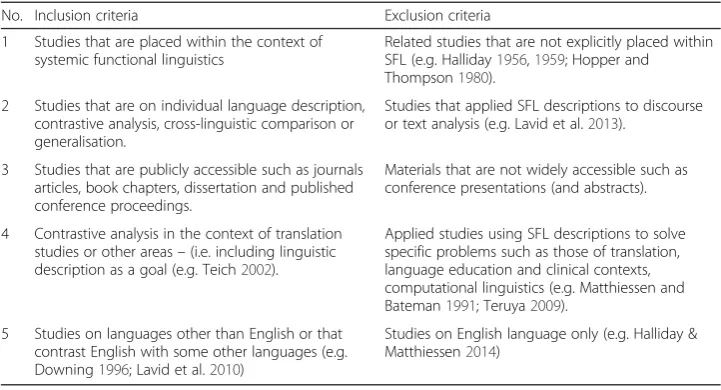
In selecting the studies, we did not take into consideration the prestige of the source of publication such as journal ranking or the perceived status of the publisher. The cri-teria for including or excluding a study from the database are outlined in Table 2.
Table 2Guiding criteria for compiling the database
No. Inclusion criteria Exclusion criteria
1 Studies that are placed within the context of systemic functional linguistics
Related studies that are not explicitly placed within SFL (e.g. Halliday1956,1959; Hopper and Thompson1980).
2 Studies that are on individual language description, contrastive analysis, cross-linguistic comparison or generalisation.
Studies that applied SFL descriptions to discourse or text analysis (e.g. Lavid et al.2013).
3 Studies that are publicly accessible such as journals articles, book chapters, dissertation and published conference proceedings.
Materials that are not widely accessible such as conference presentations (and abstracts).
4 Contrastive analysis in the context of translation studies or other areas–(i.e. including linguistic description as a goal (e.g. Teich2002).
Applied studies using SFL descriptions to solve specific problems such as those of translation, language education and clinical contexts, computational linguistics (e.g. Matthiessen and Bateman1991; Teruya2009).
5 Studies on languages other than English or that contrast English with some other languages (e.g. Downing1996; Lavid et al.2010)
Studies on English language only (e.g. Halliday & Matthiessen2014)
These criteria are only a strategy to keep our database to a manageable size by fo-cusing on studies that are central to our topic. Particular comment needs to be made of the publication types that were included in the database. The general guiding principle was to include studies that are publicly accessible, which we de-fined as published materials and those available in online databases. This criterion excluded unpublished conference presentations. Two manuscripts that are in circu-lation (Matthiessen 1987a, b) among systemic researchers were included in the database. Halliday’s studies on Chinese in the 1950’s (e.g. Halliday and Ellis 1951; Halliday 1956, 1959) are excluded since we take Categories of the Theory of Grammar (Halliday 1961) as the beginning of systemic functional linguistics proper (cf. Matthiessen 2007b; Martin 2016).
In spite of the efforts made to retrieve as many publications as possible, the database is certainly not exhaustive. For instance, although a few studies published in languages other than English are included, it was generally difficult retrieving non-English medium publications, which was done mainly through expert consultation and personal contacts. In addition, it is difficult to keep track of the increasing number of publica-tions in systemic language description and typology around the world, especially in the turn of the 21stcentury. Besides these two uncontrollable constrains, there was also the need to keep our references at a reasonable length. Thus, we adopted the qualitative re-search principle of saturation point, a strategy where data collection and analysis end at the point where further analysis does not yield new patterns or categories. Our satur-ation point was where the extra studies retrieved neither described languages other than those in our database nor made changes to our quantitative profile of studies across the different variables of our analysis (see Figs. 5, 6, 7, 8 and 9). The studies ex-cluded in this way are mainly studies on Chinese and Spanish and are mostly published between 2004 and 2008, the period with the highest number of studies in our database (see Fig. 5). In fact, we found that there is a large body of systemic typology literature on Chinese and Spanish, many of which are published in these languages rather than in English, and we recommend further reviews on the coverage of studies on these lan-guages in terms of systems and SFL dimensions of language (cf. Matthiessen 2007b). In spite of these constrains, we believe our data set is still representative of the languages covered in systemic language description and our findings should be considered in light of the limitations indicated here.
The findings of the survey are discussed in subsequent sections below, in accordance with the research objectives outlined under“Objectives”above.
Meta-analysis of studies
This section examines the characteristics of studies in SFL language description and typology. We first discuss the historical development of the field and then consider the avenues through which the studies are disseminated. We will then examine the descrip-tive coverage of the field by discussing the representadescrip-tiveness of areal and genetic lan-guages described and the research output on the individual lanlan-guages. Finally, we will summarise the methodological procedures employed in the studies and highlight some available resources in this area. Our discussion will be supported by quantitative pro-files in terms of frequency counts and percentage distribution.
Historical development
Figure 5 presents the frequency distribution of the publications in groups of five-year interval (see Appendix 1 for a list of the studies). It can be observed that systemic lin-guistics has been engaged with languages other than English since the late 1960’s. How-ever, between the first fifteen-year period, from 1969 to 1983, only ten (7.6 %) studies are recorded. The number of studies only begin to rise around the mid 1980’s and reached their peak between 2004 and 2008, which accounts for 44 (33.6 %) of the 131 studies in our database. Since 2009, however, there has been a decrease in research out-put although, compared to the earliest periods, a considerable number of studies (23, 17.6 %) are still recorded for this period. These findings generally show that, whereas systemic linguistics has been multilingual from the very start, it was not until a little over a decade ago that systemic linguists gave much attention to language typology and the description of languages other than English.
We place this historical configuration of studies within the context of other develop-ments within SFL since the 1960’s. As mentioned earlier, Michael Halliday’s description of Chinese in the 1940’s and 1950’s (e.g. Halliday and Ellis 1951; Halliday 1956, 1959) as well as the multilingual approach to language study J. R. Firth had established in London set the stage for the evolution of systemic functional theory, in general, and systemic multilingual studies, in particular. The 1960's saw very important publications. Halliday (1961) outlines many of the dimensions of language and, in the mid to late
5
1 4
7 17
21
9 44
19
4 0
5 10 15 20 25 30 35 40 45 50
Fig. 5Number of publications from 1969–2014 across groups of five-year periods (total number = 131)
24 2
35 11
50 9
0 10 20 30 40 50 60
thesis manuscript journal article Conference paper book chapter book
Fig. 6Frequency distribution of studies across publication mode (total number of studies = 131)
1960’s, the relationship between the paradigmatic and syntagmatic organisation of lan-guage had been presented in greater detail (cf. Halliday 1966a). This framework was further applied to the description of the grammar of TRANSITIVITY and THEME in English (Halliday 1967a, b, 1968), providing a model for the description of the lexico-grammar of other languages.
These developments receive corresponding resonances in the descriptions of lan-guages such as French (Huddleston et al. 1969), Gooniyandi (Barnwell 1969) and Nzema (Mock 1969). These studies show how grammatical systems and/or grammatical units are organised systemically. Huddleston and Uren (1969), for instance, examine the system of MOOD in French, giving a sketch of declarative, interrogative, and
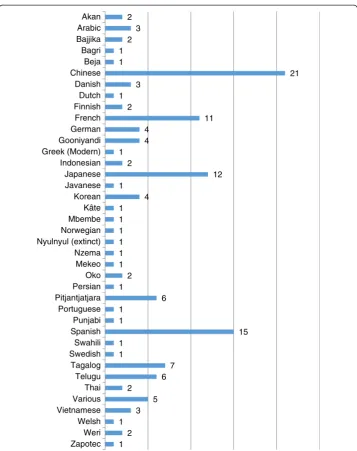
1 2 1 3 5 2 6 7 1 1 15 1 1 6 1 2 1 1 1 1 1 1 4 1 12 2 1 4 4 11 2 1 3 21 1 1 2 3 2 Zapotec Weri Welsh Vietnamese Various Thai Telugu Tagalog Swedish Swahili Spanish Punjabi Portuguese Pitjantjatjara Persian Oko Mekeo Nzema Nyulnyul (extinct) Norwegian Mbembe Kâte Korean Javanese Japanese Indonesian Greek (Modern) Gooniyandi German French Finnish Dutch Danish Chinese Beja Bagri Bajjika Arabic Akan
Fig. 7Frequency distribution of studies across languages (total number of studies = 131; total number of languages = 38 (excluding the‘Various’category). Contrastive studies are counted twice, provided none of the languages described is English)
imperative clauses and laying the foundation for later comprehensive descriptions of French lexicogrammar (e.g. Caffarel 2004, 2006). Mock’s (1969) study on Nzema (Niger-Congo: Kwa) also focuses on identifying and analysing grammatical units.
One important theoretical development in the 1970’s and into the 1980’s was the ex-plicit articulation of the dimension of metafunction within the theory, although
Middle east, 2,
5%
Latin-America,
1, 3%
Europe, 11,
29%
Australia/Ocea
nia, 6, 16%
Asia, 12, 31%
Africa, 6, 16%
Fig. 8Percentage distribution of languages described by regions (total number of languages = 38)
1 1 1 1 1 1 1
5 1
1 1
10 1
3 1
5 1
2
0 2 4 6 8 10 12
Trans-New Guinea Tai-Kadai Sino-Tibetan Pama-Nyungan Oto-Manguean Nyulnyulan Non-Pama-Nyungan Niger-Congo Japanese language Isolate [Korean] Indo-Iranian Indo-European Uralic: Finno-Ugric Indo-Aryan Dravidian Austronesian Austro-Asiatic Afro-Asiatic
Fig. 9Number of languages described per phylum (Total number = 38)
functional diversity was already present in the form of the analysis of the English clause (see Halliday 1961, 1966a). Halliday (1973) expounds the theory of metafunctions and shows the ontogenetic process in its manifestation in the language of the individual meaner. Also in the 1970’s and into the 1980’s seminal publications on cohesion (Halli-day and Hassan 1976) and the interpersonal systems of English (Halli(Halli-day 1984) ap-peared. These contributions complemented the analysis of transitivity and theme in Halliday (1967a, b, 1968) and finally culminated in the publication of the first edition of IFG (Halliday 1985), the first most comprehensive account of the lexicogrammar of any language using systemic functional theory. Other notable contributions in this period and earlier in the late 1960’s are studies on English phonology, particularly on inton-ation (e.g. Halliday 1967a, b), Halliday and Martin’s (1981) collection of systemic papers on key theoretical developments and descriptions and Halliday and Fawcett’s (1987) fol-low-up two volumes of contributions from key systemic scholars.
These developments together gave impetus to works on other languages, correspond-ing with a fair increase in typological work between 1984–1993 (see Fig. 5). Notable studies in grammar in this period include transitivity in Chinese (Long 1981), the study of transitivity (Indah 1985) and the nominal group (Sutjaja 1988) in Indonesian lan-guage, and cohesion in Arabic (Aziz 1988). Key studies in phonology are studies on the phonological ranks and prosodic systems of Akan (Niger-Congo: Kwa), Telugu (Dravid-ian: South Central) and Zapotec (Oto-Manguean) by Matthiessen (1987a); Prakasam (1972) and Mock (1985) respectively.
In the 1990’s, further developments in SFL theory and descriptions on English contin-ued to impact on multilingual and typological research. Halliday’s (1994) second edition of IFG and other two important works, namely, Halliday and Matthiessen’s (1995) elab-orate account of ideational semantics and Matthiessen’s (1995)Lexicogrammatical Car-tography of English Systems (affectionately calledLexiCart), were published around this time. Halliday (1994) and Matthiessen (1995) particularly give us a rich complementary account of the lexicogrammar of English and a more explicit model for research on other languages. While Halliday (1994) focuses on the metafunctional organisation of lexicogrammar, Matthiessen (1995) uses system networks to demonstrate how lexico-grammatical resources are organised systemically and extend in delicacy.
Multilingual studies in this period correspondingly became more extensive, encom-passing more language families, namely, Philippine (Martin 1990), Sinitic (McDonald 1992; Huang and Fawcett 1996); Germanic (Degand 1996), Romance (Caffarel 1992; Downing 1996; McCabe 1999), Finno-Urgic (Shore 1992, 1996); Bunuban (McGregor 1990, 1992a, 1996); Western Desert (Rose 1993, 1996, 1998) and Papuan (Boxwell 1990, 1995). Huang and Fawcett (1996) and Downing (1996) are important as some of the earliest studies to adopt a contrastive approach, involving Chinese and English and Spanish and English respectively.
This extensive work reflects in the increase in the frequency of studies from 1990 into the early 2000’s, as shown in Fig. 5. However, in terms of content, many of these studies are still not as elaborate or holistic as descriptions provided in Halliday (1985, 1994) and Matthiessen (1995). Many studies still focused on transitivity and theme, as in the 1960's and into the 1980's. Boxwell (1990, 1995), however, gives detailed analysis of cohesion in Weri (Trans-New Guinea: Southeast Papuan), specifically on co-referen-tiality and ellipsis. He shows how Weri’s data differ from Halliday and Hassan's (1976)
account on English. Some scholars (e.g. Martin 1990; Caffarel 1995) had also began to give attention to the interpersonal resources of the lexicogrammar. Caffarel (1996) gives a comprehensive overview of French grammar rooted in discourse. Studies also appear on tense in French (Caffarel 1990, 1992) and Spanish (Downing 1996) in this period.
Notably, the year 1992 records the publication of the first edited volume on systemic phonology, which marks a landmark for typological studies in phonology (cf. Tench 1992). This volume includes descriptions of six languages other than English: Arabic (Eddaikra & Tench 1992), Chinese (Halliday 1992; Lock 1992), Gooniyandi (McGregor 1992a), Telugu (Prakasam 1992), Swahili (Maw 1992) and Welsh (Kelly 1992), exclud-ing Oladeji’s (1992) phonostylistic analysis of Yoruba lullabies.
As indicated earlier, the period between 2004 and 2008 is the peak of systemic typ-ology and language description, recording 44 (33.6 %) of the studies in our database. This rise is a result of the interest in typological work in the preceding decade and can be attributed to the publication of the notable contributions on lexicogrammatical pro-files in Caffarel et al. (2004), which includes descriptions of nine individual languages and a chapter on a cross-linguistic survey of typological motifs and generalisations (Matthiessen 2004). In addition to Caffarel et al. (2004), other notable publications ap-pear in this year, including Rose (2004b), Lavid and Arus (2004), Arús (2004), and An-dersen (2004). Lavid and Arús (2004) and Arús (2004) are particularly important for also contrasting Spanish with English, a further development on Downing (1996).
The period after Caffarel et al. (2004) continues to record a steady increase in studies on systemic typology and language description. Twenty-nine (22.1 %) studies are corded between the four-year period from 2005 to 2008, and 23 (17.6 %) studies are re-corded from 2009 to 2014.
Whereas some of the output in the 21stcentury continue to be produced by scholars previously engaged in the field, new researchers have also emerged (e.g. Akerejola 2005, 2008; Teruya 2007; Kim 2007; Yang 2007; Patpong 2006a; Bardi 2008; Banks 2010; Quiroz 2008; Choi 2013) and new languages, mostly Asian, such as Japanese (e.g. Teruya 2007; Thomson and Armour 2013a, 2013b); Korean (Kim 2007; Choi 2013; Park 2013), Oko (Akerejola 2005), Bajjika (Kumar 2009), Thai (Patpong 2006a), Telugu (Prakasam 2004), German (Steiner and Teich 2004), Arabic (Bardi 2008) and Swedish (Holmberg and Karlsson 2006) are described.
We proceed, in the next section, to examine the mode of dissemination of these stud-ies within the academic community.
Mode of publication
The genre for disseminating studies in systemic language description and typology is very important. First, it indicates the depth and comprehensiveness of the languages described. SFL places importance on descriptions that are not only contributing to in-tellectual findings on language typology but also descriptions that are comprehensive enough to provide useful language material for the application in critical contexts of the community life of the language users, such as education, translation, computational applications, forensic applications, and discourse analysis. In addition, the nature of the outlet of publications does affect the extent to which they are visible to the community of linguistic science.
Six publication types are identified in our database, namely, books, book chapters, conference papers, journal articles, manuscripts and theses. As Fig. 6 indicates, the top three outlets of systemic language description and typology are book chapters (50, 38.1 %), journal articles (35, 26.7 %), and theses (24, 18.3 %).
Research articles, apart from being the most prestigious academic literature, are perhaps the best way to widely disseminate research findings. Book collections or edited volumes also allow writers to bring together their descriptions and make them accessible to readers in one document. The space constraints articles and chapters in edited volumes pose, how-ever, do not allow a comprehensive description of languages. Many research articles and book chapters in our database are, nonetheless, summaries and preliminary findings of more comprehensive descriptions (see e.g. the contributions in Caffarel et al. 2004: Ch. 1). It is, however, still useful for systemicists to publish more of aspects of their descriptions in jour-nals in order to make them more visible, especially to scholars working outside SFL.
One way by which systemic language description and typology has expanded and devel-oped is through postgraduate research. A number of scholars, notably Michael Halliday, Christian Matthiessen and Jim Martin have helped produce a number of descriptions through PhD supervision. Following the multilingual tradition established by J. R. Firth, Michael Halliday supervised PhD theses on languages other English in the 1960’s, includ-ing Barnwell’s (1969) account of Mbembe and Mock’s (1969) analysis of grammatical units in Nzema (see Teruya & Matthiessen for further discussion). These studies became some of the earliest systemic studies on the description of languages other than English.
In the 1990’s and especially at the turn of the 21stcentury, Christian Matthiessen super-vised a number of PhD theses on several languages at Macquarie University (and now at The Hong Kong Polytechnic University), including, among others, Caffarel (1996) on French, Teruya (1998) on Japanese, Thai (1998) on Vietnamese, Tam (2004) and Li (2007) on Chinese, Akerejola (2005) on OKo, Patpong (2006a) on Thai, Kim (2007) on Korean, Bardi (2008) on Arabic, and Kumar (2009) on Bajjika. Many of these are comprehensive accounts on these languages, using Halliday’sIntroduction to Functional Grammaras a model.
Some of these PhD theses continue to produce a number of books on systemic func-tional grammar.1One of the early works is by McGregor (1990) on his description of the grammar of Gooniyandi. In 2006, Continuum (now part of Bloomsbury Publishing Plc) launched a book series on systemic functional grammars and has since published descriptions of several languages, notably Caffarel (2006); Li (2007); Teruya (2007); and Lavid et al. (2010). Other book length contributions include Andersen et al. (2001) de-scription of Danish, Holmberg and Karlsson’s (2006) grammar of Swedish and Rose’s (2001) study on Pitjantjatjara.
As noted by Caffarel et al. (2004), Ch. 1, one challenge of systemic typology is the fact that it takes a great deal of time and effort to produce a comprehensive, book length description and a lot of collaboration is needed in this area. Comprehensive descrip-tions, as mentioned earlier, are crucial for application in discourse and text analysis and critical contexts such as language education.
Representativeness: areal and genetic coverage
One important consideration in language typology is a representative sample of lan-guages. This is important since the goal of typology is to make descriptive and
theoretical generalisations about language. Representativeness in language typology can be conceived of in three aspects: (1) the sample size should be large enough to allow gen-eralisations about language (i.e. numerical representativeness), (2) the sample should in-clude languages of different regions of the world (i.e. areal representativeness), and (3) the sample should include languages from every language family or, more feasibly, a variety of language families (i.e. genetic representativeness). Each of these three aspects will be ad-dressed in relation to the linguistic coverage of studies in our database.
Figure 7 lists all the languages covered by studies on the description of individual lan-guages in our database and indicates the number of research output on each of them (typology-oriented studies are labelled ‘Various’). In all, 38 languages are covered by studies that describe individual languages. Chinese (21, 16 %) has the highest research output, closely followed by Spanish (15, 11.5 %) and then by Japanese (12, 9.2 %), French (11, 8.4 %) and, finally, Pitjantjatjara (6, 4.6 %) and Telugu (6, 4.6 %). Although these figures cannot be used to judge the relative comprehensiveness of the descrip-tions of the languages, they indicate that some languages are more productive or more engaged by researchers than others. Out of the 38 languages, those with comprehensive descriptions are only 12 (31.6%), comprising Arabic, Bajjika, Chinese, French, Goo-niyandi, Japanese, Korean, Oko, Pitjantjatjara, Spanish, Swedish and Thai. We define comprehensive description as a book length (or PhD thesis length) account of gram-matical systems of at least the three metafunctions of language, ideational (either ex-periential or logical, or both), interpersonal and textual.
Given that there are about 6000 languages spoken in the world today (Lewis et al. 2015; Hammarström 2015), the quantitative coverage of SFL language description is in-finitesimal and needs to be expanded. The need to expand the description base of lin-guistic science is, however, not limited to SFL. It has been noted in the literature that many of the worlds languages are either undescribed or have not been sufficiently de-scribed to warrant inclusion in samples for language comparison and typology (see Caf-farel et al. 2004: 60–61, Teruya and Matthiessen 2015 for discussions on language sampling). The need to describe more languages has become even more important since many minority languages are increasingly being displaced by dominant and re-gional ones (see Gikandi 2015; Hammarström 2015). Comprehensive language descrip-tion, particularly from a functional linguistic perspective of the kind pursued by systemic linguists, is crucial for application in linguistic revitalisation. The inadequacy of formal syntax and documentary linguistics in revitalising critically endangered lan-guages has been lamented (Austin 2015). SFL’s text-oriented approach to language, de-fined as a semiotic resource, can produce useful resources on endangered languages for revitalisation projects.
Figure 8 presents a percentage distribution of the areal coverage of the 38 lan-guages covered in SFL language description while Fig. 9 gives a frequency distribu-tion of the languages across phyla.2 As Fig. 8 shows, there is an uneven distribution of languages across regions (see also Teruya et al. 2007). The majority (12, 31 %) are from Asia, and Europe (11, 28 %), followed by Africa (6, 16 %) and Oceania (6, 16 %). Languages spoken in the Americas and the Middle East are the least. It is obvious that a lot more research and collaboration are needed in order to approach anything close to areal representativeness in SFL description. Strictly speaking, none of the regions is adequately represented.