Research Paper
1Continuous Authentication of Smartphone Users Based on
2Activity Pattern Recognition Using Passive Mobile Sensing
3Muhammad Ehatisham-ul-Haq a,*, Muhammad Awais Azam a, Usman Naeem b, Yasar Amin a, 4
Jonathan Loo c 5
a Faculty of Telecom and Information Engineering, University of Engineering and Technology, Taxila, Punjab, Pakistan.
6
b
School of Architecture, Computing and Engineering, University of East London, UK. 7
c
School of Computing and Engineering, University of West London, London, UK. 8
* Corresponding author: [email protected] 9
Abstract: Smartphones are inescapable devices, which are becoming more and more intelligent and 10
context-aware with emerging sensing, networking and computing capabilities. They offer a captivating 11
platform to the users for performing a wide variety of tasks including socializing, communication, sending or 12
receiving emails, storing and accessing personal data etc. at anytime and anywhere. Nowadays, loads of people 13
tend to store different types of private and sensitive data in their smartphones including bank account details, 14
personal identifiers, accounts credentials, and credit card details. A lot of people keep their personal e-accounts 15
logged in all the time in their mobile devices. Hence these mobile devices are prone to different security and 16
privacy threats and attacks from the attackers. Commonly used approaches for securing mobile devices such as 17
passcode, PINs, pattern lock, face recognition, and fingerprint scan are vulnerable and exposed to several 18
attacks including smudge attacks, side-channel attacks, and shoulder-surfing attacks. To address these 19
challenges, a novel continuous authentication scheme is presented in this study, which recognizes smartphone 20
users on the basis of their physical activity patterns using accelerometer, gyroscope, and magnetometer sensors 21
of smartphone. A series of experiments are performed for user recognition using different machine learning 22
classifiers, where six different activities are analyzed for the multiple locations of smartphone on the user’s 23
body. SVM classifier achieved the best results for user recognition with an overall average accuracy of 97.95%. 24
A comprehensive analysis of the user recognition results validates the efficiency of the proposed scheme. 25
Keywords: Activity Pattern Recognition, Behavioral Biometrics, Continuous Authentication, Mobile Sensing, 26
Smartphone User Recognition, Ubiquitous Computing 27
1. Introduction
28Smartphone and mobile technologies have become much popular in a very short span of time. We have 29
moved from larger phones to very slim yet powerful smartphones. These devices have aided people with 30
internet connectivity and enabled them to do their routine tasks at anytime and anywhere. At the moment, 68% 31
of the entire world’s inhabitants possesses a mobile phone and this number is anticipated to reach up to 72% by 32
2019 (“The Statistic Portal”, 2017). Smartphones have started to replace personal computers and laptops. A 33
market research has shown that mobile phone shipments worldwide are projected to add up to 1.93 billion in 34
2019 (Gartner, 2017). Due to the increased use of smartphones, more and more data is being produced, stored, 35
accessed, and analyzed on these devices at homes, offices, and workplaces on daily basis. This data also 36
includes sensitive and confidential information including personal identifiers, bank account details, and credit 37
card information etc. As much as these mobile devices have become popular and improved worker’s output, the 38
security and privacy of sensitive data stored on these devices is still a key problem to be resolved (Krupp et al., 39
2017). The ever growing popularity of smartphones and mobile devices has resulted in several incentives for the 40
attackers. The attackers are shifting their focus on mobile and hand-held devices as these devices can be stolen 41
easily and victims’ confidential data can be compromised. By stealing mobile devices, the attackers can easily 42
selling their details via the black market (“Data Breaches 101: How They Happen, What Gets Stolen, and 44
Where It All Goes”, 2018). Therefore, ensuring the privacy of sensitive information being stored on these 45
portable devices has now become critical. Unluckily, most extensively used validation methods for 46
smartphones and mobile devices including password, PIN (Personal Identification Number), and pattern locks 47
provide weak authentication and have certain limitations. These schemes are subjected to several attacks, which 48
include side-channel attacks (Spreitzer et al., 2016), smudge attacks (Meng et al., 2016), and shoulder-surfing 49
attacks (Wakabayashi et al., 2017). Passwords and PINs need to be remembered all the time and the length of 50
time required for their input is also frustrating (Mayron, 2015). Pattern locks may be drawn by others because of 51
the distinctive traces of fingertip left on the phone screen after drawing a pattern. Biometric authentication 52
schemes for mobile devices, such as face recognition and iris recognition, are influenced by the environmental 53
conditions such as light and shelter. Fingerprint scans are subjected to spoofing and require additional hardware 54
for their operation. Furthermore, these frequently used authentication schemes only provide entry point 55
authentication and fail to detect and recognize a challenger after the point of entry. Hence, these methods are 56
ineffective to apply for authenticating and recognizing a smartphone user in a continuous way. 57
To enhance the security of mobile devices and provide potential solutions to existing challenges in 58
smartphone authentication, researchers have come up with numerous schemes, which perform authentication 59
on the basis of behavioral biometrics (Alzubaidi and Kalita, 2016). These authentication schemes offer a way to 60
continuously and passively authenticate different smartphone users by identifying their behavioral traits while 61
interacting with smartphone. (Wu et al., 2016) utilized keystrokes and gestures as behavioral biometrics for 62
continuous authentication of smartphone users. (Meng et al., 2016) proposed a touch movement based method 63
for improving the security of pattern locks. The authors identified the users on the basis of touch movements 64
while unlocking patterns. (Yang et al., 2015) utilized handwaving as a behavioral biometric for user 65
authentication. (Shen et al., 2016) proposed a method to authenticate users through the action of passcode input 66
by utilizing orientation sensors and accelerometers. (Zhang et al., 2015) identified gait pattern by using five 67
body-worn accelerometers on different locations and utilized gait pattern as a behavioral biometric for 68
identifying users. (Zeng, 2016) proposed the possibility of utilizing dynamic behavior based on simple activities 69
such as walking, running, climbing, and jumping for identifying users using wearable sensors. (Cola et al., 70
2016) used motion data of the walking activity collected from a wrist-mounted device for user authentication. 71
These wearable sensors and devices become a cause of interference for the users in performing their activities. 72
Therefore, a few researchers have made use of smartphone motion sensors to develop efficient schemes for user 73
authentication based on behavioral biometrics (Sitova et al., 2016; Neverova et al., 2016). However, the 74
performance of these schemes is compromised by the position and orientation sensitivity of smartphone motion 75
sensors. Moreover, the research on continuous user authentication is still very challenging due to the difficulty 76
in collecting real time data in open and dynamic environments (Neverova et al., 2016). Therefore, it is the need 77
of the hour to develop more efficient and reliable solutions for continuous and non-intrusive user authentication 78
to ensure the security of mobile device. 79
In this research work, an intelligent scheme is proposed for the unobtrusive authentication and validation 80
of smartphone users to address existing challenges in continuous authentication. The proposed scheme is based 81
on recognition of physical activity patterns of different smartphone users for their identification. Once a user is 82
identified, he/she can easily be validated and authorized. Our idea is to learn the activity patterns of a 83
smartphone user to differentiate him/her from other users on the basis of his/her behavioral traits. As the 84
authentication needs to be done in real time, therefore we have selected six real life activities of daily living for 85
user recognition purpose. These activities include walking, sitting, standing, running, walking upstairs, and 86
walking downstairs. These activities are likely to be performed by every normal human being for multiple times 87
in their routine life. Moreover, people usually perform these activities in a different way from each other owing 88
to their behavioral traits. Three smartphone embedded sensors i.e., accelerometer, gyroscope, and 89
magnetometer, are selected to provide data corresponding to six selected activities performed by the users. 90
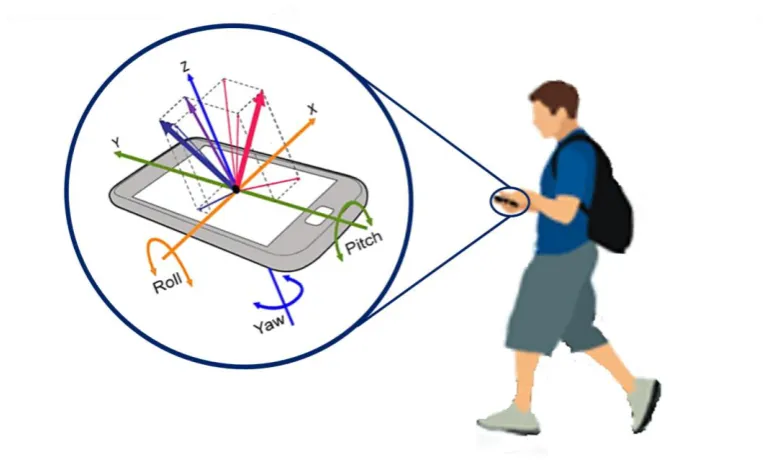
These inertial sensors provide a way to recognize smartphone users based on their activity patterns as shown in 91
Fig. 1. As in real time, the placement of smartphone on the human body is not always fixed; therefore user 92
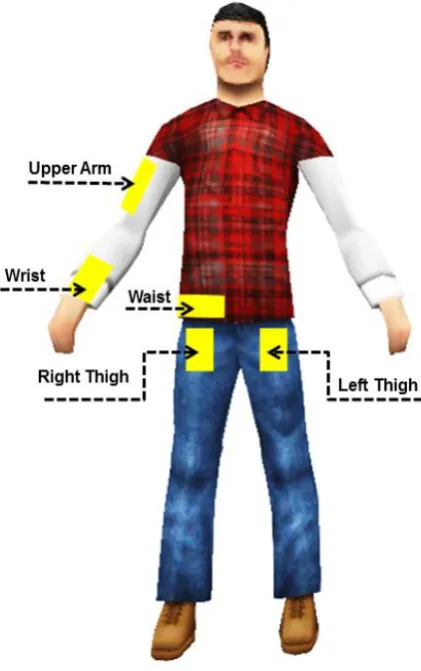
recognition is analyzed for five different smartphone positions on the user’s body. These positions include left 93
thigh (left jeans pocket), right thigh (right jeans pocket), waist, upper arm, and wrist position. A smartphone 94
needs to be in one of these positions on the user’s body for his/her recognition based on the proposed scheme. 95
An existing dataset for physical activity recognition (Shoaib et al., 2014, 2013) is utilized for this study, which 96
data after its preprocessing. These features are then further utilized for recognizing ten different users on the 98
basis of six individual activities selected in this study. For the purpose of experimentation, three different 99
classifiers i.e., Support Vector Machine (SVM), Decision Tree (DT), and K-Nearest Neighbors (K-NN), are 100
used for user recognition. 101
Fig. 1. Smartphone inertial sensors track the physical activity pattern of a user and provide a way to identify that 102
user based on activity pattern recognition 103
The significant achievements of this research work are as follow: 104
1. An innovative scheme is presented for continuously authenticating smartphone users, which is 105
based on the recognition of physical activity patterns of individual users for their identification. 106
2. The issue of position sensitivity of smartphone motion sensors is addressed in this study to reduce 107
false positives for user authentication. For this purpose, five different smartphone positions on the 108
user’s body are analyzed for user recognition. 109
3. The experiments for user recognition are performed using three prevalent machine learning 110
classifiers and a detailed comparison is presented amongst these classifiers performance for 111
recognizing users. The best one provides efficient results for user identification based on activity 112
patter recognition. 113
4. As the proposed scheme is based on activity pattern recognition, a detailed analysis is presented 114
for six different activities, which shows the best activities and the phone positions that can be 115
utilized for efficient user recognition. 116
The remaining part of the paper is structured as follows: Section 2 provides a brief description of the 117
background and related work. Section 3 explains the methodology of research in details. Section 4 presents and 118
discusses the results of user recognition comprehensively and analyzes the performance of selected machine 119
learning algorithms for user recognition. Section 5 determines the findings of this research study and gives 120
recommendations for further future work. 121
2. Background and Related Work
122With the dominant increase in computing, networking, and sensing capabilities of smartphones, 123
researchers have started to make use of the sensory data available from these devices to model human behavior 124
(Cho and Lee, 2017; Kwapisz et al., 2011; Miluzzo et al., 2010; van Deursen et al., 2015; Zhitomirsky-Geffet 125
and Blau, 2016) and infer certain contexts. Context-awareness has become increasingly significant as being 126
aware of people surroundings is very beneficial for a wide variety of pervasive applications. Human-centric 127
contexts, such as indoor or outdoor, at home or in office etc., have been studied extensively by the researchers 128
efforts have been made on context-awareness from phones’ perspective also. Sherlock framework (Yang et al., 130
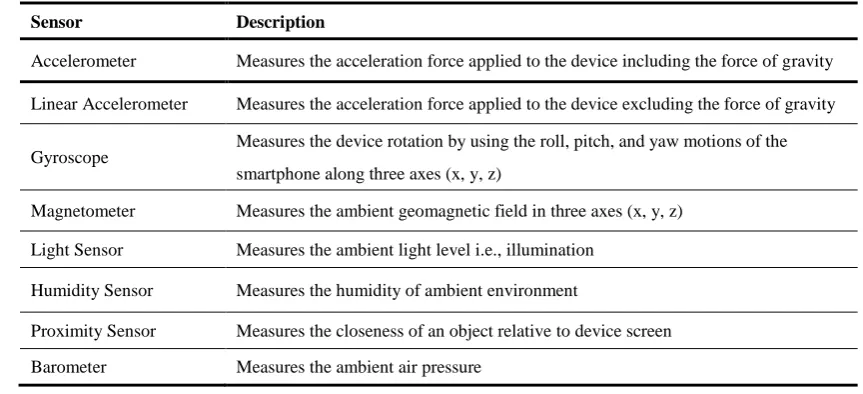
2014) collects data from smartphone sensors and recognizes the near surroundings of the smartphone. Table 1 131
shows a set of smartphone sensors that have been utilized in different research studies. The data acquired from 132
these sensors have been utilized for activity recognition (Su et al., 2014; Wannenburg and Malekian, 2016) and 133
many other aspects related to health monitoring (Lee et al., 2012; Mun et al., 2009; Pludwinski et al., 2016), 134
social activities monitoring (Gesell et al., 2013; Harari et al., 2016; Min et al., 2013), and crowdsourcing 135
(Chatzimilioudis et al., 2012; Consolvo et al., 2008). On-body wearable sensors have also been utilized to learn 136
human movements and actions (Bulling et al., 2014; Ellis et al., 2013; Shoaib et al., 2016). But these wearable 137
on-body sensors create inconvenience for the users in performing their activities. Moreover, it is hard and takes 138
a lot of time to adjust these wearable sensors on right positions. As a result, mobile sensing has been employed 139
for human activity recognition (Avci et al., 2010; Lockhart et al., 2012; Incel et al., 2013; Lara and Labrador, 140
2013), which has a diversified range of significant application areas. In (Shoaib et al., 2015a), the authors 141
provided a comprehensive survey of online activity recognition using mobile sensing. (Albert et al., 2012) 142
utilized mobile sensing for activity recognition of Parkinson’s patients. The CenceMe system (Miluzzo et al., 143
2008) recognizes simple physical activities like idle, walking, and running with the help of an accelerometer. 144
Activity recognition has been further used for different applications, such as human behavior modeling 145
(Miluzzo et al., 2010; Pei et al., 2013) and health monitoring (Mun et al., 2009). (Shoaib et al., 2015b) utilized 146
activity recognition for the detection of bad and unusual habits of different persons. Our study aims to utilize 147
activity pattern recognition for validating smartphone users. 148
The research on smartphone authentication is progressing and researchers have come up with some 149
dominant work in recent years. In literature, there exist different approaches for reliable and efficient 150
recognition of smartphone users using physiological and behavioral biometrics. (Song et al., 2016) presented a 151
novel framework for smartphone user authentication called EyeVeri, which is based on tracking human eye 152
movement using front camera of smartphone. The authors explored different gaze patterns i.e., volitional and 153
non-volitional, using pattern matching algorithms to provide access authentication. An in-depth analysis of the 154
evaluation results showed that the proposed scheme works effectively. (Alzubaidi and Kalita, 2016) provided a 155
detailed review of seven different types of behavioral biometrics, including walking style, touchscreen 156
interaction, signature, handwaving, keystroke dynamic, voice, and behavior sketching. (Yang et al., 2015) 157
proposed OpenSesame, a scheme to authenticate users on the basis of handwaving patterns. SVM classifier was 158
used for classifying a user as authorized or unauthorized. (Shrestha et al., 2013) proposed a scheme called 159
Wave-to-Access, which is based on recognition of handwaving gestures. An embedded smartphone sensor i.e., 160
ambient light sensor, was used to examine phone dialing behavior for authentication purposes. Using 161
handwaving scheme for authentication purposes has certain limitations, for example, it cannot authenticate a 162
user continuously and passively all the time. (Papadopoulos et al., 2017) addressed the challenges of 163
shoulder-surfing attacks in their study. The authors proposed IllusionPin (IPIN) for user authentication, which 164
utilized hybrid images for blending two keypads for keypad illusion. (Sitova et al., 2016) introduced a 165
behavioral authentication scheme based on Hand Movement, Orientation, and Grasp (HMOG) features for 166
continuous and unobtrusive user authentication. HMOG features keep track of how a user grasps, holds, and 167
taps on the smartphone. The authors achieved an EER (Equal Error rate) as minimum as 7.16%, which shows 168
the effectiveness of their proposed scheme. (Draffin et al., 2014) presented KeySens, in which the behavior of 169
the user was learnt by utilizing the pattern of user’s interaction with the keyboard. The authors examined 170
touchscreen interactions of the smartphone users based on the movement of fingers, touch force, and the area 171
enclosed by the fingers. (Feng et al., 2013) came up with Typing Authentication and Protection (TAP) scheme 172
for user authentication. TAP included login and post log-in phases to validate a user by exploiting the password 173
and biometric information. The experimental results were validated using three different classifiers out of which 174
Random Forest gave lowest False Acceptance Rate (FAR) of 8.93%. (Frank et al., 2013) also validated the use 175
of touchscreen interactions as a behavior biometric for user verification. (Trojahn and Ortmeier, 2013) used a 176
combination of keystroke and handwriting analysis for authentication purpose. (Zheng et al., 2014) utilized a 177
combination of smartphone inertial and touchscreen sensors for validating a smartphone user. (Shahzad et al., 178
2013) proposed a gesture based user authentication approach to provide safe unlocking facility for touchscreen 179
devices. Different features including finger velocity, device acceleration, and stroke time were used to learn 180
how a user input data. The authentication schemes based on keystrokes and touchscreen interactions take a lot 181
of time for training and learning the keystroke and touchscreen interaction patterns for a user. Moreover, 182
Table 1. A set of smartphone embedded sensors 184
Sensor Description
Accelerometer Measures the acceleration force applied to the device including the force of gravity
Linear Accelerometer Measures the acceleration force applied to the device excluding the force of gravity
Gyroscope Measures the device rotation by using the roll, pitch, and yaw motions of the smartphone along three axes (x, y, z)
Magnetometer Measures the ambient geomagnetic field in three axes (x, y, z)
Light Sensor Measures the ambient light level i.e., illumination
Humidity Sensor Measures the humidity of ambient environment
Proximity Sensor Measures the closeness of an object relative to device screen
Barometer Measures the ambient air pressure
A few researchers have worked on utilizing physiological sensors for identity authentication. (Camara et 185
al., 2015) formulated a scheme that identifies a user by utilizing Electrocardiogram (ECG) signals. Different 186
features were extracted from ECG signals and K-NN classifier was applied for the purpose of user 187
identification. The experiments reported that their proposed scheme achieved a mean accuracy of 97%. Another 188
identity authentication approach was proposed by (Hejazi et al., 2016), where the authors used a multi-class 189
SVM for user identification after applying Discrete Wavelet Transform (DWT) on ECG signals. The 190
experiments reported 3.97% false match rate. (Kang et al., 2016) utilized smartwatch sensors for recording the 191
ECG signals of different participants. The participants were kept in an exact motion state, which restricted the 192
practical application of the proposed scheme. The experimental results presented an FAR of around 5%. These 193
research studies proved that the ECG signals provide an impending solution of user authentication problem. 194
However, the placement of ECG sensors and equipment on the user’s body, such as at chest or hand, creates 195
inconvenience for the user. 196
Another approach for validating smartphone users is the use of smartphone inertial sensors for obtaining 197
data related to behavioral traits of different users. (Zhu et al., 2017) proposed a novel user authentication 198
scheme called ShakeIn, which learns how a smartphone user shakes the phone to lock/unlock it. The biometric 199
features of the users’ shaking behavior were captured with the help of embedded motion sensors of the 200
smartphone. The experiments were performed on 20 participants with 530,555 shaking samples in total. The 201
results described an Equal Error Rate (EER) of 1.2% on average. (Buriro et al., 2017) made use of user’s hand 202
movement patterns for authentication purpose. The data was collected using smartphone embedded sensors and 203
Random Forest (RF) classifier was used for evaluating the results. An EER rate of 96% was achieved by the 204
system. Gait recognition with motion sensors provides a gateway for user authentication. It tends to identify and 205
recognize the walking pattern of a person, e.g. walking style of a user under different conditions. (Damaševičius 206
et al., 2016; Fernandez-Lopez et al., 2016) utilized smartphone internal motion sensors for validating users 207
based on gait characteristics. (San-Segundo et al., 2016) used smartphone inertial sensors to develop a 208
Gait-based Person Identification (GPI) scheme based on a Gaussian Mixture Model-Universal Background 209
Model (GMM-UBM). The results showed a User Recognition Error Rate (URER) of 34%. (Derawi et al., 2010) 210
exploited smartphone motion sensors for extracting information about walking cycles. They achieved an EER 211
of 20.1%. (Mäntyjärvi et al., 2005) recognized users by utilizing their walking style using data from 212
accelerometer. The research work on gait recognition and walking pattern detection is extended to recognize 213
more physical activities for user identification. A number of studies focused on recognizing activities and 214
gestures using motion sensors, including approaches based on deep learning. (Neverova et al., 2016) proposed a 215
scheme for learning human identity based on their motion patterns using deep neural networks. This scheme 216
achieved and EER of 20%. 217
In our study, we analyzed the existing challenges in smartphone user authentication and presented a 218
reliable and applicable solution for continuous user authentication. We used smartphone inertial sensors for 219
learning and recognizing the physical activity patterns of individual users for six different activities of daily 220
3. Methodology of Research
222This research study primarily focuses on learning, identifying, and recognizing behavioral patterns of 223
different users whilst they are using their smartphones. In this work, six different daily living activities i.e., 224
walking, running, standing, sitting, walking upstairs, and walking downstairs, are used for the purpose of user 225
validation. Numerous researches have been carried out on identifying and recognizing these activities from each 226
other (Su et al., 2014; Anguita et al., 2013; Avci et al., 2010; Lockhart et al., 2012; Incel et al., 2013), where the 227
motivation is to learn and differentiate between these individual activities. This research work focuses on 228
recognizing the pattern of these activities for individual users. The aim is to recognize the differences among the 229
behavioral patterns of different users for the same activity. For this purpose, we trained the system to learn the 230
behavioral patterns of individual users for six different activities. Smartphone users are then identified by the 231
system on the basis of the way they perform a certain activity. To avoid false positives occurring because of the 232
changing location of smartphone on the user’s body, we trained the system to identify users for five different 233
and commonly used smartphone positions. These positions are shown in Fig. 2. As behavioral authentication 234
involves continuous collection of a user’s motion data from the device, therefore, the proposed system 235
continuously collects and processes small portion of sensors data in a passive way in order to authenticate a user 236
in real time scenarios. The proposed system recognizes the user from the collected portion of data on the basis of 237
his/her activity pattern. The proposed research methodology is shown in Fig.3, which consists of following 238
steps: raw data collection, preprocessing (data-denoising and segmentation), feature extraction, and user 239
recognition. 240
Fig. 2. Possible positions for the placement of smartphone on the user’s body. A smartphone user is required to 241
Fig. 3. Proposed scheme for smartphone user recognition 243
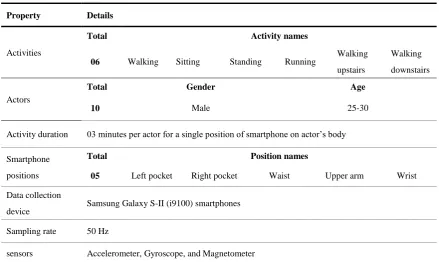
Table 2. Details of the dataset selected in this study for experimentation 244
Property Details
Activities
Total Activity names
06 Walking Sitting Standing Running
Walking
upstairs
Walking
downstairs
Actors
Total Gender Age
10 Male 25-30
Activity duration 03 minutes per actor for a single position of smartphone on actor’s body
Smartphone
positions
Total Position names
05 Left pocket Right pocket Waist Upper arm Wrist
Data collection
device Samsung Galaxy S-II (i9100) smartphones
Sampling rate 50 Hz
sensors Accelerometer, Gyroscope, and Magnetometer
3.1.Raw Data Collection : Dataset 245
To validate the proposed scheme, an existing dataset for physical activity recognition (Shoaib et al., 2013, 246
2014) was used. This dataset was selected because it was consistent to the pipeline of the proposed scheme. 247
Table 2 describes the properties of this dataset. Three sensors were used for the purpose of data collection as 248
shown in Table 2. The accelerometer was used to measure acceleration in meter per second square ( ⁄ ), the 249
magnetometer was employed to report magnetic field in micro tesla (µT), and the gyroscope was used to 250
measure the angular rotation in radians per second ( ) along each axis. The data collected from smartphone 251
sensors had the form { } , where ‘a’ and ‘g’ represent the acceleration, and 252
rotation respectively whereas, ‘b’ represents the strength of the magnetic field along x, y and z axes. 253
3.2.Preprocessing : Data De-noising and Segmentation 254
Inertial sensors of the smartphone are sensitive to interferences such as noise. The signals acquired from 255
these sensors are subjected to undesirable noise produced by unanticipated and vibrant movements of the 256
participants. This noise corrupts useful information contained in the signal. Therefore, the removal of unwanted 257
noise from the signal is necessary before further processing. In our case, the noisy data obtained from 258
smartphone inertial sensors was de-noised using an average smoothing filter of size . Noise was removed 259
from whole sample data by applying the averaging filter separately along all three dimensions of accelerometer, 260
of the sensor that is independent of the sensor orientation was also concatenated with the existing three 262
dimensions of each sensor. After adding fourth dimension, each sensor data was of the form ( ). For 263
each sensor, magnitude is simply calculated as: √ . 264
Before feature extraction from the preprocessed data, the sensors data was divided into smaller segments 265
using a fixed-size sliding window. The selection of the length of sliding window is crucial as the final accuracy 266
of recognition is affected by the length of the sliding window. Different researchers (Shoaib et al., 2013; Anjum 267
and Ilyas, 2013) have shown that simple physical activity patterns can be recognized within 5 seconds duration. 268
This led us to use a fixed-size slicing window having a length of 5 seconds in time with 250 samples at the rate 269
50 Hz. A 50% overlap was selected between the samples during the segmentation and the whole sensors data 270
along each dimension was divided into small chunks of 5 seconds for feature extraction. 271
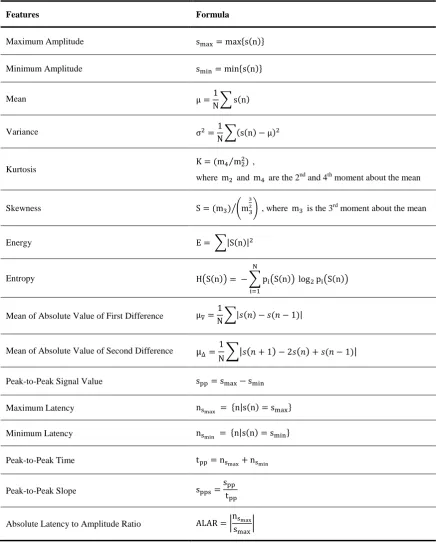
Table 3. A set of time domain features for user recognition 272
Features Formula
Maximum Amplitude { ( )}
Minimum Amplitude { ( )}
Mean ∑ ( )
Variance ∑( ( ) )
Kurtosis ( )
⁄ ,
where and are the 2nd and 4th moment about the mean
Skewness ( ) ( ⁄ ) , where is the 3rd moment about the mean
Energy ∑| ( )|
Entropy ( ( )) ∑ ( ( )) ( ( ))
Mean of Absolute Value of First Difference ∑| ( ) ( )|
Mean of Absolute Value of Second Difference ∑| ( ) ( ) ( )|
Peak-to-Peak Signal Value
Maximum Latency { | ( ) }
Minimum Latency { | ( ) }
Peak-to-Peak Time
Peak-to-Peak Slope
3.3.Feature Extraction 273
Once the data was preprocessed, next step was to extract suitable features that can discriminate between the 274
activity patterns of different users so that the users can be identified accurately. For this purpose, we selected 275
sixteen different features from the time domain. Most of these features have been utilized by the earlier studies 276
for physical activity recognition (Anjum and Ilyas, 2013; Incel et al., 2013; Shoaib et al., 2014, 2013; Su et al., 277
2014). These studies have demonstrated the excellent performance of these features for recognizing the activity 278
patterns. First and second difference of the signal highlights the varying information in the signal and provides 279
the edges and sharp changes in the signal. Similarly, maximum and minimum latency, peak-to-peak time, 280
peak-to-peak slope, and latency to amplitude ratio also gives us useful information about the signal. Hence these 281
features are useful descriptors of the signal and helpful in recognizing different activity patterns. Table 3 282
provides the details of the features selected in this study. All of these features were extracted for each 283
partitioned data segment i.e., s[n], along all four channels of three sensors. 284
3.4.User Recognition 285
After feature extraction, next step was to choose a suitable classifier for the purpose of user recognition 286
based on extracted features. In this work, different supervised machine learning approaches were used. As there 287
were ten participants in the experiment, therefore the recognition of each individual participant was a 288
multi-class classification problem. Three prevalent classifiers i.e., Support Vector Machine (SVM), Decision 289
Tree and K-Nearest Neighbors (K-NN) were used to recognize individual users from their activity patterns. 290
These classifiers were trained separately for different activity patterns of all the participants. The main reason 291
for the selection of these classifiers was their efficient performance in existing studies pertinent to physical 292
activity recognition (Anjum and Ilyas, 2013; Incel et al., 2013; Shoaib et al., 2014, 2013; Su et al., 2014). 293
Moreover, we intended to provide a performance comparison of these classifiers for recognizing users from 294
their activity patterns, which is given in Section 4. These classifiers are described in the following sections. 295
3.4.1. Decision Tree 296
Decision Tree (Kohavi, 1996) is a non-parametric supervised machine learning approach used 297
for classification and regression. This approach aims to build up a model that envisages the value of a target 298
variable by learning simple rules for decisions. These rules are deduced from the features extracted from the 299
input data. Decision tree uses an if-then-else structure for making decisions about classification. It is 300
computationally cheap with excellent interpretation, therefore it is considered as one of the key classifiers in 301
numerous activity recognition studies (Su et al., 2014; Shoaib et al., 2013). The problem in using Decision Tree 302
as a classifier lies in updating the already built model to accommodate new training samples as it might be very 303
expensive (Su et al., 2014). 304
3.4.2. K-Nearest Neighbors 305
K-Nearest Neighbors (Guo et al., 2003) is an instance-based classifier, which is based on the majority 306
voting of its neighbors (Peterson, 2009). It is one of the most commonly used algorithms for recognizing 307
patterns. It works by assigning a feature vector extracted from the input data to a class according to its nearest 308
neighbor(s). The neighbor can be a class prototype or a feature vector from the training set. The nearest 309
neighbor is determined by calculating the distance between the feature vectors. It is a discriminative non-linear 310
classifier. A number of distance measures can be used in K-NN classification like Chebyshev, Manhattan or 311
Minkowski but Euclidean distance is usually the default measure used. 312
3.4.3. Support Vector Machine 313
Support Vector Machine (Cortes and Vapnik, 1995) is a non-probabilistic classifier that has successful 314
applications in classification and regression. Support Vector Machine utilizes decision planes for outlining 315
decision boundaries. A decision plane is capable of separating a set of objects with different class associations. 316
Given a set of labeled training examples for the two classes, the training algorithm of SVM formulates a model 317
that allocates new samples to one of the two classes. An SVM model denotes different examples as points in 318
space, which are dispersed such that the examples pertaining to different classes are separated by a clear gap 319
using support vectors. New examples are then mapped into the same space and assigned to a class depending 320
upon which side of the gap they fall. SVM resists the overtraining problem and ultimately achieves a high 321
4.
Experimental Results
323In order to perform continuous authentication of smartphone users, the proposed scheme performed the 324
recognition of activity patterns for individual users. Hence, the users were identified based on their activity 325
patterns. The performance of the proposed scheme was evaluated using three different classifiers: SVM, DT, 326
and KNN. These classifiers were trained and tested on the dataset for six activities. The dataset was pre-labeled 327
for all six activities performed by ten different users. The users who performed these activities were labeled as 328
well. It means that the ground truth was available for the activities as well as for the users performing those 329
activities. So, our idea was to exploit the dataset for recognizing individual users from this labeled activity data. 330
For this reason, we combined the data of all the users related to same activity at the same body position and 331
assigned user labels to the data according to the ground truth. For example, the labeled data of the walking 332
activity for a single body position was combined for all the participants and the user labels were assigned to the 333
data. These user labels were representing the walking activity patterns of different participants. This process 334
was repeated for each activity data for all body positions. It was done in order to train the selected classifiers for 335
activity patterns of individual users. For every activity, the classifiers were trained for all five body positions 336
separately to recognize ten different users. For this purpose, sixteen different features (as described in Table 3) 337
were extracted for all four dimensions of accelerometer, gyroscope, and magnetometer. These sixteen features, 338
extracted from four dimensions of three sensors, were concatenated into a single feature vector of size 339
computed over a data segment of 5 seconds (250 samples with 50 Hz sampling rate) in time. 340
As mentioned earlier, the duration of each activity data was 3 minutes (180 seconds), therefore using a 50% 341
overlapping sliding window, total
feature vectors were computed related to each activity for a 342
single body position. For total ten participants, 71 x 10 = 710 feature vectors were computed for each activity. 343
The feature vectors computed for each activity were passed as input to the selected classifiers along with the 344
user labels for classifiers training to recognize users from their activity patterns. 345
4.1.Evaluation Approach and Performance Metrics 346
To validate the performance of different classifiers, the data was divided into training and testing splits 347
using k-fold cross validation scheme with k=10, and the classifiers were evaluated. For K-NN classifier, the 348
nearest neighbor parameter K was set equal to 1 and Euclidean distance metric with equal weight was used for 349
similarity measure. In case of DT classifier, the standard Classification and Regression Trees (CART) 350
algorithm (Breiman et al., 1984) was used for creating the decision tree and the nodes were split using Gini’s 351
diversity index as a split criterion. A linear kernel was used for SVM classifier and one-vs-one multi-class 352
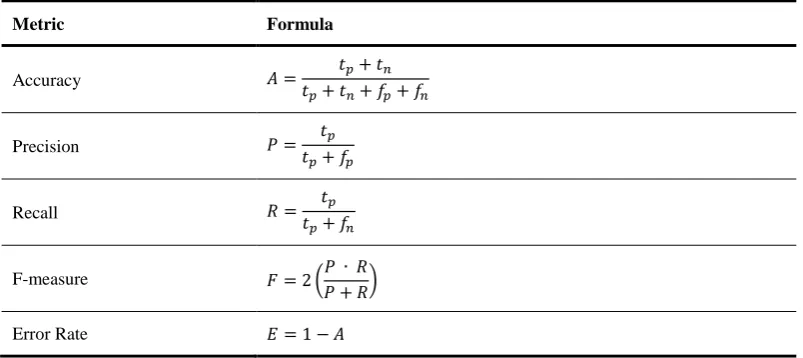
method was used for classification. In Table 4, different performance metrics are given on the basis of which the 353
performance of these classifiers was measured for user recognition. These performance measures are computed 354
separately pertaining to each activity for five different body positions. . 355
Table 4. Performance metrics for evaluating classifiers performance for user recognition are: Accuracy (A), 356
Precision (P), Recall (R), F-measure (F), and Error Rate (E). Here tp , tn , fp , and fn represent true positives, 357
true negatives, false positives, and false negatives respectively. 358
Metric Formula
Accuracy
Precision
Recall
F-measure ( )
4.2.Performance Analysis of User Recognition 359
This section provides the results of user recognition based on six selected activites. For every activity, the 360
results are presented for five different positions of the smartphone on the user’s body. To make a comparison 361
between the classifiers performance in recognizing the users, the results are computed for each selected 362
classifier i.e., DT, K-NN, and SVM. Table 5 to Table 10 summarizes the results of user recogntion based on 363
walking, running, standing sitting, walking upstairs, and walking downstairs activity respectively. It can be 364
observed from these tables that overall performance of SVM classifier is better than DT and K-NN classifiers in 365
recognizing the users from their activity patterns. 366
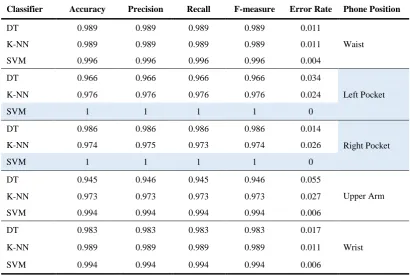
Table 5. Performance measures of selected classifiers for user recognition based on walking activity 367
Classifier Accuracy Precision Recall F-measure Error Rate Phone Position
DT 0.989 0.989 0.989 0.989 0.011
Waist
K-NN 0.989 0.989 0.989 0.989 0.011
SVM 0.996 0.996 0.996 0.996 0.004
DT 0.966 0.966 0.966 0.966 0.034
Left Pocket
K-NN 0.976 0.976 0.976 0.976 0.024
SVM 1 1 1 1 0
DT 0.986 0.986 0.986 0.986 0.014
Right Pocket
K-NN 0.974 0.975 0.973 0.974 0.026
SVM 1 1 1 1 0
DT 0.945 0.946 0.945 0.946 0.055
Upper Arm
K-NN 0.973 0.973 0.973 0.973 0.027
SVM 0.994 0.994 0.994 0.994 0.006
DT 0.983 0.983 0.983 0.983 0.017
Wrist
K-NN 0.989 0.989 0.989 0.989 0.011
SVM 0.994 0.994 0.994 0.994 0.006
Table 6. Performance measures of selected classifiers for user recognition based on running activity 368
Classifier Accuracy Precision Recall F-measure Error Rate Phone Position
DT 0.982 0.982 0.982 0.982 0.018
Waist
K-NN 0.972 0.972 0.972 0.972 0.028
SVM 0.997 0.997 0.997 0.997 0.003
DT 0.972 0.972 0.972 0.972 0.0280
Left Pocket
K-NN 0.989 0.989 0.989 0.989 0.011
SVM 0.999 0.999 0.999 0.999 0.001
DT 0.966 0.967 0.966 0.967 0.034
Right Pocket
K-NN 0.983 0.983 0.983 0.983 0.017
SVM 1 1 1 1 0
DT 0.975 0.975 0.975 0.975 0.025
Upper Arm
K-NN 0.975 0.975 0.975 0.975 0.025
SVM 0.993 0.993 0.993 0.993 0.007
DT 0.963 0.963 0.963 0.963 0.037
Wrist
SVM 0.996 0.996 0.996 0.996 0.004
Table 7. Performance measures of selected classifiers for user recognition based on standing activity 369
Classifier Accuracy Precision Recall F-measure Error Rate Phone Position
DT 0.990 0.991 0.990 0.990 0.010
Waist
K-NN 0.879 0.880 0.879 0.880 0.121
SVM 0.994 0.994 0.994 0.994 0.006
DT 0.975 0.975 0.975 0.975 0.025
Left Pocket
K-NN 0.766 0.770 0.766 0.768 0.234
SVM 0.959 0.963 0.959 0.961 0.041
DT 0.954 0.954 0.954 0.954 0.046
Right Pocket
K-NN 0.845 0.847 0.845 0.846 0.155
SVM 0.966 0.967 0.966 0.967 0.034
DT 0.951 0.951 0.951 0.951 0.049
Upper Arm
K-NN 0.734 0.755 0.734 0.744 0.266
SVM 0.954 0.955 0.954 0.954 0.046
DT 0.952 0.953 0.952 0.952 0.048
Wrist
K-NN 0.841 0.840 0.841 0.841 0.159
SVM 0.970 0.970 0.970 0.970 0.030
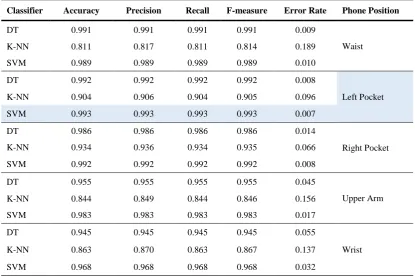
Table 8. Performance measures of selected classifiers for user recognition based on sitting activity 370
Classifier Accuracy Precision Recall F-measure Error Rate Phone Position
DT 0.991 0.991 0.991 0.991 0.009
Waist
K-NN 0.811 0.817 0.811 0.814 0.189
SVM 0.989 0.989 0.989 0.989 0.010
DT 0.992 0.992 0.992 0.992 0.008
Left Pocket
K-NN 0.904 0.906 0.904 0.905 0.096
SVM 0.993 0.993 0.993 0.993 0.007
DT 0.986 0.986 0.986 0.986 0.014
Right Pocket
K-NN 0.934 0.936 0.934 0.935 0.066
SVM 0.992 0.992 0.992 0.992 0.008
DT 0.955 0.955 0.955 0.955 0.045
Upper Arm
K-NN 0.844 0.849 0.844 0.846 0.156
SVM 0.983 0.983 0.983 0.983 0.017
DT 0.945 0.945 0.945 0.945 0.055
Wrist
K-NN 0.863 0.870 0.863 0.867 0.137
SVM 0.968 0.968 0.968 0.968 0.032
Table 9. Performance measures of selected classifiers for user recognition based on walking upstairs activity 371
Classifier Accuracy Precision Recall F-measure Error Rate Phone Position
K-NN 0.966 0.968 0.966 0.967 0.0340
SVM 0.986 0.986 0.986 0.986 0.0140
DT 0.903 0.905 0.903 0.904 0.0970
Left Pocket
K-NN 0.911 0.913 0.911 0.912 0.0890
SVM 0.986 0.986 0.986 0.986 0.0140
DT 0.901 0.903 0.901 0.902 0.0990
Right Pocket
K-NN 0.925 0.926 0.925 0.926 0.0750
SVM 0.987 0.988 0.987 0.988 0.0130
DT 0.858 0.865 0.858 0.861 0.142
Upper Arm
K-NN 0.883 0.891 0.883 0.887 0.117
SVM 0.975 0.977 0.975 0.976 0.0250
DT 0.862 0.865 0.862 0.864 0.138
Wrist
K-NN 0.858 0.860 0.858 0.859 0.142
SVM 0.969 0.970 0.969 0.970 0.0310
Table 10. Performance measures of selected classifiers for user recognition based on walking downstairs
372
activity 373
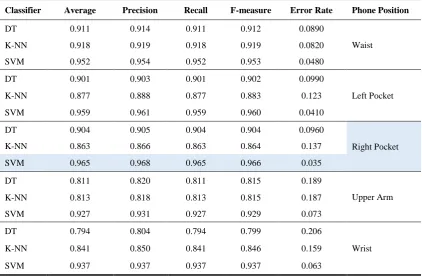
Classifier Average Precision Recall F-measure Error Rate Phone Position
DT 0.911 0.914 0.911 0.912 0.0890
Waist
K-NN 0.918 0.919 0.918 0.919 0.0820
SVM 0.952 0.954 0.952 0.953 0.0480
DT 0.901 0.903 0.901 0.902 0.0990
Left Pocket
K-NN 0.877 0.888 0.877 0.883 0.123
SVM 0.959 0.961 0.959 0.960 0.0410
DT 0.904 0.905 0.904 0.904 0.0960
Right Pocket
K-NN 0.863 0.866 0.863 0.864 0.137
SVM 0.965 0.968 0.965 0.966 0.035
DT 0.811 0.820 0.811 0.815 0.189
Upper Arm
K-NN 0.813 0.818 0.813 0.815 0.187
SVM 0.927 0.931 0.927 0.929 0.073
DT 0.794 0.804 0.794 0.799 0.206
Wrist
K-NN 0.841 0.850 0.841 0.846 0.159
SVM 0.937 0.937 0.937 0.937 0.063
In case of walking activity, SVM classifier achieved an accuracy of 100% in recognizing the users when the 374
smartphone was placed in their left jeans pocket or right jeans pocket. For the same activity, DT and K-NN 375
classifiers achieved 96.6% and 97.6% accuracy for the left pocket position and an accuracy of 98.6% and 97.3% 376
for the right pocket position respectively. The values of other performance metrics i.e., precision, recall, and 377
f-measure were also better for SVM classifier. For the waist and wrist positions, SVM classifier achieved 99.6% 378
accuracy. However, the recognition accuracies obtained for DT and K-NN classifiers are 98.9% for the waist 379
position, and 98.9% and 98.3% for the wrist position respectively. The worst accuracy achieved by SVM, DT, 380
and K-NN classifiers in recognizing users from walking activity is for upper arm position as shown in Table 5. 381
These results state that recognizing users from their walking activity is easier if the phone is kept in their left or 382
a user based on walking pattern. The same thing can be said for identifying users on the basis of running activity 384
as indicated by the results in Table 6. 385
On the basis of standing activity, the users are best recognized for the case when the smartphone was 386
hanged with a belt clipper. The best accuracy rate achieved in this case is 99.4% for the waist position using 387
SVM classifier. The accuracy rate obtained using DT and K-NN classifier for the same position is 99% and 388
87.6% respectively as given in Table 7. Table 8 shows that for sitting activity, the best accuracy rate achieved is 389
99.3% for the left pocket position using SVM classifier. On the other hand, DT and K-NN classifier achieved 390
99.2% and 90.4% accuracy for the left pocket position. The worst accuracy rate achieved by SVM for standing 391
activity is 95.4% for the upper arm position, whereas in case of sitting activity it is 97% for the wrist position. 392
These results depict that it is possible to identify a user based upon standing and sitting activities. In case of 393
these two activities, the users are distinguished from each other because of the differences in their standing and 394
sitting postures. This difference is detected by the inertial sensors of the smartphone placed on the user’s body. 395
The orientation of smartphone inertial sensors changes when a user stands or sits in a different pattern/posture 396
as compare to other persons. Hence, the readings of these sensors change, which leads to identification of that 397
user. From the results obtained from Table 7, it can be said that it is easier to recognize a user on the basis of 398
his/her standing posture/stance if the smartphone is hanged near waist position. On the other hand, it is very 399
hard to recognize the user if the smartphone is placed on the upper arm position. Similarly, results from Table 8 400
report that the identification of a user based on sitting activity is easier if the phone is placed in the jeans pocket 401
as compare to other phone positions. 402
For the case of recognizing users from walking upstairs and walking downstairs activities also, the best 403
results are also obtained using SVM classifier. The highest accuracy achieved for walking upstairs and walking 404
downstairs activity is 98.7% and 96.5% respectively for the right pocket position using SVM classifier as shown 405
in Table 9 and Table 10 respectively. The accuracy achieved by DT and K-NN classifier for walking upstairs 406
activity is 90.1% and 92.5% respectively for the right pocket position. For downstairs activity for similar phone 407
position, DT and K-NN classifiers attained an accuracy rate of 90.4% and 86.3% respectively. The results of 408
these activities, i.e., walking upstairs and walking downstairs, obtained for the waist position are comparable to 409
the results obtained for pocket positions as given in Table 9 and Table 10. Moreover, it can be observed from the 410
results reported in these tables that upper arm and wrist position provides lower user recognition accuracies. 411
Hence, it can be stated that the recognition of a user on the basis of walking upstairs and walking downstairs 412
activity is easier if the smartphone is kept in pocket of the user or hanged at the waist position. 413
Fig. 4. Comparison of selected classifiers performance for user recognition based on six selected activities 414
75 80 85 90 95 100
Walking Running Standing Sitting Walking Upstairs
Walking Downstairs
A
v
er
age
A
cc
u
rac
y
P
er
ce
n
tage
Activities
(a) (b)
(c) (d)
Fig. 5. Confusion matrices of user recognition (performed using SVM classifier) based on four different 415
activities: (a) standing with phone at waist position, accuracy = 99.4%, (b) sitting with phone in left pocket 416
position, accuracy = 99.3% (c) walking upstairs with phone in right pocket, accuracy = 98.7 (d) walking 417
downstairs with phone in right pocket, accuracy = 96.5%. 418
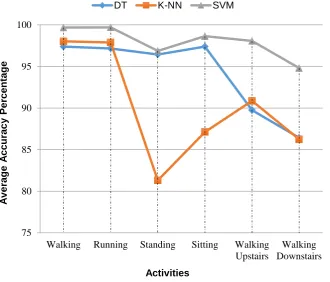
Fig. 4 shows and compares the average accuracy rate achieved by the selected classifiers in recognizing the 419
users on the basis of six different activities. For each activity, average accuracy percentage calculated over five 420
body positions is shown in the figure. It can be observed that for all six activities, SVM classifier obtained the 421
best average accuracy percentage for user recognition. The overall performance of K-NN classifier was better 422
than DT classifier in recognizing the users based on walking, running and walking upstairs activities. For the 423
remaining activities i.e., sitting, standing, walking downstairs, DT classifiers achieved better results than K-NN 424
classifier. The overall average recognition accuracy achieved for SVM classifier is 97.95%, which is 3.87% and 425
7.72% more than the overall average accuracy obtained for DT and K-NN classifiers respectively. Moreover, 426
the precision, recall, f-measure, and error rate are also better for SVM classifiers as depicted in Table 5 to Table 427
10. So, it can be concluded based on the above results and discussions that the performance of SVM classifier is 428
better for user recognition based on activity patterns recognition. It suggests SVM classifier as the best choice 429
for on-device user recognition based on recognizing the activity patterns for individual users. 430
To find out the best individual accuracies of recognition for different users, the confusion matrices for user 431
recognition are provided in Fig. 5 ((a)-(d)). For every activity except walking and running, only one confusion 432
matrix is shown for the position where the best performance metrics were achieved for user recognition using 433
SVM classifier. In case walking and running activities, the best value of accuracy, precision, recall, and 434
f-measure obtained for user recognition using SVM classifier is 100% for each (as shown in Table 5 and Table 435
6). It means that no user was misclassified or wrongly identified as any other user; hence the individual 436
a user based on the walking upstairs and walking downstairs activity, the best position to keep smartphone is the 438
right jeans pocket. On the other hand, for standing and sitting activities, the best positions are waist and left 439
pocket respectively. As discussed earlier, there were total 71 samples for all individual users corresponding to 440
each activity for a single position. Therefore the confusion matrices in Fig. 5 ((a)-(d)) are presented in terms of 441
recognized over total number of samples (i.e. 71) for the all the users. The rows of the confusion matrices are 442
representing actual users while columns are representing the predicted users. It can be seen from Fig. 5 ((a)-(d)) 443
that there are a few misclassifications where the actual user of the smartphone is identified as any other user. 444
However, for each user, the value of correctly classified samples is very high. It means that every user is 445
correctly identified with a very high accuracy. From these promising results, it is worth mentioning that it is 446
possible to efficiently recognize different users on the basis of their activity patterns because of their behavioral 447
differences. 448
Typically, there is only a single owner of a smartphone who is called as the authenticated user of that 449
phone. The owner of the phone has full access to each and everything on his/her phone. However, a smartphone 450
is not necessarily to be used by a single person only. An owner of a mobile device may share his/her phone with 451
other people, who can use that phone for performing any of their tasks as allowed by the phone owner. All such 452
users of the phone are supplementary users. The device owner may set different levels of access to his/her 453
smartphone data and services for different supplementary users. Other than authenticated and supplementary 454
users, any other user of the phone is treated as an impostor with no access given to phone data. To ensure the 455
privacy of any confidential information and data stored on the owner phone, it is necessary to identify the phone 456
user. The proposed system for user recognition identifies a user on the basis of his/her behavioral traits while 457
using smartphone. Once the user is identified by the system, the system assigns the user a respective level of 458
access privileges. The system can only identify a user on the basis of the activities for which the system is 459
trained. In real time, if a user performs a random activity for which is unknown to the system, the system is 460
improbable to be capable of identifying the user in an accurate way as there is no training of the system. 461
However, the proposed system can be trained for the new activity by collecting raw data from the motion 462
sensors of the smartphone. The system can then quickly learn the behavioral patterns of different users for the 463
new activity and adapt itself to identify users based on new activity. In this way, adaptive behavioral 464
authentication is also incorporated in the proposed system. 465
5.
Conclusions
466
In this paper, we analyzed continuous authentication of smartphone users based on their behavioral traits 467
using activity pattern recognition. For this purpose, we proposed a novel scheme for validating smartphone 468
users, which identifies the users based on the way they perform certain activities using mobile sensing. Six 469
activities of daily life i.e., walking, running, sitting, standing, walking upstairs, and walking downstairs, are 470
used to distinguish between different users based on sixteen different features extracted from the time domain. 471
For each activity, five different positions are employed for keeping a smartphone on the user’s body and the 472
user recognition results are analyzed for all these positions. It is noted that the performance of the user 473
recognition based on a particular activity is different for varying positions of the smartphone on the user’s body. 474
A user can be easily and efficiently recognized on the basis of his/her walking pattern if the phone is placed in 475
his/her jeans pocket. In contrast, keeping the phone at the upper arm position makes it very difficult to recognize 476
a user based on the walking activity. Similarly, on the basis of standing posture, a user can be easily recognized 477
if he/she keeps the phone at the waist position, whereas in case of sitting activity, the jeans pocket is the best 478
place for user recognition. In the same way, the activities of walking upstairs and walking downstairs can easily 479
distinguish between different users if the phone is kept in the jeans pocket or hanged with a belt clipper at the 480
waist. Three different machine learning algorithms i.e., Decision Tree, K-Nearest Neighbors, and Support 481
Vector Machine, are used for the purpose of user recognition. It is observed that Support Vector Machine 482
classifier provides the best performance for on-device user identification. Hence, it is an ideal choice for 483
on-device user identification based on activity pattern recognition. 484
To further extend this work, more sensors and activities can be incorporated into the system for recognizing 485
users. Physiological sensors can be used along with the motion sensors for identity authentication. The 486
emotional state of the users can also be recognized along with activity pattern recognition using physiological 487
sensors. As the behavior of the user may change in a random way in different settings; hence an un-supervised 488
machine learning approach can be used for user recognition, which will be helpful in adapting the system to 489
his/her behavioral traits as the behavior of the user changes with different contexts. Hence, context-awareness 491
can be incorporated into the system to efficiently recognize a smartphone user keeping in view the contextual 492
information. Once a user is identified, we can keep track of his/her activities for health monitoring, social 493
interaction monitoring, and behavior prediction and modeling. 494
References
495Albert, M. V., Toledo, S., Shapiro, M., Kording, K., 2012. Using mobile phones for activity recognition in 496
Parkinson’s patients. Front. Neurol. NOV. doi:10.3389/fneur.2012.00158 497
Alzubaidi, A., Kalita, J., 2016. Authentication of smartphone users using behavioral biometrics. IEEE 498
Commun. Surv. Tutorials 18, 1998–2026. doi:10.1109/COMST.2016.2537748 499
Anguita, D., Ghio, A., Oneto, L., Parra, X., Reyes-Ortiz, J.L., 2013. A Public Domain Dataset for Human 500
Activity Recognition Using Smartphones, in: 21th European Symposium on Artificial Neural Networks, 501
Computational Intelligence and Machine Learning, ESANN 2013. 502
Anjum, A., Ilyas, M.U., 2013. Activity recognition using smartphone sensors, in: 2013 IEEE 10th Consumer 503
Communications and Networking Conference, CCNC 2013. pp. 914–919. 504
doi:10.1109/CCNC.2013.6488584 505
Avci, A., Bosch, S., Marin-Perianu, M., Marin-Perianu, R., Havinga, P., 2010. Activity Recognition Using 506
Inertial Sensing for Healthcare, Wellbeing and Sports Applications: A Survey. Archit. Comput. Syst. 507
(ARCS), 2010 23rd Int. Conf. 1–10. 508
Breiman, L., Friedman, J.H., Olshen, R.A., Stone, C.J., 1984. Classification and Regression Trees, The 509
Wadsworth statisticsprobability series. doi:10.1371/journal.pone.0015807 510
Bulling, A., Blanke, U., Schiele, B., 2014. A tutorial on human activity recognition using body-worn inertial 511
sensors. ACM Comput. Surv. 1, 1–33. doi:http://dx.doi.org/10.1145/2499621 512
Buriro, A., Crispo, B., Zhauniarovich, Y., 2017. Please hold on: Unobtrusive user authentication using 513
smartphone’s built-in sensors, in: 2017 IEEE International Conference on Identity, Security and Behavior 514
Analysis, ISBA 2017. doi:10.1109/ISBA.2017.7947684 515
Camara, C., Peris-Lopez, P., Tapiador, J.E., 2015. Human Identification Using Compressed ECG Signals. J. 516
Med. Syst. 39. doi:10.1007/s10916-015-0323-2 517
Chatzimilioudis, G., Konstantinidis, A., Laoudias, C., Zeinalipour-Yazti, D., 2012. Crowdsourcing with 518
smartphones. IEEE Internet Comput. 16, 36–44. doi:10.1109/MIC.2012.70 519
Cho, K.S., Lee, J.M., 2017. Influence of smartphone addiction proneness of young children on problematic 520
behaviors and emotional intelligence: Mediating self-assessment effects of parents using smartphones. 521
Comput. Human Behav. 66, 303–311. doi:10.1016/j.chb.2016.09.063 522
Cola, G., Avvenuti, M., Musso, F., Vecchio, A., 2016. Gait-based authentication using a wrist-worn device, in: 523
Proceedings of the 13th International Conference on Mobile and Ubiquitous Systems: Computing, 524
Networking and Services - MOBIQUITOUS 2016. pp. 208–217. doi:10.1145/2994374.2994393 525
Consolvo, S., McDonald, D.W., Toscos, T., Chen, M.Y., Froehlich, J., Harrison, B., Klasnja, P., LaMarca, A., 526
LeGrand, L., Libby, R., Smith, I., Landay, J.A., 2008. Activity Sensing in the Wild: A Field Trial of 527
UbiFit Garden. Chi 2008 26Th Annu. Chi Conf. Hum. Factors Comput. Syst. Vols 1 2, Conf. Proc. 1797– 528
1806. doi:10.1145/1357054.1357335 529
Cortes, C., Vapnik, V., 1995. Support-Vector Networks. Mach. Learn. 20, 273–297. 530
doi:10.1023/A:1022627411411 531
Damaševičius, R., Maskeliunas, R., Venčkauskas, A., Woźniak, M., 2016. Smartphone user identity 532
Derawi, M.O., Nickely, C., Bours, P., Busch, C., 2010. Unobtrusive user-authentication on mobile phones using 534
biometric gait recognition, in: Proceedings - 2010 6th International Conference on Intelligent Information 535
Hiding and Multimedia Signal Processing, IIHMSP 2010. pp. 306–311. doi:10.1109/IIHMSP.2010.83 536
Data Breaches 101: How They Happen, What Gets Stolen, and Where It All Goes. 537
http://www.trendmicro.com/vinfo/us/security/news/cyber-attacks/data-breach-101 (accessed on 30.01. 538
2018) 539
Ellis, K., Godbole, S., Chen, J., Marshall, S., Lanckriet, G., Kerr, J., 2013. Physical activity recognition in 540
free-living from body-worn sensors, in: Proceedings of the 4th International SenseCam & Pervasive 541
Imaging Conference on - SenseCam ’13. pp. 88–89. doi:10.1145/2526667.2526685 542
Feng, T., Zhao, X., Carbunar, B., Shi, W., 2013. Continuous mobile authentication using virtual key typing 543
biometrics, in: Proceedings - 12th IEEE International Conference on Trust, Security and Privacy in 544
Computing and Communications, TrustCom 2013. pp. 1547–1552. doi:10.1109/TrustCom.2013.272 545
Fernandez-Lopez, P., Liu-jimenez, J., Sanchez-Redondo, C., Sanchez-reillo, R., 2016. Gait Recognition Using 546
Smartphone. Carnahan 8. doi:10.1109/CCST.2016.7815698 547
Frank, M., Biedert, R., Ma, E., Martinovic, I., Song, D., 2013. Touchalytics: On the applicability of touchscreen 548
input as a behavioral biometric for continuous authentication. IEEE Trans. Inf. Forensics Secur. 8, 136– 549
148. doi:10.1109/TIFS.2012.2225048 550
Gartner, 2017. Gartner Says Worldwide Device Shipments Will Increase 2 Percent in 2018, Reaching Highest 551
Year-Over-Year Growth Since 2015. http://www.gartner.com/newsroom/id/3816763 (accessed on 552
30.01.2018) 553
Gesell, S.B., Barkin, S.L., Valente, T.W., 2013. Social network diagnostics: A tool for monitoring group 554
interventions. Implement. Sci. 8. doi:10.1186/1748-5908-8-116 555
Guo, G., Wang, H., Bell, D., Bi, Y., Greer, K., 2003. kNN Model-Based Approach in Classification. Move to 556
Meaningful Internet Syst. 2003 CoopIS, DOA, ODBASE 2888, 986–996. doi:10.1007/b94348 557
Harari, G.M., Lane, N.D., Wang, R., Crosier, B.S., Campbell, A.T., Gosling, S.D., 2016. Using Smartphones to 558
Collect Behavioral Data in Psychological Science: Opportunities, Practical Considerations, and 559
Challenges. Perspect. Psychol. Sci. 11, 838–854. doi:10.1177/1745691616650285 560
Hejazi, M., Al-Haddad, S.A.R., Singh, Y.P., Hashim, S.J., Abdul Aziz, A.F., 2016. ECG biometric 561
authentication based on non-fiducial approach using kernel methods. Digit. Signal Process. 52, 72–86. 562
doi:10.1016/j.dsp.2016.02.008 563
Hoseini-Tabatabaei, S.A., Gluhak, A., Tafazolli, R., 2013. A survey on smartphone-based systems for 564
opportunistic user context recognition. ACM Comput. Surv. 45, 1–51. doi:10.1145/2480741.2480744 565
Incel, O.D., Kose, M., Ersoy, C., 2013. A Review and Taxonomy of Activity Recognition on Mobile Phones. 566
Bionanoscience 3, 145–171. doi:10.1007/s12668-013-0088-3 567
Kang, S.J., Lee, S.Y., Cho, H. Il, Park, H., 2016. ECG Authentication System Design Based on Signal Analysis 568
in Mobile and Wearable Devices. IEEE Signal Process. Lett. 23, 805–808. 569
doi:10.1109/LSP.2016.2531996 570
Khan, W.Z., Xiang, Y., Aalsalem, M.Y., Arshad, Q., 2013. Mobile Phone Sensing Systems: A Survey. IEEE 571
Commun. Surv. Tutorials 15, 402–427. doi:10.1109/SURV.2012.031412.00077 572
Kohavi, R., 1996. Scaling Up the Accuracy of Naive-Bayes Classifiers: A Decision-Tree Hybrid. Proc. Second 573
Int. Conf. Knowl. Discov. Data Min. 7, 202–207. doi:citeulike-article-id:3157868 574
Krupp, B., Sridhar, N., Zhao, W., 2017. SPE: Security and Privacy Enhancement Framework for Mobile 575