ORIGINAL ARTICLE
Thomas Walther · S. Nami Kartal · Won Joung Hwang Kenji Umemura · Shuichi Kawai
Strength, decay and termite resistance of oriented kenaf fi berboards
Abstract The development of oriented fi berboards made from kenaf (Hibiscus cannabinus L.) and their suitability as a construction material has been investigated. Three differ-ent types of boards consisting of fi ve layers with individual orientations were prepared using a combination of low molecular weight and high molecular weight phenol– formaldehyde (PF) resin for impregnation and adhesion purposes. Additional boards with the same structure were prepared using high molecular weight PF resin only. The mechanical properties of the boards have been examined as well as their resistance against fungal decay and termite attack. All kenaf fi berboards showed elevated mechanical properties compared with medium-density fi berboard made from wood fi bers, and showed increased decay and termite resistance. Differences in the decay and termite resistance between the board types were caused by the presence of the low molecular weight PF resin for the impregnation of the fi bers. No signifi cant difference was found for the mechani-cal properties. The effect of the PF resin for impregnation was much clearer in fungal decay resistance than for termite resistance; however, fi ber orientation had no effect on both decay and termite resistance of the specimens.
Key words Kenaf fi ber · Oriented fi berboard · Phenol resin · Decay resistance · Termite resistance
T. Walther (*)
Voith Paper Technology Center, Paul-Hartmann-Strasse 4, Heidenheim 89522, Germany
Tel. +49-732-137-2061; Fax +49-732-137-7102 e-mail: [email protected]
S.N. Kartal
Department of Forest Biology and Wood Protection Technology, Forestry Faculty, Istanbul University, 34473 Istanbul, Turkey
W.J. Hwang · K. Umemura · S. Kawai
Research Institute for Sustainable Humanosphere, Kyoto University, Kyoto 611-0011, Japan
Introduction
Kenaf (Hibiscus cannabinus L.) has gained high importance in recent years as a sustainable plant fi ber resource for composite products. The utilization of the stem bast fi bers and core for the production of composite boards has been developed worldwide1–7
at a time when the need for well-suited construction materials made from renewable resources in countries with insuffi cient forest resources is evident.
Considerable research has been performed to evaluate the utilization potential of kenaf fi bers in composite prod-ucts. Grigoriou et al.8
stated that urea–formaldehyde (UF)-bonded kenaf boards consisting of fi bers and core in the proportion of 92 : 8 were found to satisfy the American stan-dards concerning particleboards but not those applying to fi berboards. Chow et al.9
indicates that phenolic-resin-bonded boards are preferred in building construction for protection against water and high humidity. However, decay by fungi in the phenolic-bonded board is as severe as that in the urea-bonded board.10
There is also a need to evaluate decay and termite resistance of boards produced from kenaf fi bers to determine whether they can be used in outdoor or severe degradation conditions without any biocides.
The aim of this study was to evaluate the suitability of kenaf fi bers for the development of construction materials and to determine their decay and termite resistance under service conditions.
Materials and methods
Board preparation
The boards were produced using kenaf bast fi bers from Anhui Province in East China. The fi bers were refi ned and mechanically orientated in the longitudinal direction with a carding machine to a web of 12 cm in width and then coiled up on a roll.
Three types of oriented kenaf fi berboard were devel-oped. The boards consisted of fi ve individual layers, each with a certain orientation. A unidirectional board (type I) was created with all layers oriented in the longitudinal direction (0°-0°-0°-0°-0°). The second version (type II) 1consisted of a plywood-type board with an orientation of 0°-90°-0°-90°-0° and the third version (type III) was built up with a 0°-45°-90°-135°-0° orientation. The size of the boards was set to 500 × 500 mm with a thickness of 4 mm. The target density of all boards was 800 kg m−3
.
Two types of phenol–formaldehyde (PF) resin were chosen for impregnation and adhesive purposes: (1) low molecular weight (LM) PF-resin type PL-3725 (Gun Ei Chemical), solid resin content 53.5%; and (2) high molecu-lar weight (HM) PF-resin type PL-2818 (Gun Ei Chemical), solid resin content 73.6%. Both resins were mixed and an impregnation solution of the resins was prepared by adding ethanol and water to decrease the viscosity and to maintain a solid resin content of 12.5% high molecular weight PF resin and 12.5% low molecular weight PF resin. The low molecular weight PF resin was found to penetrate the cell wall to reduce swelling and shrinkage effects11
and to increase the decay and termite resistance.12
The high molec-ular weight PF resin was found not to penetrate the cell wall during previous tests and it acts as an adhesive between the fi bers.11
Two sets of boards were produced using both PF resins for type I, II, and III (so-called type Ia, IIa, IIIa) whereas another set was produced using the high molecular weight PF resin only for type I and II (so called type Ib and IIb) to compare the mechanical properties and the decay and termite resistance effects of the impregnation. Board type IIIb was not manufactured due to limitations in raw mate-rial supply.
A laboratory-scale continuous impregnation routine was established to dip the fi ber web into the PF resin solution (board type “a” with low and high molecular weight PF resin, board type “b” with high molecular weight PF resin only). Redundant impregnation solution was squeezed out by passing the fi ber web through a pair of rollers. The impregnated fi ber webs were then cut into strips with a length of 50 cm and dried at room temperature for 12 h.
Thereafter, the fi ber mats where laid by manually orient-ing the strips for each layer. One oriented layer in the mat consisted of fi ve strips in height and fi ve strips in width overlapping the previous strips to align the distribution of the fi bers in the mat.
The oriented mats were consolidated in a laboratory hot press with a specifi c pressure of 4.5 MPa and at a pressing
temperature of 160°C for 10 min to completely cure the PF resin. Afterward, all boards were conditioned at 20°C and 65% relative humidity (RH) and the samples for the tests were prepared. The macroscopic view of the structure of the oriented layers of the type IIa kenaf fi berboard can be seen in Fig. 1.
The type Ib and IIb boards reached the target density of 800 kg m−3
whereas the Ia, IIa, and IIIa boards reached an average density of 750 kg m−3 due to deviations in the weight of the kenaf raw material. The density difference of 7% between the type a and b boards was taken into consider-ation and it is displayed in Tables 1–4.
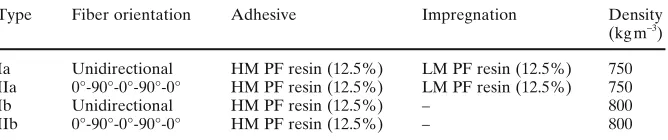
The mechanical and physical properties of the oriented boards were measured according to the Japanese Industrial Standard JIS A 5905-1994 for fi berboard. The tests included the testing of bending strength (modulus of rupture; MOR), the calculation of the modulus of elasticity (MOE), mea-surement of the internal bond strength (IB), and the thick-ness swelling in cold water (TS) for 24 h. Additional measurements of length and width changes of the samples after immersion in water were also included. The properties of the specimens from the kenaf fi berboards used in decay and termite resistance tests are shown in Table 1.
Decay resistance tests
A monoculture decay test was conducted with the brown-rot fungus, Fomitopsis palustris (Berk. et Curt) Gilbn. & Ryv. (FFPRI 0507), and the white-rot fungus, Trametes ver-sicolor (L.: Fr.) Pilat. (FFPRI 1030), according to JIS K 1571 standard method.13 A 100-ml aliquot of liquid medium con-taining 4% glucose, 0.3% peptone, and 1.5% malt extract was inoculated with stock culture of either T. versicolor or F. palustris. The inoculated liquid medium was incubated
Fig. 1. Structure of a 50 × 50 × 4 mm oriented kenaf fi berboard (type
IIa) showing the detail of the laminate structure (inset)
Table 1. Properties of the kenaf board specimens used in decay and termite resistance tests
Type Fiber orientation Adhesive Impregnation Density (kg m−3)
Ia Unidirectional HM PF resin (12.5%) LM PF resin (12.5%) 750 IIa 0°-90°-0°-90°-0° HM PF resin (12.5%) LM PF resin (12.5%) 750 Ib Unidirectional HM PF resin (12.5%) – 800 IIb 0°-90°-0°-90°-0° HM PF resin (12.5%) – 800
on a shaker (120 rpm) at 26°C for 10 days. The medium of 250 g of sea sand in a glass jar was permeated with 80–85 ml of nutrient solution containing 4% glucose, 0.3% peptone, and 1.5% malt extract for T. versicolor or containing half as much of each component for F. palustris. The jars were then inoculated with 3–4 ml of the liquid fungal stock culture previously prepared. After measuring oven-dry weights, kenaf fi berboard specimens were sterilized with gaseous ethylene oxide. When the mycelium fully covered the medium in the jars, three specimens were placed onto the top of growing mycelium in the glass jar, with either a plastic mesh spacer for F. palustris or without a plastic mesh spacer for T. versicolor. The test jars were then incubated at 27°C and for 12 weeks. Nine replicates were tested for each decay fungus for each board type. The extent of the fungal attack was expressed as the average of mass loss (percent) calculated from oven-dry weights of nine speci-mens before and after the decay procedure.
Termite resistance tests
The specimens were exposed to the subterranean termite Coptotermes formosanus Shiraki according to Japan Wood Preserving Association (JWPA) standard JWPS-TW-P.1.14 An acrylic cylinder (80 mm in diameter, 60 mm in height) which had the lower end sealed with a 5-mm-thick hard dental plaster (New Plastone, GC Corp.) was used as a container. A test specimen was placed at the center of the plaster bottom of the test container. A total of 150 worker termites and 15 soldiers collected from a laboratory termite colony at RISH, Kyoto University, were introduced into each test container. Five specimens per board type were assayed against termites. The assembled containers were set on damp cotton pads to supply water to the specimens and
kept at 28°C and >85% RH in darkness for 3 weeks. The mass loss of the specimens due to termite attack was calcu-lated based on the differences in the initial and fi nal oven-dry weights of the specimens after cleaning off the debris from termite attack.
Results and discussion
Physical and mechanical properties
The moisture content of the type a and b samples was mea-sured after conditioning and it was found that the type a samples had a moisture content of 5.14% [standard devia-tion (SD) 0.19%], whereas the type b samples had a mois-ture content of 5.93% (SD 0.07%), which indicated the reduced moisture uptake effect of the low molecular weight PF resin used for impregnation. Additional results were found regarding the thickness swelling and dimensional changes after immersion in water for 24 h displayed in Table 2. The board types Ia, IIa, and IIIa fulfi ll the requirements of JIS A 5905-1994 for fi berboards (17% or under required) with a thickness increase of 13%. The type Ib and IIb boards showed a signifi cantly increased thickness swelling of 32% which is more than double that of the type Ia and IIa boards.
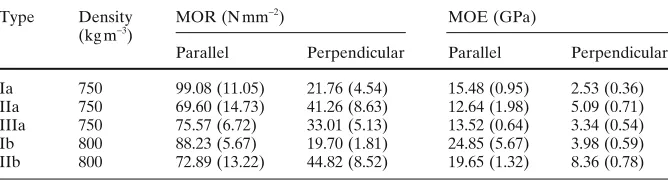
Slight dimensional changes in length and width occurred due to the sample size of 50 × 50 mm, but they indicate the plywood-like behavior of the type II and III boards with lower expansion in width compared with the type I boards. The bending strength of all board types shown in Table 3 is elevated regarding the requirements of the JIS A 5905-1994 with 30 N mm−2
except for the type I boards that have a lower bending strength perpendicular to the main board
Table 2. Mean values of the thickness swelling test results and the dimensional changes after
24-h immersion in water
Type Density Thickness swelling Dimensional change ratio (kg m−3) ratio (%)
Length(%) Width(%)
Ia 750 13.30 (0.51) 0.08 (0.05) 0.13 (0.07) IIa 750 13.21 (0.49) 0.04 (0.03) 0.06 (0.05) IIIa 750 13.29 (0.38) 0.03 (0.02) 0.06 (0.04) Ib 800 32.46 (1.72) 0.20 (0.09) 0.40 (0.06) IIb 800 31.04 (1.40) 0.22 (0.07) 0.24 (0.10)
Values in parentheses are standard deviations
Table 3. Mean values of the bending test results with modulus of rupture (MOR) and modulus
of elasticity (MOE)
Type Density MOR (N mm−2) MOE (GPa)
(kg m−3)
Parallel Perpendicular Parallel Perpendicular
Ia 750 99.08 (11.05) 21.76 (4.54) 15.48 (0.95) 2.53 (0.36) IIa 750 69.60 (14.73) 41.26 (8.63) 12.64 (1.98) 5.09 (0.71) IIIa 750 75.57 (6.72) 33.01 (5.13) 13.52 (0.64) 3.34 (0.54) Ib 800 88.23 (5.67) 19.70 (1.81) 24.85 (5.67) 3.98 (0.59) IIb 800 72.89 (13.22) 44.82 (8.52) 19.65 (1.32) 8.36 (0.78)
orientation. This effect is signifi cant due to the unidirec-tional fi ber orientation. A plywood-like effect is caused by using oriented layers of the type II and III boards with a reduction in bending strength perpendicular to the main board orientation because of the infl uence of the top and bottom layer having the same orientation. A delamination defect between the layers was observed rather than a failure of the fi ber bundles.
The modulus of elasticity was calculated by the testing machine based on the settings given before the test. All results are above the Young’s modulus in bending recom-mended by the standard. It shows that the elastic behavior of the boards is higher than medium-density fi berboard (MDF) made from wood fi bers.
The internal bond strength results displayed in Table 4 showed comparable results for all boards but with a high standard deviation for each type. The coeffi cient of varia-tion is between 33% and 35%, which indicates the high variability of the results. A double-sided t-test revealed that there was no signifi cant difference within the board types. It can be assumed that the density difference of 7% between the type IIa and IIb boards was too low to cause a signifi cant effect on the internal bond strength results. In fact, the IB strength of the boards is just below the JIS standard of 0.5 N mm−2
for fi berboards. Mostly, delamination defects between the layers shown in Fig. 2 occurred during the IB test and they can be claimed to be responsible for the poor bonding behavior of the boards. The magnifi ed fi ber bundles
shown in Fig. 2 seem to be nearly intact and only small areas on the surface of the fi ber bundles indicate former bonded areas with residues of PF resin and parts of the adjacent cell wall. The poor results of the internal bond test were not expected after the good results found in bending and the dimensional stability tests. This indicates that the bonding of the fi bers can be improved.
Decay and termite resistance
The mass losses that occurred in the specimens during the 12-week fungal decay tests are shown in Fig. 3. There was a signifi cant effect of impregnation with the low molecular weight 12.5% PF resin on the susceptibility of the kenaf board specimens. Fiber orientation had no signifi cant effect on the fungal resistance of the specimens against the brown-rot fungus. However, a slight increase was found for the mass losses of the type II specimens compared with type I specimens.
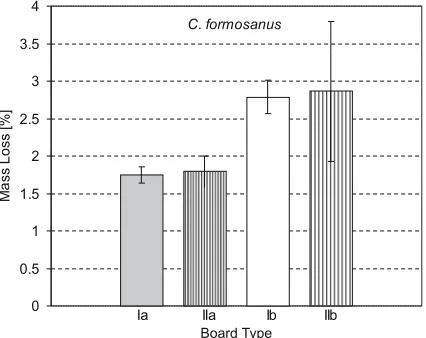
The type b specimens without low molecular weight PF resin impregnation gave lower worker termite mortalities than those impregnated with the low molecular weight 12.5% PF resin (Fig. 4). The differences among soldier termite mortalities were found insignifi cant and the mortali-ties reached almost 100% at the end of the tests. However, the effect of the layer orientation on termite mortalities was mixed. The results may suggest that the PF resin used in the study is a fast-acting chemical that kills termites when they ingest the fi bers. All specimens were found almost intact after a 3-week termite exposure whereas the specimens without low molecular weight PF resin impregnation (type b) showed higher mass losses (Fig. 5). In general, termite mortalities conformed to the mass losses in the specimens.
Fungal decay and termite resistance tests revealed that the PF resin-impregnated kenaf fi berboards seem to be suit-able for building purposes. On the other hand, the boards were resistant against termite attack even without low molecular weight PF resin impregnation. In contrast to
phe-Table 4. Mean values of the internal bond strength
Type Density (kg m−3) Internal bond strength (MPa)
Ia 750 0.44 (0.17)
IIa 750 0.30 (0.10)
IIIa 750 0.44 (0.18)
Ib 800 0.42 (0.15)
IIb 800 0.43 (0.16)
Values in parentheses are standard deviations
Fig. 2. Internal structure of type IIa kenaf fi berboard after internal
bonding strength test. Arrowheads indicate former bonded areas
Fig. 3. Mass losses in the specimens exposed to fungal decay resistance
nolic resins, urea–formaldehyde resin-bonded, wood-based composites show generally lower water resistance in humid environmental conditions that degrade adhesive bonds formed by the resin; PF resins provide excellent bond dura-bility for such composites.15
Nzokou et al.16
showed that the increase in decay and termite resistance of laminated veneer lumber products was attributed to the density and the phenolic resin, which affected moisture equilibrium. Curling and Murphy17
stated that the chemicals derived from the resins may show inhibitory properties against decay; however, decay susceptibility is dependent on more factors than just the resin type.
Conclusions
The properties of the kenaf fi berboards showed that the production of construction materials made from annual plant fi bers is possible. However, the IB values were slightly lower than the requirements of the JIS A 5905-1994 whereas the bending strength of the boards were elevated compared with conventional unoriented MDF made from wood fi bers.
The reduction in thickness increase after immersion in water, especially for the type a boards, is evident and dif-ferences between type a and type b boards are due to the impregnation effect of the low molecular weight PF resin. The total resin content of 25% of the type a boards prohib-its the degradation by fungi and termites and moisture uptake from the environment. The use of additional preser-vatives might not be necessary to withstand severe service conditions.
The mechanical properties and the resistance against fungi and termites seem to be promising for the deve lopment of a strong and durable construction material, especially for humid conditions. It might be useful as a supplement or an alternative construction material for regions with a low availability of wood products. The further development of fi berboards from annual plant fi bers will mostly depend on the production costs, which relate mainly to the cost of adhesive. Additionally, the use of adhesives made from renewable resources that provide equal strength and decay and termite resistance will be a challenge for the near future in bio-based materials research.
Acknowledgments The fi rst author gratefully acknowledges the
support of the Japan Society for the Promotion of Science (JSPS). The authors thank all laboratory personnel at the Research Institute for Sustainable Humanosphere, Laboratory of Sustainable Materials, and Laboratory of Innovative Humano-Habitability for their technical support.
References
1. Kawai S, Zhang M, Okudaira Y, Xu J, Widyorini R, Han G (2002) Development of kenaf bast fi breboard and core binderless particle-board. Proceedings of the 6th Pacifi c Rim Bio-Based Composites Symposium, Oregon State University, Portland, OR, USA, 10–13 November, pp 129–134
2. Muehl J, Krzysik AM, Youngquist JA, Chow P, Bao Z (1999) Performance of hardboards made from kenaf. In: Sellers T, Reichert NA, Columbus EP, Fuller MJ, Williams K (eds) Kenaf properties: processing and products. Mississippi State University, Ag and Bio Engineering, Mississippi, USA, pp 367–379
3. Okuda N, Sato M (2004) Manufacture and mechanical properties of binderless boards from kenaf core. J Wood Sci 50:53–61 4. Ohnishi K, Okudaira Y, Zhang M, Kawai S (2000) Manufacture
and properties of oriented medium density fi breboard from non-wood lignocellulosic fi bres I. Development of a mechanical orien-tator and its application to manufacturing oriented fi breboard. Mokuzai Gakkaishi 46:115–124
5. Ohnishi K, Umeoka K, Okudaira Y, Zhang M, Kawai S (2003) Development of kenaf boards and their properties. Proceedings of the International Kenaf Symposium, CCG International, Beijing, China, 19–21 August, pp 175–188
6. Widyorini R, Xu J, Watanabe T, Kawai S (2005) Chemical changes in steam-pressed kenaf core binderless particleboard. J Wood Sci 51:26–32
7. Xu J, Widyorini R, Kawai S (2005) Properties of kenaf core binder-less particleboard reinforced with kenaf bast fi ber-woven sheets. J Wood Sci 51:415–420
8. Grigoriou A, Passialis C, Voulgaridis E (2000) Experimental par-ticleboards from kenaf plantations grown in Greece. Holz Roh Werkst 58:309–314
9. Chow P, Harp T, Meimban R, Youngquist JA, Rowell RM (1996) Effects of acetylation on the dimensional stability and decay resis-tance of kenaf (Hibiscus cannabinus L.) fi breboard. International Research Group on Wood Preservation (IRG) Document No: IRG/WP/96-40059, p 7
Fig. 4. Termite mortalities during the 3-week exposure of kenaf fi
ber-board specimens to termites (Coptotermes formosanus)
Fig. 5. Mass losses in kenaf fi berboard specimens after a 3-week
10. Walters CS, Chow P (1975) A soil-block assay of treated and untreated particleboard. American Wood Preservers’ Association 71:170–175
11. Kawai S, Sugawara R, Onishi K, Okudaira Y, Zhang M (2001) Development of kenaf oriented fi berboard – effects of molecular weight of phenol formaldehyde resin on board properties. Pro-ceedings of Symposium on Utilization of Agricultural and Forestry Residues, Nanjing, China, 31 October–3 November, pp 12–16 12. Kartal SN, Green F (2003) Decay and termite resistance of medium
density fi berboard (MDF) made from different wood species. Int Biodeter Biodegr 51:29–35
13. Japanese Standards Association (2004) JIS K 1571. Test methods for determining the effectiveness of wood preservatives and their performance requirements (in Japanese). Japanese Standard Association, Tokyo
14. Japan Wood Preserving Association (JWPA) (2001) JWPA JWPS-TW-P 1. Introduction of wood preservation (in Japanese). JWPA, Tokyo
15. Park BD, Riedl B, Hsu EW, Shields J (2001) Application of cure-accelerated phenol-formaldehyde (PF) adhesives for three-layer medium density fi berboard (MDF) manufacture. Wood Sci Technol 35:311–323
16. Nzokou P, Zyskowski J, Boury S, Kamdem DP (2005) Natural decay resistance of LVL made veneers from durable and non-durable wood species. Holz Roh Werkst 63:173–178