English Education: Jurnal Tadris Bahasa Inggris p-ISSN 2086-6003
Vol 9 (1), 2016, 1-12
Speech Acts: Force Behind Words
Agus Hidayat
IAIN Raden Intan Lampung Email: [email protected]
Abstract. Speech act is a part of pragmatics where there are certain aims
beyond the words or phrases when a speaker says something. Speech acts are acts that refer to the action performed by produced utterances. People can perform an action by saying something. Through speech acts, the speaker can convey physical action merely through words and phrases. The conveyed utterances are paramount to the actions performed. In regard to the English as a foreign language, there are things to consider. It is easy for the speakers or listeners to determine the intended meaning of utterances if they are spoken in the mother tongue. Factors such as idiomatic expressions and cultural norms are not function as barriers to determine the intended meaning.
Keywords: pragmatics, speech acts, norms and idiomatic expressions
A. DEFINITION OF SPEECH ACTS
Communication has always been a necessity in human life. Through
communication, the trade of thought among people, which directly contributes to
the development of the quality of life itself, can be performed. The ability to percept
utterances in communication can determine the actions followed. Communication
can be conveyed through verbal and nonverbal communication. Buck (2002) states
that there are two types of communication, they are verbal and nonverbal
communication. Verbal communication is the way of communicating messages by
using words as elements. Nonverbal communication is the way of communicating
messages by using gesture, body movements, eye contact, facial expression, or
Pragmatics is a study which belief is what is communicated is more than what is
said. The utterances that the speakers produce in communication contain deeper
sense than the actual meaning of the words or phrases themselves. Yule (1996:3)
states that pragmatics has consequently more to do with the analysis of what people
mean by their utterances than what the words or phrases in those utterances might
mean by themselves. Pragmatics also strongly related with context or situation
when something is being said, thus it is very important for the speakers to focus on
the context. Leech (983: 6) also states that pragmatics is the study of meaning which
is related to the speech situations. In accordance to Leech statement, Yule (1996)
argues that pragmatics should also consider aspects of context such as who people
are talking to, when, where, and under what circumstances that will determine the
way they say and what they want to say.
Yule (1996:3) states that there are four areas which pragmatics is concerned with:
1. Pragmatics is the study of speaker meaning.
2. Pragmatics is the study of contextual meaning.
3. Pragmatics is the study of how to get more communicated than it is said.
4. Pragmatics is the study of the expression of relative distance.
In the broad sense, through pragmatics we must be able to grasp the message of the
utterances by being aware that the words or phrases contain deeper meaning than
literal meaning of what is spoken. In line with this, Richard and Schmidt (2002)
argue that pragmatics is the study of the use of language in communication related
to sentences and the context and situations in which they are used.
In the scope of pragmatics, there are some factors that should be considered. These
factors establish the very definition of pragmatics itself. The factors are Implicature,
Speech act, a variety of verbal communication and also a subdivision of pragmatics,
often takes place in verbal and nonverbal communication. Yule (1996) states that
speech acts are a study of how the speakers and hearers use language. Bach (1979)
explains that an action in verbal communication has message in itself, so the
communication is not only about language but also with action. In conclusion
speech act is the utterance that occurs and act refers to an action.
There are certain aims beyond the words or phrases when a speaker says something.
Austin (in Tsui, 1994: 4) explains that speech acts are acts that refer to the action
performed by produced utterances. In line with this, Yule (1996: 47) states that
speech acts is action which is performed via utterances. Stating the same idea,
Birner (2013) also says that uttering something means doing something. Here,
people can perform an action by saying something. Through speech acts, the
speaker can convey physical action merely through words and phrases. The
conveyed utterances are paramount to the actions performed.
B. TYPES OF SPEECH ACTS
There are three types of acts in the speech acts, they are locutionary, illocutionary,
and perlocutionary.
a. Locutionary
Locutionary speech act is roughly equivalent to uttering certain utterance with
certain sense and reference, which again is roughly equivalent to meaning in
traditional sense (Austin, 1962: 108). In line with this, Cutting (2002: 16) states that
locutionary is what is said. also proposed by Yule (1996) who states that
locutionary act is the act of producing meaningful utterances.
The example of the locutionary speech act can be seen in the following sentences:
1. It’s so dark in this room.
The above two sentences represent the actual condition. The first sentence refers to
the lighting of the room and the second sentence refers to the weight of the box.
b. Illocutionary
The illocutionary act is performed via the communicative force of an utterance,
such as promising, apologizing, offering (Yule, 1996:48). This act is also called the
act of doing something in saying something. The most significant level of action in
a speech act is the illocutionary act because the force, which has been desired by
the speakers, determines this act.
Illocutionary act can be the real description of interaction condition. For example:
1. It’s so dark in this room.
2. The box is heavy.
Based on the examples above, the first sentence shows a request to switch the light
on and the second sentence shows a request to lift up the box.
c. Perlocutionary
Hufford and Heasley (1983:250) states that perlocutionary act is the act that is
carried out by a speaker when making an utterance causes in certain effect on the
hearer and others. Perlocutionary act is also the act offering someone.
Perlocutionary act refers to the effect the utterance has on the thoughts or actions
of the other person. A perlocutionary act is specific to the circumstances of
issuance, and is therefore not conventionally achieved just by uttering that
particular utterance, and includes all those effects, intended or unintended, often
indeterminate, that some particular utterance in a particular situation cause. For
example:
1. It is so dark in this room.
Based on the example it can be inferred that the first sentence is uttered by someone
while switching the light on and the second sentence is done by someone while
lifting up the box.
C. CLASSIFICATION OF SPEECH ACTS
Speech acts can be classified into five categories as Searle in Levinson (1983: 240)
states that the classifications are representatives, directives, commissives,
expressive, and declarations.
a. Representatives
Representatives are speech acts that the utterances commit the speaker to the truth
of the expressed proposition. The utterances are produced based on the speaker’s
observation of certain things then followed by stating the fact or opinion based on
the observation. When someone says “she’s beautiful”, the speaker can state the
sentence based on the fact or just give his or her own opinion about physical
condition of a person.
It also states what the speaker believes to be the case or not. Statements of fact,
assertions, conclusions, and descriptions are all examples of the speaker
representing the world as he or she believes it is. For example when someone says
“The earth is flat”, it represents the speaker’s assertions about the earth. The
speaker has opinion that the earth is flat.
Representatives speech act can be noted by some speech acts verb, such as: remind,
tell, assert, deny, correct, state, guess, predict, report, describe, inform, insist,
b.Directives
Directives area speech acts that speaker uses to get someone else to do something.
These speech acts include requesting, questioning, command, orders, and
suggesting. For example, when someone says “Could you lend me a pencil, please?” the utterance represents the speaker requests that the hearer to do
something which is to lend him a pencil.
c. Commissives
Commissives are speech acts that the utterances commit the speaker to some future
course of action, these include promising, threatening, offering, refusal, pledges.
For example when someone says “I’ll be back”, represents the speaker’s promise
that he/she will be back.
d.Expressives
Expressives are speech acts that the utterances express a psychological state. These
speech acts include thanking, apologizing, welcoming, and congratulating. For
example, when someone says “don’t be shy, my home is your home.” The utterance represents the speaker’s expression that he/she welcomes someone.
e. Declarations
Declarations are speech acts that the utterances effect immediate changes in the
institutional state of affairs and which tend to rely on elaborate exta- linguistic
institutions. These speech acts include excommunicating, declaring war,
christening, firing from employment. For example “you are dead to me.”
D. SPEECH ACT IN SECOND LANGUAGE
In the second language situation there are things to consider when it comes to
speech act. It is easy for the speakers or listeners to determine the intended meaning
of utterances if they are spoken in the mother tongue. Factors such as idiomatic
intended meaning. When it comes to foreign language, those factors could
hindrance someone’s ability to truly understand the meaning of utterances. It is hard
to perform speech acts in a second language because learners may not know the
idiomatic expressions or cultural norms in the second language or they may transfer
their first language rules and conventions into the second language, assuming that
such rules are universal.
Because the natural tendency for language learners is to fall back on what they know
to be appropriate in their first language, it is important that these learners understand
exactly what they do in that first language in order to be able to recognize what is
transferable to other languages. Something that works in English might not transfer
in meaning when translated into the second language. For example, the following
remark as uttered by a native English speaker could easily be misinterpreted by a
native Chinese hearer:
Sarah : "I couldn’t agree with you more.”
Cheng: "Hmmm…." (Thinking: "She couldn’t agree with me? I thought she
liked my idea!") (CARLA).
In order to grasp the messages of utterances, one needs to factor in the context when
the words are uttered. Hymes (1974) proposed the SPEAKING model of speech
analysis. According to Hymes, in order to speak a language correctly, one does not
only need to learn its vocabulary and grammar, but also the context in which words
are used. In the speaking model aspects of the linguistic situation are considered
and applied to various components of a discourse sample or a communicated
message.
1. S - Setting and Scene - The setting refers to the time and place while scene
describes the environment of the situation or type of activity. (classroom, bar,
coffee shop, morning, friendly conversation)
2. P - Participants - This refers to who is involved in the speech including the
speaker and the audience, inter-viewer, caller, performer.
3. E - Ends - The purpose and goals of the speech along with any outcomes,
functions or effects of the speech.
4. A - Act Sequence - The order of events that took place during the speech
including form and content.
5. K - Key - The overall key, tone, mood or manner of the speech. (serious,
sarcastic, formal)
6. I - Instrumentalities - The form and style of the speech being given. Channel
(verbal, nonverbal, face to face, telephone, SMS,) Code (emoticons, dialect or
language variety)
7. N - Norms - Defines what is socially acceptable at the event, the rules that govern
interaction and interpretation.
8. G - Genre - The type of speech that is being given. (greeting, joke, apology,
lecture)
Based on the theory of SPEAKING, it is possible to determine the intended meaning
of utterances by analyzing the factors mentioned. The perception of meaning of
utterances can be different based on the context. The time, place, purpose,
participant, tone, the media, rules, and type of speech determine the intended
meaning of utterances.
E. SPEECH ACTS in ELT
In teaching the Speech Act in the classroom the teacher or instructor should
consider several things, since English for Indonesian students is the foreign
language. The barrier mentioned previously can be found in the classroom setting.
misinterpreted into something offensive. Someone could easily interpret
advice-giving acts as an act of criticism. When non-native speakers interact in a second
language, they tend to transfer L1 pragmatic rules into the L2 without realizing the
negative impact they may have (Blum-Kulka, 1983). In addition, even when advice
is warranted, non-native speakers of English with many different L1s tend to rely
on forms associated with direct advice, or softened advice, such as should, or had
better (Altman, 1990). Not only in advise-giving act, acts such as requests,
apologies, refusals, and compliments, have frequently been identified as
particularly problematic for EFL/ESL learners at all levels (Fujinomori, 2004).
There are three different levels of goals can be achieved in teaching speech acts in
the classroom depending on the amount of time available, and the depth of
understanding that teachers would like their students to develop. These goals
proposed by Fujimori (2004) are:
1. Conscious Rising,
2. Knowledge Building, and
3. Productive Development.
The goals of teaching speech acts in the classroom should be directed in rising
consciousness of the students that utterances in English as foreign language could
lead to misinterpretation. It is imperative to accurately understand the intended
meaning by analyzing the utterances. By understanding the norms and idiomatic
expressions of the first and second language the students could determine the
message of the utterances so that it could expand their knowledge resulting in the
ability to perform the speech act flawlessly.
F. RELATED RESEARCH
The intended meanings of utterances sometimes hide behind the words uttered. In
line with the assumption of speech acts itself that when people say something they
namely Locutionary, illocutionary, and perlocutionary. The utterances that people
hear everyday almost always contain meaning that needs to be analyzed in order to
grasp the real intended meaning. The ability to analyze the hidden meaning
occasionally brings about different result. The utterances could be in the form of
spoken words or even in the lyric of a song, speech, movie dialogue.
A research conducted by Isnaniah (2015) found out that Directive is the dominant
type of illocutionary act used by Woody in movie Toy story 3 (2013:38). It implies
that directive has a great role in the movie. Woody mainly uses the statement of
asking, advising, begging, forbidding, ordering, requesting, suggesting,
recommending, demanding, insisting, and permitting. It means that Woody mainly
used representative in communicating each other in the movie such as asking,
ordering, commanding, requesting, suggesting, etc.
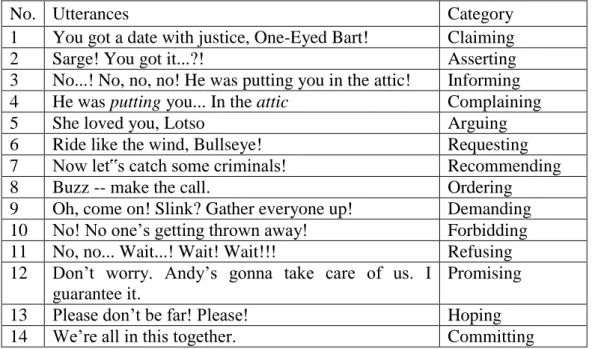
Here are some examples of utterances found in the Toy Story Movie Based on
Isnaniah’s research (2012: 38).
Table 1. The Sample of Speech Act Analysis on Woody’s Utterances in Toy Story 3 Movie
No. Utterances Category
1 You got a date with justice, One-Eyed Bart! Claiming
2 Sarge! You got it...?! Asserting
3 No...! No, no, no! He was putting you in the attic! Informing
4 He was putting you... In the attic Complaining
5 She loved you, Lotso Arguing
6 Ride like the wind, Bullseye! Requesting
7 Now let‟s catch some criminals! Recommending
8 Buzz -- make the call. Ordering
9 Oh, come on! Slink? Gather everyone up! Demanding
10 No! No one’s getting thrown away! Forbidding
11 No, no... Wait...! Wait! Wait!!! Refusing
12 Don’t worry. Andy’s gonna take care of us. I guarantee it.
Promising
13 Please don’t be far! Please! Hoping
15 Okay, fine! Perfect! I can’t believe how selfish you all are.
Regretting
G. CONCLUSION
The ability to understand the hidden message of utterance is really important to
have. Some words or utterances could be misdirected into something unpleasant if
we are not careful. By understanding Pragmatics and speech acts we can get clearer
understanding of the utterances. In Indonesia, English serves as the foreign
language. There are things that exist in English that do not exist in Indonesians such
us certain idiomatic expressions. Those expressions are barriers that could
hindrance someone to fully grasp the actual message of words or utterances. In the
effort of raising the awareness of those barriers speech acts could be socialized in
the classroom. In teaching certain expressions such as giving advice,
complementing, and congratulating, the teacher should have these three goals in
mind, namely: raising awareness, knowledge building, and productive
development.
The goals of teaching speech acts in the classroom should be directed in rising
consciousness of the students that utterances in English as foreign language could
lead to misinterpretation. It is imperative to accurately understand the intended
meaning by analyzing the utterances. By understanding the norms and idiomatic
expressions of the first and second language the students could determine the
message of the utterances so that it could expand their knowledge resulting in the
ability to perform the speech act.
H. REFERENCES
Altman, R. 1990. Giving and Taking Advice without Offence. New York: Newburry House.
Austin, J. L. 1962. How to Do Things with Words. Oxford: Oxford University Press. Bach, K. and R. M. Harnish. 1979. Linguistic Communication and Speech Acts,
Cambridge, Mass: MIT Press.
Request and Apologies. Norwood, NJ: Ablex.
Buck, R and Vanlear C. Arthur. 2002. Verbal and Nonverbal Communication:
Distinguishing Symbolic, Spontaneous, and Pseudo-Spontaneous
Nonverbal Behavior. Journal of Communication. 15, 522-528. Retrieved November12, 2012
Cutting, J. 2002. Pragmatics and Discourse. London: Routledge.
Fujimori. John. 2004. Practical Criteria for Teaching Speech Acts. Tokyo: JALT Publications.
Hymes, D. 1974. Foundations of Sociolinguistics: An Ethnographic Approach. Philadelphia
Isnaniah .2015. An Analysis of Speech Acts by Woody Pride in the movie Toy Story 3. English Education Department. Faculty of Tarbiyah and Teachers Training. Unpublished Thesis
Leech, G. 1996. Principles of Pragmatics. New York: Longman.
Searle, J. R. 2005. Expression and Meaning: Studies in the Theory of Speech Acts. Cambridge: Cambridge University Press.