A Team-Based Scheduling Model
for Interfacing Or-Parallel Prolog Engines
Joao Santos and Ricardo Rocha
CRACS & INESC TEC and Faculty of Sciences, University of Porto Rua do Campo Alegre, 1021/1055, 4169-007 Porto, Portugal
{jsantos,ricroc}@dcc.fc.up.pt
Abstract. Logic Programming languages, such as Prolog, offer a great potential for the exploitation ofimplicit parallelism. One of the most noticeable sources of im-plicit parallelism in Prolog programs isor-parallelism. Or-parallelism arises from the simultaneous evaluation of a subgoal call against the clauses that match that call. Nowadays, multicores and clusters of multicores are becoming the norm and, although, many parallel Prolog systems have been developed in the past, to the best of our knowledge, none of them was specially designed to explore the combina-tion of shared and distributed memory architectures. Conceptually, an or-parallel Prolog system consists of two components: an or-parallel engine (i.e., a set of in-dependent Prolog engines which we named a team of workers) and a scheduler. In this work, we propose a team-based scheduling model to efficiently exploit paral-lelism between different or-parallel engines running on top of clusters of multicores. Our proposal defines a layered approach where a second-level scheduler specifies a clean interface for scheduling work between the base or-parallel engines, thus en-abling different scheduling combinations to be used for distributing work among workers inside a team and among teams.
Keywords:Prolog, or-parallelism, environment copying, scheduling.
1.
Introduction
Logic Programming languages, such as Prolog, provide a high-level, declarative approach to programming. In general, logic programs can be seen as executable specifications that despite their simple declarative and procedural semantics allow for designing very com-plex and efficient applications. The inherent non-determinism in the way logic programs are structured as simple collections of alternative logic clauses makes Prolog very attrac-tive for the exploitation ofimplicit parallelism. The advantage of implicit parallelism is that one can develop specialized run-time systems to transparently explore the available parallelism in programs, thus freeing the programmers from the cumbersome task of ex-plicitly identifying it.
parallel execution of the main program. We will often refer to these Prolog engines as workers.
Arguably, or-parallel systems, such as Aurora [7] and Muse [3], have been the most successful parallel logic programming systems so far. Intuitively, the least complexity of or-parallelism makes it more attractive and productive to exploit than and-parallelism, as a first step. However, practice has shown that a main difficulty, when implementing or-parallelism, is how to efficiently represent themultiple bindingsfor the same variable produced by the parallel execution of alternative matching clauses. One of the most suc-cessful or-parallel models that solves the multiple bindings problem isenvironment copy-ing, that has been efficiently used in the implementation of or-parallel Prolog systems both on shared memory [3, 10] and distributed memory [16, 9] architectures.
Another major difficulty in the implementation of any parallel system is the design ofscheduling strategiesto efficiently assign computing tasks to idle workers. A parallel Prolog system is no exception as the parallelism that Prolog programs exhibit is usually highly irregular. Achieving the necessary cooperation, synchronization and concurrent access to shared data among several workers during execution is a difficult task. For envi-ronment copying, scheduling strategies based ondynamic schedulingof work have proved to be very efficient [2].Stack splitting[4, 8] is an alternative scheduling strategy for en-vironment copying that provides a simple and clean method to accomplish work splitting among workers in which all available work isstatically divided beforehandin comple-mentary sets between the sharing workers. Due to its static nature, stack splitting was thus first introduced aiming at distributed memory architectures [16, 9] but, recent work, also showed good results for shared memory architectures [15, 14].
Motivated by the intrinsic and strong potential that Prolog has for implicit parallelism and by our past experience in designing and developing parallel systems based on en-vironment copying [10, 9, 15, 14], we thus propose a novel computational model to effi-ciently exploit or-parallelism for clusters of low cost multicore architectures. Nowadays, the increasing availability and popularity of multicore processors have made our personal computers parallel with multiple cores sharing the main memory. Multicores and clusters of multicores are now the norm and, although, many parallel Prolog systems have been developed in the past [5], most of them are no longer available, maintained or supported. Moreover, to the best of our knowledge, none of them was specially designed to explore the combination of shared and distributed memory architectures. On one hand, the shared memory based models take advantage of synchronization mechanisms that cannot be eas-ily extended to distributed environments and, on the other hand, the distributed memory based models use specialized communication mechanisms that do not take advantage of the fact that some workers can be sharing memory resources.
intro-duce a second-level team-based scheduler and we specify a clean interface for scheduling work between the or-parallel engines, thus enabling different scheduling combinations to be used for distributing work among workers inside a team and among teams. Our pro-posal resembles the concept of teams used by some models combining and-parallelism with or-parallelism, like the Andorra-I [13] or ACE [6] systems, where a layered approach also implements different schedulers to deal with each level of parallelism.
The remainder of the paper is organized as follows. First, we introduce some back-ground about or-parallelism and the environment copying model. Next, we introduce our layered approach and discuss the major design issues, algorithms and challenges. Last, we advance directions for further work. Throughout the text, we assume the reader will have good familiarity with the general principles of Prolog implementation, and namely with the WAM [1]. When discussing some technical details, we will take as reference the state-of-the-art Yap Prolog system [12], that integrates or-parallelism based on the environment copying model and supports both dynamic and static scheduling of work.
2.
Or-Parallelism
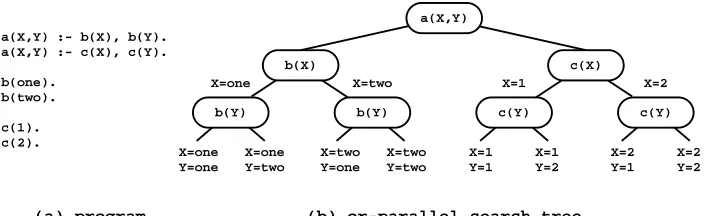
Or-parallelism arises when a subgoal call unifies with more than one of the clauses defin-ing the predicate for the subgoal call at hand. In such a case, the parallel execution of the bodies of the alternative matching clauses corresponds to the exploitation of or-parallelism. A convenient way to visualize or-parallelism is through theor-parallel search tree. Figure 1 illustrates the or-parallel search tree for a small logic program and the query goala(X,Y).
a(X,Y) :- b(X), b(Y). a(X,Y) :- c(X), c(Y).
b(one). b(two).
c(1). c(2).
a(X,Y)
b(X) c(X)
b(Y) b(Y) c(Y) c(Y)
X=one Y=one
X=one Y=two
X=two Y=one
X=two Y=two
X=1 Y=1
X=1 Y=2
X=2 Y=1
X=2 Y=2
X=one X=two X=1 X=2
(a) program (b) or-parallel search tree
Fig. 1.An or-parallel search tree
applica-tion areas such as expert systems, optimizaapplica-tion and relaxaapplica-tion problems, certain types of parsing, natural language processing, deductive database systems, among others.
Intuitively, or-parallelism seems simple to implement since the various alternative branches of the or-tree are independent of each other. However, parallel execution can result in conflicting bindings for common variables. For any two different branches of the or-tree, there are a set of ancestor nodes than are common to both branches. A variable created in one of these common nodes might be bound differently in the two branches. In Fig. 1, we can see that the two variablesXandY, created in the top node, have different combinations of bindings in different branches. The environments of alternative branches have to be organized in such a way that conflicting bindings can be easily discernible. This problem, known as themultiple bindings problem, is a major problem when implementing or-parallelism.
3.
Environment Copying
One of the most successful or-parallel models that solves the multiple bindings problem is theenvironment copyingmodel. In the environment copying model, each worker keeps a separate copy of its own environment, thus the bindings to common variables are done as usual (i.e., stored in the private execution stacks of the worker doing the binding) and without conflicts. Every time a worker shares work with another worker, all the execution stacks are copied to ensure that the requesting worker has the same environment state down to the search tree node where the sharing occurs.
As a result of environment copying, each worker can proceed with the execution ex-actly as a sequential engine, with just minimal synchronization with other workers. Syn-chronization is mostly needed when updating scheduling data and when accessing shared nodes in order to ensure that unexplored alternatives are only exploited by one worker. All other WAM data structures, such as the environment frames, the heap, and the trail do not require synchronization.
At the engine level, the search tree nodes are implemented aschoice pointsin the local stack [1]. A choice point stores the open alternatives left to try. A choice point frame is pushed onto the local stack when a subgoal call unifies with more than one candidate clause and it is popped off when the last alternative clause is taken for execution. A choice point contains the necessary information to restore the state of the computation back to when the first clause was entered; plus a reference to the next open clause to try, in case the current one fails.
3.1. Incremental Copying
To reduce the overhead of stack copying when sharing work, an optimized copy mecha-nism calledincremental copy[3] takes advantage of the fact that the requesting worker may already have traversed part of the path being shared. Therefore, it does not need to copy from the sharing worker the stacks referring to the whole path from root, but only the stacks starting from the youngest node common to both workers.
a positive answer fromP, it only needs to copy the differences betweenP andQ. These differences can be easily calculated through the information stored in the common choice point found byQand in the top registers of the execution stacks ofP. Care must be taken about variables older than the youngest common choice point that were instantiated byP, as incremental copying does not copy these bindings. WorkerQthus needs to explicitly installthe bindings for such variables. This process, called theadjustment of cells outside the increments, is implemented by searching the trail stack for bindings to variables older than the youngest common choice point [3].
3.2. Or-Frames
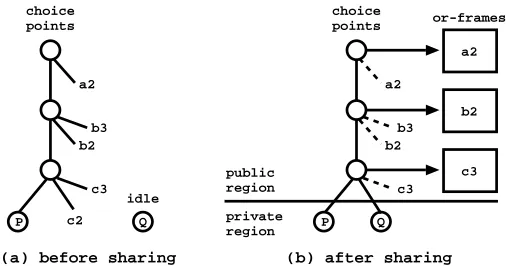
Deciding which workers to ask for work and how much work should be shared is a func-tion of the scheduler. A fundamental task when sharing work is to turnpublicthe private choice points, so that backtracking to these choice points can be synchronized between different workers. Public choice points are treated differently because we need to synchro-nize workers in such a way that we avoid executing twice the same alternative. Strategies based on dynamic scheduling of work, use or-frames to implement such synchroniza-tion [3]. Figure 2 shows a schematic representasynchroniza-tion of the sharing process between two workers using or-frames.
(b) after sharing
P Q
public region
private region
a2
b2
c3 choice
points or-frames
b3 b2 a2
c3
(a) before sharing
P c2
choice points
b3 b2 a2
c3
Q idle
Fig. 2.Or-frames and public choice points
3.3. Stack Splitting
Stack splitting was first introduced to target distributed memory architectures, thus aim-ing to reduce the mutual exclusion requirements of the or-frames when accessaim-ing shared nodes of the search tree. It accomplishes this by defining simple and clean work splitting strategies in which all available work is statically divided beforehand in two complemen-tary sets between the sharing workers. In practice, with stack splitting the synchronization requirement is removed by the preemptive split of all unexplored alternatives at the mo-ment of sharing. The splitting is such that both workers will proceed, each executing its branch of the computation, without any need for further synchronization when accessing shared nodes. This matches the problem of having a pool of tasks to compute and either (i) access the pool to get the next available task every time a worker runs out of work (dynamic scheduling) or (ii) divide the tasks between the available by assigning each task to a specific worker (static scheduling).
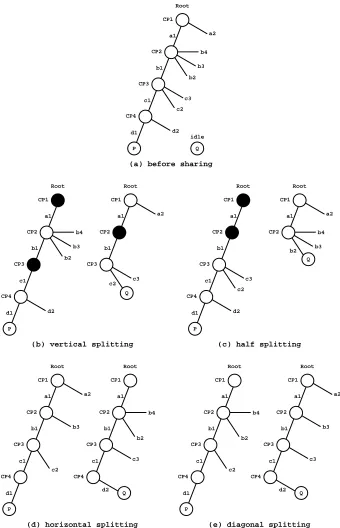
The original stack splitting proposal [4] introduced two strategies for dividing work: vertical splitting, in which the available choice points are alternately divided between the two sharing workers, and horizontal splitting, which alternately divides the unexplored alternatives in each available choice point. Diagonal splitting[9] is a more elaborated strategy that achieves a precise partitioning of the set of unexplored alternatives. It is a kind of mix between horizontal and vertical splitting, where the set of all unexplored al-ternatives in the available choice points is alternately divided between the two sharing workers. Another splitting strategy [17], which we namedhalf splitting, splits the avail-able choice points in two halves. Figure 3 illustrates the effect of these strategies in a work sharing operation between a busy workerP and an idle workerQ.
Figure 3(a) shows the initial configuration with the idle workerQrequesting work from a busy worker P with 7 unexplored alternatives in 4 choice points. Figure 3(b) shows the effect of vertical splitting, in whichP keeps its current choice point and alter-nately divides withQthe remaining choice points up to the root choice point. Figure 3(c) illustrates the effect of half splitting, where the bottom half is for workerP and the half closest to the root is for workerQ. Figure 3(d) details the effect of horizontal splitting, in which the unexplored alternatives in each choice point are alternately split between both workers, with workersP andQowning the first unexplored alternative in the even and odd choice points, respectively. Figure 3(e) describes the diagonal splitting strategy, where the unexplored alternatives in all choice points are alternately split between both workers in such a way that, in the worst case,Qmay stay with one more alternative than P. For all strategies, the corresponding execution stacks are first copied toQ, next both P andQperform splitting, according to the splitting strategy at hand, and thenP andQ are set to continue execution.
3.4. The Yap Prolog System
(a) before sharing
(b) vertical splitting (c) half splitting
(d) horizontal splitting (e) diagonal splitting
P b1 a1 c1 d1 Root CP1 CP2 CP3 CP4 c2 c3 d2 b2 b3 b4 a1 a2 Root CP1 CP2 Q b1 b2 b3 b4 a1 c1 d1 Root CP1 CP2 CP3 CP4 d2 b1 a1 a2 Root CP1 CP2 CP3 c2 c3 P Q P b1 b2 b3 b4 a1 a2 c1 d1 Root CP1 CP2 CP3 CP4 c2 c3 d2 idle Q P b1 b3 a1 c1 d1 Root CP1 CP2 CP3 CP4 b1 b2 b4 a1 c1 Root CP1 CP2 CP3 CP4 c2 Q d2 P b1 b2 b4 a1 c1 d1 Root CP1 CP2 CP3 CP4 c2 Q b1 b3 a1 a2 c1 Root CP1 CP2 CP3 CP4 c3 d2 c3 a2
and it has shown to be very competitive when compared with the original or-frames ap-proach [15, 14].
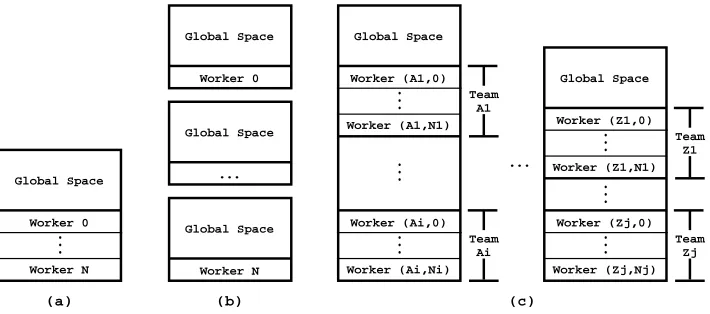
When running in shared memory architectures, Yap’s workers can be either processes (the engine using processes is called YapOr [10]) or POSIX threads (the engine using threads is called ThOr [11]). The memory organization for YapOr/ThOr is quite similar for all the approaches (see Fig. 4(a)). The memory of the system is divided into two ma-jor address spaces: theglobal spaceand a collection oflocal spaces. The global space contains the code area inherited from Yap and all data structures necessary to support parallelism. Among these structures is static information about the execution, such as the number of workers, and dynamic information responsible for determining the end of the execution. Each local space represents one worker and contains the execution stacks in-herited form Yap (heap, local, trail and auxiliary stack) and information related to the execution of that worker such as the youngest public choice point, share and prune re-quests or the load of that worker [10, 11].
When running in distributed memory architectures, Yap’s workers are processes, each with independent global and local spaces (see Fig. 4(b)). Despite not specially designed for it, this approach also fits in shared memory architectures, i.e., we can have some workers running on the same computer node, but as fully independent processes.
(a)
Global Space
(c)
Worker 0
Worker N
...
Global Space
Worker (A1,0)
Worker (A1,N1)
...
...
Worker (Ai,0)
Worker (Ai,Ni)
...
Team A1
Team Ai
(b)
Global Space
Worker N Global Space
... Global Space
Worker 0 Global Space
Worker (Z1,0)
Worker (Z1,N1)
...
...
Worker (Zj,0)
Worker (Zj,Nj)
...
Team Z1
Team Zj
...
Fig. 4.Memory layout for: (a) workers in shared memory; (b) workers in distributed memory; and (c) teams of workers in clusters of multicores
4.
Layered Approach
im-plies that all workers should be in the same computer node. On the other hand, we also want to be possible to have several teams in a computer node or distributed by other nodes. For workers inside a team, we can thus distribute work using both dynamic or static scheduling of work. For distributing work among teams, we can apply any of the four (static) stack splitting strategies described before. This idea is similar to the MPI/OpenMP hybrid programming pattern, where MPI is usually used to communicate work among workers in different computer nodes and OpenMP is used to communicate work among workers in the same node.
4.1. Memory Organization
In order to support teams, there are several changes that need to be made. An important one is the memory organization of the system. Figure 4(c) shows the new memory layout to support teams of workers. Each team of workers mimics the previous memory layout for a set of workers in shared memory (see Fig. 4(a)), where the memory of the system is divided into a global space, shared among all workers, and a collection of local spaces, each representing one worker’s team. In this new memory layout, we can also have several teams sharing the same memory address space and, in particular, sharing the global space. To accomplish that, the information stored in the global space is now related with teams instead of being related with single workers. Moreover, the global space now includes an extra area, namedteam space, where each team stores static information about the team and dynamic information about the execution of the team, such as, to determine if the team is out of work or if it has finished execution. The collection of local spaces maintains its functionality, i.e., it stores the execution stacks and information about the state of the corresponding worker.
Since our aim is to target clusters of multicores, the complete layout for the new mem-ory organization can be seem as a generalization of the previous approach for distributed memory architectures (see Fig. 4(b)), but now instead of single workers with independent global and local spaces, we may have teams, individual teams or collection of teams as described above, sharing the same memory address space.
4.2. Mixed Scheduling
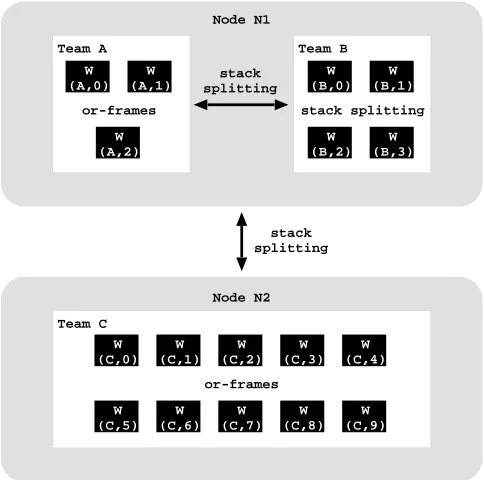
One of the main advantages of using teams is that we can combine the scheduling strate-gies mentioned before. Therefore we may have teams using static scheduling while others, at the same time, use dynamic scheduling. Figure 5 shows a schematic representation of what we want to achieve with our proposal. In this example, we have a cluster composed by two computers nodes,N1andN2. The computer nodeN1has two teams, teamAand teamB, with 3 and 4 workers each. The computer nodeN2has only one team, teamC with 10 workers.
Node N1
W (B,0) Team B
W (B,1)
Node N2
stack splitting
Team C W (A,0) Team A
W (A,1)
or-frames
stack splitting
stack splitting
W (C,4)
W (C,9) W
(C,0) W (C,1)
W (C,5)
W (C,6)
W (C,2)
W (C,3)
W (C,7)
W (C,8) or-frames W
(A,2)
W (B,2)
W (B,3)
Fig. 5.Work scheduling within and among teams
that having the access to the open alternatives in data structures shared between teams, not only would have a great impact in the communication overhead required to keep them up-to-date, but would also not clarify the notion of being a team. If two teams are syn-chronizing the access to the open alternatives, in fact they are not two different teams but only one, because no decision regarding the shared open alternatives can be made without involving both teams.
Independently of the scheduling strategy, teams will have to communicate among them when sharing work or when sending requests to perform a cut or to ensure the termi-nation of the computation. To implement the communication layer, we can use a message passing protocol, for teams physically located in the same or in different computer nodes, or a shared memory synchronization mechanism, for teams in the same computer node. Note that, in this latter case, synchronization is being use to implement communication and not for scheduling purposes, as discussed before.
4.3. Work Sharing
and-parallelism with or-parallelism [13, 6], and for that a second-level scheduler will be used.
Since the concept of a team implies that we must give priority to the exploitation of the work available inside the team, we will only ask for work to other teams when no more work exists in a team. However, even though that it is the entire team that is out of work, the sharing process will still be done between two workers, being the selected worker of the idle team then the responsible for sharing the new work with its teammates. Figure 6 shows a schematic representation of the sharing process between teams. Con-sider the cluster configuration in Fig. 5 and assume that teamChas run out of work and that teamAwas selected byC’s scheduler to share work with it. Figure 6(a) shows the state of teamAbefore the sharing request fromC. The three workers in teamAare ex-ecuting in the private region of the search tree and all share the youngest three choice points. The top public choice point is already dead, i.e., without open alternatives, but the second and third public choice points have two (b2andb3) and one (c4) open alternatives, respectively.
When teamAreceives the sharing request from teamC, one of the workers fromA will be selected to share part of its available (private and/or public) work and manage the sharing process with the requesting worker fromC. For the sake of simplicity, here we are considering that this is done by the workers 0 of each team, workersW(A,0)and W(C,0). Since this is a sharing operation between teams, static scheduling is then the strategy adopted to split work. In particular, in this example, we are using the vertical splitting strategy.
To implement vertical splitting,W(A,0) thus needs to alternately divide its choice points withW(C,0). However, since teamAis using or-frames to implement dynamic scheduling of work inside the team, we cannot apply the original stack splitting algo-rithm [15, 14] to split the available work in the public region of the search tree (please re-member that stack splitting avoids the use of or-frames). To solve that problem,W(A,0) constructs an array with the open alternatives per choice point that it will hand over to W(C,0). This array is illustrated in Fig. 6(c). The motivation for using this array is the isolation between the alternatives being shared and the scheduling strategy being used, therefore allowing that two teams can share work, independently of their scheduling strategies. Note that, when splitting work in a public choice point, firstW(A,0) needs to gain (lock) access to the corresponding or-frame, then it moves the next unexplored alternative from the or-frame to the array of open alternatives, updates the or-frame to nulland unlocks it.
At the end, the array with the open alternatives and the execution stacks ofW(A,0) are copied toW(C,0). Figure 6(b) shows the configuration of both teams after the sharing process. In teamA, we can see the effect of vertical splitting by observing the new dead nodes in the branch of W(A,0). In teamC, we can see thatW(C,0)instantiated the work received fromW(A,0)as fully private work.W(C,0)will only share its work, and allocate the corresponding or-frames if teamCis also using dynamic scheduling, when the scheduler inside the team notifies it to share work with its teammates.
4.4. Load Balancing
b3
(a) before sharing
null
b2
null
d2
(c) open alternatives (b) after sharing
W(A,0)
W(A,1) public
region
private region
null
b2
c4 Team A
W(A,2) or-frames
b3 b2
c4
d2 d3
b2
W(A,0) public region
private region
null
c4 null
W(C,0) Team A or-frames Team C
d3 W(A,1)
W(A,2) c4
e2 e3
e2 e3
response time. A good strategy, when searching for a team to request work, would be to select the busy team that holds the highest work loadand that isnearest to the idle team. The work load is a measure of the amount of open alternatives and being near cor-responds to a closer position in the search tree. Nevertheless, selecting such a team would require having precise information about the position and work load of all workers in all teams, which cannot be possible without introducing a considerable communication and synchronization overhead. A more reasonable solution is to find a compromise between the load balancing efficiency and the overhead required to support the implementation.
In our proposal, each worker holds a privateload register, as a measure of the exact number of open alternatives in its current branch, and each team holds a private load vector, as a measure of the estimated work load of each fellow team. The load register keeps its functionality [10, 15, 14] and is used to support the process of selecting a busy worker to request work from, when a teammate runs out of work. The load vector is used to support the process of selecting a busy team to request work, when another team runs out of work.
The load vector is updated in two situations: when requesting work and when detect-ing termination. A trivial case occurs when receivdetect-ing a shardetect-ing request, a zero work load can be automatically inferred for the requesting team. We do not introduce specific mes-sages to explicitly ask for work load information and, instead, the existing mesmes-sages are extended to include that information. When receiving a sharing request, the answering message is extended to include the work load of the answering team. When detecting ter-mination, the termination tokens are extended to include the work load of all teams. The following section shows more details about the load vector usage.
5.
Algorithms
In this section, we present in more detail the set of algorithms that implement the key aspects of our proposal.
5.1. Searching for Available Work
Algorithm 1 shows the pseudo-code for theGetW orkF romW orker()procedure that, given an idle workerW belonging to a teamT, searches for a new piece of work forW. In a nutshell, we can resume the algorithm as follows. Initially,W starts by selecting a busy workerBfrom its teammates to potentially share work with (line 4). Next, it sends a share request toB(line 5) and if the request gets accepted, then both workers perform the work sharing procedure, according to the scheduling strategy (dynamic or static) being used inT(line 6). After sharing,W returns to Prolog execution (line 7). Otherwise, if the sharing request gets refused, thenW should try another busy worker fromT, while there are teammates with available work (line 3).
On the other hand, if all workers inT run out of work (i.e., all workers inT are also executing theGetW orkF romW orker() procedure), then one of the workers, named the master worker1, will be selected to search for work from the other teams (line 8),
1Since all workers are out of work, there is no difference in selecting one or another worker to be
Algorithm 1GetW orkF romW orker(W)
1: T ←GetT eam(W)
2: whileT eamN otF inished(T)do 3: whileHasAvailableW ork(T)do
4: B←SelectBusyW orker(T)
5: ifSendW orkerRequest(B) =ACCEP Tthen
6: InstallW orkF romW orker(W, B)
7: return true
8: ifW=M asterW orker(T)then{W will search for work from the other teams}
9: ifGetW orkF romT eam(W)then{W has obtained work from another team}
10: return true
11: else{all teams should finish execution}
12: SetT eamAsF inished(T)
13: return false
and for that it executes the GetW orkF romT eam()procedure (line 9). If the call to GetW orkF romT eam()succeeds, this means that the master worker has obtained a new piece of work from another team and, in such case, it returns to Prolog execution to start exploiting it (line 10). Otherwise, if the call toGetW orkF romT eam()fails, this means that all teams are out of work and, in such case, teamTis set as finished (line 12) and all workers inT then finish execution by returning failure (line 13).
Algorithm 2 shows the pseudo-code for theGetW orkF romT eam()procedure that, given a master workerW, searches for a new piece of work from the other teams. Initially, Wuses its load vector to select a busy teamSfrom the set of available teams to potentially share work with (lines 1–3). Next, it sends a share request to the selected teamS(line 4) and, if the request gets accepted, it performs the work sharing procedure withS (line 5) and returns successfully (line 6). Otherwise, if the sharing request gets refused, thenW updates the load vector for teamS (line 8) and tries another busy team, while there are teams with available work (line 2). On the other hand, if all teams run out of work (i.e., all master workers are also executing theGetW orkF romT eam()procedure), thenW returns failure (line 9).
Algorithm 2GetW orkF romT eam(W)
1: load[ ]←GetLoadV ector()
2: whileT eamsW ithAvailableW ork(load[ ])do
3: S←SelectBusyT eam(load[ ])
4: ifSendT eamRequest(S) =ACCEP Tthen
5: InstallW orkF romT eam(W, S)
6: return true 7: else{request rejected}
8: load[S]←GetLoadF romAnswerRequest(S)
9: return false
mechanism is invoked (lines 1–2). When detecting termination, the load vector is updated accordingly to include the work load of all teams. If no busy team still exists in the up-dated load vector, then all teams are definitively out of work and the procedure returns failure (lines 3–4). Otherwise, it succeeds (line 5).
Algorithm 3T eamsW ithAvailableW ork(load[ ])
1: ifN oBusyT eam(load[ ])then
2: load[ ]←T erminationDetection()
3: ifN oBusyT eam(load[ ])then
4: return false 5: return true
5.2. Handling Requests
We next present in Algorithm 4 the pseudo-code for handling sharing requests. Please remember that we may have to deal with requests from workers in other teams or from workers in the same team. The main difference between both situations is that team re-quests (the former case) are first delegated to the team’s busy workerBwith the highest work load (lines 2–5). This delegation is done by the first worker that checks for the re-quest (line 2). The selected busy workerBwill then be the one responsible to answer the request (lines 6–13).
Algorithm 4CheckRequests(W)
1: T ←GetT eam(W)
2: ifHasT eamRequest(T)then
3: R←GetRequestingT eam()
4: B←SelectBusyW orker(T)
5: DelegateT eamRequestT oW orker(R, B)
6: ifHasDelegatedRequest(W)then
7: R←GetRequestingT eam()
8: ifHasAvailableW ork(W)then
9: AnswerRequest(R, ACCEP T)
10: ShareW orkW ithT eam(W, R)
11: else
12: load←GetLoad()
13: AnswerRequest(R, REJ ECT, load)
14: ifHasW orkerRequest(W)then
15: I←GetRequestingW orker()
16: ifHasAvailableW ork(W)then
17: AnswerRequest(I, ACCEP T)
18: ShareW orkW ithW orker(W, I)
19: else
Both situations are then very similar. A given workerW with pending sharing re-quests may accept or refuse them accordingly to its current work load. IfW has available work to share, i.e., if its work load is higher than a threshold value, it accepts the shar-ing request and starts the sharshar-ing process by callshar-ing the ShareW orkW ithT eam()or theShareW orkW ithW orker()procedure (lines 9–10 and 17–18 respectively). Other-wise, it replies with a negative answer (lines 13 and 20). In the case of a delegated (team) request,W includes in the answering message its current work load.
5.3. Work Sharing
At last, we present the algorithms for work sharing. We start with the work sharing op-eration between workers in the same team. Algorithm 5 shows the pseudo-code to be executed by the sharing worker and Algorithm 6 shows the pseudo-code to be executed by the requesting worker.
Algorithm 5ShareW orkW ithW orker(W, I)
1: stacks←GetStacks(W)
2: ifSchedulingM ode() =ST AT ICthen{W’s team is using static scheduling}
3: SendStacks(I, stacks)
4: strategy←GetSplittingStrategy()
5: ApplyStackSplitting(stacks, strategy)
6: else{[W’s team is using dynamic scheduling}
7: P ublishP rivateW ork(stacks)
8: orf rame←GetY oungerOrF rame(stacks)
9: AddW orkerT oP ublicRegion(W, orf rame)
10: AddW orkerT oP ublicRegion(I, orf rame)
11: SendStacks(I, stacks)
Algorithm 6InstallW orkF romW orker(W, B)
1: stacks←RecvStacks(B)
2: InstallStacks(W, stacks)
3: ifSchedulingM ode() =ST AT ICthen
4: strategy←GetSplittingStrategy()
5: ApplyStackSplitting(stacks, strategy)
Given a sharing workerW and an idle workerI, theShareW orkW ithW orker() procedure proceeds as follows. IfW’s team is using static scheduling,W starts by send-ing its execution stacks toI(line 3) and then it applies stack splitting to its own stacks accordingly to the splitting strategy in use (lines 4–5). Otherwise, if using or-frames,W turns public its private choice points (line 7), adds both workers to the or-frames in the public region (lines 8–10) and sends its execution stacks toI(line 11).
install the stacks (line 2) and, if using static scheduling, applies stack splitting accordingly to the splitting strategy in use (lines 3–5).
Finally, we discuss the work sharing operation between workers in different teams. Algorithm 7 shows the pseudo-code to be executed by the sharing worker and Algorithm 8 shows the pseudo-code to be executed by the requesting worker.
Algorithm 7ShareW orkW ithT eam(W, R)
1: stacks←GetStacks(W)
2: cp←GetY oungerChoiceP oint(stacks)
3: i←GetChoiceP ointDepth(cp)
4: strategy←GetSplittingStrategyF orSharingW orkBetweenT eams()
5: ifSchedulingM ode() =ST AT ICthen{W’s team is using static scheduling}
6: repeat{store open alternatives to share with R}
7: alts[i]←GetOpenAlternativeAndApplyStackSplitting(cp, strategy)
8: cp=P reviousChoiceP oint(cp, stacks)
9: i←i−1
10: untili
11: else{W’s team is using dynamic scheduling} 12: repeat{store open alternatives to share with R}
13: ifIsP rivateChoiceP oint(cp)then
14: alts[i]←GetOpenAlternativeAndApplyStackSplitting(cp, strategy)
15: else{cp is public}
16: LockOrF rame(cp)
17: alts[i]←GetOpenAlternativeAndApplyStackSplitting(cp, strategy)
18: U nlockOrF rame(cp)
19: cp=P reviousChoiceP oint(cp, stacks)
20: i←i−1
21: untili
22: SendStacks(R, stacks)
23: SendOpenAlternatives(R, alts[ ])
24: load←GetLoad()
25: BcastLoadInf o(W, load)
Algorithm 8InstallW orkF romT eam(W, S)
1: stacks←RecvStacks(S)
2: alts[ ]←RecvOpenAlternatives(S)
3: InstallStacks(W, stacks)
4: cp←GetY oungerChoiceP oint(stacks)
5: i←GetChoiceP ointDepth(cp)
6: repeat{install open alternatives}
7: OpenAlternative(cp)←alts[i]
8: cp←P reviousChoiceP oint(cp, stacks)
9: i←i−1
10: untili
In theInstallW orkF romT eam()procedure, the given idle workerW starts by re-ceiving the execution stacks and the array of open alternatives from the sharing worker in teamS(lines 1–2), install the stacks (line 3) and install the open alternatives from the received array (lines 4–10).
6.
Conclusions
We have proposed a novel computational model to efficiently exploit or-parallelism from the recent architectures based on clusters of multicores. The main goal behind our pro-posal is to implement the concept of teams in order to decouple the scheduling of work from the architecture of the system. In particular, our approach defines a layered approach where a team-based scheduler specifies a clean interface for scheduling work between the base or-parallel engines, thus enabling different scheduling combinations to be used for distributing work among teams in the same or in different computer nodes.
Currently, we have already started the implementation of the new model in the Yap Prolog system, trying to reuse, as much as possible, the existing infrastructure that sup-ports both dynamic and static scheduling of work for or-parallelism based on the envi-ronment copying model. Beyond the implementation of the initial prototype, further work will include: (i) support incremental copying between teams; (ii) avoid speculative work, i.e., avoid work which would not be done in a sequential system; and (iii) support se-quential semantics, i.e., predicate side-effects must be executed by leftmost workers, as otherwise we may change the sequential behavior of the program.
Acknowledgments.The authors want to thank thank the anonymous reviewers for their com-ments/suggestions and appreciate the guidance in making the paper clearer. This work is par-tially funded by the ERDF (European Regional Development Fund) through the COMPETE Pro-gramme and by FCT (Portuguese Foundation for Science and Technology) within projects SIBILA (NORTE-07-0124-FEDER-000059) and PEst (FCOMP-01-0124-FEDER-037281). Joao Santos is funded by the FCT grant SFRH/BD/76307/2011.
References
2. Ali, K., Karlsson, R.: Full Prolog and Scheduling OR-Parallelism in Muse. International Jour-nal of Parallel Programming 19(6), 445–475 (1990)
3. Ali, K., Karlsson, R.: The Muse Approach to OR-Parallel Prolog. International Journal of Par-allel Programming 19(2), 129–162 (1990)
4. Gupta, G., Pontelli, E.: Stack Splitting: A Simple Technique for Implementing Or-parallelism on Distributed Machines. In: International Conference on Logic Programming. pp. 290–304. The MIT Press (1999)
5. Gupta, G., Pontelli, E., Ali, K., Carlsson, M., Hermenegildo, M.V.: Parallel Execution of Prolog Programs: A Survey. ACM Transactions on Programming Languages and Systems 23(4), 472– 602 (2001)
6. Gupta, G., Pontelli, E., Hermenegildo, M.V., Santos Costa, V.: ACE: And/Or-parallel Copying-based Execution of Logic Programs. In: International Conference on Logic Programming. pp. 93–109. The MIT Press (1994)
7. Lusk, E., Butler, R., Disz, T., Olson, R., Overbeek, R., Stevens, R., Warren, D.H.D., Calder-wood, A., Szeredi, P., Haridi, S., Brand, P., Carlsson, M., Ciepielewski, A., Hausman, B.: The Aurora Or-Parallel Prolog System. In: International Conference on Fifth Generation Computer Systems. pp. 819–830. Institute for New Generation Computer Technology (1988)
8. Pontelli, E., Villaverde, K., Guo, H.F., Gupta, G.: Stack splitting: A technique for efficient ex-ploitation of search parallelism on share-nothing platforms. Journal of Parallel and Distributed Computing 66(10), 1267–1293 (2006)
9. Rocha, R., Silva, F., Martins, R.: YapDss: an Or-Parallel Prolog System for Scalable Beowulf Clusters. In: Portuguese Conference on Artificial Intelligence. pp. 136–150. No. 2902 in LNAI, Springer-Verlag (2003)
10. Rocha, R., Silva, F., Santos Costa, V.: YapOr: an Or-Parallel Prolog System Based on Environ-ment Copying. In: Portuguese Conference on Artificial Intelligence. pp. 178–192. No. 1695 in LNAI, Springer-Verlag (1999)
11. Santos Costa, V., Dutra, I., Rocha, R.: Threads and Or-Parallelism Unified. Journal of Theory and Practice of Logic Programming, International Conference on Logic Programming, Special Issue 10(4–6), 417–432 (2010)
12. Santos Costa, V., Rocha, R., Damas, L.: The YAP Prolog System. Journal of Theory and Prac-tice of Logic Programming 12(1 & 2), 5–34 (2012)
13. Santos Costa, V., Warren, D.H.D., Yang, R.: Andorra-I: A Parallel Prolog System that Trans-parently Exploits both And- and Or-Parallelism. In: ACM SIGPLAN Symposium on Principles and Practice of Parallel Programming. pp. 83–93. ACM (1991)
14. Vieira, R., Rocha, R., Silva, F.: On Comparing Alternative Splitting Strategies for Or-Parallel Prolog Execution on Multicores. In: Colloquium on Implementation of Constraint and LOgic Programming Systems. pp. 71–85 (2012)
15. Vieira, R., Rocha, R., Silva, F.: Or-Parallel Prolog Execution on Multicores Based on Stack Splitting. In: International Workshop on Declarative Aspects and Applications of Multicore Programming. ACM Digital Library (2012)
16. Villaverde, K., Pontelli, E., Guo, H., Gupta, G.: PALS: An Or-Parallel Implementation of Pro-log on Beowulf Architectures. In: International Conference on Logic Programming. pp. 27–42. No. 2237 in LNCS, Springer-Verlag (2001)
17. Villaverde, K., Pontelli, E., Guo, H., Gupta, G.: A Methodology for Order-Sensitive Execution of Non-deterministic Languages on Beowulf Platforms. In: International Euro-Par Conference. pp. 694–703. No. 2790 in LNCS, Springer-Verlag (2003)
University of Porto. Since 2009, he has been a researcher at the CRACS & INESC TEC research unit, collaborating in projects STAMPA and LEAP. In 2012, he started his PhD in Computer Science at University of Porto and his main research topic is Parallelism in Logic Environments.
Ricardo Rochais an Assistant Professor at the Department of Computer Science, Fac-ulty of Sciences, University of Porto, Portugal and a researcher at the CRACS & INESC TEC research unit. He received his PhD degree in Computer Science from the Univer-sity of Porto in 2001 and his main research topics are the Design and Implementation of Logic Programming Systems, Tabling in Logic Programming and Parallel and Distributed Computing. Another areas of interest include Inductive Logic Programming, Probabilis-tic Logic Programming and Deductive Databases. He is also one of the main developers of Yap Prolog system, and in particular of the execution models that support tabling and parallel evaluation. He has published more than 50 refereed papers in journals and inter-national conferences, has supervised 11 MSc students and has leading role in two inter-national projects: project STAMPA, funded with 150,000 Euros, and project LEAP, funded with 115,000 Euros. Currently, he also serves the ALP Newsletter as area co-editor for the Implementations and Systems track.