Nearest Neighbor Voting in High Dimensional
Data: Learning from Past Occurrences
Nenad Tomaˇsev and Dunja Mladeni´c
Artificial Intelligence Laboratory, Joˇzef Stefan Institute and Joˇzef Stefan International Postgraduate School
1000 Ljubljana, Slovenia
[email protected], [email protected]
Abstract. Hubnessis a recently described aspect of thecurse of dimen-sionality inherent to nearest-neighbor methods. This paper describes a new approach for exploiting the hubness phenomenon ink-nearest neigh-bor classification. We argue that some of the neighneigh-bor occurrences carry more information than others, by the virtue of being less frequent events. This observation is related to the hubness phenomenon and we explore how it affects high-dimensionalk-nearest neighbor classification. We pro-pose a new algorithm, Hubness Informationk-Nearest Neighbor (HIKNN), which introduces thek-occurrence informativeness into the hubness-aware k-nearest neighbor voting framework. The algorithm successfully over-comes some of the issues with the previous hubness-aware approaches, which is shown by performing an extensive evaluation on several types of high-dimensional data.
1.
Introduction
Supervised learning (classification) is one of the most fundamental machine learning tasks, often encountered in various practical applications. It involves assigning a label to a new piece of input data, where the label is one out of several predefined categories. Many algorithmic approaches to performing au-tomatic classification have been explored in the past. This includes, among oth-ers, Bayesian learning methods, support vector machines (SVM), decision trees and nearest neighbor methods [1].
LetD= (x1, y1),(x2, y2), ..(xn, yn)be the data set, where eachxi∈Rd. The
xiare feature vectors which reside in some high-dimensional Euclidean space,
andyi∈c1, c2, ..cCare the labels. It can be shown that in the hypothetical case
of an infinite data sample, the probability of a nearest neighbor ofxihaving label
c is asymptotically equal to the posterior class probability in pointxi, namely
p(c|xi) = limn→∞p(c|NN(xi)). Real-world data is usually very sparse, so the
point probability estimates achieved bykNN in practice are much less reliable. However, this is merely one aspect of the well knowncurse of dimensionality.
Concentration of distances[7,8] is another phenomenon of interest, since all nearest-neighbor approaches require a similarity measure. In high-dimensional spaces, it is very difficult to distinguish between relevant and irrelevant points and the very concept of nearest neighbors becomes much less meaningful.
Hubnessis a recently described aspect of the dimensionality curse, related specifically to nearest neighbor methods [9] [10]. The term is coined to reflect the emergence ofhubs, very frequent nearest neighbors. As such, these points exhibit a substantial influence on the classification outcome. Two types of hubs can be distinguished:good hubsandbad hubs, based on the proportion of label matches/mismatches in theirk-occurrences. The phenomenon ofhubnesswill be explained in more detail in Section 2.2, and the previous approaches for exploiting hubness inkNN classification will be outlined in Section 2.3.
The issue of data dimensionality needs to be emphasized because most real world data sets are in fact high-dimensional, for example: textual documents, images, audio files, data streams, medical histories, etc.
1.1. Contributions
This paper aims at further clarifying the consequences of hubness in high di-mensional kNN classification, by focusing on one specific aspect of the phe-nomenon - the difference in the information content of the individualk-occurrences. Here we summarize the main contributions of the paper:
– When there is hubness, some points occur much more frequently in k -neighbor sets. We claim that some occurrences hence become much less informative than others, and are consequently of much lower value for the kNN classification process.
– We propose a new hubness-aware approach tok-nearest neighbor classi-fication, Hubness Informationk-Nearest Neighbor (HIKNN). The algorithm exploits the notion of occurrence informativeness, which leads to a more robust voting scheme.
2.
Related work
2.1. kNN classification
The k-nearest neighbor method is among the most influential approaches in machine learning, due to its simplicity and effectiveness. Many extensions to the basic method have been proposed, dealing with various different aspects -including attribute weighting [11], adaptive distances [12] [13], fuzzy labels [14] [15] [16], evidence-theoretic approaches [17], and many more. Some advanced algorithms have been proposed recently, including the large marginkNN classi-fier which learns the Mahalanobis distance matrices via semidefinite program-ming [18] [19].
2.2. Hubs, frequent nearest neighbors
The emergence of hubs as prominent points in k-nearest neighbor methods had first been noted in analyzing music collections [20] [21]. The researchers discovered some songs which were similar to many other songs (i.e. frequent neighbors). The conceptual similarity, however, did not reflect the expected per-ceptual similarity.
The phenomenon ofhubnesswas further explored in [9] [22], where it was shown that hubness is a natural property of many inherently high-dimensional data sets. Not only do some very frequent points emerge, but the entire distribu-tion ofk-occurrences exhibits very highskewness. In other words, most points occur very rarely ink-neighbor sets, less often than what would otherwise have been expected. We refer to these rarely occurring points asanti-hubs. [23]
Denote by Nk(xi) the number of k-occurrences of xi and by Nk,c(xi)the
number of such occurrences in neighborhoods of elements from classc. The lat-ter will also be referred to as theclass hubnessof instancexi. Ak-neighborhood
ofxiis denoted byDk(xi).
The skewness of theNk(x)distribution in high dimensional data can
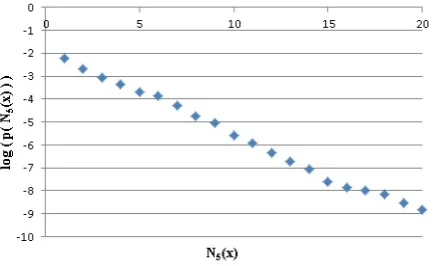
some-times be very severe [22]. Let us illustrate this point by plotting theNk(x)
dis-tribution for one of the datasets which we used for the experiments, namely the Acquis data. This is shown in Figure 1, fork = 5. Such a drastic shift in the distribution shape must certainly be taken into account when designing kNN algorithms for high dimensional data.
Hubness-aware algorithms have recently been proposed for clustering [10], instance selection [24], outlier and anomaly detection [22] [25] and classifica-tion [9] [26] [27] [28], which we will discuss below.
2.3. Hubness-aware classification
Fig. 1.The hubness distribution of the Acquis data is given for the5-occurrence proba-bilities ofN5(x)∈ {1..20}. We see that the distribution apparently forms a straight line on the logarithmic scale, so it is in fact exponential.
GNk(xi)and the number of bad ones byBNk(xi), so thatNk(xi) =GNk(xi) +
BNk(xi).
All three previously proposed approaches deal with bad hubs in seemingly similar, but radically different ways. We will refer to these algorithms as hubness-weightedkNN (hw-kNN) [9], hubness fuzzykNN (h-FNN) [26] and naive hub-ness Bayesian kNN (NHBNN) [27]. We discuss these ideas below, outlining their respective strengths and weaknesses.
hw-kNN
– Idea:When a point exhibits bad hubness, give its vote lesser weight. This has been achieved by calculating the standardized bad hubness ashB(xi) = BNk(xi)−µBNk
σBNk , whereµBNk andσBNk denote the mean and standard
devi-ation of bad hubness, respectively. Eachxiis then assigned a voting weight
ofwi=e−hB(xi).
– Strengths:
• Reduces the influence of bad hubs
• Very simple and easy to implement
– Weaknesses:
• Each element still votes by its own label, which means that bad hubs still exhibit some detrimental influence
• Some information is left unexploited, since class hubness is ignored
• It is equivalent tokNN fork= 1
h-FNN
Nk(xi) >0and only sensible for points withNk(xi)> θ, whereθ is some
predefined threshold parameter. Anti-hubs are thus considered to be spe-cial cases. Their fuzzy votes are approximated by average class-to-class fuzzy votes. This algorithm is otherwise based on the fuzzy nearest neigh-bor (FNN) framework [14], with distance weighting included.
– Strengths:
• Generalizes the hw-kNN approach by taking class hubness into account
• Combines fuzzy votes with distance weighting
– Weaknesses:
• No clear way of dealing with anti-hubs, approximations need to be used instead
• Uses a threshold parameterθfor determining anti-hubs, which is difficult to set in practice. If learned automatically from the data, it can lead to over-fitting.
NHBNN
– Idea:Observe each k-occurrence as a random event and use the Naive Bayes rule to calculate the posterior class affiliation probabilities, as shown in Equation 1. Thexit,t={1,2..k}represent theknearest neighbors ofxi.
As in h-FNN, anti-hubs are a special case and one needs to estimate their class hubness scores via local or global approximative approaches.
p(yi=c|Dk(xi))≈
p(yi=c)
∏k
t=1p(xit∈Dk(xi)|yi=c)
∑
c∈Cp(yi =c)
∏k
t=1p(xit∈Dk(xi)|yi=c)
(1)
– Strengths:
• Generalizes the hw-kNN approach by taking class hubness into account
• Rephrasing the problem in Bayesian terms allows for further improve-ments and extensions based on the known ways for improving Bayesian classifiers
– Weaknesses:
• Strong dependencies between occurrences in the samek-neighbor set greatly restrict the applicability of the approach in largerk-neighborhoods
• Due to these dependencies, class affiliation probabilities tend to be close to0or1in many cases.
• Additionally, both weaknesses of h-FNN hold for NHBNN as well
3.
The motivation
3.1. Casting a vote: label vs class hubness
introduction thatp(c|xi) = limn→∞p(c|NN(xi)). If the data were not sparse and
if there was no overlap between the classes and no noise, 1-NN would work really well. Of course, none of these conditions are met in real world data.
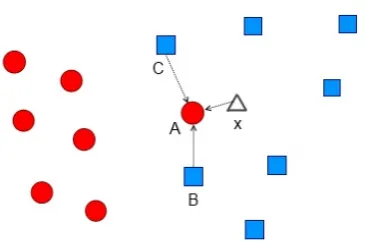
So, what happens is that nearest neighbors sometimes have different labels and this can already be seen on the training set. Observe an illustrative low-dimensional example displayed in Figure 2.
Fig. 2.Illustrative example of a binary classification case. The first class is given by the red circles, the second by the blue squares. A triangle represents an instance yet to be classified. An arrow is drawn from an instance to its nearest neighbor.
The point x is about to be classified. Let’s say that the circles represent class0and squares represent class1. According to the1-NN rule,xwould be assigned to class 0, since this is the label of NN(x) = A. But, we also have NN(B) = A and NN(C) = A, and points B and C are of class 1. If we were to try approximating p(y = c|A ∈ D1(x))≈
N1,c(A)
N1(A) forc = 0,1, we would get
p(y = 0|A ∈D1(x)) = 0andp(y = 1|A ∈D1(x)) = 1. So, according to class hubness, xshould be assigned to class1, which seems more plausible when looking at the data.
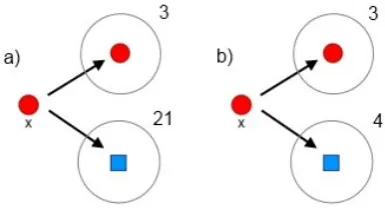
Two-dimensional data does not exhibit hubness, so Figure 2 can only serve as a simplified model. A more general case is presented in Figure 3. Two exam-ples are given, with class hubness scores shown on the right. In both examexam-ples, the label ofxis0(the red circle).
In the first example, N1,0(x) = 3 and N1,1(x) = 21, which indicates high bad hubness. Therefore, ifxis a neighbor to the point of interest, it is certainly beneficial to base the vote on the class hubness scores, instead of its label. It would reduce the probability of error.
In the second example, N1,0(x) = 3 and N1,1(x) = 4, which makes for a
very small difference in class hubness scores. Even thoughN1,1(x)> N1,0(x),
Fig. 3. A more general binary classification case. Class hubness is shown for pointx towards both classes. Two examples are depicted, example ’a’ where there is a big dif-ference in previousk-occurrences, and example ’b’ where there is nearly no observable difference.
much in the occurrence information. If there had been no previous occurrences ofxon the training data (an anti-hub), there would be no choice but to use the label. On the other hand, for high hubness points we should probably rely more on their occurrence tendencies. It is precisely the points in between which need to be handled more carefully.
Anti-hubs While discussing the relevance of hubness for kNN classification, we must keep in mind that most points are in fact anti-hubs, when the inher-ent dimensionality of the data is high. This is illustrated in Figure 4, where the percentage of points exceeding certaink-occurrence thresholds is given. The Dexter data (from the UCI repository) exhibits some hubness, so that even fork as large as10, there is still around15%of instances that never occur as neigh-bors.
Both previously proposed class-hubness based approaches (h-FNN and NHBNN) have failed to provide an easy and consistent way of handling anti-hubs, which is probably their most pronounced weakness. In Section 4 we pro-pose a new way of dealing with such low hubness points.
3.2. Informativeness
The basics What is the information content of an observed event? Intuitively, the more surprised we are about the outcome, the more information the out-come carries. We’re all quite used to the sun coming up every morning and by observing this over and over again we don’t gain any novel insights. If, however, the sun fails to appear on the sky someday, such a peculiar event would be much more informative, though unfortunate.
0% 10% 20% 30% 40% 50% 60% 70% 80% 90% 100%
1 2 3 4 5 6 7 8 9 10 11 1213 14 1516 17 1819 20
k Pe
rc en ta ge o f d at a po in ts
Nk(x) > 0 Nk(x) > 1 Nk(x) > 2 Nk(x) > 3 Nk(x) > 4
Fig. 4.Percentage of elements with hubness over a certain threshold, fork= 1tok= 20
on Dexter data. Each line corresponds to one threshold.
inverse of the probability) [29]. It is often possible to estimate the event proba-bilities directly by observing the frequencies in previous occurrences, which is what we will be doing with the neighbor points.
Hubs Suppose that there is a data pointxi∈Dwhich appears inallk-neighbor
sets of other xj ∈ D. Assume then that we are trying to determine a label of
a new data pointxand thatxi also appears in this neighborhood,Dk(x). This
would not be surprising at all, sincexiappears inallother previously observed
neighborhoods. Since such an occurrencecarries no information,xishould not
be allowed to cast a vote. By going one step further, it is easy to see that less frequent occurrences may in fact be more informative and that such neighbors might be more local to the point of interest. This is exploited in our proposed approach.
Going back to thealways-a-neighbor example, we can see that both the traditionalkNN voting scheme and the fuzzy scheme proposed in the h-FNN algorithm fail to handle the extreme case properly. The fact is that whichever pointxwe observe,xi ∈Dk(x), so there is no correlation betweenxibeing in
Dk(x)and the class affiliation ofx. In case of the originalkNN procedure,xi
would vote by its label, yi. If, on the other hand, we were to vote by the class
hubness induced fuzziness as in h-FNN, we would in fact be voting by class priors. This is, of course, the lesser evil, but it is still the wrong thing to do. Since there is no information that can be derived from the occurrence ofxi, its
vote should be equal to zero.
Anti-hubs Most high-dimensional points are anti-hubs and suppose thatxi is
one such point that never occurs ink-neighborhoods onD, i.e.Nk(xi) = 0. Let
us say that we are trying to determine the label of a new pointxandxiis found
among the neighbors, i.e. xi ∈ Dk(x). Such an occurrence would be highly
informative. We could be fairly certain that the pointxicarries some important
local information to the point of interest, since it is not a shared neighbor with many other points.
Of course, not all points are hubs and anti-hubs, as many points will fall somewhere between the two extremes. Any approach designed to handle the informativeness hubs and anti-hubs needs to be applicable to the entire spec-trum of possible occurrence frequencies, so that these medium-hubness points are processed in an appropriate way.
It is quite surprising that these simple observations have before gone unno-ticed. PreviouskNN algorithms have not been taking occurrence informative-ness explicitly into consideration.
This is very significant for high dimensional data, where hubs appear. The skewness in the Nk(x)distribution induces the skewness in the distribution of
self-information among individual neighbor occurrences. In the following Sec-tion we will propose an informaSec-tion-based voting procedure which exploits this fact.
4.
The algorithm
Let nowxi be the point of interest, to which we wish to assign a label. Letxit,
t = {1,2..k} be its k nearest neighbors. We calculate the informativeness of the occurrences according to Equation 2. In all our calculations, we assume each data point to be its own0thnearest neighbor, thereby making allNk(xi)≥
1. Not only does this give us some additional data, but since it makes all k -occurrence frequencies non-zero, we thereby avoid any pathological cases in our calculations.
p(xit∈Dk(xi))≈
Nk(xit)
n
Ixit= log
1 p(xit∈Dk(xi))
(2)
We proceed by defining relative and absolute normalized informativeness. We will also refer to them assurprise values.
α(xit) =
Ixit−minxj∈DIxj
logn−minxj∈DIxj
, β(xit) =
Ixit
logn (3)
as the number of previous occurrences (Nk(xit)) increases, two things
hap-pen simultaneously. First of all, the informativeness of the current occurrence of xit drops. Secondly, class hubness gives us a more accurate estimate of
pk(yi =c|xit ∈Dk(xi)). Therefore, when the hubness of a point is high, more
information is contained in the class hubness scores. Also, when the hubness of a point is low, more information is contained in its label.
¯
pk(yi=c|xit∈Dk(xi)) =
Nk,c(xit)
Nk(xit)
= ¯pk,c(xit)
pk(yi=c|xit)≈
{
α(xit) + (1−α(xit))·p¯k,c(xit), yit=c
(1−α(xit))·p¯k,c(xit), yit̸=c
(4)
Theαfactor controls how much information is contributed to the vote by the instance label and how much by its previous occurrences. Ifxitnever appeared
in ak-neighbor set apart from its own, i.e.Nk(xit) = 1, then it votes by its label.
If, on the other hand,Nk(xit) = maxxj∈DNk(xj), then the vote is cast entirely
according to the class hubness scores.
The fuzzy votes are based on thepk(yi = c|xit), which are approximated
according to Equation 4. These probabilities are then weighted by the absolute normalized informativenessβ(xit). This is shown in Equation 5.
uc(xi)∝ k
∑
t=1
β(xit)·dw(xit)·pk(yi=c|xit) (5)
Additional distance weighting has been introduced for purposes of later comparison with the h-FNN algorithm [26], since it also employs distance weight-ing. It is not an essential part of the algorithm. We opted for the same distance weighting scheme used in h-FNN, which was in turn first proposed in FNN [14]. It is given in Equation 6.
dw(xit) = ∥
xi−xit∥−2
∑k
t=1(∥xi−xit∥−2)
(6)
Equations 2, 3, 4 and 5 represent our proposed solution for exploiting the information contained in the past k-occurrences on the training data and we will refer to this new algorithm as Hubness Information k-Nearest Neighbor (HIKNN). It embodies some major improvements over the previous approaches:
– Unlike h-FNN and NHBNN, it is essentially parameter-free, one only needs to set the neighborhood size (k).
– Anti-hubs are no longer a special case. They are, however, handled appro-priately via the information-based framework.
– Label information is combined with information from the previousk-occurrences, so that both sources of information are exploited for the voting.
Algorithm 1HIKNN: Training Input:(X,Y,k)
training setT = (X, Y)⊂Rd×1
number of neighborsk∈ {1,2. . . n−1}
Train:
kNeighbors = findNeighborSets(T,k) for all(xi, yi)∈(X, Y)do
Nk(xi) = 0
for allc= 1. . . Cdo countNk,c(xi)
Nk(xi)+ =Nk,c(xi)
end for
calculateα(xi)andβ(xi)by Eq. 3 for allc= 1. . . Cdo
calculatepk(y=c|xi)by Eq. 4 end for
end for
The training phase of the algorithm is summarized in (1). The voting is simply done according to (5) and requires no further explanations.
The time complexity of HIKNN, as with all other hubness-based approaches, is asymptotically the same as constructing a kNN graph. Fast algorithms for constructing approximatekNN graphs exist, like the algorithm by [30]. This par-ticular procedure runs inΘ(dn1+τ)time, whereτ ∈(0,1]is a parameter which
is used to set a trade off between speed and graph construction accuracy.
5.
Experiments
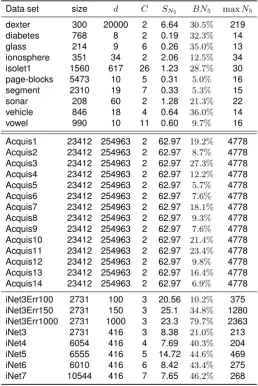
We compared our proposed HIKNN algorithm to the existing related algorithms: kNN, hw-kNN, h-FNN and NHBNN - on32classification problems. We had three test cases: low-to-medium hubness data of lower intrinsic dimensionality, high-hubness textual data and high-high-hubness image data. In all cases,10-times 10-fold cross validation was performed. Corrected resampled t-test was used to check for statistical significance. All experiments were performed for k = 5, which is a standard choice. Default values described in the respective papers were used for the parameters in h-FNN and NHBNN. The detailed results are given in Table 3 and the basic properties of the datasets are discussed in Ta-ble 2.
5.1. The data
The datasets were picked so that they correctly reflect the results on the entire repository. The Manhattan distance was used for this data, as well as for the image data. All features were normalized prior to classification.
Text The Acquis aligned corpus data (http://langtech.jrc.it/JRC-Acquis.html) represents a set of more than20000documents in several different languages. In the experiments we only used the English documents. The data was prepro-cessed and represented as a bag-of-words (term frequencies). On top of this data, 14different binary classification problems were examined. We used the cosine similarity.
Images We used several datasets in the experiments which were subsets taken from the ImageNet online repository (http://www.image-net.org/). These datasets were selected to match some of the ones used in [28]. All datasets are quantized feature representations. Representations iNet3-iNet7 are based on SIFT features and were also appended color information.
On the other hand, in case of iNet3Err100, iNet3Err150 and iNet3Err1000 -Haar wavelet features were used. These three representations have one inter-esting property. Due to an I/O error during feature extraction,5images were ac-cidentally assigned empty representations (zero vectors). Normally, this would have probably gone unnoticed. In this case, however, the hubness of zero vec-tors increased drastically with the representation dimensionality. Since all5of these points were of the minority class, the classification results were affected greatly and this a prime example of how bad the bad hubness can get in high dimensional data.
5.2. The results
The results in Table 3 show that the hubness-aware algorithms clearly outper-form the basic kNN algorithm. Also, HIKNN seems to be the overall best ap-proach, with a clear edge on the textual and UCI data, while performing more or less equal as h-FNN and NHBNN on image datasets. The detailed comparison between the algorithms is shown in Table 1. By comparing both the total num-ber of wins and also the numnum-ber of wins between pairs of algorithms, we see that HIKNN is to be preferred to the second-best algorithm in the experiments, h-FNN - since it beats it quite convincingly 27(9) : 5(1) in direct comparison and 115(74) : 79(53) overall.
Table 1.Pairwise comparison of classifiers: number of wins (with statistically significant ones in parenthesis)
kNN hw-kNN h-FNN NHBNN HIKNN Total kNN – 0 (0) 1 (0) 10 (8) 0 (0) 11 (8) hw-kNN 32 (27) – 14 (1) 18 (13) 1 (0) 65 (41) h-FNN 31 (27) 17 (9) – 25 (16) 5 (1) 79 (53) NHBNN 22 (19) 14 (9) 4 (1) – 3 (1) 43 (30) HIKNN 32 (31) 29 (14) 27 (9) 27 (20) – 115 (74)
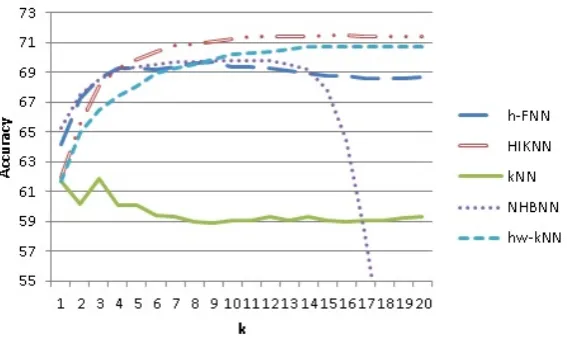
when the dependencies between neighbors become too strong, in this case for k > 15. The accuracy graphs for the other datasets depict the same general tendencies.
Fig. 5. Classifier accuracies over a range of neighborhood sizes k ∈ 1..20 on iNet6 dataset.
Table 2.Overview of the datasets. Each dataset is described by its size, dimensional-ity, the number of categories, skewness of theN5distribution (SN5), proportion of bad 5-occurrencesBN5, as well as the maximal achieved number of occurrences on the dataset.
Data set size d C SN5 BN5 maxN5
dexter 300 20000 2 6.64 30.5% 219
diabetes 768 8 2 0.19 32.3% 14
glass 214 9 6 0.26 35.0% 13
ionosphere 351 34 2 2.06 12.5% 34 isolet1 1560 617 26 1.23 28.7% 30 page-blocks 5473 10 5 0.31 5.0% 16
segment 2310 19 7 0.33 5.3% 15
sonar 208 60 2 1.28 21.3% 22
vehicle 846 18 4 0.64 36.0% 14
vowel 990 10 11 0.60 9.7% 16
Acquis1 23412 254963 2 62.97 19.2% 4778 Acquis2 23412 254963 2 62.97 8.7% 4778 Acquis3 23412 254963 2 62.97 27.3% 4778 Acquis4 23412 254963 2 62.97 12.2% 4778 Acquis5 23412 254963 2 62.97 5.7% 4778 Acquis6 23412 254963 2 62.97 7.6% 4778 Acquis7 23412 254963 2 62.97 18.1% 4778 Acquis8 23412 254963 2 62.97 9.3% 4778 Acquis9 23412 254963 2 62.97 7.6% 4778 Acquis10 23412 254963 2 62.97 21.4% 4778 Acquis11 23412 254963 2 62.97 23.4% 4778 Acquis12 23412 254963 2 62.97 9.8% 4778 Acquis13 23412 254963 2 62.97 16.4% 4778 Acquis14 23412 254963 2 62.97 6.9% 4778 iNet3Err100 2731 100 3 20.56 10.2% 375 iNet3Err150 2731 150 3 25.1 34.8% 1280 iNet3Err1000 2731 1000 3 23.3 79.7% 2363
iNet3 2731 416 3 8.38 21.0% 213
iNet4 6054 416 4 7.69 40.3% 204
iNet5 6555 416 5 14.72 44.6% 469
iNet6 6010 416 6 8.42 43.4% 275
Table 3.Overview of the experiments. Classification accuracy is given forkNN, hubness-weightedkNN (hw-kNN), hubness-based fuzzy nearest neighbor (h-FNN) and hubness information k-nearest neighbor (HIKNN). All experiments were performed fork = 5. The symbols •/◦ denote statistically significant worse/better performance (p < 0.05) compared to HIKNN. The best result in each line is in bold.
Data set kNN hw-kNN h-FNN NHBNN HIKNN
dexter 57.2 ±7.0• 67.7 ± 5.4 67.6 ±4.9 68.0 ±4.9 68.0 ±5.3 diabetes 67.8 ±3.7• 75.6 ± 3.7 75.4 ±3.2 73.9 ±3.4 75.8 ±3.6 glass 61.5 ±7.3• 65.8 ± 6.7 67.2 ±7.0 59.1 ±7.5• 67.9 ±6.7 ionosphere 80.8 ±4.5• 87.9 ± 3.6 90.3 ±3.6◦ 92.2 ±3.2◦ 87.3 ±3.8 isolet1 75.2 ±2.5• 82.5 ± 2.1• 83.8 ±1.8• 83.0 ±2.0• 86.8 ±1.5 page-blocks 95.1 ±0.6• 95.8 ± 0.6• 96.0 ±0.6 92.6 ±0.6• 96.2 ±0.6 segment 87.6 ±1.5• 88.2 ± 1.3• 88.8 ±1.3• 87.8 ±1.3• 91.2 ±1.1 sonar 82.7 ±5.5 83.4 ± 5.3 82.0 ±5.8 81.1 ±5.6• 85.3 ±5.5 vehicle 62.5 ±3.8• 65.9 ± 3.2 64.9 ±3.6• 63.7 ±3.5• 67.2 ±3.6 vowel 87.8 ±2.2• 88.2 ± 1.9• 91.0 ±1.8• 88.1 ±2.2• 93.6 ±1.6 Acquis1 78.7 ±1.0• 87.5 ± 0.8• 88.8 ±0.7 88.4 ±0.7• 89.4 ±0.6 Acquis2 92.4 ±0.5• 93.6 ± 0.5 93.3 ±0.5 92.5 ±0.5• 93.7 ±0.5 Acquis3 72.7 ±0.9• 78.7 ± 0.9 79.5 ±0.9 78.9 ±0.9 79.6 ±0.9 Acquis4 89.8 ±0.6• 90.6 ± 0.6 90.5 ±0.6 87.4 ±0.7• 91.0 ±0.5 Acquis5 97.3 ±0.3• 97.6 ± 0.3 97.5 ±0.3 95.1 ±0.4• 97.7 ±0.3 Acquis6 93.6 ±0.4• 94.4 ± 0.5 94.0 ±0.5• 92.5 ±0.5• 94.6 ±0.5 Acquis7 82.9 ±0.8• 86.3 ± 0.7• 86.1 ±0.6• 85.7 ±0.7• 87.0 ±0.7 Acquis8 92.3 ±0.5• 93.0 ± 0.5 93.1 ±0.5 91.0 ±0.5• 93.5 ±0.5 Acquis9 93.0 ±0.5• 94.8 ± 0.4 94.2 ±0.5• 93.4 ±0.5• 94.8 ±0.4 Acquis10 83.1 ±1.6• 88.8 ± 0.7• 88.7 ±0.6• 87.4 ±0.7• 89.7 ±0.5 Acquis11 77.7 ±0.9• 81.8 ± 0.8 82.4 ±0.6 81.9 ±0.7 82.5 ±0.5 Acquis12 91.9 ±0.6• 92.8 ± 0.5 92.6 ±0.5 90.7 ±0.6• 92.8 ±0.5 Acquis13 85.6 ±0.7• 87.5 ± 0.6 87.1 ±0.7• 85.2 ±0.7• 88.0 ±0.7 Acquis14 94.2 ±0.4• 94.9 ± 0.4 94.6 ±0.5 92.5 ±0.5• 95.0 ±0.5 iNet3Err100 92.4 ±0.9• 93.6 ± 0.9• 97.5 ±0.9 97.5 ±0.9 97.6 ±0.9 iNet3Err150 80.0 ±2.0• 88.7 ± 2.0• 94.6 ±0.9 94.6 ±0.9 94.8 ±0.9 iNet3Err1000 21.2 ±2.0• 27.1 ±11.2• 59.5 ±3.2 59.6 ±0.9 59.6 ±3.2 iNet3 72.0 ±2.7• 80.8 ± 2.3 82.4 ±2.2 81.8 ±2.3 82.2 ±2.0 iNet4 56.2 ±2.0• 63.3 ± 1.9• 65.2 ±1.7 64.6 ±1.9 64.7 ±1.9 iNet5 46.6 ±2.0• 56.3 ± 1.7• 61.9 ±1.7 61.8 ±1.9 60.8 ±1.9 iNet6 60.1 ±2.2• 68.1 ± 1.6• 69.3 ±1.7 69.4 ±1.7 69.9 ±1.9 iNet7 43.4 ±1.7• 55.1 ± 1.5• 59.2 ±1.5 58.2 ±1.5 56.9 ±1.6
points occur in nearly allk-neighborhoods and this dataset shows how some pathological cases of very bad hubness also occasionally emerge in practical situations. Even if the erroneous points were not of the minority class, they would still have caused significant misclassification. Also, note that the major hub in the 1000-dimensional case appears in86.5% of allk-neighbor sets. Its occurrence is, therefore, not very informative - and this further justifies the dis-cussion presented in Section 3.2.
Bad hubness of the data is closely linked to the error of thekNN classifi-cation. The Pearson correlation coefficient comparing thekNN error with bad hubness percentages on the datasets in our experiments gives0.94, which in-dicates strong positive correlation between the two quantities. HIKNN bases its votes on expectations derived from the previousk-occurrences, so it is en-couraging that the correlation between the accuracy gain over kNN and bad hubness of the data is also very strong: 0.87according to the Pearson coeffi-cient.
6.
The approximate implementation
Computing all thek-neighbor sets on the training data in order to build an oc-currence model could be overly time-consuming in large-scale data collections. Hubness-aware approaches would be applicable in large-scale scenarios only if it were possible to retain the previously observed improvements while working with some sort of approximatekNN sets.
Many approximatekNN algorithms have been proposed in the literature, either for speeding-up individual queries or constructing an entirekNN graph. It is the latter that is of interest for building an occurrence model. Many of these procedures had been proposed specifically for handling high-dimensional data, which is where hubness-aware classification has been shown to be useful.
In our experiments we focused on one such approach [30]. It is a divide and conquer method based on recursive Lanczos bisection. The time complexity of the procedure isΘ(dn1+τ), whereτ ∈(0,1]reflects the quality of the
approx-imation. There are two ways to implement the recursive division and we have chosen the GLUE method, as it has proven to be significantly faster than the OVERLAP method, though the quality of the resulting graph is only slightly infe-rior in comparison [30]. The question that we would like to answer is:for which values of τ are we able to retain the improvements observed on actual kNN sets?
(a) iNet4 (b) iNet5
(c) iNet6 (d) Acquis1 projection
Fig. 6. The accuracy of the hubness-aware approaches when the occurrence model is inferred from the approximatekNN graph generated by [30]. We see that there are significant improvements even forτ= 0.
English and French aligned versions of documents from the dataset [31] [32]. It is one of the standard dimensionality reduction techniques used in text mining and its details are beyond the scope of this paper.
The results shown in Figure 6 are indeed very encouraging. They suggest that significant improvements over thekNN baseline are possible even when the graph is constructed in linear time (w.r.t. number of instances). Moreover, the quality level ofτ = 0.2orτ = 0.3already seems good enough to capture most of the original occurrence information, as the resulting accuracies are quite close to the ones achieved in the original experiments.
The accuracy curves for different algorithms sometimes intersect. This can be seen for iNet5, iNet6 and Acquis1 in Figure 6. In general, the approximate re-sults correspond rather well to the non-approximate rere-sults, but the correlation between the two can vary depending on the particular choice ofτ.
A comparison between the results shown in Figure 6(d) and those previously summarized in Table 3 reveals that dimensionality reduction may sometimes significantly affect the classification process and improve the overall classifi-cation accuracy. Even though hubness is practically unavoidable in most high-dimensional data mining tasks, its severity does depend on the particular choice of feature representation and/or similarity measure. It is, therefore, not surpris-ing that the dimensionality reduction of the Acquis data helped thekNN classi-fiers by reducing data hubness. The hubness was not entirely eliminated and this is why all the hubness-aware classification methods still managed to out-perform thekNN baseline for all theτvalues.
These initial experiments suggest that hubness-aware methods are applica-ble even to large datasets, as the scalaapplica-ble, approximatekNN graph construc-tion methods are able to deliver good hubness estimates. More experiments are needed to reach the final verdict, on different types of high-dimensional data.
7.
Estimating class probabilities
Most frequently, in classification, we are simply interested in assigning a label to a point of interest. What this label suggests is that we are entirely certain that a point belongs to a given class. However, this is just a special case of a more general problem. We would in fact like to be able to assign a ’fuzzy’ label to each object, so that it belongs to several classes at the same time. This ’belonging’ marks our confidence in any particular atomic label choice.
There are cases, however, when the classes overlap. This happens very frequently in real-world data. There exist points then, in these overlapping re-gions, that could belong to either of the neighboring categories. In such cases it is meaningless to assign a simple ’crisp’ label to each point - what we would like to be able to do is to predict the actual class probability at each point, for every given class. This probability reflects the relative density of each class probability distribution at that point.
The HIKNN algorithm was made to be fuzzy and in the following experiments we wished to determine how well the predicted class probabilities reflect our intuition about the data. The basic kNN algorithm can also be used for point class probability estimates and it is a useful baseline for comparison.
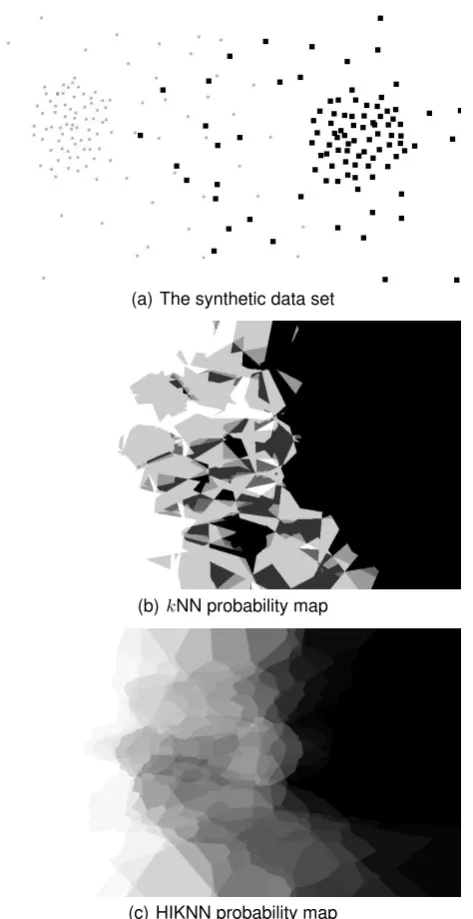
In order to check if the predicted values make sense or not, we examined the algorithm output on synthetic 2D data. The fact that data has only 2 dimen-sions allows us to draw aprobability map, where each pixel is ’classified’ by the examined algorithms and assigned a probability of belonging to each class. We have generated several such datasets and here we discuss one of them. The dataset is simple, representing2 categories with overlapping border regions. We have used HIKNN without the distance weighting. The resulting probability maps can be seen in Figure 7.
(a) The synthetic data set
(b)kNN probability map
(c) HIKNN probability map
Fig. 7.Probability maps inferred fromkNN and HIKNN on synthetic data, fork= 5. Each pixel was classified by the algorithms and assigned a probability value of belonging to each of the two classes.
un-derlying class probabilities, which we intend to explore more thoroughly in our future work.
8.
Conclusion
In this paper we presented a novel approach for handling high-dimensional data ink-NN classification, Hubness Informationk-Nearest Neighbor (HIKNN). It is a hubness-aware approach which is based on evaluating the informativeness of individual neighbor occurrences. Rare neighbors (anti-hubs) are shown to carry valuable information which can be well exploited for classification.
The algorithm is parameter-free, unlike the previous class-hubness based hubness-aware classification algorithms. The danger of over-fitting is thereby greatly reduced.
The algorithm was compared to the three recently proposed hubness-aware approaches (hw-kNN, h-FNN, NHBNN), as well as thekNN baseline on32 clas-sification problems. Our proposed approach had an overall best performance in the experiments.
Since HIKNN modifies only the voting, it is easily extensible and could be combined with various sorts of metric learning or dynamick-neighbor sets. We intend to explore these directions thoroughly in our future work.
Acknowledgments.This work was supported by the Slovenian Research Agency, the IST Programme of the EC under PASCAL2 (IST-NoE-216886) and the Serbian Ministry of Education and Science project no. OI174023.
References
1. I. H. Witten and E. Frank,Data Mining: Practical Machine Learning Tools and Tech-niques, 2nd ed. Morgan Kaufmann Publishers, 2005.
2. E. Fix and J. Hodges, “Discriminatory analysis, nonparametric discrimination: con-sistency properties,” USAF School of Aviation Medicine, Randolph Field, Texas, Tech. Rep., 1951.
3. T.M.Cover and P.E.Hart, “Nearest neighbor pattern classification,”IEEE Transac-tions on Information Theory, vol. IT-13, no. 1, pp. 21–27, 1967.
4. L. Devroye, “On the inequality of cover and hart,”IEEE Transactions on Pattern Analysis and Machine Intelligence, vol. 3, pp. 75–78, 1981.
5. C.J.Stone, “Consistent nonparametric regression,”Annals of Statistics, vol. 5, pp. 595–645, 1977.
6. A. K. L. Devroye, L. Gyorfi and G. Lugosi, “On the strong universal consistency of nearest neighbor regression function estimates,”Annals of Statistics, vol. 22, pp. 1371–1385, 1994.
7. D. Franc¸ois, V. Wertz, and M. Verleysen, “The concentration of fractional distances,” IEEE Transactions on Knowledge and Data Engineering, vol. 19, no. 7, pp. 873–886, 2007.
9. M. Radovanovi´c, A. Nanopoulos, and M. Ivanovi´c, “Nearest neighbors in high-dimensional data: The emergence and influence of hubs,” inProc. 26th Int. Conf. on Machine Learning (ICML), 2009, pp. 865–872.
10. N. Tomaˇsev, M. Radovanovi´c, D. Mladeni´c, and M. Ivanovi´c, “The role of hubness in clustering high-dimensional data.” inPAKDD (1)’11, 2011, pp. 183–195.
11. E.-H. Han, G. Karypis, and V. Kumar, “Text categorization using weight adjusted k-nearest neighbor classification,” inAdvances in Knowledge Discovery and Data Mining, ser. Lecture Notes in Computer Science, D. Cheung, G. Williams, and Q. Li, Eds. Springer Berlin / Heidelberg, 2001, vol. 2035, pp. 53–65.
12. J. Wang, P. Neskovic, and L. N. Cooper, “Improving nearest neighbor rule with a simple adaptive distance measure,” Pattern Recogn. Lett., vol. 28, pp. 207–213, January 2007.
13. Y. Song, J. Huang, D. Zhou, H. Zha, and C. L. Giles, “Iknn: Informative k-nearest neighbor pattern classification,” in Proceedings of the 11th European conference on Principles and Practice of Knowledge Discovery in Databases, ser. PKDD 2007. Berlin, Heidelberg: Springer-Verlag, 2007, pp. 248–264.
14. J. E. Keller, M. R. Gray, and J. A. Givens, “A fuzzy k-nearest-neighbor algorithm,” in IEEE Transactions on Systems, Man and Cybernetics, 1985, pp. 580–585.
15. R. Jensen and C. Cornelis, “A new approach to fuzzy-rough nearest neighbour clas-sification,” in Rough Sets and Current Trends in Computing, ser. Lecture Notes in Computer Science, C.-C. Chan, J. Grzymala-Busse, and W. Ziarko, Eds. Springer Berlin / Heidelberg, 2008, vol. 5306, pp. 310–319.
16. W. Shang, H. Huang, H. Zhu, Y. Lin, Y. Qu, and H. Dong, “An adaptive fuzzy knn text classifier,” inComputational Science — ICCS 2006, ser. Lecture Notes in Computer Science, V. Alexandrov, G. van Albada, P. Sloot, and J. Dongarra, Eds. Springer Berlin / Heidelberg, 2006, vol. 3993, pp. 216–223.
17. L. Wang, L. Khan, and B. Thuraisingham, “An effective evidence theory based k-nearest neighbor (knn) classification,” inProceedings of the 2008 IEEE/WIC/ACM International Conference on Web Intelligence and Intelligent Agent Technology -Volume 01. Washington, DC, USA: IEEE Computer Society, 2008, pp. 797–801. [Online]. Available: http://portal.acm.org/citation.cfm?id=1486927.1487026
18. K. Q. Weinberger, J. Blitzer, and L. K. Saul, “Distance metric learning for large mar-gin nearest neighbor classification,” inIn NIPS. MIT Press, 2006.
19. M. R. Min, D. A. Stanley, Z. Yuan, A. J. Bonner, and Z. Zhang, “A deep non-linear feature mapping for large-margin knn classification,” inICDM, 2009, pp. 357–366. 20. J. Aucouturier and F. Pachet, “Improving timbre similarity: How high is the sky?”
Journal of Negative Results in Speech and Audio Sciences, vol. 1, 2004.
21. J. Aucouturier, “Ten experiments on the modelling of polyphonic timbre,” Docteral dissertation, University of Paris 6, Tech. Rep., 2006.
22. M. Radovanovi´c, A. Nanopoulos, and M. Ivanovi´c, “Hubs in space: Popular nearest neighbors in high-dimensional data,”Journal of Machine Learning Research, vol. 11, pp. 2487–2531, 2011.
23. ——, “On the existence of obstinate results in vector space models,” inProc. 33rd Annual Int. ACM SIGIR Conf. on Research and Development in Information Re-trieval, 2010, pp. 186–193.
24. K. Buza, A. Nanopoulos, and L. Schmidt-Thieme, “Insight: efficient and effective instance selection for time-series classification,” inProceedings of the 15th Pacific-Asia conference on Advances in knowledge discovery and data mining - Volume Part II, ser. PAKDD’11. Springer-Verlag, 2011, pp. 149–160.
26. N. Tomaˇsev, M. Radovanovi´c, D. Mladeni´c, and M. Ivanovi´c, “Hubness-based fuzzy measures for high dimensional k-nearest neighbor classification,” inMachine Learn-ing and Data MinLearn-ing in Pattern Recognition, MLDM conference, 2011.
27. ——, “A probabilistic approach to nearest neighbor classification: Naive hubness bayesian k-nearest neighbor,” inProceeding of the CIKM conference, 2011. 28. N. Tomaˇsev, R. Brehar, D. Mladeni´c, and S. Nedevschi, “The influence of hubness
on nearest-neighbor methods in object recognition,” inIEEE Conference on Intelli-gent Computer Communication and Processing, 2011.
29. D. J. C. MacKay,Information Theory, Inference and Learning Algorithms. New York, NY, USA: Cambridge University Press, 2002.
30. J. Chen, H. ren Fang, and Y. Saad, “Fast approximatekNN graph construction for high dimensional data via recursive Lanczos bisection,”Journal of Machine Learning Research, vol. 10, pp. 1989–2012, 2009.
31. D. R. Hardoon, S. Szedm ´ak, and J. Shawe-Taylor, “Canonical correlation analysis: An overview with application to learning methods,” Neural Computation, vol. 16, no. 12, pp. 2639–2664, 2004.
32. H. Hotelling, “The most predictable criterion,” Journal of Educational Psychology, vol. 26, pp. 139–142, 1935.
Nenad Toma ˇsevis a PhD student at the Artificial Intelligence Laboratory at J. Stefan Institute. He graduated in 2008 at the Department for Mathematics and Informatics at the University of Novi Sad, Serbia. His research topics include Machine Learning, Data Mining, Artificial Life and Stochastic Optimization. He has been actively participating in teaching at both Petnica Science Center and Viˇsnjan Summer School.
Prof. Dr. Dunja Mladeni ´c works as a researcher and a project manager at J. Stefan Institute, leading Artificial Intelligence Laboratory and teaching at J. Stefan International Postgraduate School. She is an expert on study and development of Machine Learning, Data/Text Mining, Semantic Technology techniques and their application on real-world problems. She is associated with the J. Stefan Institute since 1987. She got her MSc and PhD in Computer Science at University of Ljubljana in 1995 and 1998 respectively. She was a visiting researcher at School of Computer Science, Carnegie Mellon Univer-sity, USA in 1996-1997 and in 2000-2001. Dunja Mladeni´c has experience in coordinat-ing EU projects and actcoordinat-ing on management board of several European research and development projects. She was a program co-chair of ECML 2007, a general chair of ECMLPKDD 2009. She is a co-inventor on a patent application with Cycorp Inc., USA.
Dunja Mladeni´c is the Slovenian representative in EC Enwise STRATA ETAN Expert Group ”Promoting women scientists from the Central and Eastern European countries and the Baltic States to produce gender equality in science in the wider Europe”. She serves as project evaluator of project proposals for EC programme on Information and Society Technology (IST). In 2001, she was evaluator of project proposals for National Science Foundation (NSF) initiative on Information Technology Research (ITR), NSF 00-126, USA. She has published papers in refereed journals and conferences, co-editor of several books, served in the program committee of international conferences and organized international events in the area of Text Mining, Link Analysis and Data Mining.

![Fig. 6. The accuracy of the hubness-aware approaches when the occurrence modelis inferred from the approximate kNN graph generated by [30]](https://thumb-us.123doks.com/thumbv2/123dok_us/1180850.1620746/17.595.141.478.118.381/accuracy-hubness-approaches-occurrence-modelis-inferred-approximate-generated.webp)