Ecology after 100 years: Progress and pseudo-progress
Charles J. Krebs
Department of Zoology, University of British Columbia, Vancouver, B.C. V6T 1Z4, Canada (E-mail: [email protected])
____________________________________________________________________________________________________________________________________
Abstract: Has the science of ecology fulfilled the promises made by the originators of ecological science at the start of the last century? What should ecology achieve? Have good policies for environmental management flowed out of ecological science? These important questions are rarely discussed by ecologists working on detailed studies of individual systems. Until we decide what we wish to achieve as ecologists we cannot define progress toward those goals. Ecologists desire to achieve an understanding of how the natural world operates, how humans have modified the natural world, and how to alleviate problems arising from human actions. Ecologists have made impressive gains over the past century in achieving these goals, but this progress has been uneven. Some sub-disciplines of ecology are well developed empirically and theoretically, while others languish for reasons that are not always clear. Fundamental problems can be lost to view as ecologists fiddle with unimportant pseudo-problems. Bandwagons develop and disappear with limited success in addressing problems. The public demands progress from all the sciences, and as time moves along and problems get worse, more rapid progress is demanded. The result for ecology has too often been poor, short-term science and poor management decisions. But since the science is rarely repeated and the management results may be a generation or two down the line, it is difficult for the public or for scientists to decide how good or bad the scientific advice has been. In ecology over the past 100 years we have made solid achievements in behavioural ecology, population dynamics, and ecological methods, we have made some progress in understanding community and ecosystem dynamics, but we have made less useful progress in developing theoretical ecology, landscape ecology, and natural resource management. The key to increasing progress is to adopt a systems approach with explicit hypotheses, theoretical models, and field experiments on a scale defined by the problem. With continuous feedback between problems, possible solutions, relevant theory and experimental data we can achieve our scientific goals.
____________________________________________________________________________________________________________________________________
Keywords: ecology; progress; resource management
New Zealand Journal of Ecology (2006) 30(1): 3-11 ©New Zealand Ecological Society Published on-line: 30 January 2006
Introduction
Science and progress have become synonyms during the last century, and for the most part the public appreciates and funds science because it is believed to lead to progress and to improvements in the quality of life for the people of the world. Many books and articles have discussed the relationships between science and progress (Kuhn, 1970; Losee, 2004) and many authors have evaluated how ecology and its subdisciplines in particular can best improve progress (Thompson et al., 2001; Graham and Dayton, 2002; Osmond et al., 2004; Salafsky et al., 2002). In this paper I revisit the issue of progress in ecology from an historical perspective. In particular I ask, given the scope and promise of ecology, what have we achieved, and how much have these achievements helped to address the ecological problems of the planet?
What did the ecologists of the early 20th century promise for the fledgling science of ecology? Charles Elton (1927), in one of the earliest textbooks of animal
ecology, outlined the elements of the science— communities, habitats, limiting factors, the regulation of numbers, succession, and dispersal. He pointed out clearly in 1933 that progress in solving economic problems was an essential task of the new science. After mentioning sleeping sickness, malaria, the biological control of plant and animal pests, and conservation in Africa, Elton goes on to say:
“…these practical problems undoubtedly provide one of the strongest and most urgent reasons for developing principles in animal ecology…” (Elton, 1933, p. 5)
This economic concern in ecology arose from important human problems, and I suggest that the promise early ecologists made relied in the end on providing solutions for these practical problems in disease management, agriculture, forestry, fisheries and conservation. But if this is the ultimate goal, how can we measure progress in ecology?
Philosophers of science have discussed in detail how science progresses, and there are two rather diametrically opposite models of scientific progress (Losee, 2004). William Whewell in 1837 suggested a “tributary river” model of scientific progress with facts and ideas forming the small rivulets that flow into larger theories and laws. Karl Popper in the last century proposed an “evolutionary tree” model of scientific progress in which natural selection operates on ideas and theories, and progress is defined by falsification of ideas that do not fit observations and experiments. The evolutionary model of progress was used by Graham and Dayton (2002) in their analysis of paradigms in ecology, but it is far from clear which of these two models is more appropriate for ecological science.
Given the lack of a clear model, we are tempted to measure scientific progress empirically by the number of papers published or the size of the membership in an ecological society. The journal Ecology, for example, published about 200 pages per year in the 1920s, and now exceeds 2200 pages annually. The New Zealand Ecological Society began in 1952 with 150 members and in 2004 has 535 members, a three- to four-fold increase. By these measures ecology has progressed greatly but these measures still do not clearly define progress. “Bigger is better” can be a convenient substitute for a more careful analysis of how many problems have been solved by ecological research, and we need to develop a better metric of progress if we are to convince politicians that ecological research should receive higher levels of funding.
If we restrict the science of ecology to the analysis of the interactions that determine the distribution and abundance of organisms, we can ask what ecology should achieve. I suggest three broad goals that are consistent with the promises made by Charles Elton and many early ecologists: (1) to understand how the natural world operates; (2) to understand how humans modify the natural world; and (3) to find methods to alleviate the problems arising both from nature and from human actions. Progress in science can be identified most easily with effectiveness in problem solving (Losee, 2004), and the first two goals should have the ultimate aim of facilitating the third goal of alleviating problems. The background model for achieving all of these goals is illustrated in Figure 1, the application of the scientific method to ecological problems.
Understanding the natural world
Populations, communities, and ecosystems have a long evolutionary history, and as a starting point ecologists need to analyse and understand how these systems work in the relative absence of human interference. This goal is in many ways incompatible with the current state of the planet, where humans have appropriated much of the primary production (Pauly and Christensen, 1995; Vitousek et al., 1997) and resources such as water (Postel et al., 1996; Jackson et al., 2001). It is legitimate to ask whether or not this goal of studying the natural world is worth pursuing at the present time. The argument is that all of the earth is so affected by human actions that there is no natural world remaining to be studied, and moreover what is left in a natural state is so little as to be irrelevant to our current ecological problems. For example, less than 5% of the area of the European Union countries can be classified as natural landscape (Piorr, 2003). The contrary argument for the relevance of natural landscape studies has been well summarised by Sinclair (1998), who argued that natural systems found in national parks and other protected areas form the baselines against which we can measure human-affected ecosystems. The key point here can be illustrated by an analogy with medicine — unless we understand the workings of healthy human beings, we cannot begin to diagnose, understand, and alleviate diseases and other disorders.
Palaeoecology should be the starting point for placing our understanding of current ecological conditions into an historical framework. The key point is that our current ecological theories must be consistent
with the information we can gain from palaeoenvironments. A classic example of the value of palaeoecological work has been the rejection of Clement’s monoclimax hypothesis of succession and the idea that plant communities are integrated equilibrial systems (Giller and Gee, 1987). There are many examples now described in which past plant and animal communities have no modern analogue (Collinson and Scott, 1987; McGlone et al., 2000; Brook and Bowman, 2004). The important message that palaeoecologists give to modern ecologists is to place their findings within a long-term framework that does not assume equilibrial dynamics. The current focus on the impacts of global change strongly underlines this message.
Understanding the natural world implies some generality of ideas rather than an assumption that every ecosystem is different, and it is this search for generality, or good paradigms, that is itself controversial. By generality of understanding I mean the development of some ecological principles or “laws” that are more specific than the exponential growth law (Berryman, 2003) but cover particular ecosystems or trophic compartments in such a way that predictions about future behaviour can be made and tested. For example, a generalisation that community structure on rocky intertidal shores is determined by keystone predators is useful because it predicts general patterns on all continents independent of the actual species involved. These kinds of generalisations will have exceptions and need testing, but they serve as paradigms or guideposts for further research (Paine, 2002). Developing good paradigms has been a major focus of basic ecological research over the last 50 years.
Population ecology and behavioural ecology have developed an extensive and reliable understanding of ecological processes at the individual and population level of abstraction, and are the most developed of the ecological disciplines. Community ecology and ecosystem ecology have also made progress in dealing with more difficult issues, and are hampered by the issue of scale and the difficulty of doing large-scale experiments (Osmond et al., 2004). All of these subdisciplines have progressed because they have good mathematical theory supporting their claims – whether it be population mathematics, Mendelian population genetics, or energy flow. Without some form of mathematical theory, no subdiscipline is able to decide if its quantitative data are correctly balanced. The simplest examples come from population mathematics — if you know the birth, death and movement rates for a local population, you can calculate the population growth rate and compare this with measured changes in numbers. A second example would be the analysis of soil nutrient dynamics in
ecosystems, in which, by the law of conservation of mass, what goes in must come out, unless storage changes.
Landscape ecology, by contrast, has not developed any mathematical theory. Landscape ecology asks how the spatial arrangements of habitats affect the distribution and abundance of species, and how landscape patterns affect ecosystem processes. These questions are not being answered at present, although many ecologists view them as critically important in human-dominated areas, and at present landscape ecology continues as a set of GIS-type technologies in search of a question. There are important issues that must be attacked at the landscape level, but so far landscape ecology has not articulated these or developed a paradigm that would define progress in this area (Wiens, 1999).
By all rights, theoretical ecology ought to be a key to ecological progress but to date its main contribution has been to push bandwagons that promise everything and deliver little. Theoretical ecology has made a disappointing contribution for two major reasons. First, many mathematical models score high in elegance and low in empirical relevance. Models with parameters that cannot be measured only rarely lead to scientific progress (cf. Ginzburg and Jensen, 2004). Second, without empirical feedback (Fig. 1), models become divorced from reality and become an end in themselves rather than part of the solution to a problem. Almost none of the material in the journal Theoretical Population Biology, for example, bears any relation to analysable problems in the real world. There is no harm in exploring hypothetical worlds, but the observation I make is that none of this has helped ecologists solve practical problems. Third, the arrogance many mathematical modellers have shown in the past toward empirical ecologists has hardly helped bring about the desired interactions (illustrated in Fig. 1) that are essential for progress. Fortunately this problem is now largely historical, and has been alleviated by a new generation of mathematical ecologists who think about reality in creative ways (e.g. McCallum et al., 2001; Barlow et al., 2002).
Understanding how humans modify the natural world
major concern to humans. Fourth, they harvest renewable resources. The overarching mantra for all these problems is sustainability and the general goal of maintaining long-term system properties like biodiversity or soil fertility.
Monocultures of agricultural crop plants or fish in pens are possibly the most extreme examples of human-structured communities that exceed the boundaries of single-species dominance observed in species-diverse natural ecosystems. Monocultures have been the dominant model for Western, temperate-zone agriculture for the last century because of the belief that this type of farming created maximum crop production, maximum profit, with minimum labour. But monocultures cause problems in pest management and potential problems in soil fertility, so that in the medium to long term, profit may be reduced and in some cases eliminated by crop diseases and pests. Tropical agriculture by contrast has developed empirically with mixed crops (Vandermeer, 1989), and there are strong reasons why monocultures are both less productive and socially less desirable in tropical systems. The reassessment of the use of monocultures in agriculture has come from a social movement toward a desire to achieve sustainable agriculture. At the same time we need to develop standardised biotic indicators that will provide feedback on future trends in agricultural-land- use practices, whether they involve monocultures or mixed cropping systems (Osinski et al., 2003).
There are surprisingly few detailed data available on the ecological and economic advantages and disadvantages of monocultural agriculture and forestry (Reganold et al., 2001; Rothe and Binkley, 2001; Sanderson et al., 2004). For example, there is no clear indication that soil nitrogen is increased in mixed forest stands compared with monocultures (Rothe and Binkley, 2001). Nor is it clear that species-rich pastures translate into higher livestock production (Sanderson
et al., 2004). The general recommendation that higher biodiversity is better in agricultural systems is an article of faith among ecologists, but this generalisation has a weak scientific foundation.
Species introductions are a global problem that has the potential to produce pest catastrophes. New Zealand is an interesting case in point because of the high level of species introductions and agricultural changes that have affected native species (Parkes and Murphy, 2003). Introduced species of both plants and animals have caused extinctions and range restrictions that are being reversed at great cost by intensive pest management. Australia suffers from many of the same problems with introduced species and a systematic failure to adopt sustainable agricultural practices (Short, 1998; Richards and Short, 2003). The interaction of conservation management with agricultural production
in New Zealand is especially interesting because of the need to harmonise sustainability of human industries with the conservation of biodiversity.
Pollution of ecosystems with both natural compounds and human-produced chemicals is a third source of concern for the earth’s ecosystems. These problems are multi-disciplinary involving chemistry, environmental science, and medicine as well as ecology. At present we make little progress in dealing with many forms of pollutants because the interdisciplinary groups have not yet formed to attack these complex problems. Until this happens, ecologists must rely on describing pollution catastrophes after the fact, the classic example being DDT (Grier, 1982; Lindell et al., 2001. The largest focus of ecologists has been on understanding the impacts of climate change on ecosystems, a critical and difficult task because of the variability of response of different species to changes in the physical environment (Mueter et al., 2002; Logan et al., 2003; Parmesan and Yohe, 2003). Predictions about the impacts of climate change have so far been very general, and rely on a simple postulate that all geographic ranges are limited by climatic variables. Specific predictions about the biological impacts of climate change are in high demand by the public, but are hazardous for ecologists because such long-term predictions must rely on models that are far too simple to capture the complexities of the interactions between climate change and species interactions.
Harvesting of renewable resources has been the fourth critical area that ecologists have studied in detail in order to manage fisheries and forestry resources sustainably. Ironically, fishery scientists were among the first to discuss sustainability, and yet fish are almost universally overharvested around the world (Ludwig et al., 1993; Pauly et al., 2002; Myers and Worm, 2003). Most of the problems of overharvesting are economic, social and political rather than biological, and the ecological principles of sustainable harvesting are now well worked out (Pauly et al., 2002). This is a case in which ecologists have been successful in their science (with many mistakes along the way), but their message has not transferred across to politicians and managers.
Finding methods of alleviating problems
of individual species and (much more rarely) at the level of communities and ecosystems.
Applied ecology has achieved success by operating with the single-species paradigm, and yet ecologists in general argue that we need to consider problems at the community and ecosystem level of analysis (Forsyth
et al., 2000). The dialectical interplay of the reductionist, single-species approach with the more holistic, ecosystem approach has produced a schism in ecology that hinders our attempts to alleviate problems. At the simplest level, it has produced specialisation, resulting in ecosystem ecologists rarely talking to population ecologists, and new specialised journals that proliferate faster than anyone can read them (Graham and Dayton, 2002). How can we find the middle ground?
Ecological problems are often regarded as single-species problems, and we need to develop better ways of judging which single-species problems are in reality hidden, community dynamics problems that will lead to further difficulties (the Law of Unintended Consequences, e.g. Hickling et al., 1999). One way to achieve this goal is to demand a food-web analysis for any particular ecological problem, whether it concerns an endangered species or a pest species. For example, if the rabbit is a pest species, we must ask what will be the results of reducing or eliminating rabbit populations. If the direct and indirect effects that propagate through the food web can be anticipated, the experimental designs needed to inform decision makers can be specified (Courchamp et al., 2003). The call is for multi-species management, and this must be the future of pest control. The possum in New Zealand is an excellent example of the need for multi-species approaches, and we need to ask what would be the impact of reducing or eliminating these pests from New Zealand forests (Montague, 2000; Norton, 2000; Veltman, 2000). For some pest species, the results are clear-cut and reduction or eradication can proceed with few side effects. This is clearly the case with eradicating rats that have been introduced to islands (Myers et al., 2000; Towns and Broome, 2003). But it will not be true for all pest species and there are already too many examples of pest control gone wrong by not anticipating unintended consequences (Secord, 2003). There is now a rich literature of the unintended consequences of management actions, and every management proposal should start by reviewing the historical background of the intended actions in order to avoid repeating the same mistakes (Keedwell et al., 2002). The use of adaptive management is the second general recommendation for agencies dealing with resource management, but at present it is used more in discussion than in practice (Salafsky et al., 2002; Shea
et al., 2002). By adaptive management I mean experimental management, the application of standard scientific experimental protocols to management
problems. There is no doubt that the use of the adaptive management approach would greatly improve our ability to manage renewable resources effectively.
The present tendency in both basic and applied ecology is to develop mathematical models to investigate system behaviour. Unfortunately, there is a complete disjoint between the time it takes to model a problem and the time it takes to test a hypothesis with a properly replicated field experiment or to measure the parameters of the model, so that ecological modelling has far outstripped ecological knowledge. Typically a modelling paper in journals like the
long-term issues may be useful as heuristic devices, but should not be presented as predictive statements. Making definite statements about long-term issues may gather political support in the present at the price of longer-term undermining of confidence in ecology when the predictions are found to be in error. Defining long-term predictions from complex models as “scenarios” is intellectually dishonest. Ecologists may take such predictions with a grain of salt but the public and politicians will not be so critical. If there is a message for the long term that ecologists need to amplify, it is that we must learn to live with scientific uncertainty and respond to it creatively with a worldview that includes the precautionary principle.
Disease ecology is an important area to which ecologists have much to contribute. Diseases are not simply a medical problem, and if we do not develop the understanding of how diseases like the West Nile virus and AIDS develop, propagate, and transmit from other animals to humans, we will be condemned to a reactive type of science that misses ecological causes. Disease ecology is an underdeveloped part of ecological science that needs much more investment (Mills and Childs, 1998; Mills, 1999).
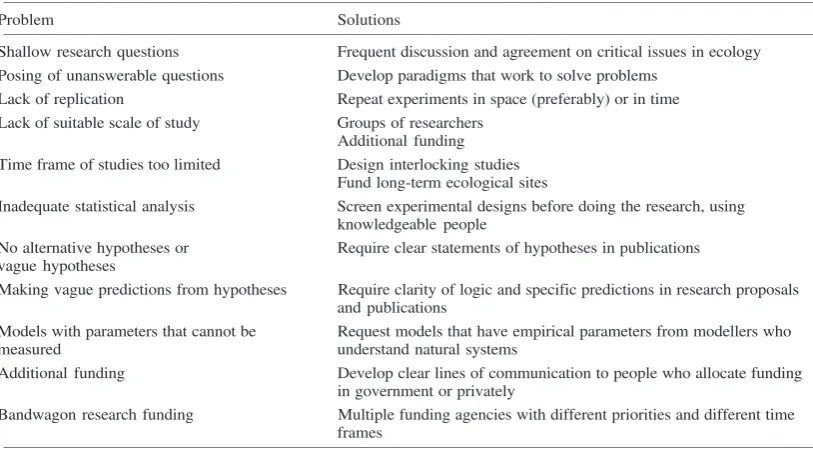
Finally, ecologists ought to recognise that while we are able to develop solutions for current problems, these will often not be implemented for financial, social or political reasons (Table 1). In a world driven by dollars, sensible environmental policies on climate change, for example, may have little hope of passing.
For some modern trends like climate change, ecologists may find themselves mapping in detail the angle of repose of the deckchairs on the Titanic, rather than solving problems. Education is the long-term solution to the lack of political determination on many environmental issues, but ecological ignorance still rules on even simple problems like the impact of domestic animals on wildlife (Lepczyk et al., 2004). Nevertheless, ecologists must press forward to develop solutions to problems. We should be confident that in the long run we will prevail and will have made a substantial contribution to the development of a sustainable human society with the ecological values we hold to be self-evident.
Conclusion
There has been a great deal of soul-searching about progress in ecological science (Loehle, 1987; Peters, 1991; O’Connor, 2000). Much of the disagreement over the rate of progress has its origin in how to measure scientific progress. To many ecologists these issues are irrelevant, but to a larger public that supports science the issue of progress is critical for continued funding. I suggest that we should adopt as the metric of progress our ability to solve ecological problems. To achieve these goals we need to do better science (Anderson et al., 2003) with better theories, better models, and better experiments. We can all profit by
Table 1. Circumstances holding back scientific progress in ecology, and possible solutions.
____________________________________________________________________________________________________________________________________
Problem Solutions
____________________________________________________________________________________________________________________________________ Shallow research questions Frequent discussion and agreement on critical issues in ecology Posing of unanswerable questions Develop paradigms that work to solve problems
Lack of replication Repeat experiments in space (preferably) or in time Lack of suitable scale of study Groups of researchers
Additional funding Time frame of studies too limited Design interlocking studies
Fund long-term ecological sites
Inadequate statistical analysis Screen experimental designs before doing the research, using knowledgeable people
No alternative hypotheses or Require clear statements of hypotheses in publications vague hypotheses
Making vague predictions from hypotheses Require clarity of logic and specific predictions in research proposals and publications
Models with parameters that cannot be Request models that have empirical parameters from modellers who
measured understand natural systems
Additional funding Develop clear lines of communication to people who allocate funding in government or privately
Bandwagon research funding Multiple funding agencies with different priorities and different time frames
raising the bar in ecology for all these areas.
Acknowledgements
I thank Dennis Chitty, Andrea Byrom, and two reviewers for their comments and suggestions. The Librarians at CSIRO Sustainable Ecosystems provided strong support during the writing of this paper. I dedicate it to the late Nigel Barlow, who was a friend, a good ecologist, and a helpful, talented modeller.
References
Anderson, D.R.; Cooch, E.G.; Gutierrez, R.J.; Krebs, C.J.; Lindberg, M.S.; Pollock, K.H.; Ribic, C.A.; Shenk, T.M. 2003. Rigorous science: suggestions on how to raise the bar. Wildlife Society Bulletin 31: 296-305.
Barlow, N.D. 1995. Critical evaluation of wildlife disease models. In:Ecology of infectious diseases in natural populations. Grenfell, B.T.; Dobson, A.P. (Editors), pp. 230-259. Cambridge University Press, Cambridge, U.K.
Barlow, N.D. 2000a. Non-linear transmission and simple models for bovine tuberculosis. Journal of Animal Ecology69: 703-713.
Barlow, N.D. 2000b. Models for possum management.
In: Montague, T. (Editor), The brushtail possum: Biology, impact and management of an introduced marsupial, pp. 208-219. Manaaki Whenua Press, Lincoln, N.Z.
Barlow, N.D.; Barron, M.C.; Parkes, J. 2002. Rabbit haemorrhagic disease in New Zealand: field test of a disease-host model. Wildlife Research29:
649-653.
Barlow, N.D.; Kean, J.M.; Briggs, C.J. 1997. Modelling the relative efficacy of culling and sterilisation for controlling populations. Wildlife Research 24:
129-141.
Berryman, A.A. 2003. On principles, laws and theory in population ecology. Oikos103: 695-701. Brook, B.W.; Bowman, D.M.J.S. 2004. The uncertain
blitzkrieg of Pleistocene megafauna. Journal of Biogeography31: 517-523.
Collinson, M.E.; Scott, A.C. 1987. Factors controlling the organization and evolution of ancient plant communities. In: Gee, J.H.R.; Giller, P.S. (Editors),
Organization of communities: Past and present, pp. 399-420. Blackwell Scientific Publications, Oxford, U.K.
Courchamp, F.; Woodroffe, R.; Roemer, G. 2003. Removing protected populations to save endangered species. Science302: 1532. Elton, C. 1927. Animal ecology. Sidgwick and Jackson,
London, U.K.
Elton, C. 1933. The ecology of animals. Methuen, London, U.K.
Forsyth, D.M.; Parkes, J.P.; Hickling, G.J. 2000. A case for multi-species management of sympatric herbivore pest impacts in the central Southern Alps, New Zealand. New Zealand Journal of Ecology24: 97-103.
Giller, P.S.; Gee, J.H.R. 1987. The analysis of community organization: the influence of equilibrium, scale and terminology. In: Gee, J.H.R.; Giller, P.S. (Editors), Organization of communities: Past and present, pp. 519-542. Blackwell Scientific Publications, Oxford, U.K. Ginzburg, L.R.; Jensen, C.X.J. 2004. Rules of thumb
for judging ecological theories. Trends in Ecology and Evolution19: 121-126.
Graham, M.H.; Dayton, P.K. 2002. On the evolution of ecological ideas: paradigms and scientific progress. Ecology83: 1481-1489.
Grier, J.W. 1982. Ban of DDT and subsequent recovery of reproduction in bald eagles. Science218: 1232-1234.
Hickling, G.J.; Henderson, R.J.; Thomas, M.C.C. 1999. Poisoning mammalian pests can have unintended consequences for future control: two case studies.
New Zealand Journal of Ecology 23: 267-273. Jackson, R.B.; Carpenter, S.R.; Dahm, C.N.; McKnight,
D.M.; Naiman, R.J.; Postel, S.L.; Running, S.W. 2001. Water in a changing world. Ecological Applications11: 1027-1045.
Keedwell, R.J.; Maloney, R.F.; Murray, D.P. 2002. Predator control for protecting kaki (Himantopus novaezelandiae) – lessons from 20 years of management. Biological Conservation105: 369-374.
Kuhn, T. 1970. The structure of scientific revolutions. University of Chicago Press, Chicago, Illinois, U.S.A.
Lepczyk, C.A.; Mertig, A.G.; Liu, J. 2004. Landowners and cat predation across rural-to-urban landscapes.
Biological Conservation115: 191-201.
Lindell, M.J.; Bremle, G.; Broberg, O.; Larsson, P. 2001. Monitoring of persistent organic pollutants (POPs): examples from Lake Vättern, Sweden.
Ambio30: 545-551.
Loehle, C. 1987. Hypothesis testing in ecology: psychological aspects and the importance of theory maturation. Quarterly Review of Biology62: 397-409.
Logan, J.A.; Regniere, J.; Powell, J.A. 2003. Assessing the impacts of global warming on forest pest dynamics. Frontiers in Ecology and the Environment1: 130-137.
Ludwig, D.; Hilborn, R.; Walters, C. 1993. Uncertainty, resource exploitation, and conservation: lessons from history. Science260: 17, 36.
McCallum, H.; Barlow, N.; Hone, J. 2001. How should pathogen transmission be modelled? Trends in Ecology and Evolution16: 295-300.
McGlone, M.S.; Wilmshurst, J.M.; Wiser, S.K. 2000. Lateglacial and Holocene vegetation and climatic change on Auckland Island, Subantarctic New Zealand. The Holocene10: 719-728.
Mills, J.N. 1999. The role of rodents in emerging human disease: examples from the hantaviruses and arenaviruses. In: Singleton, G.R.; Hinds, L.; Leirs, H.; Zhang, Z. (Editors), Ecologically-based management of rodent pests, pp.134-160. Australian Centre for International Agricultural Research, Canberra, Australia.
Mills, J.N.; Childs, J.E. 1998. Ecologic studies of rodent reservoirs: their relevance for human health.
Emerging Infectious Diseases4: 529-537. Montague, T. (Editor) 2000. The Brushtail possum:
Biology, impact and management of an introduced marsupial. Manaaki Whenua Press, Lincoln, N.Z. Mueter, F.J.; Peterman, R.M.; Pyper, B.J. 2002. Opposite effects of ocean temperature on survival rates of 120 stocks of Pacific salmon (Oncorhynchus spp.) in northern and southern areas. Canadian Journal of Fisheries and Aquatic Sciences59: 456-463.
Myers, J.H.; Simberloff, D.; Kuris, A.M.; Carey, J.R. 2000. Eradication revisited: dealing with exotic species. Trends in Ecology and Evolution15: 316-320.
Myers, R.A.; Worm, B. 2003. Rapid worldwide depletion of predatory fish communities. Nature 423: 280-283.
Norton, D. 2000. Benefits of possum control for native vegetation. In: Montague, T. (Editor), The brushtail possum: Biology, impact and management of an introduced marsupial, pp. 232-240. Manaaki Whenua Press, Lincoln, N.Z.
O’Connor, R.J. 2000. Why ecology lags behind biology.
The Scientist14: 35.
Oreskes, N.; Shrader-Frechette, K.; Belitz, K. 1994. Verification, validation, and confirmation of numerical models in the earth sciences. Science 263: 641-646.
Osinski, E.; Meier, U.; Büchs, W.; Weickel, J.; Matzdorf, B. 2003. Application of biotic indicators for evaluation of sustainable land use – current procedures and future developments. Agriculture, Ecosystems & Environment98: 407-421. Osmond, B.; Ananyev, G.; Berry, J.; Langdon, C.;
Kolber, Z.; Lin, G.; Monson, R.; Nichol, C.; Rascher, U.; Schurr, U.; Smith, S.; Yakir, D. 2004. Changing the way we think about global
change research: scaling up in experimental ecosystem science. Global Change Biology 10:
393-407.
Paine, R.T. 2002. Advances in ecological understanding: By Kuhnian revolution or conceptual evolution? Ecology83: 1553-1559. Parkes, J.; Murphy, E. 2003. Management of introduced
mammals in New Zealand. New Zealand Journal of Zoology30: 335-359.
Parmesan, C.; Yohe, G. 2003. A globally coherent fingerprint of climate change impacts across natural systems. Nature421: 37-42.
Pauly, D.; Christensen, V. 1995. Primary production required to sustain global fisheries. Nature374:
255-257.
Pauly, D.; Christensen, V.; Guenette, S.; Pitcher, T.J.; Sumaila, U.R.; Walters, C.J.; Watson, R.; Zeller, D. 2002. Towards sustainability in world fisheries.
Nature418: 689-695.
Peters, R.H. 1991. A critique for ecology. Cambridge University Press, Cambridge, U.K.
Pielke, R., Jr.; Carbone, R.E. 2002. Weather impacts, forecasts, and policy: an integrated perspective.
Bulletin of the American Meteorological Society 83: 393-403.
Piorr, H.P. 2003. Environmental policy, agri-environmental indicators and landscape indicators.
Agriculture, Ecosystems & Environment98: 17-33.
Postel, S.L.; Daily, G.C.; Ehrlich, P.R. 1996. Human appropriation of renewable fresh water. Science 271: 785-788.
Reganold, J.P.; Glover, J.D.; Andrews, P.K.; Hinman, H.R. 2001. Sustainability of three apple production systems. Nature410: 926-930.
Richards, J.D.; Short, J. 2003. Reintroduction and establishment of the western barred bandicoot
Perameles bougainville (Marsupialia: Peramelidae) at Shark Bay, Western Australia.
Biological Conservation109: 181-195.
Rothe, A.; Binkley, D. 2001. Nutritional interactions in mixed species forests: a synthesis. Canadian Journal of Forest Research31: 1855-1870. Salafsky, N.; Margoluis, R.; Redford, K.H.; Robinson,
J.G. 2002. Improving the practice of conservation: a conceptual framework and research agenda for conservation science. Conservation Biology16:
1469-1479.
Sanderson, M.A.; Skinner, R.H.; Barker, D.J.; Edwards, G.R.; Tracy, B.F.; Wedin, D.A. 2004. Plant species diversity and management of temperate forage and grazing land ecosystems. Crop Science44:
1132-1144.
D.C., U.S.A.
Secord, D. 2003. Biological control of marine invasive species: cautionary tales and land-based lessons.
Biological Invasions5: 117-131.
Shea, K.; Possingham, H.P.; Murdoch, W.W.; Roush, R. 2002. Active adaptive management in insect pest and weed control: Intervention with a plan for learning. Ecological Applications12: 927-936. Short, J. 1998. The extinction of rat-kangaroos
(Marsupialia: Potoroidae) in New South Wales, Australia. Biological Conservation86: 365-377. Sinclair, A.R.E. 1998. Natural regulation of ecosystems in protected areas as ecological baselines. Wildlife Society Bulletin26: 399-409.
Thompson, J.N.; Reichman, O.J.; Morin, P.J.; Polis, G.A.; Power, M.E.; Sterner, R.W.; Couch, C.A.; Gough, L.; Holt, R.; Hooper, D.U.; Keesing, F.; Lovell, C.R.; Milne, B.T.; Molles, M.C.; Roberts, D.W.; Strauss, S.Y. 2001. Frontiers of ecology.
BioScience51: 15-24.
Towns, D.R.; Broome, K.G. 2003. From small Maria to massive Campbell: forty years of rat eradications from New Zealand islands. New Zealand Journal of Zoology30: 377-398.
Vandermeer, J.H. 1989. The ecology of intercropping. Cambridge University Press, New York, U.S.A. Veltman, C. 2000. Do native wildlife benefit from
possum control? In: Montague, T. (Editor), The brushtail possum: Biology, impact and management of an introduced marsupial,pp. 241-250. Manaaki Whenua Press, Lincoln, N.Z. Vitousek, P.M.; Mooney, H.A.; Lubchenco, J.; Melillo,
J.M. 1997. Human domination of earth’s ecosystems. Science277: 494-499.