
Order Entry Order Sets to Improve Quality of Care:
A Case Study
abstract
BACKGROUND AND OBJECTIVES:Seattle Children’s Hospital was one of the early adopters of computerized physician order entry. As part of our 2003 go-live, order sets were created opportunistically by using an ad hoc development process. A pilot study revealed that this ad hoc development process resulted in order sets that were neither internally nor externally consistent. We sought to update order sets by using software development techniques, to try and improve consistency and also to review clinical content so that they could be updated to current evidence and consensus-based best practice. We also sought to identify and categorize errors found in the original order sets.
METHODS:This is a case study of a new order set development process that: (1) assigned order set ownership; (2) created and applied stand-ards for how orders should appear and be organized within order sets; (3) supported multidisciplinary review and update; and (4) enforced submitting completed specifications before order set build. We extracted order sets into Microsoft Word specifications, updated con-tent by using the Track Changes function, and then updated our Clinical Information System. Changes were reviewed and organized according to themes.
RESULTS:We created standard order formats for 98 orders; 191 order sets were standardized. Multidisciplinary review identified medication issues in 37% of order sets (used in 47.6% of inpatient admissions).
CONCLUSIONS:This case study demonstrates that it is not sufficient to simply implement computerized physician order entry. Clinical deci-sion supports should be subject to rigorous development processes to ensure both clinical appropriateness and correctness. Pediatrics 2013;131:S60–S67
AUTHORS:Michael G. Leu, MD, MS, MHS,aSheryl A. Morelli,
MD, MS,b,cOi-Yan Chung, MS, MT (ASCP),band Shanon
Radford, BA, PMPd
aClinical Effectiveness,bInformation Services,dProject
Management Office, Seattle Children’s Hospital, Seattle, Washington; andcDepartment of Pediatrics, University of
Washington, Seattle, Washington
KEY WORDS
computerized physician order entry, CPOE, health information technology
ABBREVIATIONS
CDS—clinical decision support CE—Clinical Effectiveness CIS—Clinical Information Systems CPI—Continuous Performance Improvement CPOE—computerized physician order entry SCH—Seattle Children’s Hospital
Drs Leu and Morelli, Ms. Chung, and Ms. Radford have had full access to all the data in the study and take responsibility for the integrity of the data and the accuracy of the data analysis.
This work was presented at a Cerner webinar on August 28, 2012.
www.pediatrics.org/cgi/doi/10.1542/peds.2012-1427g
doi:10.1542/peds.2012-1427g
Accepted for publication Dec 20, 2012
Address correspondence to Michael G. Leu, MD, MS, MHS, Clinical Effectiveness, M1-7, Seattle Children’s Hospital, 4800 Sand Point Way NE, Seattle, WA 98105. E-mail: michael.leu@seattlechildrens. org
PEDIATRICS (ISSN Numbers: Print, 0031-4005; Online, 1098-4275).
Copyright © 2013 by the American Academy of Pediatrics
BACKGROUND
Clinical decision support (CDS) enhan-ces health-related decision-making by providing evidence-based clinical knowl-edge when it is needed.1 One type of CDS is computerized physician order entry (CPOE). CPOE has been recog-nized as enhancing the efficiency, safety, and quality of medical work.2A key factor contributing to the success of CPOE is order sets. An order set is a group of orders used to manage a disease state or procedure.3
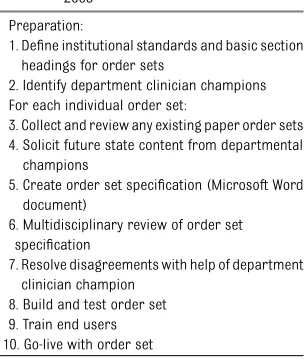
Seattle Children’s Hospital (SCH) is a 250-bed tertiary pediatric teaching hospital in Seattle, Washington. SCH was an early adopter of this functionality,4 implementing inpatient CPOE with order sets in our Clinical Information Sys-tem (CIS) in November 2003 (Cerner PowerChart, Cerner Corporation, North Kansas City, MO). A total of 230 order sets were developed and implemented initially, following the process in Table 1, and we now have.400 order sets.
In 2008, the Clinical Effectiveness (CE) team was formed. The CE team was charged with applying the principles of continuous performance improvement (CPI) (based on the Toyota Production System)5to the advancement of clini-cal care. The CE team sought to create evidence-based clinical recommenda-tions, to hardwire these recommendations
into CIS, and to use CIS reports to mon-itor adherence and clinical outcomes. With these 3 key components, CE facili-tates iterative clinical improvement. As afirst step, the CE team engaged clini-cians, informaticlini-cians, and local leaders in evidence-based medicine and in-formation services to examine existing work processes during a 3-day rapid process design workshop. Analysis of the order set development process and individual order sets revealed the following factors.
Order Sets Lacked Clinical Owners
This finding had subtle implications. Clinicians could request contradicting order set changes, resulting in either rework or delays while awaiting clar-ifications. Departments differed in how well they maintained order sets, with order set work prioritized according to departmental activity instead of hos-pital strategic initiatives. A culture grew wherein clinicians felt they had to practice within the confines of existing CIS content, not appreciating its cus-tomizability.
Lack of Leadership Support to Maintain Standards
SCH experienced rapid growth in CIS clinical decision supports such as or-der sets. Consequently, governance broke down. Order set standards, often not documented, were lost as analysts transitioned to other projects. Eventu-ally, order sets were specified by clinicians largely in the absence of standards, resulting in poor internal and external consistency (Table 2).
Ad Hoc Multidisciplinary Review
Instead of a formal review process, it was assumed that clinicians would solicit input from stakeholders before re-questing new order sets or updates. The only check was medication verification by a pharmacist, but this step was not documented and did not always occur.
This resulted in order sets that may not reflect or respect current practice.
Order Sets Not Maintained
There was no process for scheduled maintenance of order sets. Changes to the formulary, clinical guidelines, or hospital policies would occur without order set updates. As a result, many order sets contained outdated orders or inappropriate orders given newer hospital policies.
Requested Order Sets Not
Sufficiently Developed for Building
Order sets were requested through an online submission process. However, often new requests had poor specificity; for example, “We need an order set to manage anticoagulation.” Refining requests into something buildable resul-ted in new order sets requiring months or even years to develop.
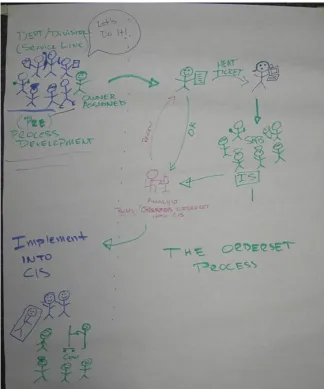
After the workshop, we created a new process (Fig 1) to address the following needs: to determine order set owner-ship; to create and apply standards for order appearance and sequence; to support multidisciplinary team review, update, and sign off on order set con-tent; and to have complete, reviewed, and approved order set specifications before submission of a build request. In addition, we added a step for infor-matician review of order sets in the production domain.
We piloted our new process to update 20 order sets for use with our new observation unit. We found a surprising
TABLE 1 Order Set Development Process, 2003
Preparation:
1. Define institutional standards and basic section headings for order sets
2. Identify department clinician champions For each individual order set:
3. Collect and review any existing paper order sets 4. Solicit future state content from departmental
champions
5. Create order set specification (Microsoft Word document)
6. Multidisciplinary review of order set specification
7. Resolve disagreements with help of department clinician champion
8. Build and test order set 9. Train end users 10. Go-live with order set
TABLE 2 Example of Variation in How an Order Is Specified in Different Order Sets
Incentive spirometry
•Only while awake, q 1 h, or age-appropriate technique
•Only while awake, q 1 h
•q 1 h, while awake after extubation
•Only while awake, q 1 h; bubbles, 10 repetitions
•Only while awake, q 1 h; use age-appropriate technique
•Only while awake, q 1 h; blow bubbles/pinwheel “q 1 h”means“every hour”.
number of order set updates were needed.
From thesefindings, and the Institute for Safe Medication Practices’ recom-mendation to periodically review order sets,6we planned to update order sets to conform to current practice, poli-cies, formulary, and available evidence and consensus-based clinical practice guidelines. We also sought to identify and categorize types of errors cor-rected to try to prevent those types of errors in the future.
METHODS
The core project team consisted of 2 physicians, a senior clinical informatics
analyst, and a project manager. The project was jointly sponsored by the vice president for CPI and the pediatrician-in-chief/chief medical information officer, who served as a point of escalation for project and clinical issues. This team had the ability to engage resources from pharmacy, laboratory, nutrition, nursing, CE, information services, CPI, individual service lines, clinical departments, and order set users.
Initial order set usage analysis led to inclusion of all order sets used in the previous 18 months. Order sets were then categorized according to de-partment and function. Order sets were excluded that were billing-only,
medication-only, or had a very narrow departmental purpose (eg, radiology contrast orders).
Ownership Assigned
We requested that individual physicians be order set owners. When unable to assign ownership, department heads assigned owners.
Standards for Order Specification and Sequence Created
which sequence the orders would appear within order sets.
The Guide also contained detailed tem-plates for emergency department, ad-mission, and postoperative order sets. These templates were organized to in-clude an order set name, last modified date, clinical owner, target age group, and links to related policies. Following this general information, orders from the Guide appeared within the follow-ing sections: admission information, nursing, nutrition, continuous infusions, medications, laboratory, radiology, di-agnostic tests, consults/therapies, and discharge information. Finally, templates included a review checklist (as discussed in the next section).
The risk of amplifying errors through standardization was recognized and mitigated by using robust peer review of the new clinical content standards by multiple physicians and clinical nurse specialists. Disputes regarding clini-cal standards were resolved by the pediatrician-in-chief.
Multidisciplinary Approval Documented
We created a review checklist to ensure that all order sets were approved by the physician owner and appropriate clin-ical nurse specialist. Our pain service reviewed order sets with opioids, and our infectious disease service reviewed order sets with antibiotics. Laboratory, radiology, and nutrition reviewed orders pertinent to their domains. In addition, pharmacy reviewed all order sets containing medications. Orders in the Guide were preapproved for use in future order sets. The order set speci-fication (Microsoft Word document) was sent by e-mail to all identified reviewers, with comments reconciled electronically until everyone was sat-isfied. Specifications were updated to match exactly what was built in CIS. Owners were notified of any significant changes resulting from order set build.
Build Verified
In the pilot, a single informatician reviewed all order sets in production to ensure that there were no errors which could harm patients. However, even with only 20 order sets, order sets would start to blur together, where a detail-oriented reviewer with fresh eyes could accom-plish this task more quickly and accu-rately. We changed this process so that order sets were reviewed in the testing domain, defects were recorded, and corrections were made before building in the production domain; we typically used at least 2 different physicians to review each order set.
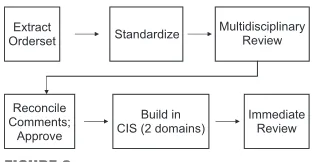
We defined the order set standardiza-tion and update process reflecting the aforementioned steps (Fig 2).
Methods of Evaluation
We planned to estimate the impact of this project by examining the number of hospital encounters in which updated order sets were used. We also wanted to examine changes made as a result of this process. We extracted existing CIS order sets into Microsoft Word order set specifications, and recorded all changes by using the Track Changes function. We examined all the changes made during the review process through qualitative analysis of themes, assuming that thefinal work products represented the gold standard.
RESULTS
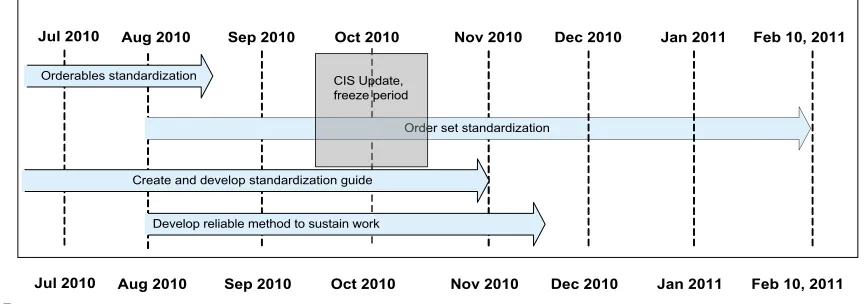
After analysis, 235 order sets were in-cluded in the project. This work was performed from July 2010 to February 2011 (Fig 3) following the new stan-dardization and update process. Eigh-teen order sets were removed because they were obsolete, and 39 were post-poned because the divisions were ac-tively updating clinical guidelines related to the order sets. A total of 178 order sets went through the standardization process (Fig 4). New clinical content standards were created (Table 3).
There were a wide range of errors corrected (Table 4). Multidisciplinary review identified medication issues in 37% of order sets (used for 47.6% of inpatient admissions). Some orders for epinephrine had the wrong route (eg, should be intramuscular). There were nonformulary medications or un-approved routes for medication speci-fied. There were a number of errors in which the dose of perioperative anti-biotics was inconsistent with the for-mulary and the perioperative antibiotic policy. Sometimes the errors were more subtle: the order set would apply to all age ranges (including neonatal), but the dosing provided would only be for large children (either in dose or frequency). There were orders for high-risk medi-cations that did not have a duration specified, so medications that should have been available only for procedural sedation in the ICU were ordered and on the patient’s medication administration record and available for administration even after the procedure was completed. There were also errors in laboratory orders, duplicate orders within order sets due to build issues, and incorrect nursing orders that were identified.
DISCUSSION
There were several key successes of our project. We developed a reliable method to create, update, review, and approve order sets. We engaged our clinical community and put the ownership of order set content into the hands of the clinical experts. We created a Guide to ensure that the standards devel-oped are documented, maintained, and,
FIGURE 2
Order set standardization process.
when indicated, updated to reflect current institutional and patient care standards. Our project identified and corrected orders that were unclear or posed potential patient safety issues.
We faced several challenges throughout the course of the project. Early on, we had difficulty engaging our clinical commu-nity. Busy clinicians would take a long time to review the order set specifi ca-tions and would not return them in a timely manner. Hospital leadership had to step in by having multiple divisions review and approve their order sets on an institution-wide patient safety day. Even-tually, the culture did change from clinicians having the view that CIS was not changeable in a timely manner, to feeling like their divisions owned the content and could update order sets as needed.
We communicated with subject matter experts and reviewers by sending out
a Microsoft Word document for review and reconciling comments offline. We found this method did not scale well to updating so many order sets. Reconciling comments was tedious, time-consuming, and created version control issues. Furthermore, e-mail use by reviewers was inconsistent and sporadic. It was best when we could bring the multi-disciplinary group of stakeholders to-gether in a room to discuss changes; in the long run, this was much sim-pler than having complex discussions over e-mail. Migrating toward a single master version of each order set helped to reduce confusion and errors.
The team made several adjustments to the management of project resources during the project. Despite the fact that they do not order, nurse and pharma-cist review were instrumental in en-suring that order sets respected existing clinical workflows; the project sponsors ensured that these reviews occurred for every order set. Also, the team was relocated to work at a single location 2 days per week for 3 months, improving communication efficiency. In this workspace, posters of order sets in different phases of development cued analysts and informaticians regarding work to be done. Co-locating the team had the unexpected benefit of improv-ing camaraderie as well as expeditimprov-ing
communication. It was pleasant to work closely together and to interact in an en-vironment without outside interruptions. It provided a supportive environment with resultant improved morale, col-laboration, and productivity gains.
We found that from a resource per-spective, the CIS analysts were less busy at the beginning of the project but were extremely busy (up to 5 analysts) at the end of the project. An unexpected benefit of creating clinical standards for orders was that through repetition, the non-clinical analysts found it easier to build clinically correct content because the orders to build were consistent.
We found that having a program manager/ administrative assistant role was in-valuable in helping to track project status and scope changes. Some divi-sions took this opportunity to overhaul their ordering approach, choosing to reorganize clinical content between or-der sets to improve the overall oror-dering experience; other hospital groups such as pain management asked us to elimi-nate all acetaminophen combinations from our order sets. Incorporating these changes related to other hospital ini-tiatives expanded our timeline from 7 to 10 months. Although these changes to project approach and scope affected the timeline, they resulted in a higher quality product.
FIGURE 4
We have continued to refine our pro-cesses. We now use simplified docu-ment managedocu-ment with 1 master copy available online instead of many copies distributed by e-mail. We have 4 in-person meetings when creating CDS: a design and an approval meeting for
the creation and sign-off of the Micro-soft Word document specifications, and BUILD and PROD reviews of the actual order set in a testing and in the pro-duction systems. Getting everyone into a room has been more efficient than having to support document version
control and reconciliation, as has hav-ing quality, safety, and usability reviews occurring in the build and production domains. As we have learned, fresh eyes can catch subtle errors.
Significance
Despite the increasing use of CPOE, little evidence exists supporting the need for systematic approaches to order set creation through standard and rigor-ous development, review, and imple-mentation processes sustained over time. Vendors and organizations have not determined best practices for customizations, resulting in systems with poor usability and unintended consequences of use.7
The major patient safety research re-lating to implementation of CPOE shows varied results in patient mortality,8–10 which may be attributed to the approach these institutions applied to order set development and implementation. To our knowledge, this is thefirst article that discusses order set standardization as an approach to computerized CDS that may improve patient safety.
Limitations
SCH is a unique site to plan a project of this nature because the hospital cul-ture tolerates continual measurement and incremental improvement.11Where there were difficulties, any team member could“stop the line,” forcing us to re-view, discuss, and incrementally change processes until common understanding and work habits were well established.
It is difficult to predict the generalizability of our methods. SCH has used CPI methods for many years to improve patient care. All employees receive ba-sic training, with leaders receiving ad-vanced training. This underlying philosophy enabled our project to identify barriers to success and rapidly improve our pro-cesses over the course of the project. In addition, this culture of change likely led to the ease at which we were able to
TABLE 3 Order Set Updates and Clinical Initiatives Addressed
Goal Action
Acetaminophen safety Eliminate all acetaminophen combination orders Opioid safety Standards including oxycodone only for patients aged$6
months
Consistent management of seizures Acute seizure medications moved to separate embeddable order set from multiple order sets
Improve ordering for chronic seizure medications
Chronic seizure medications moved to separate embeddable order set from multiple order sets; removed nonformulary medications
Consistent management of anaphylaxis Acute anaphylaxis medications moved to embeddable order sets for acute use and for potential use Consistent monitoring Monitor orders with appropriate discontinuation protocol
specified
Consistent caution parameters Aligned vital sign parameters with modified pediatric early warning scale
Consistent urine output parameters created Consistent oxygen parameters created to match policy Reduce unneeded laboratory tests Ensure end dates on recurring laboratory tests Consistent safefluid management Standards for intravenousfluids running up to standard
maintenancefluid rate Reduction of catheter-associated urinary
tract infection
Add orders to discontinue Foley catheters where they are ordered
Consistent management for transplant Standardized blood orders and starting immunosuppression for cardiac transplants Decreased volume of blood drawn for cardiac transplant
hold studies
Consistent perioperative antibiotics Standardized approach to penicillin allergy and methicillin-resistantStaphylococcus aureusfor perioperative antibiotic orders
Consistent postoperative pain management Acetaminophen, oxycodone, morphine; with ketorolac and ibuprofen if clinically acceptable
Consistent management for necrotizing enterocolitis
Simplified antibiotic choices based on evidence
Safe sedation Moved all neonatal sedation infusions to 1 place
TABLE 4 Errors Corrected
Error Example
Unsafe/suboptimal dosing Incorrect route for epinephrine: intravenous (should be intramuscular)
Unapproved nonformulary medications Unapproved routes for medication
Incorrect dosing Perioperative antibiotics not sufficiently frequent Dosing not correct for target age range of order set Dosing inconsistent with formulary
Incorrect dosing duration High-risk medications continually available through entire hospitalization
Incorrect dosing time Antibiotic orders for“standard times”of administration when antibiotics should start immediately
Incorrect laboratory orders Transplant-related laboratory studies should be every other day, not Monday, Wednesday, Friday
Build errors Duplicate orders
Use of incorrect orders for nursing communications
tutions not well versed in similar process improvement methods may be challenged to apply this type of rapid change.
Sustaining our project’s gains received much focus, especially by our project sponsors. Most of our order sets were developed with our institution’s initial implementation of CPOE in 2003. Many order sets were not reviewed again until this project. There is risk of this hap-pening again, lacking a formal/regular review process. Some order sets will be updated as new clinical pathways are developed. Pathway maintenance includes comprehensive literature sur-veillance and regular order set review.
We are working on incorporating order set review into our hospital processes for formulary and policy change review. Failure to fully integrate order set re-view into the many avenues for change at the institution will ultimately result in the inability of our project to maintain its gains over time.
CONCLUSIONS
Careful design, review, and mainte-nance of electronic order sets are vital to providing effective CDS to promote safe, evidence-based patient care. However, it is not merely sufficient to create CDS; it must be maintained to conform to the latest patient care evidence, medication formulary stand-ards, and information services standards. Often, insufficient time is allotted to maintenance, resulting in outdated or inconsistent CDS that may contribute to patient harm. Our article implies that
a certain level of quality in usability and rigorous content development practi-ces is needed, which may explain some of the conflicting results in the litera-ture regarding CPOE and patient safety outcomes.
Providing a consistent user experience through a standard order set format improves usability, while ensuring that ordering clinicians with varying levels of training and experience place orders adhering to institutional standards.12 This foundational work not only sup-ports consistency for ordering clinicians but also to the downstream consumers of these orders (eg, nursing, pharmacy, laboratory), reducing rework and im-proving efficiency of patient care (eg, decreased pharmacy or nurse calls for unclear orders, decreased reordering). Future studies are needed to better quantify these less visible benefits.
Tracking order set revisions and appro-vals is invaluable in reconciling discrep-ancies among and between order sets. Over time, this is critical in addressing questions related to order set content and may prove to be a routine tool used in reviewing patient safety events.
Multidisciplinary review and consensus is frequently discussed as an important piece of quality patient care but may be overlooked in order set develop-ment and impledevelop-mentation. We found this incredibly valuable to the quality of our order sets. Multidisciplinary re-view leads to invigorating discus-sions among colleagues within and across almost every discipline in the
with hospital policy and procedure in multidisciplinary review ensures order sets reflect hospital policies and pro-cedures. It is often challenging to en-gage multidisciplinary stakeholders who are frequently overburdened with administrative and clinical respon-sibilities. However, these individuals and the groups they represent are in-strumental in establishing and main-taining a robust order set catalog to provide clear, up-to-date CDS.
Finally, verifying that medications are dosed correctly, matching the hospital drug formulary, is essential in order set development and maintenance. Many medications used in pediatric institu-tions have little or no available in-formation on pediatric-specific dosing from the drug manufacturers. Engaging pharmacy partners and using an insti-tution’s pharmacy resources (eg, on-line drug formulary, medication code sheets) will ensure that medication orders are safe and evidence based.
As the government encourages hospitals to rapidly implement electronic health records, it is equally important to ensure that CDS and other customized clinical content is carefully designed and subject to rigorous development process, as CDS have broad implications for care delivery.
ACKNOWLEDGMENTS
We thank SCH administration for fund-ing this strategic initiative. We also ac-knowledge and thank Tony Payauys, PMP, for his work developing the meth-odology for project execution.
REFERENCES
1. Osheroff JA, Pifer EA, Teich JM, Sittig DF,
Jenders RA. Improving outcomes with
clinical decision support: an implementer’s guide. First Edition.HIMSS. 2005. Available
at: www.himss.org/content/cdsw/2005/
introduction_2005.pdf. Accessed March 5,
2012
2. Amarasingham R, Plantinga L, Diener-West M,
Gaskin DJ, Powe NR. Clinical information
technologies and inpatient outcomes: a
mul-tiple hospital study.Arch Intern Med. 2009;
169(2):108–114
3. Ash JS, Stavri PZ, Kuperman GJ. A consensus
statement on considerations for a successful
CPOE implementation. J Am Med Inform
Assoc. 2003;10(3):229–234
4. Teufel RJ II, Kazley AS, Basco WT Jr. Early
adopters of computerized physician order
entry in hospitals that care for children:
a picture of US health care shortly
quality. Clin Pediatr (Phila). 2009;48(4): 389–396
5. Liker JK.The Toyota Way: 14 Management Principles from the World’s Greatest Manufacturer. New York, NY: McGraw-Hill; 2004
6. Institute for Safe Medication Practices. ISMP’s Guidelines for Standard Order Sets. ISMP Web site. Available at: www.ismp.org/ Tools/guidelines/StandardOrderSets.pdf. Accessed March 15, 2012
7. McDonnell C, Werner K, Wendel L. Elec-tronic Health Record Usability: Vendor Practices and Perspectives. Rockville, MD:
Agency for Healthcare Research and Qual-ity; May 2010. AHRQ Publication No. 09(10)-0091-3-EF
8. Han YY, Carcillo JA, Venkataraman ST, et al. Unexpected increased mortality after implementation of a commercially sold computerized physician order entry sys-tem.Pediatrics. 2005;116(6):1506–1512 9. Del Beccaro MA, Jeffries HE, Eisenberg
MA, Harry ED. Computerized provider or-der entry implementation: no association with increased mortality rates in an in-tensive care unit.Pediatrics. 2006;118(1): 290–295
10. Longhurst CA, Parast L, Sandborg CI, et al. Decrease in hospital-wide mortality rate after implementation of a commercially sold computerized physician order entry system.Pediatrics. 2010;126(1):14–21 11. Wellman J, Jeffries H, Hagan P.Leading the
Lean Healthcare Journey: Driving Culture Change to Increase Value. Boca Raton, FL: CRC Press; 2010
12. Avansino J, Leu MG. Effects of CPOE on provider cognitive workload: a randomized crossover trial. Pediatrics. 2012;130(3). Available at: www.pediatrics.org/cgi/con-tent/full/130/3/e547
DOI: 10.1542/peds.2012-1427g
2013;131;S60
Pediatrics
Michael G. Leu, Sheryl A. Morelli, Oi-Yan Chung and Shanon Radford
Services
Updated Information &
http://pediatrics.aappublications.org/content/131/Supplement_1/S60 including high resolution figures, can be found at:
References
BIBL
http://pediatrics.aappublications.org/content/131/Supplement_1/S60# This article cites 7 articles, 4 of which you can access for free at:
Subspecialty Collections
chnology_sub
http://www.aappublications.org/cgi/collection/health_information_te
Health Information Technology
e_management_sub
http://www.aappublications.org/cgi/collection/administration:practic
Administration/Practice Management following collection(s):
This article, along with others on similar topics, appears in the
Permissions & Licensing
http://www.aappublications.org/site/misc/Permissions.xhtml in its entirety can be found online at:
Information about reproducing this article in parts (figures, tables) or
Reprints
DOI: 10.1542/peds.2012-1427g
2013;131;S60
Pediatrics
Michael G. Leu, Sheryl A. Morelli, Oi-Yan Chung and Shanon Radford
Improve Quality of Care: A Case Study
Systematic Update of Computerized Physician Order Entry Order Sets to
http://pediatrics.aappublications.org/content/131/Supplement_1/S60
located on the World Wide Web at:
The online version of this article, along with updated information and services, is
by the American Academy of Pediatrics. All rights reserved. Print ISSN: 1073-0397.

![Sōteria [salvation] in Christianity and Ụbandu [wholeness] in Igbo traditional religion: Towards a renewed understanding](data:image/gif;base64,R0lGODlhAQABAIAAAP///wAAACH5BAEAAAAALAAAAAABAAEAAAICRAEAOw==)