PERFORMANCE EVALUATION OF PROACTIVE
AND REACTIVE ROUTING PROTOCOLS IN
VEHICULAR AD-HOC NETWORK BY ANALYZING
THE EFFECT OF TRAFFIC LIGHT PERIOD
Anil Kumar Bisht
1, Ravendra Singh
21,2
Department of CSIT, FET, MJP Rohilkhand University, Bareilly, U.P., (India)
ABSTRACT
Now a day’s road safety and comfort of the passengers within their vehicles is of main concern everywhere.
In this direction Vehicular Ad-hoc Network (VANET) at the present time has been established as an innovative and rising technology for achieving the safety goal. In order for routing every time-critical information the task is more and more exigent due to mobility constraints in Vehicular Ad-hoc Networks (VANETs). A lot of learning on routing protocols is existing in literature, but the majority of them were based on randomly generated road topology. As an alternative of that here we consider the city scenario for the map of city of Arlington, Texas, USA by defining the road topology for generating the realistic movement patterns. In this paper, we evaluated the performance of proactive (OLSR) and reactive (AOMDV) routing protocols by analyzing the impact of traffic light period using ns2 and VanetMobiSim.
Keywords:
AOMDV, DREAM, LAR, OLSR, Position Based Routing, Topology Based Routing
Vehicular Ad-Hoc Network (VANET).
I. INTRODUCTION
(FCC) allocated a new 75 MHz band DSRC at the 5.9 GHz frequency in 1999 in North America. The IEEE 802.11p standard and WAVE (Wireless Access for Vehicular Environment) suite were released for trial use in recent times [2]. Routing protocols plays a significant role for establishing the communication in VANETs. As a result the warning messages can easily be exchanged among the nodes. Due to the high mobility of vehicles in VANETs performing routing is the most difficult issue to be managed. Routing protocols can be classified into two major categories [3].
The topology-based routing protocols and the position-based (geographic) routing protocol. A topology-based routing protocol utilizes the structure (topology) of the network for making any routing decisions [4]. These protocols may be: proactive or reactive. The proactive protocols also called as table-driven as these maintain the topology information beforehand for each other node in the form of a routing table. Consequently these protocols diminish the time required for path discovery. But these protocols maintain all paths in advance at the expense of need for additional bandwidth need for maintaining tables for all possible routes [4]. The protocols belonging to this class includes DSDV [5], OLSR [6] etc. Alternatively the reactive routing protocols which are also termed as on-demand routing protocols discover the path as and when requested only. So, in comparison to the proactive protocols these protocols save the extra consumption of bandwidth but problem is that these protocols require requested path to be discovered from source to destination. Its examples include AODV [7], DSR [8], and AOMDV [9]. While in case of position based routing protocols the real-time geographical positions of the nodes in any network are being utilized for decision of routing than the routing table. In order to know the exact position information of vehicles in VANETs GPS (Global Positioning System) system is required to be installed in every node i.e. vehicle. DREAM and LAR protocols are such examples.
In this paper we evaluated the performance of proactive (OLSR) and reactive (AOMDV) routing protocols by analyzing the impact of traffic light period using ns2 and VanetMobiSim. The performance metrics such as packet delivery ratio (PDR), throughput, average end-to-end delay and normalized routing load are considered for the evaluation purpose. The Intelligent Driver Model (IDM) based tool VanetMobiSim is being used for generating the realistic vehicular mobility traces. In order to map realistic vehicular mobility traces [10] the most important concern is the selection of the road topology. For this underlying principle, the real world map for city of Arlington, Texas has been considered to map the realistic results through simulation and a topology of road is generated from this map. The remaining of the paper is prepared in four parts. Part 2 summarizes both OLSR and AOMDV i.e. the candidate protocols. Part 3 presents simulation method and inspects the impact of the traffic light period over the performances of these protocols using the simulation results. Finally this paper is concluded in part 4.
II.
A BRIEF OUTLINE OF ROUTING PROTOCOLS
2.1 OLSR (Optimized Link State Routing)
retransmissions of link state information happen is replaced by multipoint-relaying im which there is a limit on the set of nodes retransmitting a packet. It is limited only to a subset of all nodes called as MPR set and this set contains only those nodes as members which can forward the messages comprising the link information onto the network [6].
2.2 AOMDV (Ad-hoc On-demand Multipath Distance Vector Routing)
There is an extended version of AODV called AOMDV [9] [11] [12] routing protocol which belong to reactive (on-demand) routing protocol category. AODV protocol is based on the concept of single path while AOMDV based on multi-path concept. This feature establishes AOMDV as suitable routing protocol for highly dynamic vehicular networks which suffer from the limitation of frequent network partitioning and route breakdown [13]. Hence during route discovery, AOMDV routing protocol establishes several paths. These multiple paths are more helpful in case of connection failure which reduces the burden of determining the new route as compared to AODV. First of all AOMDV protocol computes multiple loop-free paths and then computes paths which are disjoint [13].
III.
SIMULATION
METHOD
AND
RESULTS
In this part we evaluated the performance of OLSR and AOMDV protocols by analyzing the effect of traffic light period using the simulation results. In order to evaluate and compare the performances of both protocols in VANETs by using the network simulator NS-2[14] simulations have been carried out. VanetMobiSim tool [15] is used for generating the movement traces of vehicles (nodes) assuming that GPS is installed in every vehicle.
3.1
Mobility Model
For modeling realistic vehicular movement Advanced Intelligent Driver Model is used which is the expansion of Intelligent Driver Model (IDM) and part on VanetMobiSim tool developed by J. Harri et al [16][17]. They expand IDM by incorporating two new microscopic mobility models Intelligent Driver Model with Intersection Management (IDM-IM) and Intelligent Driver Model with Lane Changing (IDM-LC).
3.2 System Model
Fig. 1 Real Map– 1000 × 1000m, City of Arlington, Texas for simulation as road topology
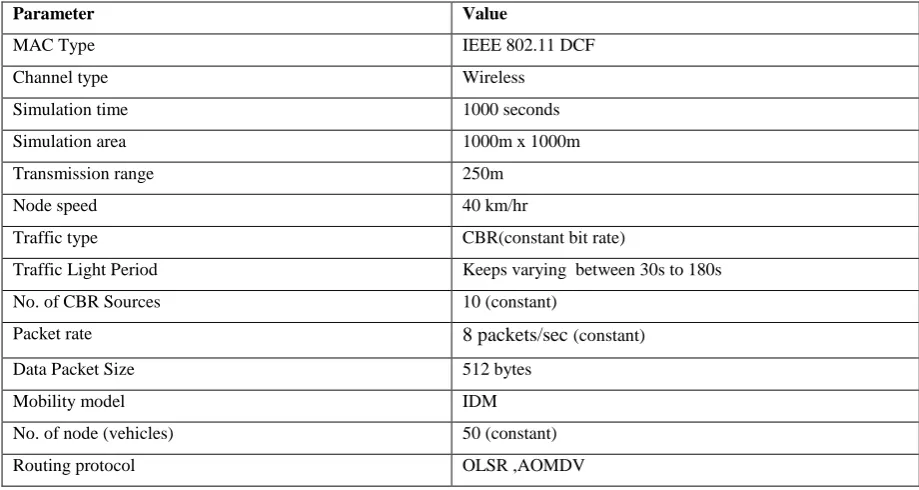
Table 1: Simulation Parameters
Parameter Value
MAC Type IEEE 802.11 DCF
Channel type Wireless
Simulation time 1000 seconds
Simulation area 1000m x 1000m
Transmission range 250m
Node speed 40 km/hr
Traffic type CBR(constant bit rate)
Traffic Light Period Keeps varying between 30s to 180s
No. of CBR Sources 10 (constant)
Packet rate 8 packets/sec (constant)
Data Packet Size 512 bytes
Mobility model IDM
No. of node (vehicles) 50 (constant)
Routing protocol OLSR ,AOMDV
3.3
Results and Analysis
OLSR and AOMDV routing protocols are evaluated for their performances against throughput, average end-to-end delay, packet delivery ratio, and normalized routing load at varying Traffic Light Period between 30s to 180s
under IDM model in city scenario where the maximum speed of vehicles is taken as 40 km/hr and keeping the
packet rate as constant at 8 packets/sec with transmission range equal to 250 meters.
3.3.1Throughput
It defines the total number of bits delivered successfully per second from source to the destination.
It is observed from Fig. 2 that overall the throughput is sharply increased in both protocols with increasing the value of traffic light period from 30 seconds to 90 second with the fact that with larger traffic light period the vehicles movement becomes restricted due to which the route is maintained for a longer period of time. As a result the established route is less suspected to break frequently and hence more number of bits delivered successfully per second to the destination. AOMDV protocol significantly shown better throughput than OLSR. 3.3.2 Average End-to-End Delay
This is the average delay between sending and receiving node for all such data packets which are delivered successfully This includes all possible delays caused by buffering and queuing at the interface queue during the route discovery process.
Fig.: 3. Delay Against Traffic Light Period
ig. 3. Shows in both protocols the curves for delay are in general dropping in nature as the traffic light period is increasing except at some points. The reason is route stability. As there are less chances of route breakage so no further need to discover the new route again due to which all possible delays caused by buffering during route discovery process is minimized. And, therefore, the data packet will take lesser time to reach the destination. But here, AOMDV has shown comparatively much higher delay than OLSR.
3.3.2 Normalized Routing Load
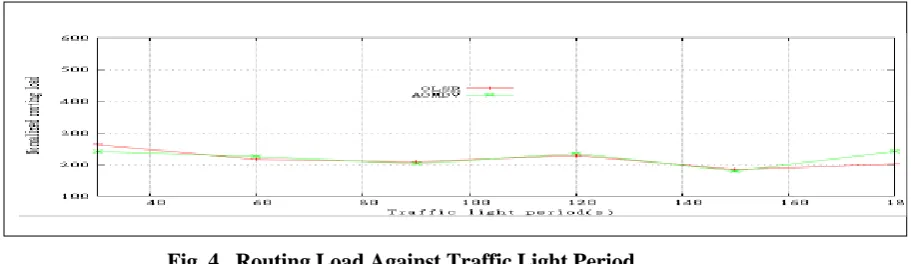
Total number of control packets transmitted by every node in the network and the number of data packets received by the destination nodes is termed as normalized routing load.
Fig. 4. Routing Load Against Traffic Light Period
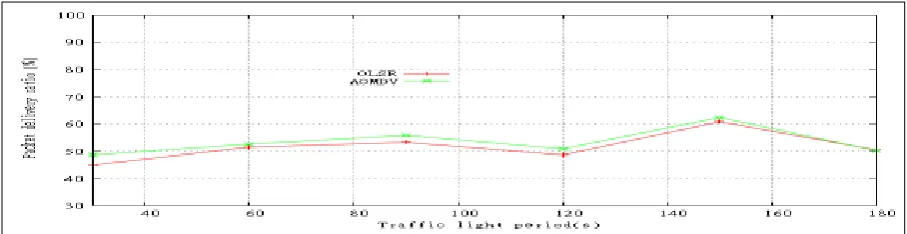
3.3.4 Packet Delivery Ratio (PDR)
This is defined as the ratio of such packets that reach the destination successfully. It can be observed that in general the value of PDR in both OLSR and AOMDV protocols is continuously increasing with respect to the increase in the traffic light period because by increasing the period of traffic light the vehicles have spend a more time in the junction and the nodes mobility become limited and the route get stabilized. Again the performance of AOMDV is superior to OLSR.
Fig. 5. PDR Against Traffic Light Period
IV.
CONCLUSIONS
In this paper we evaluated the performance of proactive (OLSR) and reactive (AOMDV) routing protocols by analyzing the impact of traffic light period through comparing their performances against different performance metrics using Advanced Intelligent Driver Model (IDM) by considering the city scenario and modeling the real map of city of Arlington, Texas, USA for obtaining the realistic vehicular traces through simulation using NS-2. The conclusion from the simulation results is that increase in traffic light period has shown a significant effect on both the protocols as shown graphically in this paper. Overall the performance of reactive routing protocol i.e. AOMDV is much better the OLSR i.e. the proactive routing protocol.
REFERENCES
[1]. “Dedicated Short Range Communications (DSRC),” http://www.leearmstrong.com/dsrc/dsrchomeset.htm
[2]. Ghassan M. T. Abdalla, Mosa Ali AbuRgheff and Sidi Mohammed Senouci “Current Trends in Vehicular Ad-hoc Networks” Ubiquitous Computing and Communication Journal.
[3]. Yan-Bo Wang, Tin-Yu Wu, Wei-Tsong Lee, Chih-Heng Ke, “2010 IEEE 24th International Conference on Advanced Information Networking and Applications Workshops.
[4]. Kevin C. Lee, Uichin Lee, Mario Gerla, UCLA, USA, “ Survey of Routing Protocols in Vehicular Ad-hoc Networks”.
[5]. C. E. Perkins and P. Bhagwat. Highly Dynamic Destination-Sequenced Distance-Vector Routing (DSDV) for Mobile Computers. In Proceedings of the ACM SIGCOMM, pages 234–244, 1994.
[7]. C.E. Perkins and E.M. Royer, “Ad-hoc on demand distance vector routing,” in Proceedings of the 2nd IEEE Workshop on Mobile Computing Systems and Applications, pp. 90–100, Feb. 1999.
[8]. D.B. Johnson and D.A. Maltz, “Dynamic source routing in ad-hoc wireless networks,”in Mobile Computing, vol. 353.
[9]. M.K Marina., S.R. Das, “ Ad Hoc On-Demand Multipath Distance Vector Routing”, Wireless Communication and Mobile Computing, Vol. 6, Wiley Inter Science, 2006.
[10]. Jerome Harri, Fethi Filali and Christian Bonnet, “Mobility Models for Vehicular Ad-hoc Networks: A Survey and Taxonomy”,March 5th, 2006.
11. S. R. Biradar, K. Majumder, S. K. Sarkar, Puttamadappa C, “Performance Evaluation and Comparison of AODV and AOMDV”, (IJCSE) International Journal on Computer Science and Engineering Vol. 02, No. 02, 2010, 373-377.
12. A.R. Sangi, J. Liu, Z. Liu, “Performance Comparison of Single and multi-Path Routing Protocol in MANET with Selfish Behaviors”, World Academy Of Science,Engineering and Technology 65 2010. 13. M.K. Marina S. R. Das, “On-demand Multipath Distance Vector Routing in Ad-hoc Networks”. 14. NS-2,"The Network Simulator -NS-2,"Available:http://www.isi.edulnsnam/ns/.
15. VanetMobiSim URL: http://vanet.eurecom.fr/
16. J. Haerri, F. Filali and C. Bonnet, “Performance comparison of AODVand OLSR in VANETs urban environments under realistic mobility patterns”, 5th annual IFIP Mediterranean Ad-hoc Networking Workshop (Med-Hoc-Net 2006), Lipari, Italy, June, 2006.
17. J. Harri and M. Fiore, “VanetMobiSim- vehicular ad-hoc network mobility extension to the CanuMobiSim framework”, manual, Institut Eurecom/Politecnico di Torino, Italy, 2006.