Æ
UCL
Un i v e r s i t y Co l l e g e Lo n d o n De p a r t m e n t o f Co m p u t e r Sc i e n c e
Synthesising Parallel Functional
Programs
to Improve Dynamic Scheduling
David J- Parrott
A thesis submitted for the degree of Doctor o f Philosophy
in the University of London
ProQuest Number: 10044485
All rights reserved
INFORMATION TO ALL USERS
The quality of this reproduction is dependent upon the quality of the copy submitted. In the unlikely event that the author did not send a complete manuscript and there are missing pages, these will be noted. Also, if material had to be removed,
a note will indicate the deletion.
uest.
ProQuest 10044485
Published by ProQuest LLC(2016). Copyright of the Dissertation is held by the Author. All rights reserved.
This work is protected against unauthorized copying under Title 17, United States Code. Microform Edition © ProQuest LLC.
ProQuest LLC
789 East Eisenhower Parkway P.O. Box 1346
A b s t r a c t
This work investigates novel methods for improving the efficiency of evaluating lazy
functional programs in parallel. We are specifically concerned with distributed memory
architectures in which it is expensive for processors to communicate with each other via
message passing.
Traditionally, improvements in parallel evaluation are found by experimental pro
cesses supported by intuition and simple mathematical models and much existing re
search has been based on improving the execution time of a number of small benchmark
programs. A key contribution of this thesis is the development of a language for synthe
sising the low-level run-time characteristics of functional programs. Using the language,
it is possible to construct large synthetic workloads in a much shorter time-scale than
the equivalent functional programs. From an experimenter’s viewpoint the behaviour of
the synthetic workloads is more predictable than that of functional programs because it
is not distorted by compile-time transformations; it is therefore simpler to obtain specific
experimental behaviour. The Izmguage enables the granularity of workloads to be altered
in a straightforward manner and can model, under controlled conditions, instabilities due
to run-time input.
It is noted that functional language compilers ought to be able to estimate the ex
pected time-costs of the individual functions of a program and that the time-cost in
formation can then be used to guide dynamic scheduling strategies. Some research has
taken place in this area but no existing research adequately deals with the problems of
laziness (or, indeed, instabilities caused by run-time input). We investigate the effect
on dynamic schedulers when laziness is not taken into account. The time-cost analysis
is then improved to take account of lazy evaluation and we are able to show that the
superior time-cost information can improve efficiency.
However, large deviations from mean time-costs due to lazy evaluation and run-time
input can precipitate inaccuracies even in the more complex compile-time estimates. We
develop a number of heuristic run-time techniques to cope with these inaccuracies and
A ck n ow led g em en ts
Many thanks are due to Chris Clack, my supervisor, whose insights, cind editorial guid
ance have been invaluable throughout this period of research. Thanks are also given to
Stuart d aym an with whom I have had many stimulating and fruitful discussions and
whose talent for detecting obscure bugs in seemingly perfect code remains unsurpassed.
I am indebted to Nigel Chapman, Stueu-t Clayman, Chris Clack, Simon Courtenage,
and Derek Long for giving their time to proof-read this thesis, and for the many use
ful suggestions they have made. Funding for my research was provided by the Science
and Engineering Research Council of Great Britain and the work benefitted greatly from
the friendly surroundings of the Department of Computer Science at Univeristy College
London.
For his unswerving moral support, graphics expertise, friendship, and generally calm
ing influence in times of stress, I am most grateful to my brother Dennis. For a safe and
comfortable haven from which to commute each day, and for their patience and enduring
support, I give hezirtfelt thanks to my parents. I am also indebted to my aunt Vi for her
flnancicd support and encouragement. Finzdly, I would like to say a big thankyou to the
friends who have been responsible for my social well-being these past three years, and
especially to Adam for providing a welcome escape to the fens on so many occasions.
Dave Parrott,
C o n ten ts
A b s t r a c t 2
A c k n o w le d g e m e n t s 3
I n t r o d u c tio n 15
Goals of the R e s e a r c h ... 16
Contributions of the W o rk ... 17
Overview of the T h e sis... 17
1 B a c k g r o u n d 19 1.1 Research Topics for Functional L anguages... 19
1.1.1 Language D e s ig n ... 19
1.1.2 Program Analysis and Transformation... 20
1.1.3 Functionzil Language Im p lem en ta tio n ... 22
1.1.4 Support for Functionzd Programmers... 22
1.2 Parallel Architectures ... 24
1.2.1 General Purpose H a r d w a re ... 25
1.2.2 Special Purpose Functional Language Reduction M achines... 25
1.2.3 Gauging the Success of Special Purpose H a r d w a r e... 28
1.2.4 Networked P r o c e s so r s... 29
1.3 The Identification and Management of P a ra U elism ... 30
1.3.1 Identifying ParaUelism by Hcind... 30
1.3.2 Using Strictness Analysis to Obtain ParaUelism in Lazy Functional L anguages... 30
1.3.4 Managing ParaUelism by Scheduling, Load Balancing, and Parti
tioning ... 32
2 S im u la tio n s a n d E x p e r im e n t a l S t im u li 3 4 2.1 Simulations of Computer System s... 35
2.1.1 Behavioural M od ellin g... 37
2.1.2 Stochastic S im u la tio n ... 38
2.1.3 Time-driven and Event-driven Sim ulations... 39
2.1.4 E m ulation... 40
2.1.5 D iscussion... 42
2.2 Generating Experimental W ork load s... 42
2.2.1 High-level Source P ro g ra m s... 43
2.2.2 Deriving Workloads from Execution T r a c e s ... 45
2.2.3 Synthetic W orkloads... 46
2.2.4 Examples of Synthetic Workloads... 48
2.2.5 D iscussion... 49
2.3 Monitoring Experimental Functional W orkloads... 50
2.3.1 Measuring Task Sizes—System Implementors Versus Application Program m ers... 52
2.3.2 Profiling Tools for Functional P rogrzim s... 55
2.4 S u m m a r y ... 56
3 M o d e llin g F u n c tio n a l W o r k lo a d s 5 7 3.1 Specification of the P rob lem ... 57
3.1.1 Experimental R equirem ents... 58
3.1.2 The Experimental Environment... 59
3.1.3 Shciring and Delayed E v a lu a tio n ... 61
3.1.4 Summary of Requirements... 64
3.2 The Paragon Workload Description L an gu age... 65
3.2.1 Task Template G raphs... 66
3.2.2 Synchronising Parent and Child T a s k s ... 68
3.2.3 Resource Consumption... 69
3.2.4 Describing Sharing and Delayed E v a lu a tio n ... 70
3.2.6 Summarising the Pzwagon Instruction S e t ... 75
3.2.7 Simulating Run-Time I n p u t ... 76
3.2.8 Formal Paragon S y n t a x ... 79
3.3 Implementation I s s u e s ... 80
3.3.1 Choosing Between Alternate Branches of an In str u c tio n ... 80
3.3.2 Making Abstract Time Units C oncrete... 82
3.3.3 Restrictions on Declared Sequence R eferences... 82
3.3.4 Evaluating Child Tasks L ocaR y... 83
3.3.5 Speculative Parallelism ... 83
3.4 Further W o r k ... 84
4 R ep ro d u c in g F u n ctio n a l L anguage B eh a v io u r 85 4.1 Introduction to Paragon Verification and V cd id a tio n ... 85
4.2 Soundness... 87
4.2.1 Primitive W o rk ... 87
4.2.2 The Dynamic C a ll-T r e e ... 88
4.2.3 Synchronisation due to BLOCK In str u c tio n s... 89
4.2.4 Synthetic C lo su r e s... 90
4.2.5 Conditionals ... 92
4.2.6 S u m m a r y ... 93
4.3 Can Paragon Describe all of the Required S tim u li? ... 93
4.3.1 Referential Transparency ... 94
4.3.2 Sharing and N on -S trictn ess... 96
4.3.3 Data D ependencies... 97
4.3.4 Dynamic I n s t a b ilit y ... 97
4.3.5 Higher-Order B eh aviou r... 98
4.4 Verifying the Im plem entation... 100
4.4.1 Memory C onsum ption...101
4.4.2 Guaranteeing the Absence of C y c l e s ... 102
4.4.3 D ea d lo ck s... 105
4.4.4 Suspension and R esum ption...106
4.5 Validating Individual W o r k lo a d s...107
4.5.2 Constructing P r o file r s ... 110
4.6 Example A lg o rith m s...110
4.6.1 Divide and Conquer Algorithms ... 110
An Example Divide and Conquer Algorithm: Quicksort . 112 4.6.2 Tail-Recursive L o o p s ... 118
4.6.3 Stream P r o c e s sin g ... 120
Sequential Stream P rocessing... 120
Parallel Stream P r o c e s sin g ...121
4.7 S u m m a r y ... 123
5 T im e -c o st A n a ly sis o f P a ra g o n W orkloads 125 5.1 An Introduction to the Time-cost A nalysis...125
5.1.1 Dealing with R e c u r s io n ... 126
5.2 A Simple Time-Cost Analysis without Sharing ...127
5.2.1 First Order R e c u r sio n ...129
5.2.2 Extending the Analysis to Tail C a lls ... 129
5.2.3 Limited Simultaneous R e c u r s io n ... 131
5.2.4 Extending the Analysis to Task Templates with many SPAWN In structions 133
5.3 Reasoning about Sharing Semantics ... 133
5.3.1 Probabilistic Events versus Mechanistic A ction s... 136
5.3.2 Predicting Interaction Between Task I n s t a n c e s ...137
5.3.3 Evaluation Points and Evaluation I n te r v a ls ... 137
5.3.4 Some Notation to Describe Lexical, Temporal, and Dependence R e la t io n s ... 140
5.3.5 Reasoning about the Interface between Parent and Child Tasks . . 142
5.3.6 Some e x a m p le s ...142
5.4 An Analysis of Declared Sequence E v a lu a tio n ...144
5.4.1 S im p lifica tio n s...144
5.4.2 Temporal Relationships and Probabilistic E v e n t s ...144
5.4.3 Determining the Necessity of Formal Parameters and Locally De clared S eq u en ces...145
The Blocking Properties of an Evaluation Interval . . . . 147
The Temporal Relationship between Evaluation Points and BLOCK Instructions... 148
5.4.5 Intactness Properties of Formal Parameters and Locally Declared S eq u en ces... 149
5.4.6 Evaluation P r o p e r tie s ...152
5.5 Attributing the Time-Cost of Shared Workloads to Task Templates . . . . 153
5.5.1 The Evaluation of Non-local Declared S e q u e n c e s ... 154
5.5.2 The Final Transformation and Analysis of ... 156
5.5.3 Notes on the Trzmsfbrmed Program Graph, G ' ...158
5.6 S u m m a r y ... 160
6 T ech n iq u es for D y n a m ic Task M a n a g em en t 161 6.1 Introduction to Dynamic Task M anagem ent...161
6.1.1 Compile-time Decisions Alone are Insufficient for Efficient Parallel E x ecu tio n ... 163
6.1.2 Arranging for Parallel E x e c u tio n ...164
(a) Forced S ch ed u lin g... 165
(b) Demand S ch ed u lin g ... 167
6.1.3 Restricting Parallelism ... 168
6.1.4 Architecture Influences Scheduling P o l i c y ... 170
6.2 The Environment Under In v estig a tio n ... 172
6.2.1 Choosing between Demand and Forced S ch ed u lin g ... 173
6.3 Using Time-Cost Information to Guide Strategies for Demand Scheduling 174 6.3.1 Selecting a Metric for T im e - c o s t ...174
6.3.2 An Example Scheduling Scheme Based on T im e -C o sts... 176
6.3.3 Compile-Time Scheduling can Fail when Tasks S u s p e n d ... 178
6.3.4 Making Time-cost Information Available at R u n - t im e ... 179
6.3.5 Sharing Affects Decisions Based on Time-cost Inform ation...180
An Experimental Demonstration o f the Sharing Problem 182 6.3.6 Improving Time-cost Estimates by Taking Sharing into Account . 183 6.4 Instability in Functional W orkloads... 185
6.5.1 Risk Aversion and the B um ble-B ee...187
6.5.2 Risk Aversion by Modal A n alysis... 189
6.5.3 Stochastic Learning A u t o m a t a ... 191
6.5.4 Scheduling with Risk A v e r s io n ... 193
6.5.5 Conclusions and Further Work with Risk A v e r s io n ...196
6.6 Managing Latency P eriod s...196
6.6.1 Improving Latency-Tolerance by Reconfiguring the Architecture . 197 6.6.2 Experiments with Latency-Tolerance... 198
6.6.3 Conclusions and Further Work on Latency-Tolerance... 200
6.7 Summary and Conclusions about Dyucimic Task M anagem ent... 203
7 C o n clu sio n s an d F u rth er W ork 206 7.1 Summary and Conclusions...206
7.1.1 Modelling Functional W o rk lo a d s...207
7.1.2 Time-Cost Analysis ... 208
7.1.3 Dynamic Task M anagem ent... 209
7.1.4 Experiments with Granularity... 211
7.1.5 A Profiling Tool for Higher-Order, Leizy Functional Programming Languages... 211
7.2 Summary of Related W ork...212
7.3 Further W o r k ... 213
7.3.1 Improvements to P a r a g o n ...213
7.3.2 Time-Cost Analysis ... 214
7.3.3 Lexical Profiling T o o l ... 215
7.3.4 Extending Scheduling Techniques to D IG R E S S ...215
A E x p e r im e n ta l P a ra g o n P ro g r a m s 217 A .l Program with task su sp e n sio n s...217
A .2 Program with unshared, non-strict argum ents...217
A 3 Program with shared, non-strict a r g u m e n ts... 218
A.4 Program to demontrate instability in the cost of t a s k s ... 218
A .5 A large, general purpose, w o rk lo a d ... 219
A .6 Program to test scheduling based on time-cost a n sly sis...222
A .8 Program to demonstrate loss of parallelism due to throttling... 223
B E x p e r im e n t a l R e s u lts 224 B .l Excessive Throttling can be Counter-productive...224
C I m p le m e n ta t io n D e t a ils fo r L e x ic a l P r o f ilin g 226 C .l Synopsis of Lexical Profiling...226
C.2 Changes to the Compiler... 228
C.3 The Run-time Mechanisms ...230
C.3.1 Instantiating Profiled Supercom binators...233
C.3.2 Instantiating Unprofiled Supercombinators ... 234
C.3.3 Call-count Profiling ...235
C.3.4 Space P r o filin g ... 235
C.3.5 Time P r o f ilin g ... 236
C.4 A Single-Stepped Example of Lexical Profiling ... 237
List o f F igures
1.1 Four aspects of functionzJ language implementation... 22
2.1 Using a simulation to simplify design and experimentation... 35
2.2 Four components of a simulated distributed system ... 36
2.3 A single node in a time-driven simulation network... 40
2.4 Event-driven simulation... 41
2.5 How applications programmers and systems programmers relate functional programs to their run-time behaviour... 54
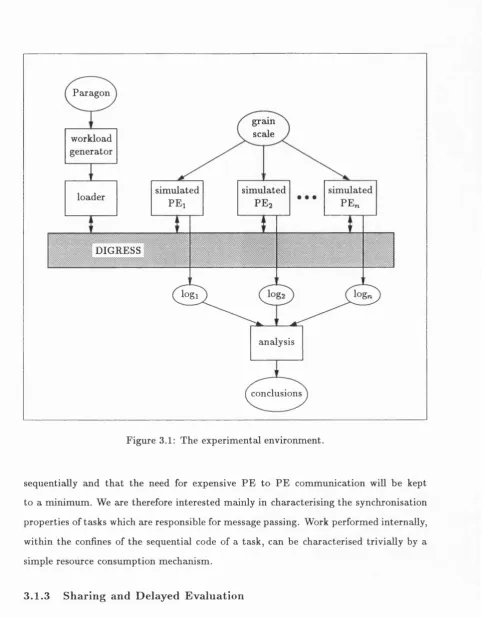
3.1 The experimental environment... 61
3.2 A graphical example of non-strictness and sharing... 63
3.3 A directed, cyclic graph of task template definitions are expanded into a caU-tree of task instances at run-time... 66
3.4 A first attempt at describing the template graph o f Figure 3.3(a)... 67
3.5 A concrete interpretation of abstract work units... 82
4.1 The most general combination of s p a w n and b l o c k instructions... 90
4.2 Equivalent parent/ child synchronisation in a functional program... 91
4.3 An example of shared computation in a Paragon m odel... 96
4.4 Call tree depicting possible origins of declared sequence, Qoo... 103
4.5 Paragon simulation of a divide and conquer algorithm...112
4.6 Best-case and worst-case call trees for quicksort...114
4.7 The distribution of total calls to the f i l t e r function...116
4.8 The distribution of total calls to the ++ function...117
4.9 A Paragon model of a tail-recursive loop with parallel sub-tasks... 119
4.10 A Paragon model of a sequential pipeline...120
4.12 A Paragon approximation of a pipeline of interleaved functions... 123
5.1 A smcdl Paragon program with mutually recursive task templates... 128
5.2 The graph of the Paragon program shown in Figure 5.1...128
5.3 A series of BLOCK instructions acting on a child task instance...140
5.4 Dividing a task template into its evaluation intervals... 141
5.5 An example of a recursive Paragon progrcim with declared sequence eval uation and parameter passing... 154
5.6 The graph, G, representing the Pziragon program shown in Figure 5.5. . . 155
5.7 Expanding G to G* by a collecting interpretation...156
5.8 Expanding G* to G^ by path analysis...157
5.9 The final mapping of costs to the original program graph... 158
5.10 Task templates with inconsistent tail-call modifiers... 159
5.11 Coping with inconsistent tall-czdl modifiers...159
6.1 Distributing work to parallel processing elements... 166
6.2 Alternative memory organisations for GRIP... 172
6.3 Asymptotic time-complexities for two algorithms... 175
6.4 Exporting tasks in descending order of their time-costs...177
6.5 Compile-time scheduling may fail when tasks suspend... 179
6.6 Global scheduling outperforms localised scheduling when tasks suspend. . 181
6.7 The disruption of scheduling mechanisms by sharing... 182
6.8 An effect of sharing on schedulers which use time-cost analysis... 184
6.9 Improving Dynamic Scheduling by Accounting for Sharing... 185
6.10 Tasks made unstable by sharing and run-time input... 186
6.11 The equivalence between foraging insects and PEs looking for work. . . . 188
6.12 A possible source of intransitive time-cost comparisons...189
6.13 Mean time-costs calculated for Program A .7... 193
6.14 Risk aversion is at least as good and can be better than scheduling with mean time-cost information... 194
6.15 Increasing the number of PEs per physical processor to improve latency-tolerance... 197
6.17 Mapping the technique to 1 PE per physical processor with many task
pools per P E ... 203
B .l Loss of parallelism when the throttling threshold is too low... 224
C .l The profiling framework...228
C.2 An example of an unprofiled function which is shared by two profiled functions... 229
C.3 Duplicating the shared function... 230
C.4 Profiling the shared function in its own right... 230
C.5 A naïve attempt at profiling lazy, higher-order functions... 231
C.6 Lexiccil profiling using boxed arguments... 232
C.7 A fully augmented graph cell...232
C.8 Instzintiating a profiled supercombinator...234
C.9 Instantiating an unprofiled supercombinator...235
List o f T ables
3.1 Paragon ranges... 78
3.2 BNF syntax table for Paragon... 81
4.1 Counting primitive operations using lexical cind dynamic profiling styles, . 109 4.2 Summary of quicksort profiles... 113
4.3 Normcdising the beta distribution... 117
5.1 An initicd set of qualified T»- —> Tj symbols... 143
6.1 The real costs of executing the tasks given in Figure 6 , 7 ...183
B .l Profile results for quicksort... 225
In tro d u ctio n
Declarative programming languages are designed for describing what is required of a
programming solution rather than how to perform the low-level computations which
ultimately achieve the solution [DGP91]. In particular, functional languages liberate the
programmer from such concerns as memory management and the undesirable properties
of side effects [Hug89]. The lack of side effects ensures that an expression can be replaced
by its value at any time during the execution of a program without altering the final
outcome. This feature, known as referential transpzirency, is one of the reasons that
functional languages are promoted as good tools for programming pzirallel cind distributed
systems [Bur90a].
In the absence of side effects, concurrent threads of execution can be constructed
automatically, without the need for explicit synchronisation and communications an
notations in the source code. This allows programmers with no specizd knowledge of
the underlying architecture to write parallel programs. Functional programs which exe
cute on sequential processors should execute on parzdlel processors without modification,
although to make best use of the hardware, inherently parallel algorithms are recom
mended. The importance of referential transparency, implicit memory management, and
automatic synchronisation in reducing programming complexity is apparent when paral
lel programs written in functional languages are compared with those written in parallel
imperative languages such as Occam [Ker87].
Most m odem functional languages have lazy evaluation semantics. That is, an expres
sion is evaluated only when it is guaranteed that the result of the evaluation is needed.
This is a powerful tool for programmers because it allows algorithms to be expressed in
elegant and novel ways [BW88, Hug89]. However, laziness is one of the greatest challenges
for researchers who wish to build efficient implementations of functional languages. Un
in th is thesis.
G o a ls o f t h e R e s e a r c h
The ultimate goal of our research is to provide improved dynamic scheduling techniques
for a newly developed parallel reduction machine called DIGRESS [Cla92a]. DIGRESS
has a loosely-coupled architecture. To achieve this goal it is necessary to make a careful
study of the way that functional workloads behave on loosely-coupled parallel machines.
The complexity of automatically scheduling lazy functional workloads is especially chal
lenging.
It was recognised in the initial stages of the research that it is unrealistic to develop
many léirge-scale functional programs specifically for the purpose of providing workloads
to stimulate the scheduler. This is a common problem faced by meiny researchers when
attempting to evaluate the success of an infrastructure for executing functional programs
in parallel. It is often the case that a limited number of trivial test programs are used
to demonstrate general properties of implementations. We therefore attempt to pro
vide a fast mechanism for building workloads by synthesising the run-time behaviour of
functional programs. The aim is to be able to construct workloads whose behaviour is
well-defined; and which take only a fraction of the time required to build real functional
programs.
One of the primary methods proposed for the design of scheduling algorithms is to
derive time-cost information at compile-time to guide decisions made at run-time. Recall
that we are dealing exclusively with lazy functional workloads. Existing time-complexity
analyses often claim to deal with lazy languages [BH89, San90, Wad88] but in truth they
are lim ited to caU-by-name languages because they fzdl to take sharing semantics fuUy
into account [Mah90]. One of our aims is to exploit the fact that we have an abstraction
of functional language behaviour to devise a time-cost analysis of synthetic workloads
that will make sensible approximations in the presence of non-strictness, sharing, and
paraRel evaluation. We then intend to use the results of the analysis to investigate the
utility o f the improved information for scheduling purposes.
Finally, given that even the best compile-time analysis cannot be expected to have
detailed knowledge of run-time inputs to the workload, we aim to develop and test a
C o n t r ib u tio n s o f t h e W ork
In realising the goals stated above, the following contributions are made to research in
parallel implementations of functional programming languages;
• We develop a method for rapidly constructing well-defined, low-level workloads
with which to stimulate experimental architectures.
• Time-cost anedysis of workloads in the presence of sharing semantics is explored.
We are able to comment on the suitability of this analysis for improving scheduling
algorithms, and consequently the efficiency of program execution.
• Scheduling algorithms for use with the chosen patraUel architecture are designed
and tested.
• The experiments conducted with scheduling algorithms and synthetic workloads
enable us to quantify the Tninimum acceptable workload granularity for efficient
parallel execution of functional programs to be achieved on our chosen circhitecture.
• A technique for profiling lazy functional programs is implemented. We use the
resulting profiler to cheiracterise real functional workloads in order to construct
realistic synthetic workloads. We demonstrate the strengths and weaknesses of two
different types of profiling tool in this context.
O v e r v ie w o f t h e T h e s is
The main topics of this research are the design and stnalysis of synthetic functional
workloads, and their use in developing new scheduling strategies for the DIGRESS parallel
architecture. In Chapter 1 we provide a general background to current research topics
in functional programming. We also discuss parallel architectures and to the way in
which parallelism within functional programs is identified and managed. In Chapter 2
the discussion concentrates on the topics of simulating experimental computer systems
and their workloads. Methods commonly employed to record the results of the associated
experiments are also explored in this chapter.
In Chapter 3, we develop a workload description language called Paragon which will
be used to provide synthetic workloads that model key features of the behaviour of real,
in the remaining parts of the thesis. In Chapter 4 we provide evidence that Paragon
workloads perform as expected and demonstrate examples of synthetic workloads that
behave in a similar manner to a number of common functional language constructs. A
prohhng tool for higher-order, lazy functional languages was developed to support this
work, the implementation details of which are presented in Appendix C.
Chapter 5 is devoted to the theory of analysing lazy workloads at compile-time. We
start with a small subset of the Paragon language which bans lazy evaluation and move
towards an cdmost complete subset where laziness is tackled by a series of transformations
on the original program graph. In Chapter 6 a number of dynamic scheduHng algorithms
are presented. These are related to existing algorithms and improvements are depicted
graphically. Finally, in Chapter 7 the work is reviewed and conclusions are drawn.
At the conclusion of each chapter, a summary is given, including proposals for further
work where appropriate. The proposals are reiterated, briefly, in the review of Chapter 7.
Related work is discussed in the introductory chapters and in the introductions to each
major section of the thesis. A summary of related work with references to the more
C h ap ter 1
B ackground
To put our research into context, and to explain some of the terms used in the intro
duction, this chapter provides a brief description of the sort of research that is currently
being conducted in connection with functional languages. General purpose parallel ar
chitectures and circhitectures constructed specifically for executing functional programs
are also discussed. In the fined part of the chapter, we deal with methods for identifying
and managing paraUehsm within functioned programs.
1.1
R e s e a r c h T o p ic s fo r F u n c tio n a l L a n g u a g e s
Research into functional programming languages can be arreinged into a number of broad
categories such as language design, program analysis, functional language implementa
tion, and programmer support. The work reported in this thesis is related to all four of
these categories.
1.1.1
Language D esign
There are mciny functional languages in existence and yet more currently in development.
Some of the earher languages were constructed primarily to learn about the nature of
functional languages per se and to experiment with compilation techniques (e.g. Ponder
[Fai85] and FP [Bac78]). Other languages such as ML [MCP93, HMM86, Wik87] and
Haskell [HPJW"''91] have been designed more with the end-user in mind, but have also
been the subject of vast amounts of theoretical research. Haskell is the most recent of
the large functional languages and its design is stiU incomplete at the time of writing. Its
which allows the same function name to be re-used for different types of input, with the
support of a meta-type (or class) mechanism [HB91]. Novel features, such as functional
arrays [HS85] have also been included into the Haskell definition.
It has long been recognised that functional languages are both elegant and concise.
This is pcirtly due to the nature of the lambda calculus on which functional languages are
based and partly due to the efforts of language designers to ‘sugar’ the lambda calculus.
For example, the foUowing notational style is typically used to construct a list of values
related by generator functions and constraints:
C (x , y) I X <- o r d in a te s , y = f x , 0 <= x <= 20 ]
This expression describes a list of coordinate pairs (z, y), based on the equation y = / ( z ) .
The expression very closely resembles the mathematical set notation
{ ( z ,y ) I z G X , y = / ( z ) , 0 < z < 20}
for the set of ordinates, X .
The above is an example of a design feature which aids programming ‘in the small’.
Another aspect of language design is the consideration of programming ‘in the large’;
i.e. large scale issues such as the management of program modules and their associated
interfaces. Both the ML emd Haskell design committees have paid much attention to this,
in order to meike the lemguages attractive for serious software development employing
teams of prograunmers.
For our reseairch we are concerned primarily with the behaviour of functional prograuns
at run-time rather than their high-level descriptions. When a program is compiled aind
executed it becomes a workload. The programming languages mentioned above are all
used to provide semantic descriptions of the workload. Later (in Chapter 3) a language is
developed which aiims to provide pragmatic descriptions of workloads, paying no attention
to their semantics. These will then be used in place of real functionad workloads to drive
our experiments.
1.1.2
Program A nalysis and Transform ation
There aire potentiadly unlimited ways in which computer prograims can be amalysed. Func
tional prograims are especially amenable to analysis because of their mathematical basis
S trictn ess a n a ly sis We attempt to discover which arguments of a function are defi
nitely going to be required when the function is executed [CPJ85, HY86, JL89b,
DW89]. This can improve efficiency because closures do not have to be constructed
to represent the arguments in their unevaluated state [Myc81]. Strictness informa
tion is also important for obtaining parallelism (see Section 1.3, below).
T im e -c o m p le x ity a n a ly sis Predictions of the algorithmic complexity of a program
[BH89, Le 85, Le 88, Ros89, San90, Wad88, Weg75] can help to determine the
success or failure o f a program transformation that was meant to improve efficiency.
Also, if a measure of the absolute costs of the sub-components of a program can
be determined then parallel execution can be made more efficient [Mah90] (see
Chapter 6).
Sharing a n a ly sis Knowing whether or not the result of a computation is shared [Gol87]
allows a compiler to optimise the object code for a program [BPJR88, FW87].
Knowledge of sharing properties can also be used to improve garbage collectors
[Hud86]. We use sharing information in Chapter 5 to improve the quality of infor
mation derived from a time-cost analysis.
P a rtia l ev a lu a tio n A functional program which takes no run-time input can be eval
uated in full at compile-time. Most functional programs do, however, read input
at run-time but portions of many programs cein be isolated from run-time input
and Ccin often be evaluated by the compiler [BHY89, HG84, Lau91, HS92, NN89, WCRS91].
And there are many others. The anctlyses most relevant to this thesis are those for
time-complexity and shciring. A time-cost analysis for the synthetic workload language of
Chapter 3 is developed in Chapter 5. This cinalysis takes sharing into account and the
results cire used to test dynamic scheduling algorithms of Chapter 6. We shall develop a
number of workloads in Chapter 6 which correspond to workloads generated by functional
language compilers. They represent the final output of the compiler and it is assumed
Parallélisation
Hardware
design
Theory
Figure 1.1: Four aspects of functional language implementation.
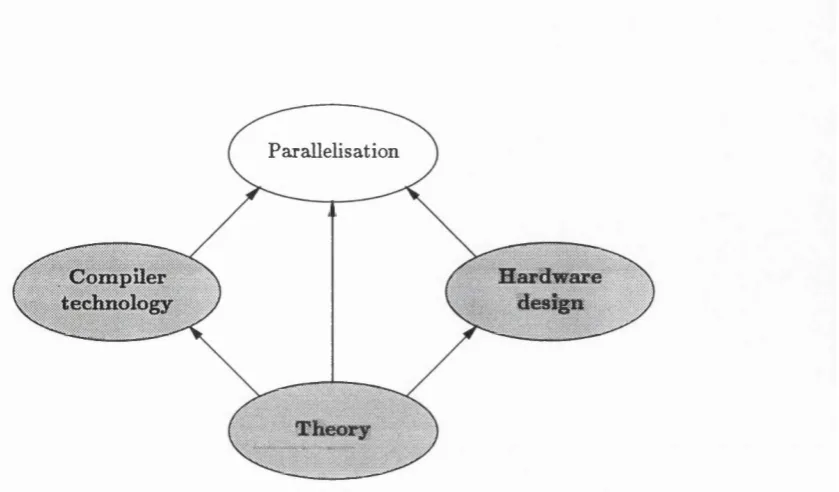
1 .1 .3 F u n c tio n a l L a n g u a g e I m p le m e n ta tio n
Figure 1.1 shows the relationships between four aspects of functioned language imple mentation. In this thesis we axe mainly concerned with the aspect of parallélisation and, more specifically, the development of run-time strategies for improving the efficiency of parallel execution. The remaining aspects of theory, compiler technology, and hardware design under-pin the work on parallélisation. For our research we shall be using a newly designed architecture, based on a network of distributed workstations. To illustrate the context of the work, we shall examine a number of hardware configurations used for the execution of functional programs in Section 1.2. Methods for exploiting paraUehsm axe presented in Section 1.3.
1 .1 .4 S u p p o r t for F u n ctio n a l P r o g r a m m e r s
Until recently, programmer support for functional languages was a poorly considered area. Fax more effort has been expended on language design and compilation than has been apportioned for user support. W ith language m aturity, however, comes the desire to improve the environment in which the language is used. Here, we look briefly at the issues of debugging and profihng.
D e b u g g in g
Unlike imperative languages where it is possible to insert ‘print’ statements to foUow
the actions of the program, functional languages are side-effect free and produce all of
their output as the result o f the whole program. An attempt to add side-effect output
to functioned programs in a referentiaUy transparent manner was made in [PC90] but
quickly abandoned because of the difficulty in interpreting the lazily generated output.
It is often the case that the side-effect style of output bears scant resemblance to the
order envisaged by the programmer because of the evaluation order imposed by Icizy
evaluation semantics [HHO90].
Another example of a debugging tool is that of [H085] which provides a method for
transforming a functional program into an equivalent program which carries debugging
information in the form of shadow variables. Using this, traces of the execution can be
constructed and examined on completion of the whole program or when breakpoints are
reached. This work also suggests the use of an interactive environment in which functions
cm be redefined and tested m arbitrary number of times. An interactive environment is
offered by many modem functional language compilers. The Standard ML of New Jersey
compiler [TD90] and the Haskell [HPJW'^91] compilers from the universities of Yale and
Chalmers are now packaged with facilities for intelligent progrzim editing, compiling,
execution, m d debugging via the GNU Emacs editor [Sta86].
More recently, algorithmic debugging has come to the fore [NF92]. Here, trace in
formation gathered for a program run is used to drive a question and answer session to
determine where an error might have occurred in the design of the algorithm. At each
stage, the user is presented with a portion of the caU-tree for the program, and the known
results at that stage, and has the option of descending further into the caU-tree if the
results are incorrect or moving back up the tree if expected results are found. In this
way, errors in the algorithm can be pin-pointed. The main problem with the technique
is the large volume of information presented to the user [HHO90].
P r o filin g
Profiling differs from debugging in that summaries of a program executions cire presented
to the programmer rather than intermediate results, or complete traces. TraditionaUy,
function-calls made (e.g. [GKM82]). For higher-order, Icizy functioned languages there are many
problems associated with profiling. Consider, for instance, the possibility that a computa
tion is described within the definition of one function, but at run-time is evaluated by
another function, B , (a very common occurrence under lazy evaluation). We must decide
whether the function-calls, memory-usage, and time taken to execute the stray compu
tation should be attributed to >1 or 5 [CPC91]. Higher-order languages cause problems
for profiler implementation because it is not known at compile-time which function is to
be czdled when higher-order variables are used [ADM88].
Currently, research into profiling functional Ismguages is particularly active. At
present, even the interface which allows the program m er to specify what is to be profiled
has not reached a steady state. The profiler of [SPJ92] chooses to annotate individual expressions in the source code (in a manner sim ilar to that of [PC90]) while that of
[CPC91] chooses to profile on function boundaries, reporting on functions whose names
are specified directly to the compiler. Both of these profilers report their measurements in
close correspondence to the source code (i.e. for the above example the cost of executing
the stray expression is attributed to function A).
The work by Runciman and Wakeling [RW90, RW92] has paid close attention to the
study of memory usage, making a clear distinction between the functions which produce
data objects and the constructor functions which define the shape of the objects. Also,
for the example above, the memory used by the stray expression is reported according
to the locality of its execution, thus attributing the memory usage to function B.
It is clear that much further work is required to standardise functional language
profilers, and to bring together the innovations that have been developed separately at
disparate research sites.
Profiling tools have an obvious use for the construction of synthetic workloads: we
wish to ensure that the pragmatic descriptions specified are equivcdent to those generated
by real functional progrzims. This is demonstrated in Chapter 4 and implementation
details for the profiler described in [CPC91] are given in Appendix C.
1.2
P a r a lle l A r c h it e c t u r e s
In order to experiment with the execution of functional programs in parallel it is first
putations may belong to either of the following categories:
P r o c ess-p a ra llel — a MIMD (multiple instruction, multiple data) architecture is re
quired. Programs are decomposed into separate tasks whose control flow is mutually
independent. Data dependencies may exist between tasks which imply synchroni
sations, but the execution of separate tasks is otherwise independent.
D a ta -p a r a llel — a SIMD (single instruction, multiple data) architecture is required.
In this case, complex data structures provide the vehicle for parallelism. A sin
gle instruction is applied simultaneously to a subset of the components of a data
structure [HS86].
For certain specied purpose parallel computations there is the possibility of using more
exotic hardware such as systohc arrays and associative memory which implement fixed
algorithms on data whose structure is pre defined [QD84]. For the most part the work
of this thesis is concerned with MIMD paredlel architectures.
1.2.1
G eneral P u rp ose Hardware
There are now many examples of generzil purpose parallel machines, réinging from multi
processor workstations, for which individual programs have little or no control over the
exploitation of parallelism, up to the large vector processing machines such as the Cray
X-MP, software for which requires extensive vectorisation work [BH92]. Functional lan
guage implementations have been reported for the Intel iPSC hypercube [GH86, G0I88]
and for transputers [Bur90a, KLB91, GWW89, SK84, MS90, MS87, BBC'*'90].
1.2.2
Special P u rp ose Functional Language R ed u ctio n M achines
In the 1950s and 1960s, high level languages were developed in response to a crisis in
software construction (e.g. Lisp (1959), Fortran (1954-57), Cobol (1959-60), and Algol
(1958-68) [Bar88, Wex81]). From then until the present day new languages have been
constructed to solve different classes of problems. The primary purpose of the earliest
high-level languages was to replace assembly language programming. Consequently, these
languages encourage programmers to express eilgorithms in an imperative style which is
similar to that of assembly code because compilers can more easily construct efficient
assembly progrzims when the high level imperative source program behaves in a similcir
Functional programs pose new problems for compiler writers because they provide
new facilities such as higher-order functions, delayed evaluation, and sharing seman
tics. At the same time, functioned languages ban many of the features traditionally
found in imperative languages such as assignment statements. The task of mapping lazy,
higher-order functional languages to a machine language instruction set that is inherently
imperative can therefore be complex and subject to inefficiency. A popular solution has
been to construct special purpose hardware whose low level instruction sets cire targeted
towards the requirements of functional languages so that the mapping from high level
functional language to machine level code is simplified. Examples of special purpose
architectures are described below.
T h e S K IM R e d u c tio n M a ch in e
The SKIM reduction machine [CGMN80] (and later, SKIM II [SCN84]) is an example
of a SISD processor. It is not a parallel machine but is one of the earhest attempts
to build specialised hardware for functional languages. It was designed at Cambridge
following Turner’s idea [Tur79] that S, K , and I combinators could be used as a low
level representation of functional programs. The operations of a small set of combinators
are microcoded into the hardware so that the machine language has applicative charac
teristics and is more suitable for the execution of functional programs than traditional
hardware. Further optimisations centre on the way that memory is organised. Each
memory cell contains a head and a tail pzirt, which provides a natural data structure for
functional language implementation, and a single bit that is used for garbage collection
(a single bit is sufficient for mark/ scan and one-bit reference count garbage collectors
[Coh81]).
N O R M A
The NORMA reduction machine [Sch86] is similar in nature to SKIM. It is a SISD
architecture with specially configured memory to support data structures (all memory
cells contain head and tad fields), garbage collection, and graph reduction techniques
such as pointer reversal [CPJ86, PJ87b]. The machine is microprogrammable and the
initial graph reduction implementation is based on extended Turner combinators. A
novel feature of this architecture is that special hardwgire is provided to inspect status
the graph. Traditionally, this testing imposes a significant overhead on graph reduction
[PJ87a].
C O B W E B
The COBWEB architecture [HOS85, AHK^87, BBK87] is designed to utilise the VLSI
fabrication technique of wafer-scale integration. Normally, many identical integrated cir
cuits are constructed on a single wafer and separated, tested, and packaged as individual
components. With wafer-scale technology, the separation does not take place: proces
sors constructed on a wafer remain in their original configuration and the whole wafer
is used as a fine-grained parallel machine. The COBWEB reduction mechanism uses
variable-sized tokens to encode function definitions, and final and intermediate results of
reduction.
A lic e a n d F la g s h ip
The Ahce project [DR81, CFR86] concentrated on the implicit parallelism within declar
ative programming languages. Programs are represented as a graph where each node is
a packet containing a function applied to a vector of arguments. The packets are aug
mented with a number of status entries which determine how they are to be executed.
The architecture consists of a complex interconnection (switching) network attached to
a number of processing agents. The system is controlled by a central, shared processor
responsible for the distribution of work between processing agents. A prototype Alice
was implemented using trzmsputer chips microcoded in Occam; the intention was to move
to custom designed processors at a later stage.
The Alice project was later superseded by the Flagship project [WWW+88, WW87b,
Det86]. This was also influenced by the Manchester Dataflow Computer [GKW85,
Gur85], cin architecture designed for the paredlel evaluation of data-driven computa
tions. Flagship continues to use the packet-based representation of functional programs
designed for Alice but the hardware is modified so that memory is closely coupled to the
processing elements in order to reduce the bottleneck of the interconnecting switching
network. The Flagship hardware is designed to execute progrcuns written in a number of
T h e G R I P M u ltip r o c e s s o r
The GRIP architecture [PJCSH87] was designed at University College London. It consists
of a number of parallel processing elements, each with a small amount of local memory,
and a number of intelligent memory units (IMUs), closely coupled via a futurebus in
terface. A GRIP machine consists of a number of boards, each of which contains four
processing elements and a single IMU. Fast communication is achieved between the units
of a single board via an internal bus. The IMUs are the main innovation of GRIP; rather
than limiting memory operations to data storage and retrieval, the units are microcoded
to perform high level tasks such as graph manipulation. This leads to interesting design
decisions regarding the balance of intelligence between processing elements and IMUs.
M a c h in e à R é d u c t io n S y m b o liq u e ( M a R S )
The MaRS project [CCC"^88] combines many of the features of the architectures listed
above. Like SKIM it uses a combinatorial machine language; like Alice it employs a
tightly coupled interconnection network; and like GRIP the machine contains a num
ber of memory processors which are intelligent enough to carry out dynamic allocation
and garbage collection activities. The processing and memory nodes communicate via
message passing. MaRS therefore resembles a distributed memory architecture.
1.2.3
G auging th e Success o f S pecial P u rp o se H ardware
The special purpose graph reduction machines listed above have all been used as the basis
for advanced research into graph reduction techniques (e.g. [Rob89, WW87b, HPJ91,
HPJ92]). The GRIP multiprocessor, now at Glasgow, has even been made avedlable
to the wider research community for the parallel execution of experimental programs
[HPJ90].
However, none of the machines have been adopted by a major manufacturer for mass
production. There are meiny reasons for this, one of which is that it is time consuming
(and therefore expensive) to adapt existing appHcations to run on the new hcirdware.
Gradual evolution is preferable to sudden changes and is the reason that C is able to
replace Fortran as the most widely used, general purpose, computer language. Many of
the original Fortran libraries were easily converted to C and in some cases C and Fortran
The move to specialised hardware is drastic and, imsurprisingly, is not well received by
end users.
1.2.4
N etw orked Processors
Another type of parallel architecture is a set of processors loosely-coupled via a local
area network (LAN). This is an interesting area because many educational, commercial,
and industrial sites possess large numbers of processors connected via LAlNs, primarily
because the connectivity sdlows physical resources such as file servers and printers to
be shared between the processors. LANs also provide general com m unications facilities between the processors allowing, for example, a user process to be executed on a remote
processor while another process is executed on the local processor. This is coarse grained
parallelism requiring careful management of communications overheads.
Networks of workstations have been used to emulate parallel machines. For exam
ple, the DAPS project [Hud84, HG84] used workstations to emulate the topology of a
special purpose hardware design. The DIGRESS project [Cla92a], whose LAN-based
architecture is described in Chapter 3, moves beyond emulation towards using a network
of workstations as a real parallel machine. Research effort is thus expended to optimise
program execution for the network of workstations rather than for the machine being
emulated by the network. One of the DIGRESS project’s aims is to utilise idle worksta
tions (especially overnight) for applications that would otherwise require access to large
médnframe or supercomputer facilities.
Communication across local area networks is slow in comparison to tightly coupled
parallel processing. Moreover, errors in transmission may occur and, for general purpose
LANs, there will be other traffic using up the available bandwidth. Latency periods are
therefore less predictable than for bus-bound communication. However, the advantage of
gaining large scale parallel processing virtually for free is attractive enough to encourage
further research.
Much of this thesis is concerned with the provision of synthetic, functional language
workloads. These allow the issues raised by high and unpredictable latency to be explored
1.3
T h e I d e n tific a tio n a n d M a n a g e m e n t o f P a r a lle lis m
Given that fhnctional programmers may be unaware o f the low-level aspects of program
execution, it is evident that support must be provided by the compiler and possibly some
run-time system code to identify parallelism. It has been noted that to achieve reasonable
speed-ups on parallel processors, parallel algorithms should be employed [Bus87, Roe89,
HPJ92]. To supplement algorithmic parallelism, a great deal of research has been directed
towards attempting to extract implicit parallelism &om functioned programs via methods
such as strictness analysis (e.g. [CPJ85, HY86, BH86, WH87, JL89b, DW89, Wad87b,
Hun90, Noc90, Jen91, etc]).
Irrespective of how parallelism is obtained from functional programs, another inter
esting and challenging problem is how to map the resulting threads of execution onto the
available processing elements. Unlike more general problems such as the analysis and
trcinsformation of functioned programs, the mapping issue is very closely related to the
underlying architecture. There is a likelihood that different behaviour will be obtained
when different architectures are studied. It is essentied, therefore, for implementors of
functional systems to develop a thorough understanding of the way that parallel func
tional programs interact with specific architectures.
1.3.1
Identifyin g Parallelism by H and
One of the simplest techniques for identifying parallelism within a functional program is to
use annotations and functions with special parallel evaluation properties [Bur84, HPJ92,
Kel87, Roe89, PJ89]. This places the onus directly on programmers to find the parallelism
within programs. We have already mentioned in Section 1.1.4 that the behaviour of
functional programs is often counter-intuitive for many programmers. Therefore, explicit
specification of parallel activity can be very difficult to get right [Cla93j.
1.3.2
U sing Strictn ess A nalysis to O btain Parallelism in L azy Func
tional Languages
In parallel implementations of lazy functional languages, strictness information plays a
large part in determining when pzirallel evaluation can take place [CPJ85]. Strictness
information specifies that a value wiU definitely be required at some time in the future
This improves the efficiency of graph reduction because fewer closures are required to
represent unevaluated objects. It also aids parallelism. All of the strict arguments of
a function czm be evaluated in advance of (or concurrently with) the evaluation of the
function itself and, because referential transparency ensures that the arguments can be
evaluated in any order, they can be evaluated in parallel with each other.
Modem strictness analysis techniques are able to approximate the extent to which
non-flat data stmctures such as lists can be evaluated strictly [JL89b, Wad87b]. List
structures Eire heavily used in functional programming, hence it is useful to classify their
strictness properties as accurately as possible, e.g.:
• A function which needs to inspect the contents of every list cell that it visits is said
to be head strict in that list.
• A function which needs to inspect the whole list structure (but not necessarily the
contents of the cells) is said to be tail strict.
• A function is hyper-strict in its argument if every sub component of the argument is
to be evaluated in full (this definition applies to all types of a structured arguments,
not just lists).
The hyper-strictness property is especially useful for parallelising progreims which employ
pipelines of functions of the form ( /n (/n -i(' • - fi(H st) ■ ■ •)))• If the functions f i . . . f n
are executed lazily then a large aunount of synchronisation takes place because every
component of the result is demanded individually and calculated only upon receipt of
the demand [PJ87b]. The demands must pass aU the way along the pipeline before the
intermediate results can be calculated and passed back. If the values are hyper-strict
then the functions can execute more efficiently in parallel because the calculation of the
whole structure begins immediately at each stage of the pipeline (see Section 4.6.3).
There are, of course, many applications for which these simple classifications are
insufficient and it is often possible to build a more complete strictness profile of complex
data structures [HW87, JL89b]. Recent innovations using projections [WH87, DW89,
Hun90] (based on continuations [Hug87a]) are leading to a better understanding of the
problem cind better classifications.
Most strictness analysis techniques are based on abstract interpretation [FH88, Chap
ter 20] or projection analysis^ over finite domains. Unfortunately many recursive data
alter-structures can only be described by infinite domains and therefore approximations have
to be made. The situation can be improved, however, if contextuzJ information is taken
into account at run-time. Bum proposed evaluation transformers [Bur87, Bur90a, Bur91,
KLB91] which deal with non-flat data structures (speciflcally lists) and allow the strict
ness information held about an object to be improved at run-time when more is known
about its context.
1.3.3
Skeletons
One method of managing parallel behaviour is provided by skeletons [DFH^]. These are
predefined templates with well-defined function semantics and also well-defined behaviour
for a range of parallel architectures. It is intended that programmers code with the
skeleton Hbrary in mind, expressing algorithms so that they correspond to the form of
one or more skeletons. The compiler knows about skeletons in advance and is able to
generate code for efficient pzuallel evaluation. Skeletons express notions such as pipelines
of processes, divide and conquer algorithms, and data-parallel operations [HS86].
For some skeletons, at least, a degree of knowledge of the underlying architecture is
required of the programmer in order to select the most appropriate skeleton. To ease
this, work is taking place to transform between skeletal forms [DFH"*"].
1.3.4
M anaging Parallelism by Scheduling, Load B alan cin g, and P arti
tion in g
For programs to execute efficiently in parallel, both interprocess communications and the
amount of time that each, processor spends idle must be niinimised. A processor becomes
idle when it runs out of work and has either to sectrch for more work or to wait for work to
be sent, according to the chosen load balancing strategy. Work is supplied to processors
in the form of tasks.
The three topics of load balancing, partitioning, and scheduling are closely related: all
three are concerned with obtaining optimal execution times on parallel machines. Load
balancing algorithms (e.g. [Hud84, Sar87]) attempt to ensure that every processor in a
parallel machine has an equal amount of work to perform at all times. Partitioning (e.g.
[G0I88, HG85]) is the art of determining the subdivisions of a program to be executed as
parallel tasks. Scheduling (e.g. [CK88, Mah90, BBC'^QO, MS90, PJ89, HPJ92, KLB91])
is the ordering of run-time activities so that the most efficient behaviour is obtained.
Each of these can be managed statically, at compile-time, or dynamically, at run-time.
Typically, there is more information available at run-time with which to make educated
decisions, but at the sufferance of run-time overheads for the gathering, storage, and