379 | P a g e
Application of Lean Practices in Central
India –A Case Study
Yash Dave
Lecturer, Manufacturing Engineering, Dhar Polytechnic College Dhar (M.P), (India)
ABSTRACT
Industries located in central India are continuously facing cutthroat competition not only from the industries located in other region of the country but also from foreign industries. This condition also becomes more critical because industries based in central India are facing one more volatile issue that is low productivity levels. The concept of Lean manufacturing offers a good solution for increasing the overall productivity of the industry. Lean
Manufacturing focuses on elimination of waste in any form by implementing the lean practices. Keywords:
Lean practices
I. INTRODUCTION
Womack and Jones define lean production as “doing more and more with less and less human effort, equipment and
less space while coming closer and closer to providing customer with exactly what they want”[1].Lean
manufacturing is the process of analyzing the flow of materials and information in an environment and continuously
improving the process to delight the customer. Lean manufacturing applies the modern elements and technologies of
different areas such as Process Improvement, Operational Improvement, World Class Manufacturing, and Just-In
Time, Continuous Flow, Concurrent Engineering, Continuous Improvement, Kaizen, and Supply Chain Integration.
The aim of this research is to determine the level of practical use of the lean practices in the industries located at
central India industrial areas, for improvement.
II. RESEARCH OBJECTIVE
The main objective of this research paper is to identify the major lean practices which are being implemented
throughout the world as well as in central India region. It also has an aim to establish the factor that which lean
practice is being highly adopted by the industries and vice versa in central India base industries.
III. LITERATURE REVIEW
Literature regarding the implementation of lean practices in India as well as abroad has been reviewed by searching
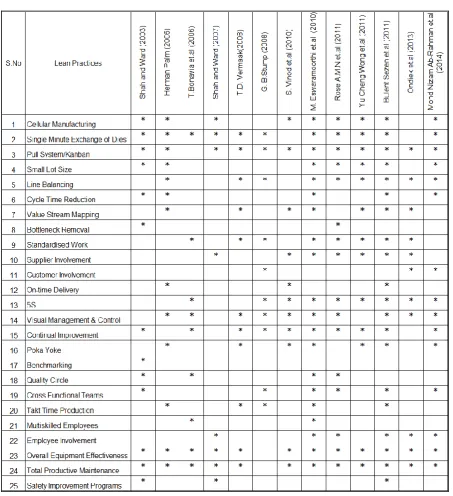
various electronic database and research journals. A table 1.1 is prepared by the author to show the important lean
380 | P a g e
Table 1.1 Lean Practices
IV. RESEARCH METHODOLOGY
A survey based approach has been adopted in order to meet the above stated objectives. A research questionnaire
has been prepared which is followed by pilot study, pretest, and validation. The final questionnaire has been sent to
250 industries located at central India region. Out of 250 industries only 128 has answered the satisfactorily. Data
381 | P a g e
V. ANALYSIS
In order to gauge the level of practical use of the lean practices in central Indian industries the respondent companies
were asked to rate the level of adoption on each of the lean practices listed on Likert scale from 1 to 5 (1 for never
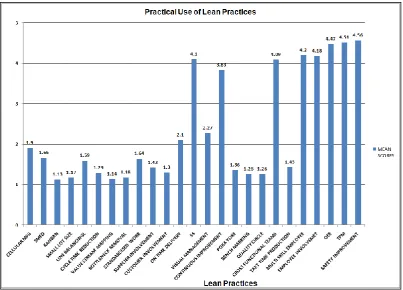
used, 2 for rarely used, 3 for partially used, 4 for frequently used and 5 for continuous used). Figure 1.1 illustrates
the distribution of lean practice mean scores. Among all of the lean practices, safety improvement program is found
to be the leading lean practice, with mean score 4.56. Other lean practices that have been extensively implemented is
the total productive Maintenance (TPM), overall equipment effectiveness(OEE), multiskilled employees, employee
involvement, cross functional teams, continuous improvement and 5S and these practices having a mean scores
greater than 3.0. However, the least practiced lean tools are the Kanban, value stream mapping and many other lean
practices up to cellular manufacturing and SMED as shown in figure 1.1 having mean score less than 2.0, showing
low implementation in industries. Low application of these lean practices is also because of several factors such as
practices like value stream mapping require lot of planning at each level, in depth knowledge of particular practice
in order to implement it effectively among team members, uncertainty of demand from the customer of a particular
product and not the least but most important is adequate arrangement of finance for making the proper arrangements
for the effective application of the practice. On the contrary, a practice like 5S is the simplest and easy to use in
industry instantly irrespective to the size, expertise, and others factors related with an industry. In field trips of
industries by the researcher during this study it is found that, workforce in industries also familiar about the practices
like safety improvement programs; use of personal protective equipment, resolving any problem in the cell through
cross functional teams by basic practices. This pattern also reflects in the figure 1.1. Another lean practice which is
widely and continuously used in the industries as endorsed by the collected data is TPM and OEE. It is clear from
the figure 1.1 that industries particularly in central India region are adopting the Total productive maintenance and
the concept of overall equipment effectiveness on fast track basis. One of the reason for rapid implementation of
TPM and its associated practices is that in present scenario it is utmost important for the industries to keep
equipment and machines as well as utilities services in operational mode( 24* 7). Industries cannot afford to stop the
production because of poor maintenance. In this way, it is clear that industries are embracing the simple and quick to
implement practices rapidly such as 5S, Kaizen, total productive maintenance. Gradually companies are moving to
the use of advanced lean practices such as value stream mapping and many others.
VI. RESULT & DISCUSSIONS
The sample industries have varied level of using the various lean practices. The level of practical use of lean
practices in the sample industries is measured on 1 to 5 likert scale. As shown in figure 1.1, it has been resulted from
this research study that among sample industries highest used lean practices are TPM (Total productive
maintenance) based practices and 5S such as safety improvement programs with mean score 4.56, Total productive
maintenance (TPM) and overall equipment effectiveness (OEE) with mean scores 4.51 and 4.47 respectively then
followed by 5S. This trend shows that in sample industries application level of TPM based lean practices are quite
high as compare to other lean practices. Obviously this indicates companies are highly inclined towards TPM based
activities. On the other hand among sample industries lowest used lean practices are Kanban with mean score 1.13,
value stream mapping with mean score 1.14, small lot size with mean score 1.17 and bottleneck removal with mean
382 | P a g e
low. This is also justified by the fact these all low score lean practices requires an expertise as well as separatebudget provision to implement effectively. This indicates that the sample industries can use these least used lean
practices in order to become more productive. This reflects that industries could work more in this direction and
acquire maturity by mastering the application / implementation of advance lean practices such as value stream
mapping (VSM), to improve the overall performance. One more fact which is very clear from this discussion is that
sample companies are using the lean practices in isolation or in separate component. Companies must understand
that simultaneously application of several lean practices can improve their performance considerably instead of
using lean practices in separate mode for example application of SMED practice involve many lean practices such as
visual management,5S, cycle time reduction etc. This study also explains the combined effect of lean practices in the
form of integrated model on the productivity.
Figure 1.1: Practical use of the Lean practices
REFERENCES
[1] Bonavia, T., & Marin, J. A. (2006). An empirical study of lean production in the ceramic tile industry in
Spain.International Journal of Operations & Production Management,26(5), 505-531.
[2] Eswaramoorthi, M., Kathiresan, G. R., Prasad, P. S. S., & Mohanram, P. V. (2011). A survey on lean practices
in Indian machine tool industries.The International Journal of Advanced Manufacturing Technology,52(9-12),
1091-1101.
[3] Groover, M. P. (1980).Automation, production systems, and computer-integrated manufacturing. Prentice Hall
383 | P a g e
[4] Manzouri, M., Ab-Rahman, M. N., Zain, C. R. C. M., & Jamsari, E. A. (2014). Increasing production andeliminating waste through lean tools and techniques for halal food companies. Sustainability, 6(12), 9179-9204.
[5] Ondiek, G. O., & Kisombe, S. M. (2013). A Survey on Adoption of Lean Manufacturing Tools and Techniques
in Sugar Processing Industries in Kenya.Industrial Engineering Letters,3(10), 92-104.
[6] Palm, H. (2008). The application, utilization and level of value adding of selected Lean Manufacturing
techniques amongst Assembly Manufacturing in Gauteng.
[7] Rose, A. M. N., Deros, B. M., Rahman, M. A., & Nordin, N. (2011, January). Lean manufacturing best
practices in SMEs. InProceedings of the 2011 International Conference on Industrial Engineering and
Operations Management, 872-877.
[8] Sezen, B., Karakadilar, I. S., & Buyukozkan, G. (2012). Proposition of a model for measuring adherence to lean
practices: applied to Turkish automotive part suppliers.International Journal of Production Research, 50(14),
3878-3894.
[9] Shah, R., & Ward, P. T. (2003). Lean manufacturing: context, practice bundles, and performance.Journal of
operations management,21(2), 129-149.
[10] Shah, R., & Ward, P. T. (2007). Defining and developing measures of lean production.Journal of operations
management,25(4), 785-805.
[11] Stump, G. B. (2008). An Integrated Framework for Applying Lean Manufacturing and Other Strategies in Mass
Customization Environments, (Master's Theses) University of Kentucky.
[12] Vermaak, T. D. (2008).Critical success factors for the implementation of lean thinking in South African
manufacturing organizations(Doctoral dissertation, University of Johannesburg).
[13] Vinodh, S., Arvind, K. R., & Somanaathan, M. (2011). Tools and techniques for enabling sustainability through
lean initiatives.Clean Technologies and Environmental Policy,13(3), 469-479.
[14] Wong, Y. C., & Wong, K. Y. (2011). Approaches and practices of lean manufacturing: The case of electrical