Devising, Implementing, and Evaluating Interventions to
Eliminate Health Care Disparities in Minority Children
abstract
Despite an accumulating body of literature addressing racial/ethnic disparities in children’s health and health care, there have been few published studies of interventions that have been successful in elimi-nating these disparities. The objectives of this article, therefore, are to (1) describe 3 interventions that have been successful in eliminating racial/ethnic disparities in children’s health and health care, (2) high-light tips and pitfalls regarding devising, implementing, and evaluating pediatric disparities interventions, and (3) propose a research agenda for pediatric disparities interventions. Key characteristics of the 3 suc-cessful interventions include rigorous study designs; large sample sizes; appropriate comparison groups; community-based interven-tions that are culturally and linguistically sensitive and involve collab-oration with participants; research staff from the same community as the participants; appropriate blinding of outcomes assessors; and sta-tistical adjustment of outcomes for relevant covariates. On the basis of these characteristics, I propose tips, pitfalls, an approach, and a re-search agenda for devising, implementing, and evaluating successful pediatric disparities interventions. Examination of 3 successful inter-ventions indicates that pediatric health care disparities can be elimi-nated. Achievement of this goal requires an intervention that is rigor-ous, evidence-based, and culturally and linguistically appropriate. The intervention must also include community collaboration, minimize at-trition, adjust for potential confounders, and incorporate mechanisms for sustainability.Pediatrics2009;124:S214–S223
AUTHOR:Glenn Flores, MD
Division of General Pediatrics, Department of Pediatrics, University of Texas Southwestern Medical Center, Dallas, Texas; and Children’s Medical Center, Dallas, Texas
KEY WORDS
disparities, minority groups, children, intervention studies, African Americans, Hispanic Americans, Native Americans
ABBREVIATIONS
RCT—randomized, controlled trial aOR—adjusted odds ratio CI— confidence interval
DMA—Division of Medical Assistance DPH—Department of Public Health IRB—institutional review board
The views presented in this article are those of the author, not the organizations with which he is affiliated.
This work was presented in part at the Starting Early: A Life-Course Perspective on Child Health Disparities—Developing a Research Action Agenda conference; November 7, 2008; Washington, DC.
www.pediatrics.org/cgi/doi/10.1542/peds.2009-1100J
doi:10.1542/peds.2009-1100J
Accepted for publication Jul 20, 2009
Address correspondence to Glenn Flores, MD, University of Texas Southwestern Medical Center, Division of General Pediatrics, Department of Pediatrics, 5323 Harry Hines Blvd, Dallas, TX 75390. E-mail: glenn.fl[email protected]
PEDIATRICS (ISSN Numbers: Print, 0031-4005; Online, 1098-4275).
Copyright © 2009 by the American Academy of Pediatrics
Published studies are accumulating on racial/ethnic disparities in children’s health and health care. Recent na-tional data, for example, reveal that ra-cial/ethnic minority children in the United States experience multiple dis-parities in medical and oral health, ac-cess to care, and use of services.1
In-deed, these data reveal that minority children in America often face a “triple threat” of greater risks of suboptimal medical and oral health status, im-paired access to medical and dental care, and lower receipt of prescription medications and essential medical and dental services. The authors of this nationwide analysis1 also
docu-mented that certain pediatric dispari-ties are particularly marked for spe-cific racial/ethnic groups and that multiracial children experience many disparities.
Despite the accumulating body of litera-ture addressing racial/ethnic disparities in children’s health and health care, there have been few published studies of rigorous interventions that specifically have targeted and successfully elimi-nated these disparities. In addition, pre-vious work has neither examined the key elements of the few such successful in-terventions nor provided practical guid-ance on how to devise, implement, and evaluate pediatric disparities interven-tions. The objectives of this article, there-fore, are to (1) describe several interven-tions that have been successful in eliminating racial/ethnic disparities in children’s health and health care, (2) highlight tips and pitfalls regarding de-vising, implementing, and evaluating pe-diatric disparities interventions, and (3) propose a research agenda for pediatric disparities interventions.
EXAMPLES OF SUCCESSFUL PEDIATRIC DISPARITIES INTERVENTIONS
In the following sections, 3 examples of published randomized, controlled
tri-als (RCTs) of interventions that have been successful in reducing or elimi-nating racial/ethnic disparities in chil-dren’s health and health care are ex-amined. These studies were identified via a PubMed search of interventions that targeted racial/ethnic disparities in children; they were selected be-cause they (1) are particularly cogent cases of the reduction or elimination of pediatric disparities, (2) targeted 3 major US racial/ethnic minority groups (Native Americans, African Americans, and Latinos) that are con-sidered to experience some of the most stark pediatric disparities and represent some of the most under-served populations of children, and (3) were methodologically rigorous.
Increasing Breastfeeding Rates in Native American Infants
Native American infants have some of the lowest rates of breastfeeding among US racial/ethnic groups, with only 61% ever initiating breastfeeding, compared with 75% in non-Latino white infants.2 In a population-based
observational study of a Navajo com-munity, Wright et al3examined the
im-pact of a breastfeeding-promotion program on breastfeeding rates. Be-fore intervention implementation, the researchers used qualitative ap-proaches, including ethnographic in-terviews and participant observation, along with a survey, to identify factors associated with infant feeding prac-tices in the Navajo community.4–6The
qualitative research findings were then used to develop a culturally sen-sitive breastfeeding-promotion inter-vention specifically intended to over-come breastfeeding obstacles. This 1-year intervention had 3 components: (1) a community intervention that con-sisted of radio public-service an-nouncements, a video, a billboard mes-sage, and t-shirts for infants supplied through the Supplemental Nutrition Program for Women, Infants, and
Chil-dren (WIC); (2) a health care system in-tervention composed of a 3-day health care provider conference on lactation management, formation of a task force, and videotaped instruction for WIC case-workers; and (3) breastfeeding educa-tion for families, including use of a video, several brochures, and a tribal foster-grandparent program.7
To assess the impact of the breastfeed-ing intervention, medical records were reviewed for all infants born in 1 Na-vajo community during the year before implementation (n⫽977) and the year after intervention implementation (n ⫽ 858).3 The main study outcome
was postintervention changes in the proportions that were exclusively breastfeeding; other outcomes in-cluded incidence of common infant ill-nesses in the first year and feeding-group illness incidence.
The proportion of infants exclusively breastfed for any period of time signif-icantly increased after the interven-tion from 16% to 55%. After the inter-vention, the proportion of infants fed formula from birth decreased from 84% to 45% (P⬍.0004), the proportion of infants ever breastfed increased from 71% to 81% (P⬍.001), the mean age of formula introduction increased from 12 to 49 days (P ⬍ .001), and the mean breastfeeding duration in-creased from 101 to 132 days (P ⬍
.001) among infants ever breastfeed-ing. The proportion of infants diag-nosed with pneumonia and gastroen-teritis also declined significantly after the intervention. Feeding-group–spe-cific rates of illnesses were un-changed, however, indicating that the observed reductions were attributable to increases in breastfeeding.
Enhancing HIV-Preventive Behaviors in African-American Adolescent Girls
HIV/AIDS of any racial/ethnic group of female adolescents in the United States, accounting for more than two thirds of new HIV/AIDS cases among adolescent girls. This population has more than quadruple the number of cases than white female adolescents, although their total population is far smaller.8In an RCT, DiClemente et al9
evaluated the efficacy of an HIV-prevention intervention for African-American adolescent girls. Researchers collaborated with African-American girls in the community to devise the study protocol. The theoretical frame-work for the intervention was derived from social cognitive theory10 and
the theory of gender and power.11The
intervention consisted of interactive group sessions that focused on racial/ethnic and gender pride, HIV knowledge, communication, condom-use skills, and healthy relationships. Sessions were led by a trained health educator and 2 peer educators who were all African-American females. The comparison group attended ses-sions that addressed exercise and nu-trition. All intervention- and comparison-group participants attended four 4-hour sessions on consecutive Satur-days at a family medicine clinic; ses-sions were attended by an average of 10 to 12 participants.
The study objective was to evaluate the efficacy of the intervention in reducing sexual risk behaviors, sexually trans-mitted diseases, and pregnancy and in enhancing mediators of HIV-preventive behaviors.9 Subjects consisted of 522
sexually experienced African-American girls 14 to 18 years old enrolled at 4 community health agencies. Outcome measures included consistent con-dom use (during every episode of vaginal intercourse), sexual behaviors, observed condom-application skills, sexually transmitted infections, self-reported pregnancy, and mediators
of HIV-preventive behaviors. Outcomes were assessed 6 and 12 months after enrollment.
Compared with the control group, girls in the intervention group had signifi-cantly higher adjusted odds over the entire 12-month period of reported condom use in the previous 30 days (adjusted odds ratio [aOR]: 2.0 [95% confidence interval (CI): 1.28 –3.17]) and previous 6 months (aOR: 2.30 [95% CI: 1.51–3.50]) and condom use at last intercourse (aOR: 3.94 [95% CI: 2.58 – 6.03]) and were significantly less likely to have had a new vaginal sex partner in the past 30 days (aOR: 0.40 [95% CI: 0.19 – 0.82]).9 Girls in the intervention
group were also significantly more likely than controls at the 12-month as-sessment to apply condoms to sex partners (adjusted relative change: 38%; P⬍ .001), have better condom-application skills (adjusted relative change: 32%;P⬍.001), a higher per-centage of condom-protected sex acts, fewer unprotected vaginal sex acts in the past 6 months (adjusted relative change:⫺45%;P⫽.001), and higher adjusted scores on measures of me-diators including HIV knowledge, condom attitudes, condom barriers, condom-use self-efficacy, and fre-quency with which HIV-preventive practices were discussed with part-ners. Compared with controls, girls in the intervention group also had a lower adjusted risk of chlamydia infec-tions (aOR: 0.17 [95% CI: 0.03– 0.92]) and a statistically nonsignificant trend toward reduced risk of self-reported pregnancy (aOR: 0.53 [95% CI: 0.27– 1.03];P⫽.06).
The authors concluded that a cultur-ally congruent, gender-tailored inter-vention for African-American adoles-cent girls can enhance HIV-preventive behaviors, skills, and mediators, and might have the potential to reduce pregnancy and chlamydia infection.9
Insuring Uninsured Latino Children
Latinos continue to be the most unin-sured racial/ethnic group of US chil-dren. In 2007, 20% of Latino children had no health insurance, compared with 7% of white, 12% of African-American, and 12% of Asian/Pacific Is-lander children.12In an RCT, Flores et
al13evaluated the effectiveness of a
community-based case manager inter-vention in insuring uninsured Latino children. Before intervention imple-mentation, the investigators con-ducted qualitative research by using 6 focus groups of parents of uninsured Latino children. The groups identified reasons why parents were unable to insure uninsured Latino children in a state in which all low-income children were eligible for insurance.14The
qual-itative research findings were then used to develop a culturally sensitive, linguistically appropriate intervention that was aimed at eliminating barriers to insuring uninsured children.
The intervention consisted of assign-ment of the uninsured child and his or her family to a community-based case manager, who was a bilingual Latina caseworker who had attended a 1-day intensive training session and was from the same communities as the participants.13 Case managers
Medical Security Plan, which insures non–Medicaid-eligible children in Mas-sachusetts, including noncitizens); (5) served as a family advocate by being the liaison between the family and the DMA or DPH; and (6) rectified with the DMA and DPH situations in which a child was inappropriately deemed inel-igible for insurance or had coverage inappropriately discontinued.13 The
control group received only traditional Medicaid and State Children’s Health Insurance Program (SCHIP) outreach and enrollment.
The study outcomes were receipt of health insurance, coverage continuity, time interval to obtain coverage, and parental satisfaction with the process of obtaining insurance for their chil-dren. All participants were contacted monthly for 1 year to monitor out-comes by a researcher who was blinded to group assignment.
A total of 139 subjects were randomly assigned to the intervention and 136 to the control group. Children in the in-tervention group were more likely than control children to obtain health insurance (96% vs 57%;P⬍.0001) and had more than double the adjusted likelihood (adjusted relative risk: 2.30 [95% CI: 1.87–2.81]) and 8 times the adjusted odds (a OR: 7.78 [95% CI: 5.20 –11.64]) of obtaining insurance. Seventy-eight percent of the children in the intervention group were continu-ously insured versus 30% of the con-trols (P⬍.0001). In addition, children in the intervention group obtained in-surance more quickly (mean: 87.5 vs 134.8 days; P⬍ .009), and their par-ents were more satisfied with the pro-cess of obtaining insurance (P ⬍
.0001).
The authors concluded that community-based case managers are more effec-tive than traditional Medicaid/State Children’s Health Insurance Program outreach and enrollment in insuring uninsured Latino children. They also
stated that case management may be a useful mechanism for further reduc-ing the number of uninsured children, especially among high-risk popula-tions.13 This intervention also was
found to have successfully eliminated a racial/ethnic disparity, given that the uninsurance rate among Latino chil-dren receiving the intervention was 4%, compared with national uninsur-ance rates of 21% for Latino children and 7% of non-Latino white children at the time when the study was conducted.
Comparison of Selected Features of Successful Disparities
Interventions
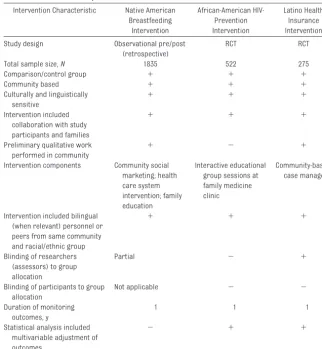
It is useful to compare and contrast selected characteristics of the 3 fea-tured successful interventions (Table
1). Two of the 3 studies were RCTs. The RCT is generally considered to be the gold standard in medical research be-cause of its rigor, objectivity, and power to minimize bias.15,16When RCTs
are not feasible or ethical or when they are too expensive, however, observa-tional studies are a suitable alterna-tive research design.17 This was the
case with the Navajo breastfeeding in-tervention,3because it would not have
been ethical or feasible to randomly assign infants to breast or formula feeding.
All 3 studies had large sample sizes of hundreds or thousands of partici-pants, which are crucial for achieving sufficient statistical power to detect important clinical differences in out-comes. The 3 studies also included
rel-TABLE 1 Comparison of Selected Features of 3 Interventions That Were Successful in Eliminating Racial/Ethnic Disparities in Children’s Health and Health Care
Intervention Characteristic Native American Breastfeeding
Intervention
African-American HIV-Prevention Intervention
Latino Health Insurance Intervention
Study design Observational pre/post (retrospective)
RCT RCT
Total sample size,N 1835 522 275
Comparison/control group ⫹ ⫹ ⫹
Community based ⫹ ⫹ ⫹
Culturally and linguistically sensitive
⫹ ⫹ ⫹
Intervention included collaboration with study participants and families
⫹ ⫹ ⫹
Preliminary qualitative work performed in community
⫹ ⫺ ⫹
Intervention components Community social marketing; health care system intervention; family education
Interactive educational group sessions at family medicine clinic
Community-based case managers
Intervention included bilingual (when relevant) personnel or peers from same community and racial/ethnic group
⫹ ⫹ ⫹
Blinding of researchers (assessors) to group allocation
Partial ⫺ ⫹
Blinding of participants to group allocation
Not applicable ⫺ ⫺
Duration of monitoring outcomes, y
1 1 1
Statistical analysis included multivariable adjustment of outcomes
evant comparison groups within the racial/ethnic population being studied; these comparison groups are critical for demonstrating comparative im-provement in outcomes. Some might argue that a suitable comparison group in a disparities intervention study should consist of white subjects, to demonstrate reduction or elimina-tion of the disparity in comparison to outcome rates in whites. This ap-proach, however, may not only be un-feasible or unethical but, more impor-tantly, it goes beyond the scientific and conceptual frameworks of disparity reduction/elimination, which focus on significantly reducing an adverse health care outcome within a high-risk population.
All 3 interventions were community based and culturally and linguistically sensitive. In addition, the interventions included collaboration with study par-ticipants and families, and 2 studies devised the intervention on the basis of preliminary qualitative work per-formed in the community (Table 1). All 4 of these components are critical for ensuring that the intervention is tai-lored to the target population and has a high probability of effectiveness.
The 3 studies had diverse components in the individual interventions, but all 3 interventions included bilingual (when relevant) personnel or peers from the same community and racial/ethnic group as the participants (Table 1).
Blinding of research team members who were assessing outcomes is criti-cal for preventing ascertainment bi-as,18 especially for more subjective
outcomes. Two of the studies included at least partial blinding of the asses-sors. Blinding of participants to group allocation is challenging in community-based disparities research, because the participants and families often re-alize immediately whether the inter-vention was received, and none of the 3 studies blinded its participants. All 3
studies monitored outcomes for 1 year, and 2 performed multivariable adjustment of outcomes to control for relevant potential confounders.
TIPS FOR AND PITFALLS IN CONDUCTING DISPARITIES-ELIMINATION INTERVENTIONS
In this section, we examine tips for and pitfalls in successfully conduct-ing disparities-elimination tions on the basis of the 3 interven-tions reviewed above and personal perspectives and experiences from my 8 years as a principal investigator on 3 RCTs of disparities interventions.
Tips
Incorporate Community Collaboration in All Study Phases
Collaboration with the community throughout all study phases can be an important determinant of whether a disparities intervention study will suc-ceed or fail. Community engagement and cooperation are usually essential when initiating a study and obtaining institutional review board (IRB) ap-proval, particularly when the study is community based. Lack of community collaboration may seriously hinder or prevent participant recruitment and follow-up. Failure to sustain commu-nity collaboration and involvement at the study’s conclusion and during the dissemination phase may foster re-sentment and the perception that res-idents were used as “guinea pigs,” pre-clude future studies, and hinder applying study findings to improving the health and health care of children.
Community collaboration can be achieved through partnerships with community leaders and community-based organizations, having com-munity members serve on the study advisory committee and IRB, and part-nering with community-based organi-zations and small businesses to
re-cruit participants and disseminate study findings.
Consider Qualitative Approaches in the Initial Study Phase
Focus groups, ethnographic inter-views, and other qualitative ap-proaches can be powerful tools to use when devising and implementing suc-cessful disparities interventions. Prop-erly executed qualitative approaches can result in instant community en-gagement and collaboration; permit an evidence-based framework for in-tervention development and tailoring; and ensure that the intervention is rel-evant, feasible, and culturally appro-priate. For example, in developing and implementing an intervention to in-sure uninin-sured Latino children,13focus
groups of parents of uninsured Latino children14allowed our research team
to engage and collaborate with the lo-cal Latino community, confirm several hypotheses about key barriers to in-suring children (such as lack of knowl-edge about programs and eligibility), reject certain hypotheses in the litera-ture (such as that families did not want to insure their uninsured chil-dren), obtain new relevant informa-tion (such as system problems and misinformation from insurance rep-resentatives), tailor the intervention to families’ needs and priorities, and obtain pilot data regarding the ac-ceptability and potential feasibility of the intervention.
Carefully Calculate Power and Sample Size
out-come can be avoided by carefully cal-culating power and sample size well ahead of the initiation of the interven-tion, and confirming feasibility by col-lecting pilot data on realistic partici-pant recruitment target numbers.
Anticipate Substantial Attrition
Even with careful power and sample-size calculations and extensive pilot work, a disparities intervention can be doomed to failure if substantial partic-ipant attrition occurs. In my experi-ence, attrition is particularly salient and challenging when one is working with disadvantaged populations, the members of which often have limited financial resources, are frequently highly mobile and transient, are chal-lenged by chaotic lives, and not infre-quently confront multiple competing demands. In 2 RCTs of disparities inter-ventions,13,19 we experienced attrition
rates of 28% to 40%. We therefore al-ways build an attrition rate of 40% into power and sample-size calculations for community-based RCTs.
Employ Study Personnel From the Community
Our research teams have found that employing personnel from the study community is invaluable because it (1) establishes immediate community col-laboration, (2) frequently results in greater engagement from study staff, who are highly invested in their com-munity of residence, (3) creates strong bonds between participants and re-search staff because of the shared community, (4) enhances empathy for fellow community residents, (5) raises awareness of current and potential barriers to intervention success and practical mechanisms for overcoming barriers, and (6) provides employment in communities that frequently have high levels of unemployment. Of course, proper training on confidenti-ality should be a priority for personnel hired from the community, given that
they may handle the protected health information of study participants who live in their community.
Provide Participation Incentives
Our research teams have found that study participants view participation incentives as appropriate rewards and important gestures of respect for the often considerable investments of time and effort required for partici-pants and their families to participate in an intervention study. In addition to an enrollment incentive, smaller in-centives for each follow-up assess-ment completed and a larger incentive at study completion can minimize attri-tion and ensure that each participant completes the study.
Use Multiple Approaches to Ensure Optimal Participant Follow-up
Because our intervention studies fre-quently have enrolled participants in communities with limited resources, high mobility, and occasional lack of access to a consistent telephone num-ber, our research teams routinely col-lect multiple telephone numbers (home, cell, work, pager, and those of relatives and friends) and addresses (home, work, and those of relatives and friends) for each participant in an effort to minimize attrition. In addition, when multiple means of communica-tion fail, research staff make repeated home visits to avoid dropping partici-pants from the study.
Adjust for Key Covariates in Analyzing Outcomes
The main study outcomes may be sub-ject to substantial confounding by rel-evant covariates such as family in-come, parental education, language barriers, and severity of the child’s ill-ness. Although randomization is a pow-erful mechanism for eliminating many baseline intergroup differences, such differences may still occur or even arise during the course of a study.
Fail-ure to adjust for such covariates through block randomization, multiva-riable analyses, stratification, or other relevant statistical procedures may lead to confounding and false-positive or false-negative conclusions regard-ing the efficacy of an intervention.
Pitfalls
IRB Approval
Disparities intervention studies and community-based research are still relatively new entrants to the medical research field, so it has been our expe-rience that IRB members may have variable familiarity with and expertise in these types of research (particu-larly in institutions with a heavy focus on basic science). The result can be delayed IRB approval, unnecessary protocol changes, or even outright protocol rejection. In addition, mem-bers of IRBs may have limited experi-ence with commonly faced obstacles in disparities intervention research, such as recruitment challenges and difficulties in working with poor, inner-city, immigrant, uninsured, or limited English-proficient populations. Our re-search teams have overcome these pitfalls by establishing early relation-ships with IRBs, preparing protocols with extra attention to rigor and addi-tional explanations of health services research concepts, and encouraging disparities researchers and commu-nity members to apply for open IRB positions.
Attrition
ex-penses, unforeseen departures of re-search staff, and unexpected reduc-tions in (or complete loss of) grant funding can conspire to jeopardize suf-ficient participant accrual and study completion. The only safeguards against such pitfalls are building into the study protocol such “safety nets” as added time in the recruit-ment phase in case of setbacks, dili-gent efforts to minimize study drop-outs and withdrawals, and amending the study protocol to broaden the po-tential recruitment pool.
Sustaining Successful Interventions
Even highly successful disparities in-terventions are likely to be discontin-ued if no mechanism exists for sustain-ability. Lack of success in procuring renewal of research grants; institu-tional or philanthropic commitments; or local, state, or federal program-matic funding can spell the end of effective interventions. Sustaining successful disparities interventions, therefore, requires substantial plan-ning, extensive dissemination of study findings, collaborations with policy makers, and innovative approaches to ensure long-term continuation of ef-fective interventions.
An Approach: Devising, Implementing, and Evaluating Successful Disparities Interventions
Figure 1 summarizes an approach to devising, implementing, and evaluat-ing an intervention to eliminate or re-duce racial/ethnic disparities in chil-dren’s health and health care. This diagram is an attempt to incorporate the principles described above from comparisons of the 3 successful dis-parities intervention, as well as the tips and pitfalls.
RESEARCH AGENDA
It is beyond the scope of this article to provide a comprehensive review of
ra-cial/ethnic disparities in children’s health and health care along with a systematic examination of disparities in need of interventions. A suggested research agenda, however, is pro-posed, comprising one perspective on selected urgent priorities and unan-swered questions that need to be addressed through clinical and community-based pediatric dispari-ties interventions (Table 2).
Condition-Specific Disparity Targets
Most racial/ethnic minority groups of children have higher adjusted odds than white children of having no health insurance or being sporadically in-sured, and Native American children have higher adjusted odds than white children of having no dental
insur-Determine appropriate study design
Observational study RCT
Preliminary qualitative study in community to ensure community engagement, intervention tailored to
community needs, cultural and linguistic appropriateness
Calculate power/sample size, with sufficient accounting for potential attrition
Employ study personnel from community
Blind participants and researchers to maximum extent feasible
Obtain IRB approval
Provide attractive participation and follow-up incentives Identify disparity to eliminate/reduce
Use multiple approaches to ensure optimal participant follow-up and study completion
Adjust for key covariates in outcomes analyses
Disseminate study findings
Secure means of sustaining intervention
FIGURE 1
An approach to devising, implementing, and evaluating an intervention to eliminate or reduce racial/ ethnic disparities in children’s health and health care.
TABLE 2 A Proposed Research Agenda for Clinical and Community-Based Interventions for Selected Racial/ Ethnic Disparities in Children’s Health and Health Care
Condition-specific disparity targets
Health and dental insurance
Nonfinancial access barriers to health and dental care
Infant mortality
Childhood and adolescent mortality
Mental health care Organ transplantation
Survival rates for Down syndrome and congenital heart defects
Pediatric disparity domains with major knowledge gaps in need of intervention studies
Does culturally competent and linguistically appropriate care improve minority outcomes and reduce/eliminate disparities?
Can quality-improvement approaches reduce/ eliminate disparities?
ance.1 Greater adjusted odds of no
health or dental insurance and spo-radic insurance also occur for chil-dren in households in which a lan-guage other than English is spoken, compared with those in households with English as the primary language.20
To date, only 1 RCT (in Latinos) has evaluated an intervention to eliminate racial/ethnic disparities in children’s health or dental insurance coverage,13
so more such studies are needed among diverse groups of minority chil-dren, including multicenter studies. Multiple racial/ethnic and linguistic disparities among US children also ex-ist in nonfinancial barriers to health and dental care,1,20 but essentially
nothing is known about interventions that might be effective in eliminating these disparities.
The infant mortality rate among Afri-can AmeriAfri-cans and Native AmeriAfri-cans is substantially higher than that of whites and has changed little over the most recent 7-year period for which data are available.21There have been
no published studies (to my knowl-edge), however, on interventions that are effective in reducing or eliminating infant mortality disparities. Substan-tial racial/ethnic disparities in child-hood mortality also exist for all 4 major racial/ethnic groups of US children (compared with whites), including sig-nificantly higher risks of all-cause mortality,22 drowning deaths,23 injury
fatalities,24and mortality from
congen-ital heart defects.25Again, there have
been no published studies (to my knowledge) on interventions that are effective in reducing or eliminating ra-cial/ethnic disparities in all-cause or condition-specific mortality.
There are several other condition-specific pediatric disparities in ur-gent need of efficacious interventions. Compared with white children, racial/ ethnic minority children experience multiple disparities in mental health
care, including significantly higher un-met need for mental health services and significantly lower access to men-tal health care specialists and anti-depressant medications.26–29 Compared
with their white peers, African-American children have a significantly lower adjusted likelihood of being acti-vated on the kidney transplant waiting list, and a significantly higher median age at heart transplant (8 vs 5 years old in whites) and likelihood of heart transplant graft failure.30,31 Stark
dis-parities also exist in survival for African-Americans for 2 conditions that first present in childhood: the me-dian age at death for Down syndrome (25 vs 50 years old among whites)32
and the average age at death from con-genital heart defects (3 to 6 times lower age than in whites).25
Disparity Domains With Major Knowledge Gaps in Need of Intervention Studies
There is an urgent need for interven-tion studies in several pediatric ra-cial/ethnic disparity domains with major knowledge gaps. Rigorous in-tervention studies are still needed to evaluate the impact of culturally competent and linguistically appro-priate care on outcomes among ra-cial/ethnic minority children, includ-ing whether such interventions can reduce or eliminate disparities.33 It
has been cogently argued that sev-eral racial/ethnic disparities in chil-dren’s health and health care can be framed as quality-of-care issues,34
and several studies have docu-mented such gaps in quality of care for minority children.35 Research is
still lacking, however, on interven-tions that are efficacious in reducing or eliminating such quality dispari-ties. Multicenter intervention studies have the potential to address critical pediatric disparities issues by pro-viding large sample sizes and the statistical power needed to examine
clinically significant subgroups, but there have been no published multi-center evaluations (to my knowl-edge) of interventions aimed at reducing or eliminating pediatric ra-cial/ethnic disparities.
SUMMARY AND CONCLUSIONS
Despite an accumulating body of lit-erature addressing racial/ethnic disparities in children’s health and health care, there have been few published studies of interventions that have been successful in elimi-nating these disparities. Key charac-teristics of 3 successful interven-tions include rigorous study designs, large sample sizes, appropriate com-parison groups, community-based interventions that are culturally and linguistically sensitive and involve collaboration with participants, re-search staff that include personnel from the same community as partic-ipants, appropriate blinding of out-comes assessors, and statistical ad-justment of outcomes for relevant covariates.
Tips for successfully conducting pedi-atric disparities elimination interven-tions include community collaboration in all study phases, preintervention qualitative research, careful sample-size and power calculations that ac-count for attrition, and using multiple approaches to ensure optimal partici-pant follow-up. Pitfalls in conducting pediatric disparities-elimination inter-ventions include IRB approval, attri-tion, and barriers to sustainability.
con-genital heart defects. Interventions also are needed to address major disparities knowledge gaps regard-ing the impact of culturally and lin-guistically appropriate care and quality-improvement approaches on pediatric disparities, and multi-center disparities interventions are still lacking.
Examination of 3 successful interven-tions indicates that pediatric health care disparities can be eliminated. Achievement of this goal requires an intervention that is rigorous, evidence based, and culturally and linguistically appropriate. The intervention must also include community collaboration, minimize attrition, adjust for potential
confounders, and incorporate mecha-nisms for sustainability.
ACKNOWLEDGMENTS
This work was funded in part by grants to Dr Flores from the Commonwealth Fund and the Improving Chronic Illness Care program of the Robert Wood Johnson Foundation.
REFERENCES
1. Flores G, Tomany-Korman SC. Racial and ethnic disparities in medical and dental health, access to care, and use of services in US children.Pediatrics. 2008;121(2). Available at: www.pediatrics.org/cgi/ content/full/121/2/e286
2. Singh GK, Kogan MD, Dee DL. Nativity/ immigrant status, race/ethnicity, and socio-economic determinants of breastfeeding ini-tiation and duration in the United States, 2003.
Pediatrics.2007;119(suppl 1):S38 –S46 3. Wright AL, Bauer M, Naylor A, Sutcliffe E,
Clark L. Increasing breastfeeding rates to reduce infant illness at the community level.Pediatrics.1998;101(5):837– 844 4. Wright AL, Clark C, Bauer M. Maternal
em-ployment and infant feeding practices among the Navajo.Med Anthropol Q.1993; 7(2):260 –281
5. Wright AL, Bauer M, Clark C, Morgan F, Beg-ishe K. Cultural interpretations and individ-ual beliefs about breastfeeding among the Navajo.Am Ethnol.1993;20(4):781–796 6. Bauer M, Wright AL. Integrating qualitative
and quantitative methods to model infant feeding behavior among Navajo mothers.
Hum Organ.1996;55(2):183–192
7. Wright AL, Naylor A, Wester R, Bauer M, Sut-cliffe E. Using cultural knowledge in health promotion: breastfeeding among the Na-vajo. Health Educ Behav. 1997;24(5): 625– 639
8. Centers for Disease Control and Prevention. Racial/ethnic disparities in diagnoses of HIV/AIDS: 33 states, 2001–2004.MMWR Morb Mortal Wkly Rep.2006;55(5):121–125 9. DiClemente RJ, Wingood GM, Harrington KF,
et al. Efficacy of an HIV prevention interven-tion for African American adolescent girls: a randomized controlled trial.JAMA.2004; 292(2):171–179
10. Bandura A. Social cognitive theory and exer-cise of control over HIV infection. In: Di-Clemente RJ, Peterson J, eds.Preventing AIDS: Theories and Methods of Behavioral Interventions. New York, NY: Plenum Pub-lishing Corp; 1994:25–59
11. Wingood GM, DiClemente RJ. The theory of gender and power: a social structural the-ory for guiding the design and implementa-tion of public health intervenimplementa-tions to reduce women’s risk of HIV. In: DiClemente RJ, Crosby RA, Kegler M, eds.Emerging Theo-ries in Health Promotion Practice and Research: Strategies for Enhancing Public Health. San Francisco, CA: Jossey-Bass; 2002:313–347
12. DeNavas-Walt C, Proctor BD, Smith JC, US Census Bureau.Income, Poverty, and Health Insurance Coverage in the United States: 2007.Washington, DC: US Government Print-ing Office; 2008. Current Population Reports publication P60-235
13. Flores G, Abreu M, Chaisson CE, et al. A ran-domized trial of the effectiveness of community-based case management in in-suring uninsured Latino children. Pediat-rics.2005;116(6):1433–1441
14. Flores G, Abreu M, Brown V, Tomany-Korman SC. How Medicaid and the State Children’s Health Insurance Program can do a better job of insuring uninsured children: the perspec-tives of parents of uninsured Latino children.
Ambul Pediatr.2005;5(6):332–340
15. Feinstein AR.Clinical Epidemiology: The Ar-chitecture of Clinical Research. Philadel-phia, PA: WB Saunders; 1985
16. Feinstein AR. Problems of randomized tri-als. In: Abel U, Koch A, eds.Nonrandomized Comparative Clinical Studies: Proceedings of the International Conference on Nonran-domized Comparative Clinical Studies in Heidelberg, April 10 –11, 1997. Du¨sseldorf, Germany: Symposion Publishing; 1997. Available at: www.symposion.com/nrccs/ feinstein.htm. Accessed September 25, 2008
17. Lawlor DA, Davey Smith G, Kundu D, Bruck-dorfer KR, Ebrahim S. Those confounded vitamins: what can we learn from the differ-ences between observational versus ran-domised trial evidence? Lancet. 2004; 363(9422):1724 –1727
18. Schulz KF, Grimes DA. Blinding in random-ised trials: hiding who got what. Lancet.
2002;359(9307):696 –700
19. Flores G, Snowden-Bridon C, Torres S, et al. A randomized controlled trial of the effective-ness of parent mentors in improving asthma outcomes in minority children.Pediatrics.
2009: In press
20. Flores G, Tomany-Korman S. The language spoken at home and disparities in medical and dental health, access to care, and use of services in US children.Pediatrics.2008; 121(6). Available at: www.pediatrics.org/ cgi/content/full/121/6/e1703
21. Centers for Disease Control and Prevention. Racial/ethnic disparities in infant mortality: United States, 1995–2002. MMWR Morb Mortal Wkly Rep.2005;54(22):553–556 22. Singh GK, Yu SM. US childhood mortality,
1950 through 1993: trends and socioeco-nomic differentials.Am J Public Health.
1996;86(4):505–512
23. Saluja G, Brenner RA, Trumble AC, Smith GS, Schroeder T, Cox C. Swimming pool drown-ings among US residents aged 5–24 years: understanding racial/ethnic disparities.
Am J Public Health.2006;96(4):728 –733 24. Bernard SJ, Paulozzi LJ, Wallace DL; Centers
for Disease Control and Prevention. Fatal in-juries among children by race and ethnicity: United States, 1999 –2002.MMWR Surveill Summ.2007;56(5):1–16
25. Boneva RS, Botto LD, Moore CA, Yang Q, Cor-rea A, Erickson JD. Mortality associated with congenital heart defects in the United States: trends and racial disparities, 1979 –1997. Circulation. 2001;103(19): 2376 –2381
26. Zimmerman FJ. Social and economic deter-minants of disparities in professional help-seeking for child mental health problems:
evidence from a national sample. Health Serv Res.2005;40(5 pt 1):1514 –1533 27. Kataoka SH, Zhang L, Wells KB. Unmet need
for mental health care among U.S. children: variation by ethnicity and insurance status.
Am J Psychiatry.2002;159(9):1548 –1555 28. Richardson LP, DiGiuseppe D, Garrison M,
eth-nicity. Arch Pediatr Adolesc Med. 2003; 157(10):984 –989
29. Sturm R, Ringel JS, Andreyeva T. Geographic disparities in children’s mental health care.
Pediatrics.2003;112(4). Available at: www. pediatrics.org/cgi/content/full/112/4/e308
30. Furth SL, Garg PP, Neu AM, Hwang W, Fivush BA, Powe NR. Racial differences in access to the kidney transplant waiting list for chil-dren and adolescents with end-stage renal disease.Pediatrics.2000;106(4):756 –761
31. Mahle WT, Kanter KR, Vincent RN. Disparities in outcome for black patients after pediat-ric heart transplantation.J Pediatr.2005; 147(6):739 –743
32. Centers for Disease Control and Prevention. Racial disparities in median age at death of persons with Down syndrome: United States, 1968 –1997.MMWR Morb Mortal Wkly Rep.2001;50(22):463– 465
33. Flores G. Culture, ethnicity and linguistic issues in pediatric care: Urgent
priori-ties, unanswered questions, and a re-search agenda.Ambul Pediatr.2004;4(4): 276 –282
34. Beal AC. Policies to reduce racial and eth-nic disparities in child health and health care. Health Aff (Milwood). 2004;23(5): 171–179
DOI: 10.1542/peds.2009-1100J
2009;124;S214
Pediatrics
Glenn Flores
Disparities in Minority Children
Devising, Implementing, and Evaluating Interventions to Eliminate Health Care
Services
Updated Information &
http://pediatrics.aappublications.org/content/124/Supplement_3/S214
including high resolution figures, can be found at:
References
#BIBL
http://pediatrics.aappublications.org/content/124/Supplement_3/S214
This article cites 26 articles, 6 of which you can access for free at:
Subspecialty Collections
_sub
http://www.aappublications.org/cgi/collection/community_pediatrics
Community Pediatrics following collection(s):
This article, along with others on similar topics, appears in the
Permissions & Licensing
http://www.aappublications.org/site/misc/Permissions.xhtml
in its entirety can be found online at:
Information about reproducing this article in parts (figures, tables) or
Reprints
http://www.aappublications.org/site/misc/reprints.xhtml
DOI: 10.1542/peds.2009-1100J
2009;124;S214
Pediatrics
Glenn Flores
http://pediatrics.aappublications.org/content/124/Supplement_3/S214
located on the World Wide Web at:
The online version of this article, along with updated information and services, is
by the American Academy of Pediatrics. All rights reserved. Print ISSN: 1073-0397.