INTERNATIONAL RESEARCH JOURNAL OF PHARMACY
www.irjponline.com
ISSN 2230 – 8407
Research Article
EVALUATION OF PHYTOCHEMICALS, TOTAL PHENOLS, ANTIOXIDANT AND
ANTHELMINTIC ACTIVITY OF HOT WATER EXTRACTS OF CUMINUM CYMINUM SEEDS
Manju Madhavan *, Sheeja T Tharakan
Assistant Professor, Department of Botany, Vimala College, Thrissur, India *Corresponding Author Email: [email protected]
Article Received on: 07/11/17 Approved for publication: 27/11/17
DOI: 10.7897/2230-8407.0811232
ABSTRACT
In traditional medicine, cumin seeds were used as stomachic, diuretic, carminative, stimulant, astringent and abortifacient properties. Its seeds are used commonly for herbal drink preparation in Kerala and consumed as part of diet. The present study was carried out to investigate the phytochemical profile, total phenol content, antioxidant and anthelmintic activity of hot water extracts of seeds of Cuminum cyminum. Phytochemical analysis showed the presence of saponins, steroids, alkaloids, phenols and tannins. The total phenol content in 5 µg/ µl hot water extract is 50 µg/ µl phenol expressed as catechol equivalent. The radical scavenging potential showed dose dependent increase on increasing the concentration of cumin seed extracts 1-5 µg. IC50 value of seeds was 1.82 µg/µl. Anthelmintic activity also showed dose dependant increase.
Keywords: Cuminum cyminum, Phytochemical analysis, Anthelmintic activity, Antioxidant activity
INTRODUCTION
India is the largest producer of medicinal plants. Medicinal plants are the richest bioresource of drugs of traditional systems
of medicine, modern medicines, nutraceuticals, food
supplements, folk medicines, pharmaceutical intermediates and chemical entities for synthetic drugs. Traditional medicine using plant extracts continues to provide health coverage for over 80% of the world’s population, especially in the developing world1.
Plant-derived substances have recently become of great interest owing to their versatile applications and also minimal toxicity, cost effectiveness and pharmacological activity and provide an easy remedy for many human ailments as compared to the synthetic drugs2. Therapeutic efficacy of medicinal plants
depends upon the quality and quantity of chemical constituents.
Plants are the source of many important phytochemicals. The most important are phenols, flavonoids, alkaloids, cardiac glycosides, saponins, terpenoids, steroids, and tannins. These compounds are well known to possess biological and pharmacological activity against various chronic diseases such as cancer and cardiovascular and gastrointestinal disorders3. The
primary benefits of using plant derived medicines are that they are relatively safer than their synthetic alternatives offering profound therapeutic benefits and more affordable treatment4.
Two important property of plant phytochemicals is their antioxidant and anthelmintic activity. An antioxidant can be broadly defined as any substance that delays or inhibits oxidative damage to a target molecule removes or scavange free radicals or molecule possessing unpaired electrons. Thus this property can prevent oxidative damage to proteins, lipids and DNA and chronic diseases such as cancer, diabetes, aging and other degenerative diseases in humans5. Helminthiasis is a
common infection in humans and animal causing blood loss, injury to organs, intestinal or lymphatic obstruction6. The most
among helminths, the colon parasites including the tapeworm, pinworm and whipworm are parasitic worms that spend part of their life cycle in the large intestine. Infection of these parasites can cause significant damages and discomforts. These parasites can cause nutrient deficiencies and other health problems such as fatigue, anemia, nausea and diarrhea. Anthelmintic herbs work by stopping the parasitic worms form reproducing or preventing their growth and has no side effects.
Hot water extracts of Cumin seeds is evaluated in this present study. Cumin is used in traditional medicines to treat many diseases. The previous pharmacological studies revealed that Cuminum cyminum exerted antimicrobial, insecticidal, anti-inflammatory, analgesic, antioxidant, anticancer, antidiabetic, antiplatelet aggregation, hypotensive, bronchodilatory, immunological, contraceptive, anti-amyloidogenic, anti-osteoporotic, aldose reductase , alpha-glucosidase and tyrosinase inhibitory effects, protective and central nervous effects7. Seeds
of Cumin are used for preparing medicated drinking water in Kerala. The main objective of the present study is to phytochemical analysis, total phenol quantification, the antioxidant and anthelmintic potential of hot water extract of Cuminum cyminum L.seeds
MATERIALS AND METHODS Preparation of crude plant extract
Phytochemical Analysis
The plant extract was diluted with distilled water for phytochemical analysis of primary and secondary metabolites using standard procedures 8,9
Total phenolic content
The concentration of phenolics in seed extract was determined using spectrophotometric method10. The diluted working
solutions of the test extracts were prepared in water. The reaction mixture was prepared by mixing 5 µl, 2.5 µl , 1µl of hot water extract, Make up the volume to three ml of distilled water, added 0.5 ml of Folin-Ciocalteu’s reagent and 2 ml 20% Na2CO3. Blank was concomitantly prepared, containing 3ml
water, 0.5ml Folin-Ciocalteu’s reagent and 2ml of 20% of Na2CO3. The samples were thereafter incubated in a dark for
30min. The absorbance was determined using
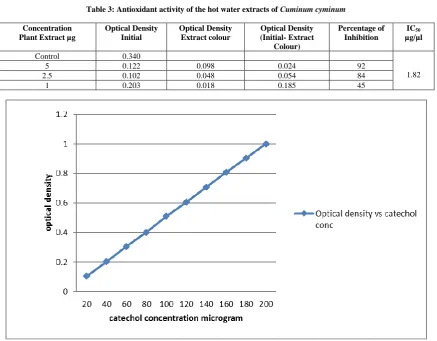
spectrophotometer at λmax = 650 nm. The samples were prepared in triplicate for each analysis and the mean value of absorbance was obtained. The same procedure was repeated for the standard solution of catechol and the calibration line was constructed(Figure 1). Based on the measured absorbance, the concentration of phenolics was read (µg/µl) from the calibration line; then the content of phenolics in extracts was expressed in terms of catechol equivalent (µg of CE/µg of extract).
Antioxidant activity
The ability of the seed extracts to scavenge DPPH free radicals was assessed by the standard method11. The stock solution of
extracts were prepared in water to achieve the concentration of 1 mg/ml. Dilutions were made to obtain concentrations of 5, 2.5, 1μg/ml. Diluted solutions (1 ml each) were mixed with 1 ml of methanolic solution of .002% DPPH . After 30 min incubation in darkness at room temperature (23oC), the absorbance was
recorded at 517 nm Labtronics NT 290 Spectrophotometer. Control sample contained all the reagents except the extract. Percentage inhibition was calculated using equation 1, whilst IC50 values were estimated from the % inhibition versus
concentration plot. The effective concentration of sample required to scavenge DPPH radical by 50% (IC50 value) was
obtained by linear regression analysis of dose-response curve plotting between % inhibition and concentrations12.
The optical density was recorded and % inhibition was calculated using the formula given below
Percent (%) inhibition of DPPH activity = {(A-B)/A }x100 Where, A = optical density of the blank and B = optical density of the sample.
Anthelmintic activity
The anthelmintic assay was carried out as per the Ayaiyeoba et al method13. Adult earthworms (Pheretima posthuma), were
used to evaluate anthelmintic activity in vitro. Earthworms of 3-5 cm in length and 0.1-0.2 cm in width (same type) were collected from Kerala Agricultural University, Mannuthy. Test samples of the extract was prepared at the concentrations,
paralysis was noted when no movement of any sort could be observed except when the worms were shaken vigorously. Time for death of worms was recorded after ascertaining that worms neither moved when shaken vigorously.
RESULTS AND DISCUSSION
Phytochemical analysis is very useful in the evaluation of active biological components of medicinal plants. The qualitative analysis of the powdered Cumin seeds showed the presence of secondary metabolites such as alkaloids, Total phenols and Tannins, steroids, saponins and the primary metabolites (Table 1). Phytochemicals such as saponins, flavonoids, tannins, steroids and alkaloids have anti-inflammatory effects14. Phenols
and alkaloids have antimicrobial, antidiarrhoeal, anthelmintic activities15. Alkaloids acts as an analgesic drug and can increase
nutrient absorption and blood circulation, hypoglycemic activities reduce pain and stimulate nerve system as it has narcotic effect16. Saponins helps in controlling cholesterol,
antidiabetic properties17 in addition to its anticancer and
anthelmintic activity18. The steroids have antidiarrhoeal
activities19.
Presence of total phenols was detected in Cumin seeds. The phenolic compounds are heterogeneous groups of substances that are present in almost all plants, inside the vacuole, cytoplasm or consisting the cell wall20. Natural antioxidant
mainly come from plants in the form of phenolic compounds such as flavonoid, phenolic acids, tocopherols etc. The total phenol content play a very important role in the protection of the plants against the deleterious effects of UV rays and also against certain phytopathogenic microorganisms20. It is also well known
that phenolic compounds contribute to the quality and nutritional value and also provide health beneficial effects21.
Phenols are found to be useful in the preparation of antimicrobial compounds22. The Folin-Ciocalteu reagent is
sensitive to reducing compounds including polyphenols, thereby producing a blue colour upon reaction23. This is confirmed by
the presence of blue colour in the extracts in comparison to the catechol which is taken as the standard. The phenol possess biological properties such as antiapoptosis, antiaging,
anticarcinogen, antiinflammation, antiatherosclerosis,
cardiovascular protection and improvement of endothelial function, as well as inhibition of angiogenesis and cell proliferation activities24. They are also found in many medicinal
plants, and herbal medicines containing these compounds have often been used in pharmacy.
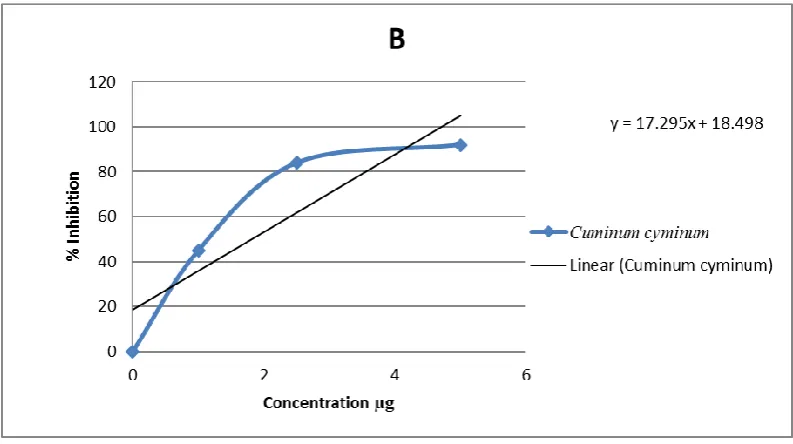
The DPPH activity of hot water extract was calculated from 1 µg, 2.5 µg and 5 µg extract. All the concentrations showed antioxidant activity (Figure 2). Table 3 shows the results of the free radical (DPPH) scavenging activity in % inhibition. The radical scavenging potential showed dose dependent increase on increasing the concentration of cumin extracts 1-5 µg. IC50 value
was 1. 82µg/µl. Antioxidants due to their scavenging activity are useful for the management of diseases. DPPH stable free radical method is a sensitive way to determine the antioxidant activity of plant extracts25. Phenolic compounds are known for their
Table 1: Preliminary phytochemical screening of hot water extracts of Cuminum cyminum seeds
Sl No Plant Constituents Test /Reagent Observations Aqueous Extract
1 Carbohydrates Molisch Test Violet Ring observed +
2 Proteins Biuret Test: Violet to pink colouration +
3 Amino Acids Ninhydrin Test: Blue to violet colouration +
4 Alkaloids Mayer’s Test White precipitate +
5 Steroid Salkowski reaction: Chloroform layer appears red and acid layer shows greenish yellow fluorescence
+++
6 Saponins Foam test Persistent Foam +
7 Phenols and Tannins Folin Test Blue Colouration ++++
Bromine water Decolouration of Bromine water +
Acetic acid No red Colouration _
‘+ ’low , ‘++’ Average, ‘+++’High, ‘ –’ Nil
Table 2 : Total Phenol Quantification of hot water extracts of Cuminum cyminum
Concentration Plant Extract µg/ µl Phenol concentration µg/µl CE
5 50
2.5 27
1 18.2
Table 3: Antioxidant activity of the hot water extracts of Cuminum cyminum
Concentration Plant Extract µg
Optical Density Initial
Optical Density Extract colour
Optical Density (Initial- Extract
Colour)
Percentage of Inhibition
IC50
µg/µl
Control 0.340
1.82
5 0.122 0.098 0.024 92
2.5 0.102 0.048 0.054 84
1 0.203 0.018 0.185 45
Figure 2: DPPH free radical scavenging activity of hot water extracts of Cuminum cyminum
Figure 3: Anthelmintic activity of hot water extract of Cuminum cyminum
elucidate the mechanism of action of these active ingredients to open the new door for natural anthelmintics.
REFERENCES
1. Purushoth Prabhu T, Paneerselvam P, SureshR, Clement AtleeW, Balasubramanian S. GC-MS analysis of ethanolic extract of Canthium parviflorum Lamk Leaf. Journal of Applied Pharmaceutical Science.2013; 3(2):166-168.
2. Osuntokun OT, Oljubu SA. Comparative study of
phytochemical and proximate analysis of seven Nigerian medicinal plants. Applied Science Research Journal.2014; 2(1):10-26.
3. Farina Mujeeb, Preeti Bajpai, Neelam Pathak.
Phytochemical Evaluation, Antimicrobial Activity, and Determination of Bioactive Components from Leaves of Aegle marmelos BioMed Research International 2014; Article ID 497606: 11 pages.
4. Nishaa S, Vishnupriya M,Sasikumar JM,Gopalakrishnan VK. Phytochemical screening and GC-MS analysis of ethanolic extract of rhizomes of Maranta arundinacea L Research Journal of Pharmaceutical, Biological and Chemical Sciences 2013; 4 (2):52-59.
5. Jamuna Senguttuvan, Subramaniam Paulsamy,
Krishnamoorthy Karthika.Phytochemical analysis and evaluation of leaf and root parts of the medicinal herb, Hypochaeris radicata L. for invitro antioxidant
activities. Asian Pacific Journal of Tropical
Biomedicine.2014; 4(Suppl 1): 359–S367.
6. Das SS, Monalisha Dey, Ghosh AK. Determination of Anthelmintic Activity of the Leaf and Bark Extract of
Tamarindus indica Linn. Indian Journal of Pharmaceutical Sciences 2011;73(1):104-10
7. Ali Esmail Al-Snafi. The pharmacological activities of
Cuminum cyminum - A review. IOSR Journal Of Pharmacy. 2016; 6 (6): 46-65.
8. Kokate, C K. Pharmacognosy. 16th Edn., Nirali Prakasham, Mumbai, India ;2009
9. Khandelwal K R. Practical Pharmacognosy Techniques and Experiments. 15th ed., Pune, Nirali Prakashan; 2006 10.Bray Η G, Thorpe WV. Analysis of phenolic compounds of
interest in metabolism. Meth. Biochemical Analysis. 1954; 1:27–52.
11.Braca A, Sortino C, Politi M Morelli I, Mendez J. Anti-oxidant activity of flavonoids from Licania licaniaeflora. Journal of Ethnopharmacology 2002;79(3): 379-381 12.Iranshahi M, Askari M, Sahebkar A, Adjipavlou-Litina D.
Evaluation of antioxidant, anti-inflammatory and
lipoxygenase inhibitory activities of the prenylated coumarin
umbelliprenin. DARU Journal of Pharmaceutical
Sciences 2009. 17(2):99-103.
13.Ajaiyeoba E O , Onocha P A, Olarenwaju O T. Invitro anthelmintic properties of Buchholzia coriaceae and Gynandropis gynandra extract , Pharmaceutical Biology. 2001;39(3):217-220
14.Orhan I, Kupeli E, Sener B, Yesilada E. Appraisal of anti – inflammatory potential of the clubmoss, Lycopodium clavatum L. Journal of Ethnopharmacology. 2007; 109(1):146-150
15.Parekh Jigna,Sumitra Chanda V, In vitro antimicrobial activity and phytochemical analysis of some Indian medicinal plants. Turkish Journal of Biology. 2007;31 .53-58.
16.Cherian S, Augusti KT, Insulin sparing action of leucopelargonin derivative isolated from Ficus bengalensis
Linn. Indian Journal of Experimental Biology 1995;33: 608-611.
17.Prashant Tiwari, Bimlesh Kumar, Mandeep Kaur, Gurpreet
Kaur, Harleen Kaur Phytochemical screening and
Extraction: A Review. Internationale Pharmaceutica Sciencia 2011;1(1):198-106
18.Cowan MM. Plant products as antimicrobial agents. Clinical Microbiology Reviews, 1999;12(4):564-582.
19.Surabhi Shrivastava ,Leelavathi S. Preliminary
Phytochemical Evaluation of leaf extracts of Catunaragum spinosa Thunb.2010;3(2):114-118
20.Rupasinghe, HP, Jackson CJ, Poysa V, Di Berado C, Bewley JD, Jenkinson J, Soyasapogenol A and B distribution in Soybean (Glycine max L.Merr)in relation to seed physiology, genetic variability and growing location. Journal of Agricultural Food Chemistry, 2003;51(20): 5888-5894
21.Sharanabasappa GK, Santosh MK, Shaila D, Seetharam YN, Sanjeevarao I. Phytochemical Studies on Bauhinia racemosa Lam. Bauhinia purpurea Linn. and Hardwickia binata Roxb .2007: 4(1): 21-31.
22.Vaya J, Belinky PA, Aviram M. Antioxidant constituents from licorice roots: Isolation, structure elucidation and antioxidative capacity toward LDL oxidation. Free Radic Biol Med. 1997; 23(2):302-313.
23.Han X, Shen T, Lou H. Dietary polyphenols and their biological significance. International Journal of Molecular Sciences. 2007;8(9) : 950-988.
24.Usha V, Shanthanayaki M Suriyavathana M. Studies on phytochemical analysis and antioxidant activity of selected medicinal plants from Kolli hills. Journal of Pharmacy Research. 2010; 3 (2):260-262.
25.Miliauskas G, Venskutonis PR, Van beek TA. Screening of radical scavenging activity of some medicinal and aromatic plants extracts. Food Chemistry. 2004; 85(2):231–237.
26. Ashafa AO, Grierson DS, Afolayan AJ. In
Vitro Antioxidant Activity of Extracts From the Leaves of Felicia muricata Thunb. an Underutilized Medicinal Plant in the Eastern Cape Province, South Africa. African Journal of Traditional Complementary and alternative Medicines. 2010; 7(4): 296–302.
27.Sangh Partap, Saurabh Kumar, Amit Kumar, Neeraj K,Sharma, Jha K K. In-vitro anthelmintic activity of Luffa cylindrica leaves in Indian adult earthworm. Journal of Pharmacognosy and Phytochemistry. 2012;1(2): 27-28
Cite this article as:
Manju Madhavan and Sheeja T Tharakan. Evaluation of phytochemicals, total phenols, antioxidant and anthelmintic activity of hot water extracts of Cuminumcyminum seeds. Int.
Res. J. Pharm. 2017;8(11):135-139 http://dx.doi.org/
10.7897/2230-8407.0811232
Source of support: Nil, Conflict of interest: None Declared