Phase 1 Trial of 4 Thyroid Hormone Regimens for Transient
Hypothyroxinemia in Neonates of
⬍
28 Weeks’ Gestation
WHAT’S KNOWN ON THIS SUBJECT: Transient low levels of thryoid hormones in ELGANs are associated with cognitive delay and CP independent of other risk factors. It is not clear whether or not to treat, what target blood levels are desirable, or how to achieve them.
WHAT THIS STUDY ADDS: Our study defines chemical
euthyroidism and demonstrates a method of therapy to achieve this. A future trial will need to determine the impact on central nervous system outcomes.
abstract
BACKGROUND:Transiently low levels of thyroid hormones occur in⬃50% of neonates born 24 –28 weeks’ gestation and are associated with higher rates of cerebral palsy and cognitive impairment. Raising hormone levels shows promise for improving neurodevelopmental outcome.
OBJECTIVE:To identify whether any of 4 thyroid hormone supplementation regimens could raise T4and FT4without suppressing TSH (biochemical euthy-roidism).
METHODS:Eligible subjects had gestational ages between 240⁄7 and 276⁄7
weeks and were randomized⬍24 hours of birth to one of six study arms (n⫽ 20 –27 per arm): placebo (vehicle: 5% dextrose), potassium iodide (30g/ kg/d) and continuous or bolus daily infusions of either 4 or 8g/kg/d of T4for 42 days. T4was accompanied by 1g/kg/d T3during the first 14 postnatal days and infused with 1 mg/mL albumin to prevent adherence to plastic tubing.
RESULTS:FT4was elevated in the first 7 days in all hormone-treated subjects; however, only the continuous 8g/kg/d treatment arm showed a significant elevation in all treatment epochs (P⬍.002 versus all other groups). TT4 re-mained elevated in the first 7 days in all hormone-treated subjects (P⬍.05 versus placebo or iodine arms). After 14 days, both 8g/kg/d arms as well as the continuous 4g/kg/d arm produced a sustained elevation of the mean and median TT4,⬎7g/dL (90 nM/L;P⬍.002 versus placebo). The least suppression of THS was achieved in the 4g/kg/d T4continuous infusion arm. Although not pre-hypothesized, the duration of mechanical ventilation was significantly lower in the continuous 4g/kg/d T4arm and in the 8g/kg/d T4bolus arm (P⬍.05 versus remaining arms). ROP was significantly lower in the combined 4 thyroid hormone treatment arms than in the combined pla-cebo and iodine arms (P⬍.04). NEC was higher in the combined 8g/kg/d arms (P⬍.05 versus other arms).
CONCLUSIONS:Elevation of TT4with only modest suppression of TSH was associated with trends suggesting clinical benefits using a continuous supple-ment of low-dose thyroid hormone (4g/kg/d) for 42 days. Future trials will be needed to assess the long-term neurodevelopmental effects of such supple-mentation.Pediatrics2009;124:e258–e268
CONTRIBUTORS:Edmund F. La Gamma, MD,aAleid G.
van Wassenaer, MD, PhD,bSusana Ares, MD, PhD,cSergio G.
Golombek, MD, MPH,aJoke H. Kok, MD, PhD,bJose Quero, MD,
PhD,cTing Hong, MD, PhD,d,eMohammad H. Rahbar, PhD,f
Gabriella Morreale de Escobar, PhD,gDelbert A. Fisher, MD,hand
Nigel Paneth, MD, MPHd,e
aDepartment of Neonatal-Perinatal Medicine, Regional Neonatal
Center, Maria Fareri Children’s Hospital at Westchester Medical Center, New York Medical College, Valhalla, New York;bDepartment of
Neonatology, Emma Children’s Hospital-Academic Medical Center, Amsterdam, Netherlands;cNeonatology Unit, University
Hospital La Paz, andgInstituto de Investigaciones Biomedicas,
Autonomous University of Madrid and Center for Biomedical Research on Rare Diseases (CIBERER), Madrid, Spain; Departments ofdEpidemiology andePediatrics and Human
Development, Michigan State University, East Lansing, Michigan;
fCenter for Clinical and Translational Sciences, University of
Texas Health Science Center at Houston, Houston, Texas;hQuest
Diagnostics Nichols Institute, San Juan Capistrano, California
KEY WORDS
thyroxine, triiodothyronine, hypothyroxinemia, thyroid hormone, monodeiodinase, extremely low birth weight neonate, transient hypothyroxinemia, nonthyroidal illness, euthyroid sick syndrome, cerebral palsy, prematurity, randomized, controlled trial
ABBREVIATIONS
CP— cerebral palsy CLD— chronic lung disease DSMB— data safety monitoring board D5W—5% dextrose water
ELGAN— extremely low gestational age neonate FT4—free circulating thyroxine
GM— germinal Matrix I2—Iodine
IVH—intraventricular hemorrhage NEC—necrotizing enterocolitis PO—per os
PVL—periventricular leukomalacia ROP—retinopathy of prematurity T3—triiodothyronine
TT3—total circulating T3
T4—thyroxine
TT4—total circulating T4
TBG—thyroid-binding globulin
THOP—transient hypothyroxinemia of prematurity
www.pediatrics.org/cgi/doi/10.1542/peds.2008-2837
doi:10.1542/peds.2008-2837
Accepted for publication Mar 31, 2009
Address correspondence to Edmund F. La Gamma, MD, Regional Neonatal Center, Maria Fareri Children’s Hospital at Westchester Medical Center, New York Medical College, Valhalla, NY 10595. E-mail: Edmund㛭[email protected]
PEDIATRICS (ISSN Numbers: Print, 0031-4005; Online, 1098-4275).
Copyright © 2009 by the American Academy of Pediatrics
Survival for extremely low gestational age neonates (ELGANs) (24 –28 weeks’ gestation) was negligible before the 1960s and now exceeds 80%.1This
ex-traordinary achievement is tempered by the intractable persistence of cere-bral palsy (CP) and its accompanying disabilities affecting nearly 1 in 8 sur-vivors at a prorated lifetime cost of nearly $1 million per handicapped child.2–4An important priority in
new-born medicine, therefore, is to trans-late gains in survival into survival with-out today’s current high rates of
neurodevelopmental impairments.5
Low levels of thyroid hormone are commonly found in the first weeks after birth, a hormone phenomenon referred to as transient hypothyrox-inemia of prematurity (THOP). Al-though the etiology of CP and its un-derlying substrate of white matter injury is mutilfactorial,6–10THOP is a
strong independent risk factor for CP, white matter injury, and lower cognitive performance, suggesting an unmet preventable cause of neu-rologic injury.11–19
Low thyroid hormone levels in ELGANs arise from a combination of (1) loss
of maternal and placenta-supplied
hormones; (2) immaturity of the
hypothalamic-pituitary-thyroid axis, cluding limited thyroidal capacity to in-crease hormone synthesis; and (3) ac-celerated inactivation (elevated reverse T3, sulfated forms, diiodothyronine, and
monoiodothyronine).20–23 Iodine
imbal-ance, medications, and adverse peri-natal events (ie, nonthyroidal illness syndrome) all exacerbate the effects of these developmental and conditional limitations on thyroid homeostasis.20–23
Several trials have treated THOP in ELGANs by using a variety of dosage regimens. In all cases, intervention lowered plasma thyrotropin levels to values consistent with a significant overshoot in treatment.16,21,24,25
Be-cause excessive thyroid hormone
ex-posure during fetal brain growth may be as undesirable for normal develop-ment as is deficiency,26–28 it is
impor-tant to identify how to supplement endogenous production without inter-fering with the maturing homeostatic control systems.
We used a masked randomized trial to identify a dosing regimen that would first elevate serum levels of free cir-culating thyroxine (FT4) and total
cir-culating T4 (TT4) to target values
(ⱖ1.5 ng/dL [19 pM/L] andⱖ6g/dL [77 nM/L], respectively) while second-arily minimizing suppression of thy-rotropin levels (⬍0.4 mIU/L) over the period of supplementation (42 days) to achieve the most physiologic pat-tern of homeostasis.
METHODS
Study Design and Intervention
Thyroid hormone (Bedford Pharma-ceuticals, Mansfield, MA) was adminis-tered in 4 treatment arms within 24 hours of birth as thyroxine (T4) at 4 or
8g/kg per day delivered either as a bolus (1 mL/kg in 5% dextrose solution in water intravenously or per os [PO]) or via continuous infusion (0.5 mL/kg per hour intravenously or PO). The dos-age was increased by 25% when con-verting to oral administration.29
Tri-iodothyronine (T3) was provided to all 4 T4-treated arms at 1.0g/kg per day for the first 14 postnatal days as imme-diately available active hormone.20,21
Subjects in the 2 continuous-infusion arms who began feedings every 2 hours had the appropriate amount of study drug added to ingested milk ev-ery 4 hours. T4 and T3 were infused
along with 1 mg/mL albumin to pre-vent a measured 40% loss to plastic tubing.30One arm of the study was
pro-vided with iodine (Upsher-Smith,
Ma-ple Grove, MN), 30 g/kg per day in
1 mL of aqueous oral solution. The pla-cebo arm received 5% dextrose
solu-tion in water (0.5 mL/kg per hour intra-venously or PO).
Study Population and Exclusions
The study was approved by the institu-tional review board of the 3 clinical en-rollment sites and the data center. Neonates of 240⁄7to 276⁄7weeks of
ges-tation were enrolled⬍24 hours after birth. Exclusions included mothers
⬍18 years of age or those with thyroid disease or reported substance abuse (ie, alcoholism or use of heroin or
methadone)31and newborns with
ma-jor congenital malformations or if death was expected within 48 hours. If death or withdrawal of consent oc-curred in the first week of life, the sub-ject was replaced in its study arm by the next available eligible newborn.
Clinical Definitions and Management Strategies
Gestational age was based on the best estimate of the attending neonatolo-gist using obstetrical parameters and examination. Necrotizing enterocolitis
(NEC) was recorded ifⱖ Bell’s stage
2,32 retinopathy of prematurity (ROP)
as ⱖ stage 3 in either eye,33 and
chronic lung disease (CLD) as oxygen requirement at 36 weeks to keep oximeter saturationsⱖ88% to 90%.34
Fluids and nutrition were provided ac-cording to guidelines.35–38 Soy-based
formulas were excluded because they are associated with prolonged
in-creases in thyrotropin.39
Vasopres-sors (ie, dopamine/dobutamine) were avoided because these drugs sup-press thyrotropin.31
Iodine Precautions
Iodinated skin cleansers (eg, Povidone Iodine, Aplicore, Inc, Meriden CT) were avoided because excess iodine sup-presses hormone synthesis.31Instead,
Data Monitoring
Clinical status was recorded daily for 2 weeks and weekly thereafter. Cranial ultrasounds were conducted on
post-natal days 1 to 3, 7 to 10, and ⱖ4
weeks, and were interpreted by a masked radiologist (Paula Brill, MD, Cornell University Medical Center,
New York, NY). Free T4was measured
by using the equilibrium dialysis technique and the other hormones were measured by standard immuno-assay technology (Quest Diagnostics, Chantilly, VA).40
Data Safety Monitoring Board
A data safety monitoring board (DSMB) and a separate independent medical monitor reviewed study progress and evaluated potential adverse events on a quarterly basis.
Statistical Considerations
A randomization/minimization program (SAS software [SAS Institute, Inc, Cary, NC]) balanced 2 gestational age strata (240⁄7–260⁄7 and 261⁄7–276⁄7 weeks),
gen-der, and center. Multiple births were treated as individual subjects, because ex utero experiences over the first 6
postnatal weeks were considered
unique to individuals.
Power calculations were based on a sample size necessary to detect a 25% difference in mean FT4levels
be-tween each pair of the 6 study arms at a 5% significance level with a power of 0.8 allowing for up to a 20% dropout rate by the date of final as-sessment. Hormone results were ex-amined as area under the curve over time, normalized to weekly values for comparison (analysis of variance; SAS 9.1). For comparing categorical outcomes (eg, death), we used the2
test. When overall significance was attained, preplanned pairwise com-parisons between study arms were conducted.
RESULTS
Enrollment
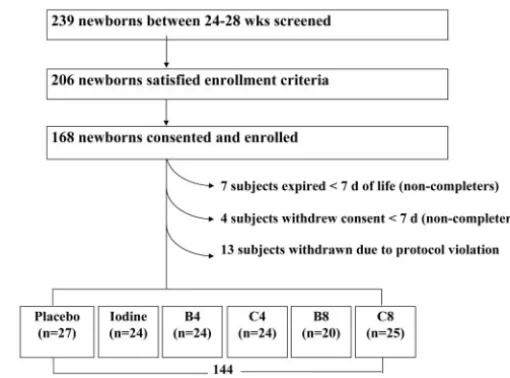
From April 2005 to March 2007, 168
subjects participated: 46% (n ⫽ 77)
were enrolled in New York, 31% (n⫽
52) in Amsterdam, and 23% (n⫽39) in Madrid (Fig 1).
Changes in Enrollment During the Trial
Eleven subjects were removed from the randomization/minimization file before 7 days by study design (7 deaths, 4 pa-rental withdrawals). In addition, the DSMB interrupted trial enrollment for 2 reasons: (1) By the time 20 subjects had been entered in the bolus 8g/kg per day arm, that arm had experienced 6 deaths (postnatal ages: 10, 16, 25, 27, 28, and 31 days) at a time when no other arm had⬎3 deaths (not statistically sig-nificant); and (2) A pharmacy drug dilu-tion error was discovered that resulted in a doubling of the dosage in the Madrid arm. From the onset of the trial until the error was discovered, infants slated to receive 4 and 8g/kg per day instead received 8 and 16g/kg per day of T4.
Recipients of both 8g/kg per day in the
initially designated 4g/kg group were retained in the 8g/kg per day arms. The 13 recipients of 16g/kg per day were excluded from the analysis and re-placed by new enrollments. Adjusting
the SAS randomization/minimization
files and extending the enrollment pe-riod ensured that adequate numbers of subjects were assigned to each group.
Baseline Comparison of Study Arms
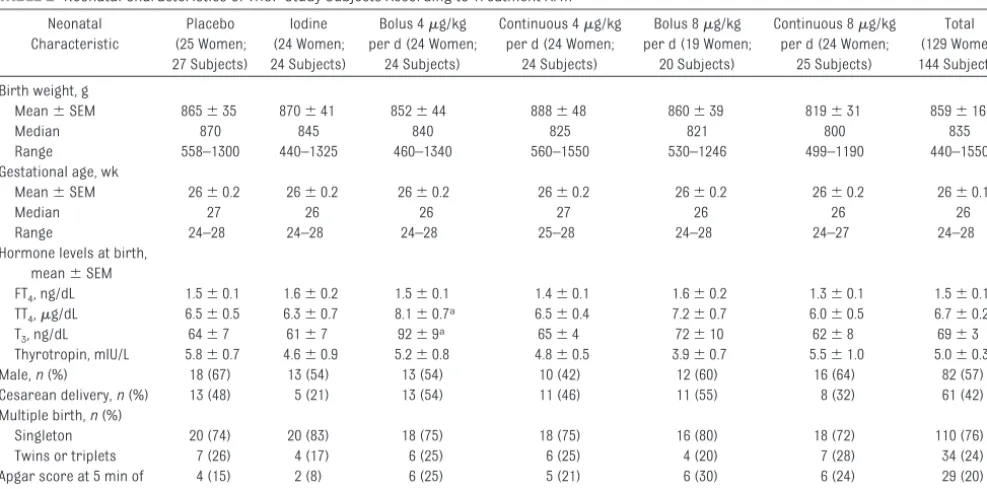
No mother in the study had abnormal T4
or FT4values, but 8 mothers had serum
thyrotropin levels of⬎5.0 mIU/L, sug-gesting subclinical hypothyroidism at delivery (Table 1). No arm of the study
included infants from ⬎2 of these
women. Baseline newborn values of T4,
FT4, T3, thyroid-binding globulin (TBG),
thyrotropin, or cortisol did not differ across study arms (Tables 1 and 2).
Serum Hormone Results Over Time
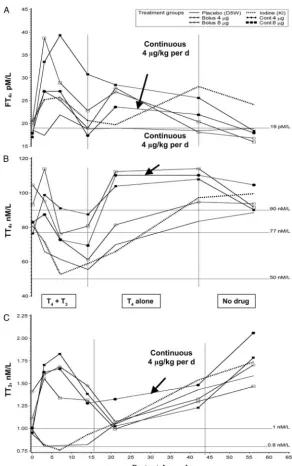
Free T4
The median FT4 value for the placebo
arm was ⬍19 pM/L (1.5 ng/dL)
throughout the entire period of obser-vation (not shown), indicating that 50% of the control subjects at any given
FIGURE 1
date had values below our predefined threshold (Fig 2A). Interestingly, 5% to 33% of subjects across treatment arms had at least 1 plasma FT4value
below the threshold of 19 pM/L, consis-tent with the severity of illness.41–43
Only the continuous 8g/kg per day
treatment arm showed a significant el-evation in free T4at all time points
dur-ing study drug intervention (P⬍.002 versus all other groups); this per-sisted after cessation of treatment
(P⬍ .01 versus placebo and bolus 4
g/kg per day; day 56).
Total T4
During the first 3 days, an elevation in
TT4 was significant when compared
TABLE 1 Maternal Characteristics of THOP Study Subjects According to Treatment Arm
Maternal Characteristic Placebo (25 Women; 27 Subjects)
Iodine (24 Women; 24 Subjects)
Bolus 4g/kg per d (24 Women;
24 Subjects)
Continuous 4g/kg per d (14 Women;
Subjects)
Bolus 8g/kg per d (19 Women;
Subjects)
Continuous 8g/kg per d (24 Women;
25 Subjects)
Total (129 Women; 144
Subjects)
Maternal age, mean⫾SEM, y 31⫾1 29⫾1 28⫾1 30⫾1 30⫾1 31⫾1 30⫾1
Ethnicity,n(%)
White 18 (67) 15 (63) 12 (50) 13 (54) 15 (75) 15 (60) 88 (61)
Black 7 (26) 6 (25) 7 (29) 8 (33) 4 (20) 4 (16) 36 (25)
Hispanic 2 (7) 2 (8) 2 (8) 3 (12) 1 (5) 4 (16) 14 (10)
Preeclampsia,n(%) 5 (19) 1 (4) 3 (12) 6 (25) 1 (5) 3 (12) 19 (13)
Feverⱖ100.4°F during pregnancy,n(%)
3 (11) 0 (0)a 9 (38)a 2 (8) 1 (5) 1 (4) 16 (11)
Rupture of membrane⬎24 h,
n(%)
4 (15) 7 (30) 10 (45) 6 (29) 6 (30) 4 (19) 37 (28)
Treatment before delivery,
n(%)
Antibiotic 11 (41) 8 (33) 18 (75)a 13 (54) 8 (40) 10 (40) 68 (47)
Antenatal steroids 23 (85) 21 (88) 23 (96) 21 (88) 13 (65) 20 (80) 121 (84)
Hormone levels after delivery, mean⫾SEM
FT4, ng/dL 1.7⫾0.4 1.3⫾0.1 1.3⫾0.1 1.3⫾0.1 1.5⫾0.1 1.3⫾0.1 1.4⫾0.1
TT4,g/dL 11.4⫾0.6 11.5⫾0.5 11.8⫾0.6 11.2⫾0.6 11.2⫾0.8 11.1⫾0.5 11.4⫾0.2
Thyrotropin, mIU/L 2.5⫾0.4 2.4⫾0.3 2.7⫾0.4 2.1⫾0.4 2.0⫾0.5 2.0⫾0.2 2.3⫾0.1
Thyrotropin⬎5.0 mIU/L 2 (10) 2 (9) 1 (5) 1 (5) 2 (12) 0 (0) 8 (7)
The total number of mothers is⬍144, because 1 mother can appear in up to 3 arms depending on her neonate’s treatment assignment as a consequence of multiple gestation. aP⬍.05 for the occurrence of the sign or the mean of the variable in this arm is significantly different from that seen across all study arms.
TABLE 2 Neonatal Characteristics of THOP Study Subjects According to Treatment Arm
Neonatal Characteristic
Placebo (25 Women; 27 Subjects)
Iodine (24 Women; 24 Subjects)
Bolus 4g/kg per d (24 Women;
24 Subjects)
Continuous 4g/kg per d (24 Women;
24 Subjects)
Bolus 8g/kg per d (19 Women;
20 Subjects)
Continuous 8g/kg per d (24 Women;
25 Subjects)
Total (129 Women; 144 Subjects)
Birth weight, g
Mean⫾SEM 865⫾35 870⫾41 852⫾44 888⫾48 860⫾39 819⫾31 859⫾16
Median 870 845 840 825 821 800 835
Range 558–1300 440–1325 460–1340 560–1550 530–1246 499–1190 440–1550
Gestational age, wk
Mean⫾SEM 26⫾0.2 26⫾0.2 26⫾0.2 26⫾0.2 26⫾0.2 26⫾0.2 26⫾0.1
Median 27 26 26 27 26 26 26
Range 24–28 24–28 24–28 25–28 24–28 24–27 24–28
Hormone levels at birth, mean⫾SEM
FT4, ng/dL 1.5⫾0.1 1.6⫾0.2 1.5⫾0.1 1.4⫾0.1 1.6⫾0.2 1.3⫾0.1 1.5⫾0.1
TT4,g/dL 6.5⫾0.5 6.3⫾0.7 8.1⫾0.7a 6.5⫾0.4 7.2⫾0.7 6.0⫾0.5 6.7⫾0.2
T3, ng/dL 64⫾7 61⫾7 92⫾9a 65⫾4 72⫾10 62⫾8 69⫾3
Thyrotropin, mIU/L 5.8⫾0.7 4.6⫾0.9 5.2⫾0.8 4.8⫾0.5 3.9⫾0.7 5.5⫾1.0 5.0⫾0.3
Male,n(%) 18 (67) 13 (54) 13 (54) 10 (42) 12 (60) 16 (64) 82 (57)
Cesarean delivery,n(%) 13 (48) 5 (21) 13 (54) 11 (46) 11 (55) 8 (32) 61 (42)
Multiple birth,n(%)
Singleton 20 (74) 20 (83) 18 (75) 18 (75) 16 (80) 18 (72) 110 (76)
Twins or triplets 7 (26) 4 (17) 6 (25) 6 (25) 4 (20) 7 (28) 34 (24)
Apgar score at 5 min of
⬍7,n(%)
4 (15) 2 (8) 6 (25) 5 (21) 6 (30) 6 (24) 29 (20)
with the iodine arm (Fig 2B;P⬍.03 for all hormone arms). After 14 days, both
8g/kg per day arms as well as the
continuous 4g/kg per day arm
pro-duced a sustained elevation of TT4
above the desired level of 7g/dL (90 nM/L; hormone arms versus placebo,
P⬍ .002). This persisted after study drugs were discontinued in the
contin-uous 4g/kg per day arm (P⬍.001
versus placebo control).
Total T3
Total circulating T3 (TT3) in both
pla-cebo and iodine arms fell below
base-line and remained at ⬃0.8 nM/L (52
ng/dL) (Fig 2C). In all
hormone-supplemented subjects, TT3remained
significantly elevated relative to either placebo or iodine study arms from birth to day 14 (P ⬍ .001). After 14 days, all study arms showed a gradual rise in TT3levels to above the desired values of 1 nM/L (65 ng/dL), becoming
statistically indistinguishable from
each other.
Thyrotropin
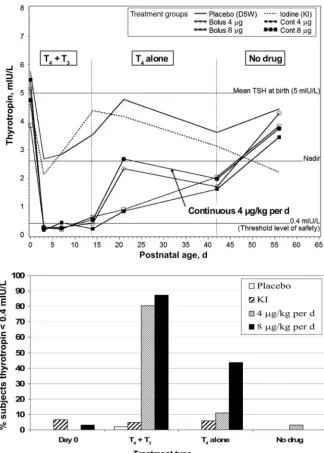
In all subjects, by the third postnatal day, thyrotropin levels fell below the cohort’s mean value at birth (5.2 mIU/L; Fig 3, top) and remained low
(⬍0.4 mIU/L) in all
hormone-supplemented arms during the 2-week period of infusion of T3(P⬍.001
ver-sus placebo and iodine arms). Thyro-tropin values of both 4g/kg per day arms were intermediate between both
8 g/kg per day and placebo/iodine
arms during days 15 to 42 (P⬍.001 for both comparisons). By 2 weeks after ending the hormone supplementation,
the iodine arm and both 8g/kg per
day arms had significantly lower thyro-tropin levels than the placebo arm (P⬍.04).
Few subjects had thyrotropin levels of
⬍0.4 mIU/L at birth (Fig 3, bottom). In contrast, during combined drug treat-ments (birth to 14 days) over 80% of hormone-treated subjects
experi-FIGURE 2
enced low thyrotropin (P⬍ .001 ver-sus placebo or iodine). When only T4
was given (days 15 to 42), abnormally
low thyrotropin levels were still
ob-served in ⬎40% of the combined 8
g/kg per day arms but in only 11% of
the combined 4 g/kg per day arms
(Fig 3, bottom;P⬍.002 vs 8g/kg per day). Two weeks after completion of drug therapy nearly all subjects had thyrotropin values of⬎0.4 mIU/L.
Thyroid-Binding Globulin
The values for TBG did not differ signif-icantly across study arms, reaching a nadir at day 7 and then gradually ris-ing as a cohort from 15 mg/L at birth to 20 mg/L by study completion indepen-dent of interventions (not shown).
Cortisol
At baseline, average cortisol values
ranged between 10 and 20 g/dL
across study arms, reflecting enroll-ment at all hours of the day of birth. Subsequently, samples were obtained at the diurnal nadir, thus becoming more tightly clustered. Cortisol values did not differ significantly by study arm; all values declined gradually and
were 5 to 10 g/dL by day 56 in all
arms.
Neonatal Clinical Outcomes
At enrollment, the bolus 4 g/kg per day arm had more mothers with fever or antibiotic use before delivery and higher neonatal T3 levels; the iodine
arm had the fewest mothers with fever (bothP⬍.05, Table 1). At discharge, the rate of NEC was highest in the con-tinuous 8g/kg per day arm (P⬍.05 versus other groups). However, NEC-related mortality did not differ across treatment arms and overall was 66% (10 of 15) for these ELGANs.
The duration of mechanical ventilation was lowest in both the continuous 4
g/kg per day T4arm and the bolus 8
g/kg per day T4arm (P⬍.05 versus
remaining groups; Table 3). ROP was
lowest in the 8 g/kg per day bolus
arm (P⬍.05 versus other groups) and although not prehypothesized, ROP was considerably lower in the com-bined 4 thyroid hormone treatment arms than in the combined placebo
FIGURE 3
and iodine arms (5% [5 of 93] vs 18% [9 of 51];P⬍.04). There were no differ-ences in intraventricular hemorrhage (IVH) across treatment arms, but white matter damage was lowest in the bolus 4g/kg per day arm (P⬍.05 versus other arms; Table 3).
DISCUSSION
At birth, ELGANs experience a 50% in-crease in O2consumption, a fall in
en-vironmental temperature, increased motor activity, increased metabolic and nutrient demands for ex utero growth, and a range of other organ-level maturational adjustments the transition of which proceeds optimally only in the euthyroid state.20,21,24,25,27,44
THOP occurs in nearly 50% of ELGANs because of an immature hypothalamic-pituitary-thyroid axis, increased in-activation of T4and T3 hormones,
at-tendant low plasma TT4, and in some
cases of nutritional deprivation, de-creased synthesis of TBG.20,21,24,25,44,45
Moreover, TT4 levels vary inversely
with the severity of neonatal ill-ness.41–43Serum FT
4levels typically
re-equilibrate to cord blood values or higher within 1 week after birth, yet TT4 can be delayed as long as 3 to 4 weeks.17,20,46 Considering these
pat-terns, defining “normal” thyroid levels is difficult.
Because ELGANs frequently suffer se-vere systemic illness and experience changing biological requirements dur-ing a period of critical brain develop-ment,10,20–25,44,47,48 basing target
hor-mone values on either healthy fetal levels or levels observed in term
neo-nates seems imprudent.24 We argue
that biochemical euthyroidism is the minimum thyroid hormone threshold associated with a reduced risk of neonatal illness or better long-term neurodevelopment.
To address the uncertainty, we tar-geted hormone values associated with favorable clinical outcomes.21,24,25First,
several large studies show that
neuro-developmental outcome is generally better in ELGANs and other premature neonatal populations without THOP.11,49
Second, short-term improvement in clinical outcomes is reported after thy-roid hormone treatment of sick new-borns.16,18 Third, mortality is lower in
neonatal cardiac surgical patients with euthyroid sick syndrome with hormone supplementation.50–52Fourth,
beneficial effects on IQ have been seen after thyroid hormone supple-mentation of newborns with other conditions (eg, trisomy 21)53and
con-genital hypothyroidism.54–56 Thus, we
identified our goal for a minimum
threshold for FT4 concentration as
ⱖ1.5 ng/dL (19 pM/L), for TT4
con-centration asⱖ6g/dL (77 nM/L), and
for TT3 concentration as ⱖ52 ng/dL
(0.8 nM/L).11,16,18,24,25,49–56
In addition to defining minimum target values to exceed, we sought to identify a clinical euthyroid state defined bio-chemically as a dose and mode of thy-TABLE 3 Hospital Morbidities at Discharge for the THOP Trial According to Treatment Arm
Placebo (N⫽27)
Iodine (N⫽24)
Bolus 4g/kg per d (N⫽24)
Continuous 4g/kg per d (N⫽24)
Bolus 8g/kg per d (N⫽20)
Continuous 8g/kg per d (N⫽25)
Total (N⫽144)
Discharge weight or at death, mean⫾SEM, g 2973⫾238 2653⫾162 2346⫾93 2596⫾167 2134⫾186 2338⫾167 2521⫾74
Median 2630 2620 2235 2302 2300 2400 2473
Range 1190–6335 750–4100 1235–3260 910–4600 850–3275 820–3840 750–6335
Duration of ventilator, mean⫾SEM, d 38⫾145 19⫾5 14⫾3 9⫾2a 13⫾3a 20⫾4 19⫾3
Median 11 9 5 5 10 12 8
Range 0–300 0–95 0–51 0–39 0–35 0–78 0–300
Duration of CPAP, mean⫾SEM, d 23⫾4 19⫾3 22⫾3 25⫾3 24⫾5 27⫾4 23⫾2
Median 18 19 23 27 20 25 23
Range 0–100 0–45 0–52 0–43 0–83 0–56 0–100
Duration of hospital stay, mean⫾SEM, d 100⫾12 88⫾8 76⫾6 83⫾7 67⫾8 82⫾6 83⫾4
Median 84 89 77 82 64 75 82
Range 18–343 15–210 7–116 10–146 10–133 25–132 7–343
Death at⬎7 d,n(%) 4 (15) 4 (17) 2 (8) 2 (8) 6 (30) 4 (16) 22 (15)
ROPⱖstage 3,n(%) 5 (19) 4 (17) 1 (4) 2 (8) 0 (0)a 2 (8) 14 (10)
NECⱖstage 2,n(%) 2 (7) 2 (8) 1 (4) 1 (4) 3 (15) 6 (24)a 15 (10)
GM/IVH,n(%) 9 (36) 7 (29) 3 (13) 8 (33) 7 (39) 7 (32) 41 (30)
White matter damage,n(%) 3 (12) 2 (8) 0 (0)a 2 (8) 3 (17) 2 (9) 12 (9)
CLD,n(%) 12 (44) 8 (33) 11 (46) 5 (21) 6 (30) 9 (36) 51 (35)
Combined arms: mortality, % (n/N) 16 (8/51) 8 (4/48) 22 (10/45)
Combined arms: ROP⬎stage 3, % (n/N) 18 (9/51) 6 (3/48) 4 (2/45)
Combined arms: NEC, % (n/N) 8 (4/51) 4 (2/48) 20 (9/45)a
Combined arms: GM/IVH, % (n/N) 31 (16/51) 23 (11/48) 31 (14/45)
Combined arms: white matter, % (n/N) 10 (5/51) 4 (2/48) 11 (5/45)
Combined arms: CLD, % (n/N) 39 (20/51) 33 (16/48) 33 (15/45)
CPAP indicates continuous positive airway pressure; GM, germinal matrix.
roid hormone supplementation that si-multaneously raised the level of FT4
and TT4 without suppressing
thyro-tropin to nearly undetectable levels (a problem in all previous neonatal clini-cal trials).16,24 Each of these
bench-marks was achieved by using a contin-uous infusion of thyroid hormone at 4
g/kg per day of T4for 42 days (Figs 2
and 3).
Supplementation of the prohormone T4with the active hormone T3for the
first 14 postnatal days raised the TT3
blood level (Fig 2) but was coupled with thyrotropin values at or below the as-say’s level of detection, which is con-sistent with overtreatment during the period of dual therapy (Fig 3) suggest-ing that T3supplementation is
unnec-essary. The fewest cases with a thyro-tropin level of⬍0.4 mIU/L were seen in
the 4g/kg per day arms and in
un-treated subjects (Fig 3, bottom). A rea-sonable conclusion is that 8g/kg per day is overtreatment and that 4g/kg per day can produce a biochemically euthyroid state with less frequent sup-pression of thyrotropin. Moreover, T3
production was not suppressed by us-ing this lower dose regimen compared with previous reports.57 The current
trial becomes the first to succeed in raising thyroid hormone levels to achieve the predefined threshold val-ues of biochemical euthyroidism with-out suppressing thyrotropin values to
⬍0.4 mIU/L in the majority of infants. Although not prehypothesized, the
mortality rate in the two 4 g arms
(8% [4 of 48]) was half that of the pla-cebo/iodine arms (16% [8 of 51]) and also less than half that of higher dos-age arms (22% [10 of 45]; Table 3). Al-though the pattern suggests a nadir in
mortality when the lower thyroid hor-mone dose is used, these mortality dif-ferences failed to achieve statistical significance in this sample, which is underpowered for mortality analyses (Table 3). In a related analysis, when all hormone groups were combined, a statistically significant reduction in
ROP stage ⱖ3 was found compared
with the iodine/placebo arms (Table 3;
P⬍.04). This is an intriguing result for future investigation, because thyroid hormone effects on vascular and reti-nal development in both animals and
humans have been described.58
Al-though these correlations are clearly of interest to clinicians, future experi-mentation with an appropriately large sample size will be necessary to con-firm the validity of these posthoc associations.
An important issue in our study was the dosage error in the Madrid phar-macy. We note that the ensuing dosage (16g/kg per day) is nearly the same as the 10 to 15g/kg per day starting dose range routinely used to treat con-genital hypothyroidism55and that
ear-lier interventional trials used as high
as 25 g/kg per day.59 The Madrid
team is following the 13 infants treated with the 16g/kg per day dose as out-patients, and their outcomes will be the subject of a separate report. At present, their initial hospital course did not differ significantly from the other hormone intervention groups. Another issue in the study is that the DSMB closed enrollment to the bolus 8
g/kg per day group because of a per-ceived trend toward higher mortality. This interruption occurred after 20 of the intended 24 subjects had been en-rolled, and thus did little to harm the
power of the study. At completion of the trial, we found that death rates across arms were statistically indis-tinguishable (Table 3).55
CONCLUSIONS
The THOP 1 trial accomplished the goal of elevating thyroid hormone blood lev-els in extremely premature neonates to exceed a predefined target thresh-old without completely suppressing thyrotropin by using continuous 4
g/kg of T4 as replacement therapy. The next step is to undertake a prop-erly powered clinical trial that targets long-term neurodevelopmental out-comes and discerns whether thyroid hormone intervention will do more than simply elevate blood levels to tar-get ranges in developing ELGANs.
ACKNOWLEDGMENTS
The THOP 1 trial was supported by the National Institute of Neurological Dis-orders and Stroke grant NS45109, phase 1 trial of thyroid hormones in premature infants. The program direc-tor was Deborah Hirtz, MD.
REFERENCES
1. March of Dimes Foundation. PeriStats. Available at: www.marchofdimes.com/peristats. Accessed February 9, 2009
2. Centers for Disease Control and Prevention. Economic costs associated with mental retardation, cerebral palsy, hearing loss, and vision impairment: United States, 2003.MMWR Morb Mortal Wkly Rep.2004;53(3):57–59
3. Hirtz D, Thurman DJ, Gwinn-Hardy K, Mohamed M, Chaudhuri AR, Zalutsky R. How common are the “common” neurologic disorders?Neurology.2007;68(5):326 –337
4. Lorenz JM, Wooliever DE, Jetton JR, Paneth N. A quantitative review of mortality and developmental disability in extremely premature newborns.Arch Pediatr Adolesc Med.1998;152(5):425– 435
5. Eichenwald EC, Stark AR. Management and outcomes of very low birth weight.N Engl J Med.
2008;358(16):1700 –1711
6. Back SA, Rivkees SA. Emerging concepts in periventricular white matter injury.Semin Perinatol.
2004;28(6):405– 414
7. Hack M, Flannery DJ, Schluchter M, Cartar L, Borawski E, Klein N. Outcomes in young adulthood for very-low-birth-weight infants.N Engl J Med.2002;346(3):149 –157
8. Kuban KC, Leviton A. Cerebral palsy.N Engl J Med.1994;330(3):188 –195
9. Perlman JM. Neurobehavioral deficits in premature graduates of intensive care—potential med-ical and neonatal environmental risk factors.Pediatrics.2001;108(6):1339 –1348
10. Sharlin DS, Tighe D, Gilbert ME, Zoeller RT. The balance between oligodendrocyte and astrocyte production in major white matter tracts is linearly related to serum total thyroxine. Endocrinol-ogy.2008;149(5):2527–2536
11. Den Ouden AL, Kok JH, Verkerk PH, Brand R, Verloove-Vanhorick SP. The relation between neonatal thyroxine levels and neurodevelopmental outcome at age 5 and 9 years in a national cohort of very preterm and/or very low birth weight infants.Pediatr Res.1996;39(1):142–145
12. Leviton A, Paneth N, Reuss ML, et al. Hypothyroxinemia of prematurity and the risk of cerebral white matter damage.J Pediatr.1999;134(6):706 –711
13. Lucas A, Morley R, Fewtrell MS. Low triiodothyronine concentration in preterm infants and sub-sequent intelligence quotient (IQ) at 8 year follow up.BMJ.1996;312(7039):1132–1133
14. Lucas A, Rennie J, Baker BA, Morley R. Low plasma triiodothyronine concentrations and outcome in preterm infants.Arch Dis Child.1988;63(10):1201–1206
15. Meijer WJ, Verloove-Vanhorick SP, Brand R, van den Brande JL. Transient hypothyroxinaemia associated with developmental delay in very preterm infants.Arch Dis Child.1992;67(7):944 –947
16. Osborne D. Thyroid hormone for preventing neurodevelopment impairment in preterm infants.
Rev Cochrane Library. 2001;(4). Available at: http://mrw.interscience.wiley.com/cochrane/ clsysrev/articles/CD001070/abstract.html. Accessed December 16, 2008
17. Reuss ML, Leviton A, Paneth N, Susser M. Thyroxine values from newborn screening of 919 infants born before 29 weeks’ gestation.Am J Public Health.1997;87(10):1693–1697
18. van Wassenaer AG, Kok JH, de Vijlder JJ, et al. Effects of thyroxine supplementation on neurologic development in infants born at less than 30 weeks’ gestation.N Engl J Med.1997;336(1):21–26
19. Various A. Transient Hypothyroxinemia Prematurity.Semin Perinatol.LaGamma EF, ed. December 2008;32(6):377– 446
20. Fisher DA. Thyroid function and dysfunction in premature infants.Pediatr Endocrinol Rev.2007; 4(4):317–328
21. Kok JH, Briet JM, van Wassenaer AG. Postnatal thyroid hormone replacement in very preterm infants.Semin Perinatol.2001;25(6):417– 425
22. Morreale de Escobar G, Obregon MJ, Escobar del Rey F. Is neuropsychological development related to maternal hypothyroidism or to maternal hypothyroxinemia?J Clin Endocrinol Metab.
2000;85(11):3975–3987
23. Morreale de Escobar G, Obregon MJ, Escobar del Rey F. Role of thyroid hormone during early brain development.Eur J Endocrinol.2004;151(suppl 3):U25–U37
24. La Gamma EF, van Wassenaer AG, Golombek SG, et al. Neonatal thyroxine supplementation for transient hypothyroxinemia of prematurity: beneficial or detrimental?Treat Endocrinol.2006; 5(6):335–346
25. Rapaport R, Rose SR, Freemark M. Hypothyroxinemia in the preterm infant: the benefits and risks of thyroxine treatment.J Pediatr.2001;139(2):182–188
26. Anselmo J, Cao D, Karrison T, Weiss RE, Refetoff S. Fetal loss associated with excess thyroid hormone exposure.JAMA.2004;292(6):691– 695
has long-term consequences for treatment of thyroidal and central congenital hypothyroidism.
J Clin Endocrinol Metab.2005;90(7):4094 – 4100
28. Kopp P, van Sande J, Parma J, et al. Brief report: congenital hyperthyroidism caused by a mutation in the thyrotropin-receptor gene.N Engl J Med.1995;332(3):150 –154
29. Fish LH, Schwartz HL, Cavanaugh J, Steffes MW, Bantle JP, Oppenheimer JH. Replacement dose, metabolism, and bioavailability of levothyroxine in the treatment of hypothyroidism: role of tri-iodothyronine in pituitary feedback in humans.N Engl J Med.1987;316(13):764 –770
30. Golombek SFM, Corbi D, LaGamma EF. Stability of thyroid hormones on a continuous infusion. Presented at the 13th International Thyroid Congress; October 30 –November 4, 2005; Buenos Aires, Argentina
31. Surks MI, Sievert R. Drugs and thyroid function.N Engl J Med.1995;333(25):1688 –1694
32. Bell MJ, Ternberg JL, Feigin RD, et al. Neonatal necrotizing enterocolitis: therapeutic decisions based upon clinical staging.Ann Surg.1978;187(1):1–7
33. An international classification of retinopathy of prematurity.Pediatrics.1984;74(1):127–133
34. Mishra R, Golombek SG, Ramirez-Tolentino SR, Das S, La Gamma EF. Low-birth-weight neonates exhibit a physiological set-point to regulate CO2: an untapped potential to minimize volutrauma-associated lung injury.Am J Perinatol.2003;20(8):453– 463
35. Brumberg H, La Gamma EF. New perspectives on nutrition enhance outcomes for premature infants.Pediatr Ann.2003;32(9):617– 625
36. La Gamma EF, Browne LE. Feeding practices for infants weighing less than 1500 g at birth and the pathogenesis of necrotizing enterocolitis.Clin Perinatol.1994;21(2):271–306
37. Omar SA, DeCristofaro JD, Agarwal BI, La Gamma EF. Effects of prenatal steroids on water and sodium homeostasis in extremely low birth weight neonates.Pediatrics.1999;104(3 pt 1):482– 488
38. Omar SA, DeCristofaro JD, Agarwal BI, LaGamma EF. Effect of prenatal steroids on potassium balance in extremely low birth weight neonates.Pediatrics.2000;106(3):561–567
39. Conrad SC, Chiu H, Silverman BL. Soy formula complicates management of congenital hypothy-roidism.Arch Dis Child.2004;89(1):37– 40
40. Nelson J, Yoo E, Wilcox R. Accuracy issues in free thyroxine testing methods.Semin Perinatol.
2008;32(6):403– 406
41. Williams FL, Simpson J, Delahunty C, et al. Developmental trends in cord and postpartum serum thyroid hormones in preterm infants.J Clin Endocrinol Metab.2004;89(11):5314 –5320
42. Williams FL, Ogston SA, van Toor H, Visser TJ, Hume R. Serum thyroid hormones in preterm infants: associations with postnatal illnesses and drug usage. J Clin Endocrinol Metab.2005;90(11): 5954 –5963
43. Simpson J, Williams FL, Delahunty C, et al. Serum thyroid hormones in preterm infants and relationships to indices of severity of intercurrent illness.J Clin Endocrinol Metab.2005;90(3): 1271–1279
44. Mercado M, Yu VY, Francis I, Szymonowicz W, Gold H. Thyroid function in very preterm infants.Early Hum Dev.1988;16(2–3):131–141
45. Rapoport B, DeGroot LJ. Current concepts of thyroid physiology.Semin Nucl Med.1971;1(3): 265–286
46. Mitchell ML, Walraven C, Rojas DA, McIntosh KF, Hermos RJ. Screening very-low-birthweight in-fants for congenital hypothyroidism.Lancet.1994;343(8888):60 – 61
47. Anderson GW, Schoonover CM, Jones SA. Control of thyroid hormone action in the developing rat brain.Thyroid.2003;13(11):1039 –1056
48. Bernal J, Guadano-Ferraz A, Morte B. Perspectives in the study of thyroid hormone action on brain development and function.Thyroid.2003;13(11):1005–1012
49. Reuss ML, Paneth N, Pinto-Martin JA, Lorenz JM, Susser M. The relation of transient hypothyrox-inemia in preterm infants to neurologic development at two years of age.N Engl J Med.1996; 334(13):821– 827
50. De Groot LJ. Dangerous dogmas in medicine: the nonthyroidal illness syndrome.J Clin Endocrinol Metab.1999;84(1):151–164
51. Kahaly GJ, Dillmann WH. Thyroid hormone action in the heart.Endocr Rev.2005;26(5):704 –728
52. Scho¨nberger W, Grimm W, Emmrich P, Gempp W. Reduction of mortality rate in premature infants by substitution of thyroid hormones.Eur J Pediatr.1981;135(3):245–253
53. van Trotsenburg AS, Vulsma T, van Rozenburg-Marres SL, et al. The effect of thyroxine treatment started in the neonatal period on development and growth of two-year-old Down syndrome children: a randomized clinical trial.J Clin Endocrinol Metab.2005;90(6):3304 –3311
hyperthyrotropinemia: normal thyroid function and physical development at the ages of 6 –14 years.J Clin Endocrinol Metab.1996;81(4):1563–1567
55. Rovet J. Congenital hypothyroidism: treatment and outcome.Curr Opin Endocrinol Diabetes Obes.
2005;12(1):42–52
56. Tillotson SL, Fuggle PW, Smith I, Ades AE, Grant DB. Relation between biochemical severity and intelligence in early treated congenital hypothyroidism: a threshold effect.BMJ.1994;309(6952): 440 – 445
57. van Wassenaer AG, Kok JH, Dekker FW, Endert E, de Vijlder JJ. Thyroxine administration to infants of less than 30 weeks gestational age decreases plasma tri- iodothyronine concentrations.Eur J Endocrinol.1998;139(5):508 –515
58. Rovet J, Simic N. The role of transient hypothyroxinemia of prematurity in development of visual abilities.Semin Perinatol.2008;32(6):431– 437
59. Amato M, Pasquier S, Carasso A, Von Muralt G. Postnatal thyroxine administration for idiopathic respiratory distress syndrome in preterm infants.Horm Res.1988;29(1):27–30
(Continued from first page)
DOI: 10.1542/peds.2008-2837 originally published online July 5, 2009;
2009;124;e258
Pediatrics
Escobar, Delbert A. Fisher and Nigel Paneth
Joke H. Kok, Jose Quero, Ting Hong, Mohammad H. Rahbar, Gabriella Morreale de
Edmund F. La Gamma, Aleid G. van Wassenaer, Susana Ares, Sergio G. Golombek,
Services
Updated Information &
http://pediatrics.aappublications.org/content/124/2/e258
including high resolution figures, can be found at:
References
http://pediatrics.aappublications.org/content/124/2/e258#BIBL
This article cites 56 articles, 12 of which you can access for free at:
Subspecialty Collections
sub
http://www.aappublications.org/cgi/collection/fetus:newborn_infant_
Fetus/Newborn Infant
ub
http://www.aappublications.org/cgi/collection/metabolic_disorders_s
Metabolic Disorders
http://www.aappublications.org/cgi/collection/endocrinology_sub
Endocrinology
following collection(s):
This article, along with others on similar topics, appears in the
Permissions & Licensing
http://www.aappublications.org/site/misc/Permissions.xhtml
in its entirety can be found online at:
Information about reproducing this article in parts (figures, tables) or
Reprints
http://www.aappublications.org/site/misc/reprints.xhtml
DOI: 10.1542/peds.2008-2837 originally published online July 5, 2009;
2009;124;e258
Pediatrics
Escobar, Delbert A. Fisher and Nigel Paneth
Joke H. Kok, Jose Quero, Ting Hong, Mohammad H. Rahbar, Gabriella Morreale de
Edmund F. La Gamma, Aleid G. van Wassenaer, Susana Ares, Sergio G. Golombek,
in Neonates of <28 Weeks' Gestation
Phase 1 Trial of 4 Thyroid Hormone Regimens for Transient Hypothyroxinemia
http://pediatrics.aappublications.org/content/124/2/e258
located on the World Wide Web at:
The online version of this article, along with updated information and services, is
by the American Academy of Pediatrics. All rights reserved. Print ISSN: 1073-0397.