COMPARATIVE STUDY OF DIFFERENT PAPR
REDUCTION TECHNIQUES OF OFDM TO IMPROVE
PERFORMANCE OF 802.11A
Mr. S. S. Ghatage
1, Mr. J. A. Shaikh
2 1,2Department of Electronics Engineering PVPIT,
Budhgaon, Maharashtra, (India)
ABSTRACT
Orthogonal Frequency Division Multiplexing (OFDM) is considered to be a promising technique against the
multipath fading channel for wireless communications. However, the main drawback of OFDM system is the
high Peak to Average Power Ratio (PAPR) of the transmitted signals system which leads to power inefficiency
in RF section of the transmitter. Many PAPR reduction schemes have been proposed to overcome this problem.
This paper present different PAPR reduction techniques and conclude an overall comparison of these
techniques.
Keywords: Bit error rate (BER), Multicarrier, Orthogonal frequency division multiplexing
(OFDM), Peak to average power ratio (PAPR).
I.
INTRODUCTION
Orthogonal frequency division multiplexing (OFDM) is amulticarrier modulation scheme. It is one of the most attractive candidates for fourth generation (4G) wireless communication. It effectively combats the multipath fading channel and improves the bandwidth efficiency. At the same time, it also increases system capacity so as to provide a reliable transmission [1]. OFDM offerslow inter-symbol interference (ISI), high spectral efficiency, immune to the multipath delay, immunity to frequency selective fading and high power efficiency. Due to these merits, OFDM is chosen as high data rate communication systems such as 802.11a, Digital Video Broadcasting (DVB) and based mobile worldwide interoperability for microwave access (mobile Wi-MAX) [8]. Fig.1 shows the OFDM block diagram.
However OFDM system suffers from serious problem of high PAPR. In OFDM system, output is superposition of multiple sub-carriers. In this case, some instantaneous power output might increase greatly and become far higher than the mean power of system. To transmit signals with such high PAPR, it requires power amplifiers with very high power scope.These kinds of amplifiers are very expensive and have low efficiency. If the peak power istoo high, it could be out of the scope of the linear power amplifier. This gives rise to non-lineardistortion which changes the superposition of the signal spectrum resulting in performance degradation. If no measure is taken to reduce the high PAPR, MIMO-OFDM system could face serious restriction for practical applications [1]-[4]. Therefore, reducing the PAPR is of practical interest. Many PAPR reduction methods have been proposed. Some methods are designed based on employing redundancy, such as coding [4], [5], selective mapping with explicit or implicit side information [6], [3], [5], or tone reservation. An apparent effect of using redundancy for PAPR reduction is the reduced transmission rate. PAPR reduction may also be achieved by using extended signal constellation, such as tone injection.
PAPR can be described by its complementary cumulative distribution function (CCDF). In thisprobabilistic approach,certain schemes have been proposed by researchers. An effective PAPRreduction technique should be given the best trade-off between the capacity of PAPR reductionand transmission power, data rate loss, implementation complexity and Bit-Error-Ratio (BER)performance etc.
In this paper, firstly the distribution of PAPR based on the characteristics of the OFDM signalsare investigated then typical PAPR reduction techniques are analyzed. The remainder of this paper is organized as follows. In section II, some basics about PAPR problem in OFDM is given. Section III describes differentPAPR reduction techniques. Section IV contains the comparison of different PAPR reduction techniques. Section V contains the conclusion.
II.
PAPR
PROBLEM
IN
OFDM
OFDM signal exhibits a very high PAPR, which is due to the summation of sinc waves and non-constant envelope. Therefore, RF power amplifiers have to be operated in a very large linear region [7]. Otherwise, the signal peaks get into non-linear region causing signal distortion. This signal distortion introduces inter modulation among the subcarriers and out-of-band radiation [5]. PAPR is a very important situation in the communication system because it has big effects on the transmitted signal. Low PAPR makes the transmit power amplifier works efficiently, on the other hand, the high PAPR makes the signal peaks move into the non-linear region of the RF power amplifier which reduces the efficiency of the RF power amplifier. In addition, high PAPR requires a high-resolution DAC at the transmitter, high-resolution analog to digitalconverter (ADC) at the receiver [5]. Any non-linearity in the signal will cause distortion such as inter-carrier interference (ICI) and inter symbol interference (ISI).
PAPR of OFDM signal is given by,
of received signals is N times the average power when phase values are the same. The PAPR of baseband signal will reach its theoretical maximum at (𝑑𝐵) =10log 𝑁.
The Cumulative Distribution Function (CDF) is used to measure the efficiency of any PAPR reduction technique. Normally, the Complementary CDF (CCDF) is used instead of CDF, which helps us to measure the probability that the PAPR of a certain data block exceeds the given threshold [2]. By implementing the Central Limit Theorem for a multicarrier signal with a largenumber of sub-carriers, the real and imaginary part of the time domain signals have a mean of zero and a variance of 0.5 and thus follow a Gaussian distribution. So Rayleigh distribution is followed for the amplitude of the multicarrier signal, where as a central chi-square distribution with two degrees of freedom is followed for the power distribution of the system.
III.
PAPR
REDUCTION
TECHNIQUES
Over the years, different solutions have been proposed to combat this high PAPR problem. The first solution, in the history of OFDM, was proposed by Greenstein, about ten years after the discovery, although addressing the same basic issue; these solutions differ greatly in the specific approach taken. Furthermore, different researchers do not entirely agree on the impact of the high signal peaks on the system performance. Several PAPR reduction techniques have been proposed in the literature. These techniques are divided into two groups - signal scrambling techniques and signal distortion techniques. Here, we are discussing about these two techniques.
Signal Scrambling Techniques:
Block Coding Techniques
Block Coding Scheme with Error Correction
Selected Mapping (SLM)
Partial Transmit Sequence (PTS)
Interleaving Technique
Tone Reservation (TR)
Tone Injection (TI)
Signal Distortion Techniques:
Peak Windowing
Envelope Scaling
Peak Reduction Carrier
Clipping and Filtering
3.1 Signal Scrambling Techniques:
of high PAPR to a great extent. This type of approach includes Selective Mapping (SLM) and Partial Transmit Sequences (PTS). SLM method applies scrambling rotation to all sub-carriers independently while PTS method only takes scrambling to part of the sub-carriers.
SLM:
In SLM technique, whole set of signal represent the same signal but most favorable signal is chosen related to PAPR transmitted. The side information must be transmitted with the chosen signal. This technique is probabilistic based, which will not remove the peaks but prevent it from frequently generation. This scheme is very reliable but has drawback that is side information must be transmitted along with chosen signal.
The SLM-OFDM transmitter is depicted in fig. 3.1.
Fig 3.1: Block diagram of SLM technique.
PTS:
Partial transmit sequence is also one of the Probabilistic based technique. Main idea of this scheme is data block divide into non overlapping sub block with independent rotation factor. This rotation factor generates time domain data with lowest amplitude. This is modified technique of SLM scheme and gives better performance than SLM. Because of differential modulation, no needs to transmit the side information. The PTS-OFDM transmitter is depicted in fig. 3.2 with the hint that one PTS can always be left unrotated.
Linear block codes:
This technique also known as standard array of linear block codes. In this scheme distinct U signal is transmitted along with transmitted sequence. U distinct signal is usually constructed using proper co–set words. Using scrambling codes, no needs to transmit side information and received signal can be easily decoded. Main thing is that to select standard array of codes to reduce the PAPR. This technique transmits the signal with minimum PAPR using scrambling code. This technique has better performance than SLM technique.
Interleaving
In this technique,threshold mechanism is used which also reduces the complexity. Adaptive interleaving is to establish an early terminating threshold. So the searching process is terminated when the value of PAPR reaches below the threshold value. This technique is less complex than PTS.
Tone Reservation (TR)
The main idea of this method is to keep a small set of tones for PAPR reduction. This can be originated as a convex problem and this problem can be solved accurately. Tone reservation method is based on adding a data block and time domain signal. A data block is dependent time domain signal to the original multicarrier signal to minimize the high peak. This time domain signal can be calculated simply at the transmitter of system and stripped off at the receiver. The amount of PAPR reduction depends on some factors such as number of reserved tones, amount of complexity,location of the reserved tones and allowed power on reserved tones This method explains an additive scheme for minimizing PAPR in the multicarrier communication system. It shows that reserving a small fraction of tones leads to large minimization in PAPR ever using with simple algorithm at the transmitter of the system without any additional complexity at the receiver end. Here, N is the small number of tones, reserving tones for PAPR reduction may present a non–negligible fraction of the available bandwidth and resulting in a reduction in data rate. The advantage of TR method is that it is less complex, no side information and also no additional operation is required at the receiver of the system.
Tone Injection :
This method is generally used as an additive method for PAPR reduction. Using this method data rate loss is very less. This method uses the set of active constellation point for an original constellation point to reduce the PAPR. In this unit, all original constellations are mapped on the several equivalent constellation points& this extra points freedom can be easily used to reduce the PAPR. This method is popularly used as the tone injection method because of the newly applying points into basic constellation for the new points for larger constellation. Main thing is injecting tone of appropriate phase and frequency in OFDM symbol. Main demerits are that transmission of side information is necessary at the receiver side.
3.2 Signal distortion techniques:
Peak windowing:
spectrum is a convolution of the original OFDM spectrum with the spectrum of the applied window. Means the windows should be narrow as possible. By using this technique, PAPR can be reducingto 4db of each subcarrier.
Clipping & Filtering:
Clipping & Filtering techniques is mostly effective techniques to reduce the high PAPR in OFDM system. Here clipping is the nonlinear process which increase the band noise distortion, also increase in the bit error rate decreases the spectral efficiency. When this technique is used with filtering,it gives better performance. Filtering after clipping will reduce out of band radiation. This technique will reduce the PAPR without spectrum expansion. Here if the OFDM signal is over sampled then the scheme of correction is suitable with the clipping so that each subcarrier generated with the interference. In this scheme, each signal must be oversampled by factor of four. This scheme is more compatible with the PSK modulation scheme.
Envelope scaling :
This technique is related to scaling means before OFDM signals sent to the IFFT, all subcarriersare scaled the input envelope. In this technique, 256 subcarriers are used so all subcarriers will remains equal. Main idea is that the input envelopes in some sub carriers are scaled to achieve the smallest amount of PAPR at the output of the IFFT. Here receiver does not need any side information at the receiver end for decoding. This scheme is suitable for the PSK modulation. When it is applied with the QAM high degradation is occurred in the BER.
IV.
COMPARISON
OF
DIFFERENT
TECHNIQUES
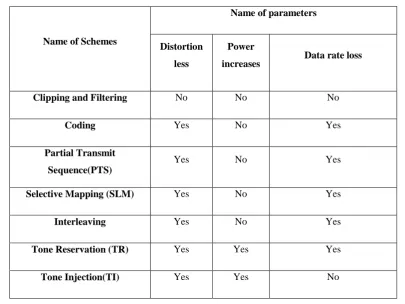
Table 4.1 shows the comparison of different PAPR reduction techniques. TABLE 4.1
COMPARISON OF DIFFERRENT PAPR REDUCTION TECHNIQUES
Name of Schemes
Name of parameters
Distortion
less
Power
increases Data rate loss
Clipping and Filtering No No No
Coding Yes No Yes
Partial Transmit
Sequence(PTS)
Yes No Yes
Selective Mapping (SLM) Yes No Yes
Interleaving Yes No Yes
Tone Reservation (TR) Yes Yes Yes
IV.
CONCLUSION
OFDM is a very attractive technique for wireless communications due to its spectrum efficiency and channel robustness. One of the serious drawbacks of OFDM systems is that the composite transmit signal can exhibit a very high PAPR, when the input sequences are highly correlated. In this paper, several important aspects of OFDM PAPR reduction are described as well as mathematical analysis is provided. This paper describes the different PAPR reduction techniques. All described techniques are used toreduce the PAPR in OFDM system. All techniques are different in their way, and using each technique, PAPR will be reduced at certain level.
REFERENCES
[1] R. W. Chang, “Synthesis of band limited orthogonal signals for multichannel data transmission”, Bell Syst. Tech J., Vol. 45, December 1996.
[2] Salzberg B. R., “Performance of an efficient parallel data transmission system”, IEEE transaction comm., Vol. COM-15, December 1967.
[3] Weinstein, S.B. and P.M. Ebert, “Data transmission by Frequency Division Multiplexing using the DFT”, IEEE Trans. Comm., Vol. COM-19, October 1971
[4] Tao Jian, Yiyan Wu, “An Overview: Peak to Average Power Ratio Reduction Techniques for OFDM Signals”, IEEE Transaction on broadcasting, Vol.54, No. 2, June 2008.
[5] H. Rohling et al., "OFDM Air Interface for the 4th Generation of Mobile Communication Systems," in Proc. 6th International OFDM Workshop, Hamburg, Germany, September 2000.
[6] Murthy T, Rao KD, “Effect of PAPR Reduction Techniques on the Performance of MB-OFDM UWB in Wireless Communications”, IETE J Res 2010;56:62-8
[7] Richard van Nee, Ramjee Prasad, “OFDM for wireless multimedia communications”, Artech House Publication, 2000.