ISSN 2286-4822 www.euacademic.org
Impact Factor: 3.1 (UIF) DRJI Value: 5.9 (B+)
Dynamic Analysis of High Rise Flat Plate Building
with Different Retrofitting Systems
RAJIB KUMAR BISWAS Graduate Student Department of Civil Engineering Ahsanullah University of Science and Technology Dr. Md. MAHMUDUR RAHMAN Professor Department of Civil Engineering Ahsanullah University of Science and Technology Bangladesh
Abstract:
Nowadays the world is going towards the implementation of performance based engineering analysis. However in some metropolitan cities like Bangladesh multi-storied flat plate buildings are still constructed in conventional ways. Those ordinary buildings designed without proper seismic consideration could be vulnerable to damage even under low level of ground shaking from distant location. This research paper intended to investigate the lateral stiffness increment of five types of cases based on whether they are retrofitted or not under dynamic loading. Among the cases four cases consisted of dual systems i.e. that retrofitted by shear wall and diagonal bracing only at exterior or exterior and centre frame. Valid results are obtained by Finite Element Analysis of a 15 storied flat plate garments building modeled using software package SAP 2000 for earthquake zone II in Bangladesh. The paper also deals with the structural response of the shear wall and diagonal bracing. Dynamic responses of our model under earthquake, El-Centro, have been investigated. This paper demonstrates the accuracy and exactness of Time History analysis in comparison with the most commonly adopted Response Spectrum Analysis and Equivalent Static Analysis.
I. Introduction:
Through the years flat plate attracts the eye of architects for its beautiful view and of engineers for its reduced floor height. But its demands get down because of its weakness to lateral forces. Because it does not allow any beam at its edge so necessarily due to deflection control, slab thickness needs to be increased. On the other hand, the world is becoming congested, so sky is the limit and the modern trend is towards taller and slender structures. But in Bangladesh engineers often don’t consider seismic behavior of those structures. So there should be much more detailed analysis to assure acceptable seismic performance beyond the elastic range. Time History and Response Spectrum analysis should be performed in high rise structures because it predicts the structural response more accurately in comparison with Equivalent Static analysis.
II. Methods of Dynamic Analysis:
carried out manually, but for complex structures, the finite element analysis can be used to calculate the mode shapes and frequencies.
Time History Analysis: It is an analysis of the dynamic response of the structure at each increment of time, when its base is subjected to a specific ground motion. Alternatively, recorded ground motions database from past natural events can be a reliable source for time histories but they are not recorded in any given site to include all seismological characteristics suitable for that site. Recorded ground motions are randomly selected from three main parameters in time history generation- analogous magnitude, distance and soil condition category.
Response Spectrum Analysis: It gives the maximum response of idealized single degree of freedom system having certain period and damping during earthquake ground motion. Here terms like maximum absolute acceleration, maximum relative velocity or maximum relative displacement can be described by plotting maximum response against un-damped natural frequency condition and various damping values.
III. Retrofitting Methods:
Retrofitting methods are systems of adding extra structural elements to provide resistance especially against earthquake. Its basic principle is to strengthen slab-column joints, wall connections etc. Practically it is called seismic retrofitting of structures. There are few types as follows: Conventional Strengthening Method, Traditional Method of Seismic Retrofitting, Retrofit of Structures Using Innovative materials, and Base Isolation.
The main objectives of present study include:
1. To analyze the dynamic effect of loads on building. 2. Dynamic analysis for seismic loads on framed structures using Time History Method, Response Spectrum Method and Equivalent Static Method.
3. To investigate the dynamic response under El–Centro earthquake.
V. Details of the Present Study:
General
Whenever we talk about a structure we always think about the loads it carries and its resistivity against it. For that, we have to know about the axial force, shear force, moment, stress and displacement of that structure. As we will try to know the behavior of our structures under dynamic loads, in this segment of our work we will show our data about displacement which is obtained by SAP2000 software analysis.
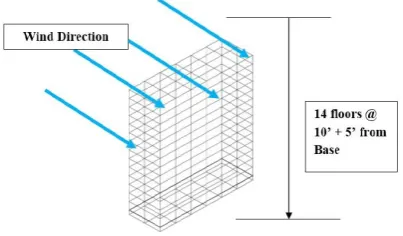
Figure 01: Conceptual Frame View (Grid Division)
Details of the Models
slabs are taken as .791 ft thick. The modulus of elasticity and shear modulus of concrete have been taken as E = 2.48×10⁷ kN/m2 and G = 1.03 ×10⁷ KN/m2.
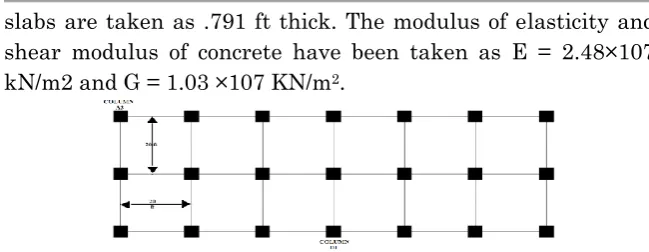
Fig 02: General plan view of a 15 story garments building
Here we studied 4 different cases. Case 01 has diagonal bracing only at exterior, in Case 02 there is bracing at both interior and exterior, in case 03 there is Shear Wall at exterior whereas in case 04 there is Shear Wall at both interior and exterior. In this study Shear wall section are taken as 8 inch thick and diagonal bracing are taken as 12 in x 12 inch.
V. Result and Discussion:
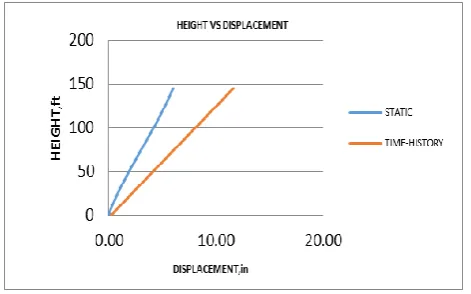
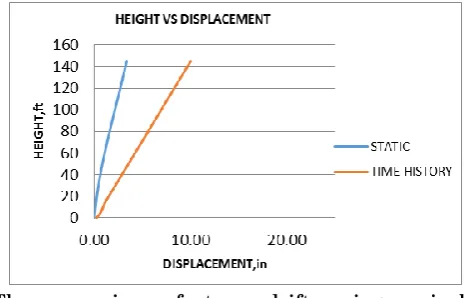
Equivalent static method is a linear static method for the seismic analysis whereas time-history method is a linear dynamic method. Fig. 01,02,03,04 illustrate the comparison of storey drift using equivalent static method and time-history method for fifteen store flat plate building with different retrofitting systems. The percentage variation between the two methods of analysis for the above cases are 54.7%, 48%, 54.60%, 66.4% respectively. A detail of percentage variation in storey drift of different models of shear walls is illustrated in Table 1.
Fig 01: The comparison of storey drifts using equivalent static method and time-history method for case 01
Fig 03: The comparison of storey drifts using equivalent static method and time-history method for case 03
Fig 04: The comparison of storey drifts using equivalent static method and time-history method for case 04
CASE TYPE PERCENT VARITION
CASE 01 54.7
CASE 02 48.2
CASE 03 54.6
CASE 04 66.1
Table 1 Percentage Variation in Storey Drift between Equivalent static and Time-history Method for Different type of cases.
Comparison between Equivalent Static Method and Response Spectrum Method:
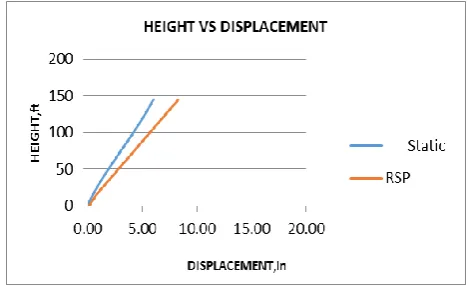
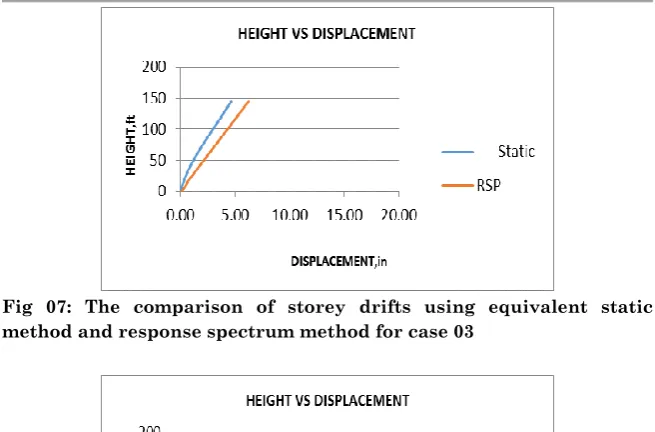
method for the seismic analysis whereas response spectrum method is a linear dynamic method. Fig.05, 06, 07, 08 illustrate the comparison of storey drift using equivalent static method and response spectrum method for fifteen storey flat plate building with different retrofitting systems. The percentage variation between the two methods of analysis for the above cases are 16.77%, 27.7%, 25.68%, 44.4% respectively. A detail of percentage variation in storey drift of different models of shear walls is illustrated in Table 2.
Fig 05: The comparison of storey drifts using equivalent static method and response spectrum method for case 01
Fig 07: The comparison of storey drifts using equivalent static method and response spectrum method for case 03
Fig 08: The comparison of storey drifts using equivalent static method and response spectrum method for case 04
CASE TYPE PERCENT VARITION
CASE 01 16.77
CASE 02 27.7
CASE 03 25.64
CASE 04 44.4
Table 2 Percentage Variation in Storey Drift between Equivalent static and Response Spectrum Method for Different type of cases:
Comparison between Response Spectrum Method and Time History Method:
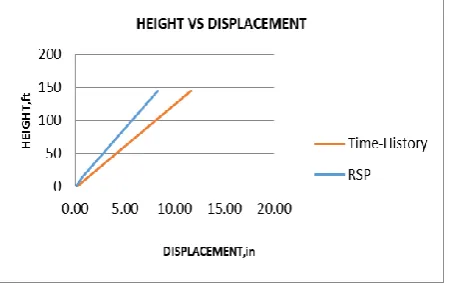
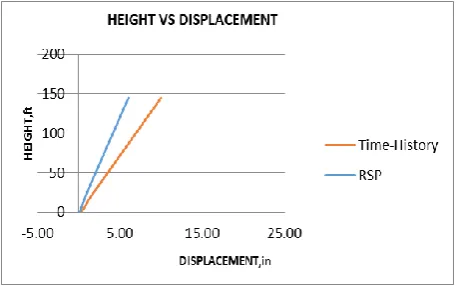
dependent effects when computing the structure’s dynamic response. A comparison for storey drift between responses Spectrum method and time history analysis is carried out for fifteen storey flat plate building with different retrofitting systems. Fig. 09,10,11,12 illustrates the comparison of storey drift using response spectrum method and time history method. The percentage variation between the two methods of analysis for the above cases is 45.6%, 28.78%, 40.00%, 39.5% respectively. A detail of percentage variation in storey drift of different models of shear walls is illustrated in Table 3.
Fig 09: The comparison of storey drifts using response spectrum and time-history method for case 01
Fig 11: The comparison of storey drifts using response spectrum and time-history method for case 03
Fig 12: The comparison of storey drifts using response spectrum and time-history method for case 04
CASE TYPE PERCENT VARITION
CASE 01 45.6
CASE 02 28.78
CASE 03 40.01
CASE 04 39.5
Table 03 Percentage Variation in Storey Drift between Time-History and Response Spectrum Method for Different type of cases
VI. Conclusions:
buildings. For higher buildings, Response Spectrum method should be used. For important structures Time History Analysis should be performed because it predicts the structural response more accurately in comparison with other two methods since it incorporates p - Δ effects and material non linearity which is true in real structures.
On the other hand flat plate is good from the perspective of gravity load. But it has been experienced that flat plate building can’t stand strongly against wind, seismic or other lateral forces. As a result, more than any other structural components, the lateral force-resisting structure has significant impact on space planning. Therefore, it is essential for a structure to have lateral resistance to withstand dynamic load. To do the initial schematic design in the right way it is important to recognize that it is critical to consider lateral forces from the very start and to integrate lateral force – resisting structure.
From the above studies it is evident that MODEL 4 is the most effective and MODEL 1 is the least effective under dynamic loading. It is found that displacements in dynamic analysis are higher in comparison to equivalent static method analysis. Therefore, in addition to equivalent static method analysis, detail dynamic analysis (Time history and Response spectrum analysis) should be performed for important high rise structures.
BIBLIOGRAPHY:
Chopra, A. K. 1995. Dynamics of structures theory and
applications to earthquake engineering. Englewood
Cliffs: N.J. Prentice-Hall.
Bracing Under Wind and Seismic Loads”. Journal of
Mechanical and Civil Engineering 9(2): 97-101.
Bungale, S. T. 2005. Wind and Earthquake ResistantBuildings
Structural Analysis and Design Monticello, New York
12701, U.S.A.
Chowdhury, Arman, Biswas, R.K, M.N. Nazmul Hoq, and S.M. Iskander. 2013. “Evaluation of the structural implication of Incorporating Base Isolator as Earthquake Protection Device.” International Organization of Scientific Research (IOSR)-International Journal of Mechanical
and Civil Engineering 8(1): 27-30.
Dinar, Y., N. Alam, and S. C. Paul. 2013. “Performance Based Analysis of RC building consisting Shear wall and varying infill percentage.” European Academic Research
1(10): 260-268.
Dinar, Y., N. U. Rahi, and P. Das. 2013. “Variation of Deflection of Steel High-Rise Structure Due to P- Delta Effect considering Global Slenderness Ratio.” International Journal of Emerging Technology and Advanced
Engineering 3(12): 250-256.
Mohan, Romy. C. Prabha. 2011. “Dynamic Analysis of RCC Buildings with Shear Wall.” International Journal of
Earth Sciences and Engineering 4(6): 659-662.
Nanduri, P.M.B. Raj Kiran, B. Dean Kumar, Y. Chandrasekhar, B.L.P. Swami. 2012. “Comparative Study of Wind Load Analysis of Flat Plate Multistoried Frames With and without Reinforced Concrete Infilled Walls”. International Journal of Emerging Technology