De Novo
Generation and
Characterization of New Zika Virus
Isolate Using Sequence Data from a
Microcephaly Case
Yin Xiang Setoh,
aNatalie A. Prow,
bNias Peng,
aLeon E. Hugo,
cGregor Devine,
cJessamine E. Hazlewood,
bAndreas Suhrbier,
bAlexander A. Khromykh
a Australian Infectious Diseases Research Centre, School of Chemistry and Molecular Biosciences, University of Queensland, St. Lucia, Queensland, Australiaa; Inflammation Biology Group, QIMR Berghofer Medical ResearchInstitute, Brisbane, Queensland, Australiab; Mosquito Control Group, QIMR Berghofer Medical Research
Institute, Brisbane, Queensland, Australiac
ABSTRACT
Zika virus (ZIKV) has recently emerged and is the etiological agent of
congenital Zika syndrome (CZS), a spectrum of congenital abnormalities arising from
neural tissue infections
in utero
. Herein, we describe the
de novo
generation of a
new ZIKV isolate, ZIKV
Natal, using a modified circular polymerase extension reaction
protocol and sequence data obtained from a ZIKV-infected fetus with microcephaly.
ZIKV
Natalthus has no laboratory passage history and is unequivocally associated with
CZS. ZIKV
Natalcould be used to establish a fetal brain infection model in IFNAR
⫺/⫺mice (including intrauterine growth restriction) without causing symptomatic
infec-tions in dams. ZIKV
Natalwas also able to be transmitted by
Aedes aegypti
mosqui-toes. ZIKV
Natalthus retains key aspects of circulating pathogenic ZIKVs and illustrates
a novel methodology for obtaining an authentic functional viral isolate by using
data from deep sequencing of infected tissues.
IMPORTANCE
The major complications of an ongoing Zika virus outbreak in the
Americas and Asia are congenital defects caused by the virus’s ability to cross the
placenta and infect the fetal brain. The ability to generate molecular tools to analyze
viral isolates from the current outbreak is essential for furthering our understanding
of how these viruses cause congenital defects. The majority of existing viral isolates
and infectious cDNA clones generated from them have undergone various numbers
of passages in cell culture and/or suckling mice, which is likely to result in the
accu-mulation of adaptive mutations that may affect viral properties. The approach
de-scribed herein allows rapid generation of new, fully functional Zika virus isolates
di-rectly from deep sequencing data from virus-infected tissues without the need for
prior virus passaging and for the generation and propagation of full-length cDNA
clones. The approach should be applicable to other medically important flaviviruses
and perhaps other positive-strand RNA viruses.
KEYWORDS
infectious DNA, Zika virus, flavivirus, mouse model
Zika virus (ZIKV) is a mosquito-borne flavivirus that has recently reemerged, with
transmission now reported in
⬎
70 countries and territories (1). In 2016, the World
Health Organization declared the ZIKV pandemic a public health emergency of
inter-national concern (2). In humans, an estimated 80% of primary infections with ZIKV
appear to be asymptomatic (3), with the majority of symptomatic cases showing mild
disease (including rash, conjunctivitis, arthralgia, myalgia, and fever), although infection
can occasionally lead to Guillain-Barré syndrome (1, 3, 4). The primary concern is
infection of pregnant mothers, which can lead to the virus infecting (and thereby
Received27 April 2017Accepted2 May 2017 Published17 May 2017
CitationSetoh YX, Prow NA, Peng N, Hugo LE, Devine G, Hazlewood JE, Suhrbier A, Khromykh AA. 2017.De novogeneration and
characterization of new Zika virus isolate using sequence data from a microcephaly case. mSphere 2:e00190-17.https://doi.org/10.1128/ mSphereDirect.00190-17.
EditorW. Paul Duprex, Boston University School of Medicine
Copyright© 2017 Setoh et al. This is an open-access article distributed under the terms of theCreative Commons Attribution 4.0 International license.
Address correspondence to Andreas Suhrbier, [email protected], or Alexander A. Khromykh,
Y.X.S. and N.A.P. are equal first authors and A.S. and A.A.K. are equal senior authors. Solicited external reviewers: Matthew Evans, Icahn School of Medicine at Mount Sinai; Ted Pierson, National Institute of Allergy and Infectious Diseases.
This paper was submitted via the mSphereDirect™ pathway.
De novo generation and characterisation of human Zika virus isolate unequivocally associated with microcephaly
Host-Microbe Biology
crossm
on September 8, 2020 by guest
http://msphere.asm.org/
damaging) the fetal brain, resulting in a range of congenital birth defects now
recog-nized as congenital Zika syndrome (CZS) (1, 3). In a recent study of symptomatic
mothers, abnormal clinical or brain imaging findings were seen in 55% of the infants
born to mothers infected in the first trimester, 52% of the infants born to mothers
infected in the second trimester, and 29% of the infants born to mothers infected in the
third trimester (5). In that study, microcephaly was evident in 3.4% of the neonates
examined, with microcephaly usually associated with fetal growth restriction. There is
also emerging evidence that children who were infected
in utero
but showed no overt
congenital defects at birth manifest a range of disabilities over time (1, 5, 6).
One of the first cases of ZIKV-associated severe microcephaly was identified in 2015
in an aborted fetus from a mother who was infected with ZIKV during the first trimester
of pregnancy while living in the Natal region of Brazil (7). Viral RNA, viral proteins, and
viral particles were detected in fetal brain tissues (7), and a complete genome sequence
of the virus was obtained by next-generation sequencing of brain tissue (GenBank
accession number
KU527068
). This ZIKV
Natalsequence therefore represents a ZIKV
sequence unequivocally associated with a human case of microcephaly and is free of
any potential adaptive mutations arising from serial passage, for instance, in cells
in
vitro
or in suckling mice.
Flavivirus infectious cDNA clones have facilitated numerous scientific discoveries
over the years; however, the well-documented instability of plasmids harboring
full-length flavivirus cDNA sequences during propagation in bacteria remains an issue.
Recently, three groups have independently reported that the toxicity of ZIKV sequences
has hindered the stable propagation in bacteria of plasmid DNAs harboring full-length
ZIKV cDNA (8–10), with insertion of introns required to resolve the issue (9, 10).
We have recently developed and optimized a protocol to generate
de novo
infec-tious flaviviruses that does not involve the generation of DNA plasmids encoding the
complete viral genome or
in vitro
RNA transcription. The method, based on the circular
polymerase extension cloning protocols described previously (11), significantly
simpli-fies and accelerates the process of
de novo
virus generation (12, 13). The protocol
involves the generation of a circular DNA (with high-fidelity polymerase) that
encom-passes the entire viral cDNA sequence
in vitro
. A cytomegalovirus (CMV) promoter sits
directly upstream of the first nucleotide of viral cDNA, and following the transfection of
circular polymerase extension reaction (CPER) products into mammalian cells, viral RNA
is synthesized and infectious virus is recovered. The protocol has been successfully used
to generate wild-type (WT) and mutant West Nile viruses (13), chimeric viruses
con-sisting of different West Nile virus strains (12), and chimeric viruses concon-sisting of West
Nile virus and Brazilian Rocio virus (14).
Herein, we describe the application of a modified CPER protocol to generate an
infectious ZIKV
Natalisolate
de novo
from a published sequence. We describe the
behavior of this new isolate
in vitro
, in mouse models, and in
Aedes aegypti
mosquitoes.
RESULTS
Recovery of infectious ZIKV
Natalfrom the published sequence.
The sequence of
ZIKV
Natal(derived by deep sequencing of an infected fetal brain [7]) was obtained from
GenBank (accession number
KU527068
). Seven overlapping double-stranded DNA
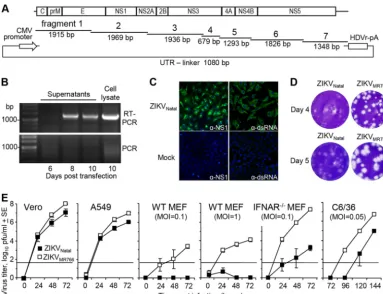
(dsDNA) fragments covering the entire viral sequence (Fig. 1A) were cloned into pUC19
vectors. An eighth pUC19 plasmid contained the untranslated region (UTR) linker,
which comprised the minimal CMV promoter and the first 22 nucleotides (nt) of the
viral sequence at one end and the last 22 nt of the viral sequence, the hepatitis delta
virus ribozyme (HDVr) site, and a polyadenylation (pA) signal at the other (Fig. 1A). The
CMV promoter initiates viral RNA transcription, and the HDVr sequence ensures
au-thentic formation of the 3
=
UTR. These plasmids were then used to generate cDNA
fragments by PCR, with the resulting eight dsDNA fragments mixed in equimolar
amounts and subjected to 12 cycles of CPER with Q5 DNA polymerase. The CPER
products were then transfected into Vero cells, and on days 6, 8, and 10 after
transfection, the tissue culture supernatants were harvested. The presence of viral RNA
on September 8, 2020 by guest
http://msphere.asm.org/
in the supernatants was demonstrated by reverse transcription (RT)-PCR of isolated RNA
with fragment 5-specific primers, with the minus RT control showing no bands (Fig. 1B).
Further confirmation of virus recovery was obtained by immunofluorescent-antibody
staining of Vero cells with anti-NS1 and anti-dsRNA antibodies 3 days after infection
with the day 10 supernatant (Fig. 1C).
The viral titer in the day 10 supernatant was 5
⫻
10
5PFU/ml, as determined by
plaque assay on Vero cells. This virus (passage 0) was amplified in C6/36 cells in two
independent expansions to produce passage 1 virus stocks that were used in
subse-quent experiments, i.e., (i) infection at a multiplicity of infection (MOI) of 0.001, reaching
7.6 log10
50% cell culture infective doses (CCID50) by day 5, and (ii) infection at an MOI
of 0.003, reaching 4.5
⫻
10
7PFU/ml on day 6 and 1.25
⫻
10
8PFU/ml on day 8. In a
separate experiment, a different DNA polymerase, PrimeSTAR GXL, was used to
gen-erate circular DNA by CPER. Transfection of this DNA resulted in the recovery of higher
virus titers by day 10 after transfection (passage 0, 2.6
⫻
10
7PFU/ml). These results
illustrate that the modified CPER protocol can efficiently produce high titers of ZIKV
either directly after transfection or after a single passage.
Sequencing of ZIKV
Natal.
RNA from virus recovered from day 10 supernatants
(Fig. 1B) was used to generate amplicons by RT-PCR, which were then subjected to
FIG 1 De novogeneration of infectious ZIKVNatalby CPER. (A) Schematic representation of CPER assembly with seven synthetic DNA fragments covering the entire genome of ZIKVNatalwith ~22-nt overlapping ends. The fragments were mixed with the UTR linker, which contained the CMV promoter followed by the first 22 nt of ZIKVNataland, at the other end, the last 22 nt of ZIKVNatal, an HDVr site, and a poly(A) tail (pA). After CPER, the products were transfected into Vero cells. (B) On the posttransfection days indicated, RNA was isolated from Vero cell supernatants and a cell lysate and subjected to RT-PCR with fragment 5-specific primers (RT-PCR). To demonstrate that the bands were not due to contaminating DNA, a control (RT minus) PCR was performed in parallel (PCR). (C) Vero cells were infected with ZIKVNatal(culture supernatant from day 10 posttransfection), and mock-infected cells were used as controls. At 3 days postinfection, Vero cells were analyzed by immunofluorescent-antibody staining with anti-NS1 (4G4) and anti-dsRNA (3G1) antibodies (green) and DAPI counter-stain (blue). (D) Plaque morphology following infection of Vero cells with ZIKVNataland ZIKVMR766. Vero cells were fixed and stained with crystal violet on the postinfection days indicated. (E) Growth kinetics of ZIKVNataland ZIKVMR766in the cell lines indicated. Infection was performed at an MOI of 0.1, unless otherwise indicated. Virus titers in the culture supernatants were determined by plaque assays on Vero cells. The data and standard errors (SE) shown are from six independent experiments with Vero cells, A549 cells, and WT MEFs (MOI of 1) and three independent experiments with WT MEFs (MOI of 0.1), IFNAR⫺/⫺MEFs, and C6/36 cells. The horizontal line represents the limit of detection (50 PFU/ml).
on September 8, 2020 by guest
http://msphere.asm.org/
deep sequencing with the Illumina MiSeq platform. A total of 451,583 reads were
mapped to 100% of the genome, with a mean read coverage of 5,734. The sequencing
quality scores were 83.4% at Q20 and 76.2% at Q30. The only changes from the
consensus published sequence (accession no.
KU527068
) were polymorphisms at nt
4328 at the start of the NS2B gene (C to T; a read coverage, 9,170, 83% T, 14% C); nt
4574 at the end of the NS2B gene (A to G; read coverage, 10,322; 98% G); and nt 5900
in the NS3 gene (C to T; read coverage, 3,960; 47% C, 51% T). None of these nucleotide
changes introduced amino acid changes. The remaining sequence matched the
pub-lished sequence.
In vitro
growth properties of recovered ZIKV
Natalcompared with those of the
prototype African MR766 isolate.
The plaque morphology of ZIKV
Natalwas compared
with that of the prototype mouse-adapted African isolate ZIKVMR766
in Vero cells. The
plaques generated by ZIKVNatal
were generally smaller and less distinct than those
produced by ZIKVMR766
(Fig. 1D).
Analysis of growth kinetics revealed that ZIKVNatal
replicated less efficiently than
ZIKVMR766
in Vero, A549, and C6/36 cells and in IFNAR
⫺/⫺mouse embryonic fibroblasts
(MEFs) infected at an MOI of 0.1 (determined on the basis of viral titers in Vero cells)
(Fig. 1E). ZIKVNatal
was unable to replicate efficiently in WT MEFs infected at an MOI of
0.1 or 1 on the basis of viral titers determined in Vero cells (Fig. 1E, WT MEFs). In
contrast, ZIKVMR766
did replicate in these cells, perhaps reflecting the fact that
ZIKVMR766
has been mouse adapted, with more than 100 serial passages in mouse
brains (15, 16). ZIKVMR766
also grew substantially better in IFNAR
⫺/⫺MEFs than ZIKVNatal
did (Fig. 1E, IFNAR
⫺/⫺MEFs).
ZIKV
Natalinfection of WT, IFNAR
ⴚ/ⴚ, and IRF7
ⴚ/ⴚmice.
ZIKV infection of WT mice
generally does not produce detectable viremia (17). We similarly were unable to detect
viremia in WT (C57BL/6J) mice after subcutaneous (s.c.) infection with ZIKV
MR766or
ZIKV
Natalby CCID
50assays. Even intravaginal infection (18) with a dose of 6 log
10CCID
50of ZIKV
Natalfailed to produce detectable viremia (data not shown).
A number of mouse ZIKV models have used IFNAR
⫺/⫺mice (17), and ZIKV
Natal
(10
3CCID
50s.c.) produced a 4- to 5-day viremia in IFNAR
⫺/⫺mice that was ~1 to 4 logs
lower than that produced by infection with the same dose of ZIKV
MR766(Fig. 2A).
Increasing the s.c. ZIKV
Natalinfection dose to 6 log
10CCID
50increased the peak viremia
by 2 to 3 logs (see Fig. S1A in the supplemental material).
ZIKV
MR766infection of IFNAR
⫺/⫺mice was always highly symptomatic, and all mice
reached ethically defined endpoints requiring euthanasia by days 7 to 9 (Fig. 2B),
consistent with previous reports (17, 19). In contrast, s.c. ZIKV
Natalinfection of female
IFNAR
⫺/⫺mice (
⬎
8 weeks of age) with a range of viral inoculation doses (3 to 6 log
10
CCID
50) resulted in a 100% survival rate, with no animals displaying any symptoms
(Fig. 2B). Nevertheless, ZIKV
Natalcould produce symptomatic infections in IFNAR
⫺/⫺FIG 2 ZIKVNatalinfection of IFNAR⫺/⫺and IRF7⫺/⫺mice. (A) Viremia in IFNAR⫺/⫺mice (female, 8 to 12 weeks old) after infection with ZIKVNatalor ZIKVMR766(s.c., 3 log10CCID50), determined by CCID50assays (n⫽5 for ZIKVNatal,n⫽11 for ZIKVMR766). Limit of detection, 2 log10CCID50. (B) Survival of IFNAR⫺/⫺mice (female, 8 to 12 weeks old) after s.c. infection with ZIKVNatalor ZIKVMR766. The dose of ZIKVMR766was 103CCID50(n⫽13). A range of viral doses of ZIKVNatalwere tested, i.e., 103CCID
50(n⫽8), 104CCID50(n⫽5), 105CCID50(n⫽5), and 106CCID50(n⫽6), with no mice requiring euthanasia. (C) Viremia in IRF7⫺/⫺mice (female, 8 to 12 weeks old) after infection with ZIKV
Natalor ZIKVMR766(s.c., 3 log10CCID50) (n⫽ 3 to 5). SE, standard error.
on September 8, 2020 by guest
http://msphere.asm.org/
mice requiring euthanasia in 30 to 40% of the animals when (i) 4-week-old IFNAR
⫺/⫺mice were infected s.c. with 3 log10
CCID50
(consistent with age-dependent
suscepti-bility in flavivirus models [20]) or when (ii) 8- to 12-week-old mice were infected
intraperitoneally with 5 log10
CCID50
(see Fig. S1B).
ZIKVNatal
and ZIKVMR766
infections of IRF7
⫺/⫺mice were also examined, with both
viruses producing detectable viremia (Fig. 2C). Although mild hunching was observed
for 1 to 2 days after ZIKVMR766
infection, no IRF7
⫺/⫺mice required euthanasia after s.c.
infection with either virus at 3 log10
CCID50. Infection of IRF7
⫺/⫺mice with increasing
s.c. doses of ZIKVNatal
ranging from 3 (Fig. 3C) to 6 log10
CCID50
brought forward but
did not significantly increase the peak viremia, and the mice did not show any
symptoms (see Fig. S1A).
ZIKV
Natalfetal infection of IFNAR
ⴚ/ⴚdams.
Highly symptomatic infection of dams
complicates the ability to establish an ethically acceptable fetal ZIKV infection model.
As s.c. ZIKV
Natalinfection of IFNAR
⫺/⫺mice
⬎
8 weeks old was asymptomatic, these
conditions were used to infect pregnant dams at embryonic day 6.5 (E6.5; early
pregnancy) and E12.5 (mid pregnancy), nominally the first and second trimesters (21),
with a range of ZIKV
Nataldoses. Dams and fetuses were euthanized at E17.5/E18.5, and
(i) fetuses were photographed (Fig. 3A), (ii) the pregnancy outcomes were quantitated
(Fig. 3B), and (iii) the viral tissue titers in the placentas and heads of selected fetuses
were determined by CCID
50assays (Fig. 3C). Intrauterine growth restriction (IUGR)
(described previously in mice [18, 22] and humans [5]) was observed at doses of 3 to
4 log
10CCID
50and infection at E6.5 (Fig. 3A and B, fetuses facing left). With larger doses
(4 to 6 log
10CCID
50), severely deformed fetal/placental masses were evident (Fig. 3A),
with such outcomes and abortions (reported previously [21]) increasing with the
inoculation dose (Fig. 3B).
FIG 3 Pregnancy outcomes of ZIKVNatal-infected IFNAR⫺/⫺dams. (A) Examples of E17.5/E18.5 fetuses from IFNAR⫺/⫺⫻IFNAR⫺/⫺mating after s.c. infection of dams (⬎8 weeks of age) at E6 (or E12.5 [*]) with the ZIKVNataldoses indicated. Fetuses with clear signs of IUGR are shown facing left.*, Severely deformed fetus and placenta. Severely deformed fetal/placental masses are also shown in the right two images in row 10^5 and all of the images in row 10^6. (B) The percentages of fetuses that appeared normal, showed IUGR, and were severally deformed are shown. Data are from three pregnancies per group (mean of 7.78 ⫾1.55 [standard deviation] fetuses per pregnancy). White bars indicate that one (33%) or two (66%) of the dams aborted. (C) Placenta and head virus titers of fetuses after large-and small-dose ZIKVNatalinfection of dams at E6 or E12.5.*, Fetus with IUGR shown at the top right of panel A;**, severally deformed fetal/placental masses. ND, not detected.
on September 8, 2020 by guest
http://msphere.asm.org/
Most placentas contained high titers of virus after inoculation with large or small
doses of ZIKANatal
at either E6.5 or E12.5 (Fig. 3C). As might be expected, the head of
a fetus with IUGR and the deformed fetal/placental masses contained infectious ZIKV
(Fig. 3C). The heads of some outwardly normal fetuses were also infected, with titers 2
to 3 logs lower than the corresponding placental titers (Fig. 3C). At the 3 log10
CCID50
dose, many head titers were below the limit of detection, which was not the case at 6
log10
CCID50
(Fig. 3C).
Infection of IRF7
⫺/⫺dams at E6.5 with a s.c. dose of 4 or 6 log10
CCID50
of ZIKVNatal
did not result in detectable replicating virus in the placentas or the fetal heads (
n
⫽
3
for each dose). Male IFNAR
⫺/⫺mice could also be infected, with the testes becoming
infected (see Fig. S1C), consistent with previous reports (19).
ZIKV
Natalinfection of
A. aegypti
mosquitoes.
The main vector species in the
Brazilian outbreak of ZIKV was
A. aegypti
(23–25). To determine whether ZIKV
Natalretains the ability to be transmitted by
A. aegypti
, standard artificial membrane feeding
(with blood containing ZIKV
Natal) was undertaken and mosquito infection was assessed
by CCID
50assays after 14 days. Half of the successfully blood-fed mosquitoes contained
detectable replicating virus, with whole-body titers ranging from 4.5 to 7.5 log
10/
CCID
50/ml (one mosquito was macerated in 1 ml of medium) (Fig. 4A). Saliva was also
collected from individual mosquitoes in a separate group of 20 (fed as described above
and also tested 14 days postfeeding) by allowing the mosquitoes to salivate into
capillary tubes containing a sucrose solution. Salivary expectorant from three
mosqui-toes (15%) contained detectable ZIKV, supporting the view that ZIKV
Natalretains the
ability to be transmitted by
A. aegypti
. As mosquitoes expectorate an estimated 0.11 to
24 nl of saliva (26), the 2.6-log
10CCID
50/ml titer (Fig. 3B) represents an estimated titer
in saliva of 5.2 to 7.6 log
10CCID
50/ml.
Immunofluorescent-antibody staining of whole mosquitoes (fed as described above,
14 days postfeeding) with 4G4 (pan-flavivirus anti-NS1 antibody) showed abundant
staining of midgut cells, and in some mosquitoes, clear staining of the salivary glands
was also evident (Fig. 3C). Taken together, these experiments argue that ZIKV
Natalremains mosquito transmission competent.
DISCUSSION
Herein, we describe the
de novo
generation of ZIKV
Natalby a modified CPER protocol,
with the resulting virus sequence identical (except for three synonymous nucleotide
changes) to the published sequence obtained by next-generation sequencing of
infected fetal brain tissue (7). ZIKV
Nataltherefore represents the first ZIKV isolate without
any passage history in cells and/or mice. In addition, as no virus isolate was obtained
FIG 4 A. aegyptiinfection with ZIKVNatal. (A)A. aegyptimosquitoes were artificially fed blood meals containing ZIKVNatal, and after 14 days, the mosquitoes were homogenized in 1 ml of medium and viral titers were determined by CCID50assay. The limit of detection was 2 log10CCID50/ml of medium. (B) Same as for panel A, except that saliva was collected from a separate group of mosquitoes by allowing them to salivate into capillary tubes containing 10l of a sucrose-FBS solution. Titers were determined by CCID50assay and represent the titers per milliliter of sucrose-FBS solution. The limit of detection was 2.6 log10CCID50/ml. (C) Same as for panel A, except that mosquitoes were examined by fluorescence immunohisto-chemistry with 4G4, a flavivirus-specific antibody. M, midgut; H, head; S, salivary gland.
on September 8, 2020 by guest
http://msphere.asm.org/
from the original brain tissues (7), this study also illustrates a novel pathway for
obtaining a new virus isolate (next-generation sequencing of infected tissues, followed
by
de novo
virus generation via CPER). Furthermore, ZIKV
Natalwas able to infect fetal
brains and cause IUGR in IFNAR
⫺/⫺fetuses and appears to retain the ability to be
transmitted by
A. aegypti
mosquitoes. The CPER protocol thus provides a rapid method
for obtaining an infectious flavivirus isolate from publically available sequence data
without the need for international transport of infectious material.
A similar PCR-based protocol to generate African and Asian ZIKV isolates, as well as
chimeric viruses, was recently reported that uses three DNA fragments covering the
genome overlapping by ~70 to 80 nt (27). However, no joining of these fragments into
circular DNA was performed. This may explain the relatively inefficient virus recovery
observed in the study of Atieh et al., which required two passages to obtain viral titers
of ~4 log
10CCID
50/ml for the Asian isolate and ~5 log
10CCID
50/ml for the African
isolate. In contrast, the titers of passage 0 ZIKV
Natalgenerated in two different CPER and
transfection experiments in our study were 5
⫻
10
5and 2.6
⫻
10
7PFU/ml, respectively,
and after one passage of the former, the virus reached a titer of 1.25
⫻
10
8PFU/ml or
7.6 log
10CCID
50/ml. The difference in the titers of viruses obtained in two different
CPER assembly and transfection experiments is likely due to the differences in the
processivity of the Q5 and PrimeSTAR GXL DNA polymerases, as well as the different
cycling conditions used (more cycles and longer extension times for PrimeSTAR GXL
DNA polymerase produced a higher virus titer), rather than the potential presence of
mutations that could affect the infectivity of CPER-generated DNAs. Notably, CPER does
not amplify DNA as conventional PCR would; it only doubles the amount of DNA by
extending the gaps between annealed regions of fragments for each strand. Once
polymerase reaches the next annealed region, it stops. Thus, unlike PCR, CPER is not an
amplification process and therefore will not accumulate mutations as PCR could. In
addition, both polymerases are high fidelity; hence, the introduction of different
nucleotide changes in different independent experiments that could result in different
infectivities of each CPER-generated DNA is unlikely.
A range of mouse models to study fetal infections by ZIKV have been reported (17).
A range of strategies have been used to overcome the poor replication of ZIKV in WT
mice, including (i) injection with anti-Ifnar1 monoclonal antibody (28, 29), (ii) infection
via the intraperitoneal route later in pregnancy (E13.5) (30) or infection via the
intra-vaginal route (18) (although fetal brain infection was only detectable by
immuno-fluorescent-antibody staining), (iii) the use of SJL mice and very high doses of virus (22),
(vi) direct intrauterine inoculation (31), and (v) infection of neonates (32). However, ZIKV
does replicate in type I interferon response-deficient mice, with the use of IFNAR
⫺/⫺mice widely adopted (17). Infection of IFNAR
⫺/⫺mice with many ZIKV isolates is often
highly symptomatic and lethal (17), although some recent isolates are showing reduced
lethality in these mice (33, 34). A model using IFNAR
⫺/⫺females mated with WT males
to produce IFNAR
⫹/⫺fetuses has been described, although maternal illness and demise
and resorption of the majority of fetuses were noted (29). As ZIKV
Natalinfection of
IFNAR
⫺/⫺mice (
⬎
8 weeks old) via the s.c. route was asymptomatic and nonlethal, this
system allowed infection of pregnant dams with minimal ethical concerns. Fetal head
infections and the occurrence of IUGR in ZIKV
Natal-infected IFNAR
⫺/⫺fetuses illustrate
that this model recapitulates key elements of CZS.
In ZIKV
Natal-infected IFNAR
⫺/⫺fetuses, when heads were infected, the
correspond-ing placentas always had higher viral titers. In IFNAR
⫺/⫺mice, a range of placental cells
appear to be infected (29). In humans, infection is largely restricted to Hofbauer cells,
with placental trophoblasts thought to be protected from ZIKV infection by gamma
interferon (35, 36), an activity that would clearly be absent in IFNAR
⫺/⫺mice. How,
exactly, the virus traverses the placenta in humans remains unclear (3, 35–38). Although
transplacental infection with other members of the flavivirus genus has only rarely been
reported (3), perhaps of note, a virus in the pestivirus genus (family
Flaviviridae
), bovine
viral diarrhea virus, can infect placental trophoblasts, leading to transplacental infection
and congenital abnormalities (39, 40).
on September 8, 2020 by guest
http://msphere.asm.org/
Our results support the view that ZIKV
Natalretains the ability to be transmitted by
A. aegypti
mosquitoes, with the difference in the percentage of mosquitoes infected
and the percentage with infectious saliva broadly consistent with the reported rates for
a variety of ZIKV isolates in these mosquitoes (23, 25). Previous studies have shown
that Australian
A. aegypti
can transmit the ZIKA
MR766isolate (23), and our results
now extend these findings to include a Brazilian ZIKV isolate associated with CZS.
Australia has seen 128 imported ZIKV cases, 85 confirmed and the rest suspected
(
http://health.gov.au/internet/main/publishing.nsf/Content/ohp-vectorborne-overseas-acquired.htm
; accessed 3 November 2017).
In summary, we have generated a new ZIKV isolate, ZIKV
Natal, from sequence data
and characterized the
in vitro
growth properties of the virus against those of the
prototype, ZIKV
MR766. Additionally, we have shown that it can recapitulate key aspects
of CZS in a mouse model and can be transmitted by
A. aegypti
mosquitoes. ZIKV
Natalshould thus find utility in future laboratory studies on ZIKV and provide a system for
testing new interventions against ZIKV.
MATERIALS AND METHODS
Generation of ZIKVNatalby CPER.Seven dsDNA fragments covering the entire viral sequence (accession number KU527068) (Fig. 1A) were purchased from Integrated DNA Technologies, Inc. (Baulkham Hills, NSW, Australia), as Gblocks, and each was cloned into a separate pUC19 vector. For fragment 7, the last nucleotide (T) from the Gblocks gene fragment was omitted, as all flaviviruses end with TCT at the 3=UTR, rather than the published TCTT sequence. These plasmids were grown in DH5␣, the inserted sequences were verified, and the plasmids were then used to generate viral cDNA fragments by PCR (Fig. 1A). An additional PCR fragment (UTR linker) was generated from plasmid pUC19 containing the minimal CMV promoter, the first and the last 22 nt of the ZIKVNatalsequence, the HDVr, and a pA signal (Fig. 1A). PCR fragments were generated with high-fidelity Q5 DNA polymerase and primer pairs that have complementary ends with a 24- to 30-nucleotide overlap (see Table S1). The resulting eight DNA fragments were then mixed in equimolar amounts (0.1 pmol each) and subjected to CPER with Q5 DNA polymerase (an initial 3 min of incubation at 98°C; 2 cycles of 30 s at 98°C, 30 s at 55°C, and 6 min at 72°C; and 10 cycles of 30 s at 98°C, 30 s at 55°C, and 72°C for 8 min) to generate circular DNA (Fig. 1A). In a separate CPER protocol, PrimeSTAR GXL DNA polymerase (TaKaRa) was used with the same eight PCR fragments (0.1 pmol each) but different cycling conditions (an initial 2 min of denaturation at 98°C; 20 cycles of 10 s at 98°C, 15 s at 55°C, and 12 min at 68°C; and a final extension for 12 min at 68°C.
The CPER products were then transfected directly (without additional purification) into Vero cells with Lipofectamine LTX Plus transfection reagent (Life Technologies, Inc.), in accordance with the manufacturer’s instructions. At 6, 8, and 10 days after transfection, the culture supernatants were harvested. Day 10 supernatant (from the Q5 polymerase-generated CPER transfection) was expanded once in C6/36 cells (to produce passage 1 virus), aliquoted, and stored at⫺80°C prior to use in further experiments.
RT-PCR for detection of viral RNA.The cell culture supernatants collected at various time points posttransfection were subjected to RQ1 DNase (Promega) treatment to digest any CPER DNA left over from transfection; this was followed by viral RNA isolation with the NucleoSpin RNA Virus kit (Macherey-Nagel) and RT-PCR amplification with the SuperScript III One-Step RT-PCR System and platinumTaqDNA polymerase (Life Technologies, Inc.) with primers specific for the amplification of fragment 5 (30 min at 55°C; 2 min at 94°C; 35 cycles of 15 s at 94°C, 30 s at 55°C, and 2 min at 68°C; and a final extension for 5 min at 68°C). Total cell RNA was also isolated from transfected cells at day 10 after transfection and subjected to RT-PCR with the same primers and under the same cycling conditions. PCR amplification of viral RNA isolated from transfected cell supernatant and of total RNA from transfected cells was performed without RT with Q5 DNA polymerase (NEB) (3 min at 98°C; 35 cycles of 15 s at 98°C, 30 s at 55°C, and 2 min at 72°C; and a final extension for 5 min at 72°C) to confirm the lack of CPER DNA contamination.
Immunofluorescent-antibody staining. Vero cells were infected with the 10-day transfection supernatant, fixed with 100% acetone 3 days after infection, and stained with 4G4 (anti-NS1) (41) and 3G1 (anti-dsRNA) (42) antibodies and an Alexa Fluor 488-labeled goat anti-mouse IgG secondary antibody (Life Technologies, Inc.). Coverslips were mounted with ProLong Gold Antifade Mountant with 4’,6-diamidino-2-phenylindole (DAPI; Life Technologies, Inc.), and immunofluorescence microscopy was performed with a Zeiss LSM710 confocal scanning microscope.
Deep sequencing of viral RNA.Viral RNA was isolated with the NucleoSpin RNA Virus kit (see above). RT-PCR amplicons (fragments 1, 2, 3, 4 plus 5, 6, and 7, Fig. 1A) for deep sequencing were generated from viral RNA isolated from 10-day culture fluid with the SuperScript III One-Step RT-PCR System and PlatinumTaqDNA Polymerase (Life Technologies, Inc.). These represent the same pairs of primers that were used to generate PCR fragments for CPER, except that fragments 4 and 5 were combined into one amplicon. Libraries were prepared with the Nextera XT DNA Sample Preparation kit (Illumina Inc., San Diego, CA). The prepared library was sequenced on an Illumina NextSeq500 platform 2⫻150 bp PE run with V2 chemistry. Reads were mapped to the ZIKVNatalgenome (accession no.
KU527068) with Bowtie 2 (1.1.2).
on September 8, 2020 by guest
http://msphere.asm.org/
Infection of cell lines for virus growth kinetics.C6/36 cells (ATCC CRL-1660), Vero cells (CCL-81), A549 cells (ATCC CCL-185), WT MEFs, and IFNAR⫺/⫺ MEFs (43) were infected with passage 1 of a
C6/36-derived stock of ZIKVNatalor a C6/36-derived stock of ZIKVMR766at the MOIs indicated, and 200l of culture supernatant was collected from each sample well at the postinfection times indicated. Six independent experiments were conducted with each cell line, with the exception of WT MEFs (MOI of 0.1), IFNAR⫺/⫺MEFs, and C6/36 cells (n⫽3). ZIKV
Nataltiters were determined by standard plaque assay on Vero cells. Briefly, Vero cells were seeded into six-well plates and infected with 10-fold serial dilutions of virus samples for 1 h at 37°C, after which 2 ml of 0.75% low-melting-point agarose in Dulbecco’s modified Eagle’s medium supplemented with 5% fetal bovine serum was overlaid onto the cells and allowed to solidify before incubation at 37°C in 5% CO2. At 5 days postinfection, the cells were fixed with 4% formaldehyde for 30 min at room temperature. The agar overlay was then removed, and the fixed cells were stained with 0.2% crystal violet solution and the plaques were counted.
Ethics statement.All mouse work was conducted in accordance with the Australian Code for the Care and Use of Animals for Scientific Purposes, as defined by the National Health and Medical Research Council of Australia. Animal experiments were approved by the QIMR Berghofer Medical Research Institute animal ethics committee.
Mice and ZIKV infection. C57BL/6J mice were purchased from the Animal Resources Centre (Canning Vale, WA, Australia). IRF7⫺/⫺mice were generated by T. Taniguchi (University of Tokyo) and
provided by M. S. Diamond (Washington University School of Medicine, St. Louis, MO). IFNAR⫺/⫺mice
were provided by P. Hertzog (Monash University, Melbourne, VIC, Australia). The latter mice were on a C57BL/6J background (44, 45).
ZIKVMR766(ATCC VR-84) stocks were prepared in low-passage-number C6/36 cells, aliquoted, and stored at⫺80°C (titer, 8 log10CCID50/ml). Mice were infected s.c. at the base of the tail or i.p. in 50l of medium with the ZIKV doses indicated. A scorecard system was used to evaluate animal wellbeing and included scores for posture, mobility, swelling, fur ruffling, hind leg weakness, and injection site reactions. Mice were euthanized with CO2when ethically defined endpoints were reached.
ZIKV CCID50assays.ZIKV CCID50assays for viremia and tissue titers were performed as previously described (46, 47), with minor modifications. Briefly, serum or supernatants from tissues or mosquitoes (bead macerated in medium) were collected and titrated in duplicate in 10-fold serial dilutions on low-passage-number C6/36 cells (ATCC CRL-1660). After 5 days, 50-l volumes of supernatants were individually transferred onto parallel plates (i.e., A1 to A1, A2 to A2ѧH12 to H12) containing low-passage-number Vero E6 cells (ATCC CRL-1586). After another 5 days, the plates were stained with crystal violet to visualize cytopathic effects. The titers were calculated by the method of Reed and Muench (50). A. aegyptiinfection.AnA. aegypticolony was established (at the insectory facilities of the QIMR Berghofer Medical Research Institute) from eggs ofWolbachia-free adult females collected at Innisfail, Australia, in April 2016. Mosquitoes were reared as previously described (48). Adult 3- to 4-day-oldA. aegyptimosquitoes were fed blood meals containing a 1:1 mixture of ZIKVNatal(7.6 log10CCID50/ml) and defibrinated sheep blood by membrane feeder as previously described (47). Fed mosquitoes were collected and kept for 14 days at 28°C and 75% humidity as previously described (47). The mosquitoes were then anesthetized with CO2and ice and homogenized (1 mosquito/ml of medium) as previously described (47), and after centrifugation, ZIKV titers in supernatants were determined by CCID50assays as described above. Fluorescence immunohistochemistry of whole mosquitoes was also done as previously described (47), with pan-flavivirus, anti-NS1 protein monoclonal antibody 4G4 (41). Saliva was also collected from individual mosquitoes in a separate group of 20 at 14 days postfeeding by allowing the mosquitoes to salivate into capillary tubes containing 10l of a solution containing 10% sucrose and 10% fetal bovine serum (FBS) for 20 min as previously described (49), and titers were determined by CCID50assays.
SUPPLEMENTAL MATERIAL
Supplemental material for this article may be found at
https://doi.org/10.1128/
mSphereDirect.00190-17
.
FIG S1,
TIF file, 0.5 MB.
TABLE S1,
DOCX file, 0.01 MB.
ACKNOWLEDGMENTS
This work was primarily funded by a seeding grant from the Australian Infectious
Diseases Research Centre.
We thank Nicola Angel (Australian Centre for Ecogenomics, University of
Queens-land) for help in deep sequencing of viral RNA. We thank Roy Hall for the 4G4 and
anti-dsRNA antibodies, Julian Druce (VIDRL) and Cameron Simmons (Doherty Institute)
for providing MR766 virus, I. Anraku for his assistance with management of the
biosafety level 3 facility at QIMR B, C. Winterford and his team at Histology Services
(QIMR B) for their assistance with mosquito staining, N. Beebe (University of
Queens-land/CSIRO) for mosquito collections, and O. Ong (QIMR B) and F. Frentiu (Queensland
University of Technology, Brisbane) for assistance with mosquito processing.
on September 8, 2020 by guest
http://msphere.asm.org/
REFERENCES
1. Kapogiannis BG, Chakhtoura N, Hazra R, Spong CY. 2017. Bridging knowledge gaps to understand how Zika virus exposure and infection affect child development. JAMA Pediatr 171:478 – 485.https://doi.org/10 .1001/jamapediatrics.2017.0002.
2. Falcao MB, Cimerman S, Luz KG, Chebabo A, Brigido HA, Lobo IM, Timerman A, Angerami RN, da Cunha CA, Bacha HA, Alves JR, Barbosa AN, Teixeira RF, Weissmann L, Oliveira PR, Cyrillo MA, Bandeira AC. 2016. Management of infection by the Zika virus. Ann Clin Microbiol Antimi-crob 15:57.https://doi.org/10.1186/s12941-016-0172-y.
3. Ritter JM, Martines RB, Zaki SR. 2017. Zika virus: pathology from the pandemic. Arch Pathol Lab Med 141:49 –59.https://doi.org/10.5858/arpa .2016-0397-SA.
4. Weaver SC. 2017. Emergence of epidemic Zika virus transmission and congenital Zika syndrome: are recently evolved traits to blame? mBio 8:e02063-16.https://doi.org/10.1128/mBio.02063-16.
5. Brasil P, Pereira JP, Jr., Moreira ME, Ribeiro Nogueira RM, Damasceno L, Wakimoto M, Rabello RS, Valderramos SG, Halai UA, Salles TS, Zin AA, Horovitz D, Daltro P, Boechat M, Raja Gabaglia C, Carvalho de Sequeira P, Pilotto JH, Medialdea-Carrera R, Cotrim da Cunha D, Abreu de Car-valho LM, Pone M, Machado Siqueira A, Calvet GA, Rodrigues Baião AE, Neves ES, Nassar de Carvalho PR, Hasue RH, Marschik PB, Einspieler C, Janzen C, Cherry JD, Bispo de Filippis AM, Nielsen-Saines K. 2016. Zika virus infection in pregnant women in Rio de Janeiro. N Engl J Med 375:2321–2334.https://doi.org/10.1056/NEJMoa1602412.
6. Miranda-Filho Dde B, Martelli CM, Ximenes RA, Araujo TV, Rocha MA, Ramos RC, Dhalia R, Franca RF, Marques Junior ET, Rodrigues LC. 2016. Initial description of the presumed congenital Zika syndrome. Am J Public Health 106:598 – 600.https://doi.org/10.2105/AJPH.2016.303115. 7. Mlakar J, Korva M, Tul N, Popovic´ M, Poljšak-Prijatelj M, Mraz J, Kolenc M,
Resman Rus K, Vesnaver Vipotnik T, Fabjan Vodušek V, Vizjak A, Pižem J, Petrovec M, Avšicˇ Županc T. 2016. Zika virus associated with microceph-aly. N Engl J Med 374:951–958.https://doi.org/10.1056/NEJMoa1600651. 8. Shan C, Xie X, Muruato AE, Rossi SL, Roundy CM, Azar SR, Yang Y, Tesh RB, Bourne N, Barrett AD, Vasilakis N, Weaver SC, Shi PY. 2016. An infectious cDNA clone of Zika virus to study viral virulence, mosquito transmission, and antiviral inhibitors. Cell Host Microbe 19:891–900.
https://doi.org/10.1016/j.chom.2016.05.004.
9. Tsetsarkin KA, Kenney H, Chen R, Liu G, Manukyan H, Whitehead SS, Laassri M, Chumakov K, Pletnev AG. 2016. A full-length infectious cDNA clone of Zika virus from the 2015 epidemic in Brazil as a genetic platform for studies of virus-host interactions and vaccine development. mBio 7:e01114-16.https://doi.org/10.1128/mBio.01114-16.
10. Schwarz MC, Sourisseau M, Espino MM, Gray ES, Chambers MT, Tortorella D, Evans MJ. 2016. Rescue of the 1947 Zika virus prototype strain with a cytomegalovirus promoter-driven cDNA clone. mSphere 1:e00246-16.
https://doi.org/10.1128/mSphere.00246-16.
11. Quan J, Tian J. 2009. Circular polymerase extension cloning of complex gene libraries and pathways. PLoS One 4:e6441.https://doi.org/10.1371/ journal.pone.0006441.
12. Setoh YX, Prow NA, Rawle DJ, Tan CS, Edmonds JH, Hall RA, Khromykh AA. 2015. Systematic analysis of viral genes responsible for differential virulence between American and Australian West Nile virus strains. J Gen Virol 96:1297–1308.https://doi.org/10.1099/vir.0.000069.
13. Edmonds J, van Grinsven E, Prow N, Bosco-Lauth A, Brault AC, Bowen RA, Hall RA, Khromykh AA. 2013. A novel bacterium-free method for gen-eration of flavivirus infectious DNA by circular polymerase extension reaction allows accurate recapitulation of viral heterogeneity. J Virol 87:2367–2372.https://doi.org/10.1128/JVI.03162-12.
14. Amarilla AA, Setoh YX, Periasamy P, Peng NY, Pali G, Figueiredo LT, Khromykh AA, Aquino VH. 2017. Chimeric viruses between Rocio and West Nile: the role for Rocio prM-E proteins in virulence and inhibition of interferon-␣/ signaling. Sci Rep 7:44642.https://doi.org/10.1038/ srep44642.
15. Haddow AD, Schuh AJ, Yasuda CY, Kasper MR, Heang V, Huy R, Guzman H, Tesh RB, Weaver SC. 2012. Genetic characterization of Zika virus strains: geographic expansion of the Asian lineage. PLoS Negl Trop Dis 6:e1477.https://doi.org/10.1371/journal.pntd.0001477.
16. Dick GW, Kitchen SF, Haddow AJ. 1952. Zika virus. I. Isolations and serological specificity. Trans R Soc Trop Med Hyg 46:509 –520.https:// doi.org/10.1016/0035-9203(52)90042-4.
17. Morrison TE, Diamond MS. 2017. Animal models of Zika virus infection,
pathogenesis, and immunity. J Virol 91:e00009-17. https://doi.org/10 .1128/jvi.00009-17.
18. Yockey LJ, Varela L, Rakib T, Khoury-Hanold W, Fink SL, Stutz B, Szigeti-Buck K, Van den Pol A, Lindenbach BD, Horvath TL, Iwasaki A. 2016. Vaginal exposure to Zika virus during pregnancy leads to fetal brain infection. Cell 166:1247–1256.e4. https://doi.org/10.1016/j.cell.2016.08 .004.
19. Lazear HM, Govero J, Smith AM, Platt DJ, Fernandez E, Miner JJ, Diamond MS. 2016. A mouse model of Zika virus pathogenesis. Cell Host Microbe 19:720 –730.https://doi.org/10.1016/j.chom.2016.03.010.
20. Clark DC, Brault AC, Hunsperger E. 2012. The contribution of rodent models to the pathological assessment of flaviviral infections of the central nervous system. Arch Virol 157:1423–1440. https://doi.org/10 .1007/s00705-012-1337-4.
21. Mysorekar IU, Diamond MS. 2016. Modeling Zika virus infection in pregnancy. N Engl J Med 375:481– 484. https://doi.org/10.1056/ NEJMcibr1605445.
22. Cugola FR, Fernandes IR, Russo FB, Freitas BC, Dias JL, Guimarães KP, Benazzato C, Almeida N, Pignatari GC, Romero S, Polonio CM, Cunha I, Freitas CL, Brandão WN, Rossato C, Andrade DG, Faria Dde P, Garcez AT, Buchpigel CA, Braconi CT, Mendes E, Sall AA, Zanotto PM, Peron JP, Muotri AR, Beltrão-Braga PC. 2016. The Brazilian Zika virus strain causes birth defects in experimental models. Nature 534:267–271.https://doi .org/10.1038/nature18296.
23. Hall-Mendelin S, Pyke AT, Moore PR, Mackay IM, McMahon JL, Ritchie SA, Taylor CT, Moore FA, van den Hurk AF. 2016. Assessment of local mosquito species incriminates Aedes aegypti as the potential vector of Zika virus in Australia. PLoS Negl Trop Dis 10:e0004959.https://doi.org/ 10.1371/journal.pntd.0004959.
24. Costa-da-Silva AL, Ioshino RS, Araújo HR, Kojin BB, Zanotto PM, Oliveira DB, Melo SR, Durigon EL, Capurro ML. 2017. Laboratory strains ofAedes aegyptiare competent to Brazilian Zika virus. PLoS One 12:e0171951.
https://doi.org/10.1371/journal.pone.0171951.
25. Chouin-Carneiro T, Vega-Rua A, Vazeille M, Yebakima A, Girod R, Goindin D, Dupont-Rouzeyrol M, Lourenço-de-Oliveira R, Failloux AB. 2016. Dif-ferential susceptibilities ofAedes aegyptiandAedes albopictusfrom the Americas to Zika Virus. PLoS Negl Trop Dis 10:e0004543.https://doi.org/ 10.1371/journal.pntd.0004543.
26. Ye YH, Carrasco AM, Frentiu FD, Chenoweth SF, Beebe NW, van den Hurk AF, Simmons CP, O’Neill SL, McGraw EA. 2015. Wolbachia reduces the transmission potential of dengue-infectedAedes aegypti. PLoS Negl Trop Dis 9:e0003894.https://doi.org/10.1371/journal.pntd.0003894. 27. Atieh T, Baronti C, de Lamballerie X, Nougairède A. 2016. Simple reverse
genetics systems for Asian and African Zika viruses. Sci Rep 6:39384.
https://doi.org/10.1038/srep39384.
28. Sapparapu G, Fernandez E, Kose N, Bin C, Fox JM, Bombardi RG, Zhao H, Nelson CA, Bryan AL, Barnes T, Davidson E, Mysorekar IU, Fremont DH, Doranz BJ, Diamond MS, Crowe JE. 2016. Neutralizing human antibodies prevent Zika virus replication and fetal disease in mice. Nature 540: 443– 447.https://doi.org/10.1038/nature20564.
29. Miner JJ, Cao B, Govero J, Smith AM, Fernandez E, Cabrera OH, Garber C, Noll M, Klein RS, Noguchi KK, Mysorekar IU, Diamond MS. 2016. Zika virus infection during pregnancy in mice causes placental damage and fetal demise. Cell 165:1081–1091.https://doi.org/10.1016/j.cell.2016.05.008. 30. Wu KY, Zuo GL, Li XF, Ye Q, Deng YQ, Huang XY, Cao WC, Qin CF, Luo
ZG. 2016. Vertical transmission of Zika virus targeting the radial glial cells affects cortex development of offspring mice. Cell Res 26:645– 654.
https://doi.org/10.1038/cr.2016.58.
31. Vermillion MS, Lei J, Shabi Y, Baxter VK, Crilly NP, McLane M, Griffin DE, Pekosz A, Klein SL, Burd I. 2017. Intrauterine Zika virus infection of pregnant immunocompetent mice models transplacental transmission and adverse perinatal outcomes. Nat Commun 8:14575.https://doi.org/ 10.1038/ncomms14575.
32. Manangeeswaran M, Ireland DD, Verthelyi D. 2016. Zika (PRVABC59) infection is associated with T cell infiltration and neurodegeneration in CNS of immunocompetent neonatal C57BL/6 mice. PLoS Pathog 12: e1006004.https://doi.org/10.1371/journal.ppat.1006004.
33. Tripathi S, Balasubramaniam VR, Brown JA, Mena I, Grant A, Bardina SV, Maringer K, Schwarz MC, Maestre AM, Sourisseau M, Albrecht RA, Kram-mer F, Evans MJ, Fernandez-Sesma A, Lim JK, García-Sastre A. 2017. A novel Zika virus mouse model reveals strain specific differences in virus
on September 8, 2020 by guest
http://msphere.asm.org/
pathogenesis and host inflammatory immune responses. PLoS Pathog 13:e1006258.https://doi.org/10.1371/journal.ppat.1006258.
34. Widman DG, Young E, Yount BL, Plante KS, Gallichotte EN, Carbaugh DL, Peck KM, Plante J, Swanstrom J, Heise MT, Lazear HM, Baric RS. 2017. A reverse genetics platform that spans the Zika virus family tree. mBio 8:e02014-16.https://doi.org/10.1128/mBio.02014-16.
35. Simoni MK, Jurado KA, Abrahams VM, Fikrig E, Guller S. 2017. Zika virus infection of Hofbauer cells. Am J Reprod Immunol 77:e12613.https:// doi.org/10.1111/aji.12613.
36. Bayer A, Lennemann NJ, Ouyang Y, Bramley JC, Morosky S, Marques ET, Jr., Cherry S, Sadovsky Y, Coyne CB. 2016. Type III interferons produced by human placental trophoblasts confer protection against Zika virus infection. Cell Host Microbe 19:705–712.https://doi.org/10.1016/j.chom .2016.03.008.
37. Zhang ZW, Li ZL, Yuan S. 2016. The role of secretory autophagy in Zika virus transfer through the placental barrier. Front Cell Infect Microbiol 6:206.https://doi.org/10.3389/fcimb.2016.00206.
38. Noronha Ld, Zanluca C, Azevedo ML, Luz KG, Santos CN. 2016. Zika virus damages the human placental barrier and presents marked fetal neu-rotropism. Mem Inst Oswaldo Cruz 111:287–293. https://doi.org/10 .1590/0074-02760160085.
39. Hansen TR, Smirnova NP, Webb BT, Bielefeldt-Ohmann H, Sacco RE, Van Campen H. 2015. Innate and adaptive immune responses to in utero infection with bovine viral diarrhea virus. Anim Health Res Rev 16:15–26.
https://doi.org/10.1017/S1466252315000122.
40. Fredriksen B, Press CM, Løken T, Odegaard SA. 1999. Distribution of viral antigen in uterus, placenta and foetus of cattle persistently infected with bovine virus diarrhoea virus. Vet Microbiol 64:109 –122.https://doi.org/ 10.1016/S0378-1135(98)00263-6.
41. Prow NA, Setoh YX, Biron RM, Sester DP, Kim KS, Hobson-Peters J, Hall RA, Bielefeldt-Ohmann H. 2014. The West Nile virus-like flavivirus Kou-tango is highly virulent in mice due to delayed viral clearance and the induction of a poor neutralizing antibody response. J Virol 88: 9947–9962.https://doi.org/10.1128/JVI.01304-14.
42. O’Brien CA, Hobson-Peters J, Yam AWY, Colmant AMG, McLean BJ, Prow NA, Watterson D, Hall-Mendelin S, Warrilow D, Ng ML, Khromykh AA, Hall RA. 2015. Viral RNA intermediates as targets for detection and discovery of novel and emerging mosquito-borne viruses. PLoS Negl Trop Dis 9:e0003629.https://doi.org/10.1371/journal.pntd.0003629. 43. Melian EB, Edmonds JH, Nagasaki TK, Hinzman E, Floden N, Khromykh
AA. 2013. West Nile virus NS2A protein facilitates virus-induced apopto-sis independently of interferon response. J Gen Virol 94:308 –313.
https://doi.org/10.1099/vir.0.047076-0.
44. Swann JB, Hayakawa Y, Zerafa N, Sheehan KC, Scott B, Schreiber RD, Hertzog P, Smyth MJ. 2007. Type I IFN contributes to NK cell homeo-stasis, activation, and antitumor function. J Immunol 178:7540 –7549.
https://doi.org/10.4049/jimmunol.178.12.7540.
45. Rudd PA, Wilson J, Gardner J, Larcher T, Babarit C, Le TT, Anraku I, Kumagai Y, Loo YM, Gale M, Jr., Akira S, Khromykh AA, Suhrbier A. 2012. Interferon response factors 3 and 7 protect against Chikungunya virus hemorrhagic fever and shock. J Virol 86:9888 –9898.https://doi.org/10 .1128/JVI.00956-12.
46. Gardner J, Anraku I, Le TT, Larcher T, Major L, Roques P, Schroder WA, Higgs S, Suhrbier A. 2010. Chikungunya virus arthritis in adult wild-type mice. J Virol 84:8021– 8032.https://doi.org/10.1128/JVI.02603-09. 47. Hugo LE, Prow NA, Tang B, Devine G, Suhrbier A. 2016. Chikungunya
virus transmission between Aedes albopictus and laboratory mice. Para-sit Vectors 9:555.https://doi.org/10.1186/s13071-016-1838-1.
48. Sikulu-Lord MT, Maia MF, Milali MP, Henry M, Mkandawile G, Kho EA, Wirtz RA, Hugo LE, Dowell FE, Devine GJ. 2016. Rapid and non-destructive detection and identification of two strains of Wolbachia in Aedes aegypti by near-infrared spectroscopy. PLoS Negl Trop Dis 10: e0004759.https://doi.org/10.1371/journal.pntd.0004759.
49. Poole-Smith BK, Hemme RR, Delorey M, Felix G, Gonzalez AL, Amador M, Hunsperger EA, Barrera R. 2015. Comparison of vector competence of Aedes mediovittatus and Aedes aegypti for dengue virus: implications for dengue control in the Caribbean. PLoS Negl Trop Dis 9:e0003462.
https://doi.org/10.1371/journal.pntd.0003462.