IJEDR2001049 International Journal of Engineering Development and Research (www.ijedr.org) 256
A New Method Development and Validation for
Estimation of Prednisolone in Pharmaceutical
Dosage Formulations by Reverse Phase High
Performance Liquid Chromatography
1Chikkanna V, 2Prabhakara S, 3Hanumantha Rao H.M, 4Sahajanand H 1Research Officer, 2Senior Research Scientist, 3Research Associate, 4Director
RajaRajeswari Medical College and Hospital, Bangalore
_____________________________________________________________________________________________________
Abstract - An accurate, simple, rapid, precise and cost-effective reverse phase high performance liquid chromatographic method was developed and validated for the prednisolone in solid dosage formulation. The separation was achieved by YMC basic column (150mm × 4.6mm, 5μm particle size) using methanol and water (ratio 60:40) as a mobile phase at a flow rate of 1.0 mL/min. The retention time of Prednisolone was found to be 3.3 +/- 0.2 mins. The detection was monitored at 240 nm by using a PDA detector. The developed method was validated according to the international conference on Harmonization (ICH) guidelines Q2(R1) 2005. The linearity of prednisolone was in the range of 10 ppm to 150 ppm. The recovery of the drug was ranged from 99.69 to 101.23%. The percentage of RSD was found to be less than two. The proposed method is more specific with shorter run time and cost-effective, which can be used for the determination of prednisolone in the solid dosage form.
keywords - Prednisolone, RP-HPLC, PDA, Retention time, Validation
_____________________________________________________________________________________________________
INTRODUCTION
Prednisolone is a synthetic pregnane corticosteroid closely related to its cognate prednisone. It is also known as cortisol, δ1-hydrocortisone, 1,2-dehydrocortisol, or 1,2-dehydroδ1-hydrocortisone, as well as 11β 17α 21 trihydroxypregna 1 4 diene 3 20-dione. Prednisolone is a glucocorticoid widely used as a potent anti-inflammatory or immunosuppressive drug used to treat certain types of allergies, inflammatory conditions, and autoimmune disorders. The drug prednisolone is available for oral, parenteral and topical dosage forms [1, 2].
The literature survey reveals that some analytical methods have been developed for the quantification of prednisolone in solid dosage forms. However, reported methods are less sensitive with unsatisfied peak shape, more run time and used complex mobile phase [3-7]. The purpose of the current effort is to develop and validate a new analytical method for the determination of prednisolone in a tablet dosage form. In this proposed method we have put an effort to develop a cost-effective, rapid and robust reverse phase High-performance Liquid chromatography (RP-HPLC). Our proposed method has less retention time with better symmetrical peak shape compared to previous studies. This will reduce the analysis cost, consume less time for quantification of Prednisolone in quality control labs of a Pharma company. Hence, this new RP-HPLC method is simple, rapid, reliable, robust and cost-effective as compared to other studies.
MATERIALS AND METHODS
All the chemicals and reagents were used in this method were analytical reagent grade and were obtained from Merck India. HPLC grade methanol was obtained from Spectrochem Ltd. Deionized 18.2MΩ water was used during the analysis was obtained by the water purification system (ELGA, UK). Prednisolone standard was purchased from Sigma Aldrich, USA. Sample Prednisolone dispersible tablets (Wysolone;5mg, Pfizer Limited.) were obtained from RajaRajeswari medical college and Hospital (RRMCH) Pharmacy.
Instrumentation
Chromatographic separation was performed using Shimadzu HPLC-2010CHT (Shimadzu, Japan) equipped with a UV detector, photodiode array detector (PDA) and consisting of a quaternary gradient pump and auto-injector with 100 μL fixed loop with a vacuum degasser, a column compartment & cooling autosampler.
Chromatographic Conditions
The elution of prednisolone was achieved by running HPLC in isocratic mode by using the YMC (150 mm × 4.6 mm i.d, 5μm particle size) column and equilibrated with the mobile phase [Methanol: Water (60:40)]. The mobile phase (MP) and diluent (MP) was filtered through 0.45 μm membrane filter. The injection volume was kept at 10 μL for all the injections and the active drug was monitored with a PDA detector at 240nm. The flow rate was maintained at 1.0 mL/min and the total run time was kept for 6 minutes.
IJEDR2001049 International Journal of Engineering Development and Research (www.ijedr.org) 257
10.51 mg of Prednisolone standard was accurately weighed and transferred to a 10 ml volumetric flask, added 5ml methanol and sonicated to dissolve the contents completely. Then diluted up to the mark with methanol, mixed well. Further, 5 ml of above standard solution was diluted to 100 ml with diluent(MP) to obtain the standard concentration of 52.02 ppm. The prepared working standard was mixed well and filtered through a 0.45μm nylon filter.
Preparation of Sample Solution
Twenty tablets of Prednisolone were weighed and the average tablet weight was calculated and then crushed and powdered. The equivalent to 5 mg of prednisolone was weighed and transferred to a 100 mL volumetric flask, then added about 5mL of milli-Q water and sonicated for 5 minutes to disperse the powder completely. Later added 50 mL of diluent and sonicated for 15 minutes. The solution was allowed to cool and made the volume with diluent up to the mark to obtain the sample concentration of 48.47 ppm. Finally, the sample solution was mixed well and filter through 0.45μm nylon filter.
RESULTS Method Validation
The developed analytical method was further subjected to validation according to international conference on Harmonization (ICH) guidelines[8]. Parameters like Precision, Specificity, Sensitivity, Accuracy, Linearity and Robustness and System Suitability were examined.
System Suitability
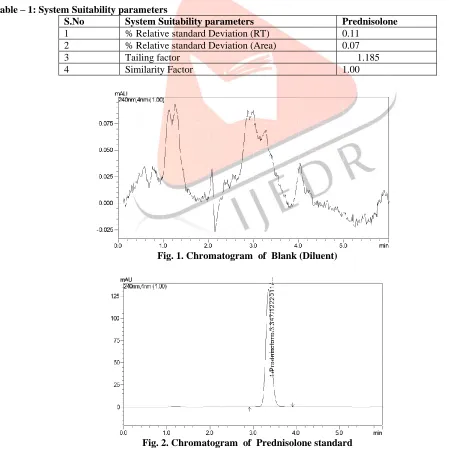
The system suitable parameters were performed as per the ICH, 2005 [8]. Relative standard deviation (RSD) for replicate injection for prednisolone RT was 0.1%, Area was 0.07%, the Tailing factor was 1.185 and the Similarity factor was 1.00. (Table-1). Hence, all the System Suitability parameters were within the limit. The chromatograms obtained by injecting Blank, Standard solution and Sample solution are given in Fig.2 (a,b & c).
Table – 1: System Suitability parameters
S.No System Suitability parameters Prednisolone
1 % Relative standard Deviation (RT) 0.11 2 % Relative standard Deviation (Area) 0.07
3 Tailing factor 1.185
4 Similarity Factor 1.00
Fig. 1. Chromatogram of Blank (Diluent)
IJEDR2001049 International Journal of Engineering Development and Research (www.ijedr.org) 258
Fig. 3. Chromatogram of Prednisolone sample
Precision
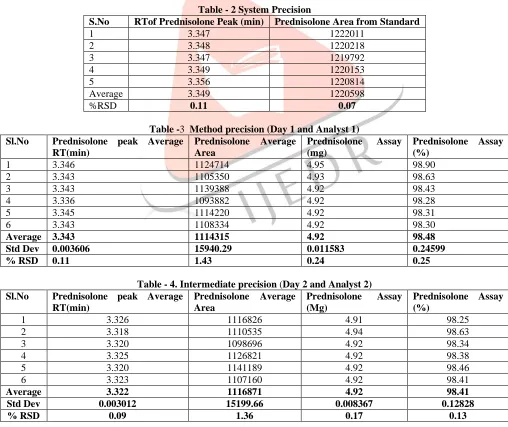
As per ICH guidelines, the developed method was tested for three precision components. The system precision was checked by using standard Prednisolone to ensure that the analytical system is precise. The retention time and area of five determinations was measured and % RSD was calculated and it was less than 1 % (Table-2). The method precision was performed on Prednisolone sample; The % RSD for Retention time and assay of the sample was found to be less than 2.0% (Table-3). The intermediate precision was performed on Prednisolone sample; The % RSD was found to be less than 2% and in all the cases, % RSD values were found well within the 2% limit. Hence, the method was found to be precise and the results showed that the method is rugged (Table- 4).
Table - 2 System Precision
S.No RTof Prednisolone Peak (min) Prednisolone Area from Standard
1 3.347 1222011
2 3.348 1220218
3 3.347 1219792
4 3.349 1220153
5 3.356 1220814
Average 3.349 1220598
%RSD 0.11 0.07
Table -3 Method precision (Day 1 and Analyst 1) Sl.No Prednisolone peak Average
RT(min)
Prednisolone Average Area
Prednisolone Assay (mg)
Prednisolone Assay (%)
1 3.346 1124714 4.95 98.90
2 3.343 1105350 4.93 98.63
3 3.343 1139388 4.92 98.43
4 3.336 1093882 4.92 98.28
5 3.345 1114220 4.92 98.31
6 3.343 1108334 4.92 98.30
Average 3.343 1114315 4.92 98.48
Std Dev 0.003606 15940.29 0.011583 0.24599
% RSD 0.11 1.43 0.24 0.25
Table - 4. Intermediate precision (Day 2 and Analyst 2) Sl.No Prednisolone peak Average
RT(min)
Prednisolone Average Area
Prednisolone Assay (Mg)
Prednisolone Assay (%)
1 3.326 1116826 4.91 98.25
2 3.318 1110535 4.94 98.63
3 3.320 1098696 4.92 98.34
4 3.325 1126821 4.92 98.38
5 3.320 1141189 4.92 98.46
6 3.323 1107160 4.92 98.41
Average 3.322 1116871 4.92 98.41
Std Dev 0.003012 15199.66 0.008367 0.12828
% RSD 0.09 1.36 0.17 0.13
IJEDR2001049 International Journal of Engineering Development and Research (www.ijedr.org) 259
To check the noninterference of diluent, the diluent solution was injected and checked for any interference in the RT of the Prednisolone. The results confirmed that there was no interference of any solvent peak. The peak purity was estimated by using a PDA detector, and the purity index was found to be greater than 0.999 (Fig. 4).
Fig 4. Peak purity of Prednisolone derived from PDA detector Linearity
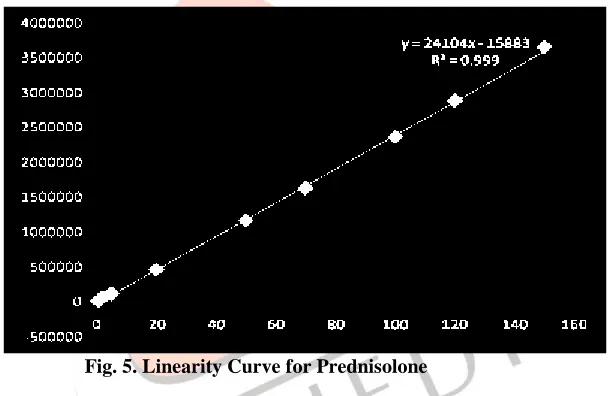
The linearity of the method was determined at ten concentration levels ranging from 50 % to 150 % for standard Prednisolone. The regression equation of Prednisolone was y = 24104X-15883 and the correlation coefficient (R2=0.999) was highly significant. The result shows an excellent correlation exists between the response factor on the y-axis and the concentration of drug on the x-axis (Fig. 5)
Fig. 5. Linearity Curve for Prednisolone Sensitivity
The LOD (k =3.3) and LOQ (k= 10) of the proposed method were calculated using the following equation; A=kσ/S, whare A = LOD or LOQ, σ is the standard deviation of the response and S is the slope of the calibration curve. The LOD and LOQ of Prednisolone were found to be 0.01μg/ml and 0.04μg/ml respectively. Hence the proposed method was found to be sensitive.
Accuracy
To check the accuracy of the method, recovery studies were carried out by the addition of standard drug solution to pre-analyzed samples at three different levels of 80,100,120%. The mean percentage recovery of the prednisolone drug was calculated and shown in Table-5. The percentage recovery varied from 100.3% to 103.46%, indicates good accuracy of the method.
Table -5. Recovery Studies for Prednisolone. SL no Amt.drug
Added ( mg\ml)
Response Area % Recovery % Mean Recovery
%RSD (Mean)
1
0.404
1097671 100.16
100.30 0.12
2 1096000 100.36
3 1096170 100.38
4
0.505
1177122 102.73
102.78 0.05
5 1177678 102.77
6 1178369 102.84
7
0.606
1181711 103.44
103.46 0.01
8 1181860 103.46
IJEDR2001049 International Journal of Engineering Development and Research (www.ijedr.org) 260
Robustness
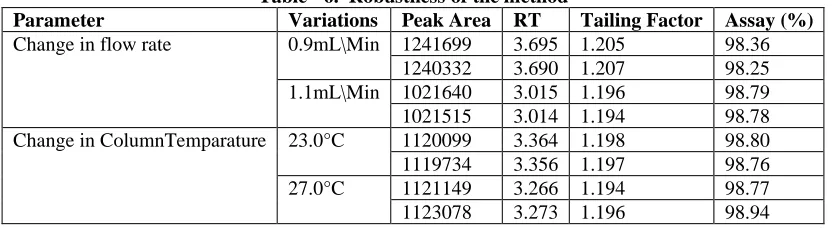
To determine the robustness of the current method, the effect of flow rate was studied at 0.9 mL and 1.1mL instead of 1.0mL/min. The effect of column temperature was studied at 23°C and 27°C instead of 25°C. Experimental conditions were deliberately altered and the system suitability parameter like tailing factor and peak area were evaluated. There were no significant changes in tailing factor and assay values by changing parameters with respect to the results obtained in the original conditions. The results confirmed that the analytical method is robust towards the above-designed changes (Table- 6).
Table - 6. Robustness of the method
Parameter Variations Peak Area RT Tailing Factor Assay (%)
Change in flow rate 0.9mL\Min 1241699 3.695 1.205 98.36 1240332 3.690 1.207 98.25 1.1mL\Min 1021640 3.015 1.196 98.79 1021515 3.014 1.194 98.78 Change in ColumnTemparature 23.0°C 1120099 3.364 1.198 98.80 1119734 3.356 1.197 98.76 27.0°C 1121149 3.266 1.194 98.77 1123078 3.273 1.196 98.94
DISCUSSION
The major goal of the study was to develop a fast, precise and cost-effective RP-HPLC method for the estimation of Prednisolone in solid dosage form. In order to attain this goal, different organic solvent concentrations and column chemistry were applied to achieve the isocratic elution of Prednisolone. The mobile phase ( methanol and water ratio; 60:40) with flow rate 1.0mL/min, detector wavelength at 240nm was found to be satisfactory. In this method, the prednisolone was eluted at 3.3 min and the total run time of the method was 6 min with good symmetrical peak shape, better similarity factor, and proper tailing factor. The method followed by Sireesha et al., in 2013 utilized the mobile phase with a combination of phosphate buffer and acetonitrile; In this method, the preparation of phosphate buffer is time-consuming and also expensive [3]. In 2012 the method developed by Rojanarati Theerasak and Thailand has some drawbacks i.e. the total run time was 12 minutes and RT of the prednisolone peak was around 10 minutes. Further, the expensive solvent Ethonal was used in the mobile phase [5]. Ali Abdo Saif Ahmed Algaradi., et al. in 2016 developed method, in this method the total run time was 25 minutes and RT of prednisolone was around 9 min. In addition, the expensive mobile phase used was Tetrhydrofuran, acetonitrile, and water [4]. The method developed by Ali Abdo Saif Ahmed Algaradi is also more time consuming and complicated in mobile phase preparation. These limitations in the HPLC method are not good for routine sample analysis in pharmaceutical formulation industries. In addition, the other methods with different parameters are also showed longer run time and complexity in mobile phase preparations [5-7]. In our proposed method the mobile phase ratio was chosen after several trails with different proportions to reach a suitable mobile phase optimization. Finally, selected the mobile phase ratio 60:40 methanol and water showed a well-separated analyte peak without the interference of other peaks. In addition, the tailing factor was also proper and the overall method with shorter run time was achieved. The system suitability parameters also checked and it was found satisfactory. The results suggest that an analytical procedure for the assay of prednisolone is specific and accurate. The test for robustness was carried out by changing the column temperature and flow rate, the results show that variations obtained in these parameters are within the acceptable limit and does not affect the results. The overall study supports that developed RP-HPLC analytical method is sensitive, reproducible with consistency and best suites for routine sample analysis. A rapid and sensitive reverse phase HPLC method for the analysis of Prednisolone in solid dosage formulations was developed and validated successfully.
CONCLUSION
The developed method achieved a good separation of analyte peak and linear over a wide range of concentrations with short run time and worked with less expensive mobile phase. Hence this is a suitable method for the analysis of prednisolone in pharmaceutical formulations and in other formulations containing prednisolone.
Acknowledgments
We would like to thank our chairman Dr. A.C.S Shanmugam, Vice Chairman ACS Arunkumar and Executive Director Dr.S. Vijayanand of RajaRajeswari Medical College, Bangalore for providing all the required research facilities to complete this research work.
REFERENCES
[1] Sversut RA, Alcaˆntara IC, Rosa AM, Baroni AC, Rodrigues PO, Singh AK, Amaral MS, Kassab NM. Simultaneous determination of gatifloxacin and prednisolone acetate in ophthalmic formulation using first-order UV derivative spectroscopy. Arabian Journal of Chemistry.,10(5),604-10 (2017).
[2] O’Neil MJ, Smith A, Heckelman PE. The Merck Index: An encyclopedia of chemicals, drugs, and biologicals, Merck & Co. Inc., Whitehouse Station, NJ.,1112(2006).
[3] K.R. Sireesha. et al. HPLC-UV Method for Simultaneous Determination of Moxifloxacin and Prednisolone Acetate in Eye Drops. Asian Journal of Chemistry., 25(3),1255-1258(2013).
IJEDR2001049 International Journal of Engineering Development and Research (www.ijedr.org) 261
[5] Rojanarati Theerasak and Thailanid. “ECO-Friendly, operator-SAFE AND cost-Effective RP-HPLC method for stability indicating assay of prednisolone tablets using ethanol :water as mobile phase”. International journal of pharmacy and pharmaceutical science., 4.1, 444-448 (2012).
[6] Ghosh, Somsubhra, D. Sathis Kumar, Anirban Sahu, David Banji, A. Harani, Ch Krishna Chaitanya, and M. Kalapana. "Development and validation for prednisolone in tablet dosage form by reverse phase-HPLC." Asian Journal of Chemistry., 23, 5092 (2011).
[7] Pardeep Kr. Sharma, Vijay Mishra, Surajpal Verma and Amit Bhatia, Simultaneous Estimation by RP-HPLC Method for the Immunosuppressant Drug Combination: Mycophenolate Mofetil, Tacrolimus with Prednisolone, Pertanika J. Sci. & Technol., 27(1), 371 - 385(2019).