I VITRO
ATIOXIDAT ACTIVITY OF
ABIES SPECTABILIS
D. DO
Samir Tote, Vilasrao Kadam. and Rumi Ghosh *
Bharati Vidyapeeth’s College of Pharmacy, Sector-8, CBD Belapur, Navi Mumbai, India.
Summary
This study evaluates the antioxidant activities of the hydroalcoholic extract of Abies spectabilis (Family: Pinaceae) in various in vitro models. The hydrogen donating ability of the hydroalcoholic extract of Abies spectabilis was measured in the presence of 2,2- diphenyl-2-picryl-hydrazyl (DPPH) radical. 100 µg/ml of Abies spectabilis and Ascorbic acid exhibited 76.33 and 81.53% inhibition, respectively, and the IC50 values were found
to be 38 µg/ml and 21.50 µg/ml for Abies spectabilis and ascorbic acid respectively. The effect of Abies spectabilis on reducing power was studied according to the reaction of Fe+3 to Fe+2. The total polyphenolic content of the Abies spectabilis was tested using Folin-Ciocalteau reagent. It was found that Abies spectabilis contained 23.37 mg/g, which is significant (p<0.05) when compared to gallic acid. Abies spectabilis inhibited the nitric oxide (NO) and hydrogen peroxide (H2O2) radical at IC50
values of 49µg/ml and 111 µg/ml against the corresponding standards curcumin (IC50 = 41 µg/ml) and α-tocopherol (IC50 =
63 µg/ml). The results indicate that the hydroalcoholic extract extract of Abies spectabilis has a significant antioxidant activity in a concentration dependent manner.
Key words: Abies spectabilis, antioxidant activity, hydrogen peroxide, nitric oxide.
*Corresponding author-Rumi Ghosh, M.Pharm. Ph.D.
Dept. of Pharmacology,Bharati Vidyapeeth’s College of Pharmacy,
Introduction
Free radicals are fundamental to any biochemical process and represent an essential part of aerobic life and our metabolism. They are continuously produced by the body’s normal use of oxygen such as respiration and some cell mediated immune functions (1). The oxygen consumption inherent in cell growth leads to the generation of a series of reactive oxygen species (ROS) (2). ROS, which include free radicals such as superoxide anion radicals (O2.), hydroxyl radicals (OH.) and non free
radical species such as hydrogen peroxide (H2O2) and singlet
oxygen (O2) are various forms of activated oxygen.
Accordingly, ROS is a collective term that includes both oxygen radicals and certain non-radicals that are oxidizing agents and / or easily converted into radicals (HOCl, HOBr, O2,
O2., H2O2) (3). All oxygen radicals are ROS, but not all ROS
are oxygen radicals. Similarly, reactive nitrogen species (RNS) are mainly nitric oxide (NO.), peroxynirite (ONOO.) and nitrogen dioxide (NO2) (4,5). ROS can be formed in living
organisms by both endogenous and exogenous sources. Endogenous sources of free radicals include normal aerobic respiration, peroxisomes and stimulation of polymorphonuclear leucocytes and macrophages. The exogenous sources include ionizing radiation, tobacco smoke, pollutants, pesticides and organic solvents (4).
The harmful action of free radicals can, however, be blocked by antioxidant substances (9). Antioxidant compounds may function as free radical scavengers, complexers of pro-oxidant metals, reducing agents and quenchers of singlet oxygen formation (10). They can greatly reduce the damage due to oxidants by neutralizing the free radicals before they can attack the cells and prevent damage to lipids, proteins, enzymes, carbohydrates and DNA (11).
Antioxidants can be classified into two major classes i.e. enzymatic and non-enzymatic. The enzymatic antioxidants are produced endogenously and include super oxide dismutase, catalase and glutathione peroxidase. The non-enzymatic antioxidants include tocopherol, carotenoids, ascorbic acid, phenolic compounds, vitamin E, flavanoids and tannins which are obtained from natural plant sources (4, 11, 12). A wide range of antioxidants from natural and synthetic origin has been proposed for use in the treatment of various human diseases. There are some synthetic antioxidants compounds such as butylated hydroxytoluene (BHT), butylated hydroxyanisole (BHA) and tertiary butyl hydroquinone which are commonly used in food processes (12, 13). However, it has been suggested that these compounds have shown toxic effects like liver damage and mutagenesis (14). Flavonoids and other phenolic compounds of plant origin have been reported as scavengers of free radicals. Hence, nowadays search for natural antioxidants source is gaining much importance (15, 16).
The plant Abies spectabilis D. Don. Syn. Abies webbiana Lindl. belonging to Family: Pinaceae is well known as the himalayan silver fir in English and talispatra in Hindi. This tall evergreen tree that reaches height up to 60 m and is 3– 10 m in girth, occurs in the Himalayan region from Kashmir to Assam at the altitude of 1600–4500 m in forests, largely located in high humid region with heavy rainfall and dense mist (17). The plant leaves particularly have been used as a crude drug in Indian traditional system of medicine for its multi-dimensional pharmacological activities (18).
activities (19). The decoctions of the leaves are useful in case of cough, phthisis, asthma, chronic bronchitis, catarrh of the bladder, other pulmonary affections (20), in fevers, during dentition (21) and in enlarged spleen (21,22). The ethanol extract of leaf of this plant showed anxiolytic activity in rats (20). Although, use of Abies spectabilis D. Don is reported for different biomedical use, the present work being made to explore the in vitro antioxidant potential.
Methods
CHEMICALS
L-Ascorbic acid, gallic acid, quercetin, 2,2-diphenyl-1-picrylhydrazyl (DPPH), potassium ferrricyanide, 2-deoxyribose, trichloroacetic acid (TCA) and ferric chloride were purchased from Sigma Chemicals Co. St Louis, MO, USA. All other chemicals and reagents used were of analytical grade.
PLAT MATERIALS
Abies spectabilis leaves were collected from Mahavir Ayur Bhandar at Mumbai and were identified and authenticated by Dr. Ganesh Iyer, Reader, Dept. of Life Sciences, Ruia College, Mumbai. The voucher specimen (A-001) has been preserved in our laboratory for future reference. The leaves with stalks were dried under shade; leaves were separated from branches, then were pulverized by a mechanical grinder, passed through a 40-mesh sieve, and stored in a well closed container for future use.
EXTRACTIO PROCEDURE
DETERMIATIO OF DPPH RADICAL SCAVEGIG ACTIVITY
The free radical scavenging activity of the extracts was measured in terms of hydrogen donating or radical-scavenging ability using the stable radical DPPH (2,2-diphenyl-1- picrylhydrazyl) (23). 0.1 mM solution of DPPH in ethanol was prepared and 1.0 ml of this solution was added to 3.0 ml of extract solution in water at different concentrations (10-100 µg/ml). Thirty minutes later, the absorbance was measured at 517 nm. Ascorbic acid was used as standard. Lower absorbance of the reaction mixture indicates higher free radical scavenging activity. The capability to scavenge the DPPH radical was calculated using the following equation:
DPPH Scavenged (%) = (A control – A test / A control) × 100
Where Acont is the absorbance of the control reaction and
Atest/std is the absorbance in the presence of the extracts.
The antioxidant activity of the extracts was expressed as IC50.
The IC50 value was defined as the concentration in µg/ml of
extracts that inhibits the formation of DPPH radicals by 50%
DETERMIATIO OF REDUCIG POWER
The reducing power of the extracts was determined with using potassium ferricyanide (24). Various concentrations of the extracts (30-1000 µg/ml) in 1.0 ml of deionized water were mixed with phosphate buffer (2.5 ml, 0.2 M, pH 6.6) and 1% potassium ferricyanide (2.5 ml). The mixture was incubated at 50°C for 20 min. Aliquots of trichloroacetic acid (2.5 ml, 10%) were added to the mixture, which was then centrifuged at 1036 x g for 10 min. The upper layer of solution (2.5 ml) was mixed with distilled water (2.5 ml) and a freshly prepared FeCl3
DETERMIATIO OF TOTAL PHEOLIC COTET Total soluble phenolic in the extract were determined with using Folin-Ciocalteau reagent (25). 1 ml of extract solution containing 1 g extract in a volumetric flask was diluted with 46 ml of distilled water. 1 ml of Folin-Ciocalteau reagent was added and the content of the flask mixed thoroughly. 3 min later 3 ml of 2% sodium carbonate was added and the mixture was allowed to stand for 2h with intermittent shaking. The absorbance of the blue color that developed was read at 760 nm. Gallic acid was used as a standard. The concentration of total phenols in the extract was expressed as µg/g of dry extract. The concentration of total phenolic compounds in the gallic acid was determined as mg of gallic acid equivalent using an equation obtained from the standard gallic acid graph.
y = 0.0082 x + 0.0546
DETERMIATIO OF HYDROXYL RADICAL
SCAVEGIG ACTIVIY
The scavenging capacity for hydroxyl radical was measured on the basis of Fenton reaction (26). The assay was performed by adding 0.1 ml of 1mM EDTA, 0.01 ml of 10 mM FeCl3, 0.1 ml of 10 mM H2O2, 0.36 ml of 10 mM deoxyribose, 1.0 ml of
different dilutions of the extract (10 – 100 µg/ml) dissolved in distilled water, 0.33 ml of phosphate buffer (50 mM, pH 7.4) and 0.1 ml of ascorbic acid in sequence. The mixture was then incubated at 37 °C for 1 h. A 1.0 ml portion of the incubated mixture was mixed with 1.0 ml of 10% TCA and 1.0 ml of 0.5% TBA (in 0.025M NaOH containing 0.025% BHA) to develop the pink chromogen measured at 532 nm. The hydroxyl radical scavenging activity of the extract is reported as % inhibition of deoxyribose degradation and is calculated as OH- Scavenged (%) = (A cont − A test)/A cont × 100
Where Acont is the absorbance of the control reaction and Atest
DETERMIATIO OF ITRIC OXIDE RADICAL SCAVEGIG ACTIVITY
Nitric oxide was generated from sodium nitroprusside and measured by the Griess reaction (27). Sodium nitroprusside in aqueous solution at physiological pH spontaneously generates nitric oxide, which interacts with oxygen to produce nitric ions that can be estimated by use of Griess reagent. Scavengers of nitric oxide compete with oxygen leading leading to reduced production of nitric oxide. Sodium nitroprusside (5 mM) in phosphate –buffered saline (PBS) was mixed with 3.0 ml of different concentrations (10-320 µg/ml) of the drugs dissolved in the suitable solvent systems and incubated at 250c for 150 min. The samples from the above were reacted with Griess reagent (1% sulphanilamide, 2% H3PO4 and 0.1%
napthylethylenediamine dihydrochloride). The absorbance of the chromophore formed during the diazotization of nitrite with sulphanilamide and subsequent coupling with napthylethylenediamine was read at 546 nm and referred to the absorbance at standard solutions of potassium nitrite, treated in the same way with Griess reagent.
NO Scavenged (%) = (A cont − A test)/A cont × 100
Where Acont is the absorbance of the control reaction and
Atest is the absorbance in the presence of the sample of the
extracts.
DETERMIATIO OF H2O2 RADICAL SCAVEGIG ACTIVITY
The ability of extracts to scavenge H2O2 was determined using
H2O2-phosphate buffer (28). A solution of H2O2 was prepared
in phosphate buffer (pH 7.4). H2O2 concentration was
determined spectrophotometrically measuring absorption with extinction coefficient for H2O2 of 81 M-1 cm-1. Extracts (10-320
µg/ml) in distilled water were added to a H2O2 solution (0.6 ml,
40 mM). Absorbance of H2O2 at 230 nm was determined 10
min later against a blank solution containing the phosphate buffer without H2O2. The % of H2O2 scavenging of both the
H2O2 scavenged (%) = (A cont − A test)/A cont × 100
Where Acont is the absorbance of the control reaction and
Atest is the absorbance in the presence of the sample of the
extracts.
Statistical Analysis
Experimental results were mean ± SEM of three measurements. The values p < 0.05 recorded were significant.
Results and Discussion
IHIBITIO OF DPPH RADICAL
DPPH is a stable free radical at room temperature and accepts an electron or hydrogen radical to become a stable diamagnetic molecule (29). The reduction capability of DPPH radicals was determined by the decrease in its absorbance at 517nm, which is induced by antioxidants.
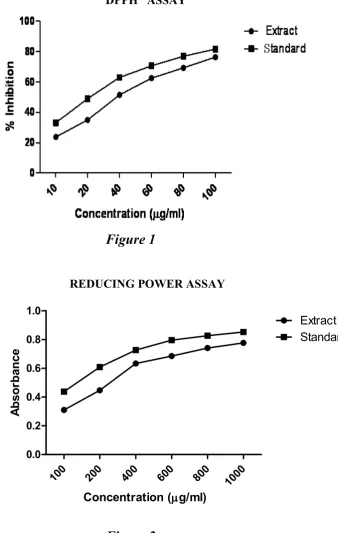
Figure 1 illustrates a significant (p < 0.05) decrease in the concentration of DPPH radical due to the scavenging ability of soluble solids in the Abies spectabilis and the standard ascorbic acid as a reference compound, presented the highest activity at all concentrations. A 100 µg/ml of Abies spectabilis and ascorbic acid exhibited 76.33 and 81.53 % inhibition, respectively and the IC50 values were found to be 38 µg/ml and
21.50 µg/ml for Abies spectabilis and ascorbic acid respectively.
REDUCIG ABILITY
For the measurements of the reductive ability, we investigated the Fe3+ - Fe2+ transformation in the presence of the Abies spectabilis using the method of Oyaizu (30).The reducing capacity of a compound may serve as a significant indicator of its potential antioxidant. Reducing power of the selected diluted extract found to be significant (p < 0.01) and as good as L-Ascorbic acid (Figure 2).
DPPH ASSAY
Figure 1
REDUCIG POWER ASSAY
100 200 400 600 800 1000
0.0 0.2 0.4 0.6 0.8 1.0
Extract
Standard
Concentration (µµµµg/ml)
A
b
s
o
rb
a
n
c
e
The antioxidant activity has been reported to be concomitant with development of reducing power. The reducing power of Abies spectabilis increased with increasing amount of sample. All the amounts of Abies spectabilis showed significant activities when compared to control and these differences were statistically significant (p < 0.01).
AMOUT OF TOTAL PHEOLIC COMPOUDS
IHIBITIO OF HYDROXYL RADICAL
The highly reactive hydroxyl radicals can cause oxidative damage to DNA, lipids and proteins (32). The effect of Abies spectabilis on the inhibition of free radical-mediated deoxyribose damage was assessed by means of the Iron (II)-dependent DNA damage assay. The Fenton reaction generates hydroxyl radicals (OH.) which degrade DNA deoxyribose, using Fe2+ salts as an important catalytic component. Oxygen radicals may attack DNA either at the sugar or the base, giving rise to a large number of products (10). Figure 4 shows the effect of the extracts on the iron (II) - dependent deoxyribose damage. The Abies spectabilis was the capable of reducing DNA damage at all concentrations (IC50 = 53 µg /ml). Ascorbic
acid, used as a standard was highly effective in inhibiting the oxidative DNA damage, showing an IC50 = 38.50 µg/ml.
HDROXYL RADICAL SCAVEGIG ACTIVITY
IHIBITIO OF ITRIC OXIDE RADICAL
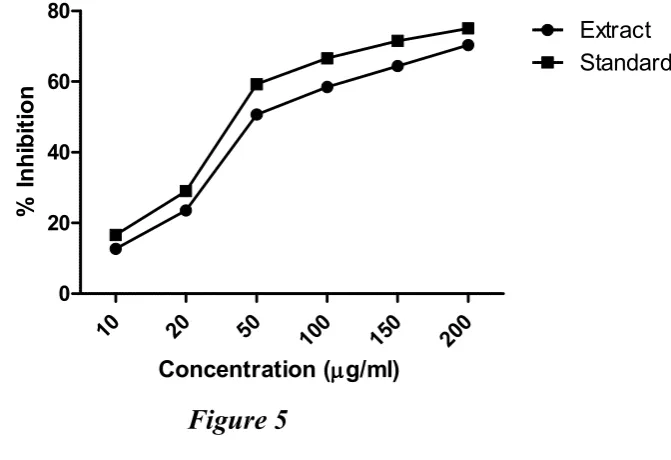
Nitric oxide radical generated from sodium nitroprusside at physiological pH (33) was found to be inhibited by Abies spectabilis. Figure 5 illustrates the percentage inhibition of nitric oxide generation by Abies spectabilis. Curcumin was used as a reference compound. The concentration of Abies spectabilis needed for 50% inhibition was found to be 49 µg/ml whereas 41 µg/ml for curcumin.
ITRIC OXIDE RADICAL SCAVEGIG ACTIVITY
10 20 50 100 150 200
0 20 40 60 80
Extract
Standard
Concentration (µµµµg/ml)
%
I
n
h
ib
it
io
n
Figure 5
IHIBITIO OF H2O2 RADICAL
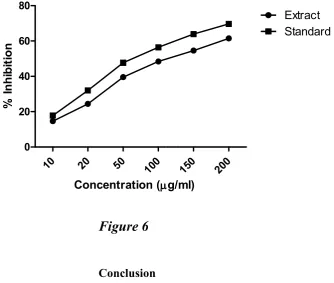
Hydrogen peroxide itself is not very reactive, but it can sometimes be toxic to cell because it may give rise to hydroxyl radical in the cells (34). Thus, removing H2O2 as well as O2- is
very important for protection of food systems. The scavenging ability of Abies spectabilis on hydrogen peroxide is shown in Figure 6 and compared with that of α-tocopherol as standard. Abies spectabilis extract at 111 µg/ml and α-tocopherol at 63 µg/ml exhibited 50% scavenging activity, respectively, on H2O2
H2O2 RADICAL SCAVEGIG ACTIVITY
10 20 50 100 150 200
0 20 40 60 80
Extract
Standard
Concentration (µµµµg/ml)
%
I
n
h
ib
it
io
n
Figure 6
Conclusion
The results from the various free radical scavenging systems show that hydroalcoholic extract of Abies spectabilis showed exhibit significant antioxidant activity by inhibiting DPPH and hydroxyl radical, nitric oxide and hydrogen peroxide scavenging, and reducing poweractivities when compared with different standards such as L-ascorbic acid, Curcumin, and α-tocopherol. In addition, the Abies spectabilis was found to contain a noticeable amount of total phenols, which play a major role in increasing antioxidants properties. The results of this study show that the Abies spectabilis can be used as easily accessible source of natural antioxidants and as a possible food supplement or in the pharmaceutical industry.
Acknowledgement
References
1) Slater TF. Free radical mechanism in tissue injury. Biochem J 1984; 222: 1-15.
2) Gulcin I, koksal E et al. Determination of In vitro antioxidant and Radical scavenging activity of Verbascum oreophilum C. Koch Var. Joannis ( Fam. Scrophulariaceae). Res J Boil Sci 2007; 2: 372-382. 3) Kumaran A, Karunakaran RJ. In vitro antioxidant activities of methanolic extracts of five Phyllanthus species from India. LWT 2007; 40: 344-352.
4) Umamaheswari M, Chatterjee TK. In vitro antioxidant activities of the fractions of Coccinia Grandis L. leaf extract. Afr J trad comp alter med 2008; 5: 61-73.
5) Antwerpen PV, Neve J. In vitro comparative assessment of the scavenging activity against three reactive oxygen species of non-steroidal anti-inflammatory drugs from the oxicam and sulphoanilide families. Euro J Pharmacol 20004; 496: 55-61.
6) Mitler R. Oxidative stress, antioxidants and stress tolerance. Trends Plant Sci 2002; 7: 405-410.
7) Barros L, Ferreira M, Queiros B, Ferreira ICFR, Baptista P. Total phenols, ascorbic acid, beta-caroten and lycopene in portugese wild gdible mushrooms and their antioxidant activities. Food Chem 2007; 103: 413-419.
8) Gulcin I, Oktay M, Kirecci E, Kufrevioglu OI. Screening of antioxidant and antimicrobial activities of anise ( Pimpinella anisum L.) seed extracts. Food Chem 2003; 83: 371-382.
9) Kumran A, Kaurunakaran RJ. Antioxidant and free radical scavenging acticity of an aqueous extract of coleus aromaticus. Food Chem 2006; 97: 109-114.
11) Huang D, Ou B et al. The chemistry behind Antioxidant Capacity Assays. J Agri Food Chem 2005; 53: 1841-1856.
12) Lee J, Koo N, Min DB. Reactive oxygen species, aging and antioxidative neutraceuticals. CRFSFS 2004; 3: 1151-1154.
13) Jayaprakasha GK, Selvi T, Sakariah KK. Antibacterial and antioxidant activities of grape (Vitis vinifera) seed extract. Food Res Int 2003; 36: 117–122.
14) Grice HC. Safety evaluation of butylated hydroxytolene ( BHT) in the liver, lung and gastrointestinal tracts. Food Chem Toxicol 1986; 24: 1127-1130.
15) Formica JV, Regelson W. Review of the biology of quercetin and related biflavanoids. Food Chem Toxicol 1995; 33: 1061-1080. 16) Rice-Evans CA, Miller NJ, Paganga G. Antioxidant properties of phenolic compounds. Trends Plant Sci Rev 1997; 2: 152-159.
17) The Wealth of India, Revised edition, Publication and information directorate, CSIR Hillside road, New Delhi 1985; Vol. I-A: 13-19.
18) Kirtikar KR, Basu BD, Singh B, Singh MP. Dehradun. Indian Medicinal Plants, 2nd Ed. Dehradun 1975: 3992.
19) Trease GE, Evans WC. Pharmacognosy, 12th Ed. Baillere Tindall, London 1983: 344, 549.
20) Nayak SS, Ghosh AK, Debnath B, Jha T. Anti-tussive activity of methanolic extracts of Abies webbiana. Phyto Res 2003; 17: 930– 932.
21) Nadkarni KM, Nadkarni AK. Indian Materia Medica. Bombay Popular Prakashan Pvt. Ltd. 1976; Vol-1: 3-4.
22) Kapoor LD. Hanbbok of Ayurvedic medicinal plants. CRC Press LLC 1995: 5.
24) Oyaizu M. Studies on product of browning reaction prepared from glucose amine. Jpn J Nutr 1986; 44: 307-315.
25) Slinkard K, Sigleton VL. Total phenol analysis: automation and comparison with manual methods. Am J Enol Vitic 1977; 28: 49-55. 26) Lloyd RV, Hanna PM and Mason RP. The origin of hydroxyl radical oxygen in the fenton reaction, Free radical biology and medicine 1997; 22: 885-888.
27) Green LC, Wagner DA, Glogowski J et al. Analysis of nitrate, nitrite, and (15 N) nitrate in biological fluids. Anal Biochem 1982; 126: 131-138.
28) Ruch RJ, Cheng SJ, Klaunig JE. Prevention of cytotoxicity and nhibition of intracellular communication by catechins isolated from Chinese green tea. Carcinogen 1989; 10: 1003-1008.
29) Kumar SS, Gupta VK. In vitro antioxidant activity of Ficus racemosa Linn. Root. Pharmacog Mag 2008; 4: 70-74.
30) Barros L, Ferreira MJ, Queiros B, Ferreira IC, Baptista P. Total phenols, ascorbic acid, beta-carotene and lycopene in Portuguese wild edible mushrooms and their antioxidant activities. Food Chem 2007; 103: 413-419.
31) Catherine A, Evans R, Miller NJ, Paganga G. Antioxidant properties of phenolic compounds. Trends Plant Sci 1997; 2: 152-159.
32) Gutteridge JM. The role of superoxide and hydroxyl radicals in phospholipids peroxidation catalysed by iron salts. FEBS Letters 1982; 150: 454-458.
33) Miranda KM, Espey MG, Wink DA. A Rapid, Simple Spectrophotometric Method for Simultaneous Detection of Nitrate and Nitrite. NITRIC OXIDE: Biol Chem 2001; 5: 67-71.