Bell Pepper And Chili Pepper Classification: An
Application Of Image Processing And Fuzzy
Logic
Eldrin James Olaes, Edwin R. Arboleda, Jesusimo L. Dioses Jr. and Rhowel M. Dellosa
Abstract: Bell pepper is often called sweet pepper and capsicum in other countries. Peppers are well-known for their different colors and uses. Capsicum peppers contain abundant antioxidants and vitamin C. In comparison to red peppers, it has nine times the level of carotene, such as lycopene which is claimed to improved heart health and reduce cancer risk. While, chili pepper, better known as ―Siling Labuyo‖ in the Philippines, is the fruit from the Genus capsicum plant, a member of the nightshade family, Solanaceae. These two kinds of pepper are commonly used as an ingredient for a different type of foods in the Philippines. Bell pepper is typically used in Filipino recipes to enhance its flavor and makes it smell better, while chili peppers are used to enhance the spiciness of the food. In this paper, the methods to be used in classifying differences of the seeds of bell pepper and chili pepper are image processing, fuzzy logic and K nearest neighbor. The morphological features of the seeds such as area, equivalent diameter, perimeter, and roundness in the gathered data from 60 samples of bell pepper and chili pepper seeds have been analyzed to classify bell pepper and chili pepper’s seeds characteristics. The fuzzy logic has been employed to determine the degrees of truth between truth and false instead of the common that only identifies truth and false. MATLAB toolbox will be utilized for the study. The areas, equivalent diameter, perimeter, and roundness will be used as inputs to Mamdai Fuzzy interference to formulate rules and come up to an output that will classify whether the seeds are bell pepper or chili pepper.
Index Terms: Bell pepper, chili pepper, fuzzy interference, fuzzy logic, image processing, K nearest neighbor, Matlab
—————————— ——————————
1.
INTRODUCTION
Bell peppers are fruits with a beautiful shape and different colors varying from green, red, yellow, orange, purple, brown to black [1]–[4]. Even though they have different colors, they are all the same kind of plant known as Capsicum annum. It is famous for its health content [5]. It contains vitamin C, which improves the immune system, prevents infections, increases the growth and repair of tissue, and helps in avoiding cancer [6]. It also has vitamin A that is good in improving eyesight, enhancing the lung function, and likewise enhances the immune system [7]. Furthermore, it contains nutrients that prevent prostate and breast cancer such as Lycopene, and nutrients that prevent cataracts and muscle degeneration such as lutein and zeaxanthin [8]. On the other hand, chili pepper, are one of the very popular spices known for its medicinal and health benefiting properties despite their fiery hotness [9]. It is considered one of the most important commercial spice crops [10]. Sampling and testing of seed observe standard procedures. These procedures are made by ISTA to assess seeds going in international trade [11]. In this study image processing and fuzzy logic were used for the identification of bell pepper and chili pepper. After extracting the features of the sample seeds, it will undergo an intelligent recognition algorithm applying fuzzy logic. Fuzzy logic identifies the degrees of truth instead of the common that only identify completely truth and completely false [12]. iabetes and other diseases which will minimize their expenses.
2
FEATURE
EXTRACTION
After capturing the samples, bell pepper and chili pepper classification undergo through five steps namely; pre-processing, image segmentation, feature extraction which then undergo the fuzzy logic algorithm to recognize and classify the bell pepper accordingly[13], [14].
Fig 1. Block Diagram of the Bell pepper classification system
2.1 Digital Image Scanning
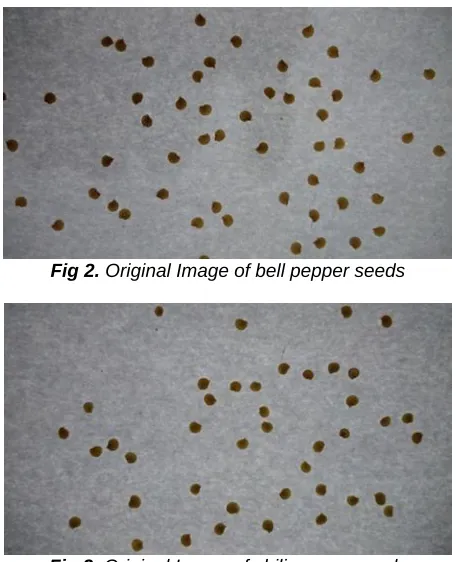
Each image used has at least 30 samples of seeds because seeds do not contain a large area and place the samples in a bond paper. A light was placed underneath the bond paper to remove the shadow of the seeds and lessen its noise. And also, it will be helpful in improving the accuracy of the morphology features [15]. The camera used has 16 megapixels and is placed 5 inches above the seeds. Figure 2 and 3 below shows the original image of the bell pepper seeds and chili pepper seeds.
————————————————
Eldrin James Olaes is from the Department of Computer and
Electronics Engineering , Cavite State University, Philippines, Indang, Cavite.
Edwin R. Arboleda is from the Department of Computer and
Electronics Engineering , Cavite State University, Philippines, Indang, Cavite..
Jesusimo L. Dioses Jr. is from Isabela State University
Rhowel M. Dellosa is from Asia Technological School of Science and
Arts
Image
Acquisition Processing
Fig 2. Original Image of bell pepper seeds
Fig 3. Original Image of chili pepper seeds
2.2 Preprocessing
By using MATLAB Version 2012a, the original image of bell pepper seeds and chili pepper seeds were converted to grayscale and again converted to binary to be used in the binarization of the original image on image segmentation. Figure 4 and 5 shows the outcome of the two images after applying rgb2gray.
Fig 4. Grayscale version of bell pepper
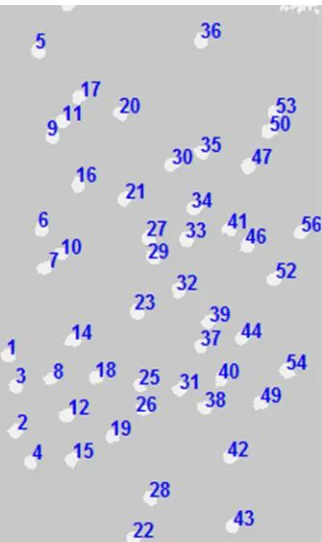
The mask is a matrix that contains 0 and 1 values and the original images of the bell pepper are binary or in gray level [12]. Figure 6 shows the raw segmented image with fewer noises. Just by adjusting the code ―c=220-b‖ using trial and error, it minimizes the noise in the image. The image is filtered first for enhancing and removing the noises and unwanted spots using Matlab function, bwareaopen. Using the code, ―z=bwareaopen (f,5000);‖ the segmented image is filtered. Figure 7 shows that the only classified image is the seeds.
Fig 7. Filtering and Identification of the Original Image
2.4 Feature Extraction
The most critical stage in the classification task is feature extraction[16]. Feature extraction traces the boundaries of holes inside the seeds and exterior boundaries of seeds in binary images. Roundness, area, perimeter, and equivalent diameter are the chosen parameters that undergo the fuzzy logic algorithm on the next step. The perimeter was not included since its significance is very low.
3 FUZZY
LOGIC
ALGORITHM
The numbering for sections is two Arabic numerals that are separated by periods, as shown in this paper. The initial, introductory paragraph is the only one with a drop cap, and after the section title, the first paragraphs have no indent.
3.1 Fuzzy Logic Controller
Describing a fuzzy set is a base for designing a Fuzzy Logic System that is close to a human thinking logic. A fuzzy set may be considered as an extension of the classical set. Crisp set theory only complies with a membership element that takes only a defined 0 or 1 value, a binary logic. However, on the fuzzy set theory, it contains a gradual or changing degree of membership in a set. It does not completely belong to a set but is in between. It is only defined by a boundary which makes the degree of membership of an element to range only in between from 0 to 1. Hence, a fuzzy set does not have a crisp or exact and defined boundary[17]–[19].
Fig 8. Block Diagram of Fuzzy Logic Controller
3.2 Control Objectives Description
Area, equivalent diameter, perimeter, and roundness will serve as the input variable of the fuzzy logic algorithm while Bell pepper and Chili pepper Classification (BCC) will serve as the output. Due to the small results of feature extraction, the perimeter can be ignored and not included in the study.
3.3 Deciding the Input and Output Variables
The corresponding variables listed above are the input as well as the output utilized in a fuzzy logic algorithm.
Area: will be determined using membership functions ―small, medium, large‖
Equivalent diameter: will be determined using membership functions ―small, medium, large‖
Perimeter: will be determined using membership functions ―small, medium, large‖
Roundness: will be determined using membership functions ―small, medium, large‖
BCC: will be determined using membership functions ―bell pepper and chili pepper‖
3.4 Membership Function
Fig 9: Membership Function for Area
Fig 10: Membership Function for Equivalent Diameter
Fig 12: Membership Function for Roundness
3.5 Output Response
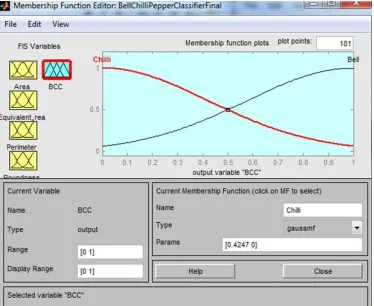
The output response ―BCC‖ which means Bell pepper and Chili pepper Classification is shown in the membership function editor. As the result is nearer to 0 it means that the classified seed is chili pepper while as the output is closer to 1, it means that the seed is bell pepper.
Fig 13: Membership Function for the Output Response
3.6 Formulation of Fuzzy Rules
There is a total of 81 rules that were made based on the given parameters; area, equivalent diameter, perimeter, and roundness. It fitted the data on the table which shows its accuracy. The certain condition will fall under these rules.
Fig 14: Rule Editor for the Bell pepper and Chilli pepper Classifier
3.7 Surface Evaluation
With the utilization and aid of the Surface Viewer, one of the building systems with the fuzzy logic toolbox that is dynamically linked to the FIS, one may grab the axes and reposition them to be able to get a different three-dimensional view on data [21]. Surface Viewer is also capable of working with cases with two or more inputs and one output. The reference input field was used when more inputs are required by the system than the surface mapping.
Fig 15: FIS Surface View
4
RESULTS
AND
ANALYSIS
4.1 Morphological Feature Extraction
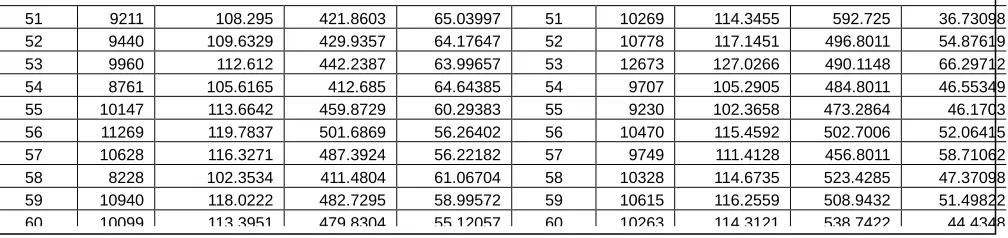
A total of 120 seeds samples, 60 samples on each were listed in table 1.
By the data gathered above, the range of the extracted features from bell pepper and chili pepper was shown in Table 2. This data is the basis for the development of the membership function on the fuzzy logic algorithm.
pepper Seeds
Diameter pepper
Seeds
Diameter
TABLE 2
Ranges of features extracted from 120 seeds of bell pepper and chili pepper
4.2 Inference Method
In Mamdani inference, the consequent of If-Then rule is defined by the fuzzy set [22]. The output fuzzy set of each rule will be reshaped by a matching number, and defuzzification is required after aggregating all of these reshaped fuzzy sets [23].
Fig16 FIS Editor
4.3 Defuzzification
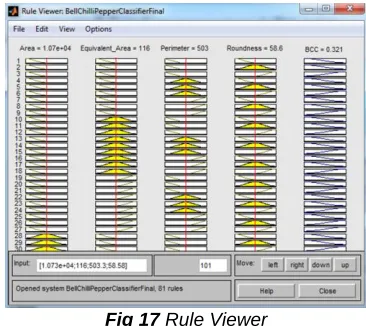
Defuzzification is the process of calculating the fuzzy model sets and corresponding membership degrees through a precise numerical value, hence, in a crisp logic results [24]. Defuzzification is usually utilized in a fuzzy control systems [25]. In accordance with that, a set of rules is required to transform various variables into a fuzzy result. The results are to be described accordingly to the terms of membership function in the set of fuzzy logic [26]. Figure 14 shows the rule viewer of the bell pepper and chili pepper classifier. Based on the simulation, it has been verified that at 1.07e+04 area, 116 equivalent diameter, 503 perimeters, and 58.6 roundness, the output response is 0.321 which is closer to 0. Therefore, the sample is a Chili pepper.
Fig 17 Rule Viewer
By the use of the data gathered from four-parameter: area, equivalent diameter, perimeter, and roundness, the researcher can now classify the bell pepper and chili pepper through fuzzy logic. It shows that the accuracy rate of fuzzy logic is 85% based on the results obtained above.
6 CONCLUSION
In this study of Classification of bell pepper and chili pepper through seeds, image processing, and fuzzy logic. The process of Feature extraction and the fuzzy logic algorithm is based on the data gathered in the bell pepper’s seeds. The simulation shows the accuracy of the algorithm that can be used to fully recognize the difference between the chili and bell pepper.
REFERENCES
[1] C. Chávez-Mendoza, E. Sanchez, E. Muñoz-Marquez, J. Sida-Arreola, and M. Flores-Cordova, ―Bioactive Compounds and Antioxidant Activity in Different Grafted Varieties of Bell Pepper,‖ Antioxidants, vol. 4, no. 2, pp. 427–446, Jun. 2015.
[2] A. Mori et al., ―Capsaicin , a Component of Red Peppers , Inhibits the Growth of Androgen-Independent , p53 Mutant Prostate Cancer Cells,‖ pp. 3222–3229, 2006.
[3] G. Romano, D. Argyropoulos, M. Nagle, M. T. Khan, and J. Müller, ―Combination of digital images and laser light to predict moisture content and color of bell pepper simultaneously during drying,‖ J. Food Eng., vol. 109, no. 3, pp. 438–448, 2012.
[4] H. F. Ioan, A. M. Nicolae, Șoproni V. Darie, M. C. Otilia, and P. Ovidiu, ―Study on the Extraction in Microwave Field of the Essential Oils from Chilli,‖ pp. 63–66, 2017.
[5] X. Kong et al., ―Transcriptome analysis of harvested bell peppers (Capsicum annuum L.) in response to cold stress,‖ Plant Physiol. Biochem., vol. 139, pp. 314–324, Jun. 2019.
[6] E. Hallmann et al., ―Polyphenols and carotenoids in pickled bell pepper from organic and conventional production,‖ Food Chem., 2018.
[7] Y. Wang, L. Gao, Q. Wang, and J. Zuo, ―Scientia Horticulturae Low temperature conditioning combined with methyl jasmonate can reduce chilling injury in bell pepper,‖ Sci. Hortic. (Amsterdam)., vol. 243, no. May 2018, pp. 434–439, 2019.
Type of Pepper
Area Equivalent Diameter
Perimeter Roundness
and H. K. No, ―Antioxidant Activities of Different Colored Sweet Bell Peppers (Capsicum annuum L.),‖ J. Food Sci., vol. 72, no. 2, pp. S98–S102, Mar. 2007. [9] S. I. Sabilla and R. Sarno, ―Development of wavelet
transforms to predict methane in chili using the electronic nose,‖ in 2017 International Conference on Advanced Mechatronics, Intelligent Manufacture, and Industrial Automation (ICAMIMIA), 2017, pp. 271–276. [10] J. Jiang, H. Cen, C. Zhang, X. Lyu, H. Weng, and H.
Xu, ―Postharvest Biology and Technology Nondestructive quality assessment of chili peppers using near-infrared hyperspectral imaging combined with multivariate analysis,‖ Postharvest Biol. Technol., vol. 146, no. May, pp. 147–154, 2018.
[11] R. Ureña, F. Rodrı́guez, and M. Berenguel, ―A machine vision system for seeds quality evaluation using fuzzy logic,‖ Comput. Electron. Agric., vol. 32, no. 1, pp. 1– 20, Jul. 2001.
[12] Hung-Pin Chen and Zong-Mu Yeh, ―Extended fuzzy Petri net for multi-stage fuzzy logic inference,‖ in Ninth IEEE International Conference on Fuzzy Systems. FUZZ- IEEE 2000 (Cat. No.00CH37063), 2000, vol. 1, pp. 441–446.
[13] E. R. Arboleda, A. C. Fajardo, and R. P. Medina, ―Classification of Coffee Bean Species Using Image Processing , Artificial Neural Network and K Nearest Neighbors,‖ 2018 IEEE Int. Conf. Innov. Res. Dev., no. May, pp. 1–5, 2018.
[14] C. L. Macalalad, E. R. Arboleda, A. A. Andilab, and R. M. Dellosa, ―Morphological Based Grain Comparison of Three Rice Grain Variety,‖ Int. Jounal Sci. Technol. Res., vol. 8, no. 08, pp. 1446–1450, 2019.
[15] E. R. Arboleda, A. C. Fajardo, and R. P. Medina, ―An Image Processing Technique for Coffee Black Beans Identification,‖ in 2018 IEEE International Conference on Innovative Research and Development (ICIRD), 2018, no. May, pp. 1–5.
[16] M. J. L. Jacoba and E. R. Arboleda, ―Identification of rain cloud amount, rain intensity and possible chance of flooding using image processing and fuzzy logic,‖ ARPN J. Eng. Appl. Sci., vol. 14, no. 14, pp. 2563– 2568, 2019.
[17] A. E. Andaya, E. R. Arboleda, A. A. Andilab, and R. M. Dellosa, ―Meat Marbling Scoring Using Image Processing with Fuzzy Logic Based Classifier,‖ Int. J. Sci. Technol. Res., vol. 8, no. 08, pp. 1442–1445, 2019.
[18] R. E. T. Bae, E. R. Arboleda, A. Andilab, and R. M. Dellosa, ―Implementation Of Template Matching , Fuzzy Logic And K Nearest Neighbor Classifier On Philippine Banknote Recognition System,‖ Int. J. Sci. Technol. Res., vol. 8, no. 08, pp. 1451–1453, 2019. [19] K. E. N. T. Rabe, E. R. Arboleda, and R. M. Dellosa,
―Fuzzy Logic Based Vehicular Congestion Estimation Monitoring System Using Image Processing And KNN Classifier,‖ Int. J. Sci. Tehnol. Res., vol. 8, no. 08, pp. 1377–1380, 2019.
[20] N. Aliyeva and E. Ismayilov, ―The analysis of how the choice of membership functions influences the quality of recognition system,‖ in 2012 International
Yan, ―Modeling and Simulation of an Adaptive Neuro-Fuzzy Inference System ( ANFIS ) for Mobile Learning,‖ vol. 5, no. 3, pp. 226–237, 2012.
[22] A. K. Sharma, V. Singh, N. K. Verma, and J. Liu, ―Condition Based Monitoring of Machine Using Mamdani Fuzzy Network,‖ in 2018 Prognostics and System Health Management Conference (PHM-Chongqing), 2018, pp. 1159–1163.
[23] C. Leal-Ramirez, O. Castillo, and A. Rodriguez-Diaz, ―Fuzzy cellular model for predator-prey interaction applied to the control of plagues in a peppers cropping,‖ Stud. Comput. Intell., vol. 318, pp. 329–351, 2010.
[24] M. Jia and X. Peng, ―Solving Fuzzy Nonlinear Systems -- A Class of Defuzzification in the Fuzzy Control,‖ in 2013 International Conference on Information Science and Cloud Computing Companion, 2013, pp. 521–528. [25] M. Karakose and S. Makinist, ―Image processing based defuzzification method for type-2 fuzzy systems,‖ in 2013 9th Asian Control Conference (ASCC), 2013, vol. 1, pp. 1–5.