4367
Inquiry: A Learning Model To Improve The
Learning Outcomes Of Character
Okta Rosfiani,Cecep Maman Hermawan, Abdul Latief Sahal, Nur Fadillah Mawartika
Abstract— Inquiry-based teaching is a teaching model that has been developed to teach students how to think, obtain higher-order thinking including cognitive processes such as understanding, comparing, and evaluating. There is a lack of studies currently investigating inquiry-based teaching that is tailored to the learning of character. The purpose of this study is to describe the use of inquiry models and analyze the improvement in learning outcomes using inquiry models. This class action research uses the Kemmis & McTaggart design. Participants in this study were sixth-grade students at one of the Integrated Islamic Elementary Schools in South Tangerang, Banten Province, Indonesia. Data has been collected through tests, observations, and documents. Data were analyzed using text analysis and descriptive statistics. The research data shows that the inquiry model can improve student learning outcomes in Character on Budi Pekerti topics. Student learning outcomes in the pre-cycle by 67%, then increased in the first cycle by 90% after being given action using an inquiry learning model.
Index Terms— inquiry learning model, learning outcomes, elementary school.
—————————— ——————————
1 INTRODUCTION
THE inquiry approach is important for use with gifted children [1]. The inquiry model is one of the very efficient learning models for presenting organized information in various subjects. [2] says that learning outcomes for inquiry-based teaching are gaining knowledge about the focus of inquiry, developing thinking and reasoning skills, developing metacognitive skills, and developing positive attitudes towards inquiry and appreciation for knowledge.[3] examine what problems arise when integrating two disciplines, how curriculum units based on birdsong differ when students experience problems from different points of view, and how projects can require inquiry-based learning. [4] requires that educators need to explain to students the need to develop information literacy to support their questions, and that specific approaches to facilitation from peers, librarians and academics are very helpful when designing inquiry-based learning. The author believes that the inquiry model is a good motivator of learning and can be done on more objective science learning with examples that show how a teacher, at least, can start with inquiry learning and incorporate more creative thinking [5]. Also, the authors share examples of differentiation in science curricula that focus on the use of inquiry with teachers who work side by side with university professors in the Science laboratory [6].So far the existing research only presents data on the results of investigations for gifted children, curriculum units (eg. music and science), science learning, and literacy. There is a lack of studies currently investigating inquiry-based teaching that is tailored to the learning of Character. [7] states that applying this method allows us to carry out further value calculations for certain details in certain images which allows, furthermore, more efficient searching to be possible.The purpose of this study is to describe the use of inquiry models, analyze improvement in learning outcomes using inquiry models. The findings of this study will help improve students'
understanding of Character subjects on the Budi Pekerti topic. Inquiry model, able to bring students to higher-level thinking and more critical. As explained by [2] that inquiry-based teaching is another teaching model that has been developed to teach students how to think. Inquiry-based teaching rests on the same basic theory previously described for concept teaching.
2
LITERATURE
REVIEW
2.1 Inquiry Learning Model
The inquiry teaching model is another teaching model that has been developed to teach students how to think [2]. This model is based on three interrelated components: (1) input consists of curriculum information and assessment, (2) interventions representing educational procedures and materials, and (3) outputs signifying learning achievement [8]. [9] suggested that stakeholders should make policies that support inquiry learning environments to increase student interest in learning, which not only affect student outcomes in cognitive assessment but also in affective and psychomotor assessments. The author believes that this is broader and more comprehensive.The Community of Inquiry (COI) framework will help educators better understand the use of e-learning as an effective pedagogical platform [10]. [11], recommends that to enhance the students' level of knowledge construction, teachers should design case-based discussions that are combined with social events or life experiences that integrate authentic aspects of personal life rather than pure theory or debate issues. Such a truly reflective inquiry model needs to be firmly grounded in critical theory by incorporating the application of principles, not procedures, in the investigation of social issues [12]. The author suggested developing understanding through inquiry by conducting a self-designed, open-ended, systematic inquiry that required autonomous learning involving metacognitive skills and time management skills [13].
2.2 Learning Outcomes
Learning outcomes are changes that change people in their attitudes and behavior. Meanwhile, according to [14], learning outcomes are arguments presented to show emptiness and usefulness when abused in this way, and an explanation of their inability is offered. We conclude with several recommendations for accreditation guidelines for assessing
————————————————
Department of Teacher Education Madrasah Ibtidaiyah, Faculty of Character, Universitas Muhammadiyah Jakarta, Indonesia. E-mail: [email protected]
Department of Teacher Education Madrasah Ibtidaiyah, Faculty of Character, Universitas Muhammadiyah Jakarta, Indonesia.
Bachelor degree, alumni in Madrasah Ibtidaiyah Teacher Education in the Faculty of Character in Universitas Muhammadiyah Jakarta, Indonesia.
learning outcomes [15]. Learning outcomes focus on what students have achieved rather than the content of what has been taught and also focus on what students can show at the end of learning activities [16]. This development is framed in a transparency assessment framework, which provides insight into the current "as is" situation as well as an indication of what is needed to move the assessment of learning outcomes towards the "ideal" which is fully implemented throughout the higher education sector [17]. According to [18] the time devoted to students for assignments, as a result of interactivity with lecturers, is a significant predictor of emotional academic involvement but does not predict desired learning outcomes. The author describes differences in student learning outcomes, learning approaches, and student motivation in physical education as a consequence of policies in both countries. These differences appear to indicate a different and strong influence from each educational environment and assessment policy [19]. However, students did note differences in course delivery in terms of time, assessment, and overall structure [20].
3 METHOD
3.1 Research design
Action research is promoted in the UK in the context of developing practices in health and social care, but its application has not been evaluated [21]. This study aimed to explore the utility of action research in bridging the gap between research and practice [22]. Educators intend to improve educational practices by examining the issues or problems they face by reflecting on these problems, collecting and analyzing data, and implementing changes based on their findings [23]. Action research uses qualitative and quantitative methods [24].Participatory action research was combined with a social marketing approach to generate and implement a narrative-based curriculum [25]. Using the design model of Stephen Kemmis and Robbin MC Taggart, action research is effective in a variety of ways for teachers in the classroom setting [26].
3.2 Participants
According to [27], virtual participants help to increase understanding of the complexity of the role of interactive researchers. It seems likely that the experience of the participants in the research process was largely taken for granted [28]. [29] argued that, involvement in the research process is the context in which such reflexive thinking might occur and that through certain methodological approaches, participants' thinking becomes more aware and therefore potentially accessible to researchers. [30], suggests that for such cases the researcher tells the participant at first, in an appropriate friendly tone, that he cannot express anything from his affections.This classroom action research was conducted at one of the Integrated Islamic Elementary Schools in South Tangerang City, Banten Province, Indonesia. Participants studied were sixth-grade students totaling 18 students in a composition of 11 male students and 7 female students.
3.3 Test
A test is several questions that have right or wrong answers. A test is a tool or procedure used to find out or measure something in an atmosphere, by means and rules that have
been determined. A test is also some questions that require answers or many questions that must be responded to measure a person's ability level or reveal certain aspects of the person subjected to the test [31].
The utility of using modeling and simulation from understanding the problem at the beginning of a test program to maximizing the utility of test information after the test is discussed along with some problem areas and potential solutions [32]. But if all students achieved mastery or nearly so, the conundrum is that if they have achieved mastery, the item difficulty level values would be high (i.e., easy) and the discrimination levels minimal (most students would have scores within a very narrow range) [33].
3.4 Observation
As in all learning, the initial learning effort to make observations to understand student behavior is certainly awkward and less informative than subsequent attempts [33]. Also, [34] everyday observers can develop practices that are more like scientific observers.
Fig. 1. Graphs of Cycle I Research Results
The observation sheet used during the learning process that applies the Inquiry model aims to find out how far the effect of the action has reached the target action, in addition to this observation sheet aims to observe the implementation of learning according to the Learning Implementation Plan (LIP) that has been prepared before. The observation sheet is enclosed in the attached sheet.
3.5 Data Analysis
This classroom action research uses quantitative and qualitative data collection. Data were analyzed using descriptive statistics by calculating the average value of the classroom on the achievement of student learning outcomes, the data were also analyzed using text.
3.6 Triangulation
4369 collecting and converging (or integrating) different types of
data about the same phenomenon [23].
4 RESULTS
AND
DISCUSSION
RESULTS
4.1 Pre-CycleBefore applying the inquiry-based teaching model, the learning outcomes of Character students on the Budi Pekerti topic showed six students (34%) received learning results below the Minimum Mastery Criteria (MMC) score of 80, while the other twelve students (67%) received scores above MMC.
4.2 Cycle 1
After using the inquiry model in cycle 1, the observation data shows that the teaching activities of the teacher in cycle 1 have reached 100%, which means that the six steps of the inquiry-based teaching model have been implemented by the teacher. Also, student learning outcomes showed an improvement, where sixteen people (90%) students achieved MMC scores, there were only two students who had not yet
achieved MMC scores.Observation data and student learning
outcomes in the pre-cycle and cycle 1 showed a significant increase. Student learning outcomes in the pre-cycle showed 67.0% of students achieved MMC scores, then in cycle 1 increased to 90.0% of students achieved MMC scores. Based on these improvements, the research is considered complete in cycle 1, and conclusions can be drawn. The following are six phase inquiry-based lessons [2], from the results of Cycle 1 research.
TABLE 1 COMPARISON OF STUDENT LEARNING COMPLETENESS
Phase 1 Gain attention and explain the inquiry process
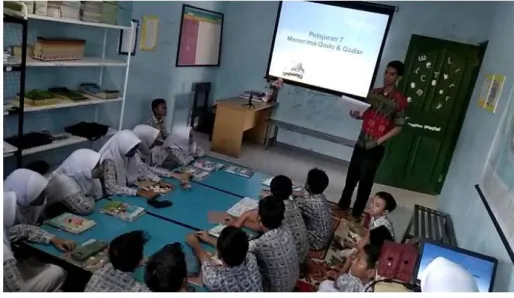
To get students' attention, the teacher starts learning by motivating students so that they are actively involved during learning activities through doing joint brain gymnastics. The teacher explains the learning objectives about the meaning of qodo and qodar, differences in qodo and qodar, the relationship between qodo and qodar, as well as examples of qodo and qodar in human life through visualization images, such as death, one's birth, and others.
Fig. 2. The teacher begins learning
The teacher explains the learning objectives about the meaning of qodo and qodar, differences in qodo and qodar, the relationship between qodo and qodar, as well as examples of qodo and qodar in human life through visualization images, such as death, one's birth, and others.
Phase 2 Present the inquiry problem or discrepant
event
The teacher displays a video of a child's failure trying to overcome obstacles but still failed until in the end, he succeeded thanks to his continuous efforts. Besides, the teacher also shows a picture of the time the sun rises and tides. The teacher names each event by grouping the parts of the qodo and qodar. Furthermore, students are asked to identify the next picture displayed, which is a picture of the turn of the night and day, the teacher asks whether this event is included in the qodo or qodar? A student named Sakti tried to give an answer whose results he said included qodo, because the turn of the night and day had been there for as long as the sunrise had been timed and could not be changed by humans, the teacher justified his answer. Then the teacher explains the meaning of qodo and qodar.
Fig. 3. The teacher presents the problem situation through video clips
Based on some of the events displayed on the slide, the process of transforming teacher-student knowledge becomes easier, as evidenced by the teacher testing the understanding of a student named Najwa by asking questions about "is this qodar?", The student can answer it correctly.
Phase 3 Have students formulate hypotheses to
Percentages Pre-Cycle Cycle 1
Percentage is complete Percentage is incomplete
67,0% 33,0%
explain the problem or event
The teacher encourages students to submit answers while explaining the problem situation
.
Fig. 4. Students submit their temporary answers
"How do you get boiling water?" The teacher asked another question, "During a bus accident, a child was found safe, while another adult died. If seen, a child is the weakest person but he can survive death. How do you explain it?". Then the teacher asks another question for a situation that is incompatible or contradictory, "What if someone dies from suicide?"
Phase 4 Encourage Students to Collect Data to Test
Hypotheses
Students collect data from various sources to provide an opinion on some questions raised by the teacher. The question in the student worksheet is a story of a life event involving qodo and qodar. The teacher encourages each group to present their work. The teacher allows other groups to give responses.
Phase 5 Formulate explanations and/or conclusions
The teacher gives feedback on the presentation of each group. Teachers and students conduct questions and answer to reinforce and correct misunderstandings.
Phase 6 Reflect on the problem situation and the
thinking processes used to inquire into it
The teacher encourages to reflect on what students have done from qodo and qodar lessons, the teacher also encourages students to be able to analyze their thought processes.
Fig. 5. The teacher encourages students to reflect on their thinking processes
D
ISCUSSIONThe findings show that inquiry learning models can help students obtain higher-order thinking including cognitive processes such as understanding, comparing, and evaluating.
Higher-order thinking can be recognized when it is operating. In general, the research reported here shows several patterns about supporting an integrated inquiry learning approach [39]. Another case with the opinion of [40] that, the inquiry literature until now has not had the benefit of a complete list of student outcomes that are reasonably expected when inquiry pedagogy is introduced or carried out in class. Knowledge generated from such communal investigations is more objective and useful because it has been tried and tested in a wider and more diverse field of experience [41]. However, through reading and rereading the data, it is noted how teachers consistently support students in their efforts and that this support is needed throughout the entire academic year for student success [42]. The inquiry has been proven to directly influence student learning assessment, where an inquiry has a significant influence on student learning assessment [43].
5 CONCLUSION
This study shows that the inquiry model can improve student learning outcomes in the Character of Budi Pekerti topics on qodo and qodar material in the sixth grade of Tirta Buaran Integrated Islamic Elementary School in South Tangerang, Indonesia. Student learning outcomes in the pre-cycle by 67%, then increased in the first cycle by 90% after being given action using an inquiry learning model.
ACKNOWLEDGMENT
We would like to thank the University of Muhammadiyah Jakarta for providing support for our research.
REFERENCES
[1] C. J. Rooks, D. L., & Maker, ―Inquiry: A teaching approach for gifted visually impaired learners.,‖ Gift. Educ.
lnternational., vol. 25, pp. 172-187., 2009.
[2] R. I. Arends, Learning to teach. New York: The McGraw Hill Education, 2012.
[3] J. Younker, B. A. & Bracken, ―Inquiry-based learning through birdsong: an interdisciplinary projectbased experience,‖ J. Music Teach. Educ., vol. 24, no. 3, pp. 37-52., 2015.
[4] P. McKinney, ―Information literacy and inquiry based learning: Evaluation of a five year programme of curriculum development.,‖ J. Librariansh. Inf. Sci., vol. 46, no. 2, pp. 148–166, 2013.
[5] T. Thompson, ―Teaching Creativity Through Inquiry Science.,‖ Gift. Child Today., vol. 40, no. 1, pp. 29–42.,
2017.
[6] D. A. Sisk, ―Differentiation for Effective Instruction in Science.,‖ Gift. Educ. Int., vol. 23, no. 1, pp. 32–45., 2007.
[7] & T. M. Kovács, B. L., ―New search method in digital library image collections: a theoretical inquiry.,‖ J.
Librariansh. Inf. Sci., vol. 46, no. 3, pp. 217-225., 2014.
[8] A. Cohen, S. B., Alberto, P. A., & Troutman, ―Selecting and developing educational materials: an inquiry model.,‖
Teach. Except. Child., vol. 12, no. 1, pp. 7–11, 1979.
[9] A. Rosfiani, O., Akbar, M., & Neolaka, ―Assessing student social student learning: Effects of learning environment, inquiry, and student learning interest.,‖ TARBIYA J. Educ.
Muslim Soc., vol. 6, no. 1, pp. 45–56, 2019.
[10]M. Lee, R., & Faulkner, ―The roles of extrinsic factors in a community of inquiry model of e-learning.,‖ E–Learning
Digit. Media., vol. 8, no. 1, 2011.
4371 model to investigate students’ knowledge construction in
asynchronous online discussions.,‖ J. Educ. Comput. Res., vol. 51, no. 3, pp. 327–354, 2014.
[12]L. M. Ross, E. W., & Hannay, ―Towards a critical theory of reflective inquiry.,‖ J. Teach. Educ., vol. 37, no. 4, pp. 9–
15, 1986.
[13]C. O. Spector, B. S., Burkett, R. S., & Steffen, ―Factors contributing to preservice teachers’ discomfort in a web-based course structured as an inquiry.,‖ J. Educ. Technol.
Syst., vol. 30, no. 3, pp. 293–310, 2002.
[14]P. Hussey, T., & Smith, ―The trouble with learning outcomes.,‖ Learn. High. Educ., vol. 3, no. 3, pp. 220–
233, 2002.
[15]J. G. Nemeth, J., & Long, ―Assessing learning outcomes in U.S. planning studio courses.,‖ J. Plan. Educ. Res., vol. 32, no. 4, pp. 476-490., 2012.
[16]D. Kennady, Writing and using learning outcomes a
practical guide. University College Cork: Watermans
Printers, 2007.
[17]M. Martin, L., & Mahat, ―The assessment of learning outcomes in Australia: Finding the holy grail.,‖ AERA
Open., vol. 3, no. 1, pp. 1-19., 2017.
[18]H. L. Nkhoma, M., Sriratanaviriyakul, N., & Quang, ―Using case method to enrich students’ learning outcomes.,‖ Act.
Learn. High. Educ., vol. 18, no. 1, pp. 37–50., 2017.
[19]& C. A. Ding, H., ―Instructional and learning outcomes in China and the USA as policy implications.,‖ Eur. Phys.
Educ. Rev., 2017.
[20]A. Goette, W. F., Delello, J. A., Schmitt, A. L., Sullivan, J. R., & Rangel, ―Comparing delivery approaches to teaching abnormal psychology: Investigating student perceptions and learning outcomes.,‖ Psychol. Learn. Teaching., vol. 16, no. 3, pp. 336–352, 2017.
[21]C. McVicar, A., Munn-Giddings, C., & Abu-Helil, ―Exploring the development of action research in nursing and social care in the UK: A comparative bibliometric review of action research designs in social work (2000–2010).,‖ Action Res., vol. 10, no. 1, pp. 79–101., 2012.
[22]I. Voigt, J. R., Hansen, U. M., Glindorf, M., Poulsen, R., & Willaing, ―Action research as a method for changing patient education practice in a clinical diabetes setting.,‖
Action Res., vol. 12, no. 3, pp. 315–336, 2014.
[23]J. Creswell, Educational Research: Planning, Conducting, and Evaluating Quantitative And Qualitative Research (5th ed.). Upper Saddle River, NJ: Pearson., 2015.
[24]J. Martí, ―Measuring in action research: Four ways of integrating quantitative methods in participatory dynamics.,‖ Action Res., vol. 14, no. 2, pp. 168–183.,
2015.
[25]D. Hamby, A., Pierce, M., Daniloski, K., & Brinberg, ―The use of participatory action research to create a positive youth development program.,‖ Soc. Mark. Quarterly., vol. 17, no. 3, pp. 2–17., 2011.
[26]B. J. Barbre, J. O., & Buckner, ―Utilizing action research during student teaching.,‖ SAGE Open., vol. 3, no. 1, 2013.
[27]A. Sandberg, F., & Wallo, ―The interactive researcher as a virtual participant: A Habermasian interpretation.,‖ Action Res., vol. 11, no. 2, pp. 194–212., 2013.
[28]B. K. Dennis, ―Understanding participant experiences: reflections of a novice research participant.,‖ Int. J. Qual.
Methods., vol. 13, no. 1, pp. 395–410, 2014.
[29]F. Cassell, C., Radcliffe, L., & Malik, ―Participant reflexivity
in organizational research Design.,‖ Organ. Res.
Methods., 2019.
[30]P. Davis, ―Unwarranted participant questions and virtuous researcher lies.,‖ Assoc. Res. Ethics Committees., vol. 7, no. 3, pp. 91-99., 2011.
[31]Rasyid, H., & Mansyur, Penilaian hasil belajar jilid 2. Bandung: PT. Wacana Prima., 2008.
[32]E. Keck, ―Modeling and simulation in the operational test and evaluation process.,‖ Simulation., vol. 45, no. 3, pp. 156–158., 1990.
[33]F. D. J. Shermis, M. D., & Vesta, Classroom assessment
in action. Amerika: Rowman & Littlefield Publishers, Inc.,
2011.
[34]K. Eberbach, C., & Crowley, ―From everyday to scientific observation: How children learn to observe the biologist’s world.,‖ Rev. Educ. Res., vol. 79, no. 1, pp. 39–68, 2009. [35]S. Risjord, M., Moloney, M., & Dunbar, ―Methodological
Triangulation in Nursing Research.,‖ Philos. Soc. Sci., vol. 3, no. 1, pp. 40–59, 2001.
[36]R. S. Natow, ―The use of triangulation in qualitative studies employing elite interviews.,‖ Qual. Res., 2019.
[37]J. A. Bennett, ―A Case for Theory Triangulation.,‖ Nurs.
Sci. Quarterly., vol. 10, no. 2, pp. 97-102., 1997.
[38]K. R. Howe, ―Mixed Methods, Triangulation, and Causal Explanation.,‖ J. Mix. Methods Res., vol. 6, no. 2, pp. 89–
96., 2012.
[39]T. Mulder, Y. G., Lazonder, A. W., & de Jong, ―Simulation-Based Inquiry Learning and Computer Modeling.,‖ Simul.
Gaming., vol. 46, no. 3–4, pp. 322–347., 2015.
[40]B. M. Saunders-Stewart, K. S., Gyles, P. D. T., & Shore, ―Student outcomes in inquiry instruction.,‖ J. Adv. Acad., vol. 23, no. 1, pp. 5–31., 2012.
[41]J. Bleazby, ―How Compatible are Communities of Inquiry and the Internet? Some Concerns about the Community of Inquiry Approach to E-learning.,‖ E-Learning Digit.
Media., vol. 9, no. 1, pp. 1–12., 2012.
[42]R. Barone, D., & Barone, ―Valuing the Process and Product of Inquiry-Based Instruction and Learning.,‖ J.
Educ. Gift., vol. 42, no. 1, pp. 35–63., 2018.
[43]A. Rosfiani, O., Akbar, M., & Neolaka, ―The effect of learning environment, inquiry and student learning interest on student social studies learning assessment.,‖ in ICTES First International Conference on Technology and