2239
Identification And Classification Of Defects In
Tomato Weed Plants Using Deep Convnet
G.Sivapriya, Dr.P.Keerthika
Abstract: A new method has been proposed in the paper for spotting the diseased areas of tomato leaf using deep convolution neural network algorithm. Nowadays plants are being affected by different kinds of diseases which results in reduced crop yield. It is possible to prevent the diseases by locating it in starting stages. In the proposed method deep layered convolution neural network architecture is used for automatic detection of diseased spots. Max pooling layers are used in this architecture which gives the better results and for reducing the over fitting different drop out mechanisms are added. The proposed deep CNN architecture is tested with many images and the accuracy in classification is achieved with 96.2 %. The architecture is trained with various dropouts and batch size in each iteration. The accuracy achieved through this method is higher than the traditional algorithms like AlexNet, VGG16 and Inception-v4 of identifying the images.
Index Terms: Batch size, Convolution neural network, Deep learning, Fully connected (FC) layer, Max pooling.
—————————— ——————————
1.
INTRODUCTION
Agriculture is the major resource for any country’s
economy and its yield is detoriating due to various environmental and climatic changes. Plant leaves are regularly compromised by different sorts of illnesses. Plant disease identification is continuously a significant research point in numerous fields. Most grown plants are affected by many different kinds of diseases due to various environmental factors. So the mandatory thing is to identify the plague at an early stage and feeding the appropriate pesticides. In this study the analysis has been done using the tomato plant leaves. The most common diseases for tomato leaves are Septoria leaf spot which leaves the edges dark and produces the circular spots with grayish white center and early blight, late blight, mosaic virus, blossom drop diseases affects the growth of the plants. Image processing techniques like preprocessing, object detection, edge detection and filters. Then, many machine learning algorithms have been developed for classifying the images, where the features have to be specified by the user. Neural network algorithms are designed by the inspiration of human brain. Normally human brains learn certain things through previous experience and through proper training methods. Acquired knowledge will be applied while encountering certain situation. It was inspired in neural network algorithms where networks are trained and tested with set of data’s. Complexity in extracting the features using machine learning approaches made us to move to the deep neural networks. In terms of image segmentation and classification, deep neural networks is mostly preferred than any older methods as it provides the promising results especially in medical diagnosis. Many algorithms like K-means, Artificial Neural Networks, Bio-inspired algorithms, Support Vector Machine is being used in recent days. Convolution Neural Network (CNN) has wide range of application in image processing tasks like detecting the objects, faces and for classification problems. It contains three
important layers which are convolution layers, merged layers and at last entirely connected blankets (Fully connected layers). Each blanket in CNN is responsible for extracting some features and the size of the hidden layers varies based on the application. In proposed work, CNN architecture is used for classifying the leaf diseases and compared with predefined architectures like AlexNet and GoogleNet. Since CNN is more powerful, it helps in classifying the diseases accurately. It is one of the deep learning algorithms which are designed to learn the features automatically.
2
RELATED
WORKS
2.2 Final Stage
Many algorithms have been implemented using various machine learning techniques like artificial neural network, deep neural network, genetic algorithm, bio-inspired algorithms. In recent year machine learning is being used in almost all the fields like medical image analysis, designing of embedded systems, various decision making systems, face recognition, advanced 3D printing, online transportation networks and virtual assistants. Siri, Alexa, Google Now are some of well-known virtual assistants available in market. As we have chosen the problem of plant disease classification, some of the related works are reviewed for references. [1] Proposed method for plant leaf disease identification using convolution neural network. This paper proves that CNN algorithm is better than traditional algorithms in machine learning. [2] Here they have designed algorithm using deep CNN for wheat diseases like Septoria, Rust, and Tan Spot. Two pilot sites were used for the purpose of capturing the images in Germany and Spain and used for the analysis. In [3] they have used the same CNN algorithm for abolishing the
————————————————
Ms.G.Sivapriya is currently working as Assistant Professor in the Department of Electronics and Communication Engineering at M.Kumarasamy College of Engineering, Karur, India. PH- 9715397992 E-mail: [email protected]
Dr.P.Keerthika is currently working as Senior Assistant Professor in the Department of Computer Science and Engineering at Kongu Engineering College, Perundurai, Erode, India. PH- 8248510762 E-mail: [email protected]
2240
(a) (b) (c) (d)
(e) (f) (g)
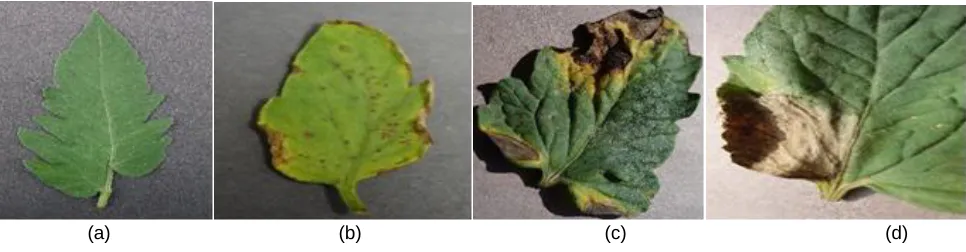
Figure 1: a) Healthy leaf of tomato b) Tomato with pathogen area c) Early blight d) Late blight e) Leaf mold f) Septoria leaf spot g) Two spotted spider mite
buzz present in RGB figures. CNN algorithm is used for both detection of noises and for reconstruction of images. The plant classification is done using deep neural network in paper [4] and various transfer learning methods and discussed and their results were compared. Plant data sets from four different sources like Flavia, UCI leaf, plantVillage, Swedish leaf were used and their classification accuracy is presented. AlexNet CNN is in [5] for recognizing the images of ear. For reducing the non-linearity, a rectified linear unit is added. AFCNet is designed in paper [6] for the classification of lesions where GoogleNet with some modifications is proposed and used for extracting the features. Simple Linear Iterative Clustering (SLIC) and Support Vector Machine(SVM) algorithm is used in the paper [7]. The tea plant leafs are obtained and preprocessed using SLIC for enhancing the features and classification is done using SVM. Features are extracted using Fuzzy contour extraction GLCM algorithm and are used to train the network. For the classification of crop insects in the field they[8] have used transfer learning approach for various algorithms and compared the accuracy with proposed CNN algorithm. Many pre trained networks like Alexnet, GoogleNet, ResNet, VGG Network were used for their comparison. In [9] rice disease is identified using convolution neural network and
compared their performance with traditional algorithms like Support Vector machine, Particle Swarm optimization and Back Propagation algorithm. The result shows that the accuracy in classification of CNN is larger than the alternative algorithms.
3 PROPOSED
WORK
2241
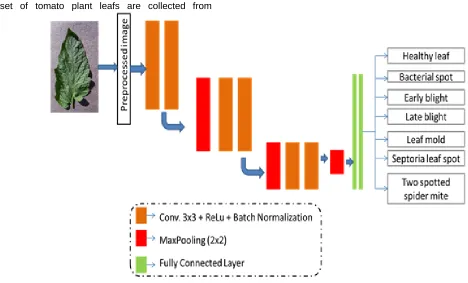
the quality of the image. 3 sets of 2 convolution layer and a max pooling layers are used for identifying the finer details of the image. Pooling layer output is given as input to the final layer (FC) for the classifying diseases.
3.1 Data Acquisition
Image dataset of tomato plant leafs are collected from
PlantVillage database. From which 5000 different images of tomato leafs with different diseases like bacterial spot, late blight, leaf mold, Septoria leaf spot, early blight and healthy
Figure 2: Architecture of CNN
leaf images are chosen for training phase. The training must be done with more datasets of different diseases, to classify the output correctly. The database can be enlarged by doing image transformation like data augmentation. To train the neural network these common data augmentation techniques like flipping the images, cropping are used.
3.2 Image Preprocessing
Image preprocessing is basically done to make certain feature visible in an image. Image dataset obtained might contain low contrast images and noisy images. To improve the image equality histogram normalization is used which spread out the intensity value uniformly throughout the image. Low contrast portions of the images will be enhanced with histogram equalization. Median filtering can be applied for suppressing the noises in the image. The first step is to read the image and resize it. As the images might be captured from different devices and vary in size, so all images should be resized to a fixed size. Next step is to removal of noises. It is usually done to smoothen the image and to eliminate the unwanted buzz involved in the given diagrams.
3.3 CNN
The architecture of CNN comprises of the following layer: convolution blanket, pooling blanket and entirely connected blanket. Features can be extracted with the help of first two layers. Fully connected layer helps in classification of bugs. One of the deep learning algorithm is CNN. It accepts the given input and it assigns weighs and bias through learning
methods and helps in differentiating the images. Preprocessing of the image is necessary for most of the classification algorithms but it is lower in convolution network. CNN is applicable in wide areas like image/video processing, natural language processing and pattern recognition. CNN is look-alike an Artificial Neural Network, which consists of several neuron, each neuron is connected with every other and assigns weighs/bias through proper learning. The main difference is in ANN the input is taken as a vector whereas in CNN the multi-channel images can be fed as input.
3.4 Convolution Layer
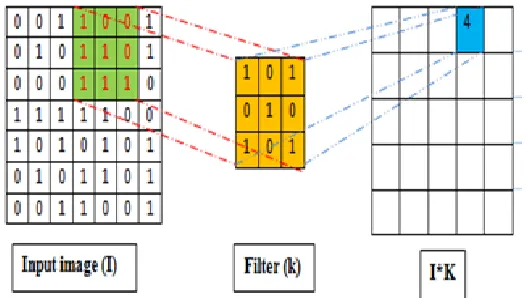
Kernel/filter is first carried out in the convolution layer. The filter size and stride has to be selected by us. The filter moves across the image with the given stride. The filter moves right and it traverses through the entire image. If RGB image is chosen then the kernel depth should be chosen equally to the input image. To reduce the output image size we have to increase the stride value. The stride value of one gives the same input image size at the output. The figure 3 splash the convolution operation. Convolution layer is most significant layer of Convolution neural network. Convolution is carried out by taking the dot product between the given input image and the chosen kernel.
2242
Here * represents the convolution operation, Zi is the output layer, W represents the weights and b is the bias input.
3.4 Pooling Layer
Pooling layer looks as like the layer called as convolution layer but it reduces the dimensions without the help of the kernel like in convolution layer. It takes the highest value or the average value of the input patch. The figure 4 shows the working max pooling layer by taking the stride as 2, by doing so only the dimensions of the image is reduced and depth remain the same. For example, if we take an image size of 200x200x64 and if we apply max pooling layer by taking the value of stride as 2, dimensions gets reduced to 100x100x64. It actually does the down sampling of the image. Another important is adding dropout layer, it helps in reducing over fitting or for regularization. To reduce the spatial length, need to use pooling layer. If the input to this layer is of size MxM and if stride of 2 is taken then the output image will of size M/2 x M/2.
Figure 3: Input image for Convolution operation (I) and filter (k)
Figure 4: Operation of Max pooling layer
It can be mathematically represented as
p represents the pooling operation, W is weight function, b is the bias input.
3.5 Fully Connected (Fc) Layer
The last step in CNN is entirely connected blanket which helps in performing classification. So far we have extracted the features, the next step is the classification of diseases. Classification is done with the help of entirely connected blankets. The features extracted from convolution and pooling layers are converted into vectors and given as input to the neurons in the entirely connected blankets. ReLu activation function is used here for classifying the leaf diseases. The first level of fully connected layer gets the input and converts into a vector and weights are applied for correct classification. The last entirely connected blanket gives the probabilities for each bugs. ReLu activation function is mostly preferred in almost all deep learning algorithms. It makes the training faster and it is mathematically represented as y=max(0,x).
3.6 Batch Normalization
Batch normalization is usually done after the convolution and fully connected layers. The ultimate confronting in deep neural network is the training time. It is mandatory to reduce the time as much as possible. The input can be standardized before each layer with the help of batch normalization and it helps in accelerating the training process. The inputs are standardized by taking the mean value and the standard deviation of every individual input variable.
4
EXPERIMENTAL
RESULTS
2243 Table 1: Input image, Kernel and output image sizes of each layers
Layers Input Image size Kernel size and channel Output image size
1-CONV 1 128X128 3x3,64 128X128
1-CONV 2 128X128 3x3,64 128X128
Max Pooling 128X128 2x2, 64 with stride 2 64X64
2-CONV 1 64X64 3x3,64 64X64
2-CONV 2 64X64 3x3,64 32X32
Max Pooling 32X32 2x2, 64 with stride 2 32X32
3-CONV 1 32X32 3x3,64 32X32
3-CONV 2 32X32 3x3,64 32X32
Max Pooling 32X32 2x2, 64 with stride 2 16X16
Entirely Connected Blanket
1 16x16 1x1 1x1
Entirely Connected Blanket
2 1x1 1x1 1x1
ReLu Classifier 1x1xC C
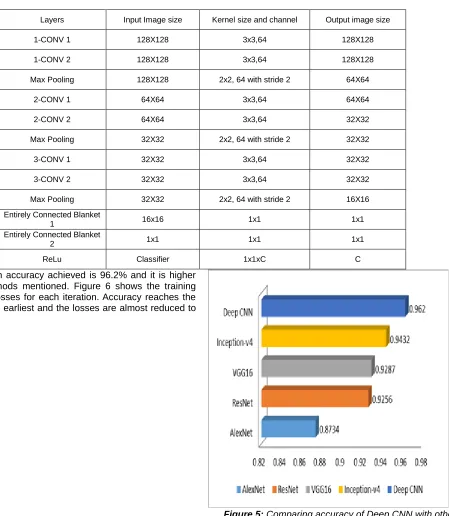
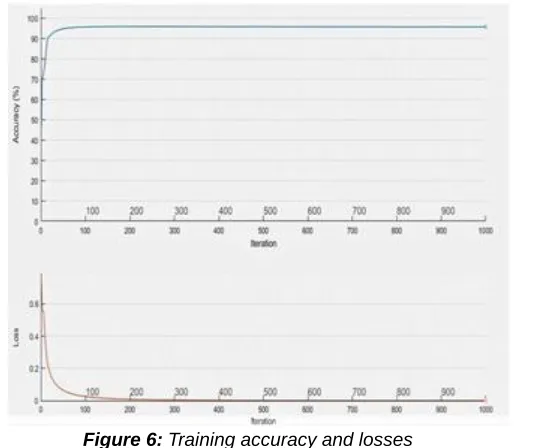
The validation accuracy achieved is 96.2% and it is higher than other methods mentioned. Figure 6 shows the training accuracy and losses for each iteration. Accuracy reaches the maximum at the earliest and the losses are almost reduced to an extreme.
2244 Figure 6: Training accuracy and losses
4
CONCLUSION
For solving the problems in identifying the plant and human diseases, deep learning technique is mostly preferred as it reaches the maximum accuracy. In this paper tomato leaf disease classification is done with the help of deep convolution neural network architecture. Training datasets are created with some data augmentation techniques, preprocessed and fed as input to the input layer of CNN. To make the network to predict accurately, the network must be trained with different set of images. The training of network is done with seven different types of tomato based leaf diseases and the deep neural architecture is capable of extracting the features of its own and classifies the diseases with a higher level of accuracy in real time scenarios. The network is trained with different input images with different backgrounds and data set is increased with data augmentation. The proposed method reached the accuracy of 96.2%, thus it can be used for the real time detection of tomato based diseases.
REFERENCES
[1] Geetharamani G., ArunPandian J. ―Identification of plant leaf diseases using a nine-layer deep convolutional neural network‖, Computers and Electrical Engineering 76 (2019) 323–338.
[2] ArtzaiPicona, Aitor Alvarez-Gila, Maximiliam Seitz, Amaia Ortiz-Barredo, JoneEchazarra, Alexander Johannes, ―Deep convolutional neural networks for mobile capture device-based crop disease classification in the wild‖, Computers and Electronics in Agriculture 161 (2019) 280– 290
[3] Wenhua Zhang, Lianghai Jin ∗, Enmin Song, XiangyangXu, ―Removal of impulse noise in color images based on convolutional neural network‖, Applied Soft Computing Journal 82 (2019) 105558
[4] Aydin Kaya, Ali SeydiKeceli, CagatayCatal, HamdiYalinYalic, HuseyinTemucin, BedirTekinerdogan, ―Analysis of transfer learning for deep neural network based plant classification models‖, Computers and Electronics in Agriculture 158 (2019) 20–29
[5] Ali AbdAlmisreb , Nursuriati Jamil, ―Utilizing AlexNet Deep Transfer Learning for Ear Recognition‖, Fourth
International Conference on Information Retrieval and Knowledge Management, 2018
[6] Lakshmi Priya.B, Jayanthi.K,BijuPottakkat, ―GoogLeNet based Ensemble FCNet Classifier for Focal Liver Lesion Diagnosis‖, DOI 10.1109/JBHI.2019.2942774, IEEE Journal of Biomedical and Health Informatics.
[7] Yunyun Sun, Zhaohui Jiang, ―SLIC_SVM based leaf diseases saliency map extraction of tea plant‖, Computers and Electronics in Agriculture 157 (2019) 102–109
[8] K. Thenmozhi, U. Srinivasulu Reddy, ―Crop pest classification based on deep convolutional neural network and transfer learning‖ Computers and Electronics in Agriculture 164 (2019) 104906.
[9] Yang Lu, Shujuan Yi, Nianyin Zeng, Yurong Liu , Yong Zhang, ―Identification of rice diseases using deep convolutional neural networks‖, Neurocomputing 267 (2017) 378–384.
[10] Jayme Garcia ArnalBarbedo, ―Plant disease identification from individual lesions and spots using deep learning‖, Biosystemsemgineering (I80), 2019, 96-107. [11] MingqiLv, Wei Xu, Tieming Chen, ―A hybrid deep
convolutional and recurrent neural network for complex activity recognition using multimodal sensors‖, Neurocomputing (2019), 16:41.
[12] LongzheQuan, Huaiqu Feng, ―Maize seedling detection under different growth stages and complex field environments based on an improved Faster ReCNN‖, Biosystems engineering 184 (2019) I-23.
[13] Shanwen Zhang a, Wenzhun Huang a, Chuanlei Zhang, ―Three-channel convolutional neural networks for vegetable leaf disease recognition‖, Cognitive Systems Research 53 (2019) 31–41.
[14] MelikeSardogan, AdemTuncer, ―Plant Leaf Disease Detection and Classification Based on CNN with LVQ Algorithm‖, UMBK’18, 3rd International conference on Computer Science and Engineering.
[15] Jose Cleydson F. Silva , Ruan M. Teixeira ―Machine learning approaches and their current application in plant molecular biology: A systematic review‖, Plant Science 284 (2019) 37–47
[16] Yongxiang Lei, Xiaofang Chen, Mengcan Min, Yongfang Xie , ―A Semi-Supervised Laplacian Extreme Learning Machine and Feature Fusion with CNN for Industrial Superheat Identification‖, Neurocomputing (2019)
[17] Suh, H.K., IJsselmuiden, J., Hofstee, J.W., van Henten, E.J., 2018. Transfer learning for the classification of sugar beet and volunteer potato under field conditions. Biosyst. Eng. 174, 50–65.
[18] Liu, Z., Gao, J., Yang, G., Zhang, H., He, Y., 2016. Localization and classification of paddy field pests using a saliency map and deep convolutional neural network. Sci. Rep. 6, 20410.
[19] Deng, J., Dong, W., Socher, R., Li, L.J., Li, K., Fei-Fei, L., 2009. ImageNet: A large-scale hierarchical image database. In: IEEE Conference on Computer Vision and Pattern Recognition, 2009. CVPR 2009, pp. 248–255. [20] Zhang Y-D, Dong Z, Chen X, Jia W, Du S,
2245