Management Accounting Information System based on Decision Support and Business Intelligence on ROI and ROE F.RahnamayRoodposhti (Department of accounting, Science and Research Branch, Islamic Azad University (IAU), Tehran, Iran)
H.nikoomaram (Department of accounting, Science and Research Branch, Islamic Azad University (IAU), Tehran, Iran)
Mohammad mahmoodi (Department of accounting, Science and Research Branch, Islamic Azad University (IAU), Tehran, Iran)
Citation: F.RahnamayRoodposhti, H.nikoomaram, Mohammad mahmoodi, (2012) ―Management Accounting Information System based on Decision Support and Business
730
Author (s)
F.RahnamayRoodposhti
Department of accounting, Science and Research Branch, Islamic Azad University (IAU), Tehran, Iran.
E-mail: [email protected]
H.nikoomaram
Department of accounting, Science and Research Branch, Islamic Azad University (IAU), Tehran, Iran.
E-mail:[email protected]
Mohammad mahmoodi
Department of accounting, Science and Research Branch, Islamic Azad University (IAU), Tehran, Iran.
E-mail: [email protected]
Management Accounting Information System based on Decision Support and Business Intelligence on ROI and ROE
Abstract:
The purpose of this study was to analysis the effect of management accounting information system (MAIS) based on decision support (DS) and business intelligence (BI) in return on investment (ROI) and return on equity (ROE) of Tehran stock exchange companies. We used analytical hierarchical process (AHP) through the weighting of MAIS based on DS and BI elements Then, questionnaires based on DS and BI distributed in Tehran stock Exchange manufactured companies applying the managerial accounting information system. According to the answers here and weighting above, enterprises is divided into three categories as followed; the first categories with 25, second 20 and third categories 21 organizations. in the next, Samples were measured in three groups of companies with management accounting information system based decision support and business intelligence in Strong, Average and Weak categories. We examined each of the variables and significant correlation between management accounting Includes sales, cost of goods sold, inventory, operating profits, net profit, rate of goods waste, Percent of actual production to capacity and portion of market sale with Return on investment and return on equity were examined. Companies categorized in three groups were assessed and the results show a significant relationship between management accounting information system based on decision support and business intelligence with ROI and ROE are meaningful in strong and average companies than weak in their management accounting information system.
Key words: management accounting information system, decision support, Business intelligence, Return on investment, Return on equity.
Introduction
In this Millennium, the technology and databases are designed as the main resources of the organizations. The entities try to have the incredible amount of the technology and data bases which they can provide the more benefits in this competitive and dynamic world .Implementing the Technological Information is adjusted the business activities in the whole accounting systems and accounting software and considered as the applicable resource for
this data. However, the importance of integrating of decision support, regarding of the required decision and the necessity of decision support through business intelligence, is probably set forth as specification in the domains of information systems.
The evaluation and precise selection of accounting information systems being of concerns to which result in some concurrent
problems, regarding of functional
731
can play the main roles in business intelligence and decision support. However, this information system can probably lead to perform a better decision support and then to promote the higher quality of enterprises fulfillments.
Also ,There is a main financial issues in companies is to measure their functions. Nowadays, one of the most important financial issues of companies is performance
Measurement . The methods of assessing companies‘ performance help to find out the extent to which companies have tried to increase stockholders‘ benefits, the criteria used by banks and other credit institutes to grant loans to companies, the factors considered by companies‘ owners to determine managers‘ rewards, and the relevant legal requirements regarded as important by governmental authorities (Bacidor et al., 1997, pp. 12).
So, as it is probably noted,determining the effect of management accounting information system based on decision support and business intelligence as the special importance, it is brought the valuable concept in the scientific world. It can be the integrated framework as well as the significant approach for researchers. Accordingly, if these aspects collaborating with the appropriate ways of determining the effect of accounting information system will be come up with the scientific framework and applied approach. The main core of this study involves in the aspects of decision support and business intelligence to evaluate their effects on the entities financial performance in the management accounting information system. It is noted that whether it is utilized the management accounting information system based on the decision support and business intelligence as the successful factor of organizations and how their effects can be concisely considerable in organizations.
Accounting information system
Accounting information system (AIS) is the responsible of making decision and determining relevant information through processing of accounting event and financial
issues for internal and external parties. It is considered as the inductive subset of both accounting and management information system (MIS) which they comprise the same goal. the accounting is concentrated on the
information while the management
information system includes the information systems designing the data .
732
information system itself (IT controls). The literature within this paradigm investigates such topics as continuous auditing, web seals, information security, and methods for data querying (e.g., O'Donnell, 2005; Alles et al., 2008b; Borthick and Curtis, 2008; Walters, 2007; Abu-Musa, 2006; Weidenmier and Ramamoorti, 2006). From this literature a general picture of AIS research emerges. It seems that AIS research is some kind of catchall for a broad range of topics, which have in common that they pivot on accounting information that is communicated through IT(Editorial board of IJAIS 2009).
In this business area, it appears that AIS studies have developed to be the core part of the researches in Information Technology. So we are facing these following results, according to the previous studies:
The review literature of many articles illustrates five entirely subjects. It is designed the evaluation system and models of information technology applicability as the novel research linkage of AIS. in addition, to increase this systematic subject and numbers of AIS researches, it is focused on the new researches and concepts.
The information systems including accounting and Technology are more commonly identified based on the effective performance for decision making.
There is the lack of qualitative and quantitative researches for the measurement of accounting information systems in the recent years. However, the literature demands the business intelligence and decision support in the measurement of AIS.
Decision support, business intelligence
Most of the earlier theories have summarized intelligence as an educational ability and have focused on achievement talent. Many research studies dealing with defining intelligence, set forth that intelligence comes to existence through reciprocal effects of intelligence and
non- intelligence characteristics
(Ijazahmadtatlah et.al 2012).
Gartner (2006) has stated the business intelligence as the top technology priority for information technology is able to focus on the
project since the users can cope with the financial and business applicability and feasibility(Gartner,2007). Herschel (2005) believed that the business intelligence is a highly field of decision making They added that Gartner‗s Business Intelligence (BI) is the collection of information technology and the analysis of the decision. Furthermore, they stated that BI refers identifying and classifying of the concepts relevant to decisions and the pool of economic and business data (Herschel et al.,2005).
As chou‗s perspective, BI application has more potentially transformed from an environment dominated to the increase of the return on investment through collecting of the data by specializing the ERP and CRM, analyzing a variety of data and finally developing the reports based on the firms ‗ desires (chou,d,cetal., 2005). Furthermore, they are capable of make the rational decisions. BI refers to the skills, technologies,application and practices to help a business acquire to support significantly better business decision making from multitude of sources and to understand particularly the economic dynamics from the theories and approaches(Maria,2005).
BI application includes the activities implied the business philosophy which helps the organizations to monitoring and managing the business information as long as the effective decision-making (Ghoshal et al.,).the term of business intelligence can be implied the following advantages in this environment (Lönnqvist et al., 2006):
733
Jourdan, Zack et al., (2008) collected, synthesized, and analyzed articles on a variety of topics closely related to business intelligence (BI).They found a generally increasing level of activity during the 10-year period and a focus on exploratory research methodologies. Furthermore, they stated that
several methodologies were either
underrepresented or absent from the pool of BI research (Zack Jourdan et al., 2008). In the alternative research, Gessner, Guy H and et al., (2005) developed the BI researches incorporated the return on investment , the results elicit that the proposed information in the right lifetime duration has increased the return on investment under the customer‗s relationship. The key components of BI strategy is the organizational information management, it causes the enterprises and firms to identify the changes in the customer perceptions.
However, the subject area by reviewing the literature of the decision support and business intelligence (Ghazanfariet.,al 2011) encompasses as following model in four major level and elements(F.rahnamayroodposhti, mohammadmahmoodi 2010):
A. Communications and reasoning include elements: Backward & Forward Reasoning, Import Data from other systems and Export Reports to other systems, Web and mobile. B. Analytical tools include elements: Data warehouse, Data mining, OLAP, Fuzzy decision, Simulation models, Prototyping. C. Alarming and reporting system include elements: Multi agent, Situation awareness modeling, Visual Graphs, Alarms & Warning. D. Effective decision making include elements: Group Sorting tools & Methodology(Groupware), Flexible models,
Problem Clustering, Summarization,
optimization Technique.
Designing model
To assess effects of the management information system based on Decision Support and Business Intelligence on ROI and ROE, the regression model was evaluated in three different categories including strong, average, and weak levels; as follows: The first
regression model; dependent variable: Return on Investment
𝑅𝑂𝐼𝑖𝑡 = 𝛽1+ 𝛽2𝑆1𝑡+ 𝛽3𝐶𝐺𝑆2𝑡+ 𝛽4𝐼3𝑡
+ 𝛽5𝑂𝑃4𝑡 + 𝛽6𝑁𝑃5𝑡
+ 𝛽7𝑅𝑊6𝑡+ 𝛽8𝑃𝑖𝑡 + 𝛽9𝑃𝑀𝑖𝑡
+ 𝜀𝑖𝑡
The second regression model; dependent variable: Return on Equity
𝑅𝑂𝐸𝑖𝑡 = 𝛽1+ 𝛽2𝑆1𝑡+ 𝛽3𝐶𝐺𝑆2𝑡+ 𝛽4𝐼3𝑡
+ 𝛽5𝑂𝑃4𝑡 + 𝛽6𝑁𝑃5𝑡
+ 𝛽7𝑅𝑊6𝑡+ 𝛽8𝑃𝑖𝑡 + 𝛽9𝑃𝑀𝑖𝑡
+ 𝜀𝑖𝑡
The provided information by an MAIS includes both financial and non-financial information. The financial information involve revenues, costs as well as profits; while the non-financials include actual production volumes, production capacities, rate of wastes, and also market shares (Simon; 1987). As a result, given management accounting system‘s attributes were used as independent variables in the present model, as follows:
Return on Investment (ROI), Return on Equity (ROE), Sales price (S), Cost of Goods Sold (CGS), inventory (I), Operational Profit (OP), Net Profit (NP), Rate of Wasted goods (RW), Percentage of actual production to production capacity (P), and Proportion of Market sales(PM).
Methodology
734
taken the interview in above companies. The numbers of questionnaires were selected based on the amount of sample weighting, i.e. these 68 enterprises were applying the information system as well as they were accepted in Tehran Stock Exchange during 2008 to 2010.after collecting the data, it was finally decreased to 66 reliable and appropriate questionnaires. They include the 16 elements of decision support and business intelligence with yes or no answer as taken 1 or 0 respectively. Furthermore, the analysis will be assigned the measurement of both decision support model and the business intelligence for the organizations dealt with management AIS. In the next, the regression models of ROI and ROE in companies with different level of managerial accounting information system based on decision support and the business intelligence were analyzed and as a result, the necessities of decision support and business intelligence application in companies significantly will be known.
Results
According to the table 1,the result shows that the weighting of each element is equally to the weight of major level to the weight of elements. The agreement rate of matrix is considered in the decision support and business intelligence factors fewer than 10 percent of the expected account. The results show the major matrix, communication and reasoning, analytical tools, alarming and reporting and effective decision making matrix are respectively 0.032619, 0.03337, 0.09501, 0.021257 and 0.041863.
The respondents were asked to answer the questionnaires based on the weighting of calculated numbers through AHP approach in order to account yes or no item of decision support and business intelligence for the enterprises. Then, the researcher determined that the average weighting of each enterprise is calculated weighting matrix multiplied by the enterprises ‗responses as following:
Wij= 𝑤𝑞1
𝑤𝑞2
𝑤𝑞3 .. .. 𝑤𝑞15 𝑤𝑞16
* [Aq1 , Aq2, Aq3, … . , Aq15, Aq16]𝑖=1,…,66
Where:
𝑊𝑖𝑗: represent the weighting of accounting
information system management based on decision support and business intelligence in each enterprise.
𝑊𝑞1……𝑊𝑞16: represents the weighting factor
of every decision support system questions and business intelligence through AHP approach.
𝐴𝑞1……𝐴𝑞16: represents the responses of every enterprise. (Every element is 1 unless it is 0 based on 16 choices),
the weighting of enterprises is divided as 3 categories:
The first category, some organizations which develop the decision support and business intelligence for strong level show the average weighting of 0.70 to up included 25 organizations.
The second category, some organizations which develop the decision support and business intelligence for average level show the average weighting from 0.40 to 0.70 included 20 organizations.
The third category, some organizations which develop the decision support and business intelligence for weak level show the average
weighting fewer 0.40 included 21
organizations.
To estimate the model, the Pool and Panel potential alternatives were studied. Fischer‘s statistical test results showed that hypothesis H0 of the study could not be accepted, that is,
735
Hussmann‘s test results, it was revealed that the hypothesis of the research on estimation of the Panel model as a random effect was rejected in these cases: ROI and ROE models for the firms with strong level-MAIS, ROE model for the firms with average level-MAIS, and also ROI model for the firms with weak level-MAIS. Therefore, these models should be estimated in fixed situations.
Also, the Hussmann‘s test results showed that the hypothesis on estimation of the Panel model as a random effect was acceptable in these cases: ROI model for the firms with average level-MAIS, as well as ROE model for the firms with weak level-MAIS. Hence, these models should be assessed in random situations.
As it is clear in table 2, the F-statistic for the firms with strong MAIS (0.000) proved that the model was significant (confidence level = 99%). Therefore, hypothesis H0 was rejected
and H1 was accepted naturally. In the next
step, it was studied effects of the research‘s independent variables on its dependent variable ―ROE‖. The related statistical probabilities for variables like ―CGS‖, ―I‖, OP‖, ―RW‖, ―P‖, and ―PM‖ showed that they were statistically reliable (< 0.05). As it is shown in table 3, R2 coefficient was .906678.
Nevertheless, the F-statistic for the firms with average MAIS (0.010863) proved that the model was significant (confidence level = 99%). Therefore, hypothesis H0 was rejected
and H1 was accepted. In the next step, effects
of the research‘s independent variables on its dependent variable ―ROI‖ were studied. The related significance level for all variables showed that none of them were statistically reliable (> 0.05). The R2 coefficient in this case was 0.199953.
Finally, it was seen for the firms with weak MAIS that their F-statistic (0.00000) proved model‘s significance at confidence level of 99%. Hence, hypothesis H0 was rejected and
H1 was accepted. In the next step, effects of
the research‘s independent variables on its dependent variable ―ROI‖ were studied. The related significance level for all variables revealed that variables like ―CGS‖, ―RW‖, and
―P‖ were statistically reliable (< 0.05). Totally, The R2 coefficient in this case was 0.958633.
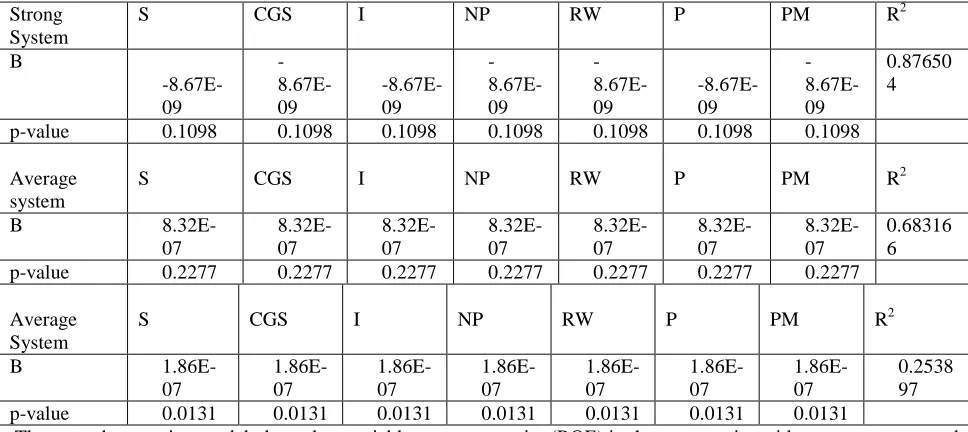
Like table 2, there are similar analyses for the obtained results shown in table 3. Clearly, the F-statistic for firms with strong MAIS (0.000) in table 4 proved that the model was significant (confidence level = 99%). Therefore, hypothesis H0 was rejected and H1
was accepted naturally. In the next step, it was studied effects of the research‘s independent variables on its dependent variable ―ROE‖. The related significance levels for variables like ―CGS‖, ―I‖, OP‖, ―RW‖, ―P‖, and ―PM‖ showed that they were statistically reliable (< 0.05). As it is shown in table 4, R2 coefficient was 0.876504. Also, the F-statistic for the firms with average MAIS (0.000003) proved that the model was significant (confidence level = 99%). Therefore, hypothesis H0 was
rejected and H1 was accepted. In the next step,
effects of the research‘s independent variables on its dependent variable ―ROE‖ were studied. The related significance level for all variables showed that variables like ―I‖, ―OP‖ and ―NP‖ were statistically reliable (< 0.05). The R2 coefficient in this case was 0.683166.
Totally, it was seen for the firms with weak MAIS that their F-statistic (0.001885) proved model‘s significance at confidence level of 99%. Hence, hypothesis H0 was rejected and
H1 was accepted. In the next step, effects of
the research‘s independent variables on its dependent variable ―ROE‖ were studied. The related significance level for all variables revealed that variables like ―CGS‖, ―PM‖, and ―RW‖ were statistically reliable (< 0.05). The R2 coefficient in this case was 0.253897.
Conclusion
736
study can be captured basically with business value of IT is applicable for the study.this business value of IT is derived from accounting. This study is consistent with the previous researches like (e.g., Dehning et al., 2006; Elbashir et al., 2008; Kobelsky et al., 2008; Bradley, 2008; Brazel and Dang, 2008; Bajaj et al., 2008; Wang and Alam, 2007; Burney and Matherly, 2007). Colin Fergusona, Poh-Sun Seow (2011)and Poston and Grabski,s (2000) indicated the importance of computer science performance in AIS, this study is more significantly consistent with their studies. Comparing the further researches by Jourdan, Zack et al., (2008), the models of this study is beyond the analysis of articles and subject researches on the business intelligence and its components. so it can be considered as the new perspective for further researches. the results of this study are consistent with Gessner , Guy H and et al., (2005) ‗ articles ―return on investment in business intelligence ― with relevant of ROI analysis. However, it is significantly concluded that the business intelligence application leads to increase the return on investment.
Based on the results of this research as well as obtained R2s, we conclude that the
organizations with high level Decision Support and Business Intelligence in MAIS have higher significance relations with returns on investments (ROI) than average and weak level systems. Also, the organizations with weak level Decision Support and Business Intelligence MAIS have higher significance relations with returns on investments than average level systems. Moreover, the organizations with high level Decision Support and Business Intelligence MAIS have higher significance relations with returns on equities (ROE) than average and weak level systems. Also, the organizations with average level Decision Support and Business Intelligence MAIS have higher significance relations with returns on equities than weak level systems. Therefore, the results of the present research show that there‘s more significant relation between high level Decision Support and Business Intelligence MAIS and ROI/ROE performance measures than any other level. Hence, it is suggested to entities‘ managers, who seek obtaining more profits and meeting investors and stakeholders‘ expectations to plan implementing Decision Support and Business Intelligence systems in their business unit‘s management accounting systems.
Table1: Decision support and Business Intelligence weight of elements by AHP (F.Roodposhtiet.,al 2012)
Major level Weight Element level Weight Final Weight of
each element Communications
and reasoning
0.080657895
Web and mobile 0.106156 0.008562346
Import Data from other
systems and Export
Reports to other systems 0.260498 0.021011217
Backward & Forward
Reasoning 0.633346 0.051084332
Analytical tools
0.455087719
OLAP 0.284316 0.129388724
Data mining 0.407747 0.185560546
Data warehouse 0.153295 0.069762495
Fuzzy decision 0.025961 0.011814368
Simulation models 0.067209 0.030585781
Prototyping 0.061473 0.027975804
Alarming and reporting
systems 0.175307018
Multi agent 0.333937 0.058541438
Situation awareness
modeling 0.567873 0.099552175
VisualGraphs 0.09819 0.017213404
Effective
decision making 0.288947368
Group Sorting tools &
Methodology(Groupware) 0.295217 0.085302079
737
Clustering
Summarization 0.068821 0.019885628
Optimization Technique 0.485014 0.140143449
Table 2- A regression analysis during 2008-2010;
Table 3- A regression analysis during 2008-2010; Strong
System
S CGS I NP RW P PM R2
B -8.67E-09 - 8.67E-09 -8.67E-09 - 8.67E-09 - 8.67E-09 -8.67E-09 - 8.67E-09 0.87650 4
p-value 0.1098 0.1098 0.1098 0.1098 0.1098 0.1098 0.1098
Average system
S CGS I NP RW P PM R2
B
8.32E-07 8.32E-07 8.32E-07 8.32E-07 8.32E-07 8.32E-07 8.32E-07 0.68316 6
p-value 0.2277 0.2277 0.2277 0.2277 0.2277 0.2277 0.2277
Average System
S CGS I NP RW P PM R2
B
1.86E-07 1.86E-07 1.86E-07 1.86E-07 1.86E-07 1.86E-07 1.86E-07 0.2538 97
p-value 0.0131 0.0131 0.0131 0.0131 0.0131 0.0131 0.0131
The second regression model, dependent variable return on equity (ROE) in three categories with strong, average and weak level management accounting information system based on decision support and business intelligence.
Durbin Watson statistic in strong system 2.456544 , average system 2.080618 , weak system 1.428971 . Strong
System
S CGS I NP RW P PM R2
B 4.92E-09 4.92E-09 4.92E-09 4.92E-09 4.92E-09 4.92E-09 4.92E-09 .906 678
p-value 0.0643 0.0643 0.0643 0.0643 0.0643 0.0643 0.0643
Average System
S CGS I NP RW P PM R2
B 4.37E-08 4.37E-08 4.37E-08 4.37E-08 4.37E-08 4.37E-08 4.37E-08 0.199 953
p-value 0.0606 0.0606 0.0606 0.0606 0.0606 0.0606 0.0606
Weak System S CGS I NP RW P PM R2
B
7.48E-08 7.48E-08 7.48E-08 7.48E-08 7.48E-08 7.48E-08 7.48E-08 .9586 33
p-value 0.0386 0.0386 0.0386 0.0386 0.0386 0.0386 0.0386
738 References
Baars, Henning and Kemper, Hans-George(2008), ―Management Support with Structured and Unstructured Data—An Integrated Business Intelligence Framework‖ Information Systems Management, Vol.2, No.2, 132 —148.
Chou,D,C&tripuramallu,H,B(2005), ―BI and ERP integration, information management & computer security‖ Vol.13.
Editorial board of international journal of accounting information systems ,(2009) “An electronical approach in accounting information systems‖ international journal of accounting information systems Vol.10, pp.173-176.
F.rahnamayroodposhti,
mohammadmahmoodi(2010), providing an accounting information system based on business intelligence, Iranian business management journal ,first volume.
F.rahnamayroodposhti,H.nikoomaram,m ohammadmahmoodi(2012),the effect of management accounting information system based on business intelligence in profitability, American journal of scientific research ,51 volume.
Gartner .., (2007), Business intelligence &
information management .
http:www.gartner.com.
Ghazanfari, M., Jafari, M., &Rouhani, S.(2011) A tool to evaluate the business intelligence of enterprise systems.
ScientiaIranica(0). doi:
10.1016/j.scient.2011.11.011.
Gessner, Guy H. and Volonino, Linda (2005) ―Quick Response Improves Returns
on Business Intelligence Investments‖ Information Systems Management, Vol.22, No.3, pp.66- 74.
Ghoshal, S., Kim, S. K.(1986) "Building Effective Intelligence Systems for Competitive Advantage", Sloan Management Review, Vol. 28, No. 1, pp. 49–58.
Harshel,r,t& N,E(2005), “Knowledege management and business intelligence : the importance of integration‖ journal of knowledge management , Vol 9, p 45-55.
Ijaz Ahmad
tatlah,TahseenmehmoodAslam(2012), ―Emotional Intelligence and Transformative Leadership Style of Principals in High Schools‖ International Journal of Asian Social Science, Vol.2, No.4), pp.556-566.
Jourdan, Zack, Rainer, R. Kelly and Marshall, Thomas E. (2008) 'Business Intelligence: An Analysis of the Literature ', Information Systems Management, Vol.25, No.2, pp.121- 131.
Lönnqvist, Antti and Pirttimäki, Virpi,(2006) ―The Measurement of Business Intelligence‖ Information Systems Management, Vol.23, No.1, pp.32- 40,.
Maria , f(2005), improving the utilization of external strategic information . tampere university of technology , master of science thesis.