Introduction
Since landfill sites, in general, are becoming overcrowded and expensive for waste disposal, efforts must be made to minimize the quantities of materials that are delivered to landfills. If the production of waste cannot be prevented, then it is attractive to create an alternative use in another process instead of disposal. The benefits of this recycling can be economically advantageous, due lower costs of removing the waste and the reduction of pollution and contamination (G. Li et al., 2004; Senthamarai and Manoharan, 2005).
This paper presents data to show that the polymer wastes in Malaysia are not 100% recycled, i.e., reprocessing of the waste materials into other
polymeric items or energy recovery from complete combustion. However, polymer reprocessing is has a limited number of recycling cycles, since contamination and thermal degradation result from the steps of melting and reshaping (Mustafa et al., 2007).
The development of concrete with non-conventional aggregate, such as polystyrene foam
Investigation Of HDPE Plastic Waste Aggregate On The Properties Of Concrete
Abstract
Author
A. M. Mustafa Al Bakri Green Concrete@UniMAP, School of Material Engineering,Universiti Malaysia Perlis (UniMAP), 01000, P.O. Box 77, D/A PejabatPosBesar,Kangar, Perlis, Malaysia.
E-mail: [email protected]
S. Mohammad Tamizi
Green Concrete@UniMAP, School of Material Engineering,Universiti Malaysia Perlis (UniMAP), 01000, P.O. Box 77, D/A PejabatPosBesar,Kangar, Perlis, Malaysia.
E-mail:[email protected]
A. R. Rafiza
Green Concrete@UniMAP, School of Material Engineering,Universiti Malaysia Perlis (UniMAP), 01000, P.O. Box 77, D/A PejabatPosBesar,Kangar, Perlis, Malaysia.
E-mail:[email protected]
Y. Zarina
Green Concrete@UniMAP, School of Material Engineering,Universiti Malaysia Perlis (UniMAP), 01000, P.O. Box 77, D/A PejabatPosBesar,Kangar, Perlis, Malaysia.
E-mail:[email protected]
Key words: polymer wastes HDPE; coarse aggregate; compressive strength; properties
wastes, HDPE, polyethylene terephthalate (PET), and other plastic materials has been investigated for use in concrete in order to improve the properties of the concrete and reduce cost. The use of such plastic wastes in concrete will contribute to the sustainability of the concrete design and the natural environment.
Experimental Programme
The main goal of the experimental program was to determine the contribution of various types of waste aggregates to the strength of confined concrete. To that end, the experimental program had the following objectives:
1) To study the characterization of HDPE polymer waste aggregate for comparison to crushed stone coarse aggregate
2) To study the behaviour of fresh and hardened concrete with polymer waste coarse aggregate and compare its properties to those of conventional concrete
3) To produce lightweight polymer concrete for multi-purpose use
Raw Materials
Ordinary Portland Cement
The most important raw material is ordinary Portland cement (OPC) as cementitious material. OPC is suitable for normal concrete and many applications in the construction industry. The raw materials used to manufacture Portland cement are lime, silica, alumina, and iron oxide. To make OPC, a mixture of limestone and clay is heated until it almost fuses, and, then, the clinker is ground into a fine powder (M.Tawfik, 2006). Portland cement is a dry, flour-like substance that contains calcium, silicon, and aluminum, which hardens and holds the aggregate together.
Sand as fine aggregate
River sand as fine aggregate consists of particles ¼ inch (600 m) or less in size. River sand is the fine aggregate most commonly used in concrete to provide volume at low cost (George R. White, 1991). Sand and gravel are types of aggregate. A good concrete mix will contain both aggregate types.
Plastic Wastes
Waste trash bag plastics were collected from the landfill and from other locations in the environment and used to manufacture lightweight aggregates. The plastic waste sheet was shaped as desired, e.g.,
as a ball with a diameter of 25-30 mm. The heating temperature was in the range of 160 °C to 200 °C. The plastic waste aggregate was modified by heat treatment, which consisted of heating it at temperatures above the melting point, i.e., 160°C, 170 °C, 180 °C, 190 °C, and 200 °C, for 10 minutes in a laboratory oven. Then, the hot aggregate was removed from the oven and allowed to cool at room temperature. Thus, the heating process induced changes in the physical characteristics of the plastic wastes (shrinkage) and in the microstructure. The spherical diameters of the sample plastic wastes shrunk to the range of 14 - 20 mm. The shapes and textures of the samples were not homogenous or circular, but they were a mixture of angular shapes and round shapes, much like crushed stone.
Crushed Stone or crushed gravel
Crushed stone is the source of the basic properties of natural aggregate used in concrete. Crushed stone is a coarse aggregate that is produced by crushing hard stone. Coarse aggregates are materials retained on a 5-mm (3/16-inch) BS 410 test sieve that contain no more fine materials than is permitted in MS 29:1995.
Water
Water is a very important component that must be mixed into the concrete. The appropriate use of water is the single most important consideration that governs the workability of concrete because the particles requires a certain amount of water. Water is absorbed on the surface of the particles, and in the spaces between particles, providing the "lubrication" that is required for the particles to move past one another more easily. Therefore, finer particles, which are necessary for plastic behavior, require more water. Water that contains impurities will hinder the curing strength of concrete, so only potable water is used for mixing concrete. Additional small amounts of water can always be added if needed, but no water can be removed. The less water that is used, the stronger the concrete will be.
Characterization
Thermal analysis was performed using a differential scanning calorimeter (DSC) (Research Instruments, City, Country) with a constant nitrogen flow rate at 20 ml/min. The investigated temperature range was 20 -180 °C. The samples were heated at 15 °C/min up to 180 °C, held at that temperature for five minutes, and cooled at 15 °C/min to 20 °C. Each sample (4-6 mg) was weighed and sealed in the aluminium vessel.
was heated to different temperatures in the range of 160-200 °C to determine the optimal temperature that produced the best properties for the aggregate in concrete.
After heat treatment, the aggregate was tested to determine its characteristics, such as size and shape, surface texture, water absorption, color, and compression test results.
The compression test cube test and a beam flexural test were conducted using the Universal Testing Machine, operated at a crosshead speed of 3.0 kN/sec. Data were collected until the cubes failed. The results of the compression and flexural tests were obtained by averaging the values of at least three measurements.
Experimental Procedure Mixing
The raw materials, i.e., water, Portland cement, sand, and coarse aggregate, were mixed. The design mix proportions were 1:1.75:2.75, which was based on the earlier research of Yun-Wang
Choi et al. (2005) and waste PET bottles were used as the coarse aggregate. In this research, two different plastic waste-to-crushed stone ratios were used (100% plastic waste, 80:20; 60:40 and 100% crushed stone) with the water-to-cement ratio of 0.5. The mixing process created a homogeneous mixture to ensure the proper coating of cement on the aggregate. Thus, the mixing process must be thorough and not rushed. While the raw materials are being mixed, small amounts of water were repeatedly added until a consistency similar to the consistency of cookie dough was obtained.
Mix proportion
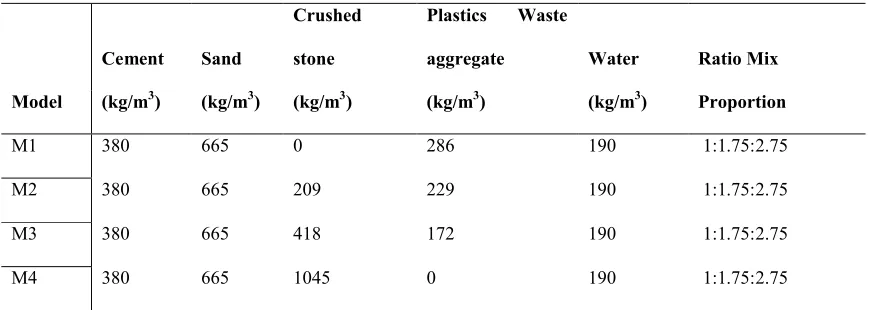
The constituents were used in different fractions to determine mixture proportions that would yield the targeted compressive strength at the test age of 28 days. The optimum mix proportions included cement, sand, coarse aggregate, plastic waste, and water to yield a cubic meter of concrete. Table 1 shows the compositions of the sample plastic waste coarse aggregate concrete mixes based on the volumetric method with the same water-to-cement ratio of 0.5.
Table 1: Mix proportion for concrete design
Model
Cement Sand
Crushed stone
Plastics Waste
aggregate Water Ratio Mix
(kg/m3) (kg/m3) (kg/m3) (kg/m3) (kg/m3) Proportion
M1 380 665 0 286 190 1:1.75:2.75
M2 380 665 209 229 190 1:1.75:2.75
M3 380 665 418 172 190 1:1.75:2.75
M4 380 665 1045 0 190 1:1.75:2.75
Mix Proportion (Plastic waste:Gravel, in volumetric percentage)
M1 - (100:0)
M2 - (80:20)
M3 - (60:40)
M4 - (0: 100)
Preparation of Test Samples
To evaluate the mechanical properties of concrete, such as compressive and flexural strength by age and mixing ratios, concrete test specimens were
removed from the molds and cured for 28 days in water so that they were at the required age.
Results and Discussion Analysis of DSC Results
DSC results indicated the melting temperature of the samples, Tm, as shown in Figure 1. Various types of plastic waste polymers were used in the research to make the coarse aggregate. From the analysis of the DSC results, the plastic waste was shaped into small, spherical balls and heated above the melting temperature, Tm. Figure 1 shows that the plastic waste began to melt at a temperature of 130 °C.
Size and shape
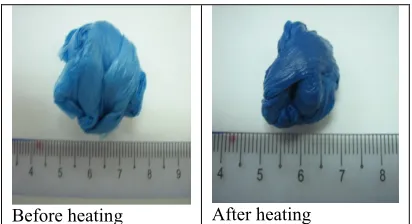
Figure 2 shows that the aggregate sizes used in this research were in the range of 14 - 20 mm. Before the heating process, the plastic waste was shaped small, spherical balls with diameters of approximately 30 mm. After heating in the oven at a temperature of 180 oC, the small balls shrank to a size that was smaller than the original size. The plastic waste was allowed to melt, and, after a few minutes, the aggregate was removed from the oven. Then, after cooling, the plastic maintained the shape of small, spherical balls with diameters in the range of 14 - 20 mm, which is the standard size for the coarse aggregate in concrete.
Surface, Texture, and Water Absorption
Aggregates are three-dimensional masses. Their shape, size, and surface texture influence the properties of the concrete, significantly influence the workability of fresh concrete, and influence the bond between the aggregate and the mortar paste. Shape and surface texture are considered to be external characteristics.
Aggregate particles that have smooth and rounded surface were used to produce concrete. On the other hand, the aggregate particles interlock, which reduces the strength of the aggregate-mortar bond. Smooth and rounded aggregate plastics result in lower compressive strength than a crushed aggregate with the same water-to-cement ratio.
From the equation below, the results show the percentage of water absorption of the aggregate is very low, i.e., around 0 – 0.5%.
% water : W2- W1 x 100 % absorption W1
where W1 = weight before immersion (dry condition)
W2 = weight after immersion (wet condition)
Compression test for aggregate
Figure 3 shows the results obtained for compressive strength of the aggregate. Five pieces with different color aggregates were heated to different temperatures. After a few minutes, the aggregate was cooled and the compression test was conducted for each aggregate. From Figure 3, it is evident that the temperature of 180 °C provided the best result. The aggregate that was heated at 180 °C had the best properties. Their strength is highest which up to 25 MPa. From this result, it can be concluded that the optimal temperature for heating plastic waste is 180 °C.
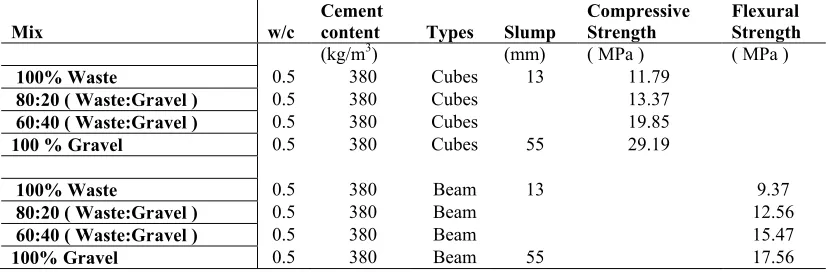
The mechanical properties of plastic waste coarse aggregate are presented in Table 2. The results show that fresh plastic waste coarse aggregate has lower water absorption and a smoother surface texture. Usually, plastics do not absorb water, but the heating process modified the aggregate, giving it a higher density. Thus, during the mixing process, less water can be used.
The compressive strength of the sample cubes ranged from 11 to 19 MPa. Concerning strength, the basic trend in the behaviour of plastic waste coarse aggregate concrete was not significantly different from that of the conventional crushed stone aggregate for lightweight concrete.
The flexural strength varied from 9 to 15 MPa. The variations in flexural strength between plastic waste concrete and conventional concrete were very small. From the surface of the fractured samples, it was apparent that the plastic waste did not have strong, interlocking bonds with the cement.
Conclusion
The aim of this research was to evaluate the recyclability of domestic plastic waste as coarse aggregate for concrete. From the results and discussion, the following conclusions were drawn:
2) The compressive and flexural strengths of concrete containing the plastic waste decreased as the proportion of plastic waste increased. The concrete that contained a 60:40 ratio of plastic waste to gravel gave the highest strength properties. The connection between the plastic waste aggregate and crushed stones will give increased strength and better properties.
3) The mechanical properties of the concrete did not display any notable differences depending on the color of the plastic waste
aggregate. The color or pigment of plastic waste will make the decorative products it is used in attractive.
4) This research also has potential application for the production of lightweight concrete, cost savings for raw materials, for minimizing the amount of polymer wastes in landfills, and the creation of decorative, attractive landscaping products.
Figure 1: Analysis of DSC results for plastic waste
Figure 3: Compressive Strength for Aggregate for Various Heating Temperatures
Compressive Strength and Flexural Strength
Table 2: Properties of Plastic Waste Coarse Aggregate Concrete and Conventional Concrete Mixes at 28 days
Mix w/c Cement content Types Slump Compressive Strength Flexural Strength
(kg/m3) (mm) ( MPa ) ( MPa )
100% Waste 0.5 380 Cubes 13 11.79
80:20 ( Waste:Gravel ) 0.5 380 Cubes 13.37
60:40 ( Waste:Gravel ) 0.5 380 Cubes 19.85
100 % Gravel 0.5 380 Cubes 55 29.19
100% Waste 0.5 380 Beam 13 9.37
80:20 ( Waste:Gravel ) 0.5 380 Beam 12.56
60:40 ( Waste:Gravel ) 0.5 380 Beam 15.47
100% Gravel 0.5 380 Beam 55 17.56
References
A.M.Mustafa, H.Kamaruddin, G.M.Ruzaidi, M.N. Norazian, M.D.Abu Bakar, and M.I Mohd Tajuddin (2007) “Preliminary Study on Concrete with Polystyrene Waste Coarse Aggregate” 1st Construction Industry Research Achievement International Conference-CIRAIC 2007-Proceeding, pp. 64-67.
G. Li, M.A. Stubblefield, G.Garrick, J.Eggers, C. Abadie, B. Huang (2004) “Development of Waste Tire Modified Concrete” Cem Concr Res Vol.34, No. 12, pp. 2283-2289.
George R. White. Concrete Technology, 3rdEdition (1991)
M.E. Tawfik and S.B. Eskander (2006)“Polymer Concrete from Marble Wastes and Recycled Polyethylene Terephthalate” Journal of Elastomers and Plastics Vol.38, No. 1, pp 65-79
RM Senthamarai, P.D. Manoharan (2005) “Concrete with Ceramic Waste Aggregate” Cem Concr Compos Vol.27, No. 9-10, pp. 910-913.