Feature Selection for Human Grasping Activity Using
Pearson’s Correlation Techniques
Nazrul H. Adnan
Department of Therapeutics, Kolej Kemahiran Tinggi Mara (KKTM), Mukim Serom 4 & 5, 84410 Ledang, Johor Darul Takzim, MALAYSIA.
1.
Introduction
The posture of the human hand determines the fingers that are used to create contact between object at the same time develops the grasping relation. The relationship between human grasp and selection of grasping object is based on the philosophy of grasping which is known as Taxonomy. The taxonomy distinguishes two dominant prehensile postures which are the power grip and the precision grip. For the grasping pattern, the use of multi-feature approaches enables to classify the object shapes used in the experiments such as the difference of grasping data distribution.
The grasping activities will produce a signal that represents the characteristic of the grasping objects. The output signal must be filtered to reduce the noise produced by thermal motion of electrons. The output signal is termed as human grasping data. In finalizing the grasping signal, Principal Component Analysis (PCA) is used to reduce the data redundancy. PCA generally functions as to reduce the dimensionality of dataset in which there are a large number of interrelated variables, while maintaining as much as possible in dataset changes.
This research paper is structured as follows: Section 2 addresses the literature review of the related researches to the several approaches, applications and problems of recognizing the fingers grasping force signal. Section 3 describes the methodologies of the system. Section 4 will present the results and discussions. Finally on section 5 described the conclusions and proposing some possible future work.
2.
Literature Review
Nowadays, Human Computer Interaction (HCI) is one of the associated technologies. Since HCI has become a common place, there was a need to make it as seamless as possible so that it was close to the natural human-to-human interaction. However, one big hurdle that must be overcome in order to achieve this objective was the lack of human grasping perception in today’s computers. Many researchers have been using many recognition tools to classify the recognition of grasping motion into hand and finger joint motions. So far, several studies have classified human objects grasping into some categories by considering the opposable fingers movement especially for robot hands based on the real time human grasping purpose [11]. Manipulation of human finger grasping creates the possibility of the interaction of human beings with the environment around them. In the last decade, there were numerous literatures on grasping force analysis, grasping force optimization and grasping force stability. The key problems in the last twenty years were force analysis [2] and grip strength [3], usually problem occurs when multi-fingered grasping takes place. Generally speaking, advances in the recognition of human activities such as motion control [4], hand grasping [5] and robot grasping [6] are progressing. They are demonstrated using popular methods such as EMG [7], Dataglove [8][9][10] and humanoid hand [11].
Many researchers have been using many recognition tools to classify the recognition of grasping motion into hand and finger joint motions. So far, several studies have classified human objects grasping into some categories by considering the opposable fingers movement especially
Abstract: The algorithm of feature selection is the collective of search technique to categorize features into their evaluation score. There are many methods to determine the feature extraction in human grasping analysis such as statistical features, PCA-best matching unit (PCA-BMU) and sum of movement (SuM). Feature selection is important in order to increase the classification accuracy by removing redundant features. In analyzing the human grasping data, only the best features are selected in order to make classifying more accurate, less redundant and quickly identifiable, especially for the objects grouping. Pearson's correlation or simply known as the angular separation is capable to measure the similarity of two vectors rather than the distance or the dissimilarity between them. Advantages of the Pearson’s correlation are that it is easy to work out and it’s easy to be interpreted.
for robot hands based on the real time human grasping purpose [1][11][12]. Manipulation of human finger grasping creates the possibility of the interaction of human beings with the environment around them. The human fingers movement able to delicate and manipulate any kind of object [13][14]. According to Ratnasingam et al. [15] humans perform recognition tasks to any object almost immediately and unlimited number of times. Human grasping of an object depends on feeling the contour shape of an object by using fingers and the use of hand palm to grasps or move the object. The shape of an object can be described sufficiently using curvatures, angles and surface contours formed by the fingers [15][16].
3.
Methodology
The grasping data are taken from 10 subjects (5 males age 25, 26, 30, 36 and 45 years old meanwhile the other 5 subjects are females, age between 26 and 28 years old). All of them are right handed subjects and occupied as a university student. With 20 trials for each object, the chosen taxonomy is based on the Cutkosky Grasp Taxonomy [1].
Based on Cutkosky taxonomy, the lists of objects are as follows; (a) Power Grip (Ball, Cylinder, Pen and Key), and (b) Precision Grip (Disc, Scissors, Pins and Paper). According to Cutkosky, all subjects should confine to single-handed operations and there should have been a better appreciation of how task requirements and object geometry combine to justify the grasp choice for better result of human grasp. The next process flow is to eliminate or minimize the unwanted signal and noise by using Gaussian Filter.
Fig. 1: Experiment of fingers grasping [17]
Gaussian Filtering makes grasping signal become smoother and lessens the abrupt changes in signal frequency. Then the grasping signals are analyzed using PCA. Since PCA functions as data reduction, PCA becomes the first choice method in reducing the redundancy in grasping signal. PCA is capable to generate an “Eigenfinger” for thumb, index and middle fingers of grasping data. The measures of the three main
finger movements are well-defined in a marginally in different way of grasp due to its special kinematical structure. According to [17] stated that thumb, index and middle fingers give more grips and stronger compare to the other fingers (ring and little fingers). Both researchers used many items in order to determine the best finger usage such as chuck, pulp, and lateral pinches and these items are tested to 100 subjects [17][18]. Fig. 1.0 shows the example of fingers grasp testier and Fig. 1.1 shows a sample of human grasp object.
GloveMAP is developed using the universal stretchable and covered with lycra fabric. GloveMAP provide as an input devices that can monitor the dexterity and flexibility characteristics of the human hand motion.
Fig. 2: Object grasping
3.1
Gaussian Filtering Techniques
GloveMAP signal is prepared with Gaussian filtering method in order to remove noise produced by random thermal motion of charge inside the electrical conductor. Noise within signal could affect the performance of objects’ feature and classification. Resistors used in GloveMAP also would produce noise as heat inside resistors buildup. Each data collection from 8 objects will be filtered using Gaussian Filtering. Fig. 3(a) and Fig. 3(b) show unfiltered and filtered voltage produced from human grasping. Both figures demonstrate the result of Gaussian Filtering into raw voltage to reduce noises and overshoot. Gaussian has an advantage of reducing noises and overshoot of the input grasping signal.
3.2
Features Extraction
Features extraction is important in order to increase the classification accuracy, facilitating the subsequent learning and generalization steps. There are many methods to determine feature extraction in human grasping analysis such as statistical features, best matching unit (BMU) and sum of movement (SuM).
3.2.1
Statistical Feature
Statistic is a numerical example of collective data that provide analysis of data behaviour. Mean, median, and standard derivation is the example of basic statistical approach on understanding data behaviour. Mean or average in mathematical (𝑥𝑥̅) in mathematical is referring to the as central values of a discrete set of numbers. Mean consists of arithmetic function of adding or summing every set of number and divided by number of values. Median is an approach to separate higher data from lower
data in sample data. Standard derivation (σ) or SD is a
measurement of amount of data variation from the mean/average. The advantage of using statistical approaches is that it is capable to analyse data quickly and straightforward. At the same time it is analysed in a standardized way.
3.2.2
PCA-BMU Feature
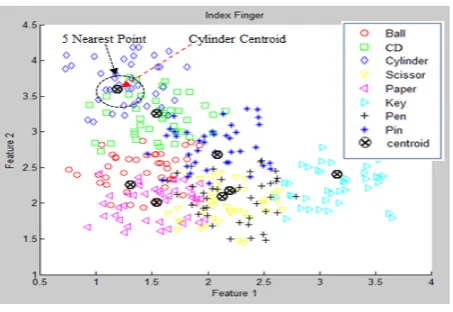
The Best Matching Unit feature is taken from the competitive learning of PCA as shown in Fig. 4. Based on Fig. 4, the output of PCA, namely as the set of principal components, are functioning as the input of BMU. The BMU objective is to cluster all data into a set of groups. The clustering is also capable to separate the data which appear similar, close to one another and place the very different ones distant from one another. Suppose that the input y = [ 𝑦𝑦1, 𝑦𝑦2,….., 𝑦𝑦𝑚𝑚]T, the weight vector of the
neuron j in BMU is 𝑤𝑤𝑗𝑗 = [ 𝑤𝑤𝑗𝑗1, 𝑤𝑤𝑗𝑗2,….., 𝑤𝑤𝑗𝑗𝑗𝑗]T.
Fig. 4. PCA and BMU Diagram
Fig. 5: Nearest points for PCA-BMU feature of an object
3.2.3
Sum of Movement (SuM) Feature
Sum of movement is a summation of finger movement data to obtain the total change inside the sample data. SuM offers versatility on feature extraction due to its capability to deal with offset data. SuM disregards data point value but instead takes change of previous data point to the next as the main information. While SuM disregards data point value, range from minimum point to maximum point remains the same as the original signal. The equation to obtain sum of movement is shown in Equation (1). Meanwhile Fig. 6 shows sample data applied with SuM.
𝑆𝑆𝑆𝑆𝑆𝑆
=
𝑆𝑆𝑆𝑆𝑆𝑆
1+
𝑆𝑆𝑆𝑆𝑆𝑆
2(1)
where,
𝑆𝑆𝑆𝑆𝑆𝑆
1=
∑
𝑛𝑛𝑛𝑛𝑛𝑛𝑛𝑛𝑛𝑛=1(
𝑥𝑥
𝑛𝑛− 𝑥𝑥
𝑛𝑛−1)
𝑆𝑆𝑆𝑆𝑆𝑆
2=
∑
𝑛𝑛𝑛𝑛𝑛𝑛𝑛𝑛𝑛𝑛𝑛𝑛𝑛𝑛=𝑛𝑛𝑛𝑛𝑛𝑛𝑛𝑛|
𝑥𝑥
𝑛𝑛− 𝑥𝑥
𝑛𝑛−1|
𝑥𝑥
is GloveMAP output voltage3.3
Pearson Correlation
Pearson's correlation or simply known as the angular separation, measure the similarity of two vector rather than distance or dissimilarity. Higher value of angular separation indicates the two objects are similar. Equation 2 shows the formulation for separation. Meanwhile Fig. 7 shows the sample of similarity measurement for three objects.
𝑆𝑆
𝑖𝑖𝑗𝑗=
∑
(
𝑥𝑥
𝑖𝑖𝑖𝑖− 𝑥𝑥̅
𝑖𝑖). (
𝑥𝑥
𝑗𝑗𝑖𝑖− 𝑥𝑥̅
𝑗𝑗)
𝑛𝑛𝑖𝑖=1
�∑
𝑛𝑛𝑖𝑖=1(
𝑥𝑥
𝑖𝑖𝑖𝑖− 𝑥𝑥̅
𝑖𝑖)
2.
∑
𝑛𝑛𝑖𝑖=1(
𝑥𝑥
𝑗𝑗𝑖𝑖− 𝑥𝑥̅
𝑗𝑗)
2where,
𝑥𝑥̅
𝑖𝑖=
1
𝑛𝑛 � 𝑥𝑥
𝑖𝑖𝑖𝑖 𝑛𝑛𝑖𝑖=1
𝑥𝑥̅
𝑗𝑗=
1
𝑛𝑛 � 𝑥𝑥
𝑗𝑗𝑖𝑖 𝑛𝑛𝑖𝑖=1
𝑘𝑘
=
feature 𝑥𝑥̅, ℴ, ℴ2, m, SuM and PCA-BMUFig. 7: Example of similarity measure between object.
4.
Results and Discussion
In this section, the analyses of overall step results are started accordingly from data acquisition, feature comparison, and similarity result for all features.
4.1
Human Grasping Data
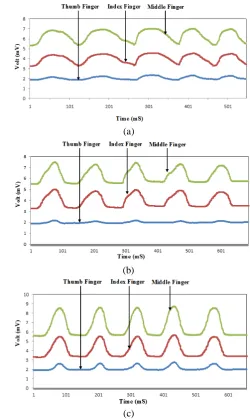
Figure 8 shows the sample of 3 out of 8 objects grasping data. The figures show three main fingers results (thumb, index and middle) involved in the experiment. All figures show that middle and index finger were given more bending compared to the thumb. Basically index and middle fingers could be defined as the two strongest fingers meanwhile the thumb functioned as the main
supportive finger whilst grasping the objects. Based on Fig. 7, it is proven that the signal for both fingers (index and middle finger) was more functioning compared to thumb fingers. Naturally, the thumb cannot bend more compared to the index and middle finger, however the thumb at the same time is moderately flexible (when the hand was spread, the thumb was easily standing a fair distance from the rest of the fingers).
(a)
(b)
(c)
Fig. 8: Grasping signals of the object (a) “Ball” (b) “CD” (c) “Cylinder”
4.2
Comparison of Features
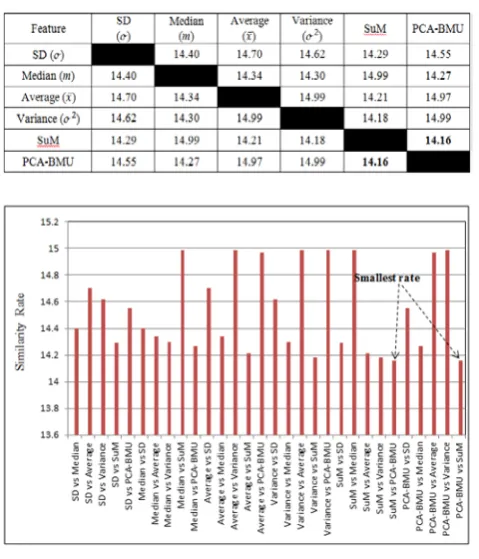
In this section, the selections of the best features are important in order to classify the human grasping data. As mentioned before, the comparisons between SD, median, average, variance, SuM and PCA-BMU were calculated based on 10 subjects and 20 repetitions using the selected object. Table 1 shows the similarity rate for all features and the results show that the similarity rate for SuM and PCA-BMU is the best similarity rate for human grasping feature.
Table 1: Similarity rates for SD, Median, Average, Variance, SuM and PCA-BMU feature
Fig. 9: Similarity rates for all features.
Figure 9 shows the similarity rate for justifying the best two features for finger grasping feature. Based on the methodology of Pearson’s Correlation, SuM and PCA-BMU features become an ideal feature with the smallest similarity rate 14.16. Smallest rate for both SuM and PCA-BMU feature shows that the correlation between feature and object in terms of classifying will became more accurate, less redundant and quickly identified especially for the objects grouping.
5.
Summary
In this paper, the methods to select the best human grasping features based on Pearson Correlation techniques were presented. Pearson's correlation / angular separation had been used to measure the similarity of two vectors rather than distance or dissimilarity between all features and finally only two features were selected (SuM and PCA-BMU feature). The result for both features became an ideal feature with the smallest similarity rate of 14.16 compared to the others. For future works, the results are by adding the signal processing technique in the research. This signal processing will be employed in solving the problem of analysing more sophisticated signal pattern especially on the signal produced during transition gesture and continuing gesture.
References
[1] Cutkosky, Mark R. "On grasp choice, grasp models, and the design of hands for manufacturing tasks."
Robotics and Automation, IEEE Transactions on 5, no. 3 (1989): 269-279.
[2] Xu, Jijie, Michael Y. Wang, Hong Wang, and
Zexiang Li. "Force analysis of whole hand grasp by multifingered robotic hand." In Robotics and Automation, 2007 IEEE International Conference on, pp. 211-216. IEEE, 2007.
[3] McDowell, Thomas W., Bryan M. Wimer, Daniel E. Welcome, Christopher Warren, and Ren G. Dong. "Effects of handle size and shape on measured grip strength." International Journal of Industrial Ergonomics 42, no. 2 (2012): 199-205.
[4] Capisani, Luca Massimiliano, and Antonella Ferrara. "Trajectory planning and second-order sliding mode motion/interaction control for robot manipulators in unknown environments." Industrial Electronics, IEEE Transactions on 59, no. 8 (2012): 3189-3198. [5] Kerr, Jeffrey, and Bernard Roth. "Analysis of
multifingered hands." The International Journal of Robotics Research 4, no. 4 (1986): 3-17.
[6] Tsoli, Aggeliki, and Odest Chadwicke Jenkins. "Neighborhood denoising for learning high-dimensional grasping manifolds." In Intelligent Robots and Systems, 2008. IROS 2008. IEEE/RSJ International Conference on, pp. 3680-3685. IEEE, 2008.
[7] Cipriani, Christian, Franco Zaccone, Silvestro Micera, and M. Chiara Carrozza. "On the shared control of an EMG-controlled prosthetic hand: analysis of user–prosthesis interaction." Robotics, IEEE Transactions on 24, no. 1 (2008): 170-184. [8] Park, Jongwoo, and Joono Cheong. "Analysis of
collective behavior and grasp motion in human hand." In Control Automation and Systems (ICCAS), 2010 International Conference on, pp. 2514-2518. IEEE, 2010.
[9] Häger-Ross, Charlotte, and Marc H. Schieber. "Quantifying the independence of human finger movements: comparisons of digits, hands, and movement frequencies." The Journal of neuroscience 20, no. 22 (2000): 8542-8550.
[10] Todorov, Emanuel, and Zoubin Ghahramani.
"Analysis of the synergies underlying complex hand manipulation." In Engineering in Medicine and Biology Society, 2004. IEMBS'04. 26th Annual International Conference of the IEEE, vol. 2, pp. 4637-4640. IEEE, 2004.
[11] Napier, John R. "The prehensile movements of the human hand." Journal of bone and joint surgery 38, no. 4 (1956): 902-913.
[12] Iberall, Thea. "Human prehension and dexterous robot hands." The International Journal of Robotics Research 16, no. 3 (1997): 285-299.
[13] Tortora, Gerard J., and Sandra Reynolds Grabowski. "Principles of anatomy and physiology." (1993). [14] Chao, Edmund Y. Biomechanics of the hand: a basic
research study. World Scientific, 1989.
[15] Ratnasingam, Sivalogeswaran, and T. M.
Informationally Structured Space (RiiSS), 2011 IEEE Workshop on, pp. 26-31. IEEE, 2011.
[16] Burke, David., S. C. Gandevia, and G. Macefield. "Responses to passive movement of receptors in joint, skin and muscle of the human hand."The Journal of physiology 402, no. 1 (1988): 347-361.
[17] Radwin, Robert G., Seoungyeon Oh, Todd R.
Jensen, and John G. Webster. "External finger forces in submaximal five-finger static pinch prehension."Ergonomics 35, no. 3 (1992): 275-288. [18] Swanson, Alfred B., Ivan B. Matev, and G. De
![Fig. 1: Experiment of fingers grasping [17]](https://thumb-us.123doks.com/thumbv2/123dok_us/8439974.1700996/2.595.91.256.476.646/fig-experiment-fingers-grasping.webp)