© Universiti Tun Hussein Onn Malaysia Publisher’s Office
JTET
http://penerbit.uthm.edu.my/ojs/index.php/jtet
ISSN 2229-8932 e-ISSN 2600-7932
Journal of Technical Education and
Training
Effectiveness of Integration of Learning Strategies and
Higher-Order Thinking Skills for Generating Ideas among
Technical Students
Yee Mei Heong
1*, Kong Hie Ping
2, Jailani Md Yunos
3, Widad Othman
4, Tee Tze
Kiong
5, Mimi Mohaffyza Mohamad
6and Kok Boon Ching
71,2,3,5,6 Faculty of Technical and Vocational Education, Universiti Tun Hussein Onn Malaysia, 86400 Parit Raja, Johor, MALAYSIA
4Faculty of Education and Language, Open University Malaysia, 50480 Kuala Lumpur, MALAYSIA
7Faculty of Electrical and Electronic Engineering, Universiti Tun Hussein Onn Malaysia, 86400 Parit Raja, Johor, MALAYSIA
DOI: https://doi.org/10.30880/jtet.2019.11.03.005
Received 19h August 2018; Accepted 03rd September 2019; Available online 30th September 2019
1.
Introduction
In this era of globalisation, the economic growth of a country requires more knowledgeable and skilled technical workers that can adapt to the technological changes in order to produce the maximum output (Mustapha, 2013). The development of employability skills is majorly concerned by the Technical and Vocational Education (TVE) and these employability skills are the foundation upon which individuals within the sphere of Technical and Vocational Educational and Training (TVET) are trained (Chinedu, Olabiyi & Kamin, 2015). Technical workers should have the thinking skills of continuously thinking and reasoning, problem solving, decision making and interpersonal competence
Abstract: Learning strategies and higher-order thinking skills (HOTS) play an important role in higher education learning. Every student as different preferences and strengths in learning strategies and HOTS, thus it can be a stimulus for developing new ways of learning. The purpose of this research is to evaluate the effectiveness of the integration of learning strategies and HOTS in generating ideas via a self-instructional manual among technical students. This quantitative approach research used the modified quasi-experimental design with a treatment group (TG) and a control group (CG) comprising 81 students. The pre- and post-individual assignments and assessment analytic rubric were used as the research instruments. The pre- and post-assignments were used to test the effectiveness of the integration of learning strategies and HOTS in generating ideas before and after treatment was given to TG students. The assessment analytic rubric was used to evaluate the pre- and post-assignments based on five evaluation criteria (ideas, designs, functions, materials and dimensions). Each TG student received a self-instructional manual for the integration of Kolb’s learning strategies and Marzano’s HOTS as a treatment for one month, while the CG students had no treatment but conventional teaching. The gathered data were analysed using SPSS software. The findings show that there are statistically significant differences between TG and CG on the five evaluation criteria for the individual post-assignment result. There are also statistically significant differences in the five evaluation criteria between the individual pre- and post-assignments results. Overall, the approach of integrating learning strategies and HOTS by using a self-instructional manual for generating ideas is significantly effective.
(King, Goodson & Rohani, 2011). Therefore, thinking skills are the key to success in this rapid era of development (Wheelihan, 2011).
Based on Rajendran (2008), students who are taught to develop creative insights to solving problems are better in more complex problem-solving than those who are not. Therefore, the need for higher-order thinking skills (HOTS) in the teaching and learning of TVET cannot be over-emphasised (Chinedu, Olabiyi & Kamin, 2015). According to the Malaysian Ministry of Education (2013), HOTS is defined as the ability to adapt knowledge, skills and value in making decision and reflection in solution finding, problem solving, innovation and creativity in creating something new.
Besides that, idea generation is an important part of solving a problem (Sharp, 2008). Ideas can be generated through the cognitive, metacognitive, chemical and biological processes occurring in our brain (Abd. Hamid, 2001). Based on the knowledge of cognitive psychology, the two factors that are involved in generating ideas are the internal and external factors (Mohamad, Esa & Junoh, 2008). The internal factors for generating ideas are the individual factors such as interest, tendency, goals and self-motivation. Meanwhile, the external factors are the environment, employers, partners, problems encountered, rewards and others.
In certain situations, thinking skills enable a person to solve the problems by looking at different perspectives (Mohd & Hassan, 2005) especially in solving high-level complex problems. For this, HOTS are required when we work to understand information that will be used for generating ideas. The generation of new ideas is often emphasised at universities because work assignments are getting more complex and challenging (Kuh, 2001). Students are given different types of academic and non-academic projects that require them to solve problems creatively. Students need to learn and apply HOTS in their course work so that the work can be done more effectively. Based on Sulaiman et al. (2017), using HOTS in the teaching and learning processes can improve students’ achievement and skills.
According to Yee et al. (2015), learning strategies refer to the behaviour of someone in performing their learning tasks. This behaviour consists of two basic aspects: cognitive learning strategies, which show the way of thinking, and learning strategies, which show the need for learning activities in the process to respond. As such, learning strategies are closely related to the tendency of students to think and communicate with others, the class condition and the activities that are carried out (Rogers, 2009). Thus, the learning strategies of students should be identified to help the students learn more about their thinking skills and improve their academic achievement.
Osman and Basar (2016) proposed that the learning skills for the 21st century are the learning that incorporates activities that require students to think, plan, discuss, analyse, evaluate, create and make decisions based on HOTS. Therefore, implementing HOTS is important in order to develop the skills and knowledge for technical students who can face the challenges of the 21st century (Rashid, 2016).
One of the methods to produce future employees is to educate students about how to think rather than find what to think (Ee, Chang & Tan, 2005). However, the findings of Tan and Samyudia (2009) showed that while university graduates have the ability to remember and calculate what has been learned, they lack problem-solving and higher-order thinking skills and are not able to apply the knowledge to think critically in new situations (MOE, 2012). This is because the students are often exposed to facts which are more concerned with the technical contents (Yusof, Othman & Karim, 2005). Therefore, they are less learned about how to apply knowledge more creatively and practically (Mohd & Hassan, 2005).
Furthermore, there are less of thinking skills development and teaching of specific thinking skills among students (Toh, 2003). Ng (2004) and Idris (2002) stated that most of the educational resources do not apply HOTS and, furthermore, learning activities do not involve metacognitive processes. The application of knowledge according to the highest cognitive taxonomic level is low, while the teaching and learning processes are more focused on low-level thinking (Mohd & Hassan, 2006).
In addition, some of the educators at universities face problems in developing thinking skills among students (Shuib, 2007). The research conducted by Ball and Garton (2005) found that most educators do not know how to apply HOTS to students and they are less confident when applying it. This shows clearly that HOTS should be taught in all subjects (Rajendran, 2008) and the HOTS should also be practised in technical and vocational education (Tee, 2013).
Besides that, students also face the problem of the lack of clear guidelines on the application thinking skills in the daily learning process. This is consistent with the findings on the need for thinking skills for 242 academic staff at UTHM (Yunos et al., 2011). The analysis showed that the effective learning of thinking skills is not achieved. As many as 69.7% of the academic staff think that the thinking skills learned by students in class are inadequate and incomplete. Thus, the lack of detailed information about thinking skills made students feel difficult to learn it.
Consequently, students have face problems in applying appropriate and effective learning strategies in their studies (Rashid, 2008). As with many characteristics about student, however, there is wide variation in terms of the number of learning strategies we know and how we use them welly. But, only a few of students approached new types of tasks with enthusiasm and was typically able to figure out how to apply what he or she already knew to tackling a new problem (Protheroe & Clarke, 2008). Nowadays, when students read a textbook and asked to summarize the main points in the topic, they can present only a disjoined lists of thoughts with little sense of how they fit together. Student might use a strategy when approaching a problem even when that method repeatedly fails. As a result, students cannot have an unreliable achievement (Rashid, 2008). Bakar & Hanafi (2007) reported that Malaysia had the lowest domination in generic skills in field of thinking skills for technical and vocational students. Therefore, HOTS are very important in technical and vocational education (McCaslin & Parks, 2002) because:
a) Careers are increasingly dependent on cognitive ability.
b) Changes in the working environment require elasticity and adaptation on the ever-changing situation. c) Technical and vocational education supplies real-world problems in the context of cognitive development.
Hence, the purpose of this study was to test the effect of integrating the Kolb’s learning strategies and Marzano’s HOTS on generating ideas among the technical students. The research objectives are to analyse the differences in the mean score of individual post-assignment between the treatment group (TG) and the control group (CG), to analyse the differences in the mean score of five evaluation criteria for individual post-assignment between TG and CG, to analyse the mean score between individual pre- and post-assignments for TG and CG, and to analyse the differences in the mean score of five evaluation criteria between pre- and post-assignments for TG and CG.
2.
Methodology
The methodology for this research is the quasi-experimental method of The Non-equivalent Control Group Design. According to McMillan (2011), this design of research is among the most widely used. The design of this research involves the treatment and control groups by using pre- and post-trials. In addition, both groups do not have the equivalence of pre-experiment sampling (Chua, 2006). The TG used the integration of Kolb’s learning strategies and Marzano’s HOTS self-instructional manual (X1) while the CG did not use any self-instructional manual but only followed the traditional teaching (X2). Table 1 shows the design of pre- and post-assignments for TG and CG. In this design, both groups needed to complete two individual assignments, namely pre- and post-assignments.
Table 1-Pre- and post-assignment designs for treatment and control groups Group Treatment
Treatment Group (TG) O1 X1 O2
Control Group (CG) O1 X2 O2
The population of this research is the technical students in Malaysia. The researchers chose UTHM because UTHM is the technical university with the most number of technical students as compared to the three other technical universities in Malaysia. The sample for this research consists of two groups, namely TG and CG from one faculty. The sample selection was done by using a random sampling method. The students from the Faculty of Civil and Environmental Engineering were selected as the sample for this research. The sample per group needs at least 30 respondents (Fraenkel et al., 2012). However, the total sample for this research was 81 students who took the subject of Creativity and Innovation (CNI).
The research instruments consist of two types, which are the individual pre- and post-assignments and the assessment analytic rubric. The individual pre- and post-assignments are used to test the effect of integrating Kolb’s learning strategies and Marzano’s HOTS on individual assignments. The assessment analytic rubric is used to evaluate the individual pre- and post-assignments. The assessment analytic rubric comprises five main criteria, namely ideas, designs, functions, materials and dimensions.
The treatment for this research was a self-instructional manual for the integration of Kolb’s learning strategies and Marzano’s HOTS. The validity of the design content of all research instruments was done by seven field experts of instrument design, thinking skills, technical and language. The reliability value of Kolb’s learning strategies inventory obtained through Cramer’s V correlation test is .90 on all items. The reliability values of individual pre- and post-assignments obtained through alpha test are respectively .81 and .83. The inter-rater reliability value of assessment analytic rubric obtained by using Cohen’s kappa test is k=.758.
3.
Result and Discussion
The findings on the research were analysed and discussed based on the research objective.
3.1
The Differences in the Mean Score of Individual Post-Assignment between TG and CG
ANCOVA (between subject factor: Groups (TG, CG); covariate: Gender, CGPA, SES, Learning strategy, Min-pre) reveals the main effects of Groups, F (1, 241) = 182.34, p = 0.000; for Gender, F (1, 241) = 0.44, p = 0.509; for CGPA, F(1, 241) = 0.00, p = 0.983; for SES, F(1, 241) = 0.07, p = 0.799; for Learning strategy, F(1, 241) = 3.07, p = 0.084; and for Min-pre, F(1, 241) = 0.74, p = 0.392.
Table 2- The mean score and level of achievement of individual post-assignment between TG and CG
Source Type III Sum of Squares Df Mean Square F Sig.
Corrected Model 665.196(a) 6 110.866 34.001 .000
Intercept 154.781 1 154.781 47.469 .000
Gender 1.433 1 1.433 .440 .509
CGPA .001 1 .001 .000 .983
SES .213 1 .213 .065 .799
Learning strategy 10.008 1 10.008 3.069 .084
Min-pre 2.421 1 2.421 .743 .392
Groups 594.544 1 594.544 182.337 *.000
Error 241.291 74 3.261
Total 7313.600 81
Corrected Total 906.487 80
*Significant differences in p<.05
The results of data analysis for ANCOVA show that there are significant differences in the mean score of individual post-work between TG and CG (p <.05). The results confirm that the treatment has a positive impact on the achievement of technical students in idea generation. There are also some variable control for controlling the treatment process, such as gender, academic achievement (CGPA), socioeconomic status (SES), learning strategy and min of individual pre-assignment (Min-pre).
Based on homogeneity subset analysis, TG > CG. The findings show that the individual post-assignment of TG (11.69%) is higher than CG (6.03%). This means that the achievement levels of individual post-assignment for TG and CG are respectively at good and medium level (Table 3). This shows that the use of MSL to integrate Kolb’s learning strategies and Marzano’s HOTS is effective in generating ideas. In the context of this study, TG students, who used the learning strategies of Kolb, are able to perform various activities in receiving and processing information to generate ideas in a complete learning cycle (Murphy et al., 2004). A complete learning cycle involves four levels of completing tasks based on critical thinking at a high level of performance (Kaye, 2010). Thus, by acquiring learning strategies and HOTS, technical students can combine new knowledge with existing ones to understand the knowledge more thoroughly (Sulaiman et al., 2017) and continue to apply the knowledge in practical work.
Table 3- Overall mean score and level of achievement of individual post-assignment between TG and CG
Groups N Individual post-assignment Sig.
Mean score Level of achievement
TG 41 11.69 Good *.000
CG 40 6.03 Less satisfactory
*Significant differences in p<.05
3.2
The Differences in the Mean Scores of Post-Assignment between TG and CG for
Evaluation Criteria
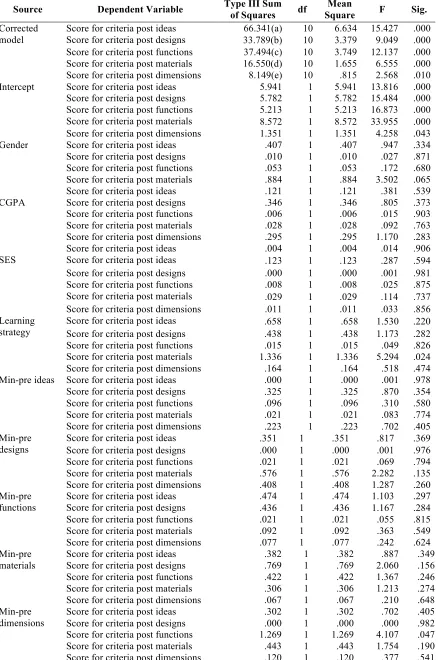
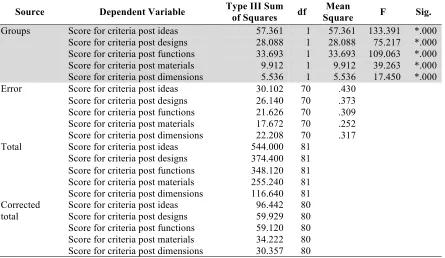
Table 4- The mean score and level of achievement of individual post-assignment between TG and CG for five evaluation criteria
Source Dependent Variable Type III Sum
of Squares df
Mean
Square F Sig.
Corrected model
Score for criteria post ideas 66.341(a) 10 6.634 15.427 .000 Score for criteria post designs 33.789(b) 10 3.379 9.049 .000 Score for criteria post functions 37.494(c) 10 3.749 12.137 .000 Score for criteria post materials 16.550(d) 10 1.655 6.555 .000 Score for criteria post dimensions 8.149(e) 10 .815 2.568 .010 Intercept
Score for criteria post ideas 5.941 1 5.941 13.816 .000 Score for criteria post designs 5.782 1 5.782 15.484 .000 Score for criteria post functions 5.213 1 5.213 16.873 .000 Score for criteria post materials 8.572 1 8.572 33.955 .000 Score for criteria post dimensions 1.351 1 1.351 4.258 .043 Gender
Score for criteria post ideas .407 1 .407 .947 .334
Score for criteria post designs .010 1 .010 .027 .871
Score for criteria post functions .053 1 .053 .172 .680 Score for criteria post materials .884 1 .884 3.502 .065
Score for criteria post ideas .121 1 .121 .381 .539
CGPA
Score for criteria post designs .346 1 .346 .805 .373
Score for criteria post functions .006 1 .006 .015 .903 Score for criteria post materials .028 1 .028 .092 .763 Score for criteria post dimensions .295 1 .295 1.170 .283
Score for criteria post ideas .004 1 .004 .014 .906
SES
Score for criteria post ideas .123 1 .123 .287 .594
Score for criteria post designs .000 1 .000 .001 .981
Score for criteria post functions .008 1 .008 .025 .875 Score for criteria post materials .029 1 .029 .114 .737 Score for criteria post dimensions .011 1 .011 .033 .856 Learning
strategy
Score for criteria post ideas .658 1 .658 1.530 .220
Score for criteria post designs .438 1 .438 1.173 .282 Score for criteria post functions .015 1 .015 .049 .826 Score for criteria post materials 1.336 1 1.336 5.294 .024 Score for criteria post dimensions .164 1 .164 .518 .474 Min-pre ideas
Score for criteria post ideas .000 1 .000 .001 .978
Score for criteria post designs .325 1 .325 .870 .354
Score for criteria post functions .096 1 .096 .310 .580 Score for criteria post materials .021 1 .021 .083 .774 Score for criteria post dimensions .223 1 .223 .702 .405 Min-pre
designs
Score for criteria post ideas .351 1 .351 .817 .369
Score for criteria post designs .000 1 .000 .001 .976
Score for criteria post functions .021 1 .021 .069 .794 Score for criteria post materials .576 1 .576 2.282 .135 Score for criteria post dimensions .408 1 .408 1.287 .260 Min-pre
functions
Score for criteria post ideas .474 1 .474 1.103 .297
Score for criteria post designs .436 1 .436 1.167 .284 Score for criteria post functions .021 1 .021 .055 .815 Score for criteria post materials .092 1 .092 .363 .549 Score for criteria post dimensions .077 1 .077 .242 .624 Min-pre
materials
Score for criteria post ideas .382 1 .382 .887 .349
Score for criteria post designs .769 1 .769 2.060 .156
Score for criteria post functions .422 1 .422 1.367 .246 Score for criteria post materials .306 1 .306 1.213 .274 Score for criteria post dimensions .067 1 .067 .210 .648 Min-pre
dimensions
Score for criteria post ideas .302 1 .302 .702 .405
Score for criteria post designs .000 1 .000 .000 .982
Table 4 (continued)-The mean score and level of achievement of individual post-assignment between TG and CG for five evaluation criteria
Source Dependent Variable Type III Sum
of Squares df
Mean
Square F Sig.
Groups Score for criteria post ideas 57.361 1 57.361 133.391 *.000 Score for criteria post designs 28.088 1 28.088 75.217 *.000 Score for criteria post functions 33.693 1 33.693 109.063 *.000 Score for criteria post materials 9.912 1 9.912 39.263 *.000 Score for criteria post dimensions 5.536 1 5.536 17.450 *.000
Error Score for criteria post ideas 30.102 70 .430
Score for criteria post designs 26.140 70 .373
Score for criteria post functions 21.626 70 .309
Score for criteria post materials 17.672 70 .252
Score for criteria post dimensions 22.208 70 .317
Total
Score for criteria post ideas 544.000 81
Score for criteria post designs 374.400 81
Score for criteria post functions 348.120 81
Score for criteria post materials 255.240 81
Score for criteria post dimensions 116.640 81
Corrected total
Score for criteria post ideas 96.442 80
Score for criteria post designs 59.929 80
Score for criteria post functions 59.120 80
Score for criteria post materials 34.222 80
Score for criteria post dimensions 30.357 80
*Significant difference in p<.05 The results of data analysis for MANCOVA show that there are significant differences in the mean scores of individual post-assignment between TG and CG for five evaluation criteria, namely ideas, designs, functions, materials and dimensions (p<.05). The results of this analysis show that the treatment has a positive impact on the achievement of the five criteria in generating ideas after controlling some variables such as gender, academic achievement, SES, learning strategy and the mean score of pre-assignment for five evaluation criteria.
Based on homogeneity subset analysis, TG scores more than CG in five evaluation criteria. The levels of achievement of individual post-assignment for five evaluation criteria for TG are higher than CG (Table 5). The mean score and level of achievement of individual post-assignment for five evaluation criteria are shown in Table 5 in descending order, starting from ideas and followed by designs, functions, materials and dimensions.
It clearly shows that the learning strategies in each type of learning style and HOTS play a significant role (Sternberg, Grigorenko & Zhang, 2008) in idea generation (Ernst & Clark, 2008). The process of generating ideas using the integration of learning strategies and HOTS allows the individual’s thinking to be apparent by translating the thoughts onto paper sheets. Students who are able to generate ideas effectively demonstrate that they are capable of implementing a good integration of learning strategies and HOTS.
Table 5- Mean score and level of achievement of individual post assignment between TG and CG for five evaluation criteria
Criteria Groups Mean score Level of achievement Sig.
Ideas CG TG 3.22 1.46 Less satisfactory Good *.000
Designs TG 2.59 Excellent *.000
CG 1.34 Satisfactory
Functions TG 2.55 Excellent *.000
CG 1.22 Satisfactory
Materials TG 2.02 Good *.000
CG 1.32 Satisfactory
Dimensions TG 1.32 Good *.000
CG 0.78 Less satisfactory
3.3
The Differences in the Mean Score between Individual Pre- and Post-Assignments for
TG and CG
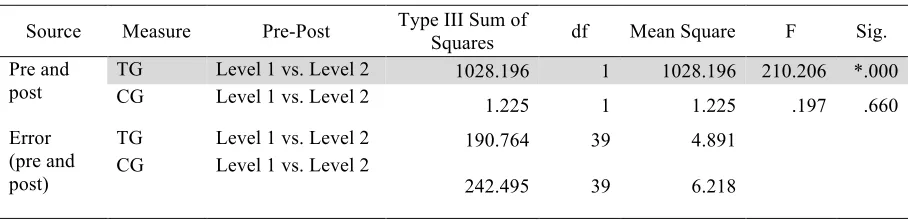
Data were analysed using MANOVA with within-subject factors of pre and post and between subject factor of Groups (TG, CG). The main effect of pre and post in TG, F (1, 39) = 210.21, p = 0.000; and the main effect of pre and post in CG, F (1, 39) = 0.20, p = 0.660.
Table 6- The mean score between individual pre- and post-assignments for TG and CG
Source Measure Pre-Post Type III Sum of
Squares df Mean Square F Sig.
Pre and post
TG Level 1 vs. Level 2 1028.196 1 1028.196 210.206 *.000
CG Level 1 vs. Level 2 1.225 1 1.225 .197 .660
Error (pre and post)
TG Level 1 vs. Level 2 190.764 39 4.891
CG Level 1 vs. Level 2
242.495 39 6.218
*Significant difference in p<.05 The results of data analysis for MANOVA show that there is a significant difference in the mean score of individual pre- and post-assignments for TG (p<.05). It is found that there is a high increase in the overall mean score between the individual pre- and post-assignments, which was 5.07%, from 6.58% to 11.65% for TG (Table 7). Based on the university’s grade system, the score is an increase of 5% from the total score of 100%, which affects the grade level of the subject (Academic Management Office, 2010). Since there is an increase of 5.07% in the overall mean score of individual post-assignment for TG, then this means an increase in the students’ grade in the course work after the treatment was given. The findings of this research also show that TG, who uses MSL, managed to increase the overall mean score of 33.8% from 15%, which is the full score of the post-assignment during the treatment process for a month.
On the other hand, there is a low increase in the pre- and post-assignments for CG, which is 0.18%, that can be considered as no improvement. In addition, there is an increase in the level of completion of individual pre- and post-assignments for TG from the satisfactory level to the good level, while there is no increase in the level of completion of individual pre- and post-assignments for CG, which remains at the moderate level.
The integration of learning strategies and Marzano’s HOTS is to teach the students to shift from cognitive to metacognitive process by knowing the “what” method for receiving and processing information to the “how” of receiving and processing information in an effective way in order to generate ideas. In general, the knowledge of learning strategies allows students to clearly understand effective learning methods and skills (Harb et al., 1995) and self-learning potential (Duff, 2000) can be developed using various learning strategies to improve their academic achievement (Crossley, 2007).
Table 7- Overall mean score and level of completion of individual post-work between TG and CG
Groups N
Mean score of individual work Sig.
Pre Post
Mean Level Mean Level
TG 40 6.58 Satisfactory 11.65 Good *.000
CG 40 5.85 Moderate 6.03 Moderate
*Significant difference in p<.05
3.4
The Differences in the Mean Score of Five Evaluation Criteria between Individual Pre-
and Post-Assignments for TG and CG
Data were analysed using MANOVA with a within-subject factor of the mean score of five evaluation criteria (ideas, designs, functions, materials and dimension) in pre- and post-assignments and between subject factor of Groups (TG, CG). The main effects of the mean score for criteria ideas in pre- and post-assignments for TG, F (1, 39) = 129.11, p =
0.000; the main effects of mean score for criteria designs in pre- and post-assignments for TG, F (1, 39) = 96.55, p =
1.40, p = 0.243); the main effects of mean score for criteria functions in pre- and post-assignments for CG, F (1, 39) = 0.62, p = 0.438; the main effects of mean score for criteria materials in pre- and post-assignments for CG, F(1, 39) = 0.11, p = 0.743; and the main effects of mean score for criteria dimensions in pre- and post-assignments for CG, F(1, 39) = 0.12, p = 0.732.
Table 8- The mean score of five evaluation criteria between individual pre- and post-assignments for TGand
CG
*Significant difference in p<.05
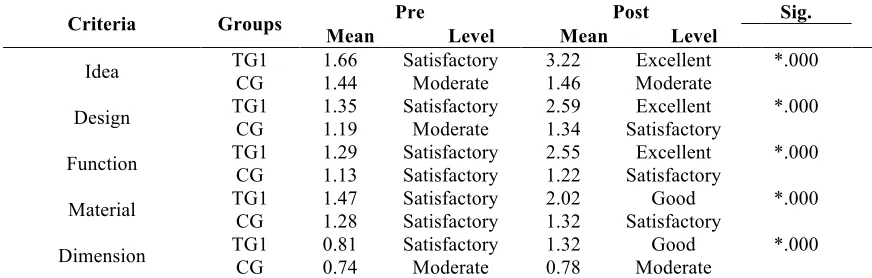
The results of data analysis for MANOVA show that there is a significant difference in the mean score of five evaluation criteria between individual pre- and post-assignments for TG (p<.05). The results of the findings show that there is an increase in the mean score between individual pre- and post-assignments in TG by as much as 1.56%, 1.24% and 1.26% based on the ideas, designs and functions criteria, respectively (Table 9). This means there is an increase in the achievement level from satisfactory to excellent. Besides that, the highest increase in the mean scores between individual pre- and post-assignments in TG are by as much as 0.55% and 0.51% based on the materials and dimensions criteria, respectively. This means there is an increase in the achievement level from satisfactory to good. On the other hand, there is a lesser increase in the mean score of 0.04% to 0.15% between individual pre- and post-assignments for CG based on all five assessment criteria. Only the designs criterion has an increase in the level of completion of individual pre- and post-assignments, while there is no increase in the achievement level for the other four criteria.
There is an increase in the achievement level for the five criteria for generating ideas (Table 9). The findings of this study have shown that if a longer period of treatment is used in this study, it is able to produce a higher achievement of idea generation. This is in line with Masek and Yamin (2012) and Behar-Horenstein and Niu (2011) who emphasised that longer treatment periods will result in a significantly higher increase in the achievement of idea generation. Hence, HOTS’s long-term learning practices are more effective in improving student empowerment (Miri, David & Uri, 2007). Moreover, learning strategies are effective strategies in learning HOTS (Othman & Rahman, 2011). This is because the cycle of learning process is related to the strategy for receiving and processing different types of knowledge or information. Besides that, according to Yee (2014), the compatibility between the usage of HOTS and learning strategies occurs.
Next, the manual gives the students examples in the real world to learn from. When students relate their learning to their own life experiences, their understanding and memory capabilities will increase (Sherman, 2013). Besides that, the theme of graphic organisers is also used in the manual because graphic organisers are effective learning strategies for encouraging HOTS (Singh et al., 2018). Graphic organisers are linked with HOTS because they promote reasoning,
Source Measure Pre-Post Type III Sum
of Squares df
Mean
Square F Sig.
Pre and post
TG ideas Level 1 vs. Level 2 94.864 1 94.864 129.107 *.000 TG designs Level 1 vs. Level 2 60.516 1 60.516 96.552 *.000 TG functions Level 1 vs. Level 2 63.504 1 63.504 123.734 *.000 TG materials Level 1 vs. Level 2 11.664 1 11.664 18.155 *.000 TG dimensions Level 1 vs. Level 2 10.000 1 10.000 19.422 *.000
CG ideas Level 1 vs. Level 2 .144 1 .144 .149 .701
CG designs Level 1 vs. Level 2 .900 1 .900 1.403 .243
CG functions Level 1 vs. Level 2 .324 1 .324 .615 .438
CG materials Level 1 vs. Level 2 .081 1 .081 .109 .743
CG dimensions Level 1 vs. Level 2 .064 1 .064 .119 .732
Error (pre and post)
TG ideas Level 1 vs. Level 2 28.656 39 .735
TG designs Level 1 vs. Level 2 24.444 39 .627
TG functions Level 1 vs. Level 2 20.016 39 .513
TG materials Level 1 vs. Level 2 25.056 39 .642
TG dimensions Level 1 vs. Level 2 20.080 39 .515
CG ideas Level 1 vs. Level 2 37.616 39 .965
CG designs Level 1 vs. Level 2 25.020 39 .642
CG functions Level 1 vs. Level 2 20.556 39 .527
CG materials Level 1 vs. Level 2 29.079 39 .746
comparing and contrasting ideas, listing, and making connections. For example, graphic organisers’ role as I-THINK map can enhance HOTS among students to understand the study content more effectively (Tee, 2013).
Table 9- The decreasing order of the mean score and level of achievement by the individual post-assignment between TG and CG based on five evaluation criteria
Criteria Groups Pre Post Sig.
Mean Level Mean Level
Idea TG1 1.66 Satisfactory 3.22 Excellent *.000
CG 1.44 Moderate 1.46 Moderate
Design TG1 CG 1.35 1.19 Satisfactory Moderate 2.59 1.34 Satisfactory Excellent *.000
Function TG1 1.29 Satisfactory 2.55 Excellent *.000
CG 1.13 Satisfactory 1.22 Satisfactory
Material TG1 CG 1.47 1.28 Satisfactory Satisfactory 2.02 1.32 Satisfactory Good *.000
Dimension TG1 0.81 Satisfactory 1.32 Good *.000
CG 0.74 Moderate 0.78 Moderate
*Significant difference in p<.05
4.
Conclusion
It can be concluded that integrating the teaching of learning strategies and HOTS is very helpful to students in developing their ability to generate ideas. The integration of learning strategies and HOTS enables students to generate ideas more effectively as well as improving student achievement. In addition, students learning the integration of learning strategies and HOTS are likely to use HOTS to generate ideas. This is because students learning the integration of learning strategies and HOTS know about the activities that can be done at every learning cycle to receive and process information for idea generation. Later, the students focused on the selection and use of Marzano’s HOTS, which is suitable for receiving and processing information effectively. With this, the students understand more clearly the HOTS usage that is appropriate to the activities carried out at each stage of the learning cycle. The integration of Kolb’s learning strategies and Marzano’s HOTS brings two simultaneous benefits to the students in terms of the achievement of ideas generation. If TVET strictly aims for the application of HOTS to be materialised, continuous and serious monitoring and improvement of HOTS need to be implemented. Subsequently, TVET can produce graduates who can develop new slights creativity and workable solutions in future.
Acknowledgement
The authors would like to thank the Ministry of Higher Education, Malaysia, for supporting this research under the
Geran Program Pensiswazahan Guru (PPG) No VOT V030 and Geran Penyelidikan Pasca Siswazah (GPPS) No VOT U984. In addition, the authors also wish to thank the staff of the Faculty of Civil and Environmental Engineering (FKAAS), Universiti Tun Hussein Onn Malaysia (UTHM), who had given their full cooperation to ensure the success of this study.
References
Abd. Hamid, M. A. (2001). Pengenalan Pemikiran Kritis & Kreatif. 1st ed. Skudai, Malaysia: Universiti Teknologi Malaysia.
Academic Management Office (2010). Academic Regulation (Degree and Diploma Programme). Johor: Universiti Tun Hussein Onn Malaysia.
Ball, A. L., & Garton, B. L. (2005). Modeling Higher Order Thinking: The Alignment between Objective, Classroom Discourse and Assessments. Journal of Agricultural Education, 46(2), 58–69.
Bakar, A. R., & Hanafi, I. (2007). Assessing Employability Skills of Technical Vocational Students in Malaysia.
Journal of Social Sciences, 3(4), 202–207.
Behar-Horenstein, L. S., & Niu, L. (2011). Teaching Critical Thinking Skills in Higher Education: A Review of the Literature. Journal of College Teaching & Learning, 8 (2), 25–42.
Chinedu, C. C., Olabiyi, O. S., & Kamin, Y. (2015). Strategies for Improving Higher Order Thinking Skills in Teaching and Learning of Design and Technology Education. Journal of Technical Educational and Training, 7(2).
Crossley, H. (2007). Effects of Traditional Teaching versus a Multisensory Instructional Package on the Science Achievement and Attitudes of English-Language Learners versus Other Middle-School Minority Students. (EdD thesis). St. John’s University, USA.
Duff, A. (2000). Learning Style of UK Higher Education Students: Four Studies of the Reliability and Replicability of the Learning Style Questionnaire (LSQ). Bristol Business School Teaching and Research Review, 14(3),131–177. Ee, J., Chang, A., & Tan, O. S. (2005). Thinking About Thinking: What Educators Need to Know? Singapore: McGraw Hill Education.
Ernst, J. V., & Clark, A. C. (2008). Students’ Preferred Learning Styles in Graphic Communications. Engineering Design Graphics Journal, 72(1), 9–18.
Fraenkel, J. R., Wallen, N. E., & Hyun, H. H. (2012). How to Design and Evaluate Research in Education. 8th ed. USA: McGraw Hill Humanities.
Harb, J. N., Terry, R. E., Hurt, P. K., & Williamson, K. J. (1995). Teaching Through the Cycle: Application of Learning Style Theory to Engineering Education at Brigham Young University. Provo, Utah: Brigham Young University.
Idris, A. (2002). Analisis Wacana Pedagogi Di Sekolah: Satu Kajian Kes. Laporan Teknik Penyelidikan SK/4/2002.
Serdang, Malaysia: Pusat Pengajian Bahasa dan Linguistik, Fakulti Sains Sosial dan Kemanusiaan, Universiti Kebangsaan Malaysia.
Kaye, C. B. (2010). The Complete Guide to Service Learning: Proven, Practical Ways to Engage Students in Civic Responsibility, Academic Curriculum & Social Action. 2nd ed. Minneapolis, MN: Free Spirit Publishing.
King, F., Goodson, L., & Rohani, F. (2011). Higher Order Thinking Skills: Definitions, Strategies, Assessment. Center of Advancement of Learning and Assessment. Tallahassee, FL: Florida State University.
Kuh, G. D. (2001). Assessing What Really Matters to Student Learning: Inside the National Survey of Student Engagement. The Magazine of Higher Learning, 33(3), 131–137.
Masek, A., & Yamin, S. (2012). The Impact of Instructional Methods on Critical Thinking: A Comparison of Problem-Based Learning and Conventional Approach in Engineering Education. International Scholarly Research Network,
2012, 1–6.
McCaslin, N. L., & Parks, D. (2002). Teacher Education in Career and Technical Education: Background and Policy Implications for the New Millennium. Journal of Vocational Education Research, 27(1), 69–108.
McMillan, J. H. (2011). Educational Research: Fundamentals for the Consumer. 6th ed. US: Pearson Education. Ministry of Education (MOE) (2012). Preliminary Report: Malaysia Education Blueprint 2013–2025. Putrajaya, Malaysia: Ministry of Education. Accessed December 3, 2014. Retrieved from http://www.bptv.edu.my/v4/images/bahanpdf/pelanstrategiktpv/PelanStrategikTranformasiPendidikanVokasional_1.pd f
Ministry of Education (MOE) (2013). Malaysia Education Blueprint 2013–2025 (Preschoool to Post-Secondary Education). Putrajaya, Malaysia: Ministry of Education.
Miri, B., David, B., & Uri, Z. (2007). Purposely Teaching for the Promotion of Higher-Order Thinking Skills: A Case of Critical Thinking. Research in Science Education, 37,353–369.
Mohamad, B., Esa, A., & Junoh, H. (2008). Psikologi Pendidikan dalam PTV. Batu Pahat, Malaysia: Penerbit UTHM. Mohd. A., & Hassan, A. (2006). Belajar Berfikir. Kuala Lumpur, Malaysia: Percetakan Zafar Sdn. Bhd.
Mohd. A., & Hassan, A. (2005). Pemikiran Reka Cipta: Kaedah Mengajar dan Bahan Latihan Untuk Guru dan Jurulatih. Pahang, Malaysia: PTC Publications & Distributors Sdn. Bhd.
Murphy, R. J., Gray, S. A., Straja, S. R., & Bogert, M. C. (2004). Student Learning Preferences and Teaching Implications. Journal of Dental Education, 68(8), 859–866.
Mustapha, R. (2013). Transforming Education toward K-Economy in Malaysia. International Journal for Educational Studies (EDUCARE), 6(1).
Ng, A. K. (2004). Liberating the Creative Spirit in Asian Students. Singapore: Prentice Hall.
Osman, B. H., & Basar, M. N. (2016). Amalan Pengajaran dan Pembelajaran Abad Ke- 21 Dalam Kalangan Pensyarah Institut Pendidikan Guru Kampus Ipoh. Jurnal Penyelidikan Dedikasi,10(2016).
Rajendran, N. S. (2008). Teaching & Acquiring Higher-Order Thinking Skills: Theory & Practice. Perak, Malaysia: Penerbit Universiti Pendidikan Sultan Idris.
Rashid, R. (2008). Hubungan antara Gaya Pembelajaran dengan Motivasi dalam Kalangan Pelajar di Sebuah Sekolah Menengah Luar Bandar, Sabah. (Master’s thesis). Universiti Teknologi Malaysia, Malaysia.
Rashid, Z. A. (2016). Tahap Kesediaan Guru dari Aspek Pengetahuan dan Keperluan Latihan dalam Aplikasi KBAT di Sekolah Menengah Daerah Batu Pahat. (Master’s thesis). Universiti Tun Hussein Onn Malaysia, Malaysia.
Rogers, K. M. A. (2009). A Preliminary Investigation and Analysis of Student Learning Style Preferences in Further and Higher Education. Journal of Further and Higher Education, 33(1), 13–21.
Shafie, M. S., & Alias, M. (2007). Hubungan di antara Gaya Pembelajaran, Gaya Pengajaran dan Minat Terhadap Subjek Kejuruteraan. Jurnal Sains Sosial, 4(1), 19–40.
Sharp, A. (2008).Teaching Fluency in Gifted Classrooms: Generating Ideas is an Important Part of Creative Problem Solving. Accessed March 25, 2013. Retrieved from http://gifted-classes-materials-lessons.suite101.com/article.cfm/ teaching_fluency_in_gifted_classrooms#ixzz0pFkVb76K.
Sherman, K. (2013). How Social Media Changes Our Thinking and Learning. JALT Learner Development SIG 20th Anniversary Conference, Gakushuin University, Mejiro, Tokyo, November 23–24 2013.
Singh, C. K. S., Singh, R. K. A., Singh, T. S. M., Mostafa, N. A., & Tunku Mohtar, T. M. (2018). Developing a Higher Order Thinking Skills Module for Weak ESL Learners. English Language Teaching, 11(7): 86–100.
Sternberg, R. J., Grigorenko, E. L., & Zhang, L. (2008). Styles of Learning and Thinking Matter in Instruction and Assessment. Perspectives on Psychological Science, 3, 486–506.
Shuib, M. (2007). Developing Undergraduates’ Thinking Skills. Prosiding Persidangan Pengajaran dan Pembelajaran di Peringkat Institusi Pengajian Tinggi (CTLHE07), 89–98.
Sulaiman, T., et al. (2017). Implementation of Higher Order Thinking Skills in Teaching of Science: A Case Study in Malaysia. International Research Journal of Education and Sciences (IRJES), 1(1).
Tan, Y. L., & Samyudia, Y. (2009). Learning Styles versus Teaching Styles: How to Match Them? Teaching and Learning Open Forum 2009, Curtin University of Technology, Miri, Sarawak, Malaysia, July 17-18, 2009.
Tee, T. K. (2013). Pengintergrasian Kemahiran Berfikir dan Peta Minda Buzan bagi Penguasaan Kemahiran Berfikir Aras Tinggi. (PhD thesis). Universiti Tun Hussein Onn Malaysia, Malaysia.
Toh, W. S. (2003). Student-Centered Educational Beliefs and Teacher Education. Jurnal Penyelidikan MPBL, 4: 20– 22.
Wheelihan, K. J. (2011). Creativity for Success. The Creativity Institute. Retrieved from http://EzineArticles.com/.
Yee, M. H. (2014). Pengintegrasian Gaya Pembelajaran Dan Kemahiran Berfikir Aras Tinggi Bagi Penjanaan Idea Dalam Kalangan Pelajar Teknikal. (PhD thesis). Universiti Tun Hussein Onn Malaysia, Malaysia.
Yee, M. H., Yunos, J. M., Othman, W., Hassan, R., Tee, T. K., & Mohamad, M. M. (2015). Disparity of Learning Styles and Higher Order Thinking Skills among Technical Students. 4th World Congress on Technical and Vocational Education and Training. Procedia–Social and Behavioral Sciences, 204(2015), 143–152.