DOI: https://doi.org/10.30880/ijie.2018.10.04.002
Prototyping and Performance Evaluation of Fire Rated
Acoustic Door
Muhammad Haziq Khalid
1, Ramhuzaini Abd Rahman
1, Hanif Abdul Latif
2,
Musli Nizam Yahya
1,*1Faculty of Mechanical and Manufacturing Engineering, Universiti Tun Hussein Onn Malaysia, Parit Raja, 86400 Batu Pahat, Johor, Malaysia
2SI Acoustics Sdn Bhd, 30, Jalan Bulan, U5/168. Seksyen U5, Bandar Pinggiran Subang, 40170, Shah Alam, Selangor, Malaysia
Received 30 Jan 2018; accepted 2 May 2018, available online 5 August 2018
1. Introduction
A fire rated door offers protection against spread of fire by stopping or delaying the transfer of thermal energy, that is, heat from one compartment to another [1]. The door is normally consists of a fire-resistant core encased in a door-shaped shell made of various materials having fire retardant properties. Selection of the core, materials and components of the door are prime important as they play crucial role in preventing the spread of fire. All the core, materials and components must therefore meet certification requirements from the related authority [2]. A sound-retardant door also known as Acoustic Door on the other hand, is used to prevent an excessive noise from passing through its surface. The door which is solid and often installed with seals around its edges have been extensively used in places where noise control and/or voice privacy are required. The installation places include the broadcast studios, auditoriums, movie theaters, industrial and defense installations.
Today, most of the safety codes require the buildings to be equipped with both acoustic isolation and fire protection systems [3]. Installing doors that have both functionalities, that is, fire/flame resistance and sound attenuation capabilities can thus be one of the solutions contributes towards fulfillment of the building codes requirement. Nevertheless, the application of such kind of doors which often called Fire Rated Acoustic Door (FRAD) should not in the same time impair other qualities of the doors such as strength and aesthetic appearance [4]. From the literature, there are several types of FRAD available depending on its construction. A fire rated door utilizing sandwich structure consists of two layers of Rockwool with insulation layer made from felt arranged in the middle for increased insulation capability has been proposed in China (patent application no. CN202810575U) [5]. Meanwhile, a fire rated door with improved acoustic absorption capability was also developed in United State (patent application no. Abstract: In recent years, demands to install fire rated doors with acoustic absorption capability in Malaysia industrial buildings are growing than ever. This may possibly be achieved by integrating the Fire Rated and Acoustic Doors into a single door consisting of sound and fire resistance features called Fire Rated Acoustic Door (FRAD). However, performance of the door still needs to be investigated as it depends on the applied internal core material. This paper presents development of two FRAD prototypes including performance evaluation on the fire rating and sound transmission classification (STC). The first prototype applies sandwich Gypsum-Rockwool-Gypsum board as its internal core while the second uses Magnesium Oxide-Rockwool-Magnesium Oxide. The door leaf and frame are made from the standard galvanized iron. The fire rating test was conducted using procedure that satisfies Malaysian Standard requirement for Fire Rated Door. The STC was estimated through calculation of the transmission loss. Results show that the developed FRAD of prototype one and two are both capable of holding integrity and insulation of the door structure when expose to fire of up to 180°C for about 53 and 120 minutes, respectively. In terms of STC, the FRAD of prototype one and two were calculated to have STC-40 and STC-42, respectively. Note that, the minimum requirements of FRAD that need to be achieved in this project are to have at least one hour rating of fire and STC-35 rating in sound resistance. Therefore, the results show that both FRAD prototypes can be utilized for acoustic door function as the STC rating is greater than the minimum requirement. In case of fire protection capability, only FRAD of prototype two exceeds the minimum fire rating. This suggests that only prototype two is possible to be implemented as FRAD since it fulfilled both the fire rating and STC requirements.
US20080264721A1) [6]. The absorption capability was improved through lamination of several layer of acoustic absorption material inside its structure. The door has a fire resistance rating of approximately 41 minutes and an STC value of approximately 49. Also, a fire rated door utilizing unique arrangement of sound blocking material and a drop seal mechanism was proposed in the United State [4]. The door was tested for transmission loss at various frequencies between 250 to 4000 Hz. The results showed that the average transmission loss that can be achieved was up to 47.8dB. In case of Malaysia, to the best of authors’ knowledge, a locally made FRAD is still not available and the application of such door are thus limited due to the cost factor. Nevertheless, as the level of awareness towards safety and health of the employees in this country dramatically increased, the demand for such FRAD installation especially inside the industrial buildings has become greater than ever.
In this paper, development of two FRAD prototypes utilizing internal cores made of sandwich Gypsum-Rockwool-Gypsum and Magnesium Oxide-Rockwool-Magnesium Oxide boards, aim for Malaysia market are presented. Performance of the prototypes in terms of fire resistant/fire rating and sound absorption capability have been evaluated by experiment and estimation using standard sound transmission classification (STC) calculation, respectively. Note that, the experiment for fire resistant testing is conducted according to the procedure recommended in Malaysia Standard (MS) for fire rating door. The estimation of STC rating on the other hand was performed through calculation of transmission loss.
The rest of the paper is organized as follow. Section 2 describes the developed FRAD prototypes. Section 3 presents the experiment setup and evaluation criteria applied in determining the fire and STC-ratings. Results from the experiment and calculation are discussed in section 4 followed by conclusion remarks in section 5.
2.
Description of the FRAD Prototypes
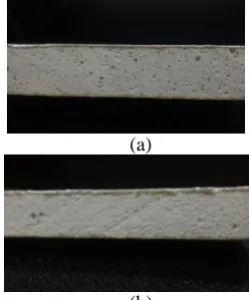
Fig. 1 shows picture of the developed FRAD prototypes. The prototypes have been developed using standard geometry and accessories (e.g., hinges, door closer and lockset) that satisfy the specifications required in Malaysian Standard for fire rated door (MS1073: PART 2, 1996) [7]. Besides, both prototypes utilized the same design and sealing elements to provide the air tightness. The door skin and frame are made from standard galvanized iron plate. The internal core for prototype one and two apply sandwich Gypsum-Rockwool-Gypsum and Magnesium Oxide (MgO)-Rockwool-Magnesium Oxide boards, respectively. Fig. 2 shows arrangement of the applied sandwich materials inside the door core. Note that, for the same applied thickness, the MgO-Rockwool-MgO board is more expensive that the Gypsum-Rockwool-Gypsum board. However, in terms of the life cycle, the former one is less durable than the latter. The MgO also has relatively higher density than the Gypsum. Furthermore, as porosity of the MgO board is lesser than the Gypsum, thiscontributes to better soundproofing and capability to withstand elevated temperature. Besides, as the MgO is more flexible and sturdier, it provides superior screw holding power than the Gypsum. Conversely, the Gypsum-Rockwool-Gypsum board is crumbly and may easily fragmented during drilling or screwing process. Fig. 3 shows comparison between Gypsum and MgO boards density applied in prototypes one and two, respectively. Obviously, the MgO board can be seen to have higher density than the Gypsum. Table 1 on the other hand summarizes properties of both prototypes.
(
a) (b) Fig. 1: FRAD prototype (a) one and (b) twoFig. 2: FRAD prototype internal core arrangement
(a)
(b)
Table 1: Properties of FRAD prototypes.
Properties Prototype
One Two
Total mass (kg) 67.8 80.4
Total surface area ( ) 2.109 2.109
Density (kg/ ) - skin and frame
(galvanized iron) 7860 7860
Internal core (kg/ )
- Rockwool 80 80
- Gypsum 600 -
- Magnesium Oxide (MgO)
- 850
3.
Experimental Setup and Evaluation
Criteria
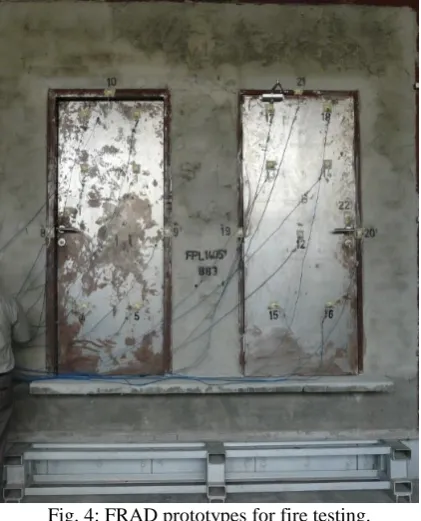
Determination of the fire rating of the developed FRAD prototypes was done through fire rating test conducted in the certified laboratory of Forest Research Institute Malaysia (FRIM). Fig. 4 shows picture of the setup of both prototypes installed at the firing chamber in the aforementioned lab. The picture was taken from the side unexposed to the fire. As can be seen from Fig. 4 the prototypes were placed side by side so that fire testing on both prototypes can be performed simultaneously. Besides, performance of both prototypes can also be monitored and compared easily. Note that, the applied testing method is in compliance with the Malaysian Standard (MS1073: PART 3, 1996) [8].
Fig. 4: FRAD prototypes for fire testing.
With reference to Fig. 5, seven thermocouples, that is, T1 to T7, were attached at the specified positions on the prototypes in order to monitor temperatures rise during the firing test. Failure is characterized according to two main criteria provided in Malaysian Standard (MS1073: Part 3:1996)[8], that is, integrity and insulation aspects.
According to the Standard, failure in integrity happens when flames or hot gasses penetrated through 6-25 mm diameter gap that causes glowing of cotton fiber pad. In terms of insulation failure, it occurs when the mean unexposed surface temperature increases by more than 140°C above its initial value. In addition, if the temperature recorded at any position on the unexposed surface exceed 180 °C, it also considered as a failure.
Fig. 5: Thermocouple fixing
The acoustical performance of FRAD prototypes on the other hand was categorized using Sound transmission class (STC) rating obtained through calculation. STC is a measure of how well the sound vibration is attenuated as it travel from one side of a wall surface to the other. The rating is the most common standard used to determine airborne sound transmission loss. Higher STC rating signifies higher transmission loss and thus shows improved performance. In this research, the initial estimation of the STC was obtained using calculation of transmission loss (TL). Note that, the results obtained from this calculation plays a strategic role in anticipating performance of the prototypes. From the results, it can be determined whether further modification is necessary or not before the prototypes undergo the actual experimental test in the certified laboratory. To obtain STC of the prototypes, value of Transmission Loss (TL) at 16 standard frequencies over the range of 125 to 4000Hz is acquired through calculation using Eq. 3.1. These frequencies range covers majority of common noises that can be heard including speech, television, music, dogs barking, and other similar annoyances. As can be clearly seen from Eq. 3.1, calculation of the transmission loss is influenced by the mass and surface area that facing the sound propagation.
T5 T1
T4
T3 T2
T7 T6
(3.1)
where TL stands for Transmission loss, m denotes the mass, A represents the surface area and f is the applied frequency.
4.
Performance Evaluation
4.1
Result of Fire Rating Test
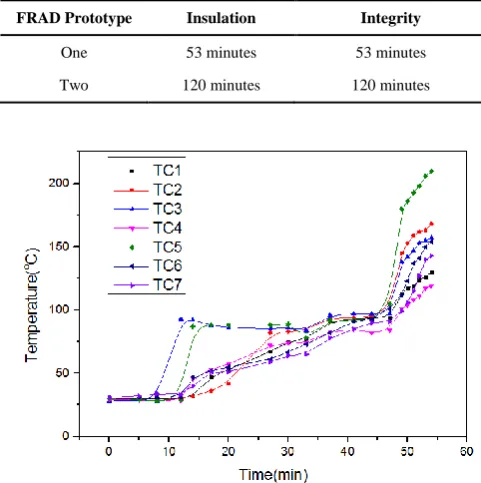
Table 2 shows result of the fire rating test. The result is presented in terms of the elapsed time, between the commencement of heating and failure of one or all the criteria provided in MS1073: Part 3:1996 [8]. The result demonstrates that the FRAD Prototype two has longer fire resistance rating if compared to the Prototype one.
In terms of reading of the temperature as showed in Fig. 5, the thermocouple T3 and T5 attached to the FRAD prototype one show a significant increment from ambient temperature up to 90°C within the first 15 minutes. Conversely, others thermocouple took about 45min to reach the same temperature. As the time reached 47 minutes, all thermocouple reading rise vigorously within 5 minutes. The temperature reading at T5 raised to the allowable maximum temperature of 180°C first. The test is then terminated as one of the thermocouple that is T5, showed temperature reading of higher than 180°C.
Table 2 Result of Fire Rating Testing
FRAD Prototype Insulation Integrity
One 53 minutes 53 minutes
Two 120 minutes 120 minutes
Fig. 5: Fire rating graph of FRAD prototype one.
Fig. 6 on the other hand, shows the temperature readings from thermocouples attached to the FRAD prototype two. Within the first 15 minutes, it can be observed that all thermocouples recorded steady increase in temperature reading of up to 90°C. The temperature then showed no increment until it passed 113 minutes of
the test. After that, the thermocouple experienced drastic rise in the temperature until it reached the maximum allowable temperature at 120 minutes.
Fig. 6: Fire rating graph of FRAD prototype two.
From the results, it can be concluded that the FRAD prototype two has at least double the fire rating time in comparison to the prototype one. The difference in the fire rating time is due to the application of different core material between both FRAD prototypes. The internal core used in prototype two is made of magnesium oxide, a type of mineral cement. Pure magnesium in raw form is not stable and are very reactive toward heat. It produces bright flame as it burned. However, Magnesium Oxide on the other hand, shows exactly the opposite characteristics. It has stone like shape and passively reacts to the fire. It is thus completely non-flammable and hence suitable for fireproofing. As the MgO board does not burn at all, the only thing that causes the temperature rise after 100 minute of fire test was due to the heat transferred by conduction from the burned metal skin through the unexposed side.
4.2
Result of STC rating Calculation
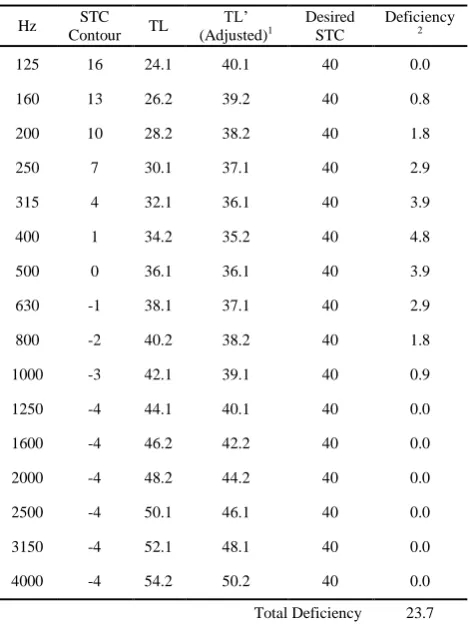
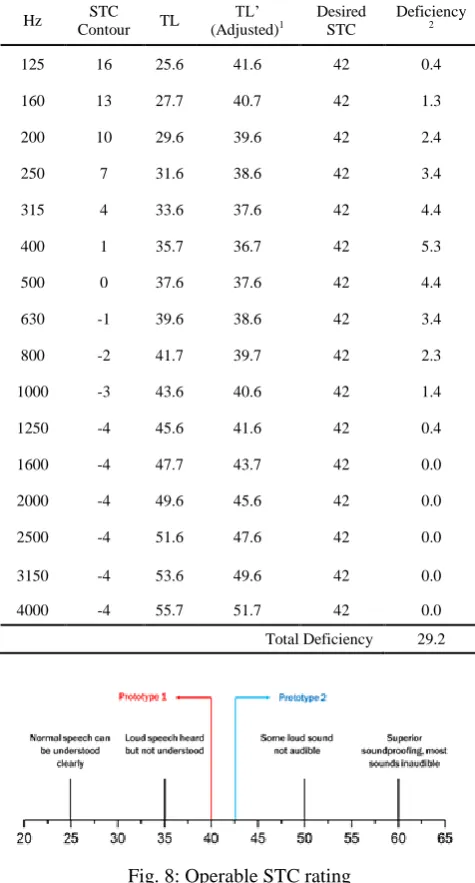
Calculation of the transmission loss (TL) for FRAD Prototype one and two are shown in Tables 3 and 4, respectively. Since TL is frequency-dependent, it is generally calculated in the third octave frequency bands between 125 to 4,000 Hz. To calculate the TL, its values have to be first converted into the corresponding STC contour. The STC which stands for the sound transmission class rating has been defined in the American Society for Testing and Materials (ASTM) Standard E413 [9]. The rating is one of the most commonly used methods in predicting the acoustic resistance of the doors.
Value of the STC contour for each frequency is then added to the corresponding TL to obtain the adjusted transmission loss (TL’) value. Subsequently the TL’ value is compared to the desired STC. This will produce deficiency if the desired STC value is higher that the TL’ value. Note that, the value must not be more than 8.0 (first limitation) in each frequency band. The deficiencies of all frequency band are then sum up to obtain the total deficiency value. Also, the total value must not exceed 32.0 (second limitation). When one of these two limiting conditions are met, the highest number that satisfies both conditions is chosen as the STC value.
Based on the calculated STC rating, the highest total deficiency that is obtained before exceeding 32.0 for FRAD prototype one is STC-40 while for prototype two is STC-42. Note that, these calculations however neglect the uses of rubber seals, as well as space gap between the frame and door. It thus obvious that the FRAD prototype two has better STC rating than the prototype one although both FRAD were developed with the same design structure and dimension. The only factor that caused the difference between STC rating of prototype one and two is the type of applied core board. The FRAD prototype one which used the Gypsum board as it core showed that the STC rating is sufficient to provide good sound proofing barrier. The STC rating is just on par to the beginning of classification as privacy condition toward the room occupant as illustrated in Fig. 8. Meanwhile, the FRAD prototype two which used MgO board as its internal core has greater STC rating. At STC-42 rating, loud speeches is audible as murmur. This result demonstrate the effectiveness of using MgO board to increase the soundproofing capability of the door.
Fig. 7: Gap about 1 cm diameter occurs on FRAD prototype one.
Table 3: STC rating data of FRAD prototype one
Hz STC
Contour TL
TL’ (Adjusted)1
Desired STC
Deficiency 2
125 16 24.1 40.1 40 0.0
160 13 26.2 39.2 40 0.8
200 10 28.2 38.2 40 1.8
250 7 30.1 37.1 40 2.9
315 4 32.1 36.1 40 3.9
400 1 34.2 35.2 40 4.8
500 0 36.1 36.1 40 3.9
630 -1 38.1 37.1 40 2.9
800 -2 40.2 38.2 40 1.8
1000 -3 42.1 39.1 40 0.9
1250 -4 44.1 40.1 40 0.0
1600 -4 46.2 42.2 40 0.0
2000 -4 48.2 44.2 40 0.0
2500 -4 50.1 46.1 40 0.0
3150 -4 52.1 48.1 40 0.0
4000 -4 54.2 50.2 40 0.0
Table 4: STC rating data of FRAD prototype two.
Hz STC
Contour TL
TL’
(Adjusted)1 Desired STC Deficiency2
125 16 25.6 41.6 42 0.4
160 13 27.7 40.7 42 1.3
200 10 29.6 39.6 42 2.4
250 7 31.6 38.6 42 3.4
315 4 33.6 37.6 42 4.4
400 1 35.7 36.7 42 5.3
500 0 37.6 37.6 42 4.4
630 -1 39.6 38.6 42 3.4
800 -2 41.7 39.7 42 2.3
1000 -3 43.6 40.6 42 1.4
1250 -4 45.6 41.6 42 0.4
1600 -4 47.7 43.7 42 0.0
2000 -4 49.6 45.6 42 0.0
2500 -4 51.6 47.6 42 0.0
3150 -4 53.6 49.6 42 0.0
4000 -4 55.7 51.7 42 0.0
Total Deficiency 29.2
Fig. 8: Operable STC rating
5.
Conclusion
As a conclusion, two FRAD prototypes have been developed and their performances in terms of fire rating and sound transmission classification (STC) have been evaluated. Prototype one applies sandwich Gypsum-Rockwool-Gypsum board as an internal core while prototype two use Magnesium Oxide-Rockwool-Magnesium board. Fire rating test to determine fire rating of the prototypes was conducted according to Malaysian Standard (MS1073: PART 3, 1996). Results of the test reveals that prototype two has higher fire rating than the prototype one which are 120 and 53 minutes fire rating, respectively. This proof that selection of the suitable fire-retardant material as internal core of FRAD is vital as it affect performance of fire rating. In terms of the acoustic performance, both prototypes are calculated to have STC rating higher than the minimum requirement (STC-35),
that is, STC-40 for prototype one and STC-42 for prototype two. Future work will focus on the validation of STC rating of both prototypes through laboratory experimentation. Besides, the mechanical properties also can be conducted by following previous studies [10,11].
Acknowledgment
The authors would like to thank the Universiti Tun Hussein Onn Malaysia for supporting this project through Geran Penyelidikan TIER1, Fasa 1, 2017 (Vot U876). The authors would also like to acknowledge the SI Acoustic Sdn. Bhd. for sharing the information, providing materials and financial for this project.
References
[1] Kettle. S, Fire Doors-General, FRIM, Kuala Lumpur, 1991.
[2] Law of Malaysia, Fire Services Act 1988, Act 189,
The Commissioner of Law Revision Malaysia, Malaysia, 2009.
[3] Rasmussen B., Sound insulation between dwelling.
InForum Acusticum 2011, Aalborg, 2011.
[4] Wright J.T. Fire resistant, sound attenuating, drop seal. US Patent US 4045913 A, 4 October 1974. [5] Haixia Qu, Novel soundproof door. China Patent
CN 202810575 U, 12 July 2012.
[6] Brandon D. T., and Kevin J.S. Acoustical sound proofing material with improved fire resistance and methods for manufacturing same. USA Patent US 20080264721 A1, 24 April 2007.
[7] MS 1073-2:1996 (CONFIRMED:2015),
Specification for fire resistant doorsets - Part 2: Methods for determination of the fire resistance - General principles. Department of Standards Malaysia, Malaysia, 2015.
[8] MS 1073-3 : 1996. Malaysian Standard: Specification of fire resistant doorsets-part 3: type of doorsets. Standards & Indsutrial Research Institute of Malaysia, Malaysia, 1996.
[9]
[10]
[11]
ASTM E413-16. Classification for Rating Sound Insulation, American Society for Testing and Material (ASTM), USA, 2016.
Nantini K., et al., Effect of Sintering on Hydroxyapatite/Sodium Alginate Properties.
International Journal of Integrated Engineering, Volume 10, No 3, (2018). pp. 18-82