© Universiti Tun Hussein Onn Malaysia Publisher’s Office
IJIE
Journal homepage: http://penerbit.uthm.edu.my/ojs/index.php/ijie
The International
Journal of
Integrated
Engineering
ISSN : 2229-838X e-ISSN : 2600-7916
*Corresponding author: [email protected]
292
Performance Indicators Development for Toll Road Minimum
Services Standards in Indonesia
Amelia Makmur
1*, Wimpy Santosa
1, Anastasia Caroline Sutandi
11Faculty of Engineering,
Parahyangan Catholic University, Bandung 40140, INDONESIA
*Corresponding Author
DOI: https://doi.org/10.30880/ijie.2019.11.08.029
Received 10 December 2019; Accepted 13 September 2019; Available online 15 December 2019
1. Introduction
Currently development programs in Indonesia pay special attention to infrastructure improvement. These last years the government increased construction of highways and roads for wider and easier public access, especially in remote areas of Indonesia. Construction of freeways is aimed to accelerate the economy and increase national connectivity. Therefore, a solid firm highway network becomes vital and unnegotiable. Freeway built conforming to higher specifications as compared to other roads are expected to contribute positively, support connectivity, and strengthen competitiveness.
In accordance with national regulations the management of freeway section is given to the private sector called Badan Usaha Jalan Tol (BUJT) or Toll Road Business Entity, they act as Toll Road Operators. Relevant freeway sections become toll roads and users must pay certain fees. The Badan Pengatur Jalan Tol (BPJT) or Indonesia Toll Road Authority, being an extension of the government, monitors toll road operation and maintenance.
The variety of private parties functioning as toll road operators spread across Indonesia compelled the government to set a certain standard to measure toll road management performance. For the fee they receive, Operators as toll road managers must provide better service in accordance with this toll road Minimum Service Standard (MSS) compared to other public roads.
The government as owner of the assets must ensure that toll roads are well managed by the operators so that the public receives good services. Given the diversity of definitions of "good service", the definitions perceived by the user community and the operators, the BPJT intends that this toll road MSS to be clear and easily understood by various
Abstract: During recent years the infrastructure sector has grown tremendously, particularly toll roads. Toll road sections spread across several provinces in Indonesia are managed by various Toll Road Operators with different management styles. In providing their services to the public, Government requires the operators to meet a certain Toll Road Minimum Service Standard. Unfortunately, some of the performance indicators do not meet this standard any longer. The purpose of this research was to obtain performance indicators. The basic performance indicators were obtained from literature review of previous Indonesian research, several benchmarked foreign countries, and from the government’s minimum service standard. Next to that a survey was conducted by collecting data through questionnaires to toll road users, operators, regulators, and experts. The result provides an overview of stakeholders’ interests in determining KPIs and SPIs. 20 KPIs and 11 SPIs were obtained. Based on the evaluation and trial test that was carried out, the performance indicators obtained from this research can be applied to develop toll road MSS performance indicators in Indonesia.
parties. The standard constitutes a minimum service that must be provided by operators to achieve user comfort, safety, and driving safety on toll roads. This toll road service standard is known as the Toll Road Minimum Service Standard, hereinafter referred to as Toll Road MSS.
To ensure that all BUJT or toll road operators meet the criteria of the Toll Road MSS, monitoring is periodically carried out. Monitoring is intended to evaluate toll road performances to know whether the performances conform to the Toll Road MSS. The evaluation and monitoring results show whether the provided toll road service meets the minimum standard. Monitoring is carried out by BPJT to ensure that the performance indicators set out in the toll road MSS are met.
The toll road MSS applied in Indonesia includes performance indicators that were established by the government as stipulated in Regulation of the Minister of Public Works No. 16/PRT/M/2014 on Toll Road Minimum Service Standard. This ministerial regulation on Toll Road MSS revokes and improves a previous regulation of the Minister of Public Works No. 392/PRT/ M/2005 on Toll Road Minimum Service Standard which was implemented by Government Regulation No. 15 of 2005 on Toll Roads. Changes and improvements to some parameters of the toll road MSS indicators show that the current MSS is still looking for a form that addresses the conditions and needs of toll road service users in Indonesia. Compliance with the minimum toll road service standard as set out in this ministerial regulation must be achieved.
In order that all operators provide good service, the BPJT makes sure that the operators meet this standard. In fact, the BPJT encounters many problems relating to the fulfillment of the determined performance indicators. Up to now most of the operators do not fully meet the Toll Road MSS [1]. Operators repeatedly did not meet some performance indicators of the Toll road MSS [2]. Even though after the BPJT had made changes to some of the toll road MSS performance indicators as set out in the Minister of Public Works Regulation No. 16/PRT/M/ 2014 on Minimum Service Standard for Toll Roads, fulfillment of all performance indicators was not achieved [3].
Whereas the problem faced by the user community is the limited choice in using toll roads. Available toll roads for travel purposes are limited. In addition, users must accept the provided service conditions that are less than their expectations. Further, other problems are related to the dynamic needs of the community, differences in community behaviour, economic levels, and environmental conditions. Provinces have their diverse needs that affect the fulfillment of performance indicators. Based on these issues, it was felt that the toll road MSS performance indicators in Indonesia needed to be evaluated. In addition, research was needed to develop new performance indicators in line with user expectations that can be met by the operators.
Therefore, the purpose of this study was to determine key performance indicators and supporting performance indicators. The key performance indicators that were obtained are performance indicators that must be met by toll road operators. While the supporting performance indicators that were obtained are performance indicators that can be used to support the achievement of key performance indicators. In addition, a trial was conducted to get a practical understanding of achieving the MSS performance of the obtained toll road performance indicators.
The result of this study hopes to help the government in providing excellent service to the public, it will also help BUJT determine toll road maintenance and operation priorities. For the user community itself the result will provide a better understanding of the Toll road MSS so that it may improve user behaviour. It is hoped that this result may initiate further research on determining key and supporting performance indicators for toll roads and other transportation facilities.
This study conducted a literature review, field surveys of relevant parties and an analysis for decision making. Literature studies and field reviews formed the basis for the proposed key performance indicators and supporting performance indicators. The surveys were carried out by involving stakeholders to provide input. As stated above the performance indicators of toll road MSS that apply in Indonesia are those that are stipulated in the Minister of Public Works Regulation No. 16/PRT/M/ 2014 on Toll Road Minimum Service Standards.
Literature review on toll roads in certain countries was conducted and some were used as benchmark, such as Malaysia, the Philippines, Japan, Australia, New Zealand, the United States and South Africa, as well as groups of countries in Europe. Previous research on development of toll road MSS in Indonesia was included, and a list of performance indicators was compiled. Several national and international studies relating to performance indicators for toll road MSS were considered in selecting performance indicators for toll road MSS. Research on toll road MSS in Canada and Greece were studied.
A field survey was conducted consisting of a survey on consumer evaluation and expectation, followed by a survey on the selection of performance indicators, in addition a pilot survey of the determined performance indicators was carried out. The respondents who provided input consisted of government officials, toll road operators and toll road user. Respondents from the provinces were toll roads were operated. The toll roads studied were toll roads operating in 2017 consisting of 37 toll roads. The toll roads in operation were in the Provinces of DKI Jakarta, Banten, West Java, Central Java, East Java, Bali, North Sumatra, and South Sulawesi.
stage to find out opinions of respondents on the key performance indicators and the supporting indicators, and the stage when the performance indicators resulting from this study were tried.
2.
Toll Road Operation and Services
Toll road minimum service standards are standards used to measure toll road services. The toll road MSS that applied in Indonesia is a minimum service standard specified in the Minister of Public Works Regulation No. 16/PRT/M/2014, on Toll Road Minimum Service Standards. As said before this current minimum service standard constitutes a revision of the Minister of Public Works Regulation No. 392/PRT/M/2005 on Toll Road Minimum Service Standards.
The operators who operate and manage toll road infrastructure consist of various operators from the private sector using different company management systems. In addition to this, the organizational culture, company policies, and locations of the toll road segments also vary. Following up on these differences, the government implemented a minimum service standard to be met by all toll road operators in providing their services. The minimum service standard is known in Indonesia as the Toll Road Minimum Service Standard, hereinafter referred to as Toll Road MSS. This standard constitutes a reference for the minimum service that must be provided to toll road user.
Toll road MSSs are benchmarks to measure the performance of toll road operators. A toll road MSS is organized according to the needs of the community, the ability of the operator and the policies that apply in each country. Considering the prevailing differences in management policies, differing operator management systems, consumer characteristics of toll road service users, and political and cultural conditions of a country, the core of service points and the determined performance indicators will vary. The difference is not only in the type of service substance, but in the performance indicators that are measured and achieved.
The toll road MSS applied at the start of 2015, consists of 8 service substances with 64 performance indicators. The relevant service substances are as follows: service substance of toll roads condition, service substance of average speed travel, service substance of accessibility, service substance of mobility, service substance of safety, service substance of handling accidents and aids, service substance of environmental, and service substance of rest area and its facilities.
2.1 Benchmarking Results of Other Countries
Each country has its own philosophy behind highway development, whether it is to be free or paid. Toll roads are known for the service that must be paid. The concept of highway development affects its management. The continent concept used in America is not applied by Indonesia, while Japan uses the archipelagic concept for highway development. Several basic principles influence highway development, namely political or economic considerations, considerations of transportation connectivity, consideration of the minimum rules in the country, environmental considerations, as well as defence strategy considerations [4].
In many countries relevant political considerations are used to construct highways to connect local states, provinces, and big cities. Japan focuses on areas that are still underdeveloped or new areas. Several countries in Europe use economic considerations for highway development, such as France which prioritizes development of commercial or industrial areas and tourist destinations, while other countries consider economic feasibility or finance feasibility. Initially Indonesia considered highway development as an alternative to roads, it now accepts that the highway network forms one of the backbones of the country's economy. Highways connecting far flung regions in the Indonesian archipelago is now considered as high priority.
Considering transportation connectivity, each country varies depending on its needs. In Japan transportation connection with ports, stations, airports are a priority for highway development. While in Europe, connection by international roads between countries is important. The United States as well Australia adhere to the continent concept. Indonesia like Japan considers connections of highways to airports, ports and other industrial centers as important.
Meanwhile, Minimum rules of a country means the minimum available roads compared to the needs of the existing population. Japan is one of the countries that decided for the rule on minimum highways compared to the needs of the existing population [4]. In Indonesia, this rule is not yet achievable, due to Indonesia’s vast area where construction of highways in remote areas is in the beginning stadium.
Environmental aspect of highway development is an important issue due to the fact that many freeway sections are constructed across settlements, green fields, forests that interfere with existing ecosystems. In some countries, including Indonesia, construction work of highways only starts after an environmental impact analysis has been made. This environmental consideration is very important to the countries that were benchmarked.
Europe, Indonesia, Japan and the Philippines. Currently toll road management is mostly carried out by the private sector followed by public and private partnership.
Not all freeways are called toll roads, because in certain countries payment for the use of certain highways are not collected as in the USA, Japan and Europe. Several countries in Europe such as the Netherlands do not impose toll road tariffs. To know more how countries other than Indonesia implement Toll road MSS, several countries were chosen for review such as Malaysia, the Philippines, Japan, Australia, New Zealand, the United States, South Africa, and specific groups of countries in Europe that combine their use of toll roads.
In addition, learning from several countries can enrich the development of toll road MSS indicators in Indonesia. Malaysia and the Philippines having same cultural aspects as Indonesia, implement a Toll road MSS that is quite good. Malaysia maximized information technology by using an Intelligent Transport System (ITS) for toll road management. In other developed countries implementing Toll road MSS is part of the provided services. Available digital data, survey, and monitoring methods have maximized information technology that in turn makes implementing Toll road MSS better compared to manual methods. The same happens in Australia, New Zealand, and the United States where the Intelligent Transport System becomes part in providing minimum toll road services [5]. In these countries’ performance indicators relating to traffic conditions dominate performance indicators using ITS in collecting and processing traffic data. In some countries, road pavement performance is still being evaluated as an effort to support aspects of toll road safety and comfort. Road pavement conditions have even become a core asset in South Africa. In Indonesia, road pavement conditions including road shoulder, form part of performance indicators, namely 14% of the total performance indicators. In the Philippines, the United States, Australia and New Zealand road pavement conditions are not included in toll road MSS performance indicators, but are included in assessing the performance of the management organization. All benchmarked countries carry out toll road management operations, this differs from Indonesia which includes this as a responsibility of the operator. Experience in toll road management will affect the selection and implementation of toll road MSS performance indicators, including operational activities, applied policies and even the availability of toll road MSS evaluation data.
2.2 Results of Prior Research
Previous research on Toll Road Minimum Service Standards in Indonesia is quite little. The study, entitled Evaluation of Toll Road Minimum Service Standard [6] used an approach by surveying policy makers using the Toll road MSS in force in 2005. The obtained findings were low consumer understanding of MSS and damaged road facilities that the operators could not control such as vandalism carried out by local communities.
In another study the toll road performance indicators for toll road MSS in effect in 2005 were evaluated. The study is entitled Enhancing a Better Operation Management of Indonesian Toll Roads [7]. This study stated that there was a need to evaluate performance indicators for toll road MSS in force in 2005. Subsequent research entitled Developing a Model of Toll Road Service using Artificial Neural Network Approach [8] designed a model using the Artificial Neural Network approach and the method used was the SERVQAL model. Customer satisfaction on the quality of toll service became the measurement used in forming the model.
In another study, entitled Analysing Service Quality of Toll Roads and Its Relationship with Customer Satisfaction in Indonesia using Multivariate Analysis [9], an analysis of the quality of service was conducted and looked at its correlation to customer satisfaction. This study found that there was a correlation between customer desires and service quality, including travel time, toll rates, and completeness of toll road physical facilities. The difference of this study compared to previous research is that it used the SERVQUAL model and focused on customer satisfaction. This study explored opinions and expectations of toll road users compared to services received.
Based on the review of previous studies conducted in Indonesia, it seems that no research has been conducted to develop toll road MSS performance indicators using literature and data of other countries' experiences, consumer opinions, expert opinions, and opinions of operators in developing performance indicators. Previous research used Toll Road MSS references derived from regulators, both current and previous ones.
Like the research conducted in Indonesia, most research outside Indonesia also aimed to evaluate the applicable toll road MSS performance indicators. One example is a study entitled The Attica Tollway Operations Authority KPI Performance System [9]. The researchers conducted a study of performance indicators to measure the level of service of toll roads in Greece. The developed KPI would be used to simplify more than performance indicators had done before in measuring toll road performance. The method used was a quantitative method, based on the data obtained from the information system. The developed performance indicator was an overall performance indicator for toll road management, not just related to toll road MSS. This study stated that the weaknesses found were performance indicators that were not clearly measurable and had to be understood, so that differences in perceptions of operators would make it difficult to assess performance. In this study of performance indicators, only data that were already in the information system were used. The weakness is that public expectations of toll road services change and develop in line with level of education, income level and community lifestyle.
public were MSS for non-toll roads. Even so, the proposed performance indicators are relevant to be applied in the toll road MSS performance indicators.
2.3. Originality
Based on previous studies related to performance indicators of public roads and toll roads, this study was made to develop toll road performance indicators in Indonesia based on the toll road MSS stipulated by the Minister of Public Works Regulation No. 392/PRT/M/ 2005, on Minimal Standard Toll Road Services. In this study the measurement of indicators was stated theoretically in accordance with the standards in force, while opinions of operators and consumers were not considered.
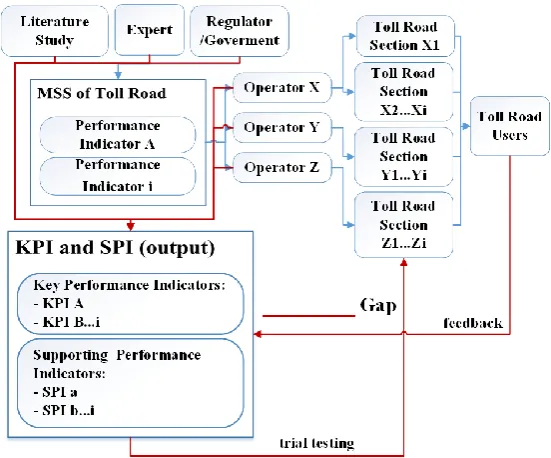
Other previous studies did not include stakeholders' overall opinions in determining new performance indicators. Evaluations in these studies were carried out based on predetermined performance indicators. The opinions of consumers providing input on performance indicators that were in force, were included as proposed improvement, while the role of operators in determining performance indicators that should be met were not included. No study was found that determined main performance indicators and supporting indicators in fulfilling toll road MSS in Indonesia. In addition, the results of re-verification of certain stakeholder groups have also not been carried out by previous researchers. This study fills the current gap in research on toll road indicators. The relevant research gap is shown in Fig. 1.
Fig. 1 - Research gap in determining performance indicators.
3.
Research Methodology
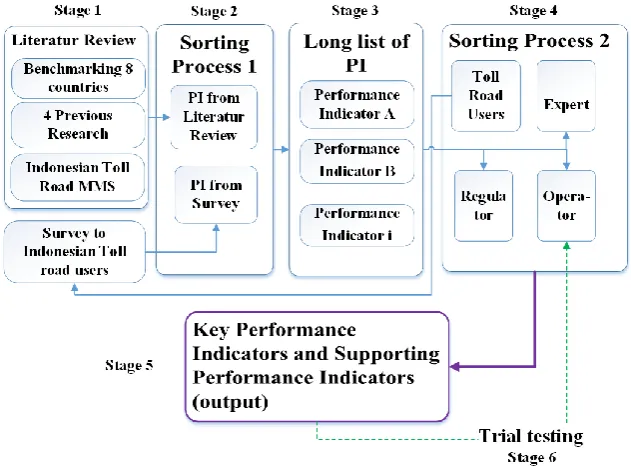
The framework of this research flow was composed of 6 research stages, each of which had its own path that was sequential to one another. In conducting a review of the performance indicators that would be proposed for the development of toll road MMS in Indonesia, the data collection method was by literature review and field survey. Literature study was carried out by benchmarking 8 selected countries to know how toll road MMS was implemented. In addition, previous Indonesian research studies were also reviewed, specially related to the development of toll road MMS and based on the toll road MMS performance indicators in Indonesia which referred to the Minister of Public Work Regulation No. 16/PRT/ M/2014 on Toll Road Minimum Service Standard.
Whereas the survey was carried out by online questionnaires that had to be filled in by respondents, in addition interviews with respondents were also conducted. It was important to first determine respondent criteria so that the collected data could be used for analysing. The data obtained from this survey were analysed using a descriptive statistical method by which the performance indicators could be determined.
BPJT and the Ministry of Public Works and Public Housing in related fields. The third phase was a trial test of the toll road performance indicators that had been obtained from the result of this study and the result of the test was confirmed by the toll road operators being executors of toll road MMS. The research framework is shown in Fig. 2.
Fig. 2 - Research framework.
4.
Results and Discussion
4.1
Sorting Analysis of Performance Indicators Based on Literature Study
The performance indicators obtained from the literature review are derived from the results of benchmarking of other countries, the results of previous research studies, and from the toll road MSS applicable in Indonesia. To facilitate the sorting process of all findings of performance indicators, grouping of similar performance indicators that had the same measurement objectives was carried out. This grouping was carried out based on the similarity of the service substance group, while considering the measurement objectives of these performance indicators.
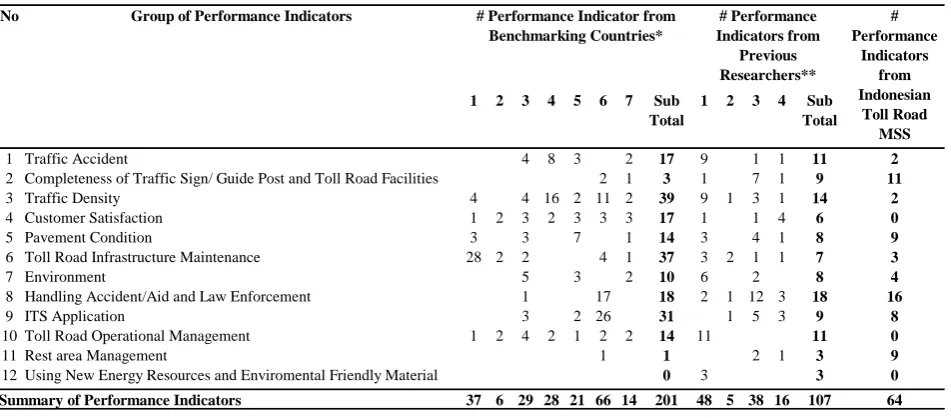
The performance indicators were grouped into 12 performance indicator groups, consisting of 201 performance indicators for benchmarking results from other countries, 107 performance indicators derived from proposal of previous researchers from Indonesia and out-side Indonesia, and 64 performance indicators from toll road MSS applied in Indonesia according to Minister of Public Works Regulation No. 16/PRT/M/2014, concerning Toll Road Minimum Service Standards. With a total number of performance indicators as many as 372 performance indicators from the results of this literature review, were later used in the sorting process for the next stage.
For the propose of this research the proposed performance indicators from the results of previous research groups were given names Researcher 1, consisting of Ralph Haas, Guy Felio, Zoubir Lounis, and Lynne Cowe Fall. While Researcher 2 was given to Greece research group consisting of Helen Tyrogianni, Bill Halkias, and Pagina Kotzampassi. As for the group of researchers from Indonesia, they were named Researcher 3 and Researcher 4. Researcher 3 was for the research group consisting of Rudy Hermawan Karsaman and Widyarini Weningtyas. While Researcher 4 was for the research group consisting of Herry T. Zuna, Sigit P. Hadiwardoyo and Hedy Rahadian. The details of the total amount of performance indicators for implementation in the benchmarked countries and the proposed performance indicators from the researchers, as well as the MSS that was applied in accordance with groups of performanceindicators is shown in Table 1.
performance indicators of the toll road MSS applied in Indonesia, the highest number was law enforcement performance indicator group (25.00%), road surface condition performance indicator group (14.06%), and ITS performance indicator group (12.50%).
Table 1 - Groups of Performance Indicators.
No
1 2 3 4 5 6 7 Sub
Total
1 2 3 4 Sub
Total
1 Traffic Accident 4 8 3 2 17 9 1 1 11 2
2 Completeness of Traffic Sign/ Guide Post and Toll Road Facilities 2 1 3 1 7 1 9 11
3 Traffic Density 4 4 16 2 11 2 39 9 1 3 1 14 2
4 Customer Satisfaction 1 2 3 2 3 3 3 17 1 1 4 6 0
5 Pavement Condition 3 3 7 1 14 3 4 1 8 9
6 Toll Road Infrastructure Maintenance 28 2 2 4 1 37 3 2 1 1 7 3
7 Environment 5 3 2 10 6 2 8 4
8 Handling Accident/Aid and Law Enforcement 1 17 18 2 1 12 3 18 16
9 ITS Application 3 2 26 31 1 5 3 9 8
10 Toll Road Operational Management 1 2 4 2 1 2 2 14 11 11 0
11 Rest area Management 1 1 2 1 3 9
12 Using New Energy Resources and Enviromental Friendly Material 0 3 3 0
37 6 29 28 21 66 14 201 48 5 38 16 107 64
Summary of Performance Indicators
*1. Malaysia 2. Philipine 3. Japan 4. Australia & New Zealand 5. South Africa 6. United States of America 7. Europe **1. Researchers no. 1 (Canada) 2. Researchers no. 2 (Greek) 3. Researchers no. 3 (Indonesia) 4. Researchers no. 4 (Indonesia)
Group of Performance Indicators # Performance Indicator from Benchmarking Countries*
# Performance Indicators from
Previous Researchers**
# Performance
Indicators from Indonesian
Toll Road MSS
The performance indicator group that was strongly proposed by previous research groups was a group of performance indicators on traffic density. It could be that traffic conditions related to traffic density are issues that greatly affect the toll road services. Users expect smooth traffic. All benchmarked countries in this group, except the Philippines, applied this performance indicator. While all previous research groups also agreed to propose performance, indicators related to traffic density. But for Indonesia this group of performance indicators is only applied to 2 performance indicators.
Based on the results of classification which was carried out in accordance with established criteria, the selected performance indicator groups were those that were applied and proposed by 50% or more of the number of bench-marked countries and previous research groups. The result at this stage showed that there were 5 classifications of performance indicator groups. The first classification consisted of 153 performance indicators from a group of performance indicators that were being applied by various countries, including Indonesia, and proposed by previous research groups. The second group consisted of 95 performance indicators that were being applied by various countries and proposed by the previous research groups. The third group consisted of 23 performance indicators that were being applied in Indonesia and proposed by the previous research groups. The fourth group consisted of 14 performance indicators proposed by the previous research group. While the fifth group was a group that was not selected in the sorting out of performance indicator groups. This fifth group of performance indicators that was only applied in other countries.
Before proceeding with the verification process for each performance indicator, a selection was first carried out by eliminating similar performance indicators within one group. This process was carried out to reduce repeated verification of similar performance indicators. In short, results of the verification process that was conducted in relation with the list of proposed performance indicators derived from the literature review were as follows: (a) classification of performance indicator groups that have been applied by various countries and in Indonesia, and proposed by previous research groups; (b) classification of performance indicator groups that were being applied by various countries and proposed by previous research groups; (c) classification of performance indicator groups that were being applied in Indonesia and proposed by previous research groups; and (d) classification of performance indicator groups that were being applied in other countries. This indicator group classification was based on slices between the three sources of information from the literature review.
4.2 Analysis of Sorting Performance Indicators Based on Toll Road User Survey
surface, the existence of clear signs as well as a clean environment. These reasons should be considered when determining future performance indicators as they would meet the expectations of toll road users.
In addition, performance indicators that were significant were safety, besides security and comfort. These performance indicators would meet toll user expectations based on the result of the survey. Safety is the most important aspect for Indonesians, so all performance indicators that support the creation of toll road safety should be of main concern. Lack of information and socialization regarding the existence of the toll road MSS, which regulates the minimum service that must be provided by the operator is a factor that is of great concern. Feedback related to toll road MSS fulfillment is very much needed in measuring toll road performance.
The grouping of performance indicators based on the survey of Indonesian toll road users, resulted in 10 proposed performance indicators with safety aspect, 9 proposed performance indicators with security aspect, and 20 proposed performance indicators with comfort aspect. Total performance indicators obtained were 39 performance indicators. Verification process of 31 proposed performance indicators based on results of the surveys was carried out to ensure that the proposed performance indicators were in accordance with the conditions in Indonesia, next to that were in compliance with prevailing laws and regulations of Indonesia, and were in accordance with the wishes of Indonesian toll road users. The result obtained through this verification process was 22 performance indicators that can be re-proposed into the long list of performance indicators that will be used for subsequent surveys.
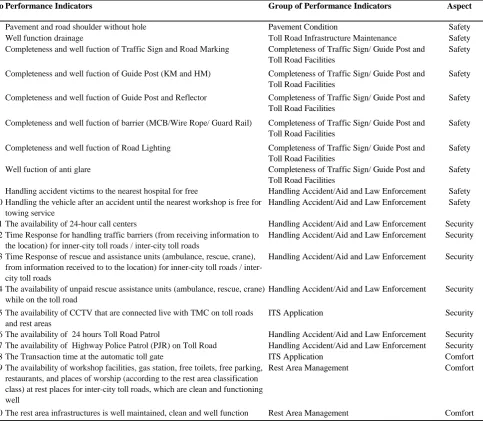
Table 2 - Key performance indicators of toll road minimum service standards in Indonesia.
No Performance Indicators Group of Performance Indicators Aspect
1 Pavement and road shoulder without hole Pavement Condition Safety
2 Well function drainage Toll Road Infrastructure Maintenance Safety
3 Completeness and well fuction of Traffic Sign and Road Marking Completeness of Traffic Sign/ Guide Post and Toll Road Facilities
Safety
4 Completeness and well fuction of Guide Post (KM and HM) Completeness of Traffic Sign/ Guide Post and
Toll Road Facilities
Safety
5 Completeness and well fuction of Guide Post and Reflector Completeness of Traffic Sign/ Guide Post and
Toll Road Facilities
Safety
6 Completeness and well fuction of barrier (MCB/Wire Rope/ Guard Rail) Completeness of Traffic Sign/ Guide Post and Toll Road Facilities
Safety
7 Completeness and well fuction of Road Lighting Completeness of Traffic Sign/ Guide Post and
Toll Road Facilities
Safety
8 Well fuction of anti glare Completeness of Traffic Sign/ Guide Post and
Toll Road Facilities
Safety
9 Handling accident victims to the nearest hospital for free Handling Accident/Aid and Law Enforcement Safety
10Handling the vehicle after an accident until the nearest workshop is free for towing service
Handling Accident/Aid and Law Enforcement Safety
11The availability of 24-hour call centers Handling Accident/Aid and Law Enforcement Security
12Time Response for handling traffic barriers (from receiving information to the location) for inner-city toll roads / inter-city toll roads
Handling Accident/Aid and Law Enforcement Security 13Time Response of rescue and assistance units (ambulance, rescue, crane),
from information received to to the location) for inner-city toll roads / inter-city toll roads
Handling Accident/Aid and Law Enforcement Security
14The availability of unpaid rescue assistance units (ambulance, rescue, crane) while on the toll road
Handling Accident/Aid and Law Enforcement Security 15The availability of CCTV that are connected live with TMC on toll roads
and rest areas
ITS Application Security
16The availability of 24 hours Toll Road Patrol Handling Accident/Aid and Law Enforcement Security
17The availability of Highway Police Patrol (PJR) on Toll Road Handling Accident/Aid and Law Enforcement Security
18The Transaction time at the automatic toll gate ITS Application Comfort
19The availability of workshop facilities, gas station, free toilets, free parking, restaurants, and places of worship (according to the rest area classification class) at rest places for inter-city toll roads, which are clean and functioning well
Rest Area Management Comfort
4.3 Selection Analysis of Performance Indicators
Based on literature review results and survey results from toll road users, 73 performance indicators are proposed to be included in the long list of performance indicators for toll road MSS in Indonesia. These performance indicators consist of 51 performance indicators from literature review results and 22 performance indicators from survey results of toll road users, but it included similar performance indicators. After having compiled and eliminated these similar performance indicators, 48 performance indicators were left and are proposed to be included in the long list of toll road performance indicators in Indonesia.
The survey results from respondents consisting of regulator, operators, and experts, originated from questionnaires distributed online to relevant respondents. In addition, a discussion was held between a group of regulators (BPJT) and operators (BUJT). The results of this discussion formed input and consideration in determining the performance indicators after having analysed data from the questionnaires. It consisted of data related to respondents’ opinions on aspects of safety, security and comfort. With respect to performance indicators related to safety aspects of the management and scheduling of heavy vehicles and the safety aspects of overloading, these were not included, because they were deleted from the questionnaires. The deletion was done after the validity and reliability test had been carried out stating that performance indicator was not valid as a measuring instrument.
By using descriptive statistics to calculate the frequency of respondents who agree and strongly agree (as many as 90% of respondents), the performance indicators could be determined and selected for the next process. The next step was to sort out all the selected indicators to separate key performance indicators from supporting performance indicators. Key performance indicators were chosen based on the percentage of the number of respondents who voted strongly in favor of more than 50%. While the rest was categorized as supporting performance indicators.
4.4 Selection Analysis of Performance Indicators
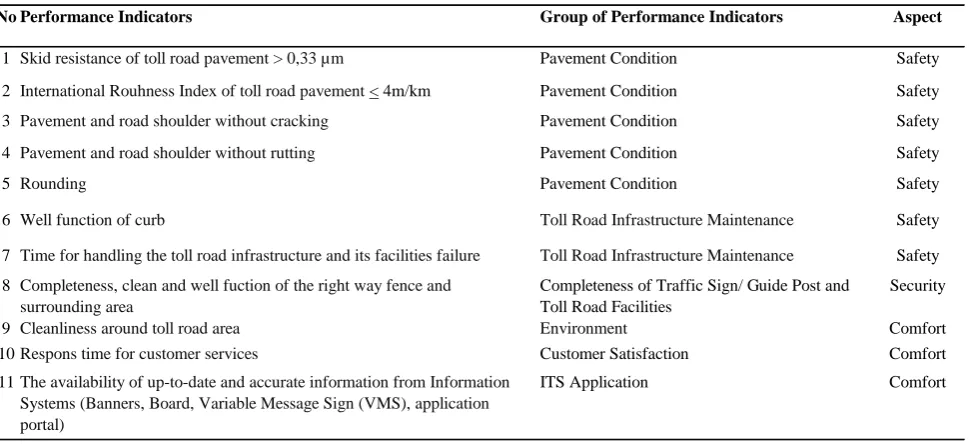
The results analysis of performance indicators with safety aspects, out of 22 performance indicators, 10 key performance indicators were proposed and 7 supporting performance indicators. While for the other 5 performance indicators that were left, they could not be selected as performance indicators in this current research. The results of the analysis also showed that there were 31 performance indicators for toll road MSS in Indonesia. The performance indicator consisted of 20 key performance indicators and 11 supporting performance indicators that could be proposed for the development of toll road MSS in Indonesia. The key performance indicators are shown in Table 2.
Of the selected key performance indicators, most were key performance indicators with safety aspects, which were 50%. Followed by the key performance indicators with security aspect, which were 35%, and the last 15% with comfort aspect. This is relevant with previous survey of toll road users in relation with the prioritizing aspect. Indonesian toll road users chose safety to be priority for driving on toll roads, followed by security aspects and the third was the comfort aspect. Meanwhile, the supporting performance indicators obtained from the results of the analysis consisted of 64% performance indicators with safety aspects, or as many as 7 supporting performance indicators. Detailed supporting performance indicators is shown in Table 3.
Table 3 - Supporting Performance Indicators of Toll Road Minimum Service Standards in Indonesia.
No Performance Indicators Group of Performance Indicators Aspect
1 Skid resistance of toll road pavement > 0,33 µm Pavement Condition Safety
2 International Rouhness Index of toll road pavement < 4m/km Pavement Condition Safety
3 Pavement and road shoulder without cracking Pavement Condition Safety
4 Pavement and road shoulder without rutting Pavement Condition Safety
5 Rounding Pavement Condition Safety
6 Well function of curb Toll Road Infrastructure Maintenance Safety
7 Time for handling the toll road infrastructure and its facilities failure Toll Road Infrastructure Maintenance Safety 8 Completeness, clean and well fuction of the right way fence and
surrounding area
Completeness of Traffic Sign/ Guide Post and Toll Road Facilities
Security
9 Cleanliness around toll road area Environment Comfort
10Respons time for customer services Customer Satisfaction Comfort
11The availability of up-to-date and accurate information from Information Systems (Banners, Board, Variable Message Sign (VMS), application portal)
The supporting performance indicators with safety aspect consisted of a group of road surface condition performance indicators, 5 supporting performance indicators and a group of performance indicators and toll road infrastructure maintenance, as many as 2 supporting performance indicators. Only one performance indicator for the security aspect, namely from the performance indicator group of signs/ instructions and toll road facilities. Whereas concerning the comfort aspect there were 3 supporting performance indicators or as high as 27% of the total number of supporting performance indicators. The three supporting performance indicators originated from environmental maintenance performance indicator groups, toll road user satisfaction performance indicators groups, and ITS application performance indicators groups. Each group of performance indicators contained 1 supporting performance indicator.
5. Summary
Based on the survey and data analysis on the performance indicators development for toll road minimum service standards, the following conclusions can be drawn:
• Obtained 31 toll road MSS performance indicators, as the output of this study, which consisted of 20 key performance indicators and 11 supporting performance indicators.
• Of the total performance indicators selected as key as well as supporting performance indicators, 17 performance indicators were related to safety aspect or 54.8% of total performance indicators; 8 performance indicators were related to security aspects or 25.8% of total performance indicators; 6 performance indicators were related to comfort aspect or 19.4% of total performance indicators.
• The safety aspect that was chosen as priority by toll road users, shown that the results correspondence with the output of this study. It then was followed by aspects of security and comfort. The selected key performance indicators consisted of 50% key performance indicators with safety aspects, followed by 35% with security aspects and 15% with comfort aspect. This shows that the selected performance indicators are in line with toll road users expectations and can be applied as performance indicators of toll road MSS in Indonesia.
• There are 3 new performance indicators that have never been implemented in Indonesia, but are being applied in several benchmarked countries. The performance indicators in question are performance indicators for the availability of 24 hour call center, performance indicators for CCTV availability that are connected live with TMC on toll roads and rest areas, and performance indicators for the availability of up-to-date and accurate information from Information Systems (Banners, Board, Variable Message Sign or VMS, and portal application). These performance indicators are performance indicators that utilize information technology in the application of ITS. The toll road MSS performance indicators that are in effect should include current information technology that is part of today’s lifestyle.
• Evaluation results related to measurement and achievement of performance indicators show that all performance indicators obtained from this study are easy to measure and can be achieved easily, it also shows that the key performance indicators are easier to measure and easier to be achieved compared to the supporting performance indicators.
• The trial testing results of toll road performance indicators show that the achievement of toll road segments measured based on performance indicators obtained from the research results show a 100% achievement. This shows that the performance indicators obtained from the results of this research can be applied to toll road MSS performance indicators in Indonesia.
Acknowledgement
The authors would like to express gratitude to Indonesian Ministry of Public Works and Public Housing, especially to The Toll Road Regulatory Agency, which has known as Badan Pengatur Jalan Tol (BPJT), Badan Usaha Jalan Tol (BUJT) or Indonesian Toll Road Operators and also to all respondents.
References
[1] Badan Pengatur Jalan Tol (2012). Laporan Akhir Monitoring Pengusahaan Jalan Tol Tahun 2012, Jakarta, Indonesia.
[2] Makmur, A. & Rajagukguk, R. P. (2015). Evaluasi Pemenuhan Indikator Standar Pelayanan Minimal Jalan tol di Indonesia. Jurnal Transportasi, 15, 107-11.
[3] Badan Pengatur Jalan Tol (2013). Laporan Akhir Monitoring Pengusahaan Jalan Tol Tahun 2013, Jakarta, Indonesia
[4] Public Private Infrastructure Advisory Facility (1997). Global Toll Road Study Knowledge Date Based. Retrieved on September 15th, 2018 from https://ppiaf.org/sites/ppiaf.org/files/documents/toolkits/ highwaystoolkit
russian/6/bibliography/pdf/global_toll_road_study-knowledge_database.pdf
[6] Weningtyas, W. (2009). Evaluation of Toll Road Minimum Service Standard. Magister Thesis of Highway System and Engineering Programme, Institut Teknologi Bandung, Indonesia.
[7] Karsaman. R.H. & Weningtyas, W. (2009). Enhanching a better operation management of Indonesian toll road. International Journal of Economics and Financial Issues, 5 (Special Issue), 296-303.
[8] Zuna, H. T., Hadiwardoyo, S. P. & Rahadian H. (2016). developing a model of toll road service quality using an artificial neural network approach. International Journal of Technology, 4, 562-570.
[9] Zuna, H. T., Hadiwardoyo, S. P. & Rahadian H. (2015). analyzing service quality of toll road and its re-lation with customer satisfaction in Indonesia using multivariate analysis. Proceeding 14th International Conference on QIR (Quality on Research), Lombok, Indonesia.
[10] tyrogianni, h., halkias, b., politou, a. & kotzampassi, p. (2012). the attica tollway operations authority kpi performance system. Procedia Journal of Social and Behavioral Sciences, 48, 2999-3008.