Education in Medicine Journal (ISSN 2180-1932) © www.saifulbahri.com/eimj |e12
ORIGINAL ARTICLE
Faculty Development: Mini-CEX as Workplace-Based Assessment
Shahid Hassan
Department of Medical Education/ORL-HNS, School of Medical Sciences, Universiti Sains Malaysia
Abstract
Background: Competence-based curriculum has become the need of medical education to meet the objectives of institutions aiming to produce skilled physicians. To achieve the optimal competence and performance of graduates a number of traditional evaluation exercises have been practiced. Some of these e.g. OSCE although meet the acceptable standard of reliability and validity is the assessment done in a controlled environment. This leaves the room for performance-based assessment in real clinical situation such as mini clinical evaluation exercise (Mini-CEX). To practice and meet the challenges of Mini-CEX it is vital to undertake faculty development program with a comprehensively chalked down Mini-CEX protocol and its objectives to achieve the intended outcome.
Objective: To undertake faculty development on Mini-CEX for its feasibility and acceptability as a method of formative assessment to evaluate the clinical competence of trainees in postgraduate program of Otolaryngology and Head-Neck Surgery.
Method: 25 trainees from the four classes of master of surgery program of 2009 in Otolaryngology and Head-Neck Surgery (ORL-HNS) undertook Mini-CEX encounters and assessed by 9 supervisors in a 12-week period of study. Faculty development program was carried out through prior lectures deliberating on background, concept and procedure of Mini-CEX followed by demonstrations using video clip of Mini-CEX encounter recorded in own clinical environment. Students were also exposed to similar settings to take up the Mini-CEX encounter without any hesitation. Trainees were assessed in outpatient clinical setting. Program was evaluated for its feasibility and acceptability with respect to patient’s factors, clinical attributes, supervisor and trainee’s performance and their reported level of satisfaction.
Result: Faculty development and trainees orientation in Min-CEX was achieved as feasible and acceptable. Higher rating of satisfaction was reported by majority assessors and trainees as they found Mini-CEX acceptable for formative assessment. Among clinical skills highest rating was received in physical examination and lowest rating in therapeutic skills.
Conclusion: A motivated faculty and organized approach towards a comprehensive knowledge on Mini-CEX for its background communication, demonstration of procedure and method to complete the rating forms is the useful guide to adopt Mini-CEX. The faculty and trainees in department of ORL-HNS found Mini-CEX as feasible and acceptable assessment tool to monitor educational activity of postgraduate program through performance-based evaluation in a real clinical situation.
Education in Medicine Journal (ISSN 2180-1932) © www.saifulbahri.com/eimj
|e13
Introduction
Medical education aims at providing quality health care to community, which evidently needs professionally competent physicians. The core clinical skills for undergraduate as well as postgraduate medical education has widely been establish and elaborated in most of the curriculum practiced in medical education. The quality of health care depends upon acquisition of competence in a controlled environment and its performance in real life situation by the medical graduates. Competence-based curriculum has become necessary to meet the objectives of medical
education. To achieve the optimal
competence and performance of students a number of methods of assessments have been developed.
Student’s assessment provides a feedback to faculty on curriculum to see whether out-come is achieved or not. These initiatives have expanded the assessment of student’s competency and performance beyond the traditional methods practiced in medical education. Objective structured clinical examination (OSCE) has been claimed to meet the acceptable standard of reliability and validity(1). Though feasible, setting up of a series of OSCE stations involves huge logistics, which is expensive to afford. Besides, competencies assessed through OSCE are limited in predicting how student will actually perform in work situation particularly in humanistic skills and professionalism. The need to explore a reliable and valid instrument to assess performance in clinical skills at work place led to another feasible method of multiple mini clinical evaluation examination known as Mini-CEX.
Mini-CEX was originally developed by the American Board of Internal Medicine USA to assess the medical residents in real life clinical setting (2). This tool can be employed to assess the core competencies of trainees during their routine clinical practice. This assessment tool offers a reliable measure of
trainee’s performance through being
observed a number of brief encounters over a period, with a number of different assessors and in different clinical settings. For Mini-CEX to be reliable at least four encounters per year is needed during trainee’s on-the-job performance if the measure is to be used as
summative assessment for evaluating
trainee’s abilities(3).
There are many standardized and reliable tools available to optimally measure the core clinical skills. The clinical skills tested include interviewing and communication skills, physical examination skills, diagnostic and
therapeutic skills, counseling and
professionalism. A number of other traditional methods to assess trainee’s competence and performance are available. These are oral examination using clinical scenarios, patient work-up followed by oral examination as long case and multiple short cases focused on diagnosis and objective structured clinical examination. However, problem with these traditional methods are that these are time consuming and takes long hours to accomplish the task and is uninfluenced by any time constraints relevant to real life clinical practice(4). It has a random case specific performance, which is usually checked through one case that is often unobserved (long case assessment). Results are difficult to be generalized and there is always a subjective bias of the supervisors. Since the rating involves single evaluator or a panel of evaluators rating with consensus, the scores are less reliable for assessment.
Education in Medicine Journal (ISSN 2180-1932) © www.saifulbahri.com/eimj
|e14 exercise works within the context of real
clinical practice. In each Mini-CEX, encounter procedure involves an examiner observing the resident to conduct a focused interview or physical examination in an inpatient, outpatient, emergency or any other setting. After asking the residents for diagnosis or
therapeutic decisions, the examiner
completes the rating form and provides the feedback.
For each encounter the examiner records the date, the complexity of patient’s problem on a 3-point scale (low, medium and high), the sex of the patient, the type of visit (new or follow up), the setting (outpatient, inpatient or emergency) the number of minutes spent observing the encounter and the number of minutes spent giving the feedback. Examiner will also note whether the encounter was data gathering, diagnosis, treatment or counseling. Using 1-9 point scale table (1-3 unsatisfactory, 4 marginal, 5-6 satisfactory and 7-9 superior) examiner will rate the
students on interviewing, physical
examination, professionalism, clinical judgment, counseling and organizational efficiency. Finally, students and the examiner will also record their satisfaction with the method on 1-9 point scale table from 1 dissatisfied to 9 most satisfied.
Material and Methods
Mini-CEX has been introduced to
postgraduate program in Otolaryngology and Head and Neck Surgery in June 2009 to complement formative assessment in surgical skills training of students from year I to IV. Each student was required to undertake at least one Mini-CEX encounter during every three months of his rotational sub-specialty posting in ORL-HNS in School of Medical Sciences (SMS), Universiti Sains Malaysia (USM). A user friendly rating form (see appendix A) for faculty to document the Mini-CEX encounter was adopted from the rating form proposed by American College of Physicians and American Society of Internal
Medicine. Instruction for evaluator as a checklist (see appendix B) was also developed to indicate how to complete the rating form. A comprehensive faculty development and trainees orientation in Mini-CEX was organized. Faculty development program was carried out through prior lectures deliberating on background, concept and procedure of Mini-CEX followed by demonstrations using video clip of Mini-CEX encounter recorded in own clinical environment. Students were also exposed to similar settings to take up the Mini-CEX encounter without any hesitation.
Each Mini-CEX encounter was focused on a limited number of competencies in a given attribute of clinical skills such as history taking, physical examination and patient’s diagnostic or therapeutic problems. All but one encounter were held in outpatient clinical setting administered by the supervisor without affecting his outpatient clinic. Each encounter was for about 15-20 minutes for the observing and 10-15 minutes for giving feedback by the supervisor. Supervisor was trained to complete the rating form in each clinical attribute besides rating the overall competence of the trainees. Mini-CEX data were collected for formative assessment to evaluate the ongoing educational activities.
Video recording of first two encounters of Mini-CEX by every supervisor was done. These videotapes were reviewed by the coordinator of Mini-CEX together with head of the department to do the rating on 1-9 points scale table as unsatisfactory (1-3), borderline (4), satisfactory (5-6), superior (7-8) and excellent (9). These videotapes were also carefully evaluated by the coordinator for an instructional feedback and faculty development of supervisor in areas showing deficiencies in undertaking the standardized
Mini-CEX encounters for faculty
development.
Education in Medicine Journal (ISSN 2180-1932) © www.saifulbahri.com/eimj
|e15 form. A hard copy of the form completed by
the supervisor was provided to trainees for their record of formative assessment. Supervisor also placed a copy on the head of the department file besides maintaining his own record of Mini-CEX encounters with various trainees during their clinical posting.
Result
Total number of in-campus trainees in 4 classes of year I to IV during 2009 were 25, whereas the total umber of supervisors in various sub-specialty units were 11 with a student supervisor ratio of 1: 2.27 (see table 1). Total Mini-CEX encounters comprising of different clinical attributes were 26 in reported 4 sub-specialties (see table 2).
All trainees were assessed in outpatient clinical setting except one (0.26%) assessed in emergency setting The mean age of the patients was 35 years and out of a total 21 patients 33.33% were male and 66.66% were female. 7 cases were new and 14 cases were followed up patients. Of these 5 (19.23%) patients were repeated for more than once. The complexity of patient problem were
rated as, low in 7 (26.92%) encounters, moderate in 6 (23.07%) encounters and high in 13 (50.00%) encounters.
Of clinical attributes 11 encounters 42.30% required the history taking, 7 (26.92%) required physical examination, 5 (19.23%) required diagnostic work up, 2 (7.69%) required therapeutic and management strategies and 1(3.84%) required counseling. The mean time examiner spent to observe the trainee’s interaction with patient was 14 minutes and the mean time spent providing feedback to the trainees was 9 minutes. The ratings in these clinical competencies ranged from 5 to 9 (see table 3).
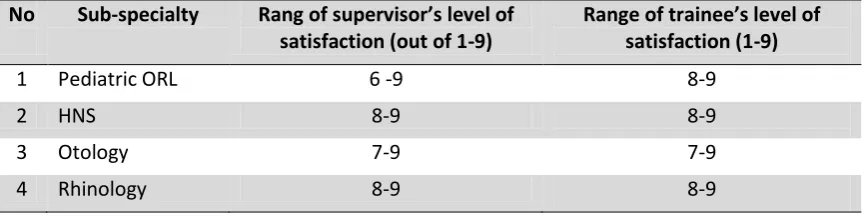
Among the supervisor’s majority were satisfied with Mini-CEX and the level of satisfaction ranged from 6 to 9 (see table 4). Among the trainees the level of satisfaction was less varied than the supervisors and majority have shown interest with high level of satisfaction for Mini-CEX ranging from 7-9 (see table 4). All supervisors filled up the patient diagnosis and the number of problems presenting to gauge the nature of patient’s complexity.
Table 1: Number of trainees, supervisors and sub-specialties in Department of ORL-HNS
No of Trainees (25) No of Sub-specialties (4) No of Supervisors (11) Year Numbers No Sub-specialty Sub-specialty Numbers
One 7 1 Otology Otology 3
Two 5 2 Rhinology Rhinology 3
Three 5 3 Head-Neck Surgery Head-Neck Surgery 3
Education in Medicine Journal (ISSN 2180-1932) © www.saifulbahri.com/eimj
|e16 Table 2: Contribution of Sub-specialties for clinical attributes vs. encounters in Mini-CEX
Table 3: The outcome of Mini-Cex encounters as supervisors differences in rating scores.
Table 4: Level of satisfaction reported by supervisors and trainees in Mini-CEX encounters.
No Sub-specialty Attributes of Clinical Competence
No of Encounters
1 Pediatric ORL History taking, physical examination and diagnostic skills.
6
2 Head and Neck Surgery
History taking, physical examination, diagnostic skills, therapeutic skills and counseling skills.
8
3 Otology History taking, physical examination, diagnostic skills and therapeutic skills.
6
4 Rhinology History taking, physical examination and diagnostic skill.
6
Total 6 26
Mini-CEX
Principal Assessor
Second Assessor
Third Assessor
Mini-CEX
Principal Assessor
Second Assessor
Third Assessor
1 8 7 7 14 6 6 7
2 7 7 8 15 8 8 8
3 6 6 7 16 9 8 9
4 5 6 6 17 7 6 7
5 8 8 7 18 6 6 7
6 9 8 8 19 5 5 6
7 5 6 7 20 5 6 6
8 8 7 9 21 6 6 7
9 7 6 7 22 8 7 8
10 6 6 6 23 7 8 8
11 8 8 8 24 7 7 7
12 5 6 7 25 6 6 6
13 9 8 9 26 8 9 9
No Sub-specialty Rang of supervisor’s level of satisfaction (out of 1-9)
Range of trainee’s level of satisfaction (1-9)
1 Pediatric ORL 6 -9 8-9
2 HNS 8-9 8-9
3 Otology 7-9 7-9
Education in Medicine Journal (ISSN 2180-1932) © www.saifulbahri.com/eimj
|e17
Discussion
Mini-CEX compared to Traditional-CEX
evaluates trainees with multiple encounters, greater variety of clinical settings and diverse set of patient problems carried out in an environment similar to that of a clinical practice and this produces more reliable ratings and evaluation. Increased opportunity for observation and just-in-time feedback from the supervising role models produces a positive educational impact on resident’s learning. This also provides trainees with formative assessment to monitor their learning objectives. Centers planning to acquire this method of assessment can capitalize on a well-trained faculty delivering the Mini-CEX and meeting its objectives. Before embarking on faculty development to introduce Mini-CEX, center needs to develop a user friendly rating form and the checklist (see appendices A and B), elaboration of clinical competence and its attributes, procedural guidelines for practice and the precise role of Mini-CEX in assessment of the postgraduate program practiced to evaluate and monitor trainee’s progress.
A number of clinical attributes to evaluate specific competence have been undertaken in 26 Mini-CEX encounters in 4 sub-specialties of ORL-HNS (see table 1 and 2). All encounters took place in ambulatory setting of the on-going clinic except one in which patient was picked up from the emergency setting. Both, new and followed up patients were employed in these encounters however, trainees were exposed to all those cases for the first time. The time spent observing and giving feedback was noted to be increased with complex patient problems.
The ratings in these clinical competencies ranged from 5 to 9. The mean rating was highest for physical examination skills followed by history taking, diagnostic skills, counseling and therapeutic skills respectively. Inter rating score among the three evaluators for the same case also varied on point scale however, the difference was minor in term of
level of satisfaction and feasibility. The rating
score varied among the supervisors
undertaking various cases in those
encounters, were close to consensus on decisions for categories as unsatisfactory, satisfactory or superior. Supervisor’s rating score though often different on point table scale (ranging between 6-9) is in agreement for one of those categories clustered as unsatisfactory, marginal, satisfactory and superior (see table 3).
Inter rating score among the three evaluators for the same case also varied on point scale however, the difference was hardly any in term of level of satisfaction.
Most of the trainees and the supervisors have found Mini-CEX a satisfactory assessment tool (see table 4) for practice of formative assessment.
All supervisors filled up the patient diagnosis and the number of problems presenting. The problem caused a broad range of presenting symptoms explored in history taking encounters as, neck masses, sore throat, solitary and multinodular goiters, nasal masses, nasal block, epistaxis, ear discharge, hearing impairment and hoarseness of voice. Physical examination included a broad range of ear, nose, throat and head and neck examinations for various lesions.
In this study Mini-CEX encounter took place in normal working environment of clinical setting. Trainees were found motivated with instigating approach to undertake their Mini-CEX encounter whenever called during their on-job practice. However, they were informed that the Mini-CEX encounters are
primarily meant for their formative
Education in Medicine Journal (ISSN 2180-1932) © www.saifulbahri.com/eimj
|e18 the last patient visiting the clinic or last
patient in the ward round(6). This is found to be less disruptive to the flow of the clinical workload as well as it allows more time to offer structured feedback to trainees. Preferences were given to employ new patients for each encounter or follow up patients with new angle for clinical judgment if possible.
Feedback sessions were considered the most important aspect of Mini-CEX, equally by the supervisors and trainees. For trainees it was an excellent source to provide structured instruction as just-in-time feedback by some role model clinicians. Besides it also provide opportunity for students to gauge their progress of clinical skills learning.
Mini-CEX encounter provided a good experience both to supervisors and to trainees as a real life encounter between trainee and patients in an on-going clinic besides, observing and giving feedback by supervisors. The entire exercise had achieved the objectives of faculty development in this new method of assessment practiced for the first time in this medical school. Supervisors and the trainees, both have shown their satisfaction and cooperation (9 of 11 supervisors involved) to induct Mini-CEX as part of formative assessment to gauge their progress in clinical skills learning., Supervisor enthusiasm to undertake more Mini-CEX encounters was shown by their high rating of satisfaction, providing prompt feedback and returning of completed rating form to coordinator and a copy to trainee. Supervisors became consistent with Mini-CEX promptly and some of them even enjoyed observing the encounter assessed by other supervisors. Trainee’s development to undertake Mini-CEX encounter was equally encouraging shown as high rating of satisfaction. For instance few trainees who were reluctant to undertake first Mini-CEX encounter were asking for more encounters with in the same posting.
Comparing the rating of trainee’s
performance it varied from minimum 5 score to maximum 9 score on point table from 1-9.
Areas performed well were physical
examination followed by history taking, diagnostic skills, therapeutic skills and
counseling. Humanistic qualities and
professionalism were also rated quite well in this study compared to those shown in other study (7). Although clinical setting was the only venue for all encounter except one but supervisors were found keen to practice Min-CEX in inpatient and emergency setting after achieving the hand-on experience and confidence to run this evaluation method. Multiple encounters provide evaluation of trainees in greater varieties of patient problems with different assessors and clinical attributes. Educational impact was positive as the trainees appreciated Mini-CEX for multiple opportunities to interact with patient in the presence of supervisors and just-in-time instructional feedback in clinical competence of real clinical practice.
This study however, has several limitations such as a very small number of encounters, trainees and supervisors involved, lack of experience both for trainees and assessors, more complex cases, more controlled setting in the presence of coordinator. However, with multiple encounters in assessment using Mini-CEX was expressed as superior to traditional CEX and all the supervisors and the trainees were satisfied with this new format of assessment. Educational impact was also considered more effective for teaching and learning as it provides more frequent encounter over time, role model observers for feedback and broad range of patient problems. However, many supervisors found it difficult to mark the students below average for their borderline or unsatisfactory performance wit face-face rating in this study. This situation might have been due to close association of supervisors and students in training. Inviting assessors off and on from other units (of same discipline) or institutions may overcome this problem. Limited time for
Education in Medicine Journal (ISSN 2180-1932) © www.saifulbahri.com/eimj
|e19
shortcoming of this assessment tool
employed for formative assessment of postgraduate medical education.
Conclusion
Mini-EX is a method of assessing the clinical skills, which is task focused and quick to perform in a broader set of routine clinical
practice administered as multiple
encounters with variable patient problems and different examiners. Mini-CEX is a
workplace-based assessment of
performance, which has been reported to be reasonably reliable and valid to confer structured clinical skills learning in medical education.
A motivated faculty and organized approach towards a comprehensive knowledge on Mini- CEX as an assessment tool for its background communication, demonstration of procedure and method to complete the rating forms is the useful guide to adopt Mini-CEX. The present study conducted with intention of faculty development in Mini-CEX used as formative assessment method
has found this measurement tool
satisfactory to be accepted and feasible to be practiced in ORL-HNS discipline of School of Medical Sciences at Universiti Sains Malaysia.
References
1. John R. Assessing students-Clinical competence versus performance. IeJSME. 2007; 1:15-21
2. John JN, Linda LB, Daniel D, Gregory SF. The Mini-CEX: a method for assessing clinical skills. Ann Intern Med. 2003; 138:476-481
3. Carr S. The foundation programme assessment tool: An opportunity to provide feedback to trainees. Postgrad Med J 2006; 82: 576-579
4. Kroboth FJ, Hanusa BH, Parker S, Coulehan JL, Kappor WN, Brown FH, et al. The inter-rater reliability and internal
consistency of clinical evaluation exercise. J Gen Intern Med. 1992; 7:174-179
5. Norcini JJ, Blank LL, Arnold GK, Kimball HR. The Mini-CEX (clinical evaluation exercise): a preliminary investigation. Ann Intern Med. 1995; 123:795-799
6. Assessment Unit-Education Deanery,
Royal Australian College of Physicians. Mini-CEX full background communication March 2008 (Googles)
7. Norcini JJ, Blank LL, Arnold GK, Kimball HR. Examiner differences in the Mini-CEX. Advances in Health Sciences Education: Theory and Practice. 1997; 1:27-33
Corresponding Author: Associate Professor Dr Shahid Hassan, Medical Education/ Otorhinolaryngology Department, School of Medical Sciences, Universiti Sains Malaysia, Kubang Kerian, 16150 Kota Bharu, Kelantan, Malaysia.
Email: [email protected], [email protected]
Education in Medicine Journal (ISSN 2180-1932) © www.saifulbahri.com/eimj |e20
Appendix A-The Mini Clinical Evaluation Exercise (Mini-CEX) rating form adopted from ABIM.
Evaluator________________________________________ Date ____/______/____
Candidate________________________________________ Year_____ Phase_____
Clinical Setting of
Discipline______________ Ambulatory In-patient Emergency
Complexity of Case Low Moderate High
Patient’s Data Age ______Years Sex ______ New Follow up
Focus History Examination Diagnosis Therapy Counseling
Medical Interviewing Skills 1 2 3 4 5 6 7 8 9
Unsatisfactory Satisfactory Superior
Physical Examination Skills 1 2 3 4 5 6 7 8 9
Unsatisfactory Satisfactory Superior Humanistic Qualities and
Professionalism
1 2 3 4 5 6 7 8 9
Unsatisfactory Satisfactory Superior
Diagnostic Skills 1 2 3 4 5 6 7 8 9
Unsatisfactory Satisfactory Superior
Therapeutic Skills 1 2 3 4 5 6 7 8 9
Unsatisfactory Satisfactory Superior
Counseling Skills 1 2 3 4 5 6 7 8 9
Unsatisfactory Satisfactory Superior
Organization and Efficiency 1 2 3 4 5 6 7 8 9
Unsatisfactory Satisfactory Superior
Overall Clinical Competency Unsatisfactory 1-3
Marginal 4
Satisfactory 5-6
Superior 7-8
Excellent 9 Evaluator Satisfaction
with Mini-CEX Low 1 2 3 4 5 6 7 8 9 High
Candidate Satisfaction
with Mini-CEX Low 1 2 3 4 5 6 7 8 9 High
Mini-CEX Time Observing ___________ Minutes
Feedback ____________ Minutes
Other Comments
Time of Encounter _______________
No of Encounter _____________
Main Diagnosis _____________
No of Problems ____________
Education in Medicine Journal (ISSN 2180-1932) © www.saifulbahri.com/eimj |e21
Appendix B: Evaluator’s checklist employed in assessment using Mini-CEX in ORL-HNS.
No Checklist for Evaluator
A About the Form
1 Mark the appropriate boxes using sign () for tasks accomplished or observed.
2 For those tasks not performed or observed mark the relevant boxes using sign ()
3 Declare the allocated time for each task or overall tasks to be undertaken 4 Observe and record the time consumed by the candidate
5 Note down the duration of time for which the feedback is given to candidate 6 Encircle the appropriate marks scored by the candidates in its relevant column 7 Fill-in evaluator and candidate’s satisfaction rating with this Mini-CEX session 8 Ensure that the form is duly signed by the evaluator as well as the candidate 9 Pass on the duly completed forms to the coordinator program Mini-CEX
B About the Program
1 Otology
2 Head and Neck Surgery and Laryngology
3 Rhinology
4 Pediatric ORL
C About the Encounter
1 The number/s of encounter undertaken
2 Number of clinical attributes assessed in an encounter
3 Time of encounter during sub-specialty posting (? weeks after posting)
D About the Patient
1 Patient’s response to volunteer for encounter (happily agreed / reluctantly agreed) 2 Patient’s feeling after the encounter (enjoyed/ did not enjoy)
3 Patient’s willingness to be part of encounter again (yes / no)
E About the Resident
1 Resident undertaking Mini-CESX was informed (few hours prior / suddenly called)