12
USABILITY EVALUATION OF A DESKTOP VIRTUAL REALITY
PROTOTYPE (DVRP) COURSEWARE TO ENHANCE
KNOWLEDGE ON DRUG ABUSE
Ameer Fuhaili Mohamad Hashim1,Huzili Hussin2, Mohamad Hashim Othman3,Sharifah Amnah Syed Ahmad4
1,2 School of Human Development & Technocommunication, Universiti Malaysia Perlis
[email protected]; [email protected] 2 School of Educational Studies,
Universiti Sains Malaysia, Penang [email protected]
3 Institut Pendidikan Guru, Tuanku Bainun Campus, Bukit Mertajam, Penang [email protected]
ABSTRACT
Evaluation is a way to measure the usability of a computer-based system. Usability is the ability to carry out tasks effectively, efficiently and with satisfaction. Usability is the extent to which users can use a computer system to achieve specified goals effectively and efficiently while promoting feelings of satisfaction in a given context of use. It can be broadly defined as “ease of use”, and “usefulness”. This study aims to evaluate the usability, of the Desktop Virtual Reality Prototype (DVRP) courseware in enhancing knowledge on drug abuse among student teachers in a Teacher Education Institution. A total of 35 student-teachers were identified through simple random method to evaluate the usability of DVRP. In order to assess the usability of the DVRP courseware, the USE Questionnaire (Lund, 2001) was employed. USE stands for Usefulness, Satisfaction, and Ease of use. The results of this study on the usability show that the uses are very positive using the DVRP courseware and very effective and efficient to be used to enhance knowledge on drug abuse.
Keywords: usability, usefulness, easy to use, easy to learn, desktop, virtual reality, courseware, evaluation, prototype, knowledge, drug abuse
1. INTRODUCTION
13
Majid Hashemipour, 2003). Among the latest innovation is virtual reality (VR). Kommers and Zhiming (1997) wrote, “VR is a newly emerging tool for scientific visualization that makes possible multisensory, three-dimensional modelling of scientific data”. The newest form of VR is called non-immersive or desktop VR which is steadily establishing itself as a popular medium to transfer knowledge in modern education and training facilities (Lee, Wong, and Chun, 2010). Currently, there has been an increasing eagerness of using desktop Virtual Reality (VR) for educational purposes because of its ability to provide real time visualization and interaction within a virtual world that closely resembles a real world. In desktop VR, which is also known as non-immersive VR, the interactive three-dimensional (3-D) computer generated program in a multimedia environment is presented on a conventional personal computer and is usually explored using keyboard, mouse, wand, joystick or touch screen (Chen, Toh & Wan, 2004; Strangman & Hall, 2003). However, according to Kaur et al. (1996), VR systems can suffer from severe usability problems such as conceptual disorientation and inability to manipulate objects. Standard evaluation methods (Nielsen, 2003) may be able to discover some usability problems. Therefore the usability testing has been widely used as an important technique to uncover the possible usability problems of a system. Poor usability of a system could prevent its effectiveness and efficiency of use.
2. BACKGROUND OF STUDY
14 3. METHOD
These study employed descriptive method. Result will be presented using mean and standard deviation. Questionnaire was used to collect the data.
3.1 Sample
The usability of DVRP can be determined by two groups of people, namely the users (students) and the experts (teachers). In this study users were chosen as sample to evaluate the usability of DVRP. Therefore the samples of this study consisted of 35 (20 females and 15 males) student teachers from Teacher Education Institute (TEI) in northern Malaysia. They were selected using simple random sampling technique. According to Petrie and Bevan (2009), number ranging from 5 to 30 samples is suitable for the purpose of assessing the finished product. The main reason that most of the usability testing approaches involve only few participants is because recruiting more users requires more time, effort and higher cost (Chwen, Siew, Kee & Chee, 2013).
3.2 Instrumentation
15 4. RESULT
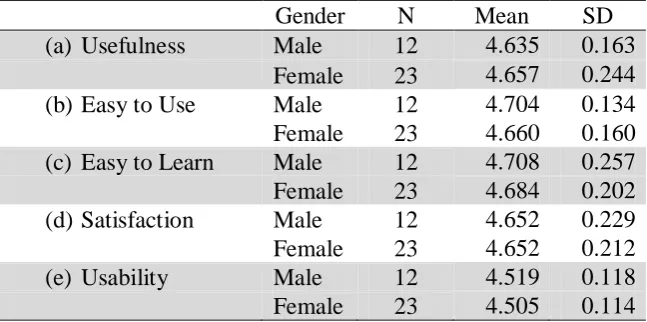
In this section, the researcher analysed the findings of the research and examined the participants’ responses to questionnaires. Table 1 shows the analysis for each domain.
4.1 Usefulness
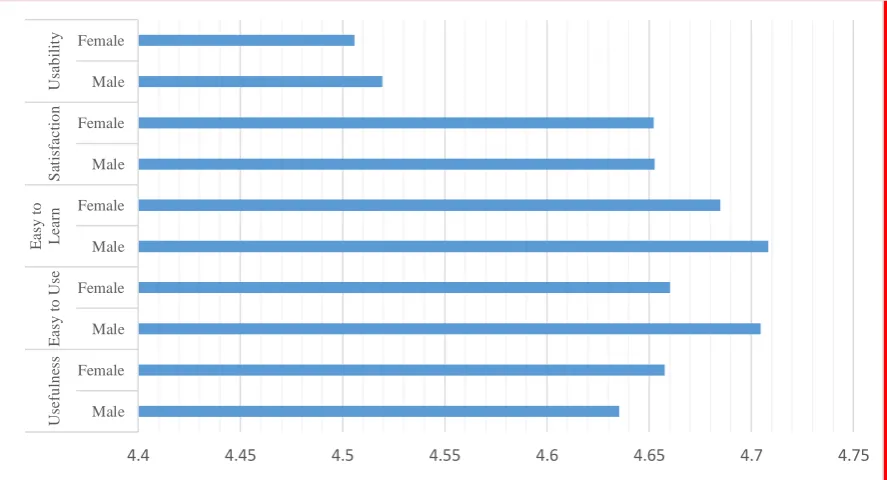
Landauer (1995) defined usefulness as “serving an intended purpose”. Grudin (1992), however, considered that usefulness is the issue of whether the system can be used to achieve some desired goal. There were eight items under usefulness attributes. The mean score on satisfaction of the DVRP courseware among female subjects (X = 4.657) were higher compared with the male subjects (X = 4.635) as shown in Table 1(a) and Figure 1.
4.2 Easy To Use
Ease of use which referred to as efficiency or productivity is on how quickly highly trained, expert users can accomplish tasks once they have learned how on a given user interface, and with frequent use. There were 11 items under easy to use attributes. The mean score on satisfaction of the DVRP courseware among male subjects (X = 4.704) was higher compared with the female subjects (X = 4.660) as shown in Table 1(b) and Figure 1.
4.3 Easy to Learn
Ease to learn referred to how easy it is for first time, novice, and casual users to figure out how to accomplish tasks given and how easy it is to remember what they have learned between infrequent uses. There were four items under easy to learn attributes. Table 3 refers to the analysis of the usefulness attributes. In terms of user easy to learn, the mean score on easy to learn of the DVRP courseware among male subjects (X = 4.708) was higher compared with the female subjects (X = 4.684) as shown in Table 1(c) and Figure 1.
4.4 Satisfaction
Satisfaction referred to which the users’ comfort with and positive attitudes towards the use of the system. There were seven items under satisfaction attributes. The mean score on satisfaction of the DVRP courseware among male subjects (X = 4.652) was higher compared with the female subjects (X = 4.652) as shown in Table 1(d) and Figure 1.
Table 1: Mean and Standard Deviation for Usefulness, Easy to Use, Easy to Learn, Satisfaction and Usability Score Between Male and Female Subject
Gender N Mean SD
(a) Usefulness Male 12 4.635 0.163
Female 23 4.657 0.244
(b) Easy to Use Male 12 4.704 0.134
Female 23 4.660 0.160
(c) Easy to Learn Male 12 4.708 0.257
Female 23 4.684 0.202
(d) Satisfaction Male 12 4.652 0.229
Female 23 4.652 0.212
(e) Usability Male 12 4.519 0.118
16 4.5 Usabillity
Landauer (1995) defined usability as “ease of operation”. The International Standards Organization (1994) defined usability as “the extent to which a product can be used by specified users to achieve specified goals with effectiveness, efficiency and satisfaction in a specified context of use”. The mean score on usability of the DVRP courseware among male subjects (X = 4.519) was higher than female subjects (X= 4.505) as shown in Table 1(e) and Figure 1.
5. DISCUSSION AND CONCLUSION
Usability denotes the ease with which these products or services can be used to achieve specified goals with effectiveness, efficiency and satisfaction in a specified context of use (Wegge & Zimmermann, 2007). The findings of this study clearly showed that DVRP courseware has a high usability. There is no great difference between male and female subject for four attributes. This study revealed that subjects of student-teachers from Teacher Education Institute (TEI) response positively to the usage of DVRP courseware. This clearly shows DVRP courseware achieved its objective in providing education against drug abuse. In addition, the virtual display with user friendly nature DVRP attracted subjects to get information about drug abuse. The findings of this research should also make a significant contribution to understanding the role of VR desktop can play in supporting learning and design in social science. It is therefore recommended that a further study is carried out using the theme on a larger sample size. A larger study and more appropriate questions should provide results with greater reliably and validity. Apart from more user tests, the cognitive walkthrough and heuristic evaluation methods should be carried out by more evaluators. Finally, including further methods apart from the four studied methods
4.4 4.45 4.5 4.55 4.6 4.65 4.7 4.75
Male Female Male Female Male Female Male Female Male Female U se fu ln es s E a sy t o U se E a sy t o L e a rn S at is fa c ti o n U sa b il it y
17
would provide a better overview of which usability evaluation method can be more suitable for the evaluation DVRP courseware.
REFERENCE
Bevan, N., Kirakowski, J., & Maissel, J. (1991). What is usability? In: Bullinger HJ (ed):
Proceedings of the 4th International Conference on Human Computer Interaction, Stuttgart, September 1991. Elsevier.
Booth, P., (1989). An introduction to human-computer interaction. London: Lawrence Erlbaum Associates.
Chen, C.J., Toh, S.C. & Fauzy, W.M. (2004). The Theoretical Framework for Designing Desktop Virtual Reality-Based Learning Environments. Journal of Interactive Learning Research, 15(2), 147-167.
Chen, C. J., Lau, S. Y., Chuah, K. M. & Teh, C. S. (2013). Group usability testing of virtual reality-based learning environments: A modified approach. Procedia the 9th International Conference on Cognitive Science - Social and Behavioral Sciences, 97, 691 – 699.
Guillemette, R. A. (1995). The evaluation of usability in interactive information systems. In: J. M. Carey (Ed.). Human factors in information systems: Emerging theoretical bases. Norwood, NJ: Ablex, 207-221.
Grudin, J. 1992. Utility and usability: Research issues and development contexts.
Interacting with Computers 4 (2), 209–17.
Hall, T., Strangman, N., & Meyer, A. (2003). Differentiated instruction and implications for UDL implementation. Wakefield, MA: National Center on Accessing the General Curriculum.
Hung, H. C. & Young, S. S. C. (2015). The Effectiveness of Adopting E-Readers to Facilitate EFL Students' Process-Based Academic Writing. Journal of Educational Technology & Society, 18 (1), 250-263.
Huang, Y. M., Liang, T. H & Chiu, C. H. (2013). Gender Differences in the Reading of E-books: Investigating Children's Attitudes, Reading Behaviors and Outcomes.
Journal of Educational Technology & Society, 16, (4), 97-110.
International Standards Organization (1994). Ergonomic requirements for office work with visual display terminals. Part 11: Guidance on usability (ISO DIS 9241-11). London: International Standards Organization.
ISO DIS 9241-11 (1996). Ergonomic requirements for office work with visual display terminals (VDT) - Part 11 Guidance on usability.
Kommer, P.A.M. & Zhiming, Z (1998). Conceptual support with virtual reality in Web– based learning. International Journal of Continuing Engineering Education and Life Long Learning, 8 (1-2) DOI: 10.1504/IJCEELL.1998.030134.
Landauer, Thomas K. (1995). The trouble with computers: Usefulness, usability and productivity. Cambridge, MA: MIT Press.
Lee, E. A. L., Wai, K. W. & Chun, C. F. (2010). How does desktop virtual reality enhance learning outcomes? A structural equation modelling approach. Computers & Education, 55, 1424-1442.
Lindgaard, G. (1994). Usability testing and system evaluation. London: Chapman & Hall. Nielsen, J. (1990a). Evaluating hypertext usability. In: D. H. Jonassen, & H. Mandl (Eds.),
18
Nielsen, J. (2003). Usability 101: Introduction to usability. Jakob Nielsen’s Alertbox.
http://www.useit.com/alertbox/20030825.html.
Ozan Erenay and Majid Hashemipour, (2003). Virtual Reality in Engineering Education: A CIM Case Study. The Turkish Online Journal of Educational Technology, 2(2), 51-56.
Parnaby, P. (2007). Evaluation through surveys. Available:
http://www.idea.org/page102.html. Last accessed 10/07/15.
Preece, J., Rogers, Y., Sharp, H., Benyon, D., Holland, S. & Carey, T. (1994). Human-computer interaction. Workingham. England: Addison-Wesley.
Reed, S. (1992). Who defines usability? You do! PC/Computing, 5(12), 220-232.
Rubin, J., (1994). Handbook of usability testing: How to plan, design, and conduct effective tests. New York: John Wiley & Sons.
Shackel, B., (1981). The concept of usability. In J. L. Bennett, D. Case, J. Sandelin, and M. Smith eds. (1984). Visual Display Terminals: Usability Issues and Health Concerns, 45–88. Englewood Cliffs, NJ: Prentice-Hall.
Shackel, B. (1990). Human factors and usability. In J. Preece and L. Keller (eds.), Human-Computer Interaction: Selected Readings. London: Prentice Hall, 27-41.
Shackel, B. (1991). Usability-Context, framework, definition, design and evaluation. In: B. Shackel & S. J. Richardson (Eds.), Human factors for informatics usability, Cambridge: Cambridge University, 21-37.
Tet, K. C. & Noraidah Sahari, (2015). Utilitarian or Experiential? An Analysis of Usability Questionnaires. International Journal of Computer Theory and Engineering, 7(2),
167-171.
Wan Norizan Wan Hashim, Mohd Razali Othman, Safi’ee Madian, Mohamad Izzat Syafiq (2013). Evaluation of End-user Satisfaction among Employees Participating in a Web-based Needs Assessment Inventory. Procedia-Social and Behavioral Sciences, the 9th International Conference on Cognitive Science, 97, 766-770. Wallace, S. & Hsiao, C. Y. (2009). The Effect of Culture on Usability: Comparing the
Perceptions and Performance of Taiwanese and North American MP3 Player Users.
Journal of Usability Studies, 4(3), 136-146.