International Journal of Medical Science and Current Research (IJMSCR)
Available online at: www.ijmscr.com
Volume2, Issue 6,Page No: 377-383
November-December 2019
377
Medicine ID-101739732
Diagnostic Accuracy of Drop-Peroxide Test to Differentiate Transudative and Exudative
Pleural Effusion
1Dr.K.Phanindra Vasu, 2Prof.K.V.V.Vijaya Kumar*, 3Dr.Ch.R.N.Bhushan Rao
MD, 4Dr. A.Ayyappa MD, 5
Dr.B.M.S. Patrudu MD, 6
Dr.G.Rajyalakshmi, 7Dr.C.L.N.Yamini Priyanka
*Corresponding Author:
Prof.K.V.V.Vijaya Kumar Professor and Head of the Department,
Department of Pulmonary Medicine Andhra Medical College Government Hospital for Chest and Communicable diseases Visakhapatnam Paper Received: 30 November 2019
Paper Published: 05 January 2020
Type of Publication: Original Research Paper Conflicts of Interest: Nil
ABSTRACT
AIM: To determine the Diagnostic accuracy of drop peroxide test using Hydrogen peroxide to differentiate exudative and transudative pleural fluid.
MATERIALS & METHODS: We screened 830 patients in the outpatient department and included 75 patients in the study who had clinical and chest X-ray evidence of pleural effusion. These patients underwent aseptic thoracocentesis. 0.25 ml of 30% hydrogen peroxide is added to 5 ml of pleural fluid, which is aspirated bedside, and we looked for the presence of bubbles. The rest of the pleural fluid is simultaneously sent for routine analysis, and the results are compared.
RESULTS: 75 patients had pleural effusion, 63 (84%) of them had exudative pleural effusion, and 12 (16%) had transudative pleural effusion by Light’s criteria, and 54 (72%) of them had exudative pleural effusion, and 21 (28%) had transudative pleural effusion by hydrogen peroxide test. 53 were the true Positives, and 11 were true negatives. 1 sample was false positive, and 10 samples were a false negative. The sensitivity of the Hydrogen peroxide test was 84.13%, Specificity was 91.67%, PPV was 98.15%, and NPV was 52.38%, and Diagnostic Accuracy was 85.33%.
CONCLUSION: Drop peroxide test can be used as a bedside test to differentiate transudative and exudative pleural effusions as it has reasonable specificity and low turnaround time.
Keywords: Light’s criteria; Pleural effusion; Drop hydrogen peroxide test; Diagnostic accuracy.
INTRODUCTION
The differentiation of any case of pleural effusions into transudate or exudate is the first step in the diagnostic workup of any case of pleural effusion,which helps us in both diagnosis and taking therapeutic decisions. It has been shown that clinicians cannot accurately differentiate exudate from transudate based on clinical history, physical examination, and radiographic test. Traditionally pleural fluid protein level is used to separate transudate from exudate, with exudative pleural effusion characterized by a protein level > 3.0 g/dl. The use of this criterion alone as a diagnostic biomarker to the misclassification of nearly 10% of the cases of pleural effusions.
Subsequently, it was found out that with the use of simultaneously obtained serum and pleural fluid protein and LDH value, 99% of cases of pleural effusions could be accurately classified as either transudate or exudate.[1] This is the basis of the currently used diagnostic criteria known as Light’s criteria.[2]
Pag
e
378
Pag
e
378
Pag
e
378
Pag
e
378
Pag
e
378
Pag
e
378
Pag
e
378
Pag
e
378
Pag
e
378
Pag
e
378
Pag
e
378
Pag
e
378
Pag
e
378
Pag
e
378
Pag
e
378
Pag
e
378
Pag
e
378
Pag
e
378
Pag
e
378
Pag
e
378
Pag
e
378
cholesterol level, pleural fluid to serum cholinesterase ratio, pleural fluid to serum bilirubin ratio, Cell-free DNA assay, capillary electrophoresis analysis, oxidative stress panel analysis of the pleural fluid were attempted to differentiate exudate and transudate in recent years(3), the results of which can take almost 24 hours. Therefore alternative bedside tests to differentiate transudate and exudate pleural effusion have been developed.
They are:
1. Pleural fluid pH (4)
2. Pleural fluid glucose (5)
3. A drop peroxide test (6)
A unique characteristic of the exudative effusion is increased catalase activity. Catalase speeds up the decomposition of hydrogen peroxide to water and oxygen; hence a simple bedside test can be performed to visualize the presence of catalase activity. Exudative fluid produces profuse bubbling within one minute of the addition of hydrogen peroxide. The bubbling develops as a result of the decomposition reaction. When hydrogen peroxide is added to transudative effusion, bubbling is not observed.
A study done by Sarkar et al. [6] showed that the sensitivity and specificity of a drop hydrogen peroxide test are equivalent to Light’s criteria.
PURPOSE OF THE STUDY
Light’s criteria are traditionally used to differentiate pleural fluid into exudate or transudate pleural fluid. However, it takes nearly 24 hours to obtain the results. Hence we want to use a bedside test, which gives us the result within 1 minute of diagnostic thoracocentesis.
AIM OF THE STUDY
To evaluate the diagnostic accuracy of a drop peroxide test in comparison to light’s criteria.
OBJECTIVES OF THE STUDY
To determine the sensitivity, specificity, positive predictive value and negative predictive value, and diagnostic index of a drop peroxide test in comparison to Light’s criteria in differentiating transudative and exudative pleural effusion.
MATERIALS AND METHODS
Study design
This is a diagnostic accuracy study
Study population
All the patients with a diagnosis of pleural effusion admitted in the department of pulmonary Medicine from October 2017 to September 2018 were included in our study.
Inclusion criteria
Patients with age > 16 years, Patients with a diagnosis of pleural effusion and patients willing to give consent for thoracocentesis
Exclusion criteria
Unwilling for thoracocentesis and Pleural fluid benzidine test positive.
Methodology
The study was undertaken in the Department of Pulmonary Medicine of tertiary care treating hospital in southern India. A total of 830 patients were screened in an outpatient department who had symptoms suggestive of pleural effusion, which are fever, cough, and shortness of breath. Those who had clinical signs suggestive of pleural effusion underwent radiological investigation like chest X-Ray PA view and ultrasound of chest for the confirmation, of diagnosis as shown below in the study flowchart in Figure 1. Those 90 patients with pleural effusion were admitted. Consented patients were subjected to diagnostic thoracocentesis, and approximately 10 ml pleural fluid was aspirated under all aseptic conditions. Benzidine test was performed before performing the pleural fluid for drop peroxide test to detect the presence of occult blood in pleural fluid. Only those samples which gave a negative result for the benzidine test were excluded from our study. 2 ml of the pleural fluid was taken in a test tube, and a drop(0.25ml) of 30% hydrogen peroxide was added and observed for the development of bubbles. The event of bubbles within 1 minute signified the exudative nature of the pleural fluid, and its absence meant the transudative nature of the pleural fluid. The remainder of the pleural fluid was also simultaneously sent to the laboratory for routine biochemical and pathological analysis
Pag
e
379
Pag
e
379
Pag
e
379
Pag
e
379
Pag
e
379
Pag
e
379
Pag
e
379
Pag
e
379
Pag
e
379
Pag
e
379
Pag
e
379
Pag
e
379
Pag
e
379
Pag
e
379
Pag
e
379
Pag
e
379
Pag
e
379
Pag
e
379
Pag
e
379
Pag
e
379
Pag
e
379
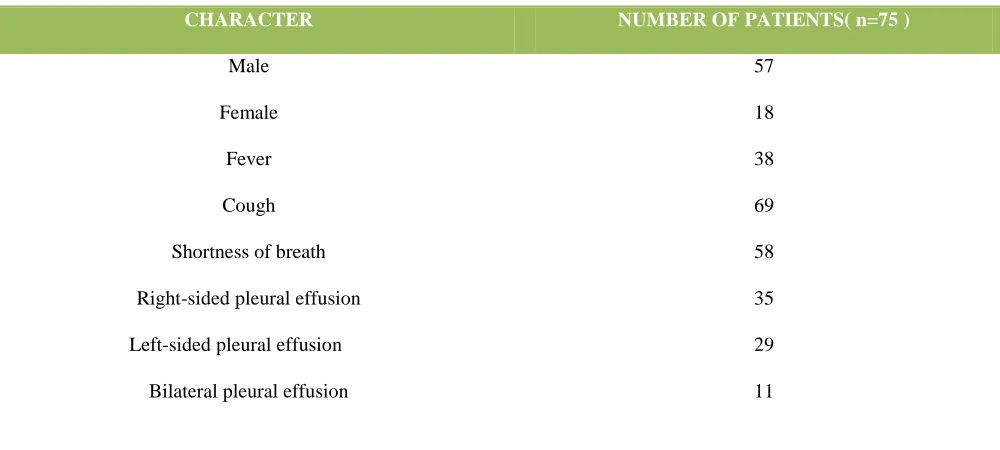
A total of 830 patients were screened in the OPD and ER, who had symptoms suggestive of pleural effusion such as cough and shortness of breath. Those who had clinical and radiological evidence of pleural effusion were admitted, and some underwent an ultrasound chest for confirmation of diagnosis. The demographical and other characteristics of the study population are given below in Table 1.
90 of those who had confirmed pleural effusion were subjected to diagnostic thoracocentesis after written consent was taken for thoracocentesis. About 10 ml of pleural fluid was aspirated under aseptic conditions, 2 ml of that fluid a drop (0.25ml) of 10% H2O2 was added bedside, and we observed for development of bubbling within 1 minute, and the
rest of the pleural fluid was immediately sent to the laboratory for investigations for parameters of Light’s criteria and cytology.simulatneously blood is also sent for appropriate investigations. Benzidine test was performed before performing the pleural fluid for drop peroxide test to detect the presence of occult blood in pleural fluid. Only those samples which gave a negative result for the benzidine test were excluded from our study. A total of 75 patients samples were taken for the final analysis. 63 (84%) of them had exudative pleural effusion, and 12 (16%) had transudative pleural effusion by Light’s criteria, and 54 (72%) of them had exudative pleural effusion, and 21 (28%) had transudative pleural effusion by hydrogen peroxide test as shown in below Figure 2
Cases were identified after screening the patient with symptoms suggestive of pleural effusion in the outpatient department
Those patients with evidence of pleural effusion on chest x ray were admitted.
Presence of pleural effusion was confirmed on ultrasound of chest
Written Informed consent was taken for the diagnostic thoracocentesis
Thoracocentesis was done under all aseptic precautions and 10 ml of pleural fluid was aspirated.Benzidine test was done to rule out
Pag
e
380
Pag
e
380
Pag
e
380
Pag
e
380
Pag
e
380
Pag
e
380
Pag
e
380
Pag
e
380
Pag
e
380
Pag
e
380
Pag
e
380
Pag
e
380
Pag
e
380
Pag
e
380
Pag
e
380
Pag
e
380
Pag
e
380
Pag
e
380
Pag
e
380
Pag
e
380
Pag
e
380
FIGURE 1: STUDY FLOWCHART.
2 ml of which was immediately taken in a test tube/container and 0.25ml of 30%
H2o2 was added to it.
Rest of the pleural fluid was sent for Light’s criteria analysis
Profuse bubbling was suggestive of Exudative nature of
pleural fluid
No bubbling was suggestive of Transudative nature of pleural
fluid
Fulfilling atleast one of the Light’s Criteria: Exudative
Not fulfilling any of the Light’s
Criteria: Transudative
830 patients screened in OPD
90 patients with pl effusion were selected
75 pts enrolled in the study based on inclusion & exclusion criteria
Drop peroxide test
Light’s criteria
Exudate
54
Transudate
12
Exudate
63 740 patients excludes from the
study
15 patients had pleural fluid benzidine test +
Transudate
Pag
e
381
Pag
e
381
Pag
e
381
Pag
e
381
Pag
e
381
Pag
e
381
Pag
e
381
Pag
e
381
Pag
e
381
Pag
e
381
Pag
e
381
Pag
e
381
Pag
e
381
Pag
e
381
Pag
e
381
Pag
e
381
Pag
e
381
Pag
e
381
Pag
e
381
Pag
e
381
Pag
e
381
FIGURE 2: RESULTS OF THE STUDY.
TABLE 1: CHARACTERISTICS OF THE STUDY POPULATION
CHARACTER NUMBER OF PATIENTS( n=75 )
Male 57
Female 18
Fever 38
Cough 69
Shortness of breath 58
Right-sided pleural effusion
Left-sided pleural effusion
35
29
Bilateral pleural effusion 11
The character of the pleural fluid diagnosed by both the lights criteria (reference test) and drop peroxide test (index test) are tabulated in Table 2. 53 were diagnosed as exudative by both Drop Peroxide Test as well as by Light’s criteria that are they were the
true positives.12 were true negatives that are transudate by both the tests.01 sample was false positive that is exudate by peroxide test, but transudate by Light’s criteria and 10 samples were exudate by Light’s criteria but transudate by peroxide test that is false negative.
TABLE 2: RESULT OF THE CHARACTER OF THE PLEURAL FLUID BY BOTH DROP PEROXIDE TEST AND LIGHT’S CRITERIA
The sensitivity of Drop peroxide test is 84.13%, Specificity is 91.67%. Positive predictive value
Pag
e
382
Pag
e
382
Pag
e
382
Pag
e
382
Pag
e
382
Pag
e
382
Pag
e
382
Pag
e
382
Pag
e
382
Pag
e
382
Pag
e
382
Pag
e
382
Pag
e
382
Pag
e
382
Pag
e
382
Pag
e
382
Pag
e
382
Pag
e
382
Pag
e
382
Pag
e
382
Pag
e
382
DISCUSSION
Managing a case of pleural effusion should follow a stepwise systematic approach. Diagnosis should always begin with a detailed clinical history, complete physical examination, chest X-ray, and followed by diagnostic thoracocentesis. Next comes the differentiation of pleural fluid into exudate and transudate. Pleural fluid analysis can narrow down the differential diagnosis. The establishment of a diagnosis with the study of pleural effusion can be done by approximately 75 percent. If an underlying cause can be established with the help of biochemical tests, treatment can be started straight away. If not CT-Chest, pleural biopsy (radiologically guided or by medical thoracoscopy) or further invasive investigations can be used to establish the diagnosis. There are no biochemical markers available that allow complete differentiation of pleural fluid into transudate and exudate. Over many years, various tests have been developed to establish the nature of the pleural fluid with varying degrees of sensitivity and specificity. Among them, Lights criteria developed by Light et al. [2] have been found to have a sensitivity and specificity of around 100% and 83%, respectively and it is considered to be a gold standard for establishing the nature of pleural fluid and differentiating it into exudates and transudates. In the last two decades, many bedside tests are developed, which would decrease the time taken between the thoracentesis and the establishing diagnosis so that treatment could be initiated early. The rapid bedside tests are the tests that are portable, inexpensive, easy to use, and can analyze pleural fluid in a short period of less than 24 hrs. Pleural fluid pH, Pleural fluid glucose, and Drop peroxide test are some of the tests which are used bedside.
In our study in a sample of 75 cases of pleural effusion 53(True positive), pleural effusion was diagnosed as exudative by both Lights criteria as well as by drop peroxide test and 11(True negative) transudative by both the tests.
The drop hydrogen peroxide test showed a sensitivity of 84.13% and specificity of 91.67%, PPV (Positive predictive value) of 98.15%, and NPV (negative predictive value) of 52.38%.
A similar study was done by Bharati Taksande et al.
(8),
which showed a sensitivity of 80.70% and specificity of 81.80%, respectively. Sensitivity is
identical to my study (84.13% vs. 80.70%), but the specificity is higher in my study (91.67% vs. 81.80%), whereas the PPV and NPV of a study done by Bharati Taksande et al. are 96.8% and 38.3% respectively. The PPV in my study is similar to that of the study done by Bharati Taksande et al.(98.15% vs. 96.8%), whereas NPV was higher in my study (52.38% vs. 38.30%). The accuracy index is higher in my study compared to that done by Bharati Taksande et al. (85.33% vs. 80.80%).
Pag
e
383
Pag
e
383
Pag
e
383
Pag
e
383
Pag
e
383
Pag
e
383
Pag
e
383
Pag
e
383
Pag
e
383
Pag
e
383
Pag
e
383
Pag
e
383
Pag
e
383
Pag
e
383
Pag
e
383
Pag
e
383
Pag
e
383
Pag
e
383
Pag
e
383
Pag
e
383
Pag
e
383
fluid, it signifies exudative fluid. If hydrogen peroxide is added to a container with transudative fluid, bubbling does not happen within one minute. The sensitivity and specificity of this test are believed to be equivalent to the widely used Light’s criteria that are 98% and 91.3%, respectively, whereas the other bedside tests mentioned like Pleural fluid pH and pleural glucose have low sensitivity and specificity as compared to the drop peroxide test. Lesho EP et al., in his study of 42 samples, concluded that the determination of pleural fluid pH using pH paper is unreliable and should not be considered an acceptable alternative with a very low sensitivity of 36% [4]. In patients of parapneumonic and malignant effusions, a low pleural fluid pH has diagnostic, prognostic, and therapeutic implications.
STRENGTH OF THE STUDY
The traumatic and the hemorrhagic effusions were excluded in our study. A wide range of variety in the etiology of pleural effusion was included in the study like tuberculosis, congestive cardiac failure, pancreatitis, chronic kidney disease, cirrhosis of the liver, malignancy, etc.
LIMITATION OF THE STUDY
The sample size was smaller in our study as compared to the similar study done by Sarkar et al.
CONCLUSION
This bedside test allows for more rapid characterize the nature of pleural fluid as an exudate or transudate. Firstly, this will shorten the diagnostic time and allow for treatment options to be considered with less delay by eliminating the need for lab work that may require several hours. Secondly, the low price of the test will make it more acceptable in the limited lab resource facility. Additional tests can be incorporated to increase the accuracy and the diagnostic ability of the test. These tests may serve to determine the cause of the effusion once the exudative or transudative nature has been verified by the hydrogen Peroxide test. For example, testing for amylase concentration in the pleural fluid would allow the physician to know if the effusion is due to pancreatic dysfunction. Estimating total and differential leukocyte counts may aid in the
diagnosis of an infectious exudative effusion. With its sensitivity and specificity equivalent to that of Lights Criteria, not only will this test decrease time to diagnosis, but it will also help clinicians in India that may be less equipped to conduct standard diagnostic tests.
CONFLICT OF INTEREST
The authors declare no conflict of interest.
BIBLIOGRAPHY
1. Costa M, Quiroga T, Cruz E. Measurement of Pleural Fluid Cholesterol and Lactate Dehydrogenase. Chest. 1995;108(5):1260-1263.
2. Light RW. Pleural effusions. Vol. 95, Medical Clinics of North America. 2011. p. 1055– 1070.
3. Porcel J. Pleural Fluid Biomarkers. Clinics in Chest Medicine. 2013;34(1):27-37.
4. Lesho E, Roth B. Is pH Paper an Acceptable, Low-Cost Alternative to the Blood Gas Analyzer for Determining Pleural Fluid pH?. Chest. 1997;112(5):1291-1292.
5. Rahman N, Mishra E, Davies H, Davies R, Lee Y. Clinically Important Factors Influencing the Diagnostic Measurement of Pleural Fluid pH and Glucose. American Journal of Respiratory and Critical Care Medicine. 2008;178(5):483-490.
6. Sarkar S, Bhattacharya G, Bhattacharjee S, Banerjee D. A drop of hydrogen peroxide can differentiate exudative pleural effusion from transudate — development of a bedside screening test. Clinica Chimica Acta. 2009;405(1-2):83-86.
7. Yale S, Brace C. Characterisation of pleural effusion using the multivariate bedside test. 2010.