1
Global Media Journal Vol 13, Issue 24
Investigating Citizens’ Experience of Public Communication of
Science (PCS) and the Role of Media in Contributing to This
Experience
(A Case Study on Isfahan Citizens
)
Zahra Maher1*, Ali Rabbani Khorasgani2, Seyed Ali Hashemianfar3 1. PhD in Sociology, University of Isfahan, Iran
2. Associate professor, Department of social sciences, University of Isfahan, Iran
3. Assitant professor, department of social sciences, University of Isfahan,
Email: [email protected]
Abstract
As new technologies and science continue to flourish in the contemporary world, one may scarcely
spot an area of human life still untouched by science and technology – from medicine and healthcare
to arts, cinema and music; from construction and architecture to recreation, leisure and sports – all are
closely associated with science and technology. Such association and interweavement of science and
technology with daily life is so strong that one may contend that they have protruded into daily life
and have become a public commodity.Press coverage of science, as an important duct, is to fill the
gap between science and the public. Most people, including decision-makers, gain their information
from mass media essentially or exclusively.The present study, therefore, aims to Identify the citizens’
experience of PCS (the means through which citizens communicate with scientists and research
achievements) and Examine the role of media in contributing to PCS and PUS among citizens.
As to research methodology, the present study follows a qualitative method. the focused group
technique was used to discover different dimensions of the contribution of media to the increase in
public understanding of science and to identify the experiences that citizens have with science
communication and the ways in which they communicate with scientists and their familiarity with
scientific productions. In this study, a "mixed purposive sampling" was used. Accordingly, three
focused groups, each including 8 citizens, were formed. The results of this study are as follows:
The media increase the communicative competence of their addressees through translation and
simplification of the scientific notions.
The role of media in the representation of the mental and cultural lifeworld dominating the
2 ability to communicate with science, media increase public participation in science and
technology programs.
The representation and transfer of citizens’ tacit knowledge in the media, which helps
increase public understanding of science and technology.
The representation of science-related issues in media such as introducing science as the result
of human efforts, representing the strengths and weaknesses of science and technology in
contributing to human welfare, justifying scientific research and the like in media.
The results of focus group discussions showed that the participants experienced the communication
of science in different ways as follows:
Using such institutions as libraries, scientific societies, science houses, science and
technology parks, cultural centers, universities, Institute for the Intellectual Development of
Children and Young Adults and non-governmental organizations
Through reward-based systems such as national and regional awards of science, scientific Olympiads and scientific festivals: ‘the promotion of science is popularizing science.’
Through educational and promotional activities
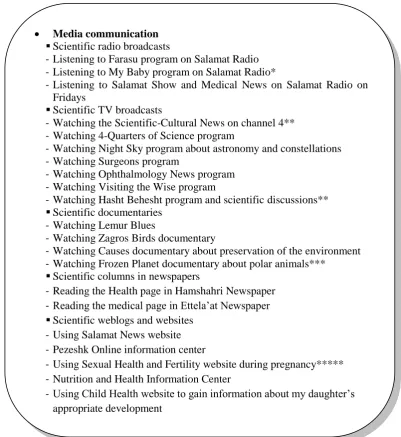
And through media such as listening to scientific radio broadcasts , watching documentaries,
scientific weblogs and websites ,reading scientific columns in newspapers and watching
scientific TV broadcasts.
Keywords: Public communications of sciences; Public understanding of science and technology;
Media.
Introduction and statement of the problem
As new technologies and science continue to flourish in the contemporary world, one may scarcely
spot an area of human life still untouched by science and technology – from medicine and healthcare
to arts, cinema and music; from construction and architecture to recreation, leisure and sports – all are
closely associated with science and technology. Home appliances such as electrical devices,
cookware, heating and cooling systems; and broadcasting tools such as the radio, television, satellite
and the Internet are so widely in use that people cannot help but using them in their daily life and
career consistent with their job and education. Such association and interweavement of science and
technology with daily life is so strong that one may contend that they have protruded into daily life
and have become a public commodity. One could hardly find a TV or radio channel that broadcasts no
news on science and technology on a daily basis. One may hardly find a movie or TV serial that
represents no sign of science and technology. Over the last few decades, a plethora of documentaries
have been broadcasted on science and technological developments. News broadcasts typically cover
science news as a specific category. Several movies have been made on the topic of science fiction
and future technological developments. The press release amazing images of the depth of oceans,
3 be overlooked by the public. The importance attached to scientific knowledge in the society and
accurate public understanding of science have led many countries over the last decades to make
determined efforts to increase public understanding of science and technology. Examples of these
measures and efforts include extensive documentary broadcasts on science and technology in the
media, science and technology newscast, press news on science and technology and public meetings
attended by eminent scientists of various disciplines (Ghanei Rad & Morshedi, 2011).
Unfortunately, there is scarcity of efforts in Iran to improve public understanding of science and
technology and involve people in science and technology as well as decision-making on the relevant
issues. Still, Islamic Republic of Iran Broadcasting (IRIB) has taken measures and produced programs
on science and technology. For instance, the number of scientific documentaries, science talks, news
and reports on science has increased in IRIB. Specifically, many reports are broadcasted on science
and technology in Iran. However, the volume of such broadcasts still remains negligible and
insufficient. Of course, high expectations may not seem justifiable in a country like Iran where
scientific and technological infrastructure is not developed so that we may not expect the authorities
to devote too much energy to developing public understanding of science (PUS). Besides, we may not
even expect people to show great interest and involvement in science and technology.Nevertheless,
since our nation has chosen to follow a knowledge-based development route where an accurate
understanding of science and technology is an advantage, it is necessary to examine and address PUS
continually consistent with the development of science and technology, which is what many countries
have already done concurrent with the development in science and technology.However, no attempt
has yet been made to explain the why and how of PUS in Iran. Still, it seems that science
communication researchers should base their attempts on a full analysis of where, why, when and
with whom PUS and scientific learning occurs because such analysis can help researchers come
across the best method of teaching science to the public. If we want to teach and transfer science
effectively, we need to use methods that create enough interest in people to listen and learn. Thus, we
need to know that where people are interested in learning, how they attend to the subject of interest
and why they remain involved in scientific activity.Communicating science in the mass media is one
of the issues that interest science analysts. Mass media are considered as the main public forum in
modern societies and provide a framework to monitor individuals in society, inform citizens of the
latest political and economic events and help shape attitudes in people (Ferree et al., 2002:10).
Moreover, mass media tend to hold monopoly over communication in many aspects so that they have
turned to be the only source of information for many people (ibid: 11). This is particularly true with
scientific issues. Press coverage of science, as an important duct, is to fill the gap between science and
the public. Most people, including decision-makers, gain their information from mass media
essentially or exclusively (ibid: 9). This is why researchers reason that press coverage can be of great
help to PUS, and, more importantly, it can contribute to the legitimacy, public support and funding of
4 Indeed, many scientific institutions create professional mediums to respond to the press demands
(Peters et al., 2008a; 2008b). Science has come to be a main subject of coverage in the mass media
(Nelkin, 1995; 1992: 31). Scientists frequently participate in debates on foreign policies, climate
change and healthcare in media broadcasts (Stehr, 1992). The perceptible media coverage of science
has exerted a marked influence in social studies on science so that a line of research has been devoted
to the analysis of media coverage of science. Several studies have already been published on the topic,
and many journals focus their scope on press coverage of science. A number of preliminary studies
have been conducted on this area of research (Bucchi & Trench, 2008).Mass media are the main
source of scientific knowledge for the general public (Friedman et al., 1986; Nelkin, 1995). This is
because the media are the most available and even only source of information on scientific
discoveries, debates, events and productions. Nisbet et al. (2002) reported a positive correlation of
using scientific journals and TV science channels with reality-based scientific knowledge. They also
found a positive correlation of using general press and scientific journals with systematic scientific
knowledge while controlling for age, gender and education. Mass media are often considered as
symbolic sites of public debate (Gumpert & Drucker, 1994). In case citizens understand scientific and
technological terms often used in the media, they may be said to have scientific literacy in the realm
of general civic discourse. Considering the problem delineated above, the present study aims to
determine the status of PUS among citizens in Isfahan City in order to provide information for
evaluating their perception of science and technology. Specifically, the study sets to identify the
mechanism through which the mass media contribute to PUS. This study set to investigate citizens’
experience of public communication of science (PCS) and the means through which citizens
communicate with scientists and research achievements. It also examined the roles that media play in
contributing to PCS and public understanding of science (PUS). Focus group method was used to
collect the data.
Research objectives
Identification of citizens’ experience of PCS (the means through which citizens communicate with scientists and research achievements).
Examining the role of media in contributing to PCS and PUS among citizens.Research questions
1. How do different media contribute to PCS and PUS?
2. What experiences do citizens have of PCS? How is communication established between citizens
and scientific achievements (i.e. scientists)? When and where do scientists communicate their
5 Methodology
Qualitative research method (focus group) was used to study the lived experiences of citizens about
communication between science and the public. Since the qualitative phase of the study was
conducted to delve into the mindsets, attitudes and lived experiences of the informants and to identify
their understanding of science, the agenda was not to support or reject a theoretical approach. Thus,
although various theoretical approaches were discussed in the previous chapters and their relevant
concepts were used in designing interview guidelines, they merely functioned as catalyzers. That is,
they were drawn upon as a frame of reference rather than a pre-determiner of the phenomenon under
study. In other words, the researcher aims to emphasize the creation of concepts as far as possible in
this stage and avoid the imposition of preexisting concepts. However, some scholars contend that it is
not necessary for a qualitative research to come up with a theory generalizable to a wide spectrum of
situations so that rich descriptions may suffice sometimes (Hemati, 2011: 311).
Definition of focus group
Focus group is an invaluable method of data collection in qualitative research. A focus group is a
semi-structured group session conducted by a group leader. The discussion is held in informal
sessions to collect data on a specific subject. A basic assumption underlying focus group is that people
are invaluable sources of information and can describe their feelings and behaviors. It is also assumed
that the dynamicity of the group can encourage people to describe their attitudes in ways that scarcely
occur in quantitative interviews.
How to select the participants in a focus group
In the present study, the subjects were selected using purposive sampling method. Purposive sampling
includes the selection of specific units based on specific goals to answer specific questions
(Mohammad Pur, 2011). From among the different purposive sampling strategies, mixed purposive
sampling was used in the present study whereby a few sampling methods are mixed together. That is,
homogenous and snowball samplings were concurrently used along with intensity sampling as the
basis. In this regard, we first tried to identify rich sources of information about the phenomenon under
study among my relatives and friends. Besides, citizens who obtained the top ten percent of PUS
scores on the quantitative questionnaire were invited to participate in the focus group (intensity
sampling). Then we asked the participants to suggest people with similar attributes for interview
(snowball sampling). According to the logic of homogenous sampling, we assigned the participants
into three groups for group discussion. Moreover, we applied the criteria for homogeneous sampling
(e.g. education, income and job) to add more to group members. Consistent with homogeneous
sampling, we decided that group members should possess a set of similar attributes in terms of the
6 Number of participants in focus groups
Three focus groups were used in the present study each comprising 8 citizens.
Steps of analyzing focus group discussions
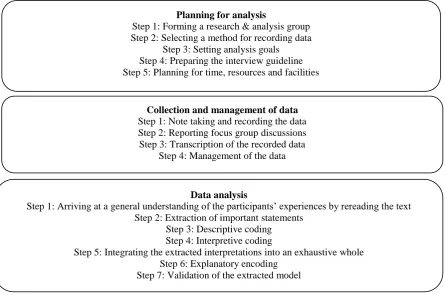
The analysis process can be divided into a few major steps as illustrated in Figure 1 (Debus, 1998;
Nowrouzi Joinani, 2009).
Figure 1: Steps of conducting and analyzing focus group
Data analysisFigure 1. Steps of conducting and analyzing focus group
As mentioned earlier, the data were analyzed using Collizzi’s seven-step method (1978). The analysis
was conducted to make up descriptive, interpretive and explanatory codes. The seven-step analysis
was performed as follows:
Step 1: Arriving at a general understanding of the participants’ experiences by rereading the
text
After transcription of the interviews based on a specific set of principles, I perused the text again. In
order to gain a better understanding of the conversations, I also referred to the audio files of
interviews and listened to some parts again. Thus, I developed a general understanding of the
participants’ experiences.
Step 2: Extraction of important statements
Planning for analysis
Step 1: Forming a research & analysis group Step 2: Selecting a method for recording data
Step 3: Setting analysis goals Step 4: Preparing the interview guideline Step 5: Planning for time, resources and facilities
Collection and management of data Step 1: Note taking and recording the data Step 2: Reporting focus group discussions Step 3: Transcription of the recorded data
Step 4: Management of the data
Data analysis
Step 1: Arriving at a general understanding of the participants’ experiences by rereading the text Step 2: Extraction of important statements
Step 3: Descriptive coding Step 4: Interpretive coding
Step 5: Integrating the extracted interpretations into an exhaustive whole Step 6: Explanatory encoding
7 In the second step, I divided the texts into meaningful units. A meaningful unit is part of a text that
conveys a meaning per se, which may vary in size from a word to a set of sentences. After the
segregation of meaningful units, I extracted the relevant and important units. In Collizzi’s method,
this step is referred to as the extraction of significant statements.
Step 3: Descriptive coding
In the third step that can be briefly referred to as the stage of descriptive coding, a description was
attributed to every significant meaningful unit. It was critical in this step that descriptive codes be
loyal representatives of the meaningful units. After encoding the whole texts, duplicated codes were
eliminated, and common descriptive codes were extracted by creating new categories.
Step 4: Interpretative coding
Following the extraction and refinement of descriptive codes, we classified the descriptive codes with
shared themes in different categories. Then we assigned a specific name to every category. These
names and titles were the interpretive codes. While descriptive codes are meant to remain loyal to the
text, interpretive codes are meanings assigned to the descriptive codes by the researcher. More
specifically, the researcher draws upon Typification II at this stage. However, Typification we is
performed by the participants, and the researcher only classifies them in descriptive coding. In this
stage, we tried to ensure the accuracy of interpretive coding by making frequent references to the text
and avoiding subjective bias in loading meanings onto the statements.
Step 5: Integrating the extracted interpretations into an exhaustive whole
In order to climb the ladder of abstraction, we articulated the interpretative codes in the form of an
exhaustive narration of the phenomenon under study. The purpose was to juxtapose the extracted
interpretations in an integrated whole.
Step 6: Explanatory encoding
We further codified the exhaustive narration of the phenomenon under study into a model of
explanatory coding relations. These codes are used to develop the research model.
Step 7: Validation of the extracted model
Eventually, in order to validate the extracted model, we referred back to five participants of the study
and asked for their opinions as to the research findings.
Legitimating
Contending that the concept of validity is positivistic, Lincoln and Cuba (1985) assert that credibility
is a better measure in qualitative research. They suggested the four measures of credibility,
transferability, dependability and confirmability instead of the classical measures of internal validity,
external validity, reliability and objectivity. Accordingly, they developed techniques to examine them.
Drawing upon this classification, expert opinion method was used to ensure credibility in the
8 the phenomenon being studied and qualitative methodology. The assistant had unlimited access to
group discussions, coding and the main extracted themes. After coding was done, we asked the
assistant to review the relations between the extracted themes and relevant interpretations and see if
the interpretations were truly representative of the themes. The outcome of the review process was a
series of questions and answers between the researcher and assistant and making modifications. In
order to ensure transferability, we tried to consider all details as to the main and subsidiary themes
and concepts, theoretical sampling, measures taken to access key informants and barriers to the
research.With regard to dependability of the findings, a certain number of key informants were
selected using mixed purposive sampling consistent with the literature and different approaches to the
sampling and number of participants. As to the confidentiality of the data, the subject and objectives
of the research were explained to the participants at the beginning of every discussion session. The
participants were ensured that the discussions were used anonymously in the study, and the audio files
would be deleted after the completion of the research. While trying to ensure the informants of the
confidentiality of the data, we tried to hold group discussions in an informal and trustful atmosphere.
In order to ensure confirmability, all discussions were recorded using a tape recorder, transcribed and
analyzed meticulously.
Results
Explanatory, interpretive and descriptive codes
1. How do different media contribute to PCS and PUS?
2. What experiences do citizens have of PCS? How is communication established between citizens
and scientific achievements (i.e. scientists)? When and where do scientists communicate their
achievements to the public?
Figures 2 through 17 illustrate the road map developed to help understand the main findings of focus
group presented in two categories: (1) citizens’ experience of PCS and (2) contribution of media to
PUS. In the road map, "●" represents explanatory codes, "■" illustrates interpretative codes, "□"
indicates interpretative sub-codes and " represents descriptive codes. In some cases, quotations are –"
9 1. Citizens’ experience of PCS
Institutional communications
Educational-promotional communication Communication through publications Reward-based communication Media communications
2. How media contribute to PUS
Representation of ‘the application of science to solving practical problems’
Providing training on how to apply thought and scientific method in solving real-life
problems
Representing science-related issues in media
Representation of the mental lifeworld dominating the society Representation of the opportunities for public participation in science Representation and transfer of tacit knowledge
10 Figure 2. Explanatory codes extracted from qualitative study
1. Citizens’ experience of PCS Institutional communications
Libraries
Scientific societies Science houses
Science and technology parks Cultural centers
Universities and research centers Schools
Institute for the Intellectual Development of Children and Young Adults
Non-governmental organizations Educational-promotional communication
Training workshops Scientific lectures Scientific visits
Science and technology shows Scientific occasions
Communication through publications Promotional books
Public scientific journals Electronic journals Educational films
Reward-based communication National and regional awards Scientific Olympiads
Scientific festivals Media communication
Scientific radio broadcasts Scientific TV broadcasts Scientific documentaries
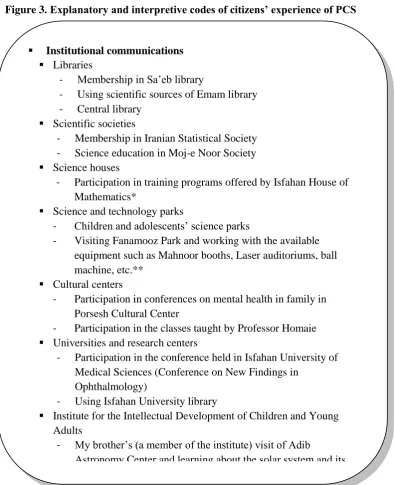
11 Figure 3. Explanatory and interpretive codes of citizens’ experience of PCS
Figure 4. Interpretive and descriptive codes of institutional communications
* Maryam (34 years old, B.S in mathematics) said, “I am a teacher and a member of Isfahan House of
Mathematics. I participate in some of its classes and lectures. I think it is necessary because it helps
improve my knowledge. I advise my students to become a member. Many of the mathematic concepts
and formulas are taught in practical manner in there so that they would be easier to understand.”
** Mohammad (45 years old, B.A in law) said, “We came to know Fanamooz Park in the University
of Technology through my daughter’s school. I have taken my daughter there a few times so far. It provides different equipment to teach sciences. It had a room called ‘Laser Shows Salon’. They filled
the room with fog using a fog machine; then they sent out the Laser rays and changed the ray angles
using a computer. They created weird images in the room, which my daughter liked a lot….” Institutional communications
Libraries
- Membership in Sa’eb library
- Using scientific sources of Emam library - Central library
Scientific societies
- Membership in Iranian Statistical Society - Science education in Moj-e Noor Society Science houses
- Participation in training programs offered by Isfahan House of Mathematics*
Science and technology parks
- Children and adolescents’ science parks
- Visiting Fanamooz Park and working with the available equipment such as Mahnoor booths, Laser auditoriums, ball machine, etc.**
Cultural centers
- Participation in conferences on mental health in family in Porsesh Cultural Center
- Participation in the classes taught by Professor Homaie Universities and research centers
- Participation in the conference held in Isfahan University of Medical Sciences (Conference on New Findings in
Ophthalmology)
- Using Isfahan University library
Institute for the Intellectual Development of Children and Young Adults
- My brother’s (a member of the institute) visit of Adib
12
(لکش 4 -83 ) یفیصوت یاهدک و یریسفت یاهدک «
تاراشتنا رب ینتبم تاطابترا »
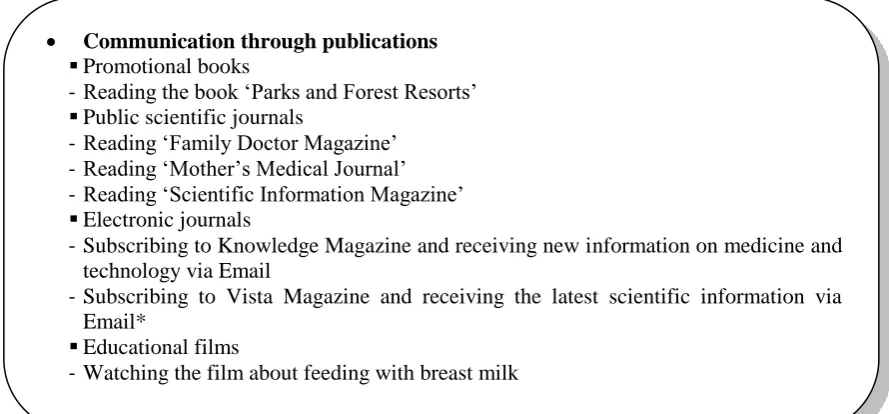
Figure 5. Interpretive and descriptive codes of communication through publications
* One of the participants said, “one of my friends introduced Vista E-Journal to me. Because my
husband has mild diabetes, after registering in the journal’s website, I asked them to email me information about diabetes. The information I receive is nice and practical.”
Figure 6. Interpretive and descriptive codes of reward-based communication
* Sara (31 years old, student) said, “when I was at high school, I passed the first and second round of
literature Olympiad exams. Then they took us to the summer Olympiad camp in Tehran. There,
prominent teachers of literature taught us. I’ll never forget it. It was one of the best experiences I’ve had in my life. They taught us how to interpret Hafiz’s poetry two hours a day – the interpretation school of Khatib Rahbar. I learned a lot.”
Communication through publications
Promotional books
-Reading the book ‘Parks and Forest Resorts’ Public scientific journals
-Reading ‘Family Doctor Magazine’ -Reading ‘Mother’s Medical Journal’ -Reading ‘Scientific Information Magazine’ Electronic journals
-Subscribing to Knowledge Magazine and receiving new information on medicine and technology via Email
-Subscribing to Vista Magazine and receiving the latest scientific information via Email*
Educational films
-Watching the film about feeding with breast milk
Reward-based communication
National and regional awards - Applying for Dr. Behboudian Award - Applying for Book of the Season Award Scientific Olympiads
- Participation in the summer camp of Literature Olympiad* Scientific festivals
- Participating in Superior Ideas Festival
- Visiting the venue of National Movement Festival - Participating in Inventions Festival
13
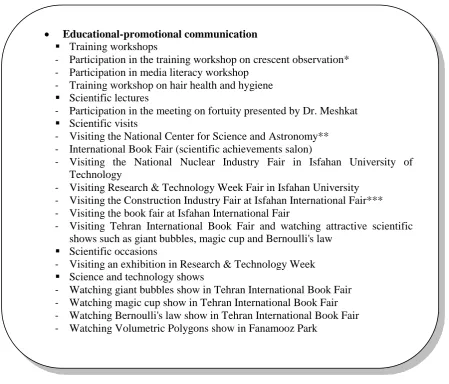
Figure 7. Interpretive and descriptive codes of educational-promotional communication
*Hamid (student at Shahid Ezdehie high school) said, “the school takes us to many scientific visits.
The same is true with training workshops. I myself participated in the training workshop on crescent
observation, which was amazing. I also learned a lot about planets.”
**Hamid (the same participant) said, “one of the visits I liked a lot was to the National Center for
Science and Astronomy in Tehran. The school took us to the excursion there. All I know about
astronomy I learned in the excursion.”
***Mohammad Reza (25 years old, Bachelor’s degree) said, “visiting the Construction Industry Fair
in Isfahan was very informative. I learned about a variety of new concretes in the fair. One of the
concretes was designed so that it had the highest strength with the lowest weight.”
Educational-promotional communication
Training workshops
- Participation in the training workshop on crescent observation* - Participation in media literacy workshop
- Training workshop on hair health and hygiene Scientific lectures
- Participation in the meeting on fortuity presented by Dr. Meshkat Scientific visits
- Visiting the National Center for Science and Astronomy** - International Book Fair (scientific achievements salon)
- Visiting the National Nuclear Industry Fair in Isfahan University of Technology
- Visiting Research & Technology Week Fair in Isfahan University - Visiting the Construction Industry Fair at Isfahan International Fair*** - Visiting the book fair at Isfahan International Fair
- Visiting Tehran International Book Fair and watching attractive scientific shows such as giant bubbles, magic cup and Bernoulli's law
Scientific occasions
- Visiting an exhibition in Research & Technology Week Science and technology shows
14 Figure 8. Interpretive and descriptive codes of media communication
*One of the participants said, “ever since I came to know My Baby program on Salamat Radio, I have
done much easier. The program is terrific. It offers great information on child nutrition.”
**Sara (31 years old, student) said, “I often watch the Scientific-Cultural News on channel 4. Though
I watch no other program, I tend to watch this.”
***Another participant (43 years old, M.A in Persian literature) said, “I do love Hasht Behesht
program. I really enjoy it to see university professors and successful people and to know their
biography. When the program starts, I ask my children to get over and watch the program.”
****One of the participants (41 years old, bank clerk) said, “I got a ten-year-old son that likes
scientific documentaries a lot. A few days ago, he was watching the Frozen Planet from Mostanad 7
program. When a documentary is shown, we cannot get him off the TV.”
Media communication
Scientific radio broadcasts
-Listening to Farasu program on Salamat Radio -Listening to My Baby program on Salamat Radio*
-Listening to Salamat Show and Medical News on Salamat Radio on Fridays
Scientific TV broadcasts
-Watching the Scientific-Cultural News on channel 4** -Watching 4-Quarters of Science program
-Watching Night Sky program about astronomy and constellations -Watching Surgeons program
-Watching Ophthalmology News program -Watching Visiting the Wise program
-Watching Hasht Behesht program and scientific discussions** Scientific documentaries
-Watching Lemur Blues
-Watching Zagros Birds documentary
-Watching Causes documentary about preservation of the environment -Watching Frozen Planet documentary about polar animals*** Scientific columns in newspapers
-Reading the Health page in Hamshahri Newspaper -Reading the medical page in Ettela’at Newspaper Scientific weblogs and websites
-Using Salamat News website -Pezeshk Online information center
-Using Sexual Health and Fertility website during pregnancy***** -Nutrition and Health Information Center
15 *****One of the participants (25 years old, homemaker) said, “during my pregnancy, I always
referred to the Internet first whenever I had a question. Sexual Health and Fertility website was
particularly good. Most specialized technicalities are written in simple words on the Internet. When I
went to the doctor, she would say the same things.”
Figure 9. Interpretive and descriptive codes of media contribution to PCS 2. How media contribute to PCS
Representation of ‘the application of science to solving practical problems’ Teaching scientific approaches to dealing with daily affairs (teaching
science-based actions)
Encouraging people to engage in certain activities
Providing training on how to apply thought and scientific method in solving real-life problems
Teaching how to raise questions
Avoiding prejudice in dealing with daily affairs Representing science-related issues in media
Explaining the need for expertise and higher education to be involved in scientific activities (introducing science as the result of human efforts) Strengths of science and technology in contributing to human welfare Explaining the rationale for scientific productions and their impact on life Explaining the rationale for scientific projects so as to solve social problems Representation of the mental lifeworld dominating the society
Releasing statistics on the use of cultural facilities
Explaining the existing intellectual movements in the society Describing different varieties of male and female attire
Describing the rules governing the relations within social groups such as teachers, doctors, etc.
Representation of the opportunities for public participation in science
Introducing scientific centers and the feasibility of public participation in them
Explaining the evolutions of science museums Representation and transfer of tacit knowledge
Consultation given by an expert with people being allowed to call him/her Interviewing citizens in different programs
Holding a roundtable attended by experts and people Representation and production of ‘a scientific culture’
Development of the scientific culture
Raising expectations of the government to develop science Increasing the audiences’ ability to communicate with science
Explaining and elaborating on scientific terms and technicalities
16 Figure 10. Interpretive codes and sub-codes as well as descriptive codes of the representation of
‘the application of science to solving practical problems’
*Bahareh (36 years old, homemaker) said, “I always follow the ‘Be Healthy’ on Channel 3. The
experts participating in the program provide very good information on how to keep food, particularly
in summer.
**The same participant (Bahareh) said, “different diseases are also introduced in the ‘Be Healthy’. In
a recent program, it talked about hair loss. I had serious hair loss for quite some time, but I didn’t
know its cause. The doctor explained that serious hair loss in women may result from hypothyroidism.
When I had thyroid examination, I found out that I had hypothyroidism and that was why I used to
lose hair.”
***Another participant said, “there was a TV program – I don’t remember its name though – that was
about air pollution in large cities. It advised citizens to take at least a glass of milk every day because
milk increases body resistance to air pollution.”
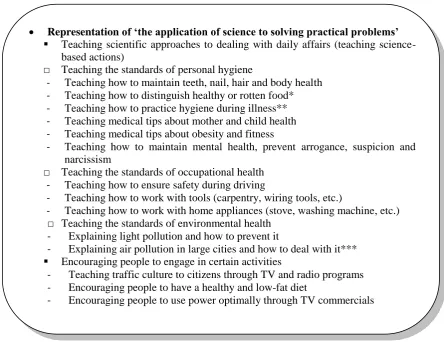
Representation of ‘the application of science to solving practical problems’ Teaching scientific approaches to dealing with daily affairs (teaching
science-based actions)
□ Teaching the standards of personal hygiene
- Teaching how to maintain teeth, nail, hair and body health - Teaching how to distinguish healthy or rotten food* - Teaching how to practice hygiene during illness** - Teaching medical tips about mother and child health - Teaching medical tips about obesity and fitness
- Teaching how to maintain mental health, prevent arrogance, suspicion and narcissism
□ Teaching the standards of occupational health - Teaching how to ensure safety during driving
- Teaching how to work with tools (carpentry, wiring tools, etc.)
- Teaching how to work with home appliances (stove, washing machine, etc.) □ Teaching the standards of environmental health
- Explaining light pollution and how to prevent it
- Explaining air pollution in large cities and how to deal with it*** Encouraging people to engage in certain activities
- Teaching traffic culture to citizens through TV and radio programs - Encouraging people to have a healthy and low-fat diet
17 Figure 11. Interpretive codes and sub-codes as well as descriptive codes of ‘Providing training
on how to apply thought and scientific method in solving real-life problems’
*Nargol (21 years old. student) said, “once, Dr. Mir Seyedi made a news report about cancer and people’s fear of it. She said, despite what people believe, cancer isn’t hereditary. For example, if one’s father or mother has cancer, it doesn’t mean he would get it too. A wrong lifestyle and unhealthy food
are the main culprits of cancer. As to the treatment, she said people are extremely afraid of the disease
unduly. Many approaches to the treatment of cancer have been developed in Iran recently. She said
about 50 percent of the cancer patients have been treated in Iran over the last three years.” Providing training on how to apply thought and scientific method in solving real-life
problems
Teaching how to raise questions
□ Arousing curiosity about the natural world
- The researcher’s curiosity about the environment (e.g. a dragonfly) in a scientific documentary
□ Arousing curiosity about manufactured products and learning about their effect on life
Avoiding prejudice in dealing with daily affairs
- Explaining about hypertension and dispelling misconceptions about the relationship between anger and hypertension in Salamat News website - Dispelling misconceptions about preserving food in summer
18 Figure 12. Interpretive and descriptive codes of ‘representing science-related issues in media’
*Qassem (41 years old, telecommunication engineer) said, “the news on TV reported about MS
disease and the medicine produced in Iran to treat it. It seems an inventor has produced an herbal
medicine called ‘Persian Gule’, and some MS patients have been treated by it. Apparently, it needs 2
billion Tomans to be produced at the industrial level.” Representing science-related issues in media introducing science as the result of human efforts
- Explaining the need for expertise and higher education to be involved in scientific activities through TV programs such as Hasht Behesht and Visiting the Elites
Strengths and weaknesses of science and technology in contributing to human welfare
- Reading a newspaper article on ‘the application of nanoparticles’ in producing many daily goods including sunscreen cream, anti-aging cream, chewing gums, tooth paste, etc. and their adverse effects on human health
- Using new technologies such as biotechnology, nanotechnology, advanced surgical methods and new imaging devices by medical doctors for better diagnosis of diseases
Explaining the rationale for scientific productions and their impact on life □ Explaining a disease and the need for its treatment
- Explaining the symptoms and causes of AIDS
- Explaining MS disease and how to control it through new medicines* - Explaining cancers and the production of new medicines to treat them □ The need for solving an environmental problem
- Explaining air pollution in Tehran and Isfahan and the need for conducting research to solve the problem
- Characteristics of Persian fallow deer, its habitat, reproduction, the risk of its extinction and the problems brought about by its likely extinction as well as conducting research to preserve the species
Explaining the rationale for scientific projects so as to solve social problems - Explaining the benefits of nanotechnology project
- Explaining the benefits of Royan project
19 Figure 13. Interpretive codes and sub-codes as well as descriptive codes of ‘representation of the
opportunities for public participation in science’
*Sara (31 years old, student) said, “I visit international book fairs in Tehran and Isfahan every year. I
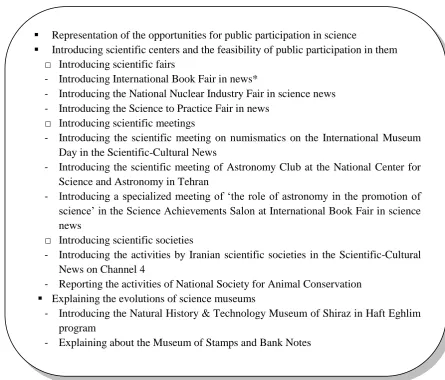
look for books relevant to my career. I understand their dates through news on different channels.” Representation of the opportunities for public participation in science
Introducing scientific centers and the feasibility of public participation in them □ Introducing scientific fairs
- Introducing International Book Fair in news*
- Introducing the National Nuclear Industry Fair in science news - Introducing the Science to Practice Fair in news
□ Introducing scientific meetings
- Introducing the scientific meeting on numismatics on the International Museum Day in the Scientific-Cultural News
- Introducing the scientific meeting of Astronomy Club at the National Center for Science and Astronomy in Tehran
- Introducing a specialized meeting of ‘the role of astronomy in the promotion of science’ in the Science Achievements Salon at International Book Fair in science news
□ Introducing scientific societies
- Introducing the activities by Iranian scientific societies in the Scientific-Cultural News on Channel 4
- Reporting the activities of National Society for Animal Conservation Explaining the evolutions of science museums
- Introducing the Natural History & Technology Museum of Shiraz in Haft Eghlim program
- Explaining about the Museum of Stamps and Bank Notes
Representation and transfer of citizens’ tacit knowledge through interacting with the audience
Consultation given by an expert with people being allowed to call him/her - Broadcasting Payesh program about stock market
- ‘Be Healthy’ program with Dr. Saberi as the guest* Interviewing citizens in different programs
Holding a roundtable attended by experts and people
20 Figure 14. Interpretive codes and sub-codes as well as descriptive codes of the ‘representation
and transfer of tacit knowledge’
*Bahareh (36 years old, homemaker) said, “I always follow the ‘Be Healthy’ program broadcasted every morning from Channel 3. It’s so cool. Doctors attend the program and people call them to ask
questions. A program was about knee pain, which came in really handy because my mother has knee
pain. All questions people put to the doctor were also mine.”
Figure 15. Interpretive codes and sub-codes as well as descriptive codes of the representation
and production of ‘a scientific culture’
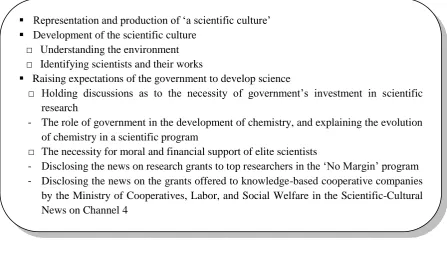
Representation and production of ‘a scientific culture’ Development of the scientific culture
□ Understanding the environment □ Identifying scientists and their works
Raising expectations of the government to develop science
□ Holding discussions as to the necessity of government’s investment in scientific research
- The role of government in the development of chemistry, and explaining the evolution of chemistry in a scientific program
□ The necessity for moral and financial support of elite scientists
- Disclosing the news on research grants to top researchers in the ‘No Margin’ program - Disclosing the news on the grants offered to knowledge-based cooperative companies
by the Ministry of Cooperatives, Labor, and Social Welfare in the Scientific-Cultural News on Channel 4
Increasing the audiences’ ability to communicate with science Explaining and elaborating on scientific terms and technicalities
- Explaining embolism and cardiovascular system in the footnotes of a medical article for ordinary readers
- Explaining medical terms in the medical articles published in Ettela’at Newspaper such as ‘nutrient micro-materials’ in an article on physical fitness
Explaining scientific debates in simple and intelligible words in the media
- Presenting the specialty knowledge of nutrition science in simple words in the Health Weekly - Using pictures, images and films to simplify scientific concepts
21 Figure 16. Interpretive codes and sub-codes as well as descriptive codes of ‘increasing the
audiences’ ability to communicate with science’
Figure 17. Interpretive codes and sub-codes as well as descriptive codes of representation of ‘the
mental lifeworld dominating the society’
*Alireza (32 years old, customs officer) said, “I watched ‘Soraya’ program which was showing, I
guess, on Channel 1. It was about the application of nuclear energy in daily life. It also provided
plenty of information about students’ refusal of the suspension of nuclear program. The families of
Nuclear Martyrs also attended the program and talked about the activities
Conceptual model of the reseach Figure 18
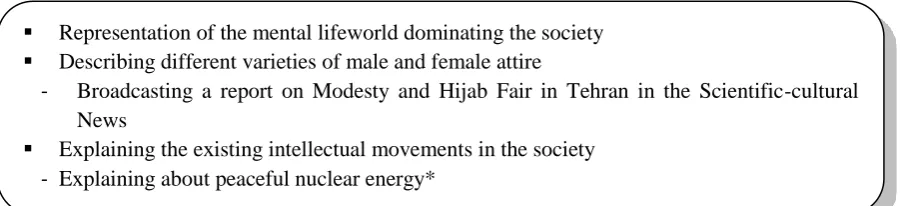
Representation of the mental lifeworld dominating the society Describing different varieties of male and female attire
- Broadcasting a report on Modesty and Hijab Fair in Tehran in the Scientific-cultural News
Explaining the existing intellectual movements in the society - Explaining about peaceful nuclear energy*
22 - Scientific festival
Scientific Olympiads-Training
workshops -Scientific lectures -Scientific visits -Promotional books -Public scientific
-Scientific radio
broadcasts
-Scientific TV
broadcasts
-teaching science-based actions -Encouraging people to engage in certain activities
-introducing science as the result of human efforts -representing the strengths and weaknesses of
science and technology in contributing to human welfare
-Explaining the rationale for scientific research and their impact on life
-Explaining the existing intellectual movements in the society
-Providing appropriate clothing fashions for men and women
-Introducing scientific centers and the feasibility of public participation in them -Explaining the evolutions of science
museums
-Consultation given by an expert with people being allowed to call him/her
-Holding a roundtable attended by experts and people
-Raising questions -Avoiding prejudice in
dealing with daily
-Developing a scientific culture -Raising expectations of the
government to develop science -Non-governmental
organizations
-Institute for the Intellectual Development of Children and Young Adults -Universities and research
centers citizens ’ experie nce of educational-promotional communication communication through reward-based communication institutional communication Media communication How media contrib ute to representation of the mental lifeworld Representing science-related issues in media Providing training on how to apply representation of ‘the application of representation of the opportunities representation and transfer of tacit knowledge
23 Discussion and conclusion
A) How media contribute to PUS
The results showed that The media tend to translate and simplify science in order to improve public
communication with science. That is, they paraphrase scientific terms and concepts such that the
audience can understand them easily. In fact, the media draw upon the language of pictures, films,
tables and figures to render the scientific contents perceptible to the audience and improve their
communication with science.participants of the focus groups had experienced the use of Health
Weekly due to its simple presentation of specialized nutrition issues, simple definition of the term
nutrient micro-materials in an article on physical fitness, simple definition of embolism and
cardiovascular system in the footnotes of a medical article for ordinary readers, which all indicate the
capacity of media to increase the audiences’ ability to communicate with science.The use of scientific
media was shown to have led to understanding the social-cultural milieu and mindset of the society.
Participation in group discussions on appropriate clothing fashions for men and women in Modesty
and Hijab Fair, achievement of nuclear technology, islamization of humanities and development of
resistive economy revealed that the participants had watched comprehensive media coverage of these
issues, which indicate the role of media in the representation of the mental and cultural lifeworld
dominating the society. In other words, the media can represent the social-cultural setting and
mindset. The audience can intellectually engage with the cultural texture of the society via media and
understand the importance of science for solving social problems. One should note that the providers,
transmitters and receivers of scientific programs via the media would produce, transmit and consume
public scientific messages in their interaction with this cultural setting. The importance of text and
cultural milieu in science is so critical that it plays not only a role in the application stage but also in
the production stage.As the mediating actors in the network, the media can reinforce the
characteristics of a science-supporting culture in the audience through representing the dominant
cultural-mental atmosphere of the society. This further supports the mediatory role of media
contribution to PUS. In focus group discussions, the participants noted that IRIB had broadcasted
programs on the necessity for moral and financial support of elite scientists such as offering research
grants to top researchers, the grants offered to knowledge-based cooperative companies by the
Ministry of Cooperatives, Labor, and Social Welfare and the necessity for government’s investment in
scientific research. These findings emphasize the role of media in creating a science patronage culture
24 importance of science in daily life, public science assigns responsibilities to the audience that prepare
social conditions for the development of science. These actions are conscious efforts that the audience
should do to support science, which are considered as scientific action according to Lewenstein (2003:
7).
Through translation and simplification of science and increasing the audiences’ ability to
communicate with science, media increase public participation in science and technology programs.
In focus group discussions, the participants claimed that they were provided with information by IRIB
and particularly through the Scientific-Cultural News on ‘International Book Fair in Tehran, the
National Nuclear Industry Fair, Science to Practice Fair, the scientific meeting on numismatics on the
International Museum Day, the scientific meeting of Astronomy Club at the National Center for
Science and Astronomy in Tehran, Iranian scientific societies, the activities of National Society for
Animal Conservation, the Museum of Stamps and Bank Notes, the Natural History & Technology
Museum of Shiraz, to name but a few, so that they were familiarized with these scientific centers and
could participate in them. Participation in and attending scientific centers provides the opportunity for
the interaction of scientific knowledge and method with non-scientific methods in a non-abstract and
tangible situation. However, one should note that the contribution of media to engaging people in
science would clearly direct the relationship between science and the public to the following
pathways: (1) providing a context for the development of science, (2) providing science with the data
that indicates participation in scientific development, and (3) realistic understanding of science that
leads to a context for scientific development and engagement in science.The results obtained from
focus group discussions indicated the representation and transfer of citizens’ tacit knowledge in the
media, which helps increase public understanding of science and technology. The focus group
participants reported that they frequently watched interviews with people in different media about
different issues, or they watched programs in which an expert offered consultation with people calling
him/her to talk about their problems and experiences and receive consultation (e.g. ‘Health Apple’ and/or ‘Payesh’ programs). Thus, the representation and transfer of citizens’ tacit knowledge through
communication with the audience could improve PUS.In fact, one could contend that scientific media
play their role of establishing communication between science and the public through representation
and transfer of people problems and the solutions they have developed for such problems. Such
knowledge, which is people’s and is developed in ways other than conventional scientific methods, is
called tacit knowledge. When media transfer the tacit knowledge from the public domain to the
science domain, they enrich the science. In this regard, the media both increase the interactions in the
science domain and engage the public in science. On the other hand, according to Latour(1987), the
flow of scientific knowledge does not always run from experts to the public so that it might as well be
shared or multilateral. Thus, media are not the only conveyors of scientific messages from scientists to
people, rather they can also convey people’s tacit knowledge (e.g. fishermen’s knowledge of a river
25 communication is established between science and the public. Therefore, the representation of tacit
knowledge in public scientific media is a further factor improving PUS, which makes it possible to
study the impact of public scientific media on the audience knowledge. Moreover, by transferring the
tacit knowledge of the public, media can increase communication between the public and experts and
distance them from the specialized issues. Bucchi (1998: 12) argues that the importance of public
science is not only for increasing public knowledge and cohering people with science. In fact, the
audience of public scientific communication is not only the public since public science touches many
experts as well without being thwarted or suppressed by the conventional pressures and limitations in
scientific communication.According to Felt (2005: 20), by moving toward the public domain and
leaving the very formal core of science system, scientists would find the opportunity for creativity.
According to Felt (ibid: 20-21), it is for three reasons that the communication of scientists with the
public can increase creativity in scientists:
a) Intellectual and debatable issues are raised in the public sphere easier than the formal canals inside
the science sphere. Examples are relativity theory, quantum physics and psychoanalysis.
b) Revisiting complicated bodies of knowledge and placing them in a more general texture modify
and increase scientists’ creativity.
c) In the era when distinction in the science domain is increasing, public evaluation is considered as
an important tool to increase synergy among different disciplines and research areas. Since the experts
of a discipline are typically naïve in other disciplines, such public evaluations are regarded as an
approach to contacting and understanding developments in the relevant disciplines.
Thus, public science can provide the opportunity for confluence of people’s ideas with the experts’.
This refers to the events occurring in the minds of people and helps interact scientific and
non-scientific thoughts, which may bring about new thoughts and ideas.In sum, the representation of
citizens’ tacit knowledge in the media and its role in PUS can be explained by the fact that scientific
knowledge and non-scientific knowledge do not develop in two different contexts. Rather they are the
result of continuous interaction between experts and non-experts. This type of knowledge is called
non-specialized knowledge by Michael (1998) and Callon (1999) while Woolgar (2000) and Logan
(2001) refer to it as interactive science. One of the important functions of media is to play a mediatory
role to link scientists with the public and produce interactive science. The focus groups discussions
revealed the representation of science-related issues in media such as introducing science as the result
of human efforts, representing the strengths and weaknesses of science and technology in contributing
to human welfare, justifying scientific research and the like in media. For example, the participants
reported that they learned about expertise and higher education through Hasht Behesht and Visiting
the Elites programs. Indeed, the media succeeded to represent the fact that science is the result of
human efforts. The participants also knew about new medicines for controlling cancers and/or
research for the preservation of an animal species through the Scientific-Cultural News. This indicates
26 treatment of diseases and solving environmental problems.The results obtained from focus group
discussions showed that Iranian media contributed to teaching science-based actions particularly in
the field of occupational health. In fact, the findings suggested that mass media created a common
informational and cultural reservoir on which citizens depend in their daily life. This common
information store makes intersubjectivity possible. The results showed that people wanted to use
scientific thought and behavior to enrich their daily life, which further supports the role of media in
creating relations in the society.Indeed, science-related issues include political conditions;
educational, social and economic needs for an innovation; market needs; customer needs; academic
requirements; environmental effects and biological issues that both improve the audience’s knowledge
of the factors affecting the development of science and technology and lead to a critical attitude
toward science and technology among the audience. The results regarding the representation of
science-related issues in media may be justified using Logan’s interactive science theory (2001).
According to Logan, science is produced as a result of the interaction of social, economic, cultural and
academic conditions. One of the important roles of media is to be a mediator for the interaction
between the public and experts to produce interactive science. This should be considered in the
production of public science. Indeed, public science should be able to both increase our understanding
of science and contribute to our scientific understanding of the world (Brown, 1986). Public science
may be considered as the social representation of science. That is, the quality or method of public
science production affects the educational role of media. Erickson (2005: 147) considers public
science – by emphasizing the representation of science – as the media programs for non-experts
produced by eminent scholars and writers, which can facilitate the audience’s understanding of
science and the interaction between experts and the public. Representation of science-related issues in
the media increases the audience awareness of their environment and the issues of interest for
specialists. In this way, media provide the audience with information and topics to discuss in society.
When such a link is created between science and the public, it creates a context for generating new
ideas about science and new topics for scientific research. Science is produced as a result of the
interaction of social, economic, cultural and academic conditions. The conveyance of such concepts in
public science increases audience’s knowledge of the uncertainty of science so that the audience may
not feel disillusioned by receiving contradictory information of the same research subject. The
development of such form of communication in the media may also increase the audience’s trust in
the media.
B) Citizens’ experience of PCS
This part of the study was conducted to answer the question ‘How is communication established
between citizens and scientific achievements (i.e. scientists)? When, where and how do scientists
communicate their achievements to the public?’
The results of focus group discussions showed that the participants experienced the communication of
27 1. Using such institutions as libraries, scientific societies, science houses, science and technology
parks, cultural centers, universities, Institute for the Intellectual Development of Children and Young
Adults and non-governmental organizations: the existence of such stable institutions has encouraged
people to accept their performance and do not consider them as transient phenomena. Just as the
existence of a ministry denotes the importance government attaches to it, the existence of stable
institutions for the development of PCS also indicates the importance that government and statesmen
attach to PUS. The permanence and stability of such institutions help the science permeate into
society. Normally, an organization whose activities people see and understand on a daily basis can
have an important role in communicating scientific achievements to people.
2. Through reward-based systems such as national and regional awards of science, scientific
Olympiads and scientific festivals: ‘the promotion of science is popularizing science.’ This sentence is
an excerpt of Science Journal, which supports the present finding and marks the real purpose for
communication of science. Normally, rewards are necessary to popularize an issue. Presenting
awards, medals, research grants and introducing the winners in media can encourage the society to
participate in science both materially and morally. Thus, one of the effective mechanisms promoting
the communication of science and publicizing scientific developments is appreciating scientists,
students, promoters and all those who are engaged in science. The criterion to this is numerous awards
that contribute to the advancement of science and technology.
3. Participants in the focus group reported that they were engaged in the communication of science,
interaction with scientists and scientific achievements mostly through educational and promotional
activities such as attending training workshops, scientific conferences, reading science fiction,
attending scientific lectures, scientific visits, scientific occasions and watching scientific shows. This
finding can be justified such that new methods of information and communication are under way to
promote science and technology, which can bring about incredible opportunities for scientific
activities. One of the crucial experiences in the promotion of science is ancillary activities that may
even be treated as recreational activities sometimes. In our society where the information feasibility
through computer, Internet and scientific journals is limited, it can be highly effective to use
recreational events to increase PUS. Drawing upon recreational occasions for the promotion of
science may have the following functions:
• Encouraging people at a larger scale to engage in science
• Adding to the attractiveness, accessibility and intelligibility of scientific issues • Demystify scientific phenomena to embed science in culture
• Increasing sensitivity towards science particularly in women and children • Promoting the idea that science is enjoyable and interesting
• Changing the cultural milieu in societies that may consider scientific phenomena to be contrary to
28 4. Participants in the focus group declared that they gained their information through watching
scientific TV broadcasts (e.g. watching the Scientific-Cultural News on Channel 4, watching
4-Quarters of Science program, watching Night Sky program about astronomy and constellations,
watching Surgeons program, watching Ophthalmology News program, watching Visiting the Wise
program, watching Hasht Behesht program and scientific discussions), watching documentaries (e.g.
watching Lemur Blues, watching Zagros Birds documentary, watching Causes documentary about
preservation of the environment, watching Frozen Planet documentary about polar animals), scientific
weblogs and websites (e.g. using Salamat News website, Pezeshk Online information center, using
Sexual Health and Fertility website during pregnancy, Nutrition and Health Information Center, Using
Child Health website), reading scientific columns in newspapers (e.g. reading the health page in
Hamshahri Newspaper, reading the medical page in Ettela’at Newspaper) and listening to scientific
radio broadcasts (e.g. listening to Farasu program, listening to My Baby program, listening Salamat
Show and Medical News).As discussed, people mainly turn their attention toward scientific programs
in media, health issues and the application of science to life. A significant part of this finding and
media conditions can be explained by Snow classification as to the gap between science culture and
humanities culture. According to Cohen, science has created a certain system of its own in attracting
the attentions and continuous specialization. However, in the process of reflecting back to the society
and actualization in the social domain, science has to go through the media canal. Like other news
categories, science news should achieve a threshold of worthiness in order to be screened. Due to the
time limitations in radio and TV channels as well as spatial limitations in print media, it is difficult to
reach such a threshold that is determined often in proportion to other news and under the pressure of
deadlines. In fact, scientific news needs to gain this opportunity in competition with other social
domains. Speaking in terms of news value, such domains as politics, economy, culture and society are
more inclusive of daily life issues. Thus, people pay greater heed to them. Weigold (2002) contends
that although the communication of science has long been addressed by social communication
scholars, science has a negligible share of coverage in media comparing with politics, professions,
sports and recreation. Thus, the amount of time and space allocated to science in newspapers is
incomparable with that allocated to other social issues. Carrada (2006: 55) argues that it would be
very difficult for science to occupy such a space as it requires considerable time and cost. He asserts
that it is only through time that such space can be acquired while it is still unknown how effective a
scientific paper or program can be in TV, radio or newspaper. However, he contends that it is
important for science to acquire such a space as it is only through media communication that scientific
discoveries are realized and put into a social, political and economic context that has an important role
in deciding the fate of science and technology by either supporting or rejecting different scientific
approaches. Weigold (2002) explains that it is not surprising that the greatest part of scientific reports
cover the issue of risk that the public highly favor. The reason for this interest is clear. Scientific