2668
Optimization Of Sand Usage For Metal Casting
Process – A Sustainable Manufacturing
Approach
Aniket Nargundkar, Apoorva Shastri
Abstract: Sand casting, also known as sand moulded casting, is a metal casting process characterized by using sand as the mould material. Over 60% of all metal castings are produced via sand casting process. Sand control is the key to good foundry sand practice. It is very important to note that almost 70% of total casting defects occur due to an improper quality of sand mould. Hence, many industries want to use the fresh sand for the moulding purpose. However, due to environmental concerns there is a need to investigate the applicability of return sand for sand moulding. This paper investigates the possibility of using ‗used‘ or ‗return‘ sand for the mould preparation. Several combinations of return sand and other additives have been experimentally investigated for moisture content, compressive strength, hardness, and permeability and the optimum combination has been selected. The results have shown that up to 80% of return sand could be used with optimum combination of other additives giving relatively high compressive strength and permeability. This would give significant reduction in sand cost and also better utility of return sand as a step towards sustainable manufacturing.
Index Terms: Cost reduction, Green Compression Strength of sand, Hardness of sand, Metal Casting, Optimization, Permeability of sand, Reused sand
—————————— ——————————
1.
INTRODUCTION
THE Casting is a neat net shape manufacturing process in which a liquid material is poured into a hollow cavity of required shape, and then allowed to freeze. The solidified part is called as a casting, which is then taken out of the mold to complete the process. Casting is the process employed for manufacturing complex and intricate products which are practically problematic to manufacture with any other process. Very Heavyweight apparatus such as machine tool body, Vessels, etc. could be cast easily in the required size and shape, instead of manufacturing by welding various tiny pieces. Casting is a very old process dating back to 5000-6000 -year-old [1]. Casting is adaptable manufacturing processes. It could be effectively used for manufacturing various shapes, sizes and the quantity by employing uniform directional properties and better vibration damping properties to the casted parts. Shapes difficult and uneconomic to obtain otherwise may be achieved through casting process. Casted parts could be designed for equal distribution of loads and for minimum stress concentration in order to achieve more strength and increased service life[2]. The typical casting processes are classified as expendable mould type such as sand casting, plaster mould casting, shell moulding, investment casting, etc., permanent mould casting such as die casting, vacuum casting and centrifugal casting, and specialized casting such as continuous casting process. Sand casting is a metal casting process in which sand is used as the mold material. Over 60% of all metal castings are produced via sand casting process[3].
Green molding sand is defined as a plastic mixture of sand grains, clay, water and other materials such as coal dust and wood floor. This sand is called as ―green‖ because of the moisture present and thus distinguished from dry sand. The tonnage of sand which is to be handled in a sand casting foundry is typically large, and its quality must be controlled to make good castings. Considering the large amount of sand to be handled, it is a great concern from environment point of view. Metal casting industry is under pressure for pollution and other environmental hazards because of the casting process itself. Various ecological matters associated are – release of damaging and toxic gases, dust and generation of waste pollutants. The waste from foundry is an area with the priority within the global foundry industry. It is an important area from environmental as well as economic opinion. The waste products generated by the foundries are dependent on the metal type used, type of furnace and the molding technology. Sand casting produces the most waste from sand. Hence, waste sand is a hot spot to make the foundry industry sustainable[4]. Sand mould control affects significantly in the output of sand casting product. Good qualities of mould are needed to produce the good quality of casting. It is very important to note that almost 70% of total casting defects occur due to an improper quality of sand mould. Sand control enables the foundry to adjust the properties of the mixture to allow for foundry process changes. Scientific sand control has yet to gain full recognition in the foundry industry[5]. Bonding the sand properties is one of the most important factors in the production of good castings. The sand control should take care of all of the phases viz. sand preparation, molding and casting. Every element at every stage has optimum requirements depending upon the product requirement. From the first stage itself special attention is required; otherwise error at earlier stage ultimately gives casting rejection. Therefore, there is a definite need to control the green molding sand properties. Hence, application of sand control is meant to produce better molding sands, which should result in better quality castings[6]. Molding sand which is a mixture of sand and other additives is usually prepared in a Muller. After mixing of the sand, clay and ————————————————
Aniket Nargundkar, Symbiosis Institute of Technology, Symbiosis International (Deemed University), Pune, India, PH-022 28116300. E-mail: [email protected]
2669
water, the sand is removed through opening of a vessel. A standard sample for sand testing is prepared in a specimen tube. It is a hollow cylindrical tube of 50 mm diameter and is placed on a removable bottom plate. The mixed sand is put into this tube before being rammed by impact. The standard specimen is prepared by three rams of hammer. The height of a standard specimen is 50 mm. The rest of the paper is organized as follows. Section 2 describes the methodology being adopted. It describes the test parameters and its importance. Also, various combinations are illustrated. Section 3 provides the test results, plots followed by discussion. A concluding remark along with future direction is mentioned at the section 4.
2
METHODOLOGY
2.1 Test Parameters
There are various parameters which determine the sand quality. The typical important parameters are moisture content, green compressive strength (GCS), hardness and permeability. The same parameters have been experimentally evaluated in the current study. Moisture in the molding sand develops the plasticity of the clay bond, and different types and amount of clay require different amounts of water to achieve the best properties. The water consumption in the sand system is directly related to the tons of metal poured. Water also acts as the main coolant and heat extractor in the system. The moisture content in the molding sand is typically determined by the weight loss method. A known weight of sand is heated up. A high wattage lamp may be used as a heater. The weight of sand gradually decreases due to loss of moisture. When the weight becomes steady, the final reading is taken. From the difference in the initial and final weights, the moisture content in the sand is determined. Permeability is the ability of the sand mix to permeate air through the molded sand specimen under pressure. The permeability meter measures the permeability no.
P. NO. = VH/PAT
V- Volume of air passed under pressure through the specimen (cc);
H - Height of the specimen (cm);
A - Area of cross section of the specimen (cm); P - Back pressure (g/cm2);
T - Time in min.
Permeability is determined by allowing 2000 cc of air through a std. specimen. The specimen tube with the std. specimen is placed above the orifice. The time taken by 2000cc of air to pass through the specimen is noted. The backpressure generated is measured on a manometer. The mould hardness test indicates the resistance of mould to damage as the metal contacts the mould surface. It is tested by an instrument resembling a dial gauge and having a plunger. When the tester is placed on the mould surface, plunger gets placed inside. The distance through which it moves depends on the mould hardness[7]. Green compression test has been the most widely used control tool to measure the rate of clay addition to a sand molding system. The green compressive strength of green sand is the maximum compressive stress that a mixture is capable of sustaining when prepared, rammed and broken under std. conditions. The sides of the specimen tube are pushed
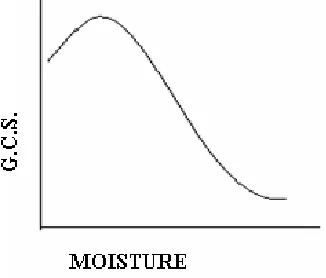
vertically downwards against the stripping post to take out the sand specimen. A fresh prepared sample is placed between the grips and then compressive force is applied from the both sides until the specimen just breaks. The reading of the machine at this stage on ‗G. C. S.‘ scale gives the green Compressive Strength[8]. The permeability, hardness and GCS are required to be on higher side. However, the relation between permeability and moisture and GCS and moisture is little tricky. As shown in fig. 1 below, as the moisture increases, permeability increase up to a certain value and then decreases sharply. Similarly, as shown in fig. 2, GCS too increases up to certain level with moisture and then decreases. Hence, it becomes critical to optimize the moisture content to achieve the higher permeability and higher GCS[9].
Fig. 1 Relation between Moisture and Permeability
2670 2.2 Testing Chart
To find the optimum combination of sand mix, different combinations mentioned in table 1 have been tried. These combinations are based on typical industry considerations. The return sand along with fresh silica sand and yellow moulding sand is used. From 35% up to 85% return sand is evaluated.
Table 1 Experimental Combinations
Sr. No Return/ Used sand Fresh Silica sand Yellow Moulding Sand
Water added as % of Total sand
1 80% 5% 15% 5%
2 80% 5% 15% 7%
3 80% 5% 15% 9%
4 80% -- 20% 5%
5 80% -- 20% 7%
6 80% -- 20% 9%
7 70% 5% 25% 7%
8 60% 10% 30% 7%
9 50% 15% 35% 7%
10 45% 10% 45% 7%
11 35% 30% 35% 7%
12 85% 5% 10% 7%
3
RESULT
AND
DISCUSSION
Table 2 Results of trials
S r . N o Ret urn/ Use d san d Fre sh Sili ca san d Yell ow Moul ding sand W at e r a d d e d M oi st ur e co nt en t Gre en com pre -ssio n stre ngth Mou ld har d-nes s Perme- alibility % of to ta l s a n d
% gm/ cm2
1 80
% 5% 15% 5 % T1
5.
2 180 55 128
T2 5 180 55 -
AV G.
5.
1 180 55 128
2 80
% 5% 15% 7 % T1
7.
4 130 60 178
T2 7 120 59 -
AV G.
7.
2 125 59.5 178
3 80% 5% 15% % 9 T1 9.2 700 70 63
T2 8.
8 690 67 65
AV
G. 9 695 68.5 64
4 80
% -- 20% 5 % T1
5.
4 520 30 36
T2 5 510 29 -
AV G.
5.
2 515 29.5 36
5 80% -- 20% % 7 T1 8 310 23 126
T2 7.
4 290 21 56
AV G.
7.
7 300 22 91
6 80
% -- 20% 9 % T1
9.
4 290 20 -
T2 8.
8 270 18 38
AV G.
9.
1 280 19 38
7 70
% 5% 25% 7 % T1
7.
2 560 40 -
T2 7.
6 570 43 -
AV G.
7.
4 565 41.5 -
8 60 %
10 % 30%
7 % T1
7.
2 590 38 -
T2 6.
8 570 35 -
AV
G. 7 580 36.5 -
2671 9 50
% 15 % 35%
7 % T1
7.
6 480 35 40
T2 7.
4 480 34 38
AV G.
7.
5 480 34.5 39
1 0
45 %
10 % 45%
7 % T1
7.
4 510 45 -
T2 6.
8 490 42 -
AV G.
7.
1 500 43.5 -
1 1
35 %
30 % 35%
7 % T1
7.
8 550 42 -
T2 7.4 540 40 -
AV G. 7.6
5 4 5
4 1 -
12 85% 5% 10% 7% T1 6.8
3 2 0
4 5
1 3 4
T2 7.2 3 3 0
4 7 -
AV G. 7
3 2 5
4 6
1 3 4
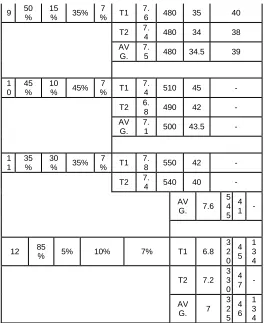
Table 2 presents the results of tests performed on the samples. As stated earlier, Moisture, hardness, GCS and permeability tests have been performed on the samples. Each test has been performed twice and average is considered as a result. Fig 3 shows the consolidated graph of test results. Various tests are plotted on x axis and values are on y axis. The data points for all 12 combinations for all the four tests have been plotted. From the plot, it is evident that test specimen 2 has resulted in lowest GCS, however highest permeability. Test specimen 3 has been resulted in highest GCS and moderate permeability. It should be noted that, test specimen 2 and 3 are identical in all combinations except the water percentage. The specimen 2 has water content as 7% and specimen 3 has 9%. Due to the 2% extra water, the GCS has been improved and at the same time permeability has been drastically reduced for specimen 3. This shows the sensitive behavior of water added and complex relationship between the moisture, GCS and permeability. From the fig. 3, it is evident that specimen 3 has been resulted in highest GCS and it is been recommended. The important point to be noted is that, specimen 3 consists of 80% of return sand. Hence, it could be considered that significant amount of return sand could be used for sand castings.
4
CONCLUSION
In this paper, twelve different combinations of return sand, fresh silica sand, yellow moulding sand and water percentage have been experimentally tested for moisture content, hardness, green compressive strength and permeability with the aim of exploring the possibility of using return sand to reduce the consumption of fresh silica sand. Results have shown that up to 80% return sand could be
used yielding relatively high strength and permeability. This is a prominent step towards a sustainable manufacturing approach. As A future scope, possibility of adding bentonite could be explored. Also, sand type could be changed such as resin bonded sand. Further, analysis could be done by changing AFS Grain Size No of sand particles.
2672
REFERENCES
[1] Rao, T. V. (2003), Metal Casting: Principles and Practice, New Age International, ISBN 978-81-224-0843-0
[2] Degarmo, E. Paul; Black, J T.; Kohser, Ronald A. (2003), Materials and Processes in Manufacturing (9th ed.), Wiley, p. 277, ISBN 0-471-65653-4
[3] Schleg, Frederick P.; Kohloff, Frederick H.; Sylvia, J. Gerin; American Foundry Society (2003), Technology of Metalcasting, American Foundry Society, ISBN 978-0-87433-257-5.
[4] Sand Casting - The Designers & Buyers Guide". www.manufacturingnetwork.com. Retrieved 2016-03-29. [5] Research into Design — Supporting Sustainable Product
Development. Edited by Amaresh Chakrabarti Copyright © 2011 Indian Institute of Science, Bangalore, India :: Published by Research Publishing ISBN: 978-981-08-7721-7
[6] Chakrabarti, A. K. (2005). Casting technology and cast alloys. PHI Learning Pvt. Ltd..
[7] P.L.Jain ; ―Principles of foundry technology‖; Tata McGraw-Hill, New Delhi.
[8] Goel, D. B., Khanduja, S. R., Sharma, A., & Pandel, U. (2005). Control of Properties of Clay-Bonded Moulding Sands. Indian Foundry Journal, 51(7), 29-35.