Licensed under Creative Common Page 10
http://ijecm.co.uk/
ISSN 2348 0386
EFFECT OF USER PERCEPTION ON THE
RELATIONSHIP BETWEEN TECHNOLOGY CONTEXT
AND ADOPTION OF CLOUD COMPUTING: EVIDENCE
FROM SMEs IN NAIROBI COUNTY, KENYA
Emily Mworia Chemjor
Adjunct Lecturer, Department of Management Science, School of Business and Economics, Moi University, Kenya
Loice Maru
Professor of Entrepreneurship and Sustainability Management,
Department of Management Science, School of Business and Economics, Moi University, Kenya [email protected]
Abstract
Small and Medium Enterprises (SMEs) are the silent drivers of developing economy. However,
SMEs continue to face a number of challenges as a result of stiff competition and rapid
evolvement in the contemporary business market. Against this background, the study sought to
investigate the mediating effect of user perception (perceived ease of use and perceived
usefulness) on the relationship between technology context and cloud computing adoption in
SMEs in Nairobi County, Kenya. The study utilized an explanatory research design using the
Innovation Diffusion Theory blended with TAM model as theoretical basis. The study sample
comprised 398 respondents. Regression results model showed technological context exhibited
a positive significant effect on adoption of cloud computing (β1= 0.414, ρ<0.05). Similarly, Mediation effect of PEOU and PU respectively showed significant effect (β1= 0.0630, ρ<0.05); (β1= 0.0220, ρ<0.05) with a total indirect effect of (β1= 0.0851, ρ<0.05) and a Z-Value of PEOU
2.7782 and PU 1.4013. Evident from computed total ratio index, 11.92% of the total effect of
Licensed under Creative Common Page 11
stakeholders in the SMEs field should strive to ensure that efforts to improve on cloud
computing adoption are guided by the technological context and user perception.
Keywords: Technological Context, Cloud Computing Adoption, Perceived Ease of Use (PEOU),
Perceived Usefulness (PU)
INTRODUCTION
Researchers argue that SMEs play a major role in poverty alleviation in developing countries and also stimulate domestic and regional economic growth in national and regional economies (Sogorb, 2005; Wagenvoort, 2003). They help to diversify economic activity and are flexible to changing market demands (Ongori, 2009). However, due to rapid evolvement in the contemporary business market, competition is stiff (Pauly, 2011). Leaving innovation as key for any business growth. Consequently, SMEs that wish to operate and survive in competitive markets have to resort to Information and Communication Technology (ICT) solutions which have the ability to enhance their competitiveness hence contribute towards efficiency and effectiveness for business sustainability. ICT empowers SMEs to compete with large firms (Swash,1998; Bayo-Moriones and Lera-Lopez, 2007).However, SMEs mainly use the traditional ICT solutions to stay competitive (Bayo-Moriones and Lera-Lopez, 2007). Traditional ICT leads to several challenges SMEs face, such as lack of capital, skilled staff and complex management.
SMEs must, therefore, be made more competitive, innovative to generate growth. Since SMEs play a role of increasing importance in the economy, especially when we consider their contribution to the generation of jobs as well as the social-economic growth of the public where they are located (Hartigan, 2005) it is then applicable that SMEs are stimulated into adopting new technologies and shaping competitive innovative products and services. Small Medium Enterprises have the right environment to prosper, from a skilled work force and drive economic growth. In particular, small and medium sized companies (SMEs) will be able to seize this opportunity in a wide variety of ways and small entrepreneurs have a critical role to play. It is noteworthy that inasmuch as SMEs play a vital role in the economy by nurturing competitiveness and employment, they are often faced with problems in attaining capital for the early start-up stages due to their small size (European Commission, 2005; Njama, 2013; Ebiringa, 2011) which may restrict their access to new technologies or innovations.
Licensed under Creative Common Page 12 transforming toward a system of deriving relative applications for millions to extend as a service rather than to run on their personal computers (Ibrahim and Musah, 2015). Computing is a massively scalable IT-related capabilities provided as a service to external customers using internet technologies (Gartner, 2009)
Erdogmus (2009) considers cloud computing a pool of highly scalable abstracted infrastructure capable of hosting end-customer applications that are billed by consumption. IT capabilities are referred to as real time over the Internet services provisioned, delivered, and consumed on request (Sultan, 2010). Besides, cloud computing is an enclosed business model about new technologies, such as virtualization, applications (Software as a Service (SaaS), platform (Platform as a Service (PaaS), and hardware (Infrastructure as a Service (IaaS) (Goscinski and Brock, 2010)
To realize business agility to enhance competitiveness, SMEs need to streamline output to reasonable costs, improve on process innovation and assimilate new technologies. IT departments are persistently under pressure to offer new solutions that are considered more flexible, efficient and cost-effective, enabling even faster time to market. A flexible IT infrastructure can remove some of the barriers to global competition and allow smaller businesses to be efficient, allowing them to have a competitive edge hence providing a degree of flexibility. Cloud computing has the potential to play a major role in addressing inefficiencies and make a dynamic contribution to the growth and competitiveness of SMEs which are the pillar for economic growth and job creation (Mutula and Brakel, 2006). By adopting cloud computing service models, SMEs will be able to avoid large up-front costs on IT resources for their production needs and business model of innovation (Chatman, 2010; Kuo, 2011; Japan-NE. 2012; Lisa, 2011)
ADOPTION OF CLOUD COMPUTING
Licensed under Creative Common Page 13 Technology context consists of three properties - relative advantage, compatibility and complexity. Rogers (2003) defines relative advantage as the degree to which an innovation is perceived as being better than the idea it superseded (other computing paradigms). Cloud computing has both technical and economic advantages over traditional IT environments. Rogers (1983) characterizes relative favourable position as how much a technological variable is seen as giving more noteworthy advantage to firms. To and Ngai (2006) note that it is sensible that organizations mull over the points of interest that originate from adopting innovations. Cloud computing services, which permit operations to be summed up and prepared through web exchanges, can substitute for or supplement ERP computer programs.
Licensed under Creative Common Page 14 to increase the adoption rate. At the point when SMEs are faced with difficulties regarding changing the procedures in which they cooperate with their business frameworks, then they are no doubt not to receive new innovation. Jain and Bhardwaj (2010). note that portability offers clients the facility of getting to and working away at their records from anyplace on the planet; if they have access to a personal and a web connection. Jain and Bhardwaj (ibid) note that shared assets is another preferred standpoint to the organizations offered by cloud computing which empowers their workers. SMEs are most likely to adopt a technology if they perceive the technology compatible with their existing work, not complex to use and has a relative advantage.
However, studies on effect of technological context on cloud computing adoption are inconclusive. While some studies have found technology context useful in understanding critical factors of IT adoption in a given organisation (Tornatzky and Fleischer 1990) results have been varying depending on different scholars and environment (To and Ngai, 2006 ;Wang et al.,
2010;Tan et al., 2008) Moreover, insignificant results on the effect of complexity and compatibility on cloud adoption was inconsistent with previous studies (Wang et al., 2010; Oliveira and Martins 2010) but consistent results with those of Lin and Lin (2008). In addition, while cloud computing has been discussed as a new technology development that can provide several advantages both strategic and operational to its adopters, the adoption rate is slower than anticipated (Goscinski and Brock, 2010). For instance, in Kenya, despite the government efforts at increasing the competitiveness of SMEs through ICT by enhancing internet infrastructure and accessibility, the adoption of cloud computing among SMEs has not been satisfactory (Makena, 2013). Kituku (2012) has also observed that cloud computing is still new to both academia and commerce in Kenya. Despite the great advantage of cloud computing, many research discoveries are in the developed countries (Osterman, 2012) and very few in the developing countries. As a result, the authors of this paper deemed it necessary to carry out a study that sought to address the research gap by analyzing the mediated effect of user perception on the relationship between technology context and cloud computing adoption.
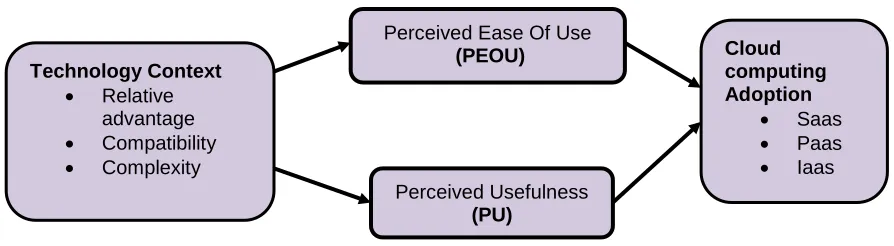
Licensed under Creative Common Page 15 variables on these two mental determinants show mixed findings (Chau and Hu 2001). Nevertheless, empirical findings confirm the positive relationships between ease of use and attitude towards use (Venkatesh and Davis 2000) and show that PEOU is a proven key determinant of users’ intention to accept IT (Venkatesh and Davis 2000). Figure 1 below is a representation of how the technology context affects cloud computing adoption mediated by user perception (Perceived ease of use and perceived usefulness).
Figure 1: Mediating effect of Perceived Ease of Use and Perceived Usefulness of Technological Context on Adoption of Cloud Computing
THEORIES AND MODELS UNDERPINNING THE STUDY
This paper is grounded on the Innovation Diffusion Theory (IDT) as developed by Rogers (2003). Diffusion is the procedure by which a development is embraced by individuals from a specific group. It is noteworthy that diffusion is not a solitary, general hypothesis, yet rather a few hypothetical points of view that identify with the general idea of diffusion, that is, it is a meta-hypothesis. The IDT hypothesis contends that potential clients settle on choices to receive or
dismiss an innovation in view of convictions that they shape about the innovation (Agarwal et al., 2000). Technology Acceptance Model is the foremost traditional adoption theory
in the field of IT (Awa, Eze, Urieto and Inyang, 2011) and provides a basis for unveiling the impacts of external variables on adoption decisions with its basic postulates resting firmly on economic, utilitarian, and attitudinal grounds. TAM proposes PU and PEOU as the fundamental determinants of IT adoption. An individual’s intention to use an application is explained and predicted by his perception of the technology’s usefulness and its simplicity.
The strengths of Rogers (2003) diffusion of innovation and Ajzen (1991) Theory of Planned Behaviour (TPB) have been explored to enrich TAM by adding usage and placing premiums on specific settings and external variables that influence a technology’s adoption process. TAM and TPB are routed to the Theory of Reasoned Action (TRA). Though TAM and TPB neglected the influences of psychological, social, and interpersonal variables on IT
Technology Context Relative
advantage
Compatibility
Complexity
Perceived Ease Of Use (PEOU)
Perceived Usefulness (PU)
Cloud computing Adoption
Saas
Paas
Licensed under Creative Common Page 16 adoption decision (Ukoha, Awa, Nwuche and Asiegbu, 2011), TPB complemented TAM’s constructs with subjective norms and perceived behavioral control to explain perceptions of ease or difficulty of performing an act given resource constraints. Taylor and Todd (1995) believe that TPB explanatory and predictive utilities are better enhanced by extending and integrating with TAM. Other researchers (Venkatesh and Davis, 2000) validated, modified, extended, and improved TAM under different situations to make for wider applicability in the novel knowledge economy.
Diffusion hypothesis gives a structure that comprehends why ICT is received by a few people and not by others. This hypothesis can clarify, anticipate, and represent elements that expand or obstruct the dispersion of innovations. Among SMEs, business visionaries and managers constitute the adopters who at their own particular volition and relying upon the apparent expenses and benefits decide to adopt information and communication technology.
RESEARCH METHODOLOGY
The study employed a positivism approach and utilized an explanatory research design and cross-sectional survey. The study comprised of 398 respondents drawn through a random sample technique, from Nairobi County, Kenya. Data that was collected from IT managers, managers or entrepreneurs and analyzed using multiple regression model. Regression was used to test the degree to which the independent variables predict the dependent variable. The Independent variable technology context. The measurement tool of relative preferred standpoint is embraced from Premkumar and Ramamurthy (2010) and Jain and Bhardwaj (2010) Complexity tool was adapted from Premkumar and Ramamurthy (1994) Gardner and Amoroso (2004). Compatibility tool was adapted from Wang et al. (2010). User perception is the mediating variable adapted from Schillewaert et al. (2005). while the dependent variable was adoption of cloud computing. Further, to accomplish construct validity, convergent and discriminant validity were set up. Information gathered on demographic variables was handled and detailed in percentage through descriptive analysis.
RESULTS AND DISCUSSION
Firm Characteristics
Licensed under Creative Common Page 17
Category of the Firms in the Sector
The study also considered the category of the firms in the sector. The firms were in the manufacturing (28.6%), consulting (20.8%), hospitality (18.3%), information technology (17.7%), computer retail (8.4%) and tour and travel (6.2%) sector. The results are indicated in Figure 2.
Figure 2: Category of the Firms in the Sector by industry type
Technology Context
In terms of the relative advantage of cloud computing, the respondents noted that the use of cloud computing at work is advantageous (M=4.54, SD=0.606).This means that cloud computing made the SMEs’ processes more efficient. In so doing, it enhanced SMEs’ productivity and performance and eventually led to profitability. As well, with cloud computing, the respondents only paid for what they used (M=4.1, SD= 0.87).This conforms to the assertion by Feuerlicht and Govardhan (2010) elucidating that cloud computing offers rented services on a pay-as-you-use basis which leads to adjusting the level of usage according to the current needs of the organization. They were also able to scale up their requirement when required (M=4.16, SD=0.795). Cloud computing therefore provides a wide array of benefits to SMEs with robust coordination features such that they can only pay for what they use and are able to scale up their requirements whenever needed. Consistently, Marston et al. (2011) echo that with cloud computing, SMEs have almost instant access to hardware resources and a faster time to market with no upfront capital investment. In addition, the respondents could access information any time from any place (M=4.29, SD=0.84). Most importantly, performance did not decrease with growing user base (M=3.83, SD=0.961).There is thus better customer care and access to information reliably. Besides, the respondents could access and share resources placed on cloud (M=4.17, SD=0.748).Individuals could access resources placed on cloud from any location hence saving on time and money. In tally with the above, Miller (2008) infers that
Manufacturing, 28.6 0%
Hospitality, 18.30% Consulting, 20.80%
Information Technology, 17.70%
Computer Retail, 8.40%
Tours & Travel, 6.20%
Licensed under Creative Common Page 18 cloud computing can offer many advantages related to capacity, reliability, and flexibility. On the whole, the results on relative advantage summed up to a mean of 4.0541, standard deviation of 0.52369, skewness -1.519 and kurtosis 5.535. From the foregoing, the relative advantage of cloud computing are self-evident.
Regarding compatibility, cloud computing was compatible with existing technological architecture of their company (M=3.89, SD=0.835).The high compatibility of cloud computing with the technological architecture of the SMEs positively affected the adoption process. However, whenever there were incompatibility issues with cloud computing, there was use of integrated services (M=3.95, SD=1.093). This means that SMEs have a backup in case of incompatibility issues. Additionally, the use of cloud computing at work was consistent with existing practices in their company (M=3.82, SD=0.912). Customization was also easy in cloud-based services (M=3.87, SD=0.916).It was also easy to import and export applications/data from cloud services (M=3.85, SD=1.021). Further, the use of cloud computing at work was compatible with their firm's existing format, interface, and other structural data (M=3.75, SD=0.998).This infers that the technical and procedural requirements of cloud computing are consistent with values and the technological requirements of the SMEs. However, in case of, non-customizable cloud-based services, the respondents incur retraining cost (M=3.54, SD=1.053). Lastly, the respondents inferred that cloud computing is compatible with all aspects of their work (M=4.03, SD=0.868).The results on the compatibility of cloud computing summed up to a mean of 3.8381, standard deviation of 0.57663, Skewness 0.051 and kurtosis -0.624. Compatibility is therefore one of the significant aspects affecting the adoption of cloud computing among the selected SMEs in Nairobi County.
Licensed under Creative Common Page 19
User Perception - Perceived Ease of Use and Perceived Usefulness
User perception consists of the following sub-constructs; perceived ease of use and perceived usefulness. The results on perceived ease of use of cloud computing summed up to a mean of 3.96, standard deviation of 0.657, Skewness -0.281 and kurtosis -0.136.The skewness and kurtosis values range from -1.96 to +1.96 indicated a normal distribution of the responses in perceived ease of use. Regarding perceived ease of use of cloud computing, the procedure is understandable, easy to learn, and make use of. Further, the use of cloud computing is adoptable if perceived to be easy to use. Additionally, Respondents, agreed that cloud computing is an easy technology for one to become skilled and its flexible to interact with.
As far as perceived usefulness was concerned, entrepreneurs ascertained that cloud computing enables them to manage their business operation in an efficient way. The results on perceived usefulness of cloud computing summed up to a mean of 4.1589 indicating that the respondents were agreeable. The standard deviation was 0.673, Skewness -0.596 and the kurtosis 0.115. As such, it has increased their business productivity and the quality of business operation and has advanced their competitiveness. Furthermore, cloud computing has enabled the entrepreneurs to accomplish organizational tasks more quickly and on the whole, cloud computing is perceived useful to the organization. It is evident in Table 1 below.
Table: 1 Perceived Ease of use and Perceived usefulness
Item : Perceived Usefulness M SD Skewness Kurtosis
Enables me to manage business operation in an efficient way. 4.26 0.766 -0.9 -1.2 enables increase of business productivity 4.19 0.968 0 -1.6 Enables one to accomplish organizational task more quickly. 4.19 0.778 -0.3 -0.9 improves the quality of business operation 4.12 0.892 0.69 -1.4 advances my competitiveness 4.18 0.841 -0.5 -0.5 when perceived useful to the organization 4 1.078 -0.1 -0.5
Composite Mean 4.1589 0.6734 -0.596 0.115
Item: Perceived Ease of Use M SD Skewness Kurtosis
The procedure is understandable. 4.02 0.799 -0.6 -0.8
Is easy to learn.. 4.02 0.71 -0.8 0.91
Is easy to make use of. 4.03 0.889 -0.9 1.03
Is adoptable and easy to use 4.03 0.833 -0.3 -1.3 It is an easy technology for one to become skillful 3.8 1.164 0.49 -0.9 Is flexible to interact with. 3.88 1.003 -0.8 1.32
Licensed under Creative Common Page 20
Adoption of Cloud Computing
Software as a Service-computing model allows users to access simple desktop applications such as word processing and spreadsheets as a service on the web. From the findings of this study, SMEs used I-cloud computing to a high extent in their businesses. On the other hand, the standard deviation of 1.085 revealed a high degree of variation in the responses. The study indicated that the respondents applied email services in their business. Further, there was an indication that the email application was accessible from anywhere anytime. This meant that the entrepreneurs could conveniently and effectively interact with their customers. From the foregoing, it was concluded that CRM users could access applications on demand and CRM services were effective. The study indicated a composite mean of 3.696, standard deviation of 0.7314, Skewness -0.768 and Kurtosis 0.397. This implied that most of the respondents were agreeable and besides, standard deviation was indicative of fewer variations in the responses.
In the Platform as a Service approach, cloud providers give the consumer a higher level of abstraction to deploy onto the cloud infrastructure consumer created or acquired applications created using programming languages, operating system, web server, libraries, services, and programming language tools (Mell and Grance, 2011). As such, the study deemed it important to establish the extent of use of the features of Platform as a Service in the selected SMEs. In regards to the extent of utilization of cloud data storage service, the results implied that the SMEs utilized cloud data storage services. Respondents indicated cloud data storage service as effective. Further, the respondents were also asked to rate the extent to which their firms enjoyed server and network service maintenance offered by their service providers. The results showed a significant number of the SMEs were enjoying server and network service maintenance. Besides, the standard deviation indicated less variation in the responses.
The respondents were also asked to rate the amount of data they stored in the I-cloud. Generally, the results items on Platform as a Service realized a composite mean of 3.58, standard deviation of 0.79549, Skewness -0.697 and Kurtosis 0.384. This implied that most of the respondents were agreeable and there was less variation in the responses. Additionally, the skewness and kurtosis values -1.96 to +1.96, indicated a normal distribution of the responses.
Licensed under Creative Common Page 21 infrastructure was the responsibility of the cloud service provider, inferred that SMEs do not have to worry much as the infrastructure is owned by the service provider. The results items on Infrastructure as a Service realized a composite mean of 3.64 standard deviation of 0.806, Skewness 1.958 and Kurtosis 2.409
Factor Analysis for Study Variables
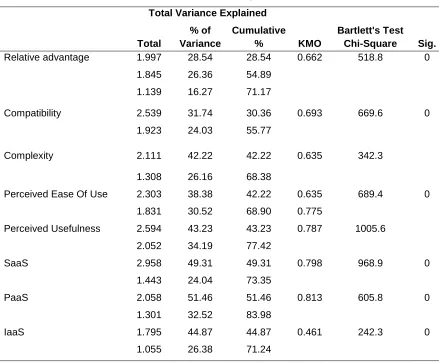
The researchers ran a principal component analysis to identify patterns in data, and to express the data in such a way as to highlight their similarities and differences. Besides having data set items reduced to manageable level while retaining as much of the original information, it helped in identifying groups or clusters of variables. By use of varimax rotation, the researcher retained all factors with Eigen values greater than 1. The criterion was based on the idea that the Eigen values represent the amount of variation explained by a factor and that the Eigen value of 1 represents a substantial amount of variation. Sampling adequacy was tested using the Kaiser- Meyer-Olkin Measure (KMO measure). As evidenced in Table 2, KMO was greater than 0.5.
Table 2: Factor Analysis Total Variance Explained
Total
% of Variance
Cumulative
% KMO
Bartlett's Test
Chi-Square Sig.
Relative advantage 1.997 28.54 28.54 0.662 518.8 0 1.845 26.36 54.89
1.139 16.27 71.17
Compatibility 2.539 31.74 30.36 0.693 669.6 0 1.923 24.03 55.77
Complexity 2.111 42.22 42.22 0.635 342.3
1.308 26.16 68.38
Perceived Ease Of Use 2.303 38.38 42.22 0.635 689.4 0 1.831 30.52 68.90 0.775
Perceived Usefulness 2.594 43.23 43.23 0.787 1005.6 2.052 34.19 77.42
SaaS 2.958 49.31 49.31 0.798 968.9 0
1.443 24.04 73.35
PaaS 2.058 51.46 51.46 0.813 605.8 0
1.301 32.52 83.98
IaaS 1.795 44.87 44.87 0.461 242.3 0
Licensed under Creative Common Page 22
Regression Analysis
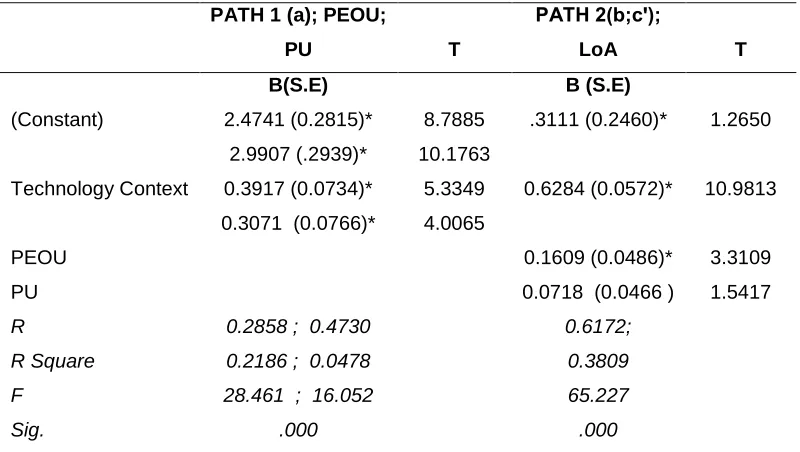
The study predicted that perceived ease of use and perceived user perception does not mediate the relationship between technology context and cloud computing adoption. In order to test the hypothesis, regression models were run as indicated in Table 3. The explanation of the models are as follows; Model 1 is the regression of mediating variable; (PEOU and PU) on technology context, model 2 is the regression of the criterion variable; level of adoption of cloud computing on both technology context (predictor variable), perceived ease of use and perceived usefulness (mediator) respectively, when both are included as simultaneous predictors of Y. From the findings in PATH 1 denoted as (a) technology context accounts for a significant proportion of variance in the mediating variable PEOU (β=0.3917, p<0.01) and PU (β= (0.3071 p<0.01) In path 2 denoted as (cꞌ) and (b) it was revealed that technology context and user perception (PEOU and PU) respectively accounts for a significant proportion of variance in adoption of cloud computing (β=0.6284, p<0.01); (β=0.1609, p<0.01) (β=-0.0718, p>0.01).The correlation of technology context (IV) to PEOU and PU (MV) is denoted as path a (0.3917); (0.3071) respectively. The correlation of PEOU and PU (MV) to cloud computing adoption (DV) is denoted as path b (0.1609); (0.0718) respectively. To establish the mediation effect and it’s significant there was need to get a product of (a) and (b) (Mackinnon, 2000). Path a(0.1609)* b(0.3917) = (0.06302) for PEOU and Path a(0. 3071) * b(0.0718)= (0.02205) for PU. However perceived usefulness (PU) and (PEOU) effect on level of adoption showed positive beta coefficients and significant p-value.
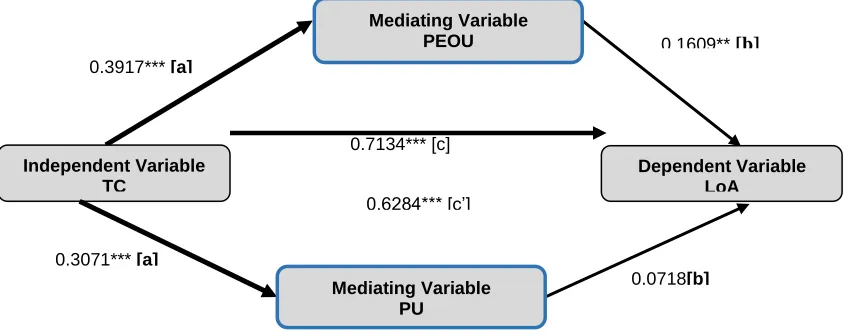
Furthermore, to test significance of mediation effect, Normal theory tests (sobel) for indirect effect was generated using PROCESS macro. The Z-value of PEOU 2.7782 yielded a p-value of 0.0055 and the Z-value of PU 1.4013 yielded a p-value of 0.1611. Due to the low p-value associated with Z-p-value for PEOU and PU it can further be concluded that a significant mediation occurred. It was further noted that the association between technology context (IV) and cloud computing adoption (DV) significantly increased due to the inclusion of the mediating variables PEOU and PU. The direct effect cꞌ (0.6284) is the size of the correlation between technology context (IV) on cloud computing adoption (DV) inclusive of PEOU and PU (MV) in the regression. The total effect c (0.7134) is the total sum of Indirect effect a*b (0.0851) added to direct effect cꞌ (0.6284).
Licensed under Creative Common Page 23 total effect is either direct or mediated by other variables not included in the model. Additionally, it is evident that the 95% confidence interval conclusively shows that significant mediation has occurred. The confidence interval for a*b does not include zero hence a clear indication of mediation. Confidence interval of the lower limit is .0392 and upper limit is .1090 as shown below in Table 4.
Basing on the explanation above, it is conclusive enough to state that PEOU and PU combined has an effect on the the relationship between technology context and adoption of cloud computing among SMEs in Nairobi Kenya as shown in Figure 3.
Table 3: Regression Coefficients of the Different Paths for Technology Context
PATH 1 (a); PEOU;
PU T
PATH 2(b;cꞌ);
LoA T
B(S.E) B (S.E)
(Constant) 2.4741 (0.2815)* 8.7885 .3111 (0.2460)* 1.2650 2.9907 (.2939)* 10.1763
Technology Context 0.3917 (0.0734)* 5.3349 0.6284 (0.0572)* 10.9813 0.3071 (0.0766)* 4.0065
PEOU 0.1609 (0.0486)* 3.3109
PU 0.0718 (0.0466 ) 1.5417
R 0.2858 ; 0.4730 0.6172;
R Square 0.2186 ; 0.0478 0.3809
F 28.461 ; 16.052 65.227
Sig. .000 .000
Table 4: Results for Mediation Effect of Perceived Ease of Use and Perceived Usefulness on the Relationship between Technology Context and Adoption of Cloud Computing
Significance of Mediation Significance
Z-value PEOU 2.7782 p = 0.0055
Z-value PU 1.4013 = 0.1611 95% Symmetrical Confidence Interval
Lower 0.0392
Upper 0.1090
standardized indirect effect
a*b 0.0687
Licensed under Creative Common Page 24 Effect size Measures
Standardized Coefficients
Total: 0.7134
Direct: 0.6284
Indirect: 0.0851 Indirect to Total Ratio: 0.1192
Figure 3: Mediation Graph Predicting the Mediation Effect of Perceived Ease of Use and Perceived Usefulness on the Relationship between Technology
Context and Adoption of Cloud Computing
CONCLUSION AND RECOMMENDATIONS
Based on the above observations, the findings validate the conceptual framework developed. This paper has shed light on the link between technology context, user perception and adoption of cloud computing among SMEs. A partial mediation is evident with an increasing effect, hence a complimentary relationship. The findings, of this study have shown that perceived usefulness and perceived ease of use have a strong correlation to user acceptance of information technology. In addition, a system perceived to be easier to use, compatible and with a relative advantage will facilitate more system use and is more likely to be accepted by users. The main implication to industry, service providers will be able to create effective public awareness and enhance insight for training and support. Socially, due to scalable pay-as-you-go cost structure, reducing IT investment will enable reliable service accessible from anywhere anytime enhancing quality and lower cost services to customers.
Independent Variable TC
Dependent Variable LoA
Mediating Variable PEOU
0.7134*** [c] 0.6284*** [c’]
0.3071*** [a]
0.0718[b] Mediating Variable
PU
0.3917*** [a]
0.1609** [b]
Licensed under Creative Common Page 25 The limitation of this study is largely related to the methodologies used. The limitations of this research is restricted to only those SME’s who have adopted cloud computing to deliver the core product or service of their business hence the data collected is only relevant to this part of the total population. This study, emphasized more of quantitative approach rather than qualitative.
On a geographical dimension, this study was primarily limited to SMEs in Nairobi. The justification of selecting Nairobi is due to its diversity of Industries compared to other areas in Kenya. Therefore, it may not be appropriate to generalize to the whole population of the SMEs in this country or any other country but only to the population from which that sample was taken. Therefore, future studies could implement the study in terms of a longitudinal rather than a cross-sectional design. The longitudinal study would need to correct changes in data relative to the time element. Despite possible limitations of using single-period data, the results of the present study provide valuable insights on the effect of user perception on the relationship between technology context and adoption of cloud computing.
REFERENCES
Agarwal, R., Sambamurthy, V., & Stair, R. M. (2000). The Evolving Relationship between General and Specific Computer Efficacy: An Empirical Assessment. Information Systems Research, 11(4), 418-430. Ajzen, I. (1991). The theory of planned behavior. Organ Behavior of Human, 50(2), 121- 79.
Akbulut, A. A. (2003). An Investigation of the Factors that Influence Electronic Information Sharing between State and Local Agencies. Unpublished Doctoral Dissertation, Louisiana State University. Armbrust, M., Fox, A., Griffith, R., Joseph, A. D., Katz, R., Konwinski, A., Lee, G., Patterson, D., Rabkin, A., Stoica, I., & Zaharia, M. (2010). A View of Cloud Computing. Communications of the ACM, 53, 50-58. Awa, H., Eze, S., Urieto, J., & Inyang, B. (2011). Upper echelon theory: A major determinant of information technology (IT) adoption by SMEs in Nigeria. Journal of Systems and Information Technology, 13(2), 144-162.
Baker, J. (2011). The Technology-Organization-Environment Framework. In Dwivedi, Y., Wade, M., & Schneberger, S. (Eds.), Information Systems Theory: Explaining and Predicting Our Digital Society (231-246). New York: Springer.
Bayo-Moriones, A., & Lera-Lo´pez, F. (2007). A Firm-Level Analysis of Determinants of ICT Adoption in Spain. Technovation, 27(6-7), 352-366.
Buyya, R., Yeo, C. S., Venugopa, S., Broberg, J., & Brandic, I. (2009). Cloud Computing and Emerging IT Platforms: Vision, Hype, and Reality for Delivering Computing as the 5th Utility. Future Generation Computer Systems, 25, 599-616.
Buyya, R., Yeo, C., Venugopa, S., Broberg, J., and Brandic, I. (2009). Cloud computing and emerging it platforms: vision, hype, and reality for delivering computing as the 5th utility. Future Generation Computer Systems, 25, 599-616
Chatman, C. (2010). How Cloud Computing is Changing the Face of Health Care Information Technology. Journal of Health Care Compliance, 12(3), 37–70.
Licensed under Creative Common Page 26 Chong, A. Y. L., & Ooi, K. B. (2008). Adoption of Interorganizational System Standards in Supply Chains: An Empirical Analysis of Rosettanet Standards. Industrial Management & Data Systems, 198, 529-547. Ebiringa, O. T. (2011). Synthesis of Literature on Small and Medium Enterprises Start-Up Financing. Int. J. Eco. Res., 2(1), 85-95.
Erdogmus, H. (2009). Cloud Computing: Does Nirvana Hide Behind the Nebula? IEEE Software, 26, 4-6. European Commission. (2005). The New SME Definition: User Guide and Model Declaration. Luxembourg: Office for Official Publications of the European Communities.
Feuerlicht, G., & Govardhan, S. (2010). Impact of Cloud Computing: Beyond a Technology Trend. In the Proceedings of the International Conference on Systems Integration 2010 [CDROM]. 8-9 June, 2010, Prague, Oeconomica, 1–8.
Gardner, C., & Amoroso, D. L. (2004). Development of an Instrument to Measure the Acceptance of Internet Technology by Consumers. Proceeding of the 37th Hawaii International Conference of System Science, IEEE, 1-10.
Gartner (2009). Cloud Computing Inquiries at Gartner. Available at: http://blogs.gartner.com thomas_ bittman/2009/10/29/cloud computing-inquiries at-gartner (accessed 16 September 2016).
Goscinski, A., & Brock, M. (2010). Toward Dynamic and Attribute Based Publication, Discovery and Selection for Cloud Computing. Future Generation Computer Systems, 26, 947-970.
Hardgrave, B., Davis, F., & Riemenschneider, C. (2003). Investigating Determinants of Software Developers’ Intentions to Follow Methodologies. Journal of Management Information Systems, 20(1), 123-151.
Hartigan, P. (2005). El emprended or social comomodelo para el futuro. Iniciativa Emprendedora Y Empresa Familiar, 46, 19-25.
Ibrahim, O. A., & Musah, A. (2015). Small and Medium Enterprises in the Cloud in Developing Countries: A Synthesis of Literature and Future Research Directions. Journal of Management and Sustainability, 5(1), 115-139.
Ishan, R. S. (2016). Cloud Computing Adoption in Australia. Unpublished PhD Thesis, Deakin University. Jain, L., & Bhardwaj, S. (2010). Enterprise Cloud Computing: Key Considerations for Adoption. International Journal of Engineering and Information Technology, 2(2), 113-117.
Japan-NE. (2012). Fujitsu Roll Out Cloud Computing Services for Hospitals. Telecom paper Africa/Asia. Available from http://www.accessmylibrary.com/article.
Kituku, K.M. (2012). Adoption of Cloud Computing in Kenya by Firms Listed in the Nairobi Stock Exchange. Unpublished MBA Thesis, University of Nairobi.
Kuo, A. M. H. (2011). Opportunities and Challenges of Cloud Computing to Improve Health Care Services. Journal of Medical Internet Research, 13(3), e67.
Lee, J. (2004). Discriminant Analysis of Technology Adoption Behaviour: A Case of Internet Technologies in Small Businesses. Journal of Computer Information Systems, 44(4), 57-66.
Lin, H. F., & Lin, S. M. (2008). Determinants of e-Business Diffusion: a Test of the Technology Diffusion Perspective. Technovation, 28, 135-145.
Lisa, B. A. (2011). Hospital Uses Cloud Computing to Improve Patient Care and Reduce Costs. Available:
http://www.microsofteu/cloudcomputing/casestudies/hospitalusescloudcomputingtoimprovepatientcarean dreducecosts.aspx. Accessed 20 Feb 2017
Lu, J, Yu, C, Liu, C, & Yao, J. (2003). Technology acceptance model for wireless internet. Internet Research: Electronic Networking Applications and Policy, 13(3), 206-222
Licensed under Creative Common Page 27 Marston, S., Li, Z., Bandyopadhyay, S., Zhang, J., & Ghalsasi, A. (2011). Cloud Computing - The Business Perspective. Decision Support Systems, 51(1), 176-189.
Mell, P., and Grance, T. (2011). The NIST definition of cloud computing. NIST Special Publication, 145-800
Miller, M. (2008). Cloud Computing: Web-Based Applications That Change the Way You Work
Mutula, S. M. & Brakel P. V. (2006). E-readiness of SMEs in the ICT Sector in Botswana with Respect to information. The Electronic Library, 24(3), 402-417.
Nairobi County, 2015. Ministry of Trade Records
Njama, G. J. (2013). Effects of Venture Capital Financing on the Growth of Small and Medium Enterprises in Kenya. Unpublished MBA Thesis, University of Nairobi.
Oliveira, T., & Martins, M. (2011). Literature Review of Information Technology Adoption Models at Firm Level. The Electronic Journal Information Systems Evaluation, 14(1), 110-121.
Oliveira, T., & Martins, M. F. (2010). Understanding e-Business adoption Across Industries in European Countries. Industrial Management & Data Systems, 110, 1337-54.
Ongori, H. (2009). Role of Information Communication Technologies Adoption in SMES: Evidence from Botswana. Research Journal of Information Technology, 1(2), 79-85.
Opia, O. (2008). An exploratory study of the moderating effects of trust on e-commerce adoption behaviour of Nigerian small enterprises. African Journal of Entrepreneurship, 1(1), April, 43-5
Osterman, M. D. (2012). Digital Literacy: Definition, Theoretical Framework, and Competencies. In M. S. Plakhotnik, S. M. Nielsen, & D. M. Pane (Eds.), Proceedings of the 11th Annual College of Education & GSN Research Conference (pp. 135-141). Miami: Florida International University.
Parisot, A. (1995). Technology and Teaching: The Adoption and Diffusion of Technological Innovations by a Community College Faculty. Bo-zeman, MT: Montana State University.
Pauly, M. (2011). T-Systems Cloud-Based Solutions for Business Applications. In R. Buyya, J. Broberg and A. Goscinski (Eds.), Cloud Computing: Principles and Paradigms. Hoboken, NJ: John Wiley & Sons, Inc.
Pedersen, S., & Liu, M. (2003). Teachers' Beliefs about Issues in the Implementation of a Student-Centred Learning Environment. Educational Technology Research and Development, 51(2), 57-76. Premkumar, G., Ramamurthy, K., & Sree, N. (1994). Implementation of Electronic Data Interchange: An Innovation Diffusion Perspective. Journal of Management Information Systems, 11, 157-186.
Rogers, E. (1983). Diffusion of Innovations. New York: Free Press.
Rogers, E. (1995). Diffusion of Innovations (4th Ed.). New York: Free Press. Rogers, E. (2003). Diffusion of Innovations (5th Ed.). New York: Free Press.
Rui, G. (2007), Information Systems Innovation Adoption among Organizations a MatchBased Framework and Empirical Studies, National University of Singapore, Singapore.
Sahin, I. (2006). Detailed Review of Rogers’ Diffusion of Innovations Theory and Educational Technology-Related Studies Based on Rogers’ Theory. The Turkish Online Journal of Educational Technology, 5(2), 14-23.
Schillewaert, N., Ahearne, M., Frambach, R., and Moenaert, R. (2005). The adoption of information technology in the sales force. Industrial Marketing Management, 34(4), 323-336.
Sogorb-Mira, F. (2005). How SME Uniqueness Affects Capital Structure: Evidence from a 1994-1998 Spanish Panel Data. Small Business Economics, 25, 447–457.
Licensed under Creative Common Page 28 Sultan, N. (2010). Cloud Computing for Education: A New Dawn? International Journal of Information Management, 30, 109-116.
Swash, G. (1998). UK Business Information on the Internet. New Library World, 99(1144), 238-242. Tan, S. K., Chong, S. C., Lin, B., & Eze, U. C. (2008). Internet-based ICT Adoption: Evidence from Malaysian SMEs. Industrial Management & Data Systems, 109, 224-244.
Taylor, S., & Todd, P. (1995). Assessing IT usage: The role of prior experience. Management Information Systems Quarterly, 19(4), 561-570. acceptance of internet technology by consumers. System Science, 1-10.
Thong, J. (1999). An Integrated Model of Information Systems Adoption in Small Businesses. Journal of Management Information Systems, 15(4), 187-214.
Thong, J., Yap, C., & Raman, K. (1994). Engagement of External Expertise in Information Systems Implementation. Journal of Management Information Systems, 11(2), 209-231.
To, M. L., & Ngai, E. W. T. (2006). Predicting the Organizational Adoption of B2C e-Commerce: An Empirical Study. Industrial Management & Data Systems, 106, 1133-47.
Tornatzky, L. G., & Fleischer, M. (1990). The Processes of Technological Innovation. Lexington, MA: Lexington Books. [23] Chau, P. Y. K., & Tam, K. Y. (1997). Factors Affecting the Adoption of Open Systems: An Exploratory Study. MIS Quarterly, 21, 1-24.
Ukoha, O., Awa, H., Nwuche, C., & Asiegbu, I. (2011). Analysis of explanatory and predictive architectures and the relevance in explaining the adoption of IT in SMEs. Interdisciplinary Journal of Information, Knowledge and Management, 6, 217-230.
Venkatesh, V., & Davis, F. (2000). A theoretical extension of the Technology Acceptance Model: Four longitudinal field studies. Management Sciences, 46(2), 186-204.
Wagenvoort, R. (2003). SME Finance in Europe: Introduction and Overview. European Investment Bank Papers, 8(2), 10-21.
Wang, Y. M., Wang, Y. S., & Yang, Y. F. (2010). Understanding the Determinants of RFID Adoption in the Manufacturing Industry. Technological Forecasting & Social Change, 77, 803-815.
Yates, D., Moore, D., & Starnes, D. (2008). The Practice of Statistics (3rd Ed.). New York: W. H. Freeman and Company.