New Models for Intermolecular
Repulsion and their Application to
van der Waals Complexes and Crystals
of Organic Molecules
Helen Hoi Yan Tsui
A thesis subm itted to the U niversity o f London in partial fulfilm ent o f the requirem ents for the degree o f D octor o f P hilosophy
U niversity C ollege London A ugust 2001
C entre for T heoretical and C om putational C hem istry C hristopher Ingold L aboratories
D epartm ent o f Chem istry U niversity C ollege London 20 G ordon Street
w ™
UCL
U nited Kingdom
N e w M odels for Interm olecular Repulsion and their Application to van d er W a a ls H e len H .Y . Tsui
ProQuest Number: U642891
All rights reserved
INFORMATION TO ALL USERS
The quality of this reproduction is dependent upon the quality of the copy submitted.
In the unlikely event that the author did not send a complete manuscript
and there are missing pages, these will be noted. Also, if material had to be removed,
a note will indicate the deletion.
uest.
ProQuest U642891
Published by ProQuest LLC(2016). Copyright of the Dissertation is held by the Author.
All rights reserved.
This work is protected against unauthorized copying under Title 17, United States Code.
Microform Edition © ProQuest LLC.
ProQuest LLC
789 East Eisenhower Parkway
P.O. Box 1346
For my family
Without their continuous love and support, I will not be who I am today.
Success
If you have tried to do something and failed,
you are better o jf than if you had tried to do nothing and succeeded.
New Models for Intermolecular Repulsion and their Application to van der W aals Helen H.Y. Tsui
Academic Acknowledgements
Academic Acknowledgements
I would like to take this opportunity to thank my supervisors, Professor David C. Clary and Professor Sarah (Sally) L, Price for their continuous support, enthusiasm and encouragement throughout my Ph.D. study. It has been a privilege and pleasure to be able to work with them. Without their guidance, I would lose direction of my Ph.D. right from the beginning.
There are many people who helped me throughout my Ph.D. study, in particular Dr John Mitchell, Dr Irilenia Nobeli and Dr Tanja van Mourik. Their knowledge of chemistry and helpful discussions has helped me to solve many problems encountered. I would also like to thank the authors of the many programs that were used in this study, in particular Dr Anthony Stone (ORIENT), Dr Roger Amos (CADPAC), Dr Richard Wheatley (GMUL), Dr Maurice Leslie, Graeme Day (DMAREL) and Professor Herman Ammon (MOLPAK).
I would like to thank all former and current members of the Clary and Price group. Their help is gratefully acknowledged. I was very lucky to be able to work within these groups of people, who are willing to lend a helping hand when I needed them. Thank you so much!
Financially, I would like to thank the following body/people/organisations:
The college access funds (1997/1998, 1998/1999), the UCL Friend's scholarship (1998/1999), and the UCL Graduate School's travel fund, along with a bursary from NATO has provided me an opportunity to attend a summer school in 1998. The Royal Society of Chemistry for a bursary to attend a five-day residential CRAC graduate school course in 2000. AVECIA and ASTRA ZENECA for funding a research assistantship that enabled more time to continue my research, and provided the basis for Chapter 9. Finally, 1 would like to thank my parents for funding my Ph.D., without their support, it would not be possible for me to continue my study.
Helen Hoi Yan Tsui (#B U l^)
New Models for Intermolecular Repulsion and their Application to van der W aals Helen H.Y. Tsui
Personal Acknowledgements
Personal Acknowledgements
I would like to thank the following people, well...the list is endless and I apologise to anyone who I forget to mention:
My family for their continuous love, encouragement and support. They have never gave up on me, and taught me that if I wish to succeed, I must work hard and put in the effort, the outcome is not important, as long as I try my best.
Sally for putting up with me. Her patience, encouragement and trust in me were a great force during my study. The completion of this thesis would not be possible without her support.
Everyone from room 124, past and present, Irene, Theresa, Tanja, John, Chitra, Jaime, Graeme, and Michael. It was a privilege to work with them.
My friends, for putting up with hearing me complaining my workload and stress, either verbally or through endless emails. It would be unfair to name them and miss a few of them, so I will not specify who they are.
Thank you all from the bottom o f my heart!
Helen Hoi Yan Tsui ( #
New Models for Intermolecular Repulsion and their Application to van d er W aals Helen H.Y. Tsui
Abstract
Abstract
Model intermolecular potentials are required for simulations of molecules in the gas, liquid, or solid phase. The widely used isotropic atom-atom model potentials are empirically fitted and based on the assumptions of transferability, combining rules and that atoms in molecules are spherical. This thesis develops a non-empirical method of modelling repulsion by applying the overlap model, which we show as a general non-empirical method o f deriving repulsion potentials for a specific molecule.
In this thesis, the repulsion parameters for an exponential atom-atom model potential are obtained from the ab initio charge density of a small organic molecule by making the assumption that the repulsion is proportional to the overlap of a pair of molecules. The proportionality constant is fixed by a limited number of intermolecular perturbation theory (IMPT) calculations. To complete the model potential, the electrostatic interaction is represented by a distributed multipole analysis, and the
Slater-Kirkwood formula is used for the dispersion.
These non-empirical potentials can reproduce experimental crystal structure when applied to crystal structure prediction of an oxyboryl derivative. A detailed study on further improving the overlap model was carried out for phenol-water, by including other minor intermolecular contributions of charge-transfer and penetration. High quality ab initio calculations on the complex were performed for use in comparison. To compare with experimental data, diffusion Monte Carlo simulations were performed with the potential, so that the effects of anharmonic zero-point motion on structure and energy of the system are included.
When the system is too large for an IMPT calculation, the proportionality constant can be determined empirically by fitting the cell volume as shown in our study of crystal structures of chlorothalonil. This is used with an anisotropic repulsion model that has been derived for Cl and N atoms in chlorothalonil. This model potential reproduces the crystal structure well, and is used to predict other polymorphs by a search for minima in the lattice energy.
New Models for intermolecular Repulsion and their Application to van der W aals Helen H.Y. Tsui
Table o f Contents
Table of Contents
Academic Acknowledgements 3
Personal Acknowledgements 4
Abstract 5
Table of Contents 6
List of Tables 11
List of Figures 14
PART I INTRODUCTION 17
1 Overview 18
2 The Theory of Intermolecular Forces 21
2.1 Summary 21
2.2 Introduction 21
2.3 The intermolecular forces between molecules 23
2.4 Long-range interactions 23
2.4.1 Electrostatic energy 23
2.4.2 Induction (polarization) energy 24
2.4.3 Dispersion energy 25
2.5 Short-range interactions 26
2.5.1 Exchange-repulsion energy 26
2.5.2 Charge penetration 26
2.5.3 Charge-transfer energy 27
2.5.4 Damping 27
2.6 The electrostatic forces between molecules and their representation in model potentials 28
2.6.1 The point charge model 28
2.6.2 The central multipole expansion model 29
2.6.3 The distributed multipole model 30
2.6.4 The use of DMA in model potentials 32
2.7 Intermolecular forces from experiments 33
2.7.1 Empirical potentials 33
New Models for Intermolecular Repulsion and their Application to van der W aals Helen H.Y. Tsui
Table of Contents
2.8 Intermolecular forces from ab initio methods 34
2.8.1 Supermolecule calculations 34
2.8.2 Perturbation Theory 35
2.8.3 Intermolecular perturbation theory (IMPT) 36
2.9 Intermolecular forces from systematic potentials 37
2.9.1 Systematic potentials for water dimer - an illustration of a systematic potential for small
polyatomics 37
2.9.2 Sensitivity of potential to each contribution 39
2.10 Why do we need new repulsion models? 41
2.11 The overlap model 42
2.12 Discussion 48
3 The Study of van der Waals Complexes and Crystal Structures 49
3.1 Summary 49
3.2 The study of van der Waals complexes 49
3.2.1 Van der Waals forces 50
3.2.2 Hydrogen bonds 50
3.2.3 The modelling of van der Waals complexes 51
3.3 The study of crystal structures 52
3.3.1 The modelling and prediction of crystal structures 53
3.3.2 Crystal structure simulation 55
3.4 Discussion 56
PART II CRYSTAL STRUCTURE PREDICTION I 57
4 Blind Crystal Structure Prediction 58
4.1 Summary 58
4.2 Introduction 58
4.2.1 Blind crystal structure prediction 59
4.2.2 Crystal structure prediction 60
4.2.3 Geometry of the blind molecule 61
4.2.4 The potential in this study 61
4.2.5 The electrostatic model 61
4.2.6 The dispersion model 61
4.2.7 The repulsion model 62
4.2.8 Derivation of the proportionality factor K 65
4.2.9 MOLPAK - search for possible crystal structures 65
4.2.10 DMAREL - energy minimisation for possible crystal structures 66
4.3 Results 66
4.3.1 The molecular structure of 2-(2-phenylethenyl)-1,3,2-benzodioxaborole 66
4.3.2 DMA analysis 67
4.3.3 Results from GMUL analyses 67
4.3.4 Atom-atom dispersion coefficients 71
New Models for Intermolecular Repulsion and their Application to van der W aals Helen H.Y. Tsui
Table of Contents_________________________________________________________ 8
4.3.5 MOLPAK search/DMAREL minimisation 72
4.4 Experimental crystal structure 74
4.5 Using correct molecular structure for prediction 76
4.6 The non-empirical repulsion model 78
4.7 Discussion 81
PART III PHENOL-WATER COMPLEX 83
5 Theoretical Modelling of Phenol-Water Complex 84
5.1 Summary 84
5.2 Introduction 85
5.3 Ab initio calculations performed on the phenol-water complex 85
5.4 Model potentials studies performed on the phenol-water system 90
5.5 Experimental studies on the phenol-water system 92
5.6 Model potentials for phenol-water complex 93
5.6.1 Geometry optimisation 94
5.6.2 Isotropic model potential 94
5.6.3 Anisotropic model potentials 95
5.6.4 Results 96
5.7 Supermolecule calculations 98
5.7.1 Methodology 99
5.7.1.1 Basis sets 99
5.7.1.2 Computation of the interaction energy 99
5.7.2 Results 100
5.8 Discussion 103
6 Model Intermolecular Potentials of Phenol-Water Complex I 105
6.1 Summary 105
6.2 Introduction 106
6.3 The non-empirical model potentials 106
6.3.1 Derivation of the repulsion model 106
6.3.2 Derivation of the proportionality factor K 108
6.3.3 Derivation of the dispersion model 109
6.3.4 The effects of damping functions 109
6.4 Results and analyses 111
6.4.1 The exponents parameters 111
6.4.2 The pre-exponential 5,*- parameters 112
6.4.3 Fitting for K using IMPT exchange-repulsion energies and total overlaps 113
6.4.4 The fitting for model K using model repulsion and atom-atom overlaps 116
6.4.5 The effects of damping 117
6.4.6 The full model potentials 119
6.4.7 Results from model potentials 120
6.5 Discussion 121
New Models for Intermolecular Repulsion and their Application to van der W aals Helen H.Y. Tsui
Table o f Contents
7 Model Intermolecular Potentials of Phenol-Water Complex II 123
7.1 Summary 123
7.2 Introduction 123
7.3 The use of existing IMPT energies with new overlaps 125
7.3.1 Derivation of the repulsion model 125
7.3.2 Derivation of the proportionality constant/(T 126
7.3.3 Analyses of the overlap models 126
7.3.4 Model potential results from ORIENT 133
7.4 Improvements in the repulsion model 134
7.4.1 The study of overlap models 134
7.4.2 Analyses of the overlap models 135
7.4.3 Results of model potentials in ORIENT calculations 139
7.5 Improvements for the dispersion model 140
7.5.1 ORIENT results for models with modified dispersion 140
7.6 Final modification o f repulsion model 141
7.6.1 Analyses of the newly fitted repulsion model 142
7.6.2 ORIENT results for newly fitted model potentials 143
7.7 Discussion 144
8 Diffusion Monte Carlo Simulations for Phenol-Water Complex 145
8.1 Summary 145
8.2 Introduction 145
8.3 Diffusion Monte Carlo simulation 147
8.3.1 Rigid-body diffusion Monte Carlo algorithm 149
8.3.2 Implementation 150
8.3.3 Specifications 151
8.4 Model potentials used in DMC simulations 151
8.5 One-particle densities 151
8.6 Results 152
8.6.1 DMC simulations 152
8.6.2 One-particle density plots 153
8.7 Discussion 155
PART IV CRYSTAL STRUCTURE PREDICTION II 156
9 Crystal Structures of Chlorothalonil 157
9.1 Summary 157
9.2 Introduction 158
9.3 Molecular model and testing of empirically derived potentials 160
9.4 Derivation of non-empirical model potential 160
9.4.1 The anisotropic atom-atom repulsion model 161
9.4.2 Overlap calculations 162
9.5 Crystal structure prediction procedure 163
New Models for Intermolecular Repulsion and their Application to van d er W aals Helen H.Y. Tsui
Table of Contents 10 9.6 Calculation of properties of the low energy structures
9.6.1 Mechanical properties
9.6.2 Simulated powder diffraction pattern
9.6.3 Morphology
9.7 Crystal structure prediction
9.7.1 Molecular geometry and empirical model 9.7.2 The non-empirical model
9.7.3 Crystal structure search
9.7.4 Application of the ANI model for low minima from search 9.8 Analysis of results from crystal structure prediction
9.8.1 Predicted structures 9.8.2 Mechanical properties 9.8.3 Powder diffraction pattern 9.8.4 Morphology calculations 9.9 Polymorphs of chlorothalonil
9.9.1 Theoretically predicted polymorphs 9.9.2 Experimental powder structure 9.10 Discussion
PART V CONCLUSION
10 Final Conclusion and Suggestions for Further Work Appendix A
Appendix B Appendix C Appendix D Bibliography Index
164 164 164 164 166 166 167 171 173 174 175 178 178 179 185 185 186 187 188 189 193 197 198 199 200
212
New Models for Intermolecular Repulsion and their Application to van der W aals Complexes and Crystals of Organic Molecules
List o f Tables 11
List of Tables
Table 2.1 Energy contributions for ASP-W2 ad ASP-W4 water dimer potentials. 39
Table 2.2 Energy contributions at minimum energy structure, upon variations of potential. 40 Table 2.3 Sensitive of minimum energy structure of (H20)z to various approximations in the model potentials. 40 Table 4.1 Molecular geometry parameters for scheme 2 ab initio optimised structure. 63 Table 4.2 Summary of repulsion parameters used in the 'estimated' repulsion model. 67
Table 4.3 The non-empirical repulsion model. 68
Table 4.4 IMPT Exchange-repulsion energies and total overlaps used for fitting for proportional constant K . 70 Table 4.5 Table of Q dispersion coefficients in kJ/mol used for the non-empirical model. 72 Table 4.6 The three lowest lattice energy of possible crystal structures submitted as predictions for the blind test.
73 Table 4.7 Molecular geometry parameters for the experimental structure [178] and ab initio structures. 75 Table 4.8 Results of the crystal structure prediction [32] of 1 (2-(2-phenylethenyl)-1,3,2-benzodioxaborole). 77 Table 4.9 Repulsion-dispersion potential parameters used in conjunction with the distributed multi pole
electrostatic model. 80
Table 4.10 Errors in the reproduction of the crystal structure of 1 (2-(2-phenylethenyl)-1,3,2-benzodioxaborole) using variations on a non-empirical potential with a distributed multipole electrostatic model potential. 81 Table 5.1 A time scale of ab initio and experimental calculations that has been performed on the phenol-water
system within the last decade. 87
Table 5.2 Table of ab initio calculations from the literature on the phenol proton donor complex (Figure 5.1). 88
Table 5.3 Table of literature results using model potentials. 91
Table 5.4 Table of experimental results from literatures. 93
Table 5.5 Table of bond lengths in  and angles for the phenol monomer. 94
Table 5.6 Table of parameters used in the OPLS model. 95
Table 5.7 Table of repulsion-dispersion parameters^ for the FIT model. 96
Table 5.8 Table of results for the phenol proton donor minimum (a), calculated using ORIENT [131] using the
corresponding model potential. 97
Table 5.9 Table of results for the phenol proton donor minimum (b), calculated using ORIENT [131] using the
corresponding model potential. 97
Table 5.10 Table of results for the 7i-bonded minimum (c), calculated using ORIENT [131] using the
corresponding model potential. 97
Table 5.11 Table of MP2 interaction energies of the minima of phenol-water for the selected basis sets calculated
using GAUSSIAN98 [167]. 100
New Models for Intermolecular Repulsion and their Application to van der W aals Helen H.Y. Tsui
List of Tables________________________________________________________________________ 12 Table 5.12 Table of structural parameters for minima from calculation using GAUSS1AN98 [167]. 100 Table 5.13 Monomer bondlengths and angle deviations on optimisation from frozen monomer for the phenol
molecule. 102
Table 5.14 Monomer bondlengths and angle deviations on optimisation from frozen monomer for the water
molecule. 102
Table 5.15 Monomer torsion angle deviations on optimisation from frozen monomer for the phenol molecule. 103
Table 6.1 Table of atomic polarizabilities values taken from Miller [169]. 109
Table 6.2 Table of parameters derived for a,^ with r^ value of fit and s,^ with correlation coefficients. 112 Table 6.3 Table of reduced atom-atom pairs and their corresponding a,^ and values. 113 Table 6.4 IMPT Exchange-repulsion energies and GMUL and model overlaps used for fitting for the proportional
constant K . 116
Table 6.5 Table of the different criteria used for each non-empirical model potentials. 119
Table 6.6 Table of repulsion and dispersion parameters used in model potentials. 120
Table 6.7 Table of results for global minimum, the phenol proton donor for the corresponding model potentials. 120
Table 6.8 Table of results for second stable minimum, the water proton donor for the corresponding model
potentials. 121
Table 7.1 Table of parameters derived for a,^ with r^ value of fit and 5,^ with correlation coefficients. 127 Table 7.2 Table of reduced atom-atom pairs and their corresponding a,^ and values. 128
Table 7.3 Table of overlaps (MP2 6-31G**) and IMPT (SCF 6-3IG**) energies. 129
Table 7.4 Table of overlaps (MP2 6-31IG**) and IMPT (SCF 6-31IG**) energies. 130
Table 7.5 Table of overlaps (MP2 cc-pVDZ) and IMPT (SCF cc-pVDZ) energies. 131
Table 7.6 Table of proportionality constants ( K ) with correlation coefficients for exchange-repulsion with
overlap and r^ of fit for K . 132
Table 7.7 Table of model repulsion parameters derived from the overlap of MP2 6-31 IG** and cc-pVDZ ab
initio charge densities of phenol-water. 132
Table 7.8 Table showing the various types of the repulsion models used in our studies. 135 Table 7.9 Table of r^ of fit and correlation coefficients for penetration and charge-transfer energy with the
corresponding overlap using the same basis sets. 137
Table 7.10 Table of proportionality constant ( K ), correlation coefficients for exchange-repulsion with overlap
and of fit for K . 137
Table 7.11 Table of model repulsion parameters derived from the overlap of MP2 6-3 IG** charge densities of
phenol-water. 138
Table 7.12 Table of model repulsion parameters derived from the overlap of MP2 6-3IIG** charge densities of
phenol-water. 138
Table 7.13 Table of model repulsion parameters derived from the overlap of MP2 cc-pVDZ charge densities of
phenol-water. 139
Table 7.14 Table of new dispersion values using Halgren's formula. 140
Table 7.15 Table of r^ of fit and correlation for penetration and charge-transfer energy with the corresponding
overlap using the same basis sets with 62 geometries. 142
Table 7.16 Table of proportionality constant ( K) , correlation coefficients for exchange-repulsion with overlap
and r^ of fit for K with 62 geometries. 142
New Models for Intermolecular Repulsion and ttieir Application to van der W aals Helen H.Y. Tsui
List of Tables________________________________________________________________ 13 Table 7.17 Table of model repulsion parameters derived from the (62 geom) fitted overlap of MP2 6-3 IG**, 6-
3110** and cc-pVDZ charge densities of phenol-water ( with K’^ ' ). 143
Table 8.1 Property of phenol-water obtained from DMC simulations for the corresponding model using
ORIENT'S minima as starting positions. 153
Table 9.1 Table of molecular structures' parameters for chlorothalonil. 166
Table 9.2 Table of repulsion-dispersion parameters of the empirically fitted (FIT) model. 167 Table 9.3 Reproductions of the crystal structure of chlorothalonil (BAWNIW) by lattice energy minimisation in
DMAREL. 167
Table 9.4 Table of non-empirically derived parameters (in atomic units). 168
Table 9.5 Table of parameters used for the non-empirical derived repulsion-dispersion model. 170 Table 9.6 Table of results from the minima found in MOLPAK search and minimised in DMAREL using the FIT
model. 173
Table 9.7 Table of results from the minima found in MOLPAK search and minimised in DMAREL using the
ANI model. 174
Table 9.8 Calculated elastic constants for the predicted crystal structures found in search. 178
Table 9.9 Table of results of morphology, using the BFDH, PCFF and FIT model. 184
Table 9.10 Table of results for structures found by Cherryman [223] with Dreiding 2.21 force field and Gasteiger
charges using Cerius^ [231]. 186
New Models for intermolecular Repulsion and their Application to van der W aals Helen H.Y. Tsui
List of Figures 14
List of Figures
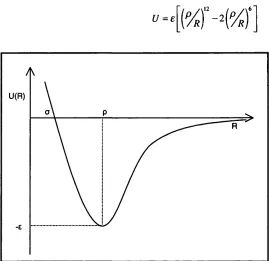
Figure 2.1 The intermolecular potential U as a function of the intermolecular separation R . 22
Figure 2.2 Diagrams representing the charge distributions that could be modelled by a pure point charge, dipole,
quadrupole and octadecapoles. 32
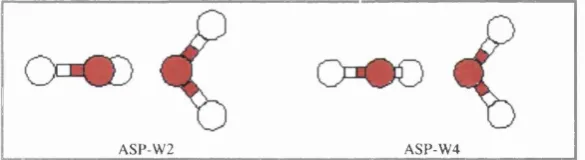
Figure 2.3 Geometry of the water dimer minimum, using ASP-W2 and ASP-W4 model potential. 39 Figure 2.4 A flow chart for the procedures required to derive a repulsion model using the overlap model. 47
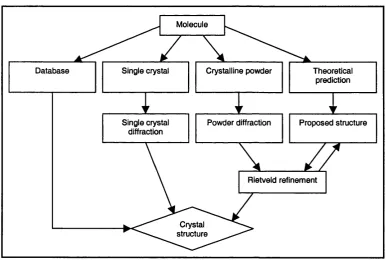
Figure 3.1 Flow chart of possible routes to obtain crystal structure. 53
Figure 4.1 The blind test molecule, 2-(2-phenylethenyl)-1,3,2-benzodioxaborole (Scheme 1). 59
Figure 4.2 Components used in CSD search. 59
Figure 4.3 Steps taken in blind crystal structure prediction. 60
Figure 4.4 Diagram of the benzodioxoboryl derivative with labelling of atoms, used for the potential derivation
(Scheme 2). 63
Figure 4.5 The dimer orientations used in IMPT calculation and in GMUL analysis. 69
Figure 4.6 The 20 relative orientations of the dimer of molecule 2 that were used to sample the IMPT exchange-
repulsion surface. 71
Figure 4.7 A graph of the 20 exchange-repulsion energies for the geometries in Figure 4.6 against corresponding model overlap derived from GMUL, to derive the proportionality constant K for the non-empirical
potential. 71
Figure 4.8 Minima found in search and minimised in DMAREL. 73
Figure 4.9 The three predicted crystal structures submitted for the blind test. 74
Figure 4.10 Overlay of the experimental structure (blue) and ab initio optimised (19° torsion) (magenta, with atom labels) molecular structures of 2-(2-phenylethenyl)-1,3,2-benzodioxaborole. 75 Figure 4.11 Experimental crystal structure of the blind test molecule,
2-(2-phenylethenyl)-1,3,2-benzodioxaborole. 76
Figure 4.12 Structural difference of the crystal structure prediction of
(2-(2-phenylethenyl)-1,3,2-benzodioxaborole) . 77
Figure 4.13 The experimental (X-ray) crystal structure of 1 overlaid with the global minimum in the lattice
energy found in the MOLPAK/DMAREL search. 78
Figure 4.14 Graphs of repulsion-dispersion energy for each atom-atom pairs using the 'estimated', non-empirical
and Williams’ models. 79
Figure 5.1 Minimum 1 Phenol proton donor - a diagram showing the different structural parameters, d (0 ...0 ),
3 and Y angles. 86
New Models for Intermolecular Repulsion and their Application to van d er W aals Helen H.Y. Tsui
List of Figures___________________________________________________________ 15 Figure 5.2 Minimum 2 Water proton donor - a diagram showing the different structural parameters, d (0 ...0 ),
P and Y angles. 86
Figure 5.3 Minimum 3 7i-bonded minimum - a diagram showing the different structural parameters, d (0...0), P,
and Y angles. 86
Figure 5.4 Minima of phenol-water complex determined from Feller and Feyereisen [11]. 89
Figure 5.5 Minima of phenol-water complex from Sagarik and Asawakun [17]. 92
Figure 5.6 Labelling of atoms for phenol molecule. 94
Figure 5.7 The three minima determined from all three model potentials. 97
Figure 5.8 Schematic diagram of the phenol proton donor (global minimum). 98
Figure 5.9 Geometries of minima from supermolecule calculation of full optimisation and frozen core. 101 Figure 6.1 Labelling of atom-atom pairs used in the overlap model, denoting the types used. 107 Figure 6.2 The 572 relative orientations of phenol-water complex that were used to sample in the overlap model.
108 Figure 6.3 The 69 relative orientations of the phenol-water complex that were used to sample the IMPT exchange
repulsion surface. 113
Figure 6.4 The dimer orientations used in IMPT calculation and in GMUL analysis. 115
Figure 6.5 Graph of plotted exchange-repulsion energies against model and GMUL overlaps. 117 Figure 6.6 Plots of repulsion-dispersion potential for Op... O* using the 631gss_rm model. 118 Figure 6.7 Plots of repulsion-dispersion potential for Op. ..H* using the 631gss_rm model. 118 Figure 6.8 Plots of repulsion-dispersion potential for Hp.. H* using the 631gss_rm model. 118 Figure 6.9 Plots of repulsion-dispersion potential for Q . . .0* using the 631gss_rm model. 119 Figure 6.10 Plots of repulsion-dispersion potential for C.. .H* using the 63lgssjrm model. 119 Figure 7.1 Graph of IMPT exchange-repulsion energy against GMUL overlap for the different basis set used. 133 Figure 7.2 Graph of IMPT exchange-repulsion energy against model overlap for the different basis set used. 133 Figure 7.3 Graphs of penetration energy versus GMUL and model overlap derived using MP2 6-3 IG** basis set.
135 Figure 7.4 Graphs of penetration energy versus GMUL and model overlap derived using MP2 6-31 IG** basis
set. 136
Figure 7.5 Graphs of penetration energy versus GMUL and model overlap derived using MP2 cc-pVDZ basis set. 136 Figure 7.6 Graphs of charge-transfer energy versus GMUL and model overlap derived using MP2 6-3 IG** basis
set. 136
Figure 7.7 Graphs of charge-transfer energy versus GMUL and model overlap derived using MP2 6-31 IG**
basis set. 136
Figure 7.8 Graphs of charge-transfer energy versus GMUL and model overlap derived using MP2 cc-pVDZ basis
set. 137
Figure 7.9 IMPT exchange-repulsion + penetration + charge-transfer energy against model overlap for
6311gss_rpcmmoéd. 141
Figure 7.10 Graph of IMPT energy against model overlap for the 6311 gss_rpcmn model. 142
Figure 8.1 Potential energy function showing the zero-point energy (ZPE). 146
Figure 8.2 Schematic diagram of population of replicas. 148
Figure 8.3 Flow chart of the core operations in the DMC algorithm. Each loop is a group of 100 RB-DMC time
steps of length At . 149
Figure 8.4 Flow chart of Rigid-Body Diffusion Monte Carlo (RB-DMC) program, Xdmc. 150
New Models for Intermolecular Repulsion and their Appiication to van der W aals Helen H.Y. Tsui
List of Figures____________________________________________________ ^ Figure 8.5 One-particle density plot for phenol-water complex using OPLS model, with the ORIENT minima
from Chapter 5 as starting positions. 154
Figure 8.6 One-particle density plot for phenol-water complex using FIT model, with the ORIENT minima from
Chapter 5 as starting positions. 154
Figure 8.7 One-particle density plot for phenol-water complex using NE-ANIS model, with the ORIENT minima
from Chapter 7 as starting positions. 154
Figure 9.1 Chemical diagram of chlorothalonil with numbering labels for atoms. 158
Figure 9.2 Diagram of chlorothalonil volume using spherical van der Waals radii. 159
Figure 9.3 Anisotropic repulsion along the local z-axes applied on chlorine and nitrogen atoms. 162 Figure 9.4 Diagram of chlorothalonil and cyanuric chloride volumes using spherical van der Waals radii. 168 Figure 9.5 Representation of the structural parameters’ sensitivity upon varying of K value. 169 Figure 9.6 Representation of the cell volume and lattice energy's sensitivity upon varying of K value. 169
Figure 9.7 Linear regression to fit K with cell volume. 170
Figure 9.8 Lattice energy change upon reduction of symmetry, for structures, which are minimised to a transition
state in the original space group. 171
Figure 9.9 Plot of minima found in search from MOLPAK and minimised in DMAREL using the FIT model. 172 Figure 9.10 27 distinct low minima by space group between lattice energy of -105 and -110 kJ/mol, using the FIT
model minimised in DMAREL using starting structures from MOLPAK. 172
Figure 9.II Predicted crystal structure FC45 ( P2^! c) (lowest minimum), which is visually indistinguishable
from the experimental structure. 175
Figure 9.12 Predicted crystal structure AB15 ( PI ). 176
Figure 9.13 Predicted crystal structure A144 ( P2,/c ). 176
Figure 9.14 Predicted crystal structure AF18 ( P2, ). 177
Figure 9.15 Predicted crystal structure AB3 ( PI ). 177
Figure 9.16 X-ray Powder diffraction patterns simulated using Cerius^ software [229]. 179 Figure 9.17 Diagrams of morphology, predicted from using the BFDH model and calculated from attachment
energy using the PCFF force field and the FIT force field with charges derived from Charge-Equilibration
(QEq_neutral 1.0) in Cerius^ [231]. 184
Figure 9.18 Figures of PI and P3/n structures solved using MC Powder solution by Tremayne [35]. 186
New Models for Intermolecular Repulsion and their Application to van der W aals Helen H.Y. Tsui
PART I INTRODUCTION 17
PARTI
INTRODUCTION
New Models for intermolecular Repulsion and their Application to van der W aals Helen H.Y. Tsui
1 Overview 18
1 Overview
The forces between molecules are of great scientific interest, as they control the properties of the solids, liquids, gases and the formation of complexes. In order to simulate these phases, we need to understand the intermolecular forces and build accurate quantitative models. This thesis develops a new non-empirical method of modelling the repulsion forces between organic molecules. These models are tested both against theoretical data, and in conjunction with models for other intermolecular contributions, in simulating van der Waals complexes and crystal structures. The non- empirical repulsion models developed in this thesis are shown to be comparable in accuracy to highly developed empirically fitted potentials when available. However, our methodology can be applied for atoms where transferability cannot be assumed and empirical potentials could not be derived.
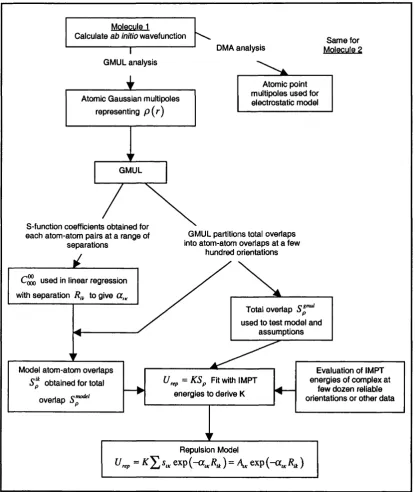
This thesis begins with an introduction to the theory of intermolecular forces (Chapter 2), demonstrating the need of improved models for describing these forces. An overview of all the contributions to the intermolecular forces that need to be modelled is given. The need for more accurate models for the short-range repulsive contribution is demonstrated to reach the accuracy provided by approaches such as Distributed Multipole Analysis (DMA) [1,2] for the electrostatic contribution. The overlap model of Wheatley and Price [3] was chosen as the basis of our repulsion development, since it is a method that only required the monomer wavefunctions of the molecules involved in the interaction. This model assumes that the repulsion is proportional to the overlap of the monomer charge distributions at all geometries that may be sampled in a simulation. An atom-atom repulsion model is fitted to the charge overlaps, and the proportionality is determined between the overlap and the exchange-repulsion energy. The exchange-repulsion energy is usually obtained from
New Models for intermolecular Repulsion and their Application to van der W aals Helen H.Y. Tsui
1 Overview_______________________________________________________ ^ intermolecular perturbation theory (IMPT) [4] calculations, and we have investigated the inclusion of charge-transfer and penetration energies.
New repulsion models were combined with distributed multipole electrostatic models and atomic polarizabilities derived dispersion models for simulations of crystal structures and van der Waals complexes. There is a need to understand the intermolecular forces that are responsible for organic crystal structures, since understanding and predicting crystal structures and polymorphism is important in organic crystalline materials, especially in pharmaceutical industry (Chapter 3 and 9). The studies of van der Waals complexes provide a severe testing of the model intermolecular potential (Chapter 3).
Application of the overlap model to van der Waals complexes is a severe test for investigating the capability and limitation of this method. The phenol-water complex was chosen to study, because it is a system that has been studied extensively [5-23], and could provide validation for the model (Chapter 5). Although there have been many ab initio studies on the system; high-level supermolecule calculations were carried out (Chapter 5) to provide results for direct comparisons with the model potentials that are extensively developed and tested (Chapter 6 and 7). In order to compare our results with experiment [7,8,12], we took into account the zero-point motion of the phenol-water complex by diffusion Monte Carlo (DMC) simulation [6,24-31] (Chapter 8).
A blind test of organic crystal structure prediction methods was set up in 1998 by the Cambridge Crystallographic Data Centre (CCDC), and a collaborative workshop held in May 1999 [32]. Most of the currently available methods of crystal structure prediction rely on model potentials to calculate the lattice energy of hypothetical crystal structures. One of the molecules used in the test was 2-(2- phenyletheny 1)-1,3,2-benzodioxaborole, which contains boron where there were no suitable empirical parameters available. This challenge provided an opportunity to test the ability of the overlap model to derive suitable repulsion parameters. Hence, we derived our own repulsion-dispersion model for the target molecule [33] and attempted to predict its crystal structure (Chapter 4).
Chlorothalonil is an important organic fungicide [34], and recently it was discovered there could be uncharacterised polymorphs. In order to investigate such possibility, we collaborated with experimentalists [35], to provide theoretical predictions of possible polymorphs and their powder diffraction patterns [36,37] (Chapter 9). Previous studies [38,39] suggested that the van der Waals radius of chlorine is not spherical, and therefore more accurate model potentials would model this anisotropy in the repulsion. A concurrent study of Mitchell and Price on cyanuric chloride [40] showed that the overlap model could be used to include anisotropy to model the repulsion potential. Following their approach, anisotropic repulsion terms were developed for simulating the crystal structure of chlorothalonil. A crystal structure prediction search was carried out, to determine the energetically feasible low energy structures. Calculations on the mechanical [41-43] and morphological [43-46] properties for hypothetical structures were used to eliminate some low energy structures as possible polymorphs.
Fundamentally this thesis is concerned with developing the modelling of the short-range repulsive forces, to produce accurate and reliable model potentials for simulating crystal structures and van der Waals complexes. The derivation of repulsion terms from the monomer wavefunction
New Models for Intermolecular Repulsion and their Application to van der W aals Helen H.Y. Tsui
1 Overview_________________________________________________________ ^ should provide a 'tailor made' description for the organic systems, unlike empirical transferable potentials. Although the accuracy of the model potential is reflected in the simulation, the reproduction of the experimental data also depends on the realism of the simulation techniques. However, the new method appears to produce potentials with an accuracy that is appropriate for the simulations.
New Models for Intermolecular Repulsion and their Application to van der W aals Helen H.Y. Tsui
2 The Theory of Intermolecular Forces__________________________ ^
2 The Theory of Intermolecular Forces
2.1 Summary
In this chapter, the theory of intermolecular forces is described with full detail, of their origin and importance in modelling. An example of a systematic potential for water dimer will be given. This provides insights into the importance of each possible contributions for the potential, as well as what is involved in constructing a model potential that aims to achieve as high accuracy as possible. Besides the electrostatic term that has been found to be the dominant intermolecular forces, the repulsion term is also identified to be important in modelling the intermolecular force, and it must be derived to reflect the true behaviour of this possible interaction. The range of repulsion models available will be described and their advantages and disadvantages compared briefly. The non- empirical atom-atom repulsion model that we use throughout the various studies in this thesis will be discussed in detail.
2.2 Introduction
The intermolecular energy U between two spherical neutral molecules is a function of the distance
R between them and must take the form as shown in Figure 2.1. It has an attractive region at long- range, where the force -Ô U jô R is negative, and a steep repulsive region at short-range to account for the low compressibility of condensed materials. There is a separation p where the energy is at its minimum, and a closer distance o where the energy of interaction goes through zero before climbing steeply. These are all conventional notations, as is the symbol e for the depth of the attractive well. New Models for Intermolecular Repulsion and their Application to van der W aals Helen H.Y. Tsui
2 The Theory of Intermolecular Forces 22 This well-known general form is often approximated by the well-known Lennard-Jones potential (Equation (2.1)), which is a function of the intermolecular distance R and two parameters p and e that depend on the molecule concerned.
U = e (2.1)
U(R)
Figure 2.1 The intermolecular potential U as n function of the intermolecular separation R .
For non-spherical molecules, the intermolecular energy also depends on the relative orientations of the molecules and may also be affected by their internal states. This makes the representation and characterisation of these interactions much more complex. Further complications arise when groups of three or more molecules must be considered, as in liquids, solids or gases. To a first approximation, for modelling solids the total intermolecular energy of a group of more than two molecules may be calculated by summing the energies for all the pairs of molecules in the group. All the non-additive terms such as charge-transfer and polarization are neglected when making this pairwise additive approximation, though some of these effects may be absorbed in empirically fitted pair potentials. However, it does explicitly include the electrostatic, repulsion and dispersion contributions, which are often the major contributions to the intermolecular potential.
The potential that has been used extensively in the description of organic molecules is the exp-6
atom-atom model potential, commonly used with a point charge electrostatic model (Equation (2.2)). This is commonly used in modelling crystal structures; usually using empirically fitted parameters.
(2.2)
where atoms i and k on two different molecules are of type i and K respectively.
Isotropic atom-atom potentials may be regarded as a fair approximation to the general description of the molecule, but the basic assumption of treating molecules as superposition of spherical charge distributions contradicts the modem theories of bonding. According to the modern theory of bonding, the valence electrons of atoms rearrange on bonding and the redistribution of
New Models for Intermolecular Repulsion and their Application to van der W aals Complexes and Crystals of Organic Molecules
2 The Theory of Intermolecular Forces_________________________________________________ 23 charge leads to non-spherical features such as 7i-density or lone pairs. Isotropic potentials will fail to describe the anisotropic effect of such features and hence, the need for better quantitative description of the intermolecular interactions led to the development of anisotropic potentials. For small polyatomics it is now possible to use potential that incorporate anisotropy for every contribution. Wheatley and Price [47] have constructed such a potential for (€12)2, and Millot, Stone and co workers for (H20)2 [48]. The complexity of these potentials indicates that in most cases, it is still a luxury for modelling most polyatomics. Sometimes isotropic potentials are quite adequate when anisotropy is not important. The rest of this chapter gives background to intermolecular forces that this isotropic atom-atom model is attempting to model, and outlines the improvements to this model that are made in the potentials developed and tested in this thesis.
2.3 The intermolecular forces between molecules
The contributions that are responsible for the attraction and repulsion between molecules can be divided into the long-range and short-range interactions, depending on the overlap between the molecular charge distribution. The energy for the long-range interactions has an inverse power relationship to the distance between the molecules, whereas the short-range one falls exponentially with distance. The intermolecular interactions are susceptible to classification by theoretical treatment, by regarding the interaction between the molecules as a perturbation for long-range [49]. This provides analytical expressions that can be quantified in terms of the properties of the individual molecular charge distributions. However, this approach breaks down when there is overlap between the two molecular charge distributions. Therefore there is no rigorous analytical theory for the interaction energy at short-range, where the repulsion dominates the exchange effects and the modification of the long-range terms. The various methods in approximating the repulsion will be discussed in detail later in this chapter. Each contribution to the interaction is described briefly below in terms of its physical significance.
2.4 Long-range interactions
The long-range effects are of three kinds: electrostatic, induction and dispersion. The electrostatic effects are the simplest to understand, since they arise from the classical interaction between the static charge distributions of the two molecules. They are strictly pairwise additive and may be either attractive or repulsive. Induction effects arise from the distortion of a particular molecule in the electric field of all its neighbouring molecules and are always attractive. Induction is strongly non additive, because the fields of several neighbouring molecules may reinforce each other or cancel out. Dispersion is not an effect that can be easily understood in classical terms. It arises when the charge distributions of the molecules are constantly fluctuating as the electrons move. All the long-range interactions are explained in detail below.
2.4.1 Electrostatic energy
Electrostatic energy is a classical interaction between the undistorted charge distributions of two molecules. For neutral molecules, it is due to the interactions between the charge distribution of New M odels for Intermolecular Repulsion and their Application to van der W aals Helen H.Y. Tsui
2 The Theory of Intermolecular Forces_________________________________________________ ^ molecules that are not spherical due to the nuclei and the electrons. The electrostatic interaction [49] can be expressed in the form of an integral over the charge density of the molecules:
(/.w — . = I P (>•')P = {0^0‘ \H \0‘'0‘ ) (2,3)
all space ^ 2 \
where ) is the charge distribution of the ground state wavefunction of molecule A in isolation, and H ' is the perturbation operator.
« ' = S - p - (2.4)
l e A j e B47T£o^ÿ
where e are the charges for the particles i and j and is the distance between particles i and j . The electrostatic energy is the first-order term in long-range perturbation theory and is usually the interaction that remains over the longest range. It is still practically impossible to evaluate this expression directly in any useful length of computer time. Alternatively, we can describe the distribution of charge in a molecule by simplified models using atomic charges or distributed multipole analysis (DMA) (See Section 2.6.3 for DMA). In this kind of description, the electrostatic interaction of two molecules separated by a relative long distance will depend on their separation, orientation, and multipole moments. Therefore the electrostatic term will be a sum of interactions between pairs of multipoles, each term falling off with distance as ^ where n, and are the orders o f the multipoles. There are problems associated with this central multipole expansion but these will be considered in detail later on. Electrostatic interaction shows the greater orientation dependence when compared to the other contributions. Hence, the electrostatic energy is expected to be the dominating force in determining the orientation of the interacting molecules.
2.4.2 Induction (polarization) energy
The induction energy [49] is a second-order perturbation theory, where the attractive term arises from the distortions of the charge density of each molecule due to the field arising from the other (undistorted) molecule:
induction Z u c A n-A ^
This term gives the additional energy due to the changes in the charge density of molecule A (a molecule with excited wavefunction and energy ) caused by the presence of molecule B, interacting with the undistorted ground state charge distribution of molecule B . The sum is thus over all the excited states of molecule A . There is a corresponding term that represents the induction energy for the first-order change in the charge density of molecule B induced by molecule A . The induction energy is always attractive because the distortions only occur to lower the energy of the pair of molecules.
The application of the multipole expansion allows the induction energy of A to be expressed in terms of the permanent multipole moments of B and the polarizabilities o f A , plus the orientation- dependent functions. The first polarizability is the dipole-dipole polarizability for all molecules, which
New Models for Intermolecular Repulsion and their Application to van der W aals Helen H.Y. Tsui
2 The Theory of Intermolecular Forces_________________________________________________ ^ describes the ease of changing the total dipole moment of the molecule. Therefore the first term in the induction energy varies as R~^, for any atom or molecule in the presence of a charge. The induction energy is very non-additive, for example if another charge is symmetrically placed on the opposite side of the molecule, there will be no induced dipole by symmetry, and the leading induction energy term is then determined by the quadrupolar polarizability. The induction energy is very important for the intermolecular interactions of ions, but the leading term for the induction energy arising from the presence of a dipolar molecule varies as R~^. This will often be very small for ensembles of neutral molecules, and zero for neutral spherical molecules. It is also very difficult to evaluate as non- pairwise; hence induction is normally neglected.
2.4.3 Dispersion energy
Dispersion interaction [49] occurs when an instantaneous dipole on one molecule induces a dipole on another molecule, and the two dipoles then interact to lower the energy. The two instantaneous dipoles are correlated and, although they occur in different orientations at different instants, the interaction does not average to zero. This can occur even when the molecules have no permanent dipole moment and can be visualised more generally as the interaction between the fluctuating charge distribution on one molecule with a second molecule. It may be represented as a second order perturbation theory:
^dispersion = “
2
~ a p A p B ^One example is argon, where there are no electrostatic or induction forces between the spherical molecules, but the dispersion forces enable the liquefaction of argon at low temperatures. The expression for the leading term in the dispersion energy may be represented as follow:
_ -3 a E, _ Q
where a is the polarizability of the molecule and E, is the ionization energy.
This was proposed by London [50] who first estimated the magnitude of the coefficient Q by assuming that the frequency of the oscillator model was that corresponding to the energy required for ionization of the molecule from its ground state. The dispersion energy is always attractive. The coefficient Q in Equation (2.7) is only an approximate parameter based on a simplified model, but it can be obtained more precisely. The Q value can be deduced using a combination of experimental and theoretical results, which illustrate the electronic transitions within the interacting molecules. The
Slater-Kirkwood relation [51] (Equation (2.7)) is an example, which will be discussed in detail in Chapter 4. The origin of this first term in the dispersion energy describes the interaction between an instantaneous dipole on one molecule and the induced dipole in another. There are further dispersion contributions in addition to this first term. The dispersion energy can be approximated as a series:
^ d isp ersio n ~ ^ ^ ' (^'^)
The additional terms arise from the interactions of higher order instantaneous multipoles, such as quadrupoles and octopoles. It is found that at large separations, only the leading term contributes New Models for Intermolecular Repulsion and their Application to van d er W aals Helen H.Y. Tsui
2 The Theory of Intermolecular Forces_________________________________________________ ^ substantially to the attractive energy [52]. Whereas at shorter separations near to the minimum of R , it is found that the higher terms can contribute one fifth of the total dispersion energy. The series is correct for spherical charge distributions, but often this is not the case in molecules, and hence, terms such as etc. should also be added. In addition, the coefficients would be functions of orientation of the molecules, if anisotropy were to be included in the potential. When charge overlap occurs, this modifies the functional form of all long-range terms.
2.5 Short-range interactions
Short-range interactions are contributions that arise at distances where the molecular wavefunctions overlap significantly. The most important contributions are the exchange and repulsion term, often combined together and described as the exchange-repulsion term. The remaining minor terms are charge penetration, charge-transfer and damping. The modification of the long-range terms arises from the overlap of the wavefunctions. These are discussed in detail below.
2.5.1 Exchange-repulsion energy
The exchange-repulsion energy [49] is a non-additive and repulsive term that consists of two components. The exchange energy is a consequence of the fact that electron motions can extend over both molecules, and is an attractive term. The second term arises when the electrons attempt to occupy the same region of space, and are forced to redistribute because the Pauli exclusion principle forbids electrons of the same spin to be in the same space. Since the repulsion energy is approximately twice as large as the exchange energy, their sum is repulsive and it is actually the dominant contribution at short-range.
2.5.2 Charge penetration
This is the error produced by the charge densities of two molecules overlapping each other, so close to each other that the nuclei on one molecule will no longer be shielded by its own electron density [49]. An electron that penetrates within the space occupied by an atom core, and is a short distance from the nucleus, will experience a reduced repulsion from the inner electrons compared to an electron outside the core. Hence a greater attraction will be experienced for the electron density associated with the other species, and produces an error in the multipole expansion at short-range. The energy difference resulting from this increased attraction is termed as charge penetration. If we assume that the penetration correction to the potential of molecule A , is proportional to the charge density
in the general case, then the correction to the energy is as follow:
= JAVX»,™,„ { r ) p ‘ (r)d^r - Jp'' (/-)p ' { r ) d ' r (2.9) It is essentially the difference between the electrostatic energy and the limit multipole expansion energy [53,54].
pen.,ration = ^ e ie c r v s .a tic ~ ^ m ultipolc BXpansion) (2.10)
The penetration correction can be modelled for practical purposes as part of the repulsion energy, which has a similar behaviour, and will be applied as shown in Chapter 7.
N ew M (xlels for Intermolecular Repulsion and their Application to van der W aals Helen H.Y. Tsui
2 The Theory of Intermolecular Forces________________________________________ 27
2.5.3 Charge-transfer energy
This is an attractive term and it arises from the transfer of charge from the occupied orbitals of one molecule to the unoccupied orbitals of another [49]. This term is very non-additive and its effect is difficult to estimate, as it is very dependent on the basis set used in the calculation. It is very often overestimated due to the basis set superposition error (BSSE). The BSSE problem originates from the fact that the basis sets used are never complete. Therefore in a complex A B, a molecule A can use the basis functions of B to improve its own wavefunction, thereby causing an unrealistic lowering of the energy of interaction. On the other hand, if very good quality basis sets are used, there is always the danger that charge-transfer is becoming part of the polarization energy, since the unoccupied orbitals of one molecule can now be represented in terms of basis functions of the other. Then, charge- transfer and polarization energy will be describing the same effect, thus, accounting twice for it. Hence this term is usually ignored, and is normally assumed to be absorbed by the exponential terms in model potentials. However, Stone [55] has computed the charge-transfer term in a BSSE-free manner, by incorporating it into his Intermolecular Perturbation Theory (IMPT) code in CADPAC [56]. Stone has compared results of his new method in determining the charge-transfer energy, along with the polarization energy calculated for the water dimer with a variety of basis sets. He concluded that his new method in comparison with the original IMPT [4] has shown that the charge-transfer energy can be calculated reliably within the framework of IMPT. It avoids contamination by basis set superposition error, and it is small by comparison with other contributions to the interaction energy. If accurate calculations need to be performed, then the charge-transfer energy should be taken into account, since Stone found that the charge-transfer contributes in the order of 20 % to the binding energy in water dimer. Charge-transfer is intrinsically non-additive. If the charge-transfer is genuinely a major contribution, then this interaction should be modelled at the electronic level rather than by an intermolecular potential. This is because the charge distribution of the complex is no longer a small perturbation on the sum of the isolated molecule distributions. It is a covalent bonding term and not an intermolecular equivalent to penetration for dispersion and induction. We included this BSSE free charge-transfer contribution into our repulsion term in our model potential in Chapter 7.
2.5.4 Damping
Damping functions are empirically fitted to damp off the dispersion [49], and, if applicable, the induction long-range terms. If the overlap between the interacting molecules is dependent on their orientation, then the damping functions should depend on orientation too. The dispersion energy appears as a power series in \jR , with the leading term -C^R~^. At short distances, this cannot be correct. Therefore the dispersion energy is damped using damping functions.
^disp (2-11)
where /s ( ^ ) , f» { R ), etc., are damping functions that tend to 1 as 7? —> oo, and to zero as 7? —» 0 , to
suppress the corresponding RT" singularity. For non-centrosymmetric molecules, there will be similar
New Models for Intermolecular Repulsion and their Application to van der W aals Helen H.Y. Tsui
2 The Theory of Intermolecular Forces_________________________________________________ ^ terms in odd powers of \jR . The induction energy behaves similarly, for ions the leading term in the
multipole expansions behaves like R~^, while for neutral polar molecules it is proportional to R~^.
There are currently three well-known damping functions, namely Tang-Toennies [57], Koide-Meath-Allnatt [58] and Hartree-Fock [59] damping functions.
Tang-Toennies: /„ (/?) = l - c \ i p { - b R ) ^ ^ ^ —j— (2.12) t=o k.
where b , a distance scaling factor, is usually the parameter B in the Bom-M ayer repulsion.
Koide-Meath-Allnatt: /„° (/?) = | ^ l - e x p ( - a „ 7 ? - è „ / ? ^ (2. 13)
Hartree-Fock: F (/?) = exp [ - (l .28F„, //? - 1)' ] (2.14)
The effects of damping functions will be shown in detail in Chapter 6, where the application of a damping function is essential. Apart from improving accuracy, the damping function overcomes the problems caused by the short-range maximum in the exp-6 potential in some types of simulation. Whereas for modelling crystal structures {e.g. minimising from physically reasonable starting points), a damping function is not necessary since it is very rare that the interacting molecules will overlap very close to each other.
2.6 The electrostatic forces between molecules and their
representation in model potentials
The calculation of the electrostatic energy requires good quality ground state wavefunctions of the isolated molecule [60]. Due to the recent advances in computing power and software, the wavefunctions and the use of better quality basis sets is now available even for larger systems. However, integration over the charge density is still an unrealistic task for computers. Hence, the current methods use parameterised representations of the charge densities that yield the electrostatic energy as a function of the relative orientation of the molecules in the interaction. Here below are descriptions of some of the traditional methods for calculating the electrostatic potential, and some advances on these methods.
2.6.1 The point charge model
The atomic point charge model assumes that the charge density of the molecule can be described by superimposing spherical atomic charge densities. This provides a reasonable picture of the molecular shape and it simplifies the procedures to implement into a computational program. Originally, the values for the charges were empirically fitted using experimental data [61]. It was soon realised that this was not the best approach for organic molecules, where it required a lot of assumptions with no physical significance to keep the number of charges to be fitted to a minimum. Therefore the Mulliken charges [62] were used instead of the experimental information, as it became clear that charges derived from the wavefunction could be a solution to the problem. Later on, various methods were suggested, in order to overcome the strong basis set dependence of the Mulliken charges.
New Models for Intermolecular Repulsion and their Application to van der W aals Helen H.Y. Tsui
2 The Theory of Intermolecular Forces_________________________________________________ ^ Wiberg and Rablen [63] reported a number of schemes for assigning atomic charges, and concluded that atomic point charge models can never exactly reproduce the electrostatic potential around a number of different molecules. Their findings conclude that the charge distribution within a molecule is too anisotropic, and cannot be successfully described using simple sets of atom-centred charges unless it is only required to model the long distance interaction. The failure of the simple atomic model is due to the inherent assumption that the charge distribution can be approximated by a superposition of spherical point charges. The electrostatic forces arise from the distribution of the valence electrons. On bonding, the charge is redistributed between the atoms so that the atomic charge densities remain spherical. The assumption that the charge densities remain spherical is a gross approximation, particularly as the valence electron density includes non-spherical features such as lone pairs and 7C-electron density. It can never account for anisotropic features that are often important in determining the electrostatic interactions of molecules. A model that attempts to advance beyond the treatment of atoms as non-spherical includes the Distributed Multipole Analysis model (See Section 2.6.3), which is a natural extension of the Central Multipole model (See Section 2.6.2).
2.6.2 The central multipole expansion model
It is possible to obtain the electrostatic interaction of two molecules as a series of expansion in terms of the multipole moments, dipole, quadrupole, octopole, etc. of the two isolated molecules. The actual mathematical expression has the following form:
' A + 4 1
1
J'
£ /„ ( R ,£ 2 ,£ iA 5 ) = £ (2.i5)
/ ; / \
where is a binomial coefficient and is the distance between the centre of mass of
molecule A and the centre of mass of molecule B . 2/ft, are the components of the multipole moments of A (referred to local axes), where I refers to the rank of the multipole and k to its components, for example is the z-component of the dipole moment. These functions depend on the orientations of the molecules as well as the direction of the intermolecular vector R^g. Calculations using this potential are further simplified by the fact that the multipole moments are often zero due to symmetry. The orientation dependence of the electrostatic interaction is represented by the factor , which is defined by [64]:
/ ; I ; \
(2.16)
A 4 j
m, m
where the are Wigner rotation matrices, the expression in parentheses is a Wigner 3 j coupling coefficient [65], and Q , , and Q,2 define the orientations respectively of the two molecules and of the vector joining their centres. The summation over w ,, and m is implied. It is often convenient to re-normalise the S functions of even total rank /, + 4 + j in the following way:
(2.17)
New Models for Intermolecular Repulsion and their Application to van der W aals Helen H.Y. Tsui