Licensed under Creative Common Page 42
http://ijecm.co.uk/
ISSN 2348 0386
THE EFFECT OF EDUCATIONAL PROCESSES IN THE
EFQM MODEL ON KNOWLEDGE, ATTITUDE, SKILL
IMPROVEMENT AND SATISFACTION
Sara Rabiei
Department of management, Islamic Azad University, Iran [email protected]
Malihe Rostami
Department of management, university of Grenoble, France Department of finance and accounting, Islamic Azad University, Iran
Abstract
In this study, the effect of educational processes in the European foundation for quality
management (EFQM) model on improving the knowledge, attitudes, skills and employees
satisfaction was considered. For this, the most important indicators of the educational process in
the EFQM model were identified. The educational process as leadership and strategy of training
and development of human resources, intellectual capital and knowledge management was
identified and to evaluate the results of the knowledge and skills and satisfaction of employees.
Then, indicators which are derived from the literature are used in a standard questionnaire. To
evaluate each indicator belonging to each factor, exploratory factor analysis and confirmatory
factor analysis were used to prove the hypothesis. According to the results, each of the three
factors, leadership and strategy of training and development of human resources, intellectual
capital and knowledge management were in good condition and impact factors for the
identification of priority the impact factors have been educational processes, respectively 70%,
73% and 79%. So it can be said that the most affected are the highest priority on the
educational processes comes from the lack of intellectual capital and knowledge management.
Keywords: EFQM model, learning process, training, development of human resources,
Licensed under Creative Common Page 43
INTRODUCTION
The purpose of the business excellence model of an organization is to support internal evaluation of quality. EFQM (European foundation for quality management) Foundation in 1989 was established and then was confirmed by the Commission in Europe and in 1991, the EFQM Model is formed. EFQM model include some concepts such as result-oriented, customer focus, leadership and stability purposes, and fact-based management process, development and involvement, continuous learning and improvement, development cooperation, trade and Corporate Social Responsibility (Islamizade and Torabpour, 1390).
EFQM is also has nine axes. Five axes of model are related to the enablers and expression of components of an organization and how they interact with each other and the next four axes are related to the results of performance and implementation of enablers. Nine indicators in this model can evaluate an organization fully assess all aspects and identify strengths and improvement points (Russell, S., 2000 and Calvo-Mora et al., 2015)
Leadership axis clarifies that how managers can influence on something. The next axis is strategy and policy of the organization with regard to the mission, values, vision and strategic guidance, in particular the concept of total quality. People or employee axis focuses on the advantage of the employees. The Partnerships axis is to focus on how organizations manage resources effectively and efficiently. The processes axis indicates that organizations how to identify, manage, review and improve its own processes. In this model people, customer and society results consider as results step and at the end key performance results show organization performance (Hakkak, M., & Ghodsi, M., 2015).
Problem statement
Licensed under Creative Common Page 44 The evaluation is a concept of regular review, systematic and comprehensive organization of activities and results is based on a model of excellence and also helps organizations to start excellence journey and consider current position, target position and how to move from the current state to the desired state (Dodangeh, J. & Rosnah, M., 2011, Dehnavieh R., 2006). Using these models, organization can evaluate its success in
implementing its improvement plans in various periods; moreover, it can compare its performance with other organizations especially the best ones. Recently, most countries in the world relying on these models have created rewards at regional and national levels as motivation for organizations and businesses in deriving excellence, growth and wealth creation. Among these models, EFQM is recognized as one of the most comprehensive performance evaluation models and it has been a pattern for many other countries to design this reward. EFQM model presents a pattern from an organization which is leading in the idea and action compared to other organizations and shows how to act in a competitive space for stability and excellence. EFQM model is a picture of a map which can be utilized by any organization to develop its various managerial and operational aspects in an integrated and comprehensive framework (Hakkak, M., & Ghodsi, M. (2015).
EFQM model determine the extent of organization and repair organization has developed to achieve excellence. With this model which is to identify the current status of the diagnostic aspects compared to an ideal of action. Using this model, organizations can identify strengths, areas of improvement and growth of the organization on the path to excellence (Hides et al., S., 2004, Calvo-Mora et al., 2015). Due to its continuous improvement cycle, EFQM model acts as a useful framework to improve the structure of quality in the organization. This cycle is started by a self-evaluation for understanding current status and obtained results (Hakkak, M., & Ghodsi, M. (2015). Training and development of human resources is one of the most important issues and major challenges. In this way, the benefit of the EFQM model in the educational process can be a way to identify the progress of knowledge, attitude and satisfaction of employees.
The concept of excellence
Licensed under Creative Common Page 45 Organizations need to establish an appropriate management system to achieve success, irrespective of the sector, size or structure. Here, the EFQM Excellence Model sets out a practical and non-prescriptive management system that allows organizations to: (1) prepare a basic structure for the design, implementation and improvement of a comprehensive management system; (2) evaluate their position on the path towards excellence, identifying their strengths and weaknesses as a starting point for the establishment of strengthening and improvement plans; (3) prepare a common framework and language that favors effective communication within the structure and (4) systematically integrate the strategic planning and interest group orientation into their management (Calvo-Mora, et al., (2015)
Excellence with an aesthetic approach and say it is a way to create balance and perfection in the fields of science, art and morality. Despite sharing a great concept that exists between the quality and excellence, excellence is not only assessing customer needs but also go beyond customer expectations. Another definition of excellence is to estimate the full organizational and stakeholder needs at the lowest cost with the highest quality (Mullen, 2002, Inayet et al., 2007). Excellence and strategic approach to estimate the definition is complete customer satisfaction (Mirsepassi et al., 2010, Monzavi & Zareii, 2010)
Organizational excellence
Over the past few decades, organizational excellence is frequently used in terms of quality. Excellence as quality literature written by many authors, it is the same or similar terms of total quality management. In fact, total quality management is internal and external customer satisfaction with minimal resources. In other words, the overall goal is achieving stakeholder satisfaction or organizational excellence. This model can be used as a model for implementation of total quality management in organizations (Haghighi, 2006, Vallejo et al., 2007).
Organizational excellence is a general method that leads to achieving balanced stakeholder's satisfaction. Thus it increases the probability of success. EFQM defines excellence as the collection of managing and achieving results based on eight basic concepts of the organization, result-oriented, leadership, stability of purpose, management by processes, people development and involvement, continuous learning, innovation and improvement, partners and increase public accountability (Tutuncu et al., 2007 and Zangeneh, 2009)
Licensed under Creative Common Page 46 self-interest and should be established according to the general mission of the organization. Also, the employees as an important factor in organizational excellence move effective to improve organization. Organizations respect to their employees, to achieve organizational and individual goals. They developed capabilities of their employees and to promote justice and equality (Steed et al., 2005 and Islamizade & Torabpour, 1390).
The EFQM excellence model
The EFQM excellence model is a non-prescriptive framework based on nine criteria, each with a specific weighting. Five of these are 'Enablers' and four are 'Results'. The 'Enablers' criteria cover what an organization does. The 'Results' criteria cover what an organization achieves. 'Enablers' cause 'Results'. The model recognizes that there are many approaches to achieving sustainable excellence in all aspects of performance and is based on the premise that excellent results with respect to performance, customers, personnel and society are achieved through partnership, resources and processes (Gené-Badia, J et al., 2001).
In Europe, the EFQM Excellence Model is the best-known and most widespread reference when introducing and improving a TQM system (Calvo-Mora et al., 2015). The EFQM excellence model is a generic model for quality management, which is used in all types of organizations, regardless of sector, size, structure or maturity. The essence of the approach is the model with nine dimensions, which are called criteria. The nine criteria are: leadership, people, policy & strategy, partnership and resources, processes, people results, customer results, society results and key performance results (Nabitz, U. et al., 2000). The EFQM excellence model is shown in figure 1.
Figure 1. The EFQM excellence model (Nabitz, U. et al., 2000, Calvo-Mora et al., 2015)
Enablers Results Leadership People Processes People results Key performance results
Licensed under Creative Common Page 47 Innovation & Learning
Main research objectives
1. Identify the impact of education processes to improve the level of knowledge, attitudes and skills.
2. Identify the impact of education processes on employees' satisfaction.
Other research objectives
1. Identify the effect of leadership training and development of human resources to improve the knowledge, attitudes and skills level
2. Identify the impact of training and development of human resources strategy to improve the knowledge, attitudes and skills level
3. Identify the impact of intellectual capital and knowledge management to improve the knowledge, attitudes and skills level
4. Identify the impact of leadership training and development of human resources on employees' satisfaction
5. Identify the impact of training and development of human resources strategy on employees' satisfaction
6. Identify the impact of intellectual capital and knowledge management on employees' satisfaction
Research hypotheses
1. The leadership training and development of human resources effect on improvement of knowledge, attitude and skills level.
2. The training and development of human resources strategy effect on improvement of knowledge, attitude and skills of level.
3. The management of intellectual capital and knowledge effect on improvement of knowledge, attitude and skills level.
4. The leadership training and development of human resources effect on employees' satisfaction.
5. The training and development of human resource strategies effect on employees' satisfaction.
Licensed under Creative Common Page 48
Research model
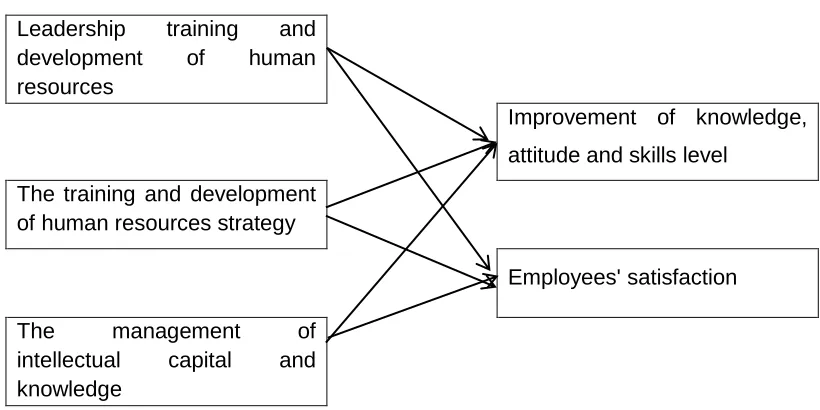
Research model is shown in figure 2. In this model, the effect of educational processes in the EFQM model on improving the knowledge, attitudes, skills and satisfaction are discussed.
Figure 2. Research model
Leadership training and development of human resources
Improvement of knowledge, attitude and skills level
The training and development of human resources strategy
Employees' satisfaction
The management of
intellectual capital and knowledge
Research variables
In a study to answer the research question or hypothesis tests, diagnosis of variables is essential. In this study, two types of variables are taken according to table 1.
Table 1. Research variables Variables Sub-variables Indicators
Education processes Leadership training and development of human resources
The role of manager in support of excellence culture, The effect of management to minimize the cost,
Decision management for continuation or discontinuation of a training program, Training needs assessments in the organization,
Communication and interaction leaders with learners and awareness of needs, Develop a corporate culture focused on education,
The development of educational goals and policies, The efficiency and effectiveness of courses. The training and
development of human resources strategy
Design and development of training strategies,
Participation of senior managers and staff in the design and development of educational strategies,
Licensed under Creative Common Page 49 The value system of training courses.
The management of intellectual capital and knowledge
Design and development of intellectual capital and knowledge management strategy,
Good access to information,
Taking advantage of information technology,
Effective use of intellectual capital and knowledge management, The formation of creative thinking and innovation in human resources. Improvement
of
knowledge, attitude and skills level
- Tend to re-training,
Satisfaction from the professors and, Innovations in employee performance, Positive behavior changes with training.
employees' Satisfaction
- Reduce absenteeism and Leave and move on, Reduce complaints of educational processes, Increase the number of certificates received, High staff motivation for better performance, Being innovative for changes in jobs.
Independent variable
Educational processes in model, which has three sub-variable as independent variable which include leadership training and development of human resources, training and development of human resources strategy, the management of intellectual capital and knowledge.
Dependent variable
In this study, the dependent variable is the improvement of knowledge, attitudes and skills level and employees' satisfaction.
RESEARCH METHODOLOGY
In this study, for evaluating the proposed model exploratory factor analysis was used to investigate the relationship between each variables and questions of questionnaire. For this purpose, questions were examined with SPSS software and Factor Analysis test to identify factors research. From twenty-eight questions that were entered to software, the four variables have a greater variance more than one, which were identified as main factors.
Then chosen variables were entered to factor matrix to evaluate the dependency of each indicator to variable. Also, in order to determine reliability of questionnaire which was used in this study, the of Cronbach's alpha test is used. The Alpha range can be between zero up to
Licensed under Creative Common Page 50 one and whatever they obtained number is close to one, so the reliability of questionnaire is more. For this purpose, as shown in the tables 2 and 3, a sample of 28 pre-test questionnaires are chosen and examined, and the coefficient alpha was 0.946. And then for the entire sample was 0.965.
Table 2. Cronbach's Alpha test of model
Number of sample Number of question Alpha
82 82 6.9.0
886 82 6.900
Table 3. Cronbach's Alpha test of each variable
Variable Alpha
Leadership training and development of human resources 0.824 The training and development of human resources strategy 0.826 The management of intellectual capital and knowledge 0.819 Improvement of knowledge, attitude and skills level 0.835
Employees' satisfaction 0.819
For determination of questionnaires validity, experts and specialists opinions were used. Also the sample adequacy test is deployed. To this aim, KMO and Bartlett's tests are used. According to KMO test result which is about 0.8 and the significant level which is 0.00, the sample adequacy of the data for factor analysis is confirmed.
EMPIRICAL RESULTS AND DISCUSSION
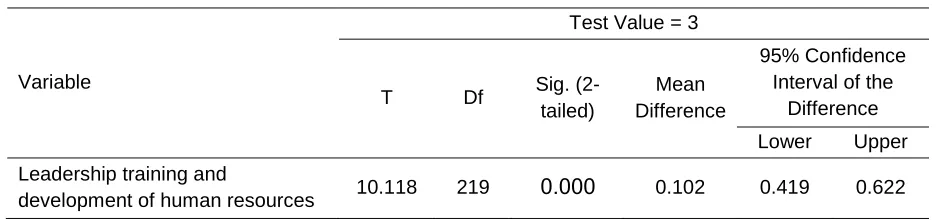
In examining the current state of variables was used from one sample t-test. Based on the results of the analysis of T-test, it is clear all significant level is less than 0.05 which means that all variables were important within the sampled expert. As it is shown in table 4, leadership, training and development of human resources, the training and development of human resources strategy and intellectual capital management has been acquired in model.
Table 4. One sample T-test
Variable
Test Value = 3
T Df Sig. (2-tailed)
Mean Difference
95% Confidence Interval of the
Difference Lower Upper Leadership training and
Licensed under Creative Common Page 51 The training and development of
human resources strategy 8.369 219 6.666 0.491 0.375 0.607 The management of intellectual
capital and knowledge 8.904 219 6.666 0.498 0.387 0.608 In this study according to the research content, Confirmatory factor analysis (CFA) is used and all variables and indicators of are discussed. T-values and Regression coefficients estimates in model are shown in figures. These figures are discussed about all variables and indicators priorities.
Also, Fit indices such as NFI (Normed Fit Index), NNFI (Non-Normed Fit Index), CFI (Comparative Fit Index), RFI (Relative Fit Index), GFI (Goodness of Fit Index), AGFI (Adjusted Goodness of Fit Index) are provided to prove model. Three conditions of hypothesis acceptance
RMSE is in the acceptable range.
All fit-indices are more than 0.9 which are shown acceptance of model.
Significant coefficients must be greater than +1.96 and less than -1.96 that significant
numbers is a bit higher than +1.96, so this condition is well established.
a) Exogenous variables of model
a-1. Exogenous variables
Symbol Variable
LEADER Leadership training and development of human resources
STRATEG The training and development of human resources strategy
MANAGEMENT The management of intellectual capital and knowledge
Licensed under Creative Common Page 52 a-3. Regression coefficients estimates of exogenous variables
a-4. Fit indices of exogenous variables Fit indices Amount
NFI 0.96
NNFI 0.97
CFI 0.97
Licensed under Creative Common Page 53
GFI 0.96
AGFI 0.95
b) Endogenous variables of model
b-1. Endogenous variables Symbol Variable
IMPROVE
Improvement of knowledge, attitude and skills level
SATISFICTION Satisfaction
b-2. T-values of endogenous variables
Licensed under Creative Common Page 54 b-4. Fit indices of endogenous variables
Fit indices Amount
NFI 0.98
NNFI 0.98
CFI 0.99
RFI 0.99
GFI 0.94
AGFI 0.9
c) First hypothesis
The leadership training and development of human resources effect on improvement of knowledge, attitude and skills level.
Leadership training and human resource development impact of 49% on improving knowledge, attitudes and skills of employees.
Licensed under Creative Common Page 56 c-3. Fit indices of first hypothesis
Fit indices Amount
NFI 0.97
NNFI 0.98
CFI 0.98
RFI 0.96
GFI 0.9
AGFI 0.9
d) Second hypothesis
The training and development of human resources strategy effect on improvement of knowledge, attitude and skills of level.
Licensed under Creative Common Page 57 d-1. T-values of second hypothesis
d-2. Estimates of second hypothesis
Licensed under Creative Common Page 58 Fit indices Amount
NFI 0.97
NNFI 0.98
CFI 0.98
RFI 0.96
GFI 0.92
AGFI 0.9
e) Third hypothesis
The management of intellectual capital and knowledge effect on improvement of knowledge, attitude and skills level.
The third hypothesis is accepted with a coefficient of 42%.
e-1. T-values of third hypothesis
Licensed under Creative Common Page 59 e-3. Fit indices of third hypothesis
Fit indices Amount
NFI 0.98
NNFI 0.98
CFI 0.99
RFI 0.97
GFI 0.93
AGFI 0.9
f) Forth hypothesis
The leadership training and development of human resources effect on satisfaction. The forth hypothesis is accepted with a coefficient of 54%.
Licensed under Creative Common Page 61 f-3. Fit indices of forth hypothesis
Fit indices Amount
NFI 0.96
NNFI 0.97
CFI 0.98
RFI 0.96
GFI 0.91
AGFI 0.91
g) Fifth hypothesis
The training and development of human resource strategies effect on satisfaction. The fifth hypothesis is accepted with a coefficient of 64%.
Licensed under Creative Common Page 62 g-2. Estimates of fifth hypothesis
g-3. Fit indices of fifth hypothesis
Fit indices Amount
NFI 0.98
NNFI 0.98
CFI 0.98
RFI 0.97
GFI 0.91
AGFI 0.9
h) Sixth hypothesis
The management of intellectual capital and knowledge effect on satisfaction. The sixth hypothesis is accepted with a coefficient of 62%.
Licensed under Creative Common Page 63 h-2. Estimates of sixth hypothesis
Licensed under Creative Common Page 64 Fit indices Amount
NFI 0.97
NNFI 0.97
CFI 0.98
RFI 0.96
GFI 0.94
AGFI 0.93
CONCLUSION
The EFQM model is a model to make excellence an organization to get more quality and result. This model is based on the premise that enablers direct and drive the results. An organization with well-developed enablers will have excellent results (Nabitz et al., 2000). In this study, the effect of educational processes in the EFQM model on improving the knowledge, attitudes, skills and satisfaction was considered.
According to hypotheses and research results, Leaders of excellence organization concentrate on mission, vision, values and basic principles of education and human resources development. They have created a culture of excellence and a role model in play. They also motivate employees and support them and pay attention to their satisfaction.
Nowadays, organizations pay attention to mission, vision and strategic objectives through the creation, development and implementation of training and human resource development. They try to design strategy of training and human resource development efforts and teamwork between senior managers and staff.
Excellent organization by measuring the management and development of human capital have found helpful. Transparency and stability in the intentions of the leaders of the organization and provides an environment in which the organization and staff can achieve excellence. Understanding the strategy of training and development can attract staff satisfaction. Also, an organization gains the highest level that behaves based on knowledge management and sharing and continuous improvement.
RESEARCH LIMITATIONS
In this study, there was a limitation which was about knowledge. People did not have complete awareness about EFQM model. So for fulfilling the questionnaire it was necessary to improve their view and knowledge.
Licensed under Creative Common Page 65 Balbastre, F. Canet-Giner, M. T. (2011). The strategy formation process in the EFQM Excellence Model: a critical review and new perspectives. Total Quality Management & Business Excellence, Issue 7. Campatellia, G. Cittib, P. &Meneghin, A. (2011). “Development of a simplified approach based on the EFQM model and Six Sigma for the implementation of TQM principles in a university administration”. Total Quality Management & Business Excellence, Volume. 22, Issue 7.
Calvo-Mora, A., Navarro-García, A., & Periañez-Cristobal, R. (2015). Project to improve knowledge management and key business results through the EFQM excellence model. International Journal of Project Management.
Calvo-Mora, A., Picón-Berjoyo, A., Ruiz-Moreno, C., & Cauzo-Bottala, L. (2015). Contextual and mediation analysis between TQM critical factors and organisational results in the EFQM Excellence Model framework. International Journal of Production Research, 53(7), 2186-2201.
Dehnavieh R., (2006), Self-assessment based on EFQM Excellence Model in hasheminejad hospital in Iran. Proceedings Seventh International Conference on Quality management, Tehran, Iran; 2006. p. 105-18.
Dodangeh, J. & Rosnah, M. (2011).“Designing Fuzzy Multi Criteria Decision Making Model for Best Selection of Areas for Improvement in European Foundation for Quality Management (EFQM) Model”. African Journal of Business Management, Vol. 5, No. 12, pp. 5010-5021.
Gené-Badia, J., Jodar-Solà, G., Peguero-Rodriguez, E., Contel-Segura, J. C., & Moliner-Molins, C. (2001). The EFQM excellence model is useful for primary health care teams. Family Practice, 18(4), 407-409.
Haghighi, M.. (2006). Review of standards iso 9000 series standards of organizational excellence model EFQM, Management Journal, Vol. 18, No. 129, S10-25.
Hakkak, M., & Ghodsi, M. (2015). Impact of implementing total productive maintenance system on organisational excellence based on EFQM model.International Journal of Business Excellence, 8(2), 197-209.
Hides, M. T., Davies, J., & Jackson, S. (2004). Implementation of EFQM excellence model self-assessment in the UK higher education sector-lessons learned from other sectors. The TQM magazine, 16(3), 194-201.
Inayet,A., and karaman- kepeneki. Y.(2007) . "Principals, opinions of organizational justice in elementary schools in Turkey " , Journal of Educational Administration , Vol . 46, No4, PP 497-513.
Islamizade, S. & Torabpour, A., (2011). Self-evaluation based on the EFQM in hospital (Ahvaz), Health Information Management, Vol. 8, No. 2, PP. 138-147.
Jonas, G., Kikuo , N., Tadashi , O. (2002),"Evaluation of TQM in Japanese industries and vali-dation of a self-assessment questionnaire", the TQM magazine, vol.14
Monzavi, T. Zareii, B. (2010). A model to explain the factors affecting the compliance process with the users of information systems: research on Iranian Offshore Engineering and Construction Company, Information Technology Management, Volume 2, Issue 5, pp. 129-148.
Mirsepassi, N. Tolouii Ashlaqi, A., Memarzade, Gh. Peidaii, M. M., (2010), Excellence model of human resources in state agencies using the Delphi technique fuzzy, Journal of Management Studies, No. 87, Ss1-23.
Nabitz, U., Klazinga, N., & Walburg, J. A. N. (2000). The EFQM excellence model: European and Dutch experiences with the EFQM approach in health care. International Journal for Quality in Health Care, 12(3), 191-202.
Russell, S. (2000). ISO 9000: 2000 and the EFQM excellence model: competition or co-operation?. Total quality management, 11(4-6), 657-665.
Licensed under Creative Common Page 66 Steed, C., Maslow, D., & Mazaletskaya, A. (2005). The EFQM Excellence Model for Deploying Quality Management: A British‐Russian Journey. Higher education in Europe, 30(3-4), 307-319.
Tutuncu, O., & Kucukusta, D. (2007). Relationship between organizational commitment and EFQM business excellence model: A study on Turkish quality award winners. Total Quality Management, 18(10), 1083-1096.
Vallejo, P., Ruiz-Sancho, A., Domínguez, M., Ayuso, M. J., Méndez, L., Romo, J., ... & Arango, C. (2007). Improving quality at the hospital psychiatric ward level through the use of the EFQM model. International Journal for Quality in Health Care, 19(2), 74-79.