IJSRR, 7(2) April – June, 2018 Page 167
Research article
Available online www.ijsrr.org
ISSN: 2279–0543
International Journal of Scientific Research and Reviews
Smart Agriculture based on IOT Control
A.
Subramanian
*, P. Mohana
2*
Department of Electrical and Electronic Engineering, IFET College of Engineering,
Villupuram,[email protected]
2
Department of Electrical and Electronic Engineering, IFET College of Engineering,
Villupuram, [email protected]
_____________________________________________________________________________
ABSTRACT
Agriculture is the backbone of our country. Growing agriculture products to the increasing population is mandatory at a huge level using smart methods. In this proposed work internet of things (IOT) is adopted for better monitoring and control of soil parameters, environment factors and crop dependent issues towards increasing the productivity. Different methods are employed on transferring the parameter between controller, devices and internet. In this work Wi-Fi communication method applied on signal transfer. Advanced microcontroller based prototype has been developed and thesignificance of the proposed work is studied. Results reveal the suitability of smart crop management system in agriculture.
KEY WORD
: Internet of things, sensors, Wi-Fi, Microcontroller*
Corresponding Author
A.
Subramanian
*Department of Electrical and Electronic Engineering,
IFET College of Engineering, Villupuram,
IJSRR, 7(2) April – June, 2018 Page 168
1.
INTRODUCTION
In this era automatic control is emerging in all fields of engineering on account of
increasing the productivity, reducing the losses and minimizing the man power. In the present
scenario application of wireless sensors and internet of things (IOT) are involved in all fields
which were already had monitored and controlled using nomadic technique and some
artificial intelligent based method.Wireless sensors or internet of things are effectively used
in the agriculture field for monitoring and controlling the different soil parameters of the land
towards increasing the productivity and saving the electric power, water usage and man
power.Different types of sensors are used to detect various signals of soil level, crops and
environment conditions and also comparable communication techniques are used on
communicating the data collected and transmitting the control signals. Control process using
microcontroller with increased memory capacity, timer and I/O port are adopted in the
agriculture monitoring and control using IOT 1. Expert systems are evolving 2 in agriculture
smart cropping by taking measures on proactive and preventive control actions on diseases
and insects to reduce the losses. Agriculture products production to meet out requirement 3 is
vital in the developing countries with high population, using IOT automation technology.
Wireless sensor network (WSN) is the key role players in IOTbased agriculture production 4.
Developing sensitive high accuracy sensors are very important to use in the agriculture field
to sense and collect different parameters of the soil and environment to improve the reliability
of the agriculture soil. Traditionally formers made oral observation on the health condition of
the crops, soli and environmenton5 fertilization, pesticides supply and watering. Thismethod
produced moderate yield which is uncertain. IOT based sensors application conforms the
quantity of the output from the agriculture. Monitoring soil fertility and environmental factors
6
is viable on improving the agro products outcome. The use of sensors is consistent on soil
parameters, environmental conditions towards improving the productivity. IOT gateway is
responsible for the transceiver operations of signals between devices and controllers 7 on
increasing the productivity from agriculture and minimizing the electric power handling on
the operation of various electrical devices, sensors etc. Remote area (area where electric
power or mechanical engines are not available) agriculture is difficult because of laying
electrical wires and cables 8,9 and this problem can be eliminated by installing PV cell based
renewable energy system generating the required power for pumping and control action of
the IOT based automation system. Smart farming will reduce the burden on handling
IJSRR, 7(2) April – June, 2018 Page 169 experimental set has been developed to understand the IOT based agriculture and Section 1
discusses the literature survey on the IOT controlled agriculture forming and section 2
explains the architecture and operation of various types of sensors and microcontroller
accomplished in this work and section 3 elaborate the operation of the experimental set and
section 4 gives the conclusion of the work.
2. SENSORS
Sensor is the part of a control circuit which collects information from devices and
environment either of electrical or nonelectrical nature. Sensor signals are simplifying the
operation of control circuits and enhance the output of the overall system. Depending upon
the nature of signals different types of sensors are used for collecting the signals from various
devices or environment. In agriculture domain the sensors are used for the following
1. Collection of soil information
2. Collecting of environmental data
3. Multiple cropping on a single land
4. Fertilizer and pesticides sensing
5. Water level and moisture sensing
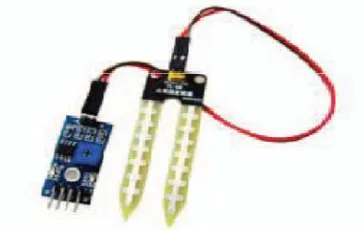
2.1 Soil moisturesensor
Different types of soil moisture sensors are available in the market to use in the
agriculture field to detect the moisture level of the soil. This data is very much useful on
supplying the water to the crops. The signal collected from sensor is given to the
microcontroller for monitoring and taking control action and also the signal is transmitted to
internet(cloud) using Wi-Fi communication method. LM393 is a simple and easily accessible
soil moisture sensor available in the market.
IJSRR, 7(2) April – June, 2018 Page 170
2.2 Temperature Sensor
Temperature sensor is used in the agriculture field to detect the temperature of the
environment and light level from the sun. Based on the temperature water supplying to the
land may be controlled through the controller. LM35 is a recently developedtemperature
sensor whose temperature range is 22℃to 55℃.
Fig 2.2 Temperature Sensor
2.3 PH sensor
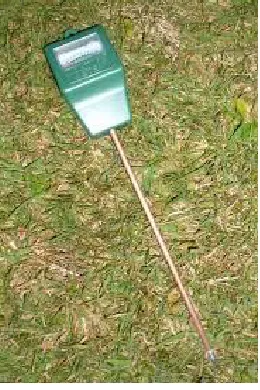
PH sensors are used in the agriculture land to detect the acidic level. The nature of the
soil is based on the PH value which decides the crop that are cultivated and the productivity.
Fig 2.3 PH Sensor
2.4 Microcontroller
Various types of microcontroller are available in the market based on the memory
capacity, RAM, ROM, timer, no of I/O ports and other pulse generation techniques.
ATMEGA328 is the simplest, handy in nature to use in the IOT based control circuits. It is
having 1KB of RAM, 2 KB of ROM, 8 timer and 12 I/O ports. Its operating frequency is20
IJSRR, 7(2) April – June, 2018 Page 171
2.5 PV Cell
Photovoltaic PV cells are used to harvest electrical energy from solar in the form of
DC energy and converted to AC using DC to AC converters. Now, third generation PV cells
are brought into application to generate large amount of power which is comparatively
generating large power than the earlier generation PV cells. Controlling and monitoring the
different parameters of PV cell, required power can be generated to drive the motor and to
supply power to the control panel. Use of PV cell on agriculture is encouraged by the
government to support on controlling power demand. In this project work a 12V, 5W PV cell
is used to generate the power required to drive the motor and to control the operation of
control panel.
3. PROPOSED SYSTEM
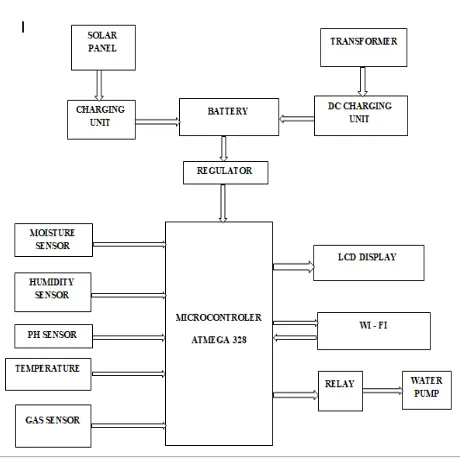
The proposed WSN based IOT agriculture monitoring and control block diagramis
shown in fig 3.1 Microcontroller receives the signal from different sensors andit is processed
based on the signal received with respect to reference.
3.1 Block Diagram
Fig 3.1 IOT based Automatic Agriculture System
3.2 Prototype:
WSN based IOT agriculture monitoring and control system is developed in a
IJSRR, 7(2) April – June, 2018 Page 172 health level sensor on enhancing the productivity of crops grown. Different methods of
signalcommunication is adapted totransmit the collected data from various levels of the soil
and environment to the processor and internet but in this work Wi-Fi technique has been
implemented based on the due futures.
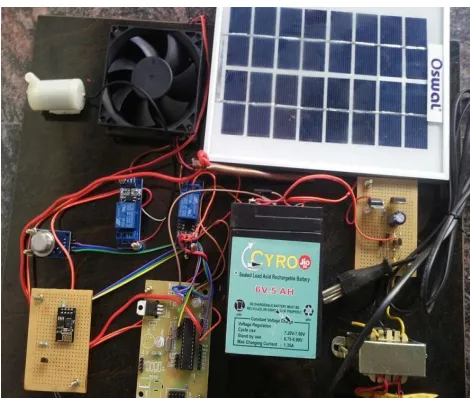
Fig3.2 shows the prototype model of the WSN coordinated IOT based
agriculture parameter control method towards enhancing the productivity. High accuracy
LM393 soil moisture sensor, LM35 and PH sensors are implemented in this project to control
the supply of water based on the signals from moisture and temperature sensors. The PH
sensor data is compared with the reference values and stored in the cloud storage memory for
further action on controlling the PH value of the soil.
In this prototype a DC motor pump, operated with 12V supply is used for pumping
the water. When the moisture level is higher than the reference value then the motor is not
operated and it comes into action when the moisture level is lower than the reference
value.Similarly the pump is brought into action based on the temperature level of the
environment. Sometimes the pump is controlled considering the two signals of the moisture
and temperature sensor. The crop health sensor will show the health condition on which the
fertilizer, pesticides and water level maintenance decisions are made. The architecture pin
configuration details are given in appendix A.
3.3 Prototype of IOT controller
IJSRR, 7(2) April – June, 2018 Page 173
4. CONCLUSION
Wireless sensor network coordinated IOT based agriculture monitoring and control method
using Wi-Fi technology is built as a prototype model and functions of the sensors are
observed on controlling the pumping motor. Wi-Fi technique has transmitted the nature of the
control signals with date and time to internet and cloud storage system. The owner of the land
can know the monitoring and control action taken in the land staying anywhere and also the
data stored in the mass storage device can be referred in future for the intelligent control
action better than the existing.
5.APPENDIX A
PIN DIAGRAM OF ATMEGA 168
Fig A1 Pin diagram of ATMEGA328
PIN DESCRIPTIONS
VCC (7)
supply voltage between 1.8 – 5.5
IJSRR, 7(2) April – June, 2018 Page 174
GND (8, 22)
Ground has 0V
Port B7 (9, 10, 14, 19, 17, 16, 15)
Port B is an 8-bit bi-directional I/O port with internal pull-up resistors (selected for
each bit).
The Port B output buffers have symmetrical drive characteristics with both high sink
and source capability.
Port B pins are tri-stated when a reset condition becomes active, even if the clock is
not running.
Port C7 (1, 23, 24, 25, 26, 27, 28)
Port C is a 7-bit bi-directional I/O port with internal pull-up resistors (selected for
each bit).
If the RSTDISBL Fuse is programmed, PC6 is used as an I/O pin.
Port D7 (2, 3, 4, 5, 6, 11, 12, 13)
Port D is an 8-bit bi-directional I/O port with internal pull-up resistors (selected for
each bit). The Port D output buffers have symmetrical drive characteristics with both
high sink and source capability. As inputs, Port D pins that are externally pulled low
will source current if the pull-up4 2545T–AVR–05/11 ATmega48/88/168resistors are
activated. The Port D pins are tri-stated when a reset condition becomes active, even
if the clock is not running.
AVCC (20)
AVCC is the supply voltage pin for the A/D Converter, PC3:0, and ADC7:6. It should
be externally connected to VCC, even if the ADC is not used. If the ADC is used, it should be
connected to VCC through a low-pass filter. Note that PC6..4 use digital supply voltage,
VCCG.
AREF (21)
AREF is the analogue reference pin for the A/D Converter.
ADC7:6 (TQFP and QFN/MLF package only)
In the TQFP and QFN/MLF package, ADC7:6 serve as analogue inputs to the A/D
converter. These pins are powered from the analogue supply and serve as 10-bit ADC
IJSRR, 7(2) April – June, 2018 Page 175
6. REFERENCE
1. Junyan ma, Xingshezhou, shining li, zhigang li. connecting agricultural to the internet
of things through sensor networks. IEEE International conference on Internet of
things and cyber physical and social computing.2011;
2. Meonghumlee,Jeonghwanhwang, Hyun yoe.Agricultural production system based on
IOT. IEEE 16th international conference on computational science and engineering.
2013;
3. Vijula Grace K.S, SiljaKharim P, Sivasakthi. Wireless sensor based control system in
Agriculture field.IEEE Proceedings of 2015 global conference on communication
Technologies. 2015;978-1-4799-8553.
4. Remyakoshya M D,Yaseen, Fayis K, NisilShaji, Harish N J, Ajay M. greenhouse
monitoring and control based on IOT using WSN. ITSI Transactions on Electrical and
Electronics Engineering.2016; 4(3): 2320-8945.
5. Shruti A, Jaishetty, Rekha, Patil. IOT sensor network based approach for agricultural
field monitoring and control. International journal of research in engineering and
technology.2016;23:5(6).
6. Vinayak N, Malavade, Pooja K,Akulwar. Role of IOT in agriculture. IOSR journal of
computer engineering. 56-57.
7. SohamAdhya, DipakSaha, Abhijit Das, Joydip Jana, HiranmaySaha. An IOT based
Smart Solar Photo Voltaic Remote Monitoring and Control Unit. 2nd international
conference on control, Instrumentation , energy and communication.2016;
8. Suma N, Sandra Rhea Samson, Saranya S, Shanmugapriya G, Subhashri R. IOT
based smart agriculture monitoring system. International Journal on Recent and
Innovation Trends in Computing and Communication. 2017; 5(2): 177-181.
9. Infantial J,Rubala D, Anitha.Agriculture field monitoring using wireless sensor
networks to improving crop production. International Journal of Engineering Science
and Computing. 2017; 7(3).
10.Pooja V N, Pooja P H, Savitri G C, Megha M S, Nirosha H. Design and
implementation of agricultural system using solar power. International Journal of
Scientific Research Publication.2017;7(6).
11.Huma Jamal, AbhilashaLal, Shashanksingh, SaiSwaplinR, ShamimBano, Shailendra
IJSRR, 7(2) April – June, 2018 Page 176
12.International Journal of Scientific Research in Computer Science Engineering and
Information technology. 2017;2(3).
13.Naga Venkatarao K, Vijay Kumar K. An IOT Based Smart Solar Photo Voltaic
Remote Monitoring and Control Unit. International Journal and Magazine of
Engineering Technology Management and Research. 2017;4(5).
14.Prathibha S R, AnupamaHongal, Jyothi M P. IOT based monitoring system in smart
agriculture. International Conference on Recent Advance in Electronics and
Communication Technology. 2017.
15.RevanasiddappaBandi, Suma Swamy, Raghav S.A framework to improve crop yield
in smart agriculture using IOT. International Journal of Research in Science and
Engineering. 2017;3(1).
16.Hemlata Channe, Sukhesh Kothari, DipaliKadam. Multidisciplinary Model for Smart
Agriculture Using Internet of Things, Sensors, Cloud Computing , mobile Computing
and Big Data Analysis. International Journal of Computer Technology and
Application. 2015; 3,374-382.
17.Ruchita A, Kale YogitaS, Alone Archana B,Pahurkar, Yugandhara V. Dhepe.
Agriculture using cloud computing and IOT. International Journal for Engineering
Application and Technology 3(5): 164-169.
18.Mahesh M,Galagalikar, Gayatri S,Deshmukh. Real Time Atomization of Irrigation
System for Social Modernization of Indian Agricultural System. International Journal