Design And Development E-Learning System By
Learning Management System (LMS) In
Vocational Education
Rabiman Rabiman, Muhammad Nurtanto, Nur Kholifah
Abstract: The unpreparedness of educators and students in the learning process becomes weakness in traditional learning. Moreover, teac hing material that has been delivered cannot be repeated while the small notes and educator explanations have limitations in knowledge transfer. This method is ineffective and also have limited learning space and time that cannot be accessed anytime and anywhere. In the current development, students have tendency and dependence on digital content or ICT. The condition is of positive value for online or virtual learning activities, teaching materials can be accessed, stored and shared through the internet. The research and development objective are to produce an LMS -based E-Learning system that is tested on Microteaching in the Mechanical Engineering Education class. The research method adopts the Han nafin and Peck approach model with specific phases (needs analysis, design, development and implementation). The developed LMS is then validated by media experts and material experts according to their capabilities. The research subjects were 15 undergraduate students aged ± 22-25 years old (adults). Data collection techniques are using questionnaires and direct observation. The results of LMS-based E-Learning development research is "very feasible" to be used. The assessment is based on the LMS usability, LMS functions, visual communication, learning design, material contents, as well as language and communication. The findings in this study are that using LMS increases satisfaction and quality of learning.
Index Terms: System E-Learning, LMS, Vocational Education, Virtual Class, Design and Development
—————————— ——————————
1.
INTRODUCTION
The learning characteristics of 21st century are new forms in the utilization of ICT learning [1], digitalization and E-learning [2] [3]. Social media, in the form of facebook [4], whatsapps, lines, etc., are often involved in the concept of virtual learning [5]. This concept shifts the role of traditional learning to be improved more effectively by taking advantage of students' current habits. E-learning can improve teaching and learning activities and be more efficient. Teachers must prepare teaching materials properly before they are being accessed and stored in repositories. The concept of E-Learning or virtual classrooms is an alternative learning in various universities [6], [7] and used for long distance learning [8], although it is realized that the emotional level of direct learning will be degraded. The development of E-learning technology is very rapid and this is one of the reasons why this concept is important to be implemented and developed massively. The urgency factors are class limitations, boredom in learning, and limited interactions. Online learning is cooperative in nature. It requires high levels of interaction and collaboration [9] [10], [11] to be successful.The researcher argues based on survey results, developments in various universities [12], [13] as well as strong statements by the OECD, that more and more learning is developed online. Students in mechanical engineering education have the devices to connect to on-line networks [14]. The success of on-line learning depends on the existence of wifi facilities that are connected to smartphone or computer. All students in Mechanical Engineering Education have those preconditions for E-Learning. So, E-learning will be
developed in the form of software applications namely LMS, to organize learning materials. LMS is designed according to the need to facilitate the packaging of interactive multimedia, teaching materials, lecture assignments, online discussions, learning videos and even interactive video conferences [15].
2 RESEARCH METHOD
This LMS research uses research and development methods. There are 5 media experts, 5 material experts, and 15 students who were involved in assessing and participating in E-Learning for microteaching learning competencies designed for teacher apprenticeship at Vocational High Schools (VSS). This research develops LMS-based E-Learning with Hannafin and Pack approach models [16]. This development model is divided into three phases which are: phase I, requirements assessment; phase II, design; and phase III, development and implementation. Evaluations and revisions are carried out in all three phases of this development model. Phase 1, the researcher identifies the objectives and learning material to be designed and analyzed for LMS data requirements. The next phase, phase II, prepare a development flowchart, LMS Storyboard, and an Outline of the LMS-based E-Learning Media Content. The final phase, phase III, is carried out by developing documents in the form of boards or learning spaces until a complete LMS is formed. The developed LMS is tested on small groups and large groups to see the user's response. This stage requires many references by experts in their fields as well as documenting LMS problems as a reference for improvement and reflective development. LMS development process builds menus with several programming languages, this work is complicated, and the failure rate is high. During the ongoing phase, the evaluation and revision process is conducted also, to improve the quality and function of the LMS.
LMS validation was carried out by five media experts according to their field and five material experts according to their scientific fields. Data collection uses questionnaires and ————————————————
Rabiman Rabiman1, Muhammad Nurtanto2, Nur Kholifah3 1
Department of Mechanical Engineering Education, Faculty of Teacher Training and Education, Universitas Sarjanawiyata Tamansiswa, Indonesia.
2
grouped according to the "feasible" category. Students' responses are collected from small and limited groups to see how much E-learning by LMS has influenced their learning.
3 RESULT AND DISCUSSION
3.1 Fase Need Assessment
This phase aims to identify the learning requirements before LMS development is carried out. Researcher data are the form of student activity in network media, and also infrastructure capacity in the form of wifi is an important consideration. The main thing to consider is that LMS improves the quality of learning, and LMS can be implemented continuously, and its features can even be developed further. The student difficulty in learning micro-teaching became problem focus and information input in developing GBIM. Researchers considered students' activities during packaging teaching materials, preparation of devices, and delivery of content that is not systematic. Pedagogical competencies of teacher candidates must be mastered and developed before being applied to
vocational schools. This makes sense for researchers, vocational education, in addition to teaching competencies to students, is also required to be able to teach the stages in mastering competencies across various characteristics of students, the variety that even can lead to misconceptions. Through LMS, prospective teachers can see the performance of their teaching then do self-reflection. The advantage of LMS is that the learning process is well stored and can be seen at any time. That reflection process can lead to new strategies. It can be concluded that prospective teachers need a lot of teaching materials and interactive videos that fit the learning objectives.
3.2 Fase Design
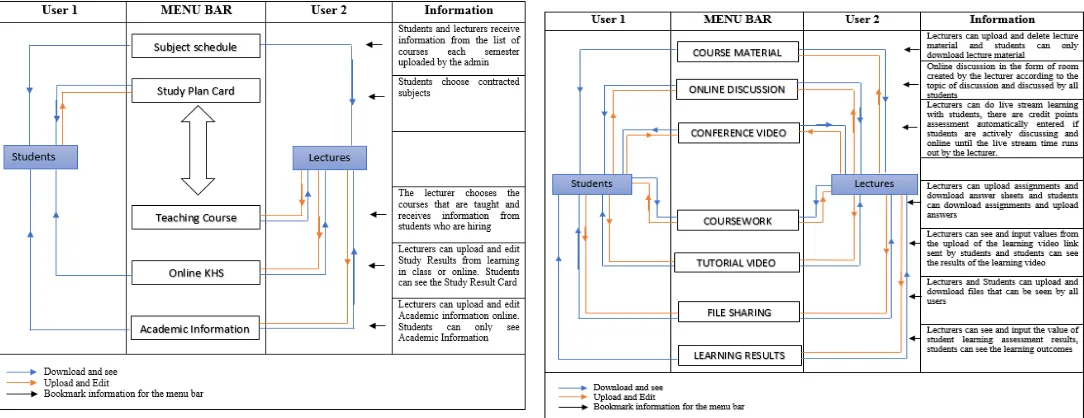
The design phase was based on study space requirements analysis. Development data was in the form of a flowchart of the LMS program, Storyboard that is a display of features or menus needed and developed, and GBIM that is the learning support contents. The design results are displayed in the following figure:
Figure 1. Layout and LMS Class Academic Flowchart
The flowchart display is divided into two separate sections: (1) academic menu in the form of class schedules, Study Result Cards, Study Plan Cards, and Academic information; and (2) LMS or virtual class menus in the way of video conferences, lecture materials, lecture assignments, learning videos, online discussions, and file sharing. Then flowchart is translated into a storyboard that contains the interface, location of the menu,
can be accessed by lecturers and students.
3.3 Fase Design and Implementation
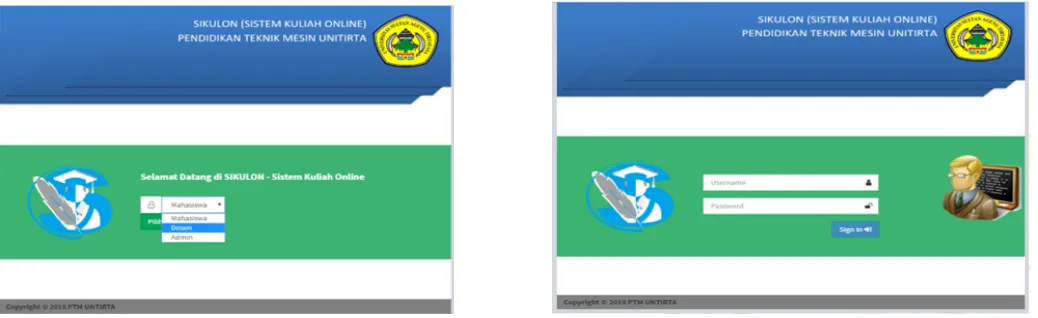
Figure 2. Display for Student and Lecturer in LMS
Students and lecturers by the learning schedule log in using their identity numbers and choose study spaces according to subjects. Virtual learning does not need to be present in class
and agreed to use LMS, this learning can be done anywhere but discipline for learning time is a full concern.
Figure 3. Display Function Menu Bar Discussion and Video Conference
LMS is equipped with a discussion and video conference menu bar to make it more dynamic. Educators can monitor how active his students during learning, to avoid taking over by
Figure 4. Individual Learning Outcomes in the Four Meetings Trial
After having results of testing the menu bar on developed LMS, then testing or validation of LMS by five media experts and 5 material experts was carried out. Media expert judgment consists of three domains, usability, functional, and visual
communication. The material expert assessment included of three domains, namely LMS learning design, LMS material content, language, and communication. The LMS validation results are as follows:
TABLE 1.
Media Expert and Material Expert Validation Results
Variable of LMS Number Total SA A U D SD Total Average Category
Expert of media
Use of LMS 350 (14) 25 (9,06%) 236 (85,51%) 9 (3,26%) 6 (2,17%) 0 (0%) 78,86 (100%)
79,18% Very Feasible Function of
LSMS 275 (11)
60 (25,55%) 156 (69,03%) 6 (2,65%) 2 (0,88%) 2 (0,88%) 82,18 (100%) Visual Communication of LMS 200 (8) 20 (13,07%) 120 (78,43%) 3 (1,96%) 10 (6,54%) 0 (0%) 76,50 (100%)
Expert of material
Learning Design of LMS
150 (6) 34 (28,46%) 76 (61,79%) 6 (4,88%) 6 (4,88%) 0 (0%) 82,00 (100%)
80,71% Very Feasible Content
material of LMS 250 (10)
40 (21,39%) 136 (72,73%) 6 (3,21%) 2 (1,07%) 3 (1,60%) 74,80 (100%) Language and
Communication of LMS
150 (6) 60 (46,88%) 64 (50,00%) 3 (2,34%) 0 (0%) 1 (0,78%) 85,33 (100%) Notes: (SA/5) Strongly Agree; (A/4) Agree; (U/3) Undecided; (D/2) Disagree; dan (SD/1) Strongly Disagree
The results of the validation from media experts and material experts produced average scores of respectively 79.18% from media experts and 80.71% from material experts, and those are in the "very feasible" category. Material experts said that the function of the LMS was by the needs of vocational education [18], [19]. Furthermore, the developed visual communication meets the LMS principles. Respondents' trials were carried out in two stages: a small group consisting of five people and a large group of fifteen people. The purpose of this
Variable of Respondent
Total
Number Skor (%) Average Category Content
material of LMS 200 187 93,5% Language and
Communication of LMS
150 132 88,0% Test Respondents as many as 15 people Learning
CONCLUSION
The design and development of the E-learning system include the requirements analysis, design, and development and implementation, and evaluation is carried out at each stage. The primary step that becomes the principle of development is the availability of guided flowcharts, storyboards and GBIM and adjusted to the characteristics of vocational education. The validation results showed that the feasibility level was 79.18% and 80.71% for media experts and material experts. This indicates that e-learning by LMS meets the media and material needs of vocational education. Students' responses in assessing LMS are positive and stable in small and limited group testing. In this case, students have the very good interest and satisfaction.
REFERENCES
[1] R. E. Islami, I. J. Sari, S. Sjaifuddin, M. Nurtanto, M. Ramli, and A. Siregar, ‗An Assessment of Pre-service Biology Teachers on Student Worksheets Based on Scientific Literacy‘, J. Phys. Conf. Ser., vol. 1155, p. 012068, Feb. 2019.
[2] M. Á. Conde, F. J. García-Peñalvo, M. J. Rodríguez-Conde, M. Alier, M. J. Casany, and J. Piguillem, ‗An evolving Learning Management System for new educational environments using 2.0 tools‘, Interact. Learn. Environ., vol. 22, no. 2, pp. 188–204, Mar. 2014.
[3] I. Sriyanti and J. Jauhari, ‗Development Of Learning Management System (LMS) As An Effort In Increasing Learning Effectiveness And Learning Activities Of Students In Sriwijaya University‘, Eurasia Proc. Educ. Soc. Sci., vol. 1, pp. 196–201, Sep. 2014.
[4] Q. Wang, H. L. Woo, C. L. Quek, Y. Yang, and M. Liu, ‗Using the Facebook group as a learning management system: An exploratory study‘, Br. J. Educ. Technol., vol. 43, no. 3, pp. 428–438, 2012.
[5] M. Nurtanto, D. Widjanarko, H. Sofyan, Rabiman, and M. B. Triyono, ‗Learning by Creating: Transforming Automotive Electrical Textual Material into Visual Animation as A Creative Learning Products‘, Int. J. Sci. Technol. Res., vol. 8, no. 10, Oct. 2019.
[6] T. Andersson, Learning Management Systems (LMS) Case study on an implementation of an LMS and its perceived effects on teachers. 2019.
[7] A. Stockless, ‗Acceptance of learning management system: The case of secondary school teachers‘, Educ. Inf. Technol., vol. 23, no. 3, pp. 1101–1121, May 2018.
[8] B. Beatty and C. Ulasewicz, ‗Faculty Perspectives on Moving from Blackboard to the Moodle Learning Management System‘, TechTrends, vol. 50, no. 4, pp. 36– 45, Aug. 2006.
[9] E. Ammenwerth, W. O. Hackl, A. Hoerbst, and M. Felderer, ‗Indicators for Cooperative, Online-Based Learning and Their Role in Quality Management of Online Learning‘, Stud.-Centered Virtual Learn. Environ. High. Educ., pp. 1–20, 2019.
[10] L. P. Macfadyen and S. Dawson, ‗Mining LMS data to develop an ―early warning system‖ for educators: A proof of concept‘, Comput. Educ., vol. 54, no. 2, pp. 588–599, Feb. 2010.
[11] G. Naveh, D. Tubin, and N. Pliskin, ‗Student LMS use and satisfaction in academic institutions: The organizational perspective‘, Internet High. Educ., vol. 13, no. 3, pp. 127– 133, Jun. 2010.
[12] T. J. McGill and J. E. Klobas, ‗A task–technology fit view of learning management system impact‘, Comput. Educ., vol. 52, no. 2, pp. 496–508, Feb. 2009.
[13] C. Gautreau, ‗Motivational Factors Affecting the Integration of a Learning Management System by Faculty‘, J. Educ. Online, vol. 8, no. 1, Jan. 2011.
[14] M. Nurtanto, H. Sofyan, M. Fawaid, and R. Rabiman, ‗Problem-Based Learning (PBL) in Industry 4.0: Improving Learning Quality through Character-Based Literacy Learning and Life Career Skill (LL-LCS)‘, Univers. J. Educ. Res., vol. 7, no. 11, pp. 2487–2494, Nov. 2019. [15] R. A. Ellis and R. A. Calvo, ‗Minimum Indicators to Assure
Quality of LMS-supported Blended Learning‘, J. Educ. Technol. Soc., vol. 10, no. 2, pp. 60–70, 2007.
[16] M. J. Hannafin, The design, development, and evaluation of instructional software /. New York : Macmillan ;, 1988. [17] M. Nurtanto, ‗Designing Ignition System Based Ergonomic
Teaching Aid In Vocational Education: Minimizing Fatigue Factors During Practice‘, vol. 8, no. 11, p. 4, 2019.
[18] M. Nurtanto, S. Nurhaji, J. A. Baser, and Y. Yadin, ‗Problem-Based Learning Implementation: Improvement in Learning Process and Results in Vocational Higher Education‘, J. Pendidik. Teknol. Dan Kejuru., vol. 24, no. 2, pp. 203–212, Sep. 2018.