Published online 2014 December 25. Research Article
Effect of a Self-Management and Follow-Up Program on Self-Efficacy in
Patients With Multiple Sclerosis: A Randomized Clinical Trial
Masomeh Hemmati Maslakpak
1,*; Zahra Raiesi
1 1Department of Medical Surgical Nursing, Urmia University of Medical Sciences, Urmia, IR Iran*Corresponding author: Masomeh Hemmati Maslakpak, Department of Medical Surgical Nursing, Urmia University of Medical Sciences, Urmia, IR Iran, Tel/Fax: +98-44132754961, E-mail: [email protected]
Received: November 27, 2014; Revised: December 9, 2014; Accepted: December 10, 2014
Background: Multiple sclerosis (MS) is the most common autoimmune disorder of the central nervous system with profound effects on patients’ independence and self-efficacy. Then, it is still questionable whether self-management programs in patients with MS affect the patients’ self-efficacy.
Objectives: The present study aimed to investigate the effect of a self-management program plus regular follow-up on self-efficacy in patients with MS.
Patients and Methods: A quasi-experimental study was performed on 80 patients with relapsing remitting MS who were randomly allocated to an intervention (n = 40) and a control group (n = 40). The MS self-efficacy scale was completed before and after the intervention. The intervention group was divided into four small subgroups of ten. Then, each subgroup was invited to participate in four training sessions about self-management. During the two months after the self-management sessions, a weekly telephone follow-up was conducted for each patient in the intervention group. The control group did not receive any intervention other than routine care. Data were analyzed using SPSS 11.5. Descriptive statistics, Chi-square, and independent-samples t-testes were used to analyze the data.
Results: No significant difference in mean scores of baseline self-efficacy was found between the control (52.90 ± 8.03) and the intervention groups (54.90 ± 9.51) (P = 0.313). However, a significant difference was observed between the control (50.90 ± 5.71) and the intervention groups (59.80 ± 5.27) regarding mean scores of self-efficacy at the end of the study (P < 0.001).
Conclusions: Implementing the self-management program plus regular follow-up increased the perception of self-efficacy in patients with MS. Similar self-management programs are recommended to be integrated in the regular caring of patients with MS.
Keywords:Multiple Sclerosis; Self-Evaluation Programs, Self-Efficacy
Copyright © 2014, Kashan University of Medical Sciences. This is an open-access article distributed under the terms of the Creative Commons Attribution-Non-Commercial 4.0 International License (http://creativecommons.org/licenses/by-nc/4.0/) which permits copy and redistribute the material just in noncommercial usages, provided the original work is properly cited.
1. Background
Multiple sclerosis (MS) is the most common autoim-mune disorder of the central nervous system (1). In 2010, the number of people with MS was globally two million to 2.5 million (approximately 30 per 100000 persons), with rates varying widely in different regions (2). Of the 100000 people with MS in the United Kingdom, about 85% are first diagnosed with relapsing remitting MS (RRMS) (3). In Iran, the prevalence ranged from 5.3 to 74.28 per 100000 persons in different regions, with the higher prevalence among females and female to male ra-tio ranging from 1.8 to 3.6. The most prevalent subtype of MS is the RRMS (4).
According to the nature of the disease and its long-term complications, multidisciplinary services are needed. In the meantime, nurses have the key position in interact-ing with patients and their families (5). Therefore, nurses should consider programs to empower patients in select-ing appropriate healthy behaviors (6). Self-management programs are among the health promotion strategies fre-quently used in patients with different chronic disorders such as MS (7).
A self-management program is a set of regular activities to help patients with a chronic disease to actively partici-pate in controlling the factors affecting the disease process, symptom self-monitoring, and making appropriate deci-sions to manage the disease process and its complications (8-11). It has been shown that self-management programs were successful in several chronic diseases and not only improved the patients level of perceived health, but also helped them in pain management, reducing the depres-sion symptoms, and timely referring to the primary phy-sician (8, 12). However, there is a gap in knowledge about application of self-management on patient’s self-efficacy in progressive long-term conditions (13). Jongen et al. have reported that some patients with RRMS are not interested in being engaged in self-management programs. They at-tributed the problem to the lack of perceived self-efficacy in disease management. Hence, they suggested that self-management programs should focus on improving the patients’ perception of self-efficacy and self-control (14).
ac-Nurs Midwifery Stud. 2014;3(4):e25661
2
tion required to produce given attainments (15).” It has been identified as a strong predictor of health status and health promotion behaviors in patients with MS (16, 17). Due to its nature and long-term course, MS has negative effects on patients’ self-efficacy (15, 17). Then, it is still questionable whether self-management programs in pa-tients with MS affect the papa-tients’ self-efficacy.
2. Objectives
The present study aimed to investigate the effect of a management program plus regular follow-up on self-efficacy in patients with MS.
3. Patients and Methods
3.1. Study Design and Participants
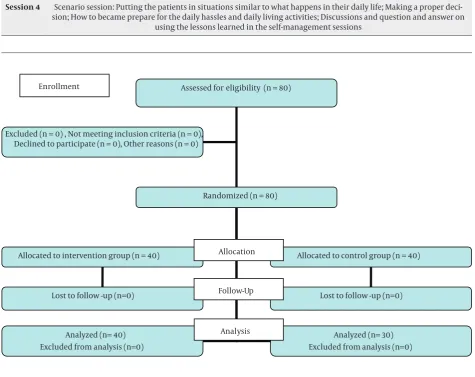
A quasi-experimental study (pretest-posttest study, with control group) was performed on 80 patients with RRMS who were a member of the MS Society of Urmia. The study was conducted from December to March 2014. Sample size was calculated using the results of a previous study conducted by Kafami et al. in which S1, S2, μ1, and μ2 were respectively equal to 1.32, 1.24, 18.17, and 16.95 (18). Then, with a type I error of 0.05 and a power of 0.80, the sample size was estimated at 35 patients for each group. However, we recruited 40 patients with inclusion criteria in each group to compensate for the possible attritions. A random number table was used to assign the patients into intervention and control groups using a simple ran-dom sampling method (Figure 1).
Inclusion criteria were being 18 to 60 years old, literate, willingness to participate in the study, ability to make phone calls and not having severe physical or psycholog-ic comorbidities, problems in communpsycholog-ication (i.e. visual or auditory loss). Patients with a relapse of the disease, those who used opiates during the study, and patients who decided to leave the study were excluded.
3.2. Instruments
A three-part instrument was used including a socio-demographic questionnaire, the multiple sclerosis self-ef-ficacy scale (MSSE), and a need assessment checklist. The first part consisted of 15 questions about the patients’ so-cio-demographic characteristics including the patient’s gender, age, marital status, number of children, having insurance, employment status, type of residency, edu-cation level, disease duration, and the interval between visits. The second part of the instrument, i.e. MSSE, con-sists of 14 questions in four dimensions of independence, control of worry and anxiety, personal control, and social self-esteem. All items of the MSSE are responded on a six-point Likert scale, ranging from one (strongly disagree) through six (strongly agree). The total score will be be-tween 14 and 84 with a higher score indicating a higher level of self-efficacy.
Two experienced Iranian health professionals, bilingual in Farsi and English languages, independently translated the English language version of the MSSE into Farsi lan-guage. Then, research team produced the consolidated forward version. Afterward, another bilingual person who did not have knowledge about the instrument per-formed backward translation; the results were consistent with the original version.
The third part of the instrument was a need assessment checklist. This checklist was designed by the research team through literature review and was consisted of 21 yes/no items on patients' needs. The content validity of MSSE and the checklist was confirmed by 13 faculty mem-bers in Urmia University of Medical Sciences and Urmia Azad University of Medical Sciences. To examine the reli-ability of the instrument and before the main study, ten patients with MS, who were not part of the study sample, responded the instrument at two times with a two-week interval. Then the reliability coefficient was calculated (r = 0.74 for the MSSE and r = 0.82 for the need assessment checklist).
3.3. Procedures
After obtaining informed consent for participation, the patient was asked to answer the socio-demographic ques-tionnaire and the MSSE scale. All quesques-tionnaires were completed through individual interviews in a private room in the MS Society of Urmia. A trained interviewer who was blind to the patients’ groups conducted all in-terviews. An interviewer asked the questions in a simple and clear way and entered the participants' answers into the study instrument. Additionally, patients in the inter-vention group answered to the need assessment check-list at this time.
Before starting self-management program, the inter-vention group was divided into four small subgroups of ten. Then, each subgroup was invited to participate in four training sessions of self-management. Every ses-sion lasted about two hours and was held in the morn-ing or evenmorn-ing accordmorn-ing to the patients free times. Three subgroups participated in the morning sessions and one subgroup in the evening because of being employed or being engaged in housekeeping activities. At the end of the fourth session, all patients in the intervention group were provided a self-management booklet including the contents of the training sessions. The content validity of the booklet was confirmed by nine faculty members in Nursing School of Urmia University of Medical Sciences. Finally, a total of 16 training sessions were held. All train-ing sessions were facilitated by both authors. The overall content of the training sessions are listed in Table 1.
3
Nurs Midwifery Stud. 2014;3(4):e25661
the second author and contained verbal reinforcements of the self-management sessions as well as answering the patients’ questions. Moreover, the researcher checked the patients’ adherence to the self-management program through questions about problem solving, decision mak-ing, and changes in life style.
To prevent the exchange of information between the control group and the intervention group, the research-ers collaborated with the MS clinic authorities to make some changes in the patients’ schedules to invite
pa-tients in the control and intervention groups in differ-ent days. The control group did not receive any inter-vention other than routine care. However, at the end of the study, the educational booklets were also provided to patients in this group to comply with the ethical standards. Once again, after two months, all patients in the control group and the intervention group were individually interviewed to answer the MSSE scale. All interviews were conducted by the same interviewer, at the MS Society of Urmia.
Table 1. Curriculum for Training Sessions of Self-Management Program
Session Content of Each Session
Session 1 Discussion about the basic information: the nature of MS; routinely used medications; diet in MS; physical activity; stress and anxiety management; skills for using health resources; methods of therapeutic communication between
patient and healthcare team
Session 2 Discussions, questions, and answers on "role management": maintenance of proper health behaviors; changes in life roles; problem solving skills; decision making skills; keeping independence through the course of the disease
Session 3 Discussions on "emotional management"; Question and answer on emotions such as fear, frustration, and depression and their appropriate management strategies; Patient's perspective for the future
Session 4 Scenario session: Putting the patients in situations similar to what happens in their daily life; Making a proper deci-sion; How to became prepare for the daily hassles and daily living activities; Discussions and question and answer on
using the lessons learned in the self-management sessions
Assessed for eligibility (n = 80)
Randomized (n = 80) Excluded (n = 0) , Not meeting inclusion criteria (n = 0),
Declined to participate (n = 0), Other reasons (n = 0)
Allocated to intervention group (n = 40) Enrollment
Lost to follow -up (n=0)
Analyzed (n= 40) Excluded from analysis (n=0)
Allocated to control group (n = 40)
Lost to follow -up (n=0)
Analyzed (n= 30) Excluded from analysis (n=0) Allocation
Follow-Up
Analysis
Nurs Midwifery Stud. 2014;3(4):e25661
4
3.4. Ethical Considerations
The study was approved by the Research Deputy and the Research Ethics Committee of Urmia University of Medical Sciences. The researcher explained the objectives to the patients and all participants signed a written in-formed consent before participation. The questionnaires were anonymous and all of the participants were assured about the confidentiality of their personal information. The participants were free to leave the study at any time. The researchers observed all ethical issues in accordance with the latest version of Helsinki declaration.
3.5. Data Analysis
Data analysis was performed using the SPSS 11.5 (SPSS Inc, Chicago, Illinois, the United States). The normality of the
data distribution was assessed using Kolmogorov-Smirnov test. Mean score and standard deviation were calculated. Chi-square test was used to compare nominal variables between the two groups. Student's t-test was also used to compare the statistical difference between the mean dif-ferences of self-efficacy and its dimensions in the two groups. P < 0.05 were considered statistically significant.
4. Results
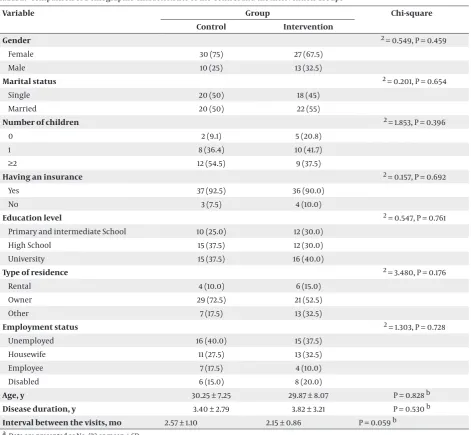
Table 2 presents the socio-demographic characteris-tics of the two study groups. No significant differences were observed between the intervention and the control group in terms of age, gender, marital status, number of children, having insurance, education level, type of resi-dency, employment status, duration of the disease, and intervals between visits.
Table 2. Comparison of Demographic Characteristics of the Control and the Intervention Groups a
Variable Group Chi-square
Control Intervention
Gender χ2 = 0.549, P = 0.459
Female 30 (75) 27 (67.5)
Male 10 (25) 13 (32.5)
Marital status χ 2 = 0.201, P = 0.654
Single 20 (50) 18 (45)
Married 20 (50) 22 (55)
Number of children χ 2 = 1.853, P = 0.396
0 2 (9.1) 5 (20.8)
1 8 (36.4) 10 (41.7)
≥2 12 (54.5) 9 (37.5)
Having an insurance χ 2 = 0.157, P = 0.692
Yes 37 (92.5) 36 (90.0)
No 3 (7.5) 4 (10.0)
Education level χ 2 = 0.547, P = 0.761
Primary and intermediate School 10 (25.0) 12 (30.0)
High School 15 (37.5) 12 (30.0)
University 15 (37.5) 16 (40.0)
Type of residence χ 2 = 3.480, P = 0.176
Rental 4 (10.0) 6 (15.0)
Owner 29 (72.5) 21 (52.5)
Other 7 (17.5) 13 (32.5)
Employment status χ 2 = 1.303, P = 0.728
Unemployed 16 (40.0) 15 (37.5)
Housewife 11 (27.5) 13 (32.5)
Employee 7 (17.5) 4 (10.0)
Disabled 6 (15.0) 8 (20.0)
Age, y 30.25 ± 7.25 29.87 ± 8.07 P = 0.828 b
Disease duration, y 3.40 ± 2.79 3.82 ± 3.21 P = 0.530 b
Interval between the visits, mo 2.57 ± 1.10 2.15 ± 0.86 P = 0.059 b
5
Nurs Midwifery Stud. 2014;3(4):e25661
Table 3. Self-Efficacy Mean Scores of the Intervention and Control Groups Before and After Implementing the Self-Management Pro-gram a
Self-Efficacy Group 95% CI P value
Control Intervention
Before intervention 52.90 ± 8.037 54.90 ± 9.518 -5.92 to 1.92 P = 0.313
After intervention 50.90 ± 5.714 59.80 ± 5.273 -11.34 to -6.45 P < 0.001
a Data are presented as mean ± SD.
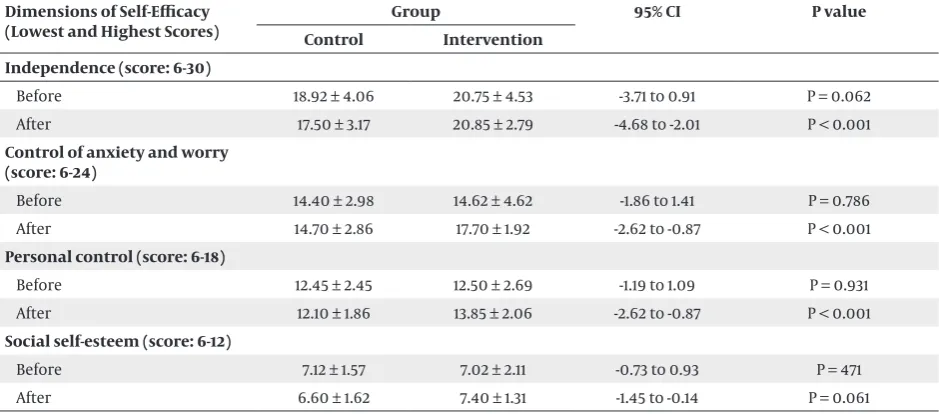
Table 4. Mean Scores of Efficacy Dimensions of the Intervention and Control Groups Before and After Implementing the Self-Management Program a
Dimensions of Self-Efficacy (Lowest and Highest Scores)
Group 95% CI P value
Control Intervention Independence (score: 6-30)
Before 18.92 ± 4.06 20.75 ± 4.53 -3.71 to 0.91 P = 0.062 After 17.50 ± 3.17 20.85 ± 2.79 -4.68 to -2.01 P < 0.001
Control of anxiety and worry (score: 6-24)
Before 14.40 ± 2.98 14.62 ± 4.62 -1.86 to 1.41 P = 0.786 After 14.70 ± 2.86 17.70 ± 1.92 -2.62 to -0.87 P < 0.001
Personal control (score: 6-18)
Before 12.45 ± 2.45 12.50 ± 2.69 -1.19 to 1.09 P = 0.931 After 12.10 ± 1.86 13.85 ± 2.06 -2.62 to -0.87 P < 0.001
Social self-esteem (score: 6-12)
Before 7.12 ± 1.57 7.02 ± 2.11 -0.73 to 0.93 P = 471 After 6.60 ± 1.62 7.40 ± 1.31 -1.45 to -0.14 P = 0.061
a Data in table are presented as mean ± SD
Independent sample t-test showed no significant differ-ence in mean scores of baseline self-efficacy between the control group (52.90 ± 8.03) and the intervention group (54.90 ± 9.51) (P = 0.313). However, a significant difference in self-efficacy mean scores was observed between the control group (50.90 ± 5.714) and the intervention group (59.80 ± 5.27) at the end of the study (P < 0.001) (Table 3).
Using the independent-samples t-test, no significant dif-ferences in mean scores of self-efficacy dimensions were found between the two groups before the intervention. However, at the end of the study, the mean scores of the intervention group increased in all self-efficacy dimen-sions. Therefore, significant differences were observed between the two groups regarding mean scores of all self-efficacy dimensions, except for the social self-esteem dimension (Table 4).
5. Discussion
The results of this study showed that the mean of self-efficacy score was significantly improved in the inter-vention group after implementing a self-management program. It may be concluded that the self-management program could increase the level of self-efficacy in pa-tients with MS. This finding is consistent with results of
Kafami et al. who studied the effect of a self-management program on health perception in patients with MS (18). Some studies have investigated and reported the positive effects of nurse-led self-management trainings on self-ef-ficacy of patients with cardiovascular disorders (19) and hypertension (20). On the other hand, Haas et al. studied the effect of a self-management program on chronic low back pain in a sample of elderly and reported that the in-tervention had no significant effect on the patients’ self-efficacy (21). Self-self-efficacy is a subjective multidimensional perception; therefore, several factors such as the patients’ personality trait and self-esteem as well as the contextual factors such as the level of available social support might affect it. Perhaps the follow-up added to the present study reinforced the effects of the main self-management pro-gram through instilling a sense of social support. How-ever, patients with MS are usually uncertain about their ability for self-management, which consequently makes them more dependent to their family or the healthcare team. Hence, it is essential to not only train them on self-management but also inspire them a sense of ability and self-control. Then, their level of uncertainty would be re-duced and their motive and sense of self-efficacy would be enhanced.
Nurs Midwifery Stud. 2014;3(4):e25661
6
program could significantly increase the mean score of the intervention group in the domain of independence. This finding was consistent with results of Garrett and Bluml who implemented a self-management program in patients with diabetes and reported that after the inter-vention, patients were able to control their blood sugar and maintain it at an acceptable level (22). Patients with MS have several problems such as weakness, abnormal gait, and ataxia that bring them difficulties in functional roles and make them dependent on their families and caregivers. However, as revealed in the present study, self-management programs might help them use their abili-ties in a better way and become more independent.
The implemented self-management program and fol-low-up in this study could significantly increase the mean score of the intervention group in the domain of "control of worry and anxiety." This improvement might be attrib-uted to the improvement in patients’ emotional respons-es to the life conditions. An improvement in emotional condition might result in an improvement in overall per-ception of self-efficacy. Emotional management was part of the self-management program and the learned con-tent might help the patients in the intervention group to select more appropriate strategies in response to stress-ful and anxious situations. This is consistent with results of Thomas et al. and Stuifbergen et al. who reported that self-management programs have beneficial effects on pa-tients’ health perceptions and anxiety levels (23, 24).
The implemented self-management program and follow-up in the current study could increase the mean score of the "personal control" dimension in interven-tion group. It seems that a sense of personal control is in mutual relationship with improvement in independence and control of anxiety and worry. Bishop and Frain have also reported that improvement in self-management might positively affect patients’ self-control and quality of life (25). Moreover, Stanton et al. have reported that in-dividuals with a feeling of being self-controlled feel high-er levels of self-efficacy (26). It seems that as Schore and Schore have reported, a feeling of being self-controlled helps the individuals to use their internal and external resources more efficiently in dealing with the demands of the disease (27).
The intervention did not significantly affect the dimen-sion of ‘social self-esteem’. The majority of people with MS are young and the aftermaths of the disease signifi-cantly increase their dependence on others. Social self-esteem is socially dependent. Any improvement is this domain would be gradual and is dependent not only to the patient’s functional abilities but also to the degree of available social supports. Moreover, changes in social self-esteems will happen gradually and need a longer time to become evident. Therefore, long-term follow-up is needed to assess the changes in this domain.
Results of this study showed that implementing a self-management program and regular follow-up would increase the perception of self-efficacy in patients with
MS. Considering the beneficial effects of this self-man-agement program, integrating similar self-manself-man-agement programs in the regular caring of patients with MS are recommended.
This study was conducted on a small number of pa-tients. Moreover, the duration of follow-up and the inter-val between intervention and outcome assessment were short. Hence, replication of the same study with larger sample size and longer follow-up and longer interval be-tween the intervention and outcome assessment is sug-gested.
Acknowledgements
This article was part of a thesis in Masters of Science in nursing. We are grateful to Ms. Zareh, honored respon-sible for Multiple Sclerosis Association of Urmia, for her cooperation in implementing this research. In addition, the authors are deeply thankful of all patients who par-ticipated in this research.
Authors’ Contributions
Masomeh Hemmati Maslakpak contributed in planning, data analysis, writing, critical revisions of the manuscript, and supervising this study. Zahra Raiesi was involved in planning, collection of data, and writing the paper. Both authors read and approved the final manuscript.
Funding/Support
This article was a thesis in M.Sc. in nursing supported by Urmia University of Medical Sciences (Grant No.: 1384, 92/8/29).
References
1. Berer K, Krishnamoorthy G. Microbial view of central nervous system autoimmunity. FEBS Lett. 2014;588(22):4207–13.
2. Milo R, Kahana E. Multiple sclerosis: geoepidemiology, genetics and the environment. Autoimmun Rev. 2010;9(5):A387–94. 3. Tsang BK, Macdonell R. Multiple sclerosis- diagnosis,
manage-ment and prognosis. Aust Fam Physician. 2011;40(12):948–55. 4. Etemadifar M, Sajjadi S, Nasr Z, Firoozeei TS, Abtahi SH, Akbari M,
et al. Epidemiology of multiple sclerosis in Iran: a systematic re-view. Eur Neurol. 2013;70(5-6):356–63.
5. Halper J, Holland NJ. Comprehensive nursing care in multiple sclerosis.New York: Springer Publishing Company; 2011. 6. Bombardier CH, Cunniffe M, Wadhwani R, Gibbons LE, Blake KD,
Kraft GH. The efficacy of telephone counseling for health promo-tion in people with multiple sclerosis: a randomized controlled trial. Arch Phys Med Rehabil. 2008;89(10):1849–56.
7. Chodosh J, Morton SC, Mojica W, Maglione M, Suttorp MJ, Hilton L, et al. Meta-analysis: chronic disease self-management pro-grams for older adults. Ann Intern Med. 2005;143(6):427–38. 8. Lorig KR, Holman H. Self-management education: history,
defini-tion, outcomes, and mechanisms. Ann Behav Med. 2003;26(1):1–7. 9. Barlow J, Turner A, Edwards R, Gilchrist M. A randomised con-trolled trial of lay-led self-management for people with multiple sclerosis. Patient Educ Couns. 2009;77(1):81–9.
10. Osborne RH, Elsworth GR, Whitfield K. The Health Education Impact Questionnaire (heiQ): an outcomes and evaluation measure for patient education and self-management interven-tions for people with chronic condiinterven-tions. Patient Educ Couns.
7
Nurs Midwifery Stud. 2014;3(4):e25661
11. Barlow J, Edwards R, Turner A. The experience of attending a lay-led, chronic disease self-management programme from the per-spective of participants with multiple sclerosis. Psychol Health.
2009;24(10):1167–80.
12. Holman H, Lorig K. Patient self-management: a key to effective-ness and efficiency in care of chronic disease. Public Health Rep.
2004;119(3):239–43.
13. Aujoulat I, Marcolongo R, Bonadiman L, Deccache A. Recon-sidering patient empowerment in chronic illness: a critique of models of self-efficacy and bodily control. Soc Sci Med.
2008;66(5):1228–39.
14. Jongen PJ, Ruimschotel R, Heerings M, Hussaarts A, Duyverman L, van der Zande A, et al. Improved self-efficacy in persons with relapsing remitting multiple sclerosis after an intensive social cognitive wellness program with participation of support part-ners: a 6-months observational study. Health Qual Life Outcomes.
2014;12:40.
15. Thomas S, Kersten P, Thomas PW. The Multiple Sclerosis-Fatigue Self- Efficacy (MS-FSE) scale: initial validation. Clin Rehabil. 2014. 16. Riazi A, Thompson AJ, Hobart JC. Self-efficacy predicts
self-report-ed health status in multiple sclerosis. Mult Scler. 2004;10(1):61–6. 17. Motl RW, McAuley E, Doerksen S, Hu L, Morris KS. Preliminary
evidence that self-efficacy predicts physical activity in multiple sclerosis. Int J Rehabil Res. 2009;32(3):260–3.
18. Kafami F, Mohamadi F, Noroozi K, Rahgozar M. The effective of self management program on health position in MS patients. J Res Develop in Nurs & Mid. 2012;9(1):24–33.
19. Sol BG, van der Graaf Y, van der Bijl JJ, Goessens NB, Visseren FL. Self-efficacy in patients with clinical manifestations of vascular diseases. Patient Educ Couns. 2006;61(3):443–8.
20. Savadkooh OK, Zakerimoghadam M, Gheyasvandian S, Kazem-nejad A. [Effect of self-management program on self-efficacy in hypertensive patients]. J Mazand Univ Med Sci. 2012;22(92):19–28. 21. Haas M, Groupp E, Muench J, Kraemer D, Brummel-Smith K,
Sharma R, et al. Chronic disease self-management program for low back pain in the elderly. J Manipulative Physiol Ther.
2005;28(4):228–37.
22. Garrett DG, Bluml BM. Patient self-management program for dia-betes: first-year clinical, humanistic, and economic outcomes. J Am Pharm Assoc (2003). 2005;45(2):130–7.
23. Thomas PW, Thomas S, Hillier C, Galvin K, Baker R. Psychological interventions for multiple sclerosis. Cochrane Database Syst Rev.
2006(1):CD004431.
24. Stuifbergen AK, Becker H, Blozis S, Timmerman G, Kullberg V. A randomized clinical trial of a wellness intervention for women with multiple sclerosis. Arch Phys Med Rehabil. 2003;84(4):467–76. 25. Bishop M, Frain M. Development and initial analysis of multiple
sclerosis self-management scale. Int J MS Care. 2007;9(2):35–42. 26. Stanton AL, Revenson TA, Tennen H. Health psychology:
psy-chological adjustment to chronic disease. Annu Rev Psychol.
2007;58:565–92.
Nurs Midwifery Stud. 2014;3(4):e25661